Class 12 PCB . Chemistry . Chemistry Part II . Amines
Chapter 9: Amines
Ch 9
Chemistry
Class 12 PCB
Amines constitute
Importance and occurrence of amines
- Occurrence: Amines occur naturally in proteins, vitamins, alkaloids and hormones.
- Uses: They are important intermediates in medicines and fibres; examples include adrenaline, ephedrine, novocain and Benadryl. Quaternary ammonium salts are used as surfactants, and diazonium salts help prepare dyes.
Structure of amines
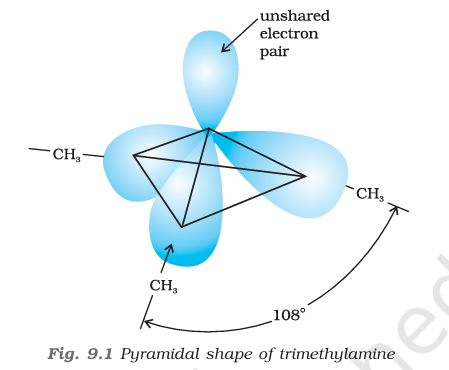
Structure of amines — The nitrogen atom is trivalent, usually -hybridised, and has one unshared pair of electrons.
- Geometry: The arrangement around nitrogen is pyramidal; its three orbitals overlap with hydrogen or carbon orbitals.
- Lone pair: The fourth nitrogen orbital contains an unshared electron pair.
- Bond angle: The angle ( or ) is less than because of the lone pair; it is about in trimethylamine.
Classification of amines
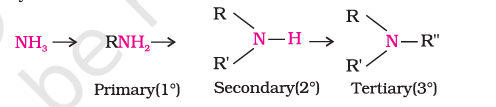
Amine classification — Amines are primary, secondary or tertiary according to the number of ammonia hydrogens replaced by alkyl and/or aryl groups.
| Type | Groups attached to nitrogen | General formula | Example |
|---|---|---|---|
| Primary (1°) | One alkyl or aryl group | or | |
| Secondary (2°) | Two alkyl and/or aryl groups | ||
| Tertiary (3°) | Three alkyl and/or aryl groups |
- Simple amines: All alkyl or aryl groups attached to nitrogen are identical.
- Mixed amines: The groups attached to nitrogen are different.
- Classification check: Count the carbon-containing groups bonded directly to nitrogen, not the total number of carbon atoms in the molecule.
Nomenclature
Naming rules
- Common names: Name the alkyl group followed by “amine” as one word, e.g. methylamine; use di- or tri- when identical groups repeat.
- Primary amines (IUPAC): Replace the final “e” of the parent alkane with “amine”; for example, is methanamine.
- Position numbers: Specify the carbon bearing ; retain the final “e” when a numerical locant is used, e.g. ethane-1,2-diamine.
- Secondary and tertiary amines: Use to mark substituents attached directly to nitrogen, e.g. -methylethanamine and -dimethylmethanamine.
- Arylamines: When is directly attached to a benzene ring, the common accepted name is aniline; its IUPAC name is benzenamine.
| Structure | Common name | IUPAC name |
|---|---|---|
| Ethylamine | Ethanamine | |
| -Propylamine | Propan-1-amine | |
| Isopropylamine | Propan-2-amine | |
| Ethylmethylamine | -Methylethanamine | |
| Trimethylamine | -Dimethylmethanamine | |
| Allylamine | Prop-2-en-1-amine | |
| Hexamethylenediamine | Hexane-1,6-diamine | |
| Aniline | Aniline or benzenamine | |
| - | -Toluidine | 2-Methylaniline |
| -Dimethylaniline | -Dimethylbenzenamine |
Preparation of amines
- Methods: Amines can be prepared by reducing nitro compounds, nitriles and amides, and by ammonolysis of alkyl halides.
- Other methods: Gabriel phthalimide synthesis and Hoffmann bromamide degradation are used to prepare primary amines.
1. Reduction of nitro compounds
- Reaction: Nitro compounds are reduced to the corresponding primary amines; nitroalkanes give alkanamines.
- Conditions: Use hydrogen with finely divided nickel, palladium or platinum, or reduce with a metal in acidic medium.
- Preferred reduction: Iron scrap with hydrochloric acid is economical because the formed hydrolyses and releases , so only a small initial amount of acid is needed.
2. Ammonolysis of alkyl halides
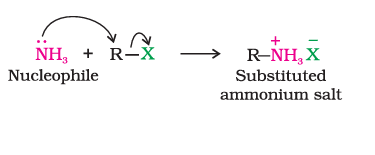
Ammonolysis — Ammonolysis is cleavage of the carbon–halogen bond in an alkyl or benzyl halide by ammonia, replacing halogen with an amino group.
- Conditions: React the halide with ethanolic ammonia in a sealed tube at .
- Substitution: Ammonia acts as a nucleophile; a primary amine is formed, then can react further with halide.
- Further alkylation: The sequence can proceed from primary to secondary to tertiary amine and finally to a quaternary ammonium salt.
- Product control: Ammonolysis gives a mixture of amines and quaternary ammonium salt; a large excess of ammonia favours the primary amine.
- Halide reactivity: .
3. Reduction of nitriles
- Reaction: Nitriles are reduced to primary amines using lithium aluminium hydride or catalytic hydrogenation.
- Use: This method increases the amine carbon chain by one carbon atom compared with the corresponding starting alkyl group.
4. Reduction of amides
- Reaction: Amides are reduced with lithium aluminium hydride followed by hydrolysis to give amines.
5. Gabriel phthalimide synthesis
- Purpose: Gabriel synthesis prepares primary amines from alkyl halides.
- Sequence: Phthalimide reacts with ethanolic to form potassium phthalimide; alkylation with gives -alkylphthalimide, and alkaline hydrolysis releases .
- Limitation: It does not prepare aromatic primary amines because aryl halides do not undergo the required nucleophilic substitution.
Gabriel synthesis sequence
- Phthalimide + ethanolic → potassium phthalimide
- Potassium phthalimide + , heat → -alkylphthalimide
- Alkaline hydrolysis → primary amine
6. Hoffmann bromamide degradation
- Conditions: Treat an amide with bromine and aqueous or ethanolic sodium hydroxide.
- Product and carbon count: The product is a primary amine containing one fewer carbon atom than the starting amide.
- Key change: An alkyl or aryl group migrates from the amide carbonyl carbon to nitrogen.
Why is excess ammonia used in ammonolysis?
How does Gabriel synthesis differ from Hoffmann bromamide degradation in carbon-chain length?
Quick recap
- Amines are ammonia derivatives; nitrogen is pyramidal, -hybridised and has a lone pair.
- Primary, secondary and tertiary amines contain one, two or three carbon-containing groups bonded to nitrogen; identical groups give simple amines.
- Use alkane-based amine names and -locants; aniline is also called benzenamine.
- Nitro compounds, nitriles and amides can be reduced to amines; nitrile reduction adds one carbon to the amine chain.
- Ammonolysis can over-alkylate; excess ammonia favours primary amine formation.
- Gabriel synthesis prepares primary alkylamines; Hoffmann bromamide degradation forms a primary amine with one fewer carbon.
Physical Properties
Physical State and Appearance
Physical state and colour
- Lower aliphatic amines are gases with a fishy odour.
- Primary amines: those with three or more carbon atoms are liquids; still higher members are solids.
- Arylamines such as aniline are usually colourless, but may become coloured on storage due to atmospheric oxidation.
Solubility and Intermolecular Association
Solubility
- In water: lower aliphatic amines dissolve because they form hydrogen bonds with water molecules.
- Effect of molar mass: solubility decreases as the hydrophobic alkyl part grows; higher amines are essentially insoluble in water.
- Organic solvents: amines dissolve in solvents such as alcohol, ether and benzene.
- Alcohols vs amines: alcohols are more polar and form stronger intermolecular hydrogen bonds. Thus, butan-1-ol is more soluble in water than butan-1-amine.
Hydrogen bonding and boiling points
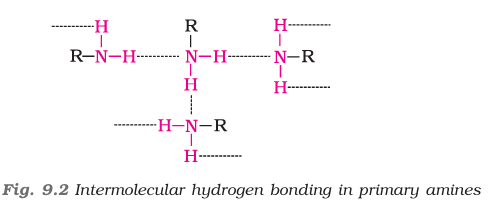
- Primary and secondary amines associate through intermolecular hydrogen bonds between an N atom and an N–H hydrogen.
- Primary amines associate more strongly than secondary amines because they have two N–H hydrogens available for hydrogen bonding.
- Tertiary amines do not form this type of intermolecular association because they have no N–H bond.
- Isomeric amines: greater association gives the boiling-point order primary > secondary > tertiary.
| Compound | Molar mass | Boiling point (K) |
|---|---|---|
| 73 | 350.8 | |
| 73 | 329.3 | |
| 73 | 310.5 | |
| 72 | 300.8 | |
| 74 | 390.3 |
Amines as Bases and Nucleophiles
Reactivity of amines
- Lone pair: nitrogen has an unshared electron pair, so amines act as nucleophiles and Lewis bases.
- N–H bond polarity: the electronegativity difference between nitrogen and hydrogen also contributes to amine reactivity.
- Class matters: the number of hydrogens attached to nitrogen differs in primary (), secondary () and tertiary () amines, affecting their reactions.
Salt formation
- With acids: amines accept a proton to form ammonium salts, showing their basic character.
- Salt properties: amine salts are water-soluble but insoluble in organic solvents such as ether.
- Separation use: salt formation can separate amines from non-basic organic compounds that are insoluble in water.
- Regeneration: treatment of an amine salt with a base such as sodium hydroxide releases the parent amine.
Base Strength and
Base strength
- In water: an amine accepts a proton from water, producing its conjugate acid and hydroxide ions.
- Strength scale: a larger or smaller indicates a stronger base.
- General trend: aliphatic amines are stronger bases than ammonia because alkyl groups donate electron density by the effect.
- Aromatic amines: they are weaker bases than ammonia because the aryl group withdraws electron density and the nitrogen lone pair is less available.
Water is omitted from the expression because it is the solvent.
Use to compare base strengths: lower means a stronger base.
| Amine | |
|---|---|
| Methanamine | 3.38 |
| -Methylmethanamine | 3.27 |
| -Dimethylmethanamine | 4.22 |
| Ethanamine | 3.29 |
| -Ethylethanamine | 3.00 |
| -Diethylethanamine | 3.25 |
| Benzenamine | 9.38 |
| Phenylmethanamine | 4.70 |
| -Methylaniline | 9.30 |
| -Dimethylaniline | 8.92 |
| Ammonia | 4.75 |
Structure–Basicity Relationship
Basicity — The basic strength of an amine depends on how readily it accepts a proton and how stable the resulting cation is relative to the amine.
Alkanamines Compared with Ammonia
Effect of alkyl groups
- Electron donation: an alkyl group pushes electron density towards nitrogen, making its lone pair more available to bind a proton.
- Cation stabilisation: the effect helps disperse the positive charge in the substituted ammonium ion.
- Overall: alkylamines are stronger bases than ammonia; in the gas phase, increasing alkyl substitution increases basicity.
This order follows the increasing electron-releasing effect of alkyl substitution.
Why aqueous basicity differs
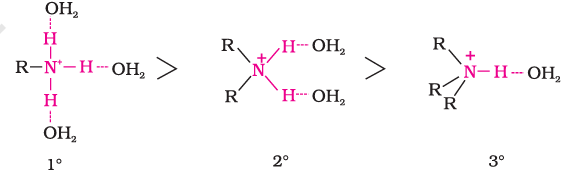
- Solvation: water stabilises substituted ammonium ions; larger ions are less effectively hydrated.
- Hydration order: primary ammonium ions are hydrated most, followed by secondary and then tertiary ions.
- Steric hindrance: larger alkyl groups make hydrogen bonding with water harder; this can change the basicity order.
- Aqueous basicity reflects the combined effects of the effect, solvation and steric hindrance, so it does not follow one universal substitution order.
Arylamines Compared with Ammonia
Why arylamines are weak bases
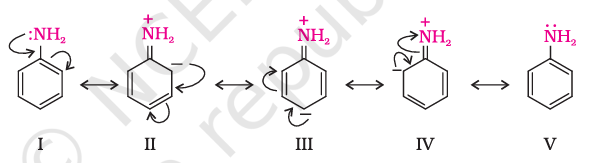
- Conjugation: in aniline, nitrogen is directly attached to the benzene ring, so its lone pair is delocalised into the ring and is less available to accept a proton.
- Relative stability: aniline has five resonance structures, while the anilinium ion has only two; this makes aniline relatively more stable and proton acceptance less favourable.
- Conclusion: aniline and other arylamines are weaker bases than ammonia.
| Substituent type | Examples | Effect on basic strength |
|---|---|---|
| Electron-releasing | , | Increases |
| Electron-withdrawing | , , , halogens | Decreases |
Why is aniline a weaker base than ammonia?
Arrange , , and in decreasing basic strength.
State the phase when giving an order of amine basicity: gas-phase trends differ from aqueous trends because solvation and steric hindrance affect aqueous basicity.
Quick recap
- Lower aliphatic amines are fishy-smelling gases; primary amines with three or more carbons are liquids, and higher ones are solids.
- Water solubility decreases as the hydrophobic alkyl part becomes larger; primary and secondary amines hydrogen-bond to each other, unlike tertiary amines.
- Amines accept protons and form water-soluble ammonium salts; larger and smaller mean stronger bases.
- Alkyl groups increase electron density by the effect; aqueous basicity also depends on solvation and steric hindrance.
- Aryl conjugation makes the nitrogen lone pair less available, so arylamines are weaker bases than ammonia.
Alkylation
Alkylation
- Alkylation: Amines react with alkyl halides to form more highly substituted amines.
- Acylation: Primary and secondary amines react with acid chlorides, anhydrides or esters by nucleophilic substitution. An N–H hydrogen is replaced by an acyl group.
Acylation and Benzoylation
Acylation
- Reaction type: The amine attacks the carbonyl carbon; a tetrahedral intermediate forms before the amide product is produced.
- Primary and secondary amines: Both can be acylated; tertiary amines lack an N–H bond to replace.
- Example: Ethanamine gives N-ethylethanamide with ethanoyl chloride; aniline gives acetanilide with ethanoic anhydride.
Benzoylation
- Definition: Acylation using benzoyl chloride, , is called benzoylation.
- Product: Methanamine forms N-methylbenzamide.
- Carboxylic acids: At room temperature, they form salts with amines.
Carbylamine Reaction
Carbylamine reaction — A primary amine heated with chloroform and ethanolic potassium hydroxide forms a foul-smelling isocyanide (carbylamine).
- Scope: Both aliphatic and aromatic primary amines give this reaction.
- Test: Secondary and tertiary amines do not react; the reaction is used to identify primary amines.
Reaction with Nitrous Acid
- Preparation: Nitrous acid is generated in situ from sodium nitrite and a mineral acid.
- Primary aliphatic amines: Form unstable alkyldiazonium salts, which release nitrogen quantitatively and produce alcohols.
- Use of nitrogen evolution: Its quantitative release is used to estimate amino acids and proteins.
- Primary aromatic amines: At –, form arenediazonium salts that are useful intermediates for preparing aromatic compounds.
- Other amines: Secondary and tertiary amines react with nitrous acid differently; no specific products are detailed here.
Reaction with Arylsulphonyl Chloride
Hinsberg’s reagent — Benzenesulphonyl chloride, , reacts differently with primary and secondary amines and is used to distinguish and separate amine classes.
| Amine class | Product / reaction | Solubility in alkali |
|---|---|---|
| Primary | Sulphonamide containing an N–H bond | Soluble: the N–H hydrogen is acidic because of the electron-withdrawing sulphonyl group. |
| Secondary | Sulphonamide with no N–H bond | Insoluble: no acidic hydrogen is attached to nitrogen. |
| Tertiary | No reaction | No sulphonamide product. |
- Alternative reagent: p-Toluenesulphonyl chloride is now often used instead of benzenesulphonyl chloride.
Electrophilic Substitution in Aniline
Effect of the amino group
- Direction: Resonance increases electron density at the ortho and para positions, so is ortho/para-directing.
- Activation: The group strongly activates the benzene ring, often causing multiple substitutions.
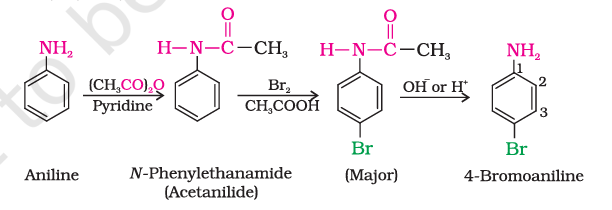
- Control: Acetylate the amino group first, perform the desired substitution, then hydrolyse the amide to recover the substituted amine.
Why acetyl protection works
- Resonance: In acetanilide, the nitrogen lone pair is delocalised toward the carbonyl oxygen, reducing the strong activating effect of the amino group.
Bromination
- Direct reaction: Aniline reacts with bromine water at room temperature to give a white precipitate of 2,4,6-tribromoaniline.
Nitration
- Direct nitration problem: Strongly acidic conditions protonate aniline to the anilinium ion, which is meta-directing; oxidation also produces tarry products.
- Product distribution at : Direct nitration gives -nitroaniline (51%), -nitroaniline (47%) and -nitroaniline (2%).
- Controlled nitration: Protect by acetylation, nitrate the acetanilide to obtain mainly the para product, then hydrolyse the amide.
Sulphonation
- First step: Aniline reacts with concentrated sulphuric acid to form anilinium hydrogensulphate.
- Heating: At –, this gives sulphanilic acid (4-aminobenzenesulphonic acid) as the major product.
- Zwitterion: Sulphanilic acid exists as .
Diazonium Salts: Names and Stability
- General formula: Arenediazonium salts have the form ; may be , , or .
- Naming: Name the parent hydrocarbon, add “diazonium,” then name the counter-ion; for example, is benzenediazonium chloride.
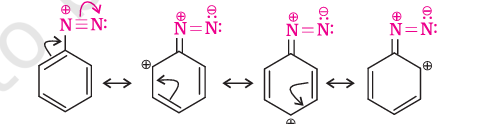
- Stability: Alkyldiazonium salts from primary aliphatic amines are highly unstable. Arenediazonium salts persist briefly in solution at –.
- Reason: Resonance stabilises the arenediazonium ion.
How can primary amines be identified by the carbylamine test?
How does the Hinsberg test distinguish the three classes of amines?
Why is the amino group protected before nitrating aniline?
Quick recap
- Amines undergo alkylation with alkyl halides; primary and secondary amines undergo acylation.
- Benzoylation uses benzoyl chloride; carboxylic acids form salts with amines at room temperature.
- The carbylamine reaction is a foul-smelling isocyanide test specific to primary amines.
- Primary aliphatic amines release nitrogen with nitrous acid; primary aromatic amines form diazonium salts at low temperature.
- Hinsberg’s reagent distinguishes amine classes by reaction and sulphonamide solubility in alkali.
- Aniline is strongly activating and ortho/para-directing; acetyl protection helps control substitutions.
- Arenediazonium salts are briefly stable at – because of resonance.
Method of Preparation of Diazoniun Salts
Preparation of Diazonium Salts
Physical Properties
- Benzenediazonium chloride: It is a colourless crystalline solid and readily dissolves in water.
- Stability: It is stable in cold solution but reacts with water when warmed; in the dry state, it decomposes easily.
- Benzenediazonium fluoroborate: It is insoluble in water and stable at room temperature.
Chemical Reactions
- Reaction types: Diazonium salts undergo reactions that either replace the diazonium group or retain it.
- Products: These reactions provide useful routes to substituted aromatic compounds and coloured azo compounds.
A. Reactions Involving Displacement of Nitrogen
| Replacement | Reagent or conditions | Product |
|---|---|---|
| Cl, Br or CN | Copper(I) salts; Sandmeyer reaction | Aryl chloride, bromide or cyanide |
| Cl or Br | Corresponding hydrogen halide and copper powder; Gattermann reaction | Aryl chloride or bromide |
| I | Potassium iodide | Aryl iodide |
| F | Fluoroboric acid, followed by heating the diazonium fluoroborate | Aryl fluoride |
| H | Hypophosphorous acid or ethanol | Arene |
| OH | Water; warm the solution to about | Phenol |
| NO2 | Aqueous sodium nitrite and copper; heat the diazonium fluoroborate | Nitroarene |
Halide and Cyanide Substitution
- Sandmeyer reaction: Copper(I) salts help introduce chlorine, bromine or the cyano group into an aromatic ring.
- Gattermann reaction: Chlorine or bromine is introduced by treating the diazonium solution with the corresponding hydrogen halide and copper powder.
Other Displacement Reactions
- Iodination: Direct introduction of iodine into benzene is difficult, but potassium iodide converts an arenediazonium salt to an aryl iodide.
- Fluorination: Fluoroboric acid first forms an arenediazonium fluoroborate precipitate; heating it gives aryl fluoride.
- Replacement by hydrogen: Hypophosphorous acid is oxidised to phosphorous acid; ethanol is oxidised to ethanal.
- Hydrolysis: Warming the diazonium solution to about replaces the diazonium group with hydroxyl.
- Replacement by nitro: Heating diazonium fluoroborate with aqueous sodium nitrite in the presence of copper gives a nitroarene.
B. Reactions Retaining the Diazo Group: Coupling
Importance in Aromatic Synthesis
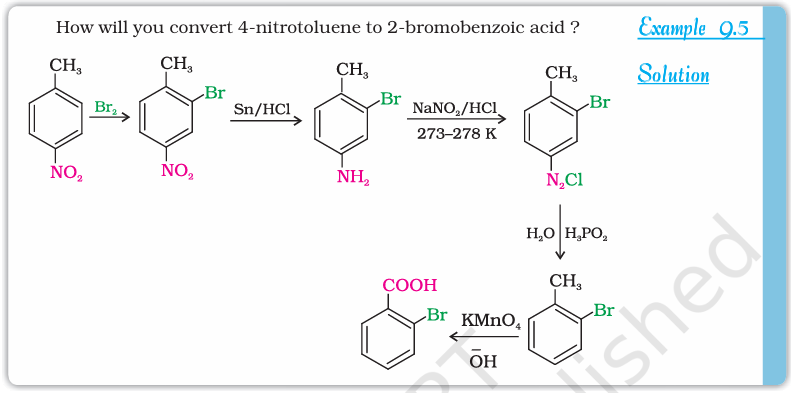
What is diazotisation, and what conditions are used to prepare benzenediazonium chloride?
Distinguish between the Sandmeyer and Gattermann reactions.
Why are diazonium salts useful in preparing aromatic compounds?
Quick recap
- Aniline forms benzenediazonium chloride with nitrous acid at –; prepare it immediately before use.
- Diazonium salts can lose nitrogen when the diazonium group is replaced by another group.
- Sandmeyer uses copper(I) salts; Gattermann uses hydrogen halide and copper powder.
- Coupling retains the link and forms often-coloured azo compounds, commonly by para substitution.
- Diazonium salts are valuable routes to aromatic halides, cyanides, phenols, nitro compounds and arenes.