Class 12 PCB . Chemistry . Chemistry Part I . Coordination Compounds
Chapter 5: Coordination Compounds
Ch 5
Chemistry
Class 12 PCB
Werner’s Theory Of Coordination Compounds
Coordination Compounds and Werner’s Theory
- Coordination compounds: Compounds in which metal atoms or ions are bonded to surrounding ions or molecules.
- Werner’s contribution: Alfred Werner developed the first systematic theory to explain their structures and behaviour.
- Importance: They are vital in biological systems and widely used in industry, analysis, and medicine.
Primary and Secondary Valences
| Colour | Complex formulation | AgCl formed per mole | Electrolyte type |
|---|---|---|---|
| Yellow | 3 mol | 1:3 | |
| Purple | 2 mol | 1:2 | |
| Green | 1 mol | 1:1 | |
| Violet | 1 mol | 1:1 |
Reading Werner’s Cobalt Complexes
- Conclusion: Six groups are attached directly to cobalt in each complex, so the secondary valence (coordination number) is 6.
- Inside vs outside: Chloride inside the brackets is bonded to cobalt and is not precipitated immediately; chloride outside the brackets is ionisable and gives .
- Example: In , two chloride ions are outside the coordination sphere, so 2 mol of form per mole of compound.
| Compound | AgCl per mole | Secondary valence |
|---|---|---|
| 2 mol | 4 | |
| 2 mol | 6 | |
| 0 mol | 6 | |
| 1 mol | 6 | |
| 0 mol | 4 |
Coordination Entities, Central Ions and Ligands
Coordination entity — A central metal atom or ion bonded to a fixed number of ions or molecules; examples include , and .
Central atom or ion — The atom or ion to which a fixed number of groups are bonded in a definite geometry; it acts as a Lewis acid. For example, the central ions in , and are , and .
Ligand — An ion or molecule bonded to the central atom or ion through one or more donor atoms.
| Type | Donor atoms used to bind | Examples |
|---|---|---|
| Unidentate | One | , , |
| Bidentate | Two | Ethane-1,2-diamine (), oxalate () |
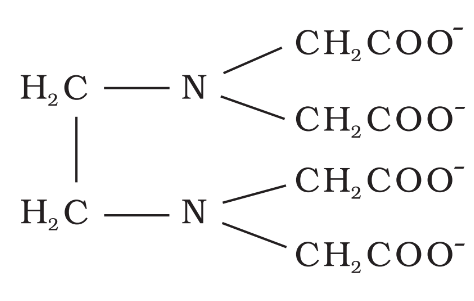
| Polydentate | Several | EDTA () is hexadentate: it binds through 2 nitrogen and 4 oxygen atoms. |
Coordination number — The number of sigma bonds formed by ligands to the central atom or ion; pi bonds, if present, are not counted.
Coordination Sphere and Geometry
Coordination sphere — The central atom or ion and its attached ligands, enclosed in square brackets; ionisable groups outside the brackets are counter ions.
Identifying the Coordination Sphere
- Example: In , is the coordination sphere and ions are counter ions.
- Coordination polyhedron: The geometry formed by ligand atoms directly attached to the central atom or ion.
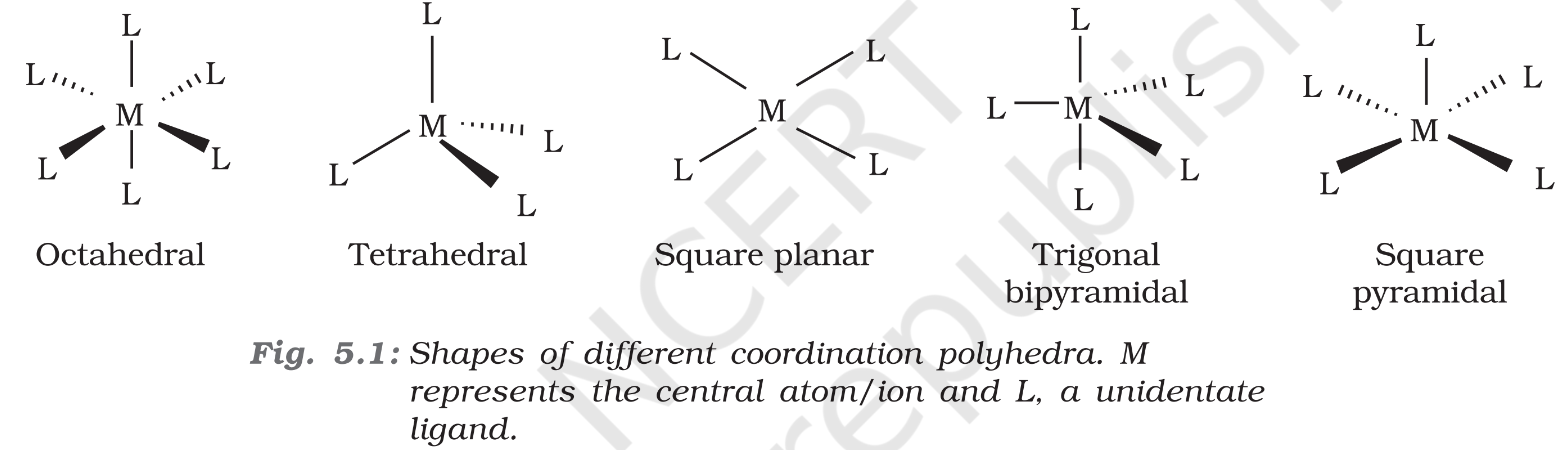
| Geometry | Example |
|---|---|
| Octahedral | , , |
| Tetrahedral | |
| Square planar | |
| Other geometries shown | Trigonal bipyramidal and square pyramidal |
| Point | Homoleptic | Heteroleptic |
|---|---|---|
| Ligand types | Only one kind of donor group | More than one kind of donor group |
| Example |
Distinguish primary and secondary valences in Werner’s theory.
What does the AgCl precipitate test reveal about a coordination compound?
Quick recap
- Primary valences are normally ionisable; secondary valences are non-ionisable and equal the coordination number.
- AgCl precipitation identifies chloride ions outside the coordination sphere; conductivity supports the complex-ion formulation.
- A ligand binds a central metal atom or ion; ligand denticity depends on the number of donor atoms used.
- Coordination number counts sigma bonds to the metal, not pi bonds.
- The coordination sphere is bracketed; ions outside it are counter ions.
- Common geometries include octahedral, tetrahedral and square planar; complexes may be homoleptic or heteroleptic.
Nomenclature And Isomerism Coordination Compounds
Writing Formulas of Coordination Entities
- Examples of charged entities: and .
- The 2004 IUPAC draft recommends alphabetising ligands irrespective of charge.
Naming Mononuclear Coordination Compounds
Naming rules
- Order: In a salt, name the cation first. Within a coordination entity, name ligands alphabetically before the metal; this reverses formula-writing order.
- Ligand names: Anionic ligand names traditionally end in -o; neutral and cationic ligand names generally remain unchanged.
- Special neutral ligands: is aqua, is ammine, is carbonyl, and is nitrosyl.
- Multipliers: Use mono-, di-, tri-, etc. for simple ligand names. Use bis-, tris-, tetrakis- for names containing numerical prefixes, enclosing the ligand name in parentheses.
- Oxidation state: Write the metal’s oxidation state as a Roman numeral in parentheses after its name.
- Metal name: Cationic and neutral entities use the usual metal name. Anionic entities take the ending -ate; some metals use Latin-based names, such as ferrate for iron.
- Donor atom: For ambidentate ligands, specify the coordinating atom, e.g. nitrito-N for N-bound nitrite and thiocyanato-S for S-bound thiocyanate.
- Neutral entities: Name a neutral coordination molecule using the same rules as a coordination cation.
| Traditional ending | 2004 IUPAC draft ending | Example |
|---|---|---|
| -o | -ido | chloro → chlorido |
| -o | -ido | hydroxo → hydroxido |
Naming examples
- : triamminetriaquachromium(III) chloride; neutral ligands mean chromium has oxidation state .
- : tris(ethane-1,2-diamine)cobalt(III) sulphate; the sulphate ions balance two complex cations, each with charge .
- : diamminesilver(I) dicyanoargentate(I); an anionic silver complex takes the ending -ate.
- : dichloridobis(triphenylphosphine)nickel(II).
- : diamminechloridonitrito-N-platinum(II); the donor-atom label identifies N-bound nitrite.
Name-to-formula examples
- Potassium tetrahydroxidozincate(II): .
- Tetracarbonylnickel(0): .
- Tetraammineaquachloridocobalt(III) chloride: .
- Potassium trioxalatoaluminate(III): .
Do not alphabetise ligands by their numerical prefixes or copy their formula order into the name: alphabetise ligand names before the metal.
Isomerism in Coordination Compounds
Isomers — Compounds with the same chemical formula but different arrangements of atoms, often giving different physical or chemical properties.
| Point | Stereoisomerism | Structural isomerism |
|---|---|---|
| What differs | Same formula and chemical bonds; different spatial arrangement. | Different bonding arrangement. |
| Main types | Geometrical and optical. | Linkage, coordination, ionisation and solvate. |
Geometrical Isomerism
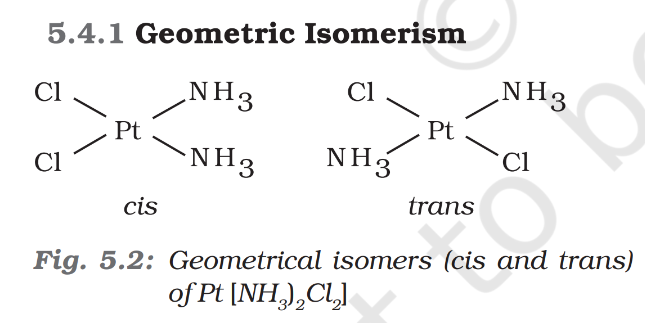
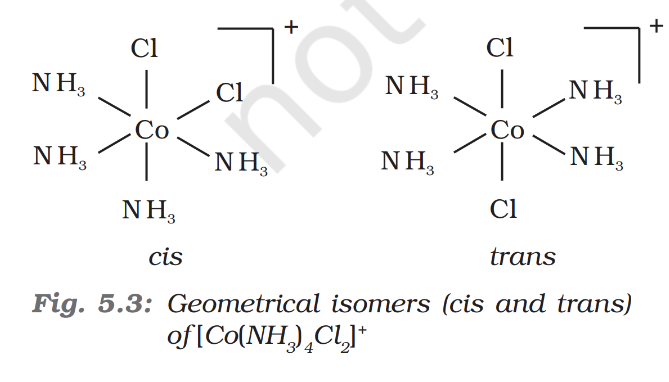
Geometrical isomerism — Isomerism in heteroleptic complexes caused by different possible geometric arrangements of ligands, especially in square-planar and octahedral geometries.
| Complex pattern | Isomer forms | Example / key feature |
|---|---|---|
| Square-planar | cis and trans | Identical ligands are adjacent in cis and opposite in trans; e.g. . |
| Square-planar | Two cis and one trans | Four different unidentate ligands can form three arrangements. |
| Octahedral | cis and trans | The two ligands are adjacent or opposite; e.g. . |
| Octahedral | cis and trans | Didentate ligands may also be present; e.g. . |
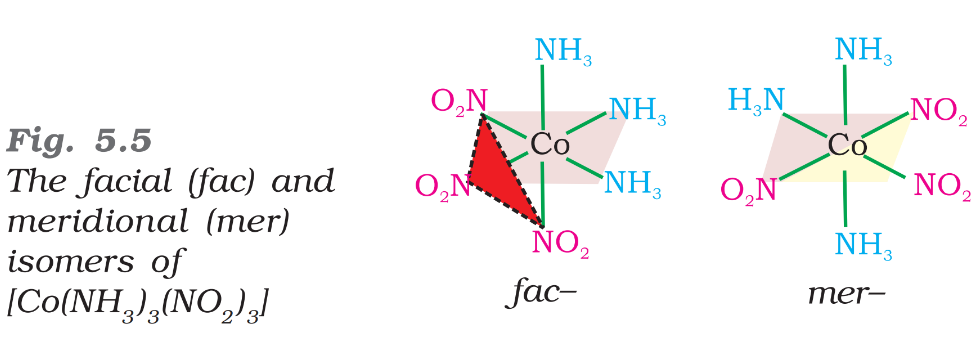
| Octahedral | fac and mer | In fac, three identical donor atoms occupy one face; in mer, they lie around a meridian. |
Geometry to remember
- Tetrahedral complexes: They do not show geometrical isomerism because the relative positions of unidentate ligands are equivalent.
- fac/mer example: Octahedral can form facial and meridional isomers.
Why do tetrahedral complexes with different unidentate ligands not show geometrical isomerism?
Optical Isomerism
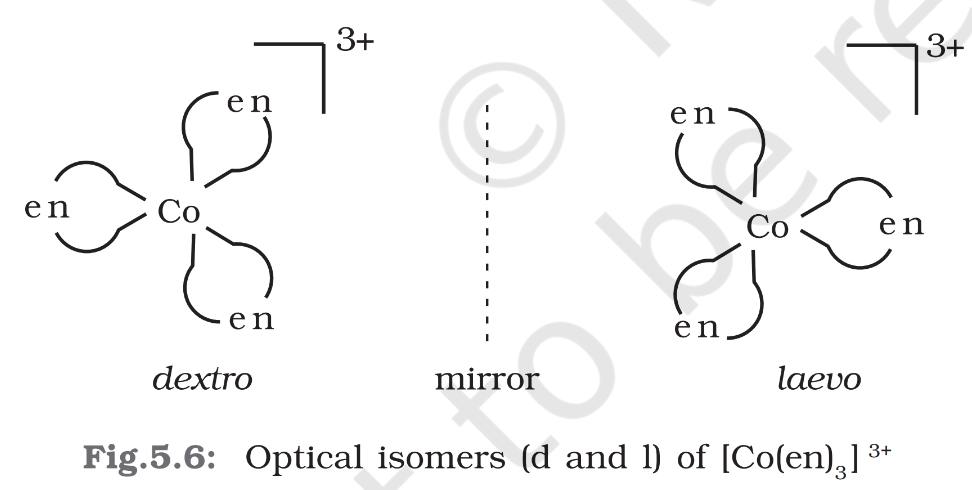
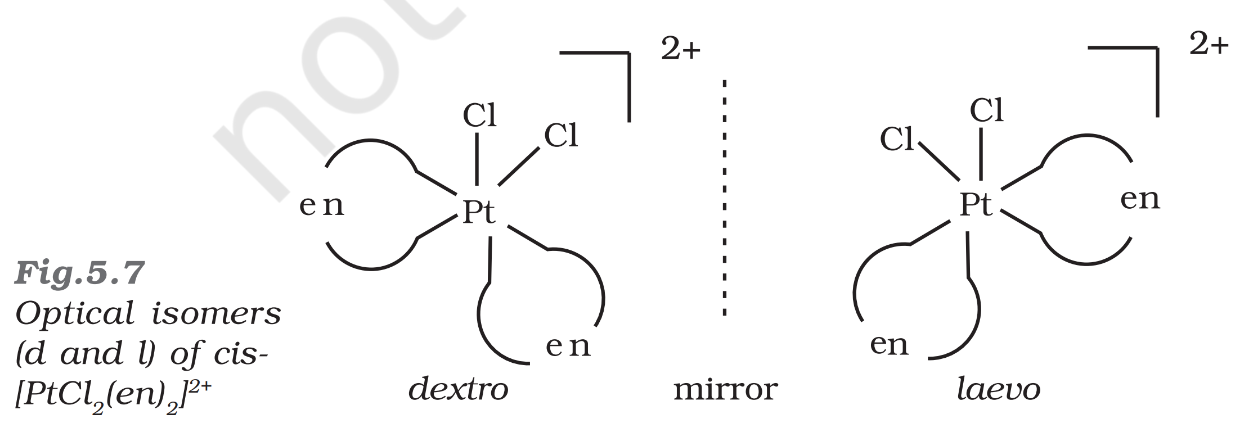
Optical isomers (enantiomers) — Mirror-image forms that cannot be superimposed on one another; a complex with this property is chiral.
Key points and examples
- Optical rotation: Dextro () rotates plane-polarised light to the right; laevo () rotates it to the left.
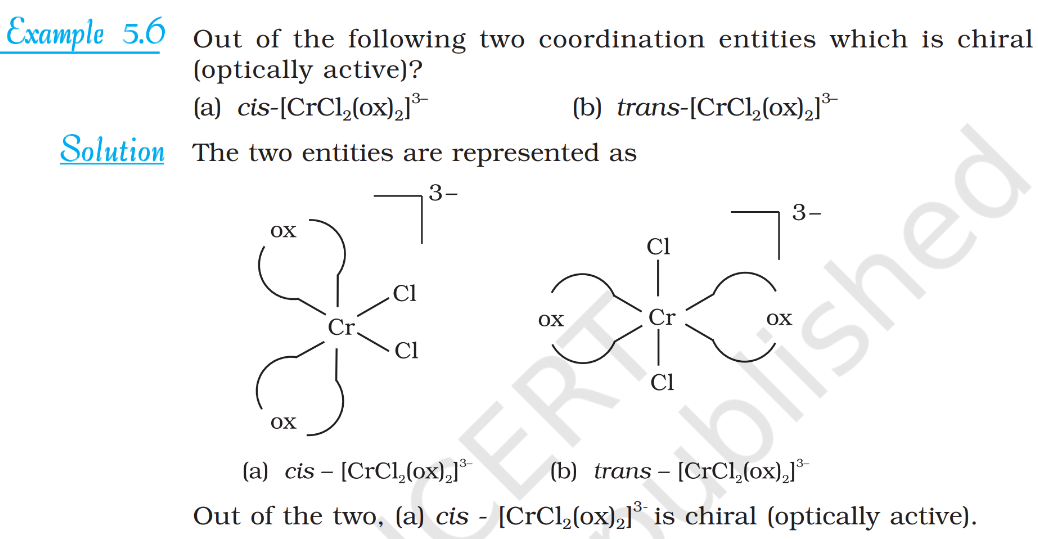
- Common occurrence: Optical isomerism is common in octahedral complexes containing didentate ligands.
- Examples: and cis- have optical isomers.
- Chiral cis complex: The cis form of is chiral and has a non-superimposable mirror-image partner.
Structural Isomerism
| Type | What changes | Example |
|---|---|---|
| Linkage | An ambidentate ligand coordinates through different donor atoms. | Thiocyanate binds as or . In , the red form has O-bound nitrite () and the yellow form N-bound nitrite (). |
| Coordination | Ligands interchange between complex cations and anions containing different metal ions. | and . |
| Ionisation | A counter-ion capable of acting as a ligand exchanges with a coordinated ligand. | and . |
| Solvate (hydrate when water is the solvent) | Solvent is either coordinated to the metal or free in the crystal lattice. | Violet and grey-green . |
Linkage-isomer example
- Ambidentate ligand: A ligand that can coordinate through either of two different donor atoms.
- Nitrite: The red and yellow forms of differ in whether nitrite binds through oxygen or nitrogen.
What is the difference between ionisation and solvate isomerism?
Quick recap
- Write the metal first in formulas; alphabetise ligands and enclose the coordination entity in square brackets.
- In names, alphabetise ligand names before the metal and state the metal oxidation number in Roman numerals.
- Anionic complexes take the metal ending -ate; use bis-/tris- for ligand names that already contain numerical prefixes.
- Use donor-atom labels such as nitrito-N and thiocyanato-S to distinguish how ambidentate ligands bind.
- Stereoisomers retain the same bonds but differ spatially; structural isomers have different bonding arrangements.
- Geometrical isomerism includes cis/trans and fac/mer forms; tetrahedral complexes do not show geometrical isomerism.
- Optical isomers are non-superimposable mirror images; structural isomerism includes linkage, coordination, ionisation and solvate types.
Bonding in Coordination Compounds
Approaches to Bonding
- Werner’s theory described bonding features but did not explain why only some elements form coordination compounds, why bonds are directional, or why complexes have characteristic magnetic and optical properties.
- Bonding theories include Valence Bond Theory (VBT), Crystal Field Theory (CFT), Ligand Field Theory (LFT), and Molecular Orbital Theory (MOT). This lecture focuses on VBT and its application.
Valence Bond Theory
Valence Bond Theory (VBT) — Ligands donate electron pairs into equivalent metal hybrid orbitals, formed by hybridising suitable metal orbitals to give the complex a definite geometry.
- Orbitals used may be , , and orbitals, or , , and orbitals.
- Bond formation occurs when ligand orbitals containing donated electron pairs overlap with the metal’s vacant hybrid orbitals.
- Geometry depends on the type and spatial arrangement of the hybrid orbitals.
| Coordination number | Hybridisation | Geometry |
|---|---|---|
| Tetrahedral | ||
| Square planar | ||
| Trigonal bipyramidal | ||
| Octahedral; outer-orbital | ||
| Octahedral; inner-orbital |
Inner- and Outer-Orbital Complexes
- Inner-orbital complexes use inner orbitals; octahedral hybridisation is . They are also called low-spin or spin-paired complexes.
- Outer-orbital complexes use outer orbitals; octahedral hybridisation is . They are also called high-spin or spin-free complexes.
- Electron pairing determines whether inner orbitals become available; the resulting number of unpaired electrons determines magnetic behaviour.
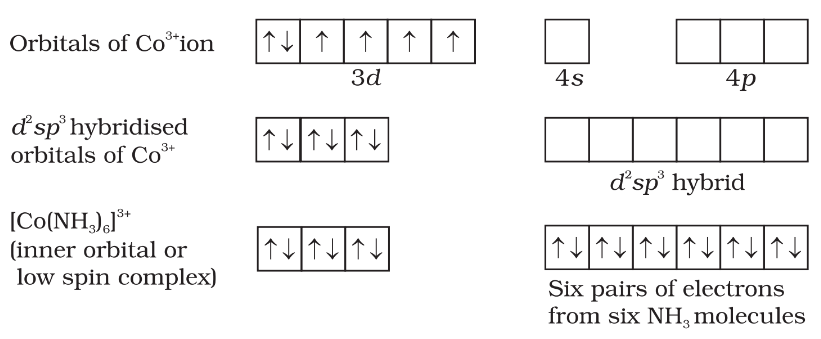
- has six ligand-donated electron pairs in six hybrid orbitals. It is octahedral, inner-orbital, low-spin, and diamagnetic because it has no unpaired electrons.
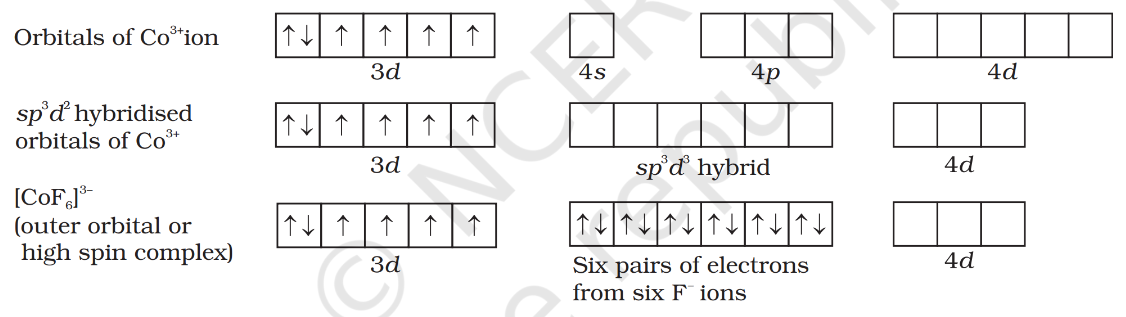
- uses outer-orbital hybridisation. It is octahedral, high-spin, and paramagnetic, with four unpaired electrons.
Tetrahedral Complexes
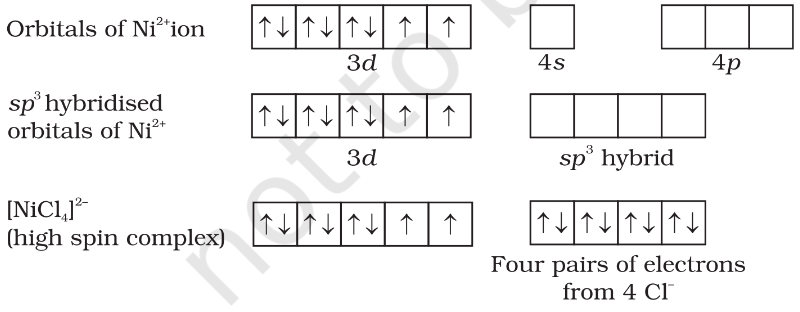
- Hybridisation uses one and three orbitals to form four equivalent, tetrahedrally directed orbitals.
- contains with configuration . It is tetrahedral and paramagnetic, with two unpaired electrons.
- is also tetrahedral, but nickel is in oxidation state and has no unpaired electrons; it is diamagnetic.
Square-Planar Complexes
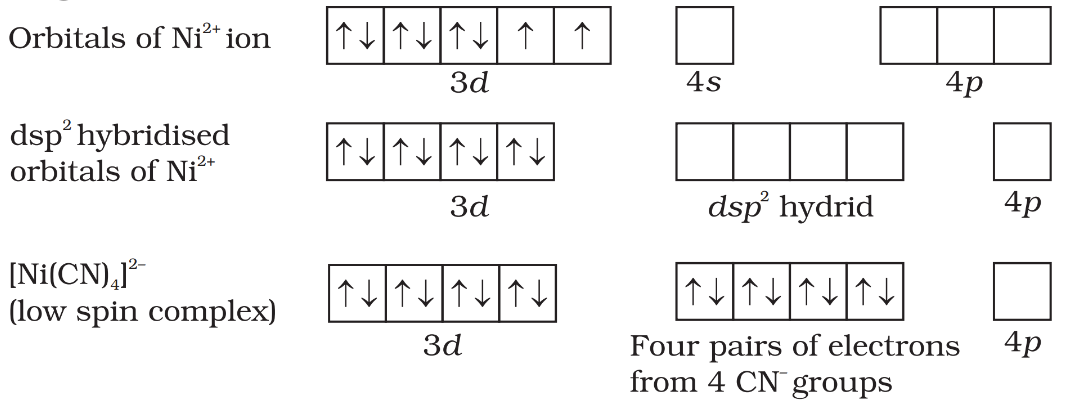
- Hybridisation is , producing four equivalent orbitals in a square-planar arrangement.
- contains with configuration . Cyanide ligands donate electron pairs; the complex is diamagnetic because it has no unpaired electrons.
- Hybrid orbitals are not physical orbitals; hybridisation is a mathematical combination of atomic-orbital wavefunctions.
Magnetic Properties and VBT
Magnetic susceptibility — A measured magnetic response used to determine the number of unpaired electrons and help infer a complex’s structure.
| Metal ion | Configuration | VBT implication |
|---|---|---|
| Two vacant orbitals are available for octahedral hybridisation with and orbitals. | ||
| Two vacant orbitals are available for octahedral hybridisation with and orbitals. | ||
| Two vacant orbitals are available for octahedral hybridisation with and orbitals. | ||
| , | Pairing creates the required vacant pair of orbitals and leaves two unpaired electrons. | |
| , | Pairing creates the required vacant pair of orbitals and leaves one unpaired electron. | |
| , | Pairing creates the required vacant pair of orbitals and leaves no unpaired electrons. |
Ligand-Dependent Magnetic Behaviour
- For to ions, the magnetic behaviour of free ions and their complexes is similar because two vacant orbitals are already available.
- For more than three electrons, Hund’s rule means a vacant pair of inner orbitals is not initially available. Pairing can create the orbitals needed for inner-orbital complexes.
- Inner-orbital examples use : has two unpaired electrons; has one; and is diamagnetic.
- Outer-orbital examples use : , , and have four, five, and four unpaired electrons, respectively.
- Key result: magnetic behaviour depends on the metal ion’s -electron count and the complex’s inner- or outer-orbital character.
The spin-only magnetic moment of is BM. Predict its geometry.
Limitations of Valence Bond Theory
- Assumptions: VBT relies on several assumptions about bonding and hybridisation.
- Magnetism: it does not quantitatively interpret magnetic data.
- Colour: it cannot explain the colours of coordination compounds.
- Stability: it does not quantitatively explain thermodynamic or kinetic stability.
- Geometry: it does not precisely predict whether a four-coordinate complex will be tetrahedral or square planar.
- Ligands: it does not distinguish between weak and strong ligands.
Distinguish inner-orbital and outer-orbital octahedral complexes.
State three limitations of VBT.
Quick recap
- VBT explains bonding as ligand electron-pair donation into metal hybrid orbitals.
- Hybridisation is linked to geometry: is tetrahedral, is square planar, and or is octahedral.
- Inner-orbital complexes use orbitals; outer-orbital complexes use orbitals.
- Unpaired electrons make a complex paramagnetic; no unpaired electrons means it is diamagnetic.
- Magnetic susceptibility data can help determine unpaired-electron numbers and infer complex structures.
- VBT cannot explain colour, quantitatively account for magnetic data or stability, or reliably predict four-coordinate geometry.
Crystal Field Theory
Basic Idea of Crystal Field Theory
Crystal field theory (CFT) — An electrostatic model that treats metal–ligand bonding as ionic and explains how ligand fields change the energies of metal orbitals.
Core assumptions
- Ligands: Anionic ligands are treated as point charges; neutral ligands such as and are treated as point dipoles.
- Degeneracy: The five orbitals of an isolated metal atom or ion have equal energy; a spherical field preserves this degeneracy.
- Splitting: Ligands create an asymmetrical field that lifts orbital degeneracy; the splitting pattern depends on complex geometry.
Octahedral Crystal Field Splitting
Orbital energy pattern
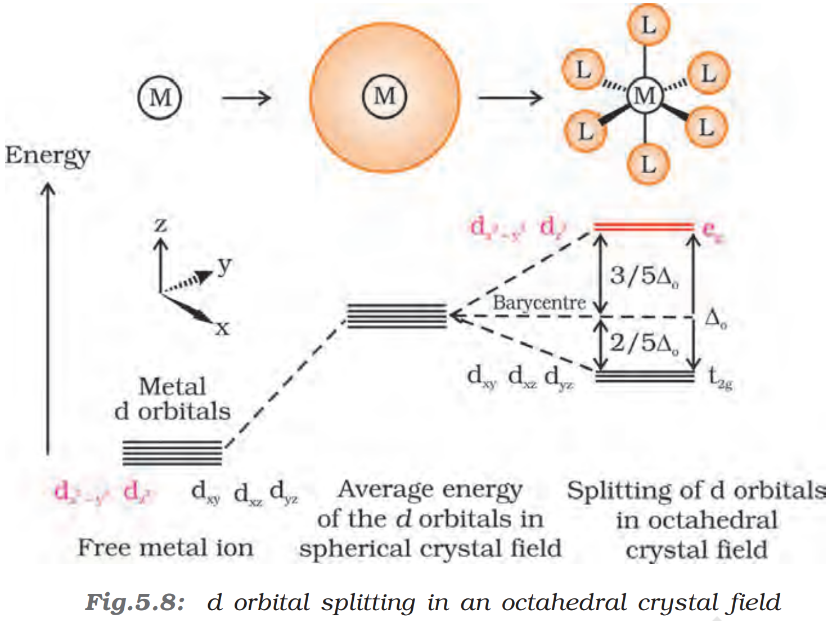
- Ligand arrangement: Six ligands approach along the axes. Orbitals directed toward them experience greater repulsion and rise in energy.
- Higher set: and form the two-orbital set.
- Lower set: , and point between the axes and form the three-orbital set.
- Splitting energy: The energy gap between the sets is ; the subscript denotes octahedral geometry.
Shifts are measured from the average energy of the five orbitals.
Spectrochemical series — An experimentally determined order of ligands by increasing crystal-field strength, based on light absorption by their complexes.
Increasing ligand field strength
High-Spin and Low-Spin Complexes
Competition between splitting and pairing
- Hund’s rule: For octahedral , and configurations, electrons occupy the lower orbitals singly before pairing.
- Pairing energy, : The energy required to pair two electrons in one orbital.
- For : The fourth electron either pairs in or occupies the higher set; the choice depends on the relative sizes of and .
| Point | Weak field | Strong field |
|---|---|---|
| Energy comparison | ||
| Fourth electron in | Enters rather than pairing in | Pairs in rather than entering |
| Configuration for | ||
| Spin character | High spin; more unpaired electrons | Low spin; fewer unpaired electrons |
- For to configurations, strong-field arrangements are more stable than weak-field arrangements.
Tetrahedral Crystal Field Splitting
Tetrahedral orbital pattern
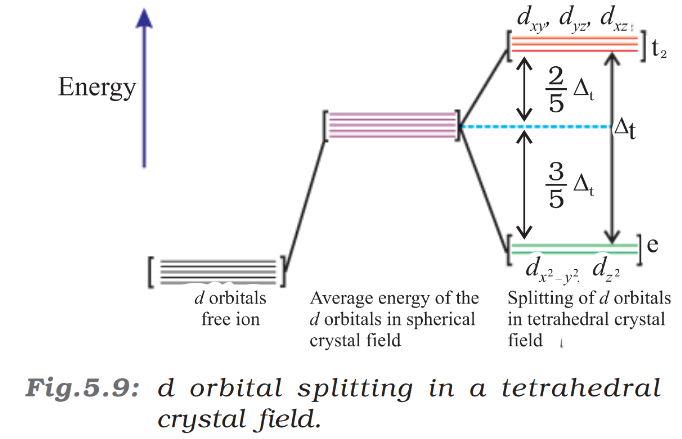
- Inverted splitting: The tetrahedral pattern is opposite to the octahedral pattern: is lower and is higher.
- Smaller splitting: The gap is usually too small to make pairing favourable, so low-spin tetrahedral complexes are rare.
- Notation: The subscript is used for octahedral and square-planar complexes with a centre of symmetry; tetrahedral complexes lack this symmetry.
For the same metal, ligands and metal–ligand distances.
Colour in Coordination Compounds
How colour arises
- Absorption: A complex appears coloured because it removes certain wavelengths from white light.
- Complementary colour: The observed colour is complementary to the absorbed colour; absorbing green light can make a complex appear red.
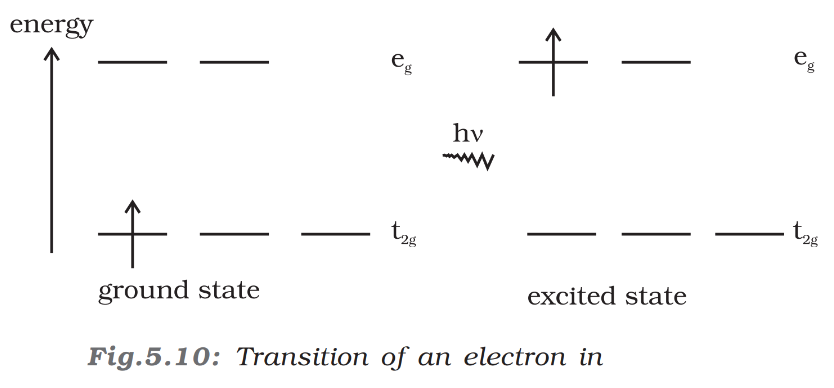
- – transition: Absorbed light promotes an electron between split -orbital levels when its energy matches the gap.
| Coordination entity | Wavelength absorbed (nm) | Absorbed colour | Observed colour |
|---|---|---|---|
| 535 | Yellow | Violet | |
| 500 | Blue-green | Red | |
| 475 | Blue | Yellow-orange | |
| 310 | Ultraviolet | Pale yellow | |
| 600 | Red | Blue | |
| 498 | Blue-green | Violet |
Example:
- Ground state: The octahedral ion has its single electron in : .
- Excitation: Blue-green light promotes the electron to , giving ; the complex therefore appears violet.
Ligands and colour changes
- Without ligands: Crystal-field splitting does not occur; the substance is colourless in the examples described.
- Hydration examples: Heating to remove water makes it colourless. Anhydrous is white, while is blue.
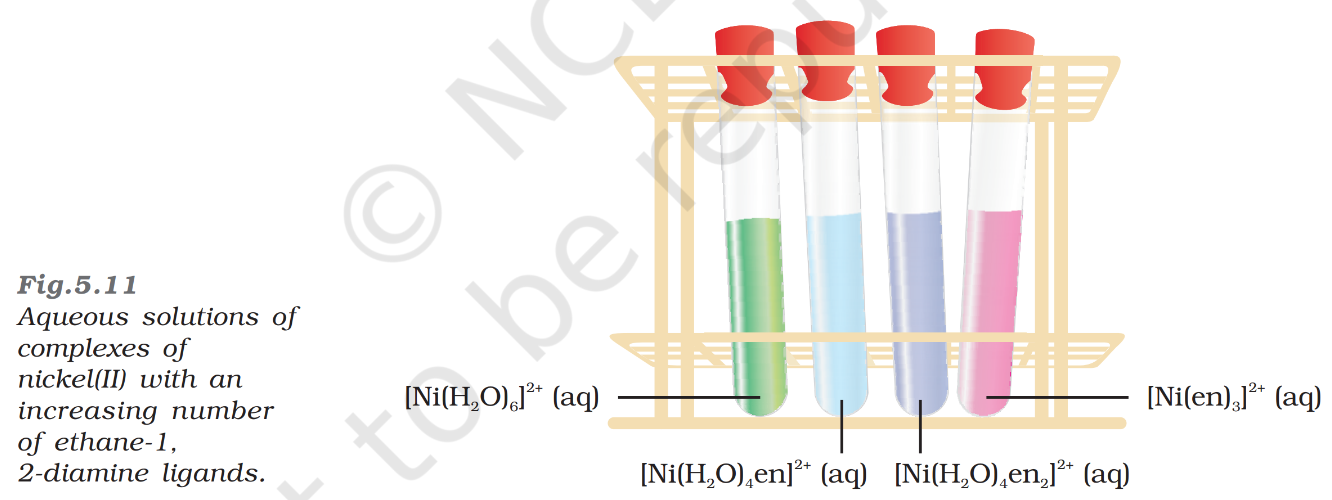
- Ligand substitution: Replacing water ligands in green with ethane-1,2-diamine () changes the complex colour.
Colours of Ruby and Emerald
- Ruby: containing about – ions in sites normally occupied by . Octahedral chromium centres produce colour through – transitions.
- Emerald: occupies octahedral sites in beryl, . Its absorption bands shift to longer wavelengths, absorbing yellow-red and blue light so green light is transmitted.
Limitations of Crystal Field Theory
Strengths and limitations
- What CFT explains: It helps explain complex formation, structure, colour and magnetic behaviour, and provides quantitative estimates of orbital separation, magnetic moments, spectral properties and stability.
- Point-charge problem: The model suggests anionic ligands should cause the greatest splitting, but they occur near the weak-field end of the spectrochemical series.
- Bonding limitation: CFT does not account for covalent character in metal–ligand bonds; ligand field theory and molecular orbital theory address these limitations.
Metal Carbonyls and Synergic Bonding
Homoleptic carbonyl — A metal carbonyl containing carbonyl ligands only.
| Carbonyl | Geometry or structural feature |
|---|---|
| Tetrahedral | |
| Trigonal bipyramidal | |
| Octahedral | |
| Two square-pyramidal units joined by an bond | |
| A bond with two bridging groups |
Metal–carbon bonding
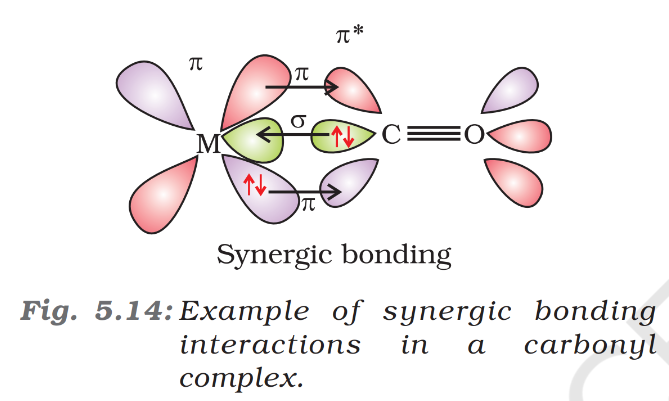
- Sigma donation: A lone pair on the carbon atom of is donated into a vacant metal orbital, forming an bond.
- Pi back-donation: A filled metal orbital donates electron density into a vacant antibonding orbital of .
- Synergic effect: The two directions of donation reinforce metal–carbonyl bonding and stabilise the complex.
Importance and Uses of Coordination Compounds
| Area | Uses and examples |
|---|---|
| Analysis | Complex formation and colour reactions help detect and estimate metal ions. Reagents include EDTA, DMG, -nitroso--naphthol and cupron. |
| Water hardness | titration estimates and ; differing stability constants allow selective estimation. |
| Metal extraction | Gold forms soluble with cyanide, oxygen and water; zinc then recovers metallic gold. |
| Metal purification | Impure nickel forms , which decomposes to yield pure nickel. |
| Biology | Chlorophyll contains magnesium; haemoglobin contains iron and carries oxygen; vitamin (cyanocobalamin) contains cobalt. Carboxypeptidase A and carbonic anhydrase are metal-containing enzymes. |
| Industrial catalysis | Wilkinson’s catalyst, , catalyses alkene hydrogenation. |
| Electroplating | Silver and gold plate more smoothly from and solutions than from simple metal-ion solutions. |
| Photography | Hypo dissolves undecomposed by forming , fixing black-and-white film. |
| Medicine | D-penicillamine and desferrioxime B remove excess copper and iron; EDTA is used for lead poisoning. Cisplatin and related platinum compounds inhibit tumour growth. |
How does CFT distinguish high-spin and low-spin octahedral complexes?
Why are many coordination compounds coloured?
What makes metal–carbon bonding in carbonyls synergic?
Quick recap
- Ligands split degenerate metal orbitals; the splitting pattern depends on geometry.
- In octahedral fields, is lower and is higher; comparing with predicts spin state.
- Tetrahedral splitting is inverted and smaller: .
- Complex colour can arise when light promotes an electron between split -orbital levels.
- CFT explains many complex properties but does not fully account for covalent metal–ligand bonding.
- Metal carbonyls are stabilised by CO-to-metal donation and metal-to-CO back-donation.
- Coordination compounds are important in analysis, metallurgy, biology, industry and medicine.