Class 12 PCB . Chemistry . Chemistry Part I . Solutions
Chapter 1: Solutions
Ch 1
Chemistry
Class 12 PCB
Introduction And Type Of Solutions
Solutions and Their Components
Solution — A homogeneous mixture of two or more components, with uniform composition and properties throughout.
Components and Composition
- Solvent: Usually the component present in the largest amount; it determines the physical state of the solution.
- Solute: One or more components other than the solvent.
- Binary solution: A solution containing two components; each component may be a solid, liquid or gas.
- Composition matters: Brass contains copper and zinc; bronze contains copper and tin; German silver contains copper, zinc and nickel. Their properties differ.
- Concentration matters: About ppm fluoride in water helps prevent tooth decay; ppm may cause mottling, and high concentrations can be poisonous.
- Medical example: Intravenous solutions have salt concentrations selected to match those of blood plasma.
Types of Solutions
| Solution type | Solute | Solvent | Example |
|---|---|---|---|
| Gaseous | Gas | Gas | Oxygen and nitrogen gases |
| Gaseous | Liquid | Gas | Chloroform mixed with nitrogen |
| Gaseous | Solid | Gas | Camphor in nitrogen |
| Liquid | Gas | Liquid | Oxygen dissolved in water |
| Liquid | Liquid | Liquid | Ethanol dissolved in water |
| Liquid | Solid | Liquid | Glucose dissolved in water |
| Solid | Gas | Solid | Hydrogen in palladium |
| Solid | Liquid | Solid | Mercury with sodium (amalgam) |
| Solid | Solid | Solid | Copper dissolved in gold |
Expressing Concentration
Concentration — The amount of a component present in a given quantity of solution.
- Qualitative terms: A dilute solution has relatively little solute; a concentrated solution has relatively much solute.
- Quantitative measures: Numerical concentration units describe composition precisely and avoid ambiguity.
Percentage Concentrations
Mass of a component per units of total solution mass; commonly used in industrial chemistry.
- Example: A glucose-by-mass solution contains g glucose and g water in g of solution.
- Application: Commercial bleaching solution contains sodium hypochlorite by mass.
Volume of a component per units of total solution volume; commonly used for liquid-containing solutions.
- Example: A ethanol-by-volume solution contains mL ethanol in enough solution to make a total volume of mL.
- Application: A (v/v) ethylene glycol solution is used as car antifreeze; it lowers water's freezing point to K (C).
Mass of solute in grams dissolved in mL of solution; commonly used in medicine and pharmacy.
Parts per Million
Parts per million (ppm) — A concentration unit for very small or trace quantities of a component.
Depending on the quantities compared, ppm may be expressed as mass/mass, volume/volume or mass/volume.
- Example: Seawater contains about g dissolved oxygen per litre; this is about g oxygen per g seawater, or ppm.
- Use: Pollutant concentrations in water and air are often given in ppm or in units such as .
Mole Fraction
Mole fraction — The ratio of moles of one component to the total moles of all components in a solution.
For a binary mixture of components and , . For any number of components, use the total moles in the denominator.
The mole fractions of all components in a solution add to unity.
- Notation: is the mole fraction of component .
- Uses: Mole fraction is useful for gas-mixture calculations and for relating solution concentration to properties such as vapour pressure.
- Example: A solution containing ethylene glycol by mass has and .
Molarity
Molarity (M) — The number of moles of solute dissolved per litre of solution.
Use the total solution volume in litres, not the solvent volume. Units include and .
- Example: A M NaOH solution contains mol NaOH in L of solution.
- Calculation example: g NaOH in mL solution gives mol L.
Molality
Molality (m) — The number of moles of solute dissolved per kilogram of solvent.
Use the solvent mass in kilograms, not the mass or volume of the solution.
- Example: A m KCl solution contains mol KCl dissolved in kg water.
- Calculation example: g ethanoic acid in g benzene gives a molality of mol kg.
| Point | Temperature-independent | Temperature-dependent |
|---|---|---|
| Units | Mass percentage, ppm, mole fraction and molality | Molarity |
| Reason | Based on masses or mole amounts, which do not change with temperature | Depends on solution volume, which changes with temperature |
Do not confuse molarity with molality: molarity uses litres of solution, while molality uses kilograms of solvent.
Define mole fraction and state its key property.
Why does molarity change with temperature, while molality does not?
Quick recap
- A solution is a homogeneous mixture; the solvent usually occurs in the greatest amount and determines its physical state.
- Solutions are classified by the physical states of their solute and solvent, giving gaseous, liquid and solid solutions.
- Mass %, volume % and mass-by-volume % express concentration per units; ppm is used for trace amounts.
- Mole fraction is the moles of a component divided by total moles; all mole fractions sum to .
- Molarity is moles of solute per litre of solution; molality is moles of solute per kilogram of solvent.
- Mass %, ppm, mole fraction and molality are temperature-independent; molarity varies because solution volume changes with temperature.
Solubility of A Solid In A Liquid
Solubility — The maximum amount of a substance that dissolves in a specified amount of solvent at a specified temperature.
Factors affecting solubility
- Depends on: the nature of the solute and solvent, temperature, and pressure.
- Pressure: has a major effect on gas solubility, but little effect on solids dissolving in liquids.
Solubility of a Solid in a Liquid
Like dissolves like — A solute generally dissolves best in a solvent with similar polarity and intermolecular interactions.
| Solvent | Solutes that dissolve readily | Solutes that do not dissolve readily |
|---|---|---|
| Water (polar) | Sodium chloride, sugar | Naphthalene, anthracene |
| Benzene (non-polar) | Naphthalene, anthracene | Sodium chloride, sugar |
Dissolution, Crystallisation and Saturation
- Dissolution: solute particles leave the solid and enter the solution, increasing its concentration.
- Crystallisation: dissolved solute particles separate from the solution and return to the solid.
- Dynamic equilibrium: in a saturated solution, dissolution and crystallisation continue at equal rates; the dissolved solute concentration stays constant at fixed conditions.
- Saturated solution: contains the maximum amount of solute that can dissolve in a given amount of solvent at a specified temperature and pressure.
- Unsaturated solution: can dissolve more solute at the same temperature.
Effect of temperature on solids
- Endothermic dissolution: if , solubility generally increases as temperature rises.
- Exothermic dissolution: if , solubility generally decreases as temperature rises.
- Reason: the dissolution equilibrium responds to temperature changes according to Le Chatelier’s principle.
Effect of pressure on solids
- Effect: pressure has no significant effect on the solubility of solids in liquids.
- Reason: solids and liquids are highly incompressible, so pressure changes have little effect on them.
Solubility of a Gas in a Liquid
- Examples: oxygen dissolves only slightly in water, but this dissolved oxygen sustains aquatic life; hydrogen chloride is highly soluble in water.
- Dynamic equilibrium: gas particles enter and leave the liquid at equal rates once equilibrium is reached.
- Pressure effect: increasing the gas pressure above a liquid increases the rate at which gas particles enter it, raising gas solubility until a new equilibrium forms.
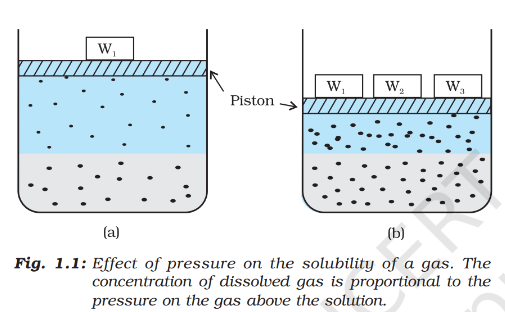
Henry’s Law
Henry’s law — At constant temperature, a gas’s partial pressure above a solution is proportional to its mole fraction in the solution.
Use consistent pressure units for and .
- : partial pressure of the gas above the solution; : mole fraction of the gas dissolved in solution.
- : Henry’s law constant; its value depends on the nature of the gas and temperature.
- At fixed pressure: a larger means a smaller , hence lower gas solubility.
- Graph: a plot of against is a straight line with slope .
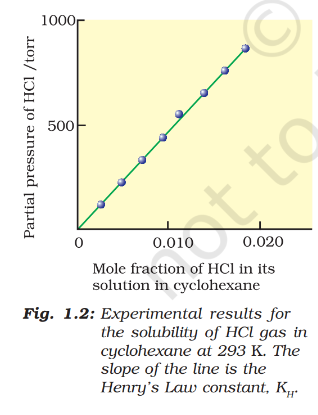
| Gas | Temperature (K) | (kbar) |
|---|---|---|
| He | 293 | 144.97 |
| 293 | 69.16 | |
| 293 | 76.48 | |
| 303 | 88.84 | |
| 293 | 34.86 | |
| 303 | 46.82 | |
| Argon | 298 | 40.3 |
| 298 | 1.67 | |
| Formaldehyde | 298 | |
| Methane | 298 | 0.413 |
| Vinyl chloride | 298 | 0.611 |
Using Henry’s law: nitrogen in water
- Given: at 293 K, and .
- Mole fraction: .
- For 1 L water: water contains about mol; since , .
- Amount dissolved: .
Applications of Henry’s Law
Applications and biological effects
- Soft drinks: bottling under high pressure → more dissolves → carbonation is retained.
- Scuba diving: high underwater pressure → more atmospheric gases dissolve in blood → ascent lowers pressure → nitrogen forms bubbles → capillaries may be blocked, causing bends.
- Avoiding bends and nitrogen toxicity: diver tanks use diluted air containing 11.7% helium, 56.2% nitrogen and 32.1% oxygen.
- High altitude: lower oxygen partial pressure → less oxygen in blood and tissues → weakness and impaired thinking (anoxia).
Effect of Temperature on Gas Solubility
- Trend: gas solubility in liquids decreases as temperature rises.
- Reason: gas dissolution is generally exothermic, similar to condensation; added heat shifts equilibrium toward gas leaving the solution.
- Example: for both nitrogen and oxygen is higher at 303 K than at 293 K, showing that their solubility decreases as temperature increases.
- Biological effect: aquatic species are generally more comfortable in cold water, where more oxygen remains dissolved.
State Henry’s law and explain the meaning of its constant.
Why does gas solubility in a liquid usually decrease as temperature rises?
Quick recap
- Solubility is the maximum amount of solute that dissolves in a specified amount of solvent under stated conditions.
- Like dissolves like: polar solutes tend to dissolve in polar solvents, and non-polar solutes in non-polar solvents.
- Saturated solutions are at dynamic equilibrium; dissolution and crystallisation occur at equal rates.
- Solid solubility: often increases with temperature for endothermic dissolution and decreases for exothermic dissolution; pressure has little effect.
- Henry’s law: ; at fixed pressure, higher means lower gas solubility.
- Gas solubility: increases with pressure and usually decreases with temperature.
Vapour Pressure of Liquid Solutions
Binary Liquid Solutions of Volatile Liquids
Components and volatility
- Liquid solution: A solution with a liquid solvent; its solute may be a gas, liquid or solid.
- Binary solution: Contains two components; this lecture focuses on liquid–liquid and solid–liquid solutions.
- Volatile component: Evaporates and contributes to vapour pressure. A liquid solution may contain one or more volatile components.
- Equilibrium: In a closed vessel, volatile components evaporate until equilibrium is established between liquid and vapour phases.
Raoult’s law — At a fixed temperature, each volatile component’s partial vapour pressure is directly proportional to its mole fraction in the liquid solution.
Partial and total pressures
- Pure-component pressure: is the vapour pressure of pure component at the same temperature.
- Attribution: Raoult gave this quantitative relationship in 1886.
- Dalton’s law: The total pressure is the sum of the partial pressures of the vapour components.
- Composition: In a binary solution, .
For two volatile components, combine Raoult’s law with Dalton’s law; use either liquid mole fraction to express the total pressure.
Interpreting total pressure
- Linear variation: Total vapour pressure varies linearly with the mole fraction of either component.
- Endpoints: At , ; at , .
- Trend: If , increasing raises total pressure; if , it lowers total pressure.
- Graph: Partial-pressure and total-pressure plots are straight lines. If , total pressure ranges from to .
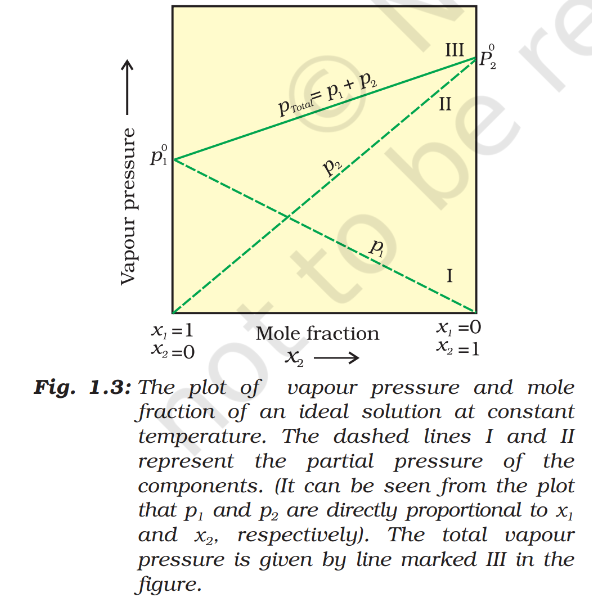
Vapour-phase mole fraction — The mole fraction of a component in the vapour above a solution equals its partial pressure divided by the total pressure.
For component , is its mole fraction in the vapour phase.
Worked numerical example
- Given: At , and . Mix of with of .
- Moles: and ; total .
- Liquid composition: and .
- Total pressure: .
- Vapour composition: and ; hence and .
- Conclusion: The vapour is richer in the more volatile component, , which has the higher pure-component vapour pressure.
Raoult’s Law as a Special Case of Henry’s Law
| Point | Raoult’s law | Henry’s law |
|---|---|---|
| Pressure relation | ||
| Proportionality constant | Pure-component vapour pressure, | Henry’s constant, |
| Connection | Special case when | For a gas dissolved in a liquid, the partial pressure is proportional to its mole fraction |
Vapour Pressure of Solutions of Solids in Liquids
Non-volatile solute and solvent vapour pressure
- Examples: Sodium chloride, glucose, urea and cane sugar dissolve in water; iodine and sulphur dissolve in carbon disulphide.
- Non-volatile solute: It does not enter the vapour phase, so the solution’s vapour pressure comes only from the solvent.
- Why pressure falls: Solute particles occupy part of the liquid surface, reducing the surface fraction covered by solvent and the number of solvent molecules escaping.
- Quantity, not identity: The decrease depends on the amount of solute, irrespective of its nature. For example, equal amounts of sucrose and urea in the same amount of water cause nearly similar decreases at the same temperature.
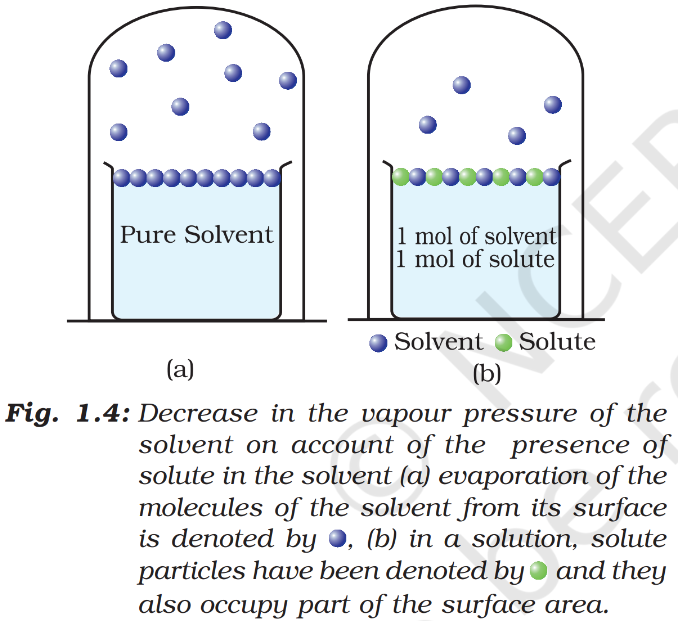
Raoult’s law for a non-volatile solute — When the solute is non-volatile, only the solvent contributes to the vapour pressure; its partial pressure is proportional to its liquid mole fraction.
Let component be the solvent and component be the non-volatile solute.
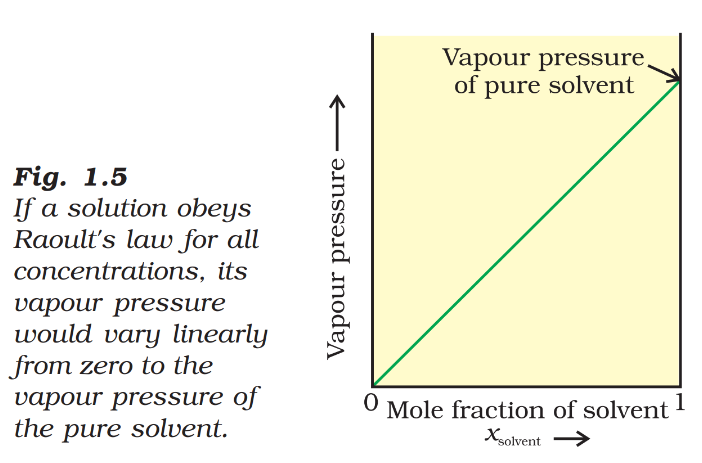
State Raoult’s law for a binary solution of two volatile liquids.
Why is a solution containing a non-volatile solute lower in vapour pressure than the pure solvent?
How is Raoult’s law related to Henry’s law?
Quick recap
- For each volatile component, Raoult’s law gives .
- Dalton’s law gives and .
- In a binary solution, total vapour pressure varies linearly with liquid composition.
- The vapour phase is richer in the more volatile component.
- Raoult’s law is a special case of Henry’s law when .
- A non-volatile solute lowers solvent vapour pressure: .
Ideal and Non ideal Solutions
Ideal Solutions
Ideal solution — A solution that obeys Raoult’s law throughout the full range of composition.
Properties and molecular basis
- Mixing enthalpy: No heat is absorbed or evolved when ideal-solution components mix.
- Mixing volume: The solution volume equals the sum of the pure-component volumes.
- Molecular condition: The attractions between unlike molecules () are nearly equal to those between like molecules ( and ).
- Examples: n-Hexane + n-heptane, bromoethane + chloroethane, and benzene + toluene behave nearly ideally.
Both enthalpy change and volume change on mixing are zero.
Non-ideal Solutions and Deviations from Raoult’s Law
Non-ideal solution — A solution that does not obey Raoult’s law over the full range of composition.
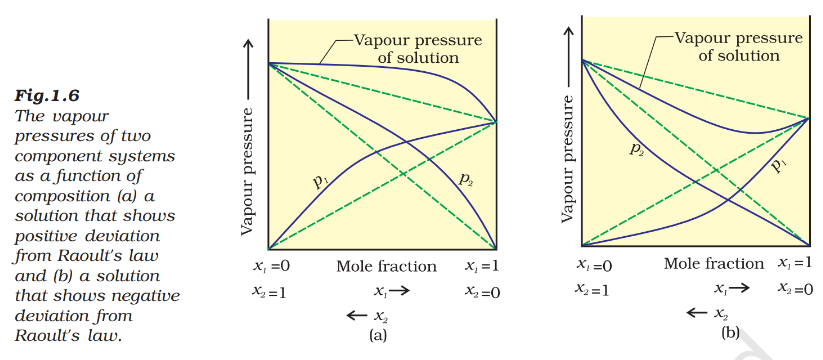
| Point | Positive deviation | Negative deviation |
|---|---|---|
| Vapour pressure | Higher than predicted by Raoult’s law | Lower than predicted by Raoult’s law |
| Molecular attractions | attractions are weaker than and attractions | attractions are stronger than and attractions |
| Escaping tendency | Molecules escape more readily, increasing vapour pressure | Molecules escape less readily, decreasing vapour pressure |
| Examples | Ethanol + acetone; carbon disulphide + acetone | Phenol + aniline; chloroform + acetone |
Examples explained by intermolecular forces
- Ethanol + acetone: Acetone disrupts some hydrogen bonds between ethanol molecules, weakening attractions and causing positive deviation.
- Carbon disulphide + acetone: Solute–solvent dipolar attractions are weaker than the like-molecule attractions, giving positive deviation.
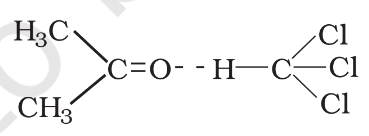
- Phenol + aniline: Hydrogen bonding between phenolic hydrogen and nitrogen’s lone pair is stronger than the corresponding like-molecule interactions, giving negative deviation.
- Chloroform + acetone: Hydrogen bonding between chloroform’s hydrogen and acetone’s carbonyl oxygen strengthens unlike-molecule attraction and lowers vapour pressure.
Azeotropes
Azeotrope — A binary mixture whose liquid and vapour have the same composition and which boils at a constant temperature.
Types and examples
- Separation: Azeotropic components cannot be separated by fractional distillation because liquid and vapour compositions are identical.
- Minimum-boiling azeotrope: Forms from solutions with large positive deviation; ethanol–water is an example.
- Ethanol–water composition: The azeotrope contains approximately ethanol by volume; further fractional distillation does not separate it.
- Maximum-boiling azeotrope: Forms from solutions with large negative deviation; nitric acid–water is an example.
- Nitric acid–water composition: Approximately nitric acid and water by mass; boiling point is .
| Point | Minimum-boiling | Maximum-boiling |
|---|---|---|
| Deviation | Large positive deviation | Large negative deviation |
| Example | Ethanol + water | Nitric acid + water |
Quick recap
- Ideal solutions obey Raoult’s law at every composition and have and .
- Ideal behaviour occurs when unlike- and like-molecule attractions are nearly equal.
- Positive deviation means higher vapour pressure and weaker attractions; negative deviation means lower vapour pressure and stronger attractions.
- Azeotropes have the same composition in liquid and vapour phases and cannot be separated by fractional distillation.
- Large positive deviations form minimum-boiling azeotropes; large negative deviations form maximum-boiling azeotropes.
Colligative Properties And Determination Of Molar Mass
Colligative Properties
Colligative properties — Properties of solutions that depend on the number of solute particles relative to the total number of particles, not on the solute’s identity.
The four colligative properties
- Relative lowering of vapour pressure of the solvent.
- Elevation of boiling point of the solvent.
- Depression of freezing point of the solvent.
- Osmotic pressure of the solution.
Relative Lowering of Vapour Pressure
- Raoult’s law: For a solution containing a non-volatile solute, the solvent vapour pressure is .
- Lowering: Adding non-volatile solute reduces the solvent’s vapour pressure; several solutes contribute through the sum of their mole fractions.
- Relative lowering: The vapour-pressure decrease divided by the pure-solvent vapour pressure equals the solute mole fraction.
For one solute, . In a dilute solution, .
are the solvent and solute masses; are their molar masses.
Example: benzene
- Given , , , and .
- Result: The solute molar mass is .
Elevation of Boiling Point
- Boiling point: The temperature at which a liquid’s vapour pressure equals atmospheric pressure.
- Effect of solute: A non-volatile solute lowers vapour pressure, so the solution must be heated to a higher temperature to boil.
- Elevation: A solution’s boiling point is higher than that of the pure solvent; water boils at at .
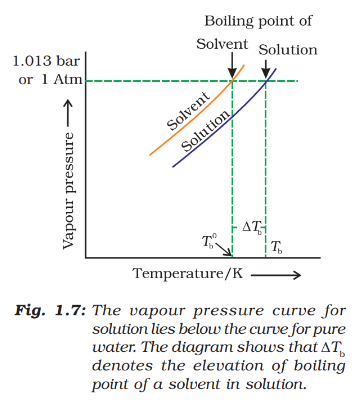
Elevation of boiling point — The difference between the boiling point of the solution and that of the pure solvent: .
For dilute solutions, is proportional to molality. is the ebullioscopic (molal boiling-point elevation) constant, with units . Molality is moles of solute per kilogram of solvent.
Examples
- Glucose in water: glucose in water gives . With , and the solution boils at .
- Unknown solute in benzene: solute in benzene raises the boiling point from to . With , .
Depression of Freezing Point
- Freezing point: The temperature at which the vapour pressure of the liquid equals that of the solid phase.
- Effect of solute: Lowering the solvent vapour pressure means it equals the vapour pressure of the pure solid solvent only at a lower temperature.
- Freezing condition: A solution freezes when its vapour pressure equals the vapour pressure of the pure solid solvent.
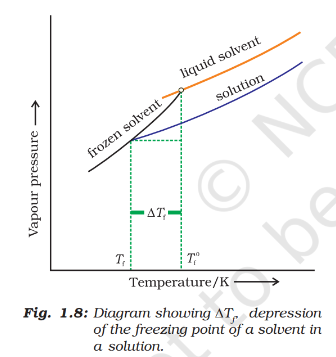
Depression of freezing point — The difference between the freezing point of the pure solvent and that of the solution: .
For dilute (ideal) solutions, is proportional to molality. is the cryoscopic (molal freezing-point depression) constant, with units .
Examples
- Ethylene glycol in water: in water gives . Using , and the solution freezes at .
- Unknown solute in benzene: solute in benzene gives . With , .
is the gas constant, is the solvent molar mass, and are the pure solvent’s freezing and boiling points in kelvin. and are its molar enthalpies of fusion and vaporisation.
| Solvent | Boiling point (K) | () | Freezing point (K) | () |
|---|---|---|---|---|
| Water | 373.15 | 0.52 | 273.0 | 1.86 |
| Ethanol | 351.5 | 1.20 | 155.7 | 1.99 |
| Cyclohexane | 353.74 | 2.79 | 279.55 | 20.00 |
| Benzene | 353.3 | 2.53 | 278.6 | 5.12 |
| Chloroform | 334.4 | 3.63 | 209.6 | 4.79 |
| Carbon tetrachloride | 350.0 | 5.03 | 250.5 | 31.8 |
| Carbon disulphide | 319.4 | 2.34 | 164.2 | 3.83 |
| Diethyl ether | 307.8 | 2.02 | 156.9 | 1.79 |
| Acetic acid | 391.1 | 2.93 | 290.0 | 3.90 |
Use solvent mass in kilograms when calculating molality. In molar-mass expressions with masses in grams, the factor accounts for this conversion.
What are colligative properties?
How is the molar mass of a solute found from boiling-point elevation?
How is the molar mass of a solute found from freezing-point depression?
Quick recap
- The four colligative properties are relative vapour-pressure lowering, boiling-point elevation, freezing-point depression and osmotic pressure.
- For a non-volatile solute, relative lowering of vapour pressure equals the solute mole fraction.
- For dilute solutions, boiling-point elevation follows ; the solution boils above the pure solvent.
- For dilute ideal solutions, freezing-point depression follows ; the solution freezes below the pure solvent.
- The constants and depend on the solvent and can help determine an unknown solute molar mass.
- Molality is moles of solute per kilogram of solvent.
Osmosis and Osmotic Pressure
Osmosis and Semipermeable Membranes
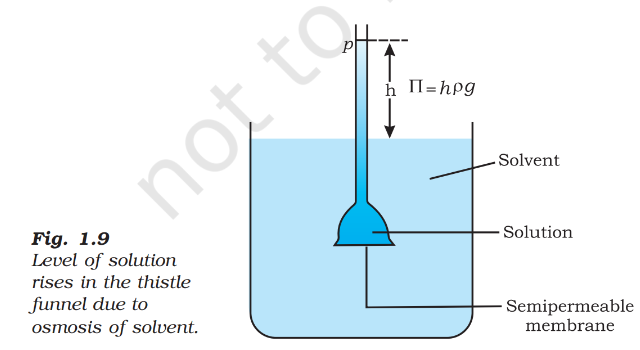
Osmosis — The flow of solvent through a semipermeable membrane from pure solvent or a dilute solution towards a more concentrated solution.
Direction and cause
- Direction: Solvent flows from the side with lower solute concentration to the side with higher solute concentration.
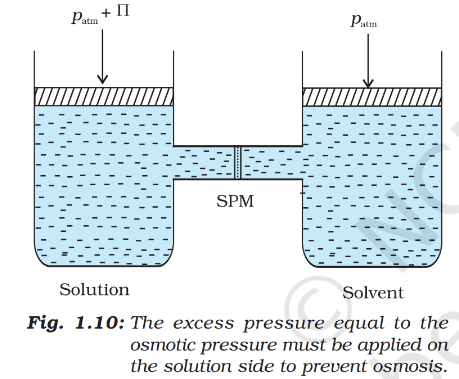
- Continuation: Osmosis proceeds until equilibrium is reached, unless pressure is applied to stop the flow.
Osmotic Pressure
Osmotic pressure as a colligative property
- Dependence: Osmotic pressure depends on the number of solute particles, not their chemical identity.
- Dilute solutions: At a fixed temperature, osmotic pressure is proportional to the solution’s molarity.
- Effect: Increasing particle concentration or temperature increases osmotic pressure.
Here is molarity, is absolute temperature and is the gas constant.
For moles of solute in litres of solution.
If grams of solute of molar mass are present in litres, use this relation to find .
Why the osmotic-pressure method is useful
- Applications: Used to determine molar masses of proteins, polymers and other macromolecules.
- Advantages: Measurements can be made near room temperature, and the method works well even for very dilute solutions.
- Biomolecules and polymers: Mild temperatures help protect heat-sensitive biomolecules; the method is useful when polymers have poor solubility.
Example: finding a protein’s molar mass
- Given: , , , and .
- Calculation: Substitution in gives a protein molar mass of approximately .
Isotonic, Hypertonic and Hypotonic Solutions
| Solution | Salt concentration | Water movement and cell effect |
|---|---|---|
| Isotonic (normal saline) | 0.9% (mass/volume) NaCl | Same osmotic pressure as blood-cell fluid; suitable for intravenous injection. |
| Hypertonic | More than 0.9% (mass/volume) NaCl | Water leaves the cells; they shrink. |
| Hypotonic | Less than 0.9% (mass/volume) NaCl | Water enters the cells; they swell. |
Examples and Uses of Osmosis
Everyday and biological examples
- Raw mango in concentrated brine → water leaves its cells → it shrivels.
- Wilted flowers or a limp carrot placed in water → water enters cells → they become firm.
- Water in soil → enters plant roots partly by osmosis → moves towards the upper parts of the plant.
- Salting meat or adding sugar to fruit → water leaves nearby bacteria by osmosis → they shrivel and die, helping preserve the food.
- A high-salt diet → water is retained in tissue cells and intercellular spaces → puffiness or swelling called edema.
Reverse Osmosis and Water Purification
Desalination
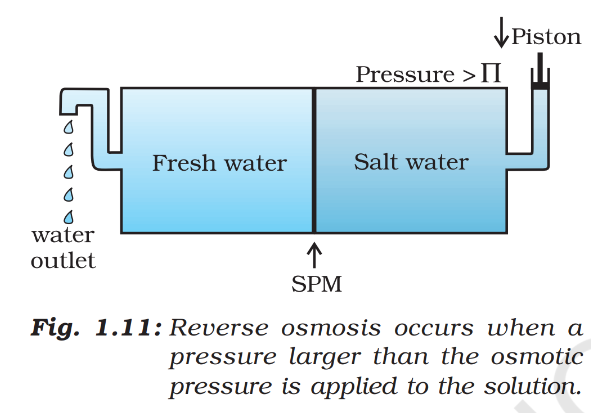
- Use: Reverse osmosis desalination removes water from seawater while retaining dissolved salts and other impurities.
- Membrane: Cellulose acetate membranes allow water through but block ions and impurities; they are supported by a suitable porous material.
- Practical application: Desalination plants supply potable water in many countries.
Abnormal Molar Masses and the van’t Hoff Factor
| Point | Dissociation | Association |
|---|---|---|
| Particle number | Increases as a solute separates into ions or particles. | Decreases as solute molecules combine into larger particles. |
| Colligative effect | Greater than expected for the undissociated solute. | Smaller than expected for the unassociated solute. |
| Experimental molar mass | Lower than the normal value. | Higher than the normal value. |
| Example | KCl produces and ions; its approaches in very dilute solution. | Ethanoic acid molecules dimerise through hydrogen bonding in benzene; its is nearly . |
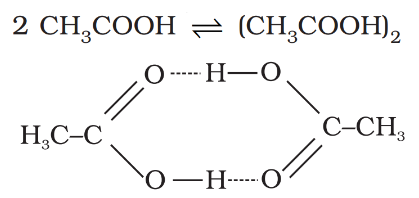
Illustrations of particle-number changes
- KCl dissociation: One mole of KCl can form one mole each of and ; the resulting two moles of particles roughly double colligative effects and can make the inferred molar mass half the true value.
- Ethanoic acid association: If all acid molecules form dimers in benzene, the number of particles is halved; the freezing-point depression or boiling-point elevation is half the normal value, giving twice the expected molar mass.
- Solvent effect: Ethanoic acid dimerisation commonly occurs in solvents with low dielectric constant.
van’t Hoff factor () — A factor introduced by van’t Hoff in 1880 to account for solute association or dissociation; it compares actual particle effects with those expected without either process.
Here and are the normal and abnormal molar masses; and are the observed and calculated colligative properties. and are particle amounts after and before association or dissociation. Association gives ; dissociation gives .
| Salt | at 0.1 m | at 0.01 m | at 0.001 m | for complete dissociation |
|---|---|---|---|---|
| NaCl | 1.87 | 1.94 | 1.97 | 2.00 |
| KCl | 1.85 | 1.94 | 1.98 | 2.00 |
| MgSO | 1.21 | 1.53 | 1.82 | 2.00 |
| KSO | 2.32 | 2.70 | 2.84 | 3.00 |
van’t Hoff-modified colligative-property equations
- Relative lowering of vapour pressure: Use the factor to account for altered particle numbers.
- Boiling and freezing changes: The usual molal relations are multiplied by .
- Osmotic pressure: The particle concentration in the solution is adjusted by .
Here and are the moles of solvent and solute, respectively.
Here is the molal elevation constant and is molality.
Here is the molal depression constant and is molality.
Here is the amount of solute and is the solution volume.
Define osmotic pressure and state how it depends on concentration for a dilute solution.
How does reverse osmosis purify seawater?
How does the van’t Hoff factor indicate association or dissociation?
- Osmosis moves solvent towards the more concentrated solution; osmotic pressure just stops this flow.
- Reverse osmosis requires applied pressure greater than osmotic pressure.
- Association lowers particle number (); dissociation raises particle number ().
Quick recap
- An SPM lets solvent through while hindering larger solute particles; osmosis moves solvent towards the more concentrated solution.
- Osmotic pressure is the excess pressure needed to stop osmosis; for dilute solutions, .
- Osmotic pressure can determine the molar masses of macromolecules, especially at near-room temperature and low concentrations.
- Isotonic solutions have equal osmotic pressures; hypertonic solutions make cells shrink, while hypotonic solutions make them swell.
- Reverse osmosis uses pressure greater than osmotic pressure to obtain water from seawater through a selective membrane.
- Dissociation increases particle number and lowers experimental molar mass; association reduces particle number and raises it.
- The van’t Hoff factor accounts for these changes: for association and for dissociation, and it modifies all colligative-property equations.