Class 12 PCB . Chemistry . Chemistry Part I . Electrochemistry
Chapter 2: Electrochemistry
Ch 2
Chemistry
Class 12 PCB
Electrochemical Cells and Galvanic Cells
Electrochemistry
Electrochemistry — The study of converting energy from spontaneous chemical reactions into electricity and using electricity to drive non-spontaneous chemical changes.
Why it matters
- Applications: Electrochemical processes produce metals, sodium hydroxide, chlorine, fluorine and other chemicals.
- Energy conversion: Batteries and fuel cells convert chemical energy into electrical energy.
- Benefits: Electrochemical processes can be energy-efficient and less polluting; sensory signalling and communication between cells also have an electrochemical basis.
Electrochemical Cells
Electrochemical cell — A device in which chemical energy and electrical energy are interconverted through redox reactions.
Galvanic (voltaic) cell — An electrochemical cell that uses a spontaneous redox reaction to produce electrical energy.
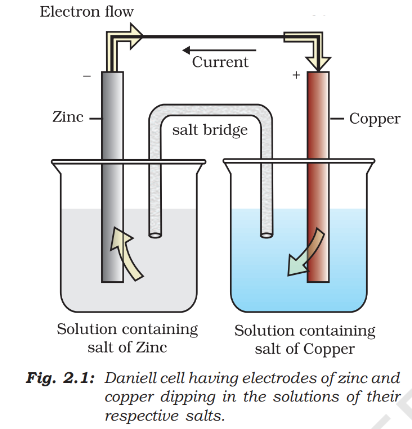
Daniell cell
- Overall reaction: Zinc is oxidised as copper(II) ions are reduced.
- Anode: Zinc metal forms ions and releases electrons.
- Cathode: ions gain electrons and deposit as copper metal.
- Salt bridge: Allows ion movement, maintains electrical neutrality and completes the internal circuit without direct mixing of the solutions.
| Opposing voltage | Cell behaviour |
|---|---|
| Below | The spontaneous Daniell-cell reaction continues. |
| Equal to | No net reaction and no current flow. |
| Above | The reaction reverses: electrons flow from copper to zinc; copper dissolves and zinc is deposited. The cell operates electrolytically. |
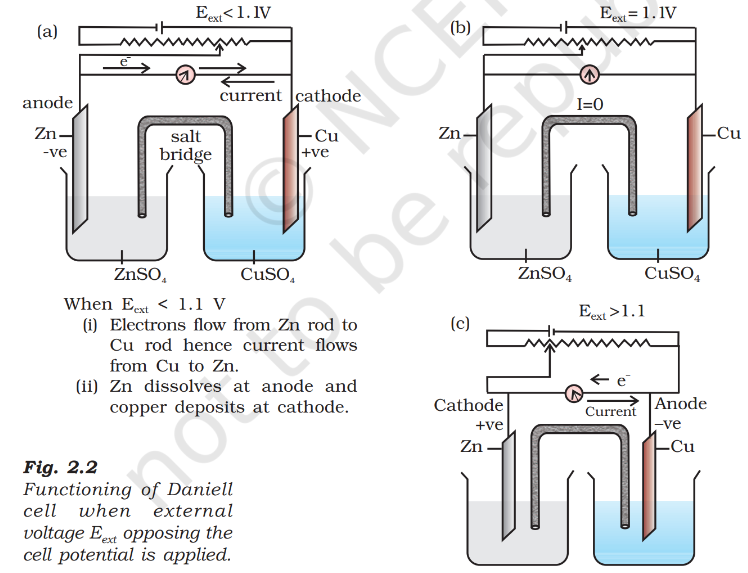
Electrolytic cell — A device that uses electrical energy to drive a non-spontaneous chemical reaction.
Galvanic Cell Structure and Potential
Half-cells and connections
- Half-cell: An electrode and its electrolyte, where one half-reaction occurs; it is also called a redox couple.
- External connection: The electrodes are joined by a conducting wire, usually with a voltmeter and switch.
- Internal connection: A salt bridge connects the electrolytes; it may be unnecessary when both electrodes share one electrolyte.
- Salt-bridge ions: Anions move towards the anode and cations towards the cathode to maintain charge balance.
Electrode potential — The potential difference that forms between an electrode and its electrolyte because of opposing tendencies for ions to deposit and metal atoms to enter solution as ions.
Standard electrode potential — The electrode potential when the species in the half-cell are in their standard states; for aqueous species, their concentrations are unity.
| Point | Anode | Cathode |
|---|---|---|
| Reaction | Oxidation | Reduction |
| Polarity in a galvanic cell | Negative | Positive |
| Electron movement | Electrons leave the electrode | Electrons enter the electrode |
Cell potential and notation
- Cell potential: The potential difference between the two electrodes; it is measured in volts.
- EMF: The cell potential when no current is drawn from the cell.
- Current direction: Conventional current flows opposite to electron flow.
- Notation: Write the anode on the left and the cathode on the right; separates phases and represents the salt bridge.
Use reduction potentials: subtract the anode (left-hand half-cell) potential from the cathode (right-hand half-cell) potential.
Copper-silver cell representation
- Cell notation: .
- Potential: .
Standard Hydrogen Electrode
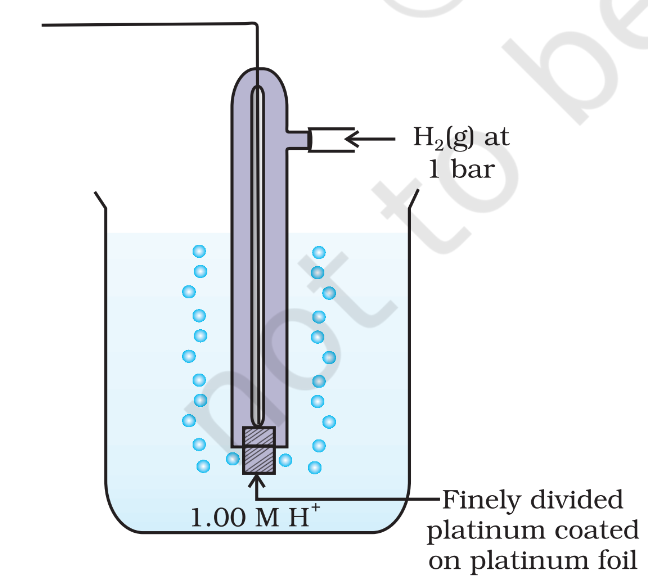
Standard hydrogen electrode (SHE) — The reference half-cell assigned a potential of zero at all temperatures, used to determine other electrode potentials.
SHE conditions and measurement
- Construction: A platinum electrode coated with platinum black is immersed in acid while pure hydrogen gas is bubbled over it.
- Standard conditions: Hydrogen pressure is and .
- Reference reaction: .
- Measurement: Individual half-cell potentials cannot be measured directly; the cell emf is measured against the SHE.
Measuring standard reduction potentials
- Setup: Connect the SHE as the anode to the standard half-cell being tested as the cathode.
- Result: At , if the species in the tested half-cell are in their standard states, the measured emf equals its standard reduction potential because .
| Half-reaction | Standard potential |
|---|---|
Reading potential signs
- Positive : The oxidised form is more readily reduced than under standard conditions; for example, can be reduced by hydrogen.
- Negative : The reduced form is a stronger reducing agent than hydrogen; zinc can reduce to hydrogen gas.
- Consequence: Copper does not dissolve in hydrochloric acid through oxidation by , but nitric acid can oxidise it using nitrate ions.
Using Standard Electrode Potentials
Daniell cell potential
- Standard half-reactions: Zinc is oxidised at the left electrode; is reduced at the right electrode.
- Calculation: Subtract the zinc reduction potential from the copper reduction potential.
A positive value is consistent with the spontaneous cell reaction as written.
Inert electrodes
- Purpose: Platinum or gold may provide a conductive surface without participating in the redox reaction.
- Examples: Platinum is used in the hydrogen half-cell and bromine half-cell .
| Reduction half-reaction | |
|---|---|
Trends in standard reduction potentials
- More positive -> greater tendency of the oxidised species to gain electrons -> stronger oxidising agent.
- More negative -> greater tendency of the reduced species to lose electrons -> stronger reducing agent.
Extremes and applications
- Fluorine: Its very high makes a strong oxidising agent; is a weak reducing agent.
- Lithium: Its very low makes lithium metal a powerful reducing agent in aqueous solution; is a weak oxidising agent.
- Uses: Electrochemical cells help determine pH, solubility products, equilibrium constants and thermodynamic properties, and are used in potentiometric titrations.
How can the standard electrode potential of the system be determined?
Can copper sulphate solution be stored in a zinc pot?
Name three substances that can oxidise ferrous ions under suitable conditions.
Quick recap
- Galvanic cells convert spontaneous redox energy into electrical energy.
- Oxidation occurs at the anode; reduction occurs at the cathode.
- In a galvanic cell, electrons travel anode to cathode and conventional current flows oppositely.
- The salt bridge maintains electrical neutrality by ion movement between half-cells.
- Cell emf is cathode reduction potential minus anode reduction potential.
- The SHE has a standard potential of zero and serves as the reference for electrode potentials.
- More positive reduction potentials indicate stronger oxidising agents; more negative values indicate stronger reducing agents.
Nernst Equation
Electrode Potential at Non-standard Concentrations
- Nernst equation: For \(\ce{M^{n+}(aq) + ne^- -> M(s)}\), , since the activity of the solid metal is unity.
- Concentration effect: The electrode potential depends on the concentration of the ionic species and differs from its standard value when conditions are non-standard.
- Constants: is the gas constant, is temperature in kelvin, is the Faraday constant, and is the number of electrons transferred.
- At 298 K: The equation can be written using common logarithms as .
Quick recap
- The Nernst equation adjusts electrode and cell potentials for non-standard concentrations.
- At , use .
- At equilibrium, and ; thus .
- Cell potential and Gibbs energy are related by .
- Conductance is ; conductivity is the reciprocal of resistivity.
- Metals conduct mainly by electrons, while electrolytic solutions conduct by ions.
Measurement Of The Conductivity of Ionic Solutions
Measuring Resistance and Conductivity
Why a Special Measurement Setup Is Needed
- DC problem: Direct current can change the composition of an ionic solution; alternating current avoids this difficulty.
- Conductivity cell: A specially designed vessel holds the solution between electrodes for measurement.
- Electrodes: Cells commonly use platinum electrodes coated with platinum black (finely divided platinum).
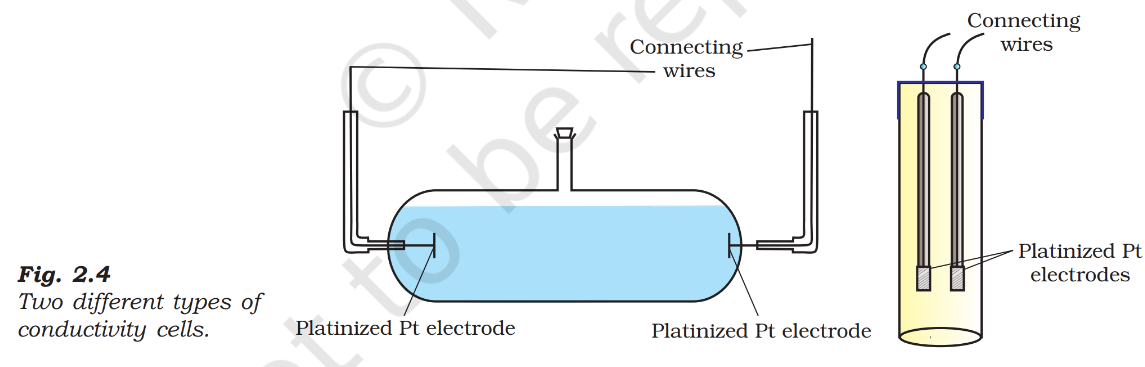
Cell constant — The ratio of electrode separation to electrode area, denoted by .
Cell Geometry and Calibration
- Geometry: The solution between electrodes forms a column of length and cross-sectional area .
- Resistance: , where resistivity is .
- Cell constant: ; its dimension is inverse length.
- Calibration: Determine using a standard solution with known conductivity, commonly a KCl solution.
| Concentration () | Conductivity () | Molar conductivity () |
|---|---|---|
Resistance Measurement and Conductivity
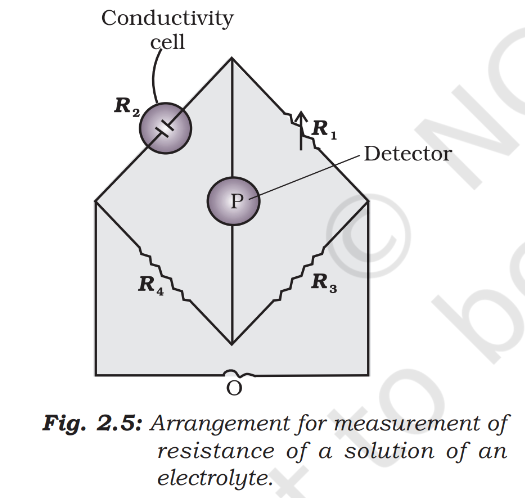
- AC Wheatstone bridge: The cell contains unknown resistance ; an oscillator supplies audio-frequency AC at – cycles per second.
- Balance condition: When no current passes through the detector, the bridge is balanced and .
- Conductivity: Once and solution resistance are known, calculate . Conductivity meters can read conductance or resistance directly.
Molar conductivity — The conductance associated with the volume of solution containing one mole of electrolyte, denoted by .
Molar Conductivity and Units
- Why it is useful: Conductivity differs among electrolytes because their ions differ in charge, size, concentration and mobility.
- SI units: when is in and in ; units are .
- Using molarity: For in , when is in ; units are .
- Unit conversion: .
Illustrative Calculations
- KCl calibration: For KCl, and give .
- KCl result: For KCl with , and .
- NaOH solution column: For diameter , length , and resistance , and .
- NaOH molar conductivity: At , .
Variation with Concentration
Conductivity versus Molar Conductivity
- Conductance and geometry: ; with unit electrode area and unit separation, .
- Conductivity, : Conductance of a unit-volume solution between electrodes of unit area and unit separation.
- Dilution effect on : Conductivity decreases because dilution reduces the number of current-carrying ions per unit volume.
- Molar conductivity, : Conductance of the volume containing one mole of electrolyte between electrodes separated by unit distance.
- Volume relation: If is the volume containing one mole, then .
- Dilution effect on : It increases on dilution because the increased volume per mole more than compensates for the fall in conductivity.
- Infinite dilution: The limiting molar conductivity, , is the value as .
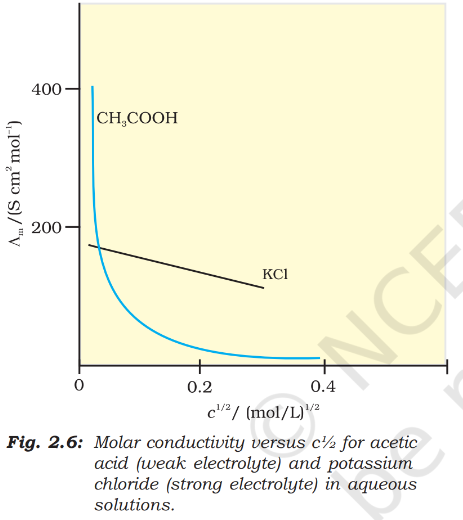
| Point | Strong electrolytes | Weak electrolytes |
|---|---|---|
| Change in | Increases gradually on dilution. | Increases steeply, especially at low concentrations. |
| Main reason | Interionic effects become less significant as ions move farther apart. | Degree of dissociation increases, producing more ions. |
| Finding | Can be found by extrapolating the linear relation to . | Cannot be reliably found by extrapolation; use Kohlrausch's law. |
Strong Electrolytes
- Concentration relation: .
- Graph: A plot of against is a straight line with intercept and slope .
- Constant : For a given solvent and temperature, depends on electrolyte type, determined by the charges on its ions.
- Types: NaCl is –, CaCl is –, and MgSO is –; electrolytes of a particular type have the same .

Kohlrausch's law of independent migration of ions — At infinite dilution, an electrolyte's limiting molar conductivity equals the sum of the independent limiting contributions of its ions.
Kohlrausch's Law and Ionic Values
- General form: , where and count each ion per formula unit.
- Example: .
- At : , , , and .
- Other ion values: , , , and .
- Further values: and .
Weak Electrolytes
- Dilution: Weak electrolytes are less dissociated at higher concentrations; dilution increases dissociation and molar conductivity.
- Limiting value: At infinite dilution, , but conductivity is too low to measure accurately; obtain using Kohlrausch's law.
- Degree of dissociation: At concentration , .
- Weak-acid constant: .
Applications of Kohlrausch's Law
- CaCl: .
- MgSO: .
- Acetic acid: using values , , and .
- Water: Its limiting molar conductivity can be determined from .
Acetic Acid Example
- Given: , , and .
- Results: , , and .
Do not confuse dilution trends: conductivity decreases, while molar conductivity increases.
Why does conductivity decrease when an electrolyte solution is diluted?
State Kohlrausch's law and give its general expression.
Quick recap
- Use AC and a conductivity cell to measure ionic-solution resistance without changing the solution composition.
- Calibrate the cell constant with a standard solution: ; then calculate .
- Conductance depends on cell geometry: ; for unit area and unit separation, .
- On dilution, conductivity decreases but molar conductivity increases.
- Strong electrolytes follow ; weak electrolytes show a steep rise in on dilution.
- Kohlrausch's law sums individual limiting ionic contributions; for weak electrolytes use to calculate .
Electrolytic Cells And Electrolysis , Batteries
Electrolytic Cells and Electrolysis
Electrolysis and metal production
- Electrorefining copper: Impure copper is the anode and dissolves; pure copper deposits at the cathode.
- Metal extraction: Sodium and magnesium are produced by electrolysis of their fused chlorides.
- Aluminium extraction: Aluminium oxide is electrolysed in the presence of cryolite.
- Reason for electrolysis: It can produce metals such as sodium, magnesium and aluminium when suitable chemical reducing agents are unavailable.
Quantitative Aspects: Faraday’s Laws
Use when current and electrolysis time are known. Charge is in coulombs when current is in amperes and time is in seconds.
Faraday constant — The charge carried by one mole of electrons: .
Charge required by electrode reactions
- Silver: Reducing mol of requires mol of electrons, or .
- Magnesium: Reducing mol of requires mol of electrons, or .
- Aluminium: Reducing mol of requires mol of electrons, or .
- General rule: If each ion requires electrons, depositing mol of metal requires of charge.
- Industrial scale: A current of corresponds to about per second.
For a species with molar mass requiring electrons per ion.
Calculating mass deposited: copper example
- Convert the electrolysis time to seconds.
- Calculate the charge passed using the current and time.
- Use the copper reaction: depositing one mole of copper requires two moles of electrons.
- Calculate the deposited mass using and .
Products of Electrolysis
| Point | Molten | Aqueous |
|---|---|---|
| Cathode product | Sodium metal: | Hydrogen forms from water: |
| Anode product | Chlorine gas: | Chlorine gas: |
| Overall products | Sodium and chlorine | Sodium hydroxide, hydrogen and chlorine |
Aqueous sodium chloride: selecting electrode reactions
- Cathode competition: Reduction of water-derived is preferred to reduction of because its reduction potential is higher: versus .
- Anode competition: Chloride ions can be oxidised to chlorine; water can also be oxidised to oxygen.
- Concentration: Actual electrode potentials depend on concentration and are described using the Nernst equation.
- Net result: The solution yields , and .
Electrolysis of sulphuric acid
- Possible anode processes: Water can form oxygen, or sulfate ions can form peroxodisulfate ions.
- Standard potentials given: Water oxidation is listed at and sulfate oxidation at .
- Product selection: Actual potentials, concentrations and kinetic effects such as overpotential affect which process occurs.
Batteries
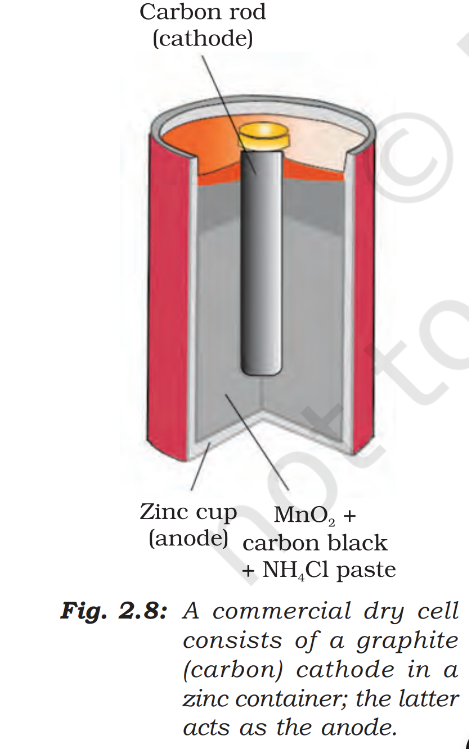
- Battery: A battery consists of one or more galvanic cells and converts the chemical energy of a redox reaction into electrical energy.
- Practical features: A useful battery should be reasonably light and compact, with a voltage that does not change appreciably during use.
Primary Batteries
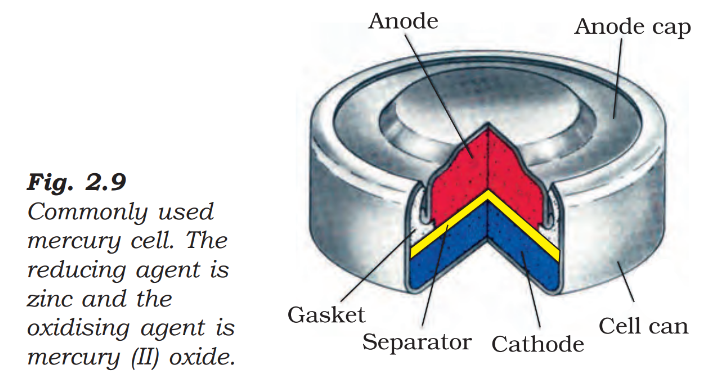
Mercury cell
- Construction: Zinc–mercury amalgam is the anode; the cathode contains and carbon, and the electrolyte is a paste of and .
- Use: Suitable for low-current devices such as hearing aids and watches.
- Voltage: Its potential is about and remains nearly constant because the overall reaction does not involve an ion in solution whose concentration changes.
Secondary Batteries
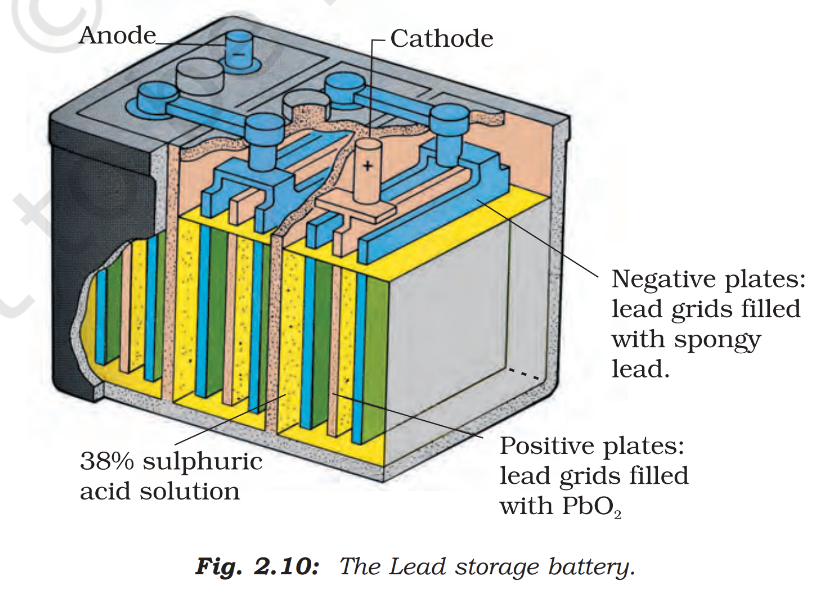
Lead storage battery
- Use: Commonly used in automobiles and inverters.
- Construction: Lead is the anode; a grid of lead packed with is the cathode; the electrolyte is a solution of sulphuric acid.
- Discharging: Both electrodes form lead sulfate, , and water is produced.
- Charging: The reaction is reversed; is converted back to lead and lead dioxide.
Nickel–cadmium cell
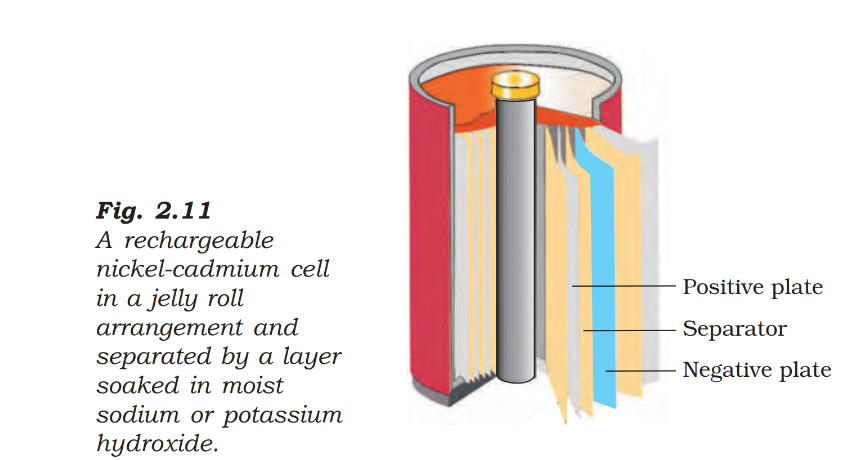
- Type: Secondary, rechargeable cell.
- Comparison: It has a longer life than a lead storage cell but is more expensive to manufacture.
- Discharge: Cadmium and nickel oxyhydroxide form cadmium oxide, nickel hydroxide and water.
State Faraday’s first law and give the relation between charge, current and time.
Why is hydrogen produced instead of sodium at the cathode during electrolysis of aqueous sodium chloride?
Distinguish primary and secondary batteries.
Quick recap
- Electrolysis uses an external voltage; reduction occurs at the negative cathode and oxidation at the positive anode.
- Faraday’s laws link substance formed to charge passed and equivalent weight; and .
- Products depend on electrolyte composition, electrode material, electrode potentials, concentration and overpotential.
- Molten produces sodium and chlorine; aqueous produces sodium hydroxide, hydrogen and chlorine.
- Dry and mercury cells are primary batteries; lead storage and nickel–cadmium cells are rechargeable secondary batteries.
- The lead storage battery forms during discharge and reverses the reaction during charging.
Fuel Cells
Fuel Cells
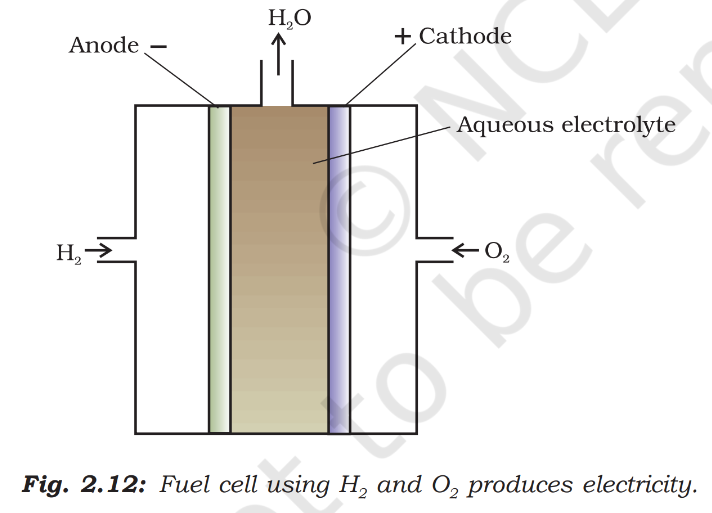
Fuel cell — A galvanic cell that converts the combustion energy of a fuel directly into electrical energy, with reactants supplied continuously and products removed continuously.
- Fuels: Hydrogen, methane and methanol are examples of fuels used in fuel cells.
- Operation: The cell runs as long as fuel and oxidant are supplied and products are removed.
- Performance: Fuel cells are about 70% efficient, compared with about 40% for thermal power plants.
- Advantages and development: They are pollution-free; improved electrodes, catalysts and electrolytes are being developed. Fuel cells have been tested experimentally in automobiles.
| Point | Fuel cells | Thermal plants |
|---|---|---|
| Energy conversion | Fuel combustion energy is converted directly into electricity. | Fuel energy first produces high-pressure steam, which drives a turbine. |
| Efficiency | About 70%. | About 40%. |
| Pollution | Pollution-free in operation, as described for fuel cells. | A major source of pollution. |
Corrosion
Corrosion — The gradual deterioration of a metal as its surface forms oxides or other metal salts.
- Examples: Iron rusts, silver tarnishes, and copper or bronze develops a green coating.
- Impact: Corrosion damages structures and metal objects, especially those made of iron, and can contribute to failures such as bridge collapse.
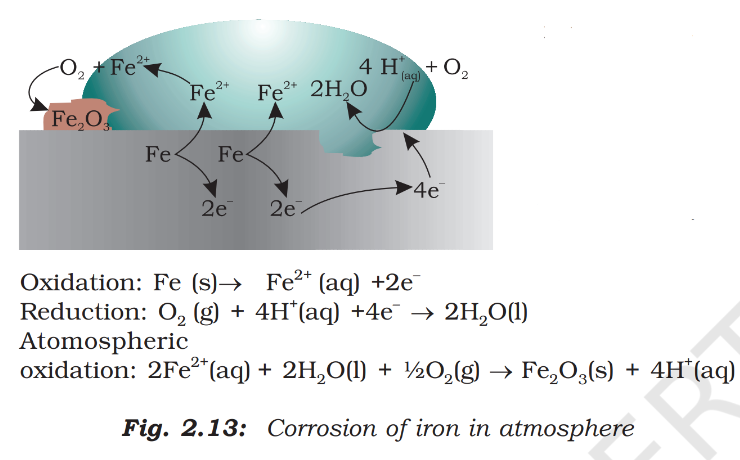
- Electrochemical nature: Metal atoms lose electrons at anodic spots; the electrons travel through the metal to cathodic spots, where oxygen is reduced.
Electrochemical rusting of iron
- Conditions: Rusting requires water and air. Dissolved carbon dioxide can form carbonic acid, supplying ; other acidic atmospheric oxides may also contribute.
- Anode: Iron is oxidised to ferrous ions, releasing electrons; .
- Cathode: Oxygen is reduced in the presence of hydrogen ions; .
- Rust formation: Ferrous ions are further oxidised by atmospheric oxygen to ferric ions, which form hydrated ferric oxide, ; hydrogen ions are also produced.
| Method | How it protects the metal | Examples |
|---|---|---|
| Surface barrier | Prevents contact between the metal and the atmosphere. | Paint or chemicals such as bisphenol |
| Metal coating | Covers the object with another metal that is inert or protects the underlying metal by reacting. | Tin or zinc |
| Sacrificial electrode | A more reactive attached metal corrodes instead of the object being protected. | Magnesium or zinc |
Hydrogen Economy
Why hydrogen is considered an alternative energy source
- Fossil-fuel combustion releases carbon dioxide.
- Rising atmospheric carbon dioxide strengthens the greenhouse effect and raises Earth’s surface temperature.
- Warming can melt polar ice and raise sea levels, threatening low-lying coasts and islands.
- Limiting carbonaceous fuels and using hydrogen can reduce reliance on these fuels; hydrogen combustion produces water only.
- Renewable hydrogen: Hydrogen can be a renewable, non-polluting energy source when produced by splitting water using solar energy.
- Key technologies: Electrolysis of water to produce hydrogen and fuel cells to convert hydrogen’s chemical energy into electricity both rely on electrochemical principles.
- Energy use: Per-capita energy consumption is used as a measure of development, assuming the energy is used productively rather than wasted.
Name two fuels other than hydrogen that can be used in fuel cells.
How is rusting of iron an electrochemical process?
Quick recap
- Fuel cells directly convert fuel combustion energy into electricity and operate continuously when reactants are supplied.
- A hydrogen–oxygen fuel cell has an overall reaction of hydrogen and oxygen forming water; its efficiency is about 70%.
- Corrosion is electrochemical: metal oxidation at anodic regions is coupled to reduction at cathodic regions.
- Iron rusting needs water and air; hydrated ferric oxide is the rust product.
- Paint, metal coatings and sacrificial electrodes are methods of corrosion prevention.
- Hydrogen can be a renewable energy carrier when solar energy is used to split water; electrolysis and fuel cells are electrochemical technologies.