Class 12 PCM . Physics . Physics Part II . Atoms
Chapter 4: Atoms
Ch 4
Physics
Class 12 PCM
Introduction
Atomic structure and Thomson’s model
Electrons and atomic neutrality
- Electron discovery: In 1897, J. J. Thomson’s experiments on electric discharge through gases showed that atoms contain negatively charged electrons.
- Common constituent: Electrons are identical and are present in atoms of all elements.
- Neutral atom: Since the atom as a whole is electrically neutral, it must also contain positive charge to balance the electrons.
Thomson’s plum pudding model — Proposed by J. J. Thomson in 1898: positive charge is spread uniformly throughout the atom, with electrons embedded in it like seeds in a watermelon.
Atomic spectra
| Feature | Continuous spectrum | Line spectrum |
|---|---|---|
| Source | Solids, liquids and dense gases | Rarefied gases heated in a flame or electrically excited |
| Appearance | Many wavelengths distributed continuously, with differing intensities | Only certain discrete wavelengths; seen as bright lines |
| Origin | Associated with oscillations of atoms or molecules and their interactions with neighbours | Can be attributed mainly to individual atoms, as atoms are widely spaced |
| Example | Radiation from condensed matter | Neon signs and mercury-vapour lamps |
Elemental spectra and hydrogen
- Characteristic spectrum: Each element emits a distinctive set of spectral lines; hydrogen’s lines have fixed relative positions.
- Significance: The characteristic radiation suggests a close link between an atom’s internal structure and the spectrum it emits.
- Balmer formula: In 1885, Johann Jakob Balmer obtained an empirical formula for the wavelengths of a group of hydrogen spectral lines.
- Hydrogen: As the simplest element, it is especially useful for studying atomic spectra.
Rutherford’s nuclear model
Scattering experiment and model
- Proposal: In 1906, Ernest Rutherford proposed scattering alpha particles from atoms to investigate atomic structure.
- Experiment: Hans Geiger and Ernest Marsden performed it around 1911.
- Nucleus: Rutherford’s model places all positive charge and most of the atom’s mass in a very small central volume called the nucleus.
- Planetary model: Electrons revolve around the nucleus, like planets around the Sun; it is also called the nuclear model.
- Hydrogen atom: It consists of one electron and one proton.
Rutherford’s model was a major step toward the modern picture of the atom, but it could not explain why atoms emit only discrete wavelengths, including hydrogen’s specific spectral lines.
Quick recap
- Atoms are electrically neutral but contain negatively charged electrons and positive charge.
- Thomson’s 1898 plum pudding model pictured electrons embedded in uniformly distributed positive charge.
- Rarefied excited gases emit discrete line spectra; dense matter emits continuous spectra.
- Each element has a characteristic spectrum; Balmer found an empirical formula for hydrogen spectral lines in 1885.
- Rutherford’s nuclear model places most atomic mass and all positive charge in a small nucleus, with electrons revolving around it.
- Rutherford’s model could not explain why atoms emit only specific wavelengths; hydrogen contains one electron and one proton.
Alpha-particle Scattering And Rutherford’s Nucler Model Of Atom
The Geiger–Marsden Experiment
Experimental setup
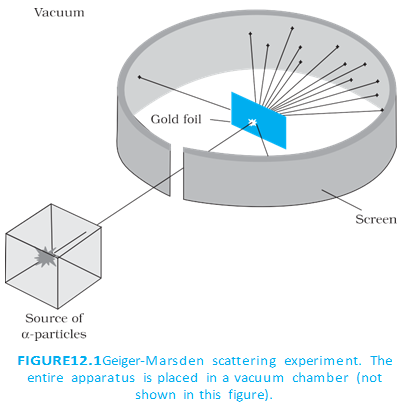
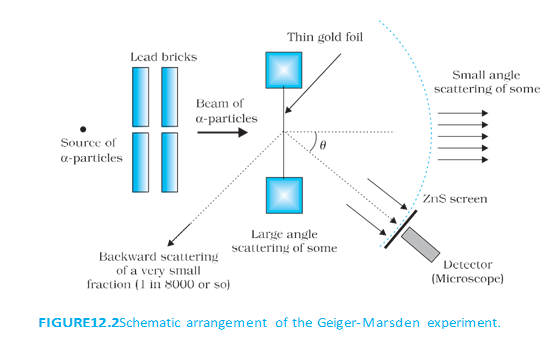
- Experimenters: At Ernest Rutherford’s suggestion, H. Geiger and E. Marsden conducted the experiments in 1911.
- Source and beam: A alpha-particle beam from was narrowed using lead bricks.
- Target: The beam struck a thin gold foil of thickness inside a vacuum chamber.
- Detection: A rotatable zinc sulphide screen and microscope detected scattered particles as brief light flashes called scintillations.
- Measurement: The number of particles scattered was recorded at different angles.
Observations and Inferences
Scattering results
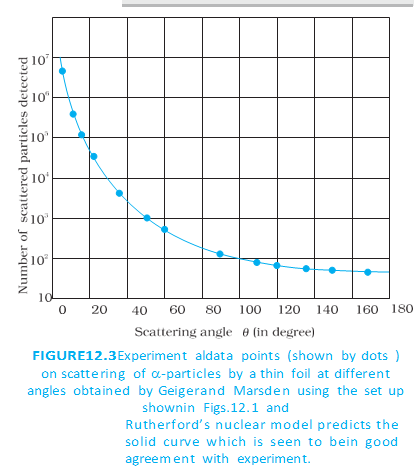
- Most particles: Most alpha particles passed through the foil without collision.
- Small-angle scattering: Only about of incident particles scattered through angles greater than .
- Large-angle scattering: About in particles deflected through more than .
- Graph: The measured scattering counts agreed with the prediction for atoms containing a small, dense, positively charged nucleus.
Why large deflections imply a nucleus
- A backward-deflected alpha particle must experience a very large repulsive force.
- Such a force is possible if positive charge and most atomic mass are concentrated in a small central region.
- A close approach to this positively charged centre causes strong repulsion and a large deflection.
- The agreement between the scattering data and the model supported the nuclear atom; Rutherford is credited with discovering the nucleus.
Rutherford’s nuclear model — The atom has a small nucleus containing all its positive charge and most of its mass, with electrons moving around it at a distance.
Model and size of the atom
- Electron motion: Rutherford pictured electrons orbiting the nucleus, like planets orbiting the Sun.
- Nuclear size: The experiments suggested a nucleus about to in size.
- Atomic size: The atom is about in size—roughly to times larger than its nucleus.
- Electron–nucleus distance: Electrons are about to nucleus-sizes away from the nucleus.
- Empty space: Most of an atom is empty space, explaining why most alpha particles pass straight through the foil.
- Role of electrons: Atomic electrons are so light that they do not appreciably affect alpha-particle scattering.
- Rutherford’s conclusion: The nucleus is tiny, dense, and positively charged; most of the atom is empty space.
- Scattering cause: Large-angle deflections occur when an alpha particle passes close to a nucleus.
Single-Nucleus Scattering and Coulomb Force
Assumptions for analysing scattering
- Thin foil: An alpha particle is assumed to undergo at most one scattering while passing through the foil.
- Alpha particle: It is a helium nucleus with charge and the mass of a helium atom.
- Gold nucleus: Its charge is , where is the atomic number; for gold, .
- Fixed target: A gold nucleus is about times heavier than an alpha particle, so it is treated as stationary during scattering.
- Analysis: The trajectory can be calculated using Newton’s second law and Coulomb’s law for repulsion.
Here is the separation between the alpha particle and nucleus, and is the permittivity of free space. The force acts along the line joining them and changes as their separation changes.
What did Rutherford infer from the observation that a very small number of alpha particles were deflected through large angles?
Why do most alpha particles pass through a thin metal foil without deflection?
Quick recap
- Geiger and Marsden conducted the gold-foil scattering experiments in 1911 at Rutherford’s suggestion.
- Most alpha particles passed through; a very small fraction scattered through large angles.
- Large deflections showed that positive charge and most atomic mass are concentrated in a tiny nucleus.
- The atom is much larger than its nucleus and consists mostly of empty space.
- Electrons are about to nucleus-sizes away from the nucleus.
- Alpha particles carry charge ; the gold nucleus carries charge , with .
- The repulsive force varies inversely with the square of the separation: .
Alpha-particle Trajectory
Impact Parameter and Scattering
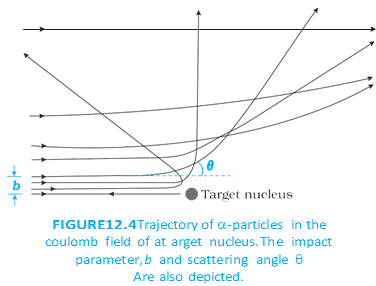
Impact parameter — The perpendicular distance between the incoming alpha-particle’s initial velocity line and the centre of the nucleus.
How the trajectory depends on impact parameter
- Small : The alpha-particle passes close to the nucleus and undergoes strong scattering.
- Head-on collision: is minimum; the particle reverses direction, so the scattering angle is approximately .
- Large : The particle passes farther away and is only slightly deflected; the scattering angle is approximately .
- Beam pattern: A beam contains particles with different impact parameters, so particles scatter through different angles and with different probabilities.
- Inference: Few particles rebound, so few undergo head-on collisions; this shows that the atom’s positive charge and most of its mass occupy a very small volume.
What scattering reveals about the nucleus
- Nuclear size: Rutherford scattering can set an upper limit on the size of the nucleus.
- Atomic structure: The rarity of large-angle or backward scattering indicates that most of an atom is empty space, with its positive charge and mass concentrated centrally.
Comparing Atomic and Solar-System Scales
Scale comparison
- Atomic ratio: Electron-orbit radius to nuclear radius is approximately .
- Solar-system analogy: If Earth’s orbit were times the Sun’s radius, its radius would be .
- Comparison: This is over 100 times Earth’s actual orbital radius of about ; on this scale Earth would be much farther from the Sun.
- Conclusion: An atom contains a much greater fraction of empty space than the solar system.
Distance of Closest Approach
Energy at the turning point
- Closest approach: In a head-on encounter, the alpha-particle momentarily stops at its nearest point to the nucleus, then reverses direction.
- Energy conservation: The initial kinetic energy becomes electrostatic potential energy at this turning point.
- Charges: The alpha-particle has charge and a nucleus of atomic number has charge .
For a head-on approach with initial kinetic energy , the centre-to-centre distance at the turning point is:
Example: 7.7 MeV alpha-particle on gold
- Energy and target: ; for gold, .
- Substitution: Using and gives .
- Result: For gold, , where .
- Interpretation: This gives an upper limit on the gold nucleus’s radius; its measured radius is about .
- Why they differ: The alpha-particle turns back before touching the nucleus, so its closest centre-to-centre distance exceeds the sum of their radii.
Electron Orbits in Rutherford’s Model
Force and orbit
- Rutherford’s picture: A tiny, massive, positively charged nucleus is surrounded by electrons revolving in orbits; the atom as a whole is electrically neutral.
- Stable circular orbit: In the hydrogen atom, the electrostatic attraction supplies the centripetal force required for the electron’s orbit.
Rearranging the force-balance equation:
Meaning of the electron’s total energy
- Bound electron: The negative total energy means the electron is bound to the nucleus.
- Unbound case: If its total energy were positive, the electron would not remain in a closed orbit around the nucleus.
Hydrogen Electron: Radius and Speed
Example: hydrogen binding energy
- Given: It takes to separate a hydrogen atom into a proton and an electron, so the electron’s total energy is .
- Orbit radius: Substituting into gives .
- Electron speed: Using the force-balance relation gives .
Equivalent form of the force-balance equation, used with the known orbit radius:
Quick recap
- The impact parameter is the perpendicular distance from the incoming path to the nucleus’s centre.
- Small impact parameters produce strong deflection; head-on particles rebound with a scattering angle of approximately , while large-impact-parameter particles are barely deflected.
- Rare backward scattering shows that atomic mass and positive charge are concentrated in a tiny nucleus.
- At closest approach, the alpha-particle’s initial kinetic energy equals its Coulomb potential energy.
- In a hydrogen orbit, Coulomb attraction provides centripetal force; the electron’s total energy is negative when it is bound.
- For hydrogen, the electron’s orbital radius is about and its speed is about .
Atomic Spectra
Emission and Absorption Spectra
Emission line spectrum — The spectrum of radiation emitted by an excited, low-pressure atomic gas or vapour, containing only specific wavelengths.
- Appearance: An emission line spectrum consists of bright lines on a dark background.
- Identification: Each element has a characteristic spectrum, so its spectral lines act like a fingerprint.
- Absorption spectrum: Dark lines appear when white light passes through a gas; their wavelengths match the gas’s emission lines.
| Emission spectrum | Absorption spectrum | |
|---|---|---|
| How it forms | Excited gas emits radiation at specific wavelengths. | White light passes through a gas, which absorbs specific wavelengths. |
| Appearance | Bright lines on a dark background. | Dark lines in a continuous spectrum. |
| Wavelengths | Characteristic wavelengths of the gas. | The dark lines match the gas’s emission-line wavelengths. |
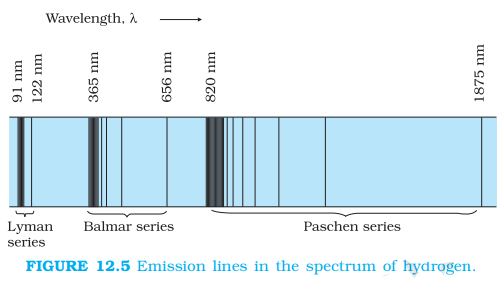
Why the Rutherford Model Could Not Explain Atomic Spectra
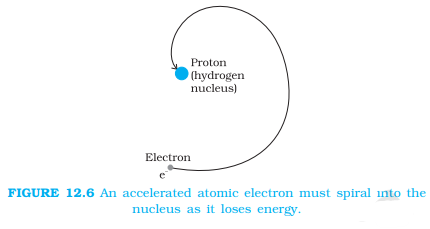
- Classical prediction: An electron revolving around a nucleus is accelerating; classical electromagnetic theory says an accelerating charge radiates energy.
- Instability: As the electron loses energy, its orbit should shrink and it should spiral into the nucleus.
- Spectrum problem: The electron’s revolution frequency would change as it spirals inward, producing a continuous spectrum—not the observed line spectrum.
- Conclusion: Classical physics and the Rutherford model alone cannot explain atomic stability or line spectra.
For an electron moving at speed in a circular orbit of radius , its revolution frequency is also the frequency of emitted radiation according to classical theory.
Hydrogen Example
- Given: For the hydrogen ground-state orbit, and .
- Classical prediction: The initial radiation frequency is .
Bohr’s Postulates
- Proposal: In 1913, Niels Bohr combined classical ideas with the emerging quantum theory to explain atomic structure and spectra.
- First postulate—stationary states: Electrons can occupy certain stable orbits without radiating energy; each allowed state has a definite energy.
- Second postulate—quantised angular momentum: Only orbits with angular momentum equal to an integral multiple of are allowed.
- Third postulate—transitions: An electron moving from a higher-energy state to a lower-energy state emits a photon whose energy equals the energy difference.
Hydrogen Orbit Radii and Energy Levels
- Allowed radii: Applying angular-momentum quantisation gives discrete radii for hydrogen’s permitted orbits.
- Energy: The negative energy shows that the electron is bound to the nucleus; the energy becomes less negative as increases.
Here is the electron mass, the elementary charge, and the permittivity of free space.
The ground-state orbit has radius ; is expressed in joules or electron volts.
Ground and Excited States
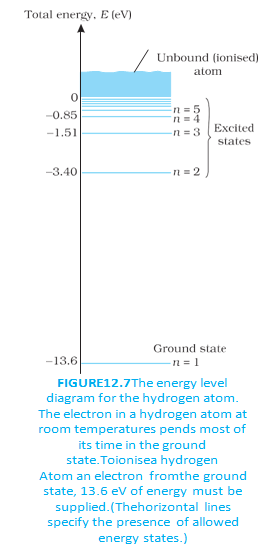
- Ground state: The lowest-energy state is , with and orbit radius equal to the Bohr radius .
- Ionisation energy: At least is needed to remove a hydrogen electron from the ground state to .
- Excited state: Supplying energy can raise the electron to a state with . At room temperature, most hydrogen atoms are in the ground state.
- Example: , so excitation from to needs .
- Another example: , so excitation from to needs .
- De-excitation: An electron falling to a lower energy state emits a photon; higher excited states require less energy to ionise.
Energy-Level Diagram
- Principal quantum number: labels the stationary states in order of increasing energy.
- Ionisation limit: At , the electron is completely removed and at rest, so the atom’s energy is .
- Level spacing: As increases, the energy levels become closer together.
Do not treat the negative sign in as meaning energy decreases for higher orbits: higher states have less negative, therefore greater, energy.
State Bohr’s three postulates.
What is the ionisation energy of ground-state hydrogen?
Why does the Rutherford model fail to explain atomic line spectra?
Quick recap
- Atomic emission spectra have characteristic bright lines; absorption lines occur at the same wavelengths.
- Classical theory predicts an unstable atom and a continuous spectrum, conflicting with observations.
- Bohr proposed stationary states, quantised angular momentum, and photon emission during downward transitions.
- Hydrogen energy levels are .
- Ground-state hydrogen requires to ionise; energy levels converge towards as .
The Line Spectra Of Hydrogen
Hydrogen’s Line Spectrum
How spectral lines form
- Emission: An electron falling from a higher level to a lower level emits a photon.
- Photon energy: For a transition from to , where , the photon energy equals the energy-level difference.
- Discrete spectrum: Since the energy levels are quantised, transitions produce only specific photon frequencies; these appear as separate spectral lines.
- Absorption: An atom absorbs a photon only when its energy exactly matches the difference between two allowed energy levels.
- Dark lines: A continuous range of frequencies passing through a rarefied gas loses the frequencies absorbed by its atoms, leaving dark absorption lines.
| Point | Emission | Absorption |
|---|---|---|
| Electron transition | Higher level to lower level | Lower level to higher level |
| Photon | Emitted by the atom | Absorbed by the atom |
| Spectrum | Bright lines at specific frequencies | Dark lines where specific frequencies are missing from a continuous spectrum |
De Broglie’s Explanation of Bohr’s Quantisation
Bohr’s angular-momentum condition — An electron in an allowed orbit has angular momentum equal to an integer multiple of .
Standing de Broglie waves
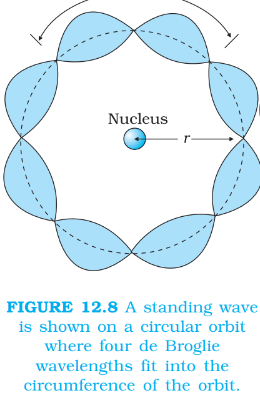
- Wave nature: De Broglie proposed that an orbiting electron also behaves as a wave.
- Resonance: A stable orbit is possible when the electron wave forms a standing wave around the entire circumference; other wavelengths cancel through interference.
- Orbit condition: For an orbit of radius , an integer number of wavelengths must fit around its circumference.
- Non-relativistic electron: When the electron’s speed is much less than the speed of light, its momentum is and its wavelength is .
Why the explanation matters
- Explanation: The wave nature of the electron explains why only certain angular momenta, orbits and energy states are allowed.
- Verification: C. J. Davisson and L. H. Germer experimentally verified the wave nature of electrons in 1927.
- Scope: Bohr’s model successfully predicts the main spectral frequencies emitted or absorbed by hydrogen-like (hydrogenic) atoms.
Limitations of Bohr’s Model
| Aspect | What the model explains | Limitation |
|---|---|---|
| Atoms covered | Hydrogenic atoms | It cannot be extended successfully even to helium, which has two electrons. |
| Forces in multi-electron atoms | The attraction between the nucleus and an electron | It omits repulsions between electrons, which matter in atoms with multiple electrons. |
| Spectral lines | The frequencies of hydrogenic-atom radiation | It does not explain why some spectral lines are more intense than others. |
Beyond the Bohr model
- Intensity: Experimental spectra show that some transitions are more favoured than others, but Bohr’s model cannot account for their relative intensities.
- Next step: A more complete description of complex atoms requires quantum mechanics.
How does de Broglie’s wave hypothesis explain Bohr’s angular-momentum quantisation?
State two limitations of Bohr’s model.
Quick recap
- Downward electron transitions emit photons with specific energies and produce discrete emission lines.
- Atoms absorb only photons matching allowed energy gaps, creating dark absorption lines in a continuous spectrum.
- A stable electron orbit fits an integer number of de Broglie wavelengths around its circumference.
- The standing-wave condition leads to Bohr’s quantised angular momentum: .
- Bohr’s model predicts hydrogenic spectral frequencies but not relative line intensities.
- The model fails for multi-electron atoms; a fuller treatment requires quantum mechanics.
Summary & Points To Ponder
Atomic Structure and Early Models
Electrically neutral atom — An atom as a whole has equal amounts of positive and negative charge.
Early Atomic Models
- Thomson’s model: The atom is a spherical cloud of positive charge with electrons embedded in it.
- Rutherford’s model: Almost all the atom’s mass and all its positive charge are concentrated in a tiny nucleus; electrons revolve around it.
- Relative size: The nucleus is typically about one ten-thousandth the size of the atom.
| Model | Cause of instability |
|---|---|
| Thomson | Electrostatic instability of the proposed charge arrangement. |
| Rutherford | Orbiting, accelerating electrons radiate energy and would spiral into the nucleus. |
Line Spectra and Bohr’s Model
Line spectrum — A line spectrum is a set of isolated, parallel spectral lines; it gives useful information about atomic structure.
Why Bohr Proposed a New Model
- Rutherford’s model: It could not explain why atoms are stable or why different elements have characteristic line spectra.
- Bohr’s model: It was proposed for hydrogenic atoms—atoms with a single electron—to explain stability and their spectra.
Bohr’s Three Postulates
- Stationary orbits: Electrons can occupy specified stable orbits without emitting radiant energy.
- Angular-momentum quantisation: Only orbits with angular momentum equal to an integer multiple of are allowed; is the principal quantum number.
- Emission: A transition from an initial orbit to a lower-energy orbit emits a photon with energy equal to the energy difference.
- Absorption: Absorbing a photon of the appropriate frequency moves the electron to a higher orbit.
Allowed stationary orbits have quantised angular momentum.
Photon frequency is determined by the difference between the initial and final orbital energies.
Quantised Radii and Energies
Angular-momentum quantisation allows only specific orbital radii in hydrogen.
Hydrogen’s total energy takes discrete, negative values.
Ground and Excited States
- Ground state: The lowest-energy state is ; for hydrogen, its energy is .
- Excited states: States with have higher energy than the ground state.
- Excitation: Collisions with atoms or electrons, or absorption of a photon of the right frequency, can raise an atom to an excited state.
de Broglie Waves and the Quantum Picture
A moving electron has an associated wavelength.
Standing-Wave Explanation
- Allowed orbits: The electron’s circular orbit corresponds to a standing wave when its circumference contains a whole number of wavelengths.
- Meaning: This wave-particle picture helps explain why only certain Bohr orbits are allowed.
The orbit circumference must equal an integer number of electron wavelengths.
Scope and Limits of Bohr’s Model
Where Bohr’s Model Works—and Fails
- Scope: Bohr’s model applies to hydrogenic, single-electron atoms; it cannot be extended even to helium.
- Spectral limitation: It does not explain the relative intensities of spectral frequencies, even for hydrogenic atoms.
- Many-electron atoms: Electron–electron electric forces are comparable to electron–nucleus forces because the charges and distances are of similar orders of magnitude.
- Solar-system comparison: Planet–planet gravitational forces are small compared with the Sun’s pull because the Sun is vastly more massive; this is not true for electrons in atoms.
| Point | Bohr model | Modern quantum mechanics |
|---|---|---|
| Electron picture | Electrons move in specified, planet-like orbits. | The orbital picture conflicts with the uncertainty principle; electrons are described by regions where they have a high probability of being found. |
| Quantum numbers | The model uses the principal quantum number . | A state is characterised by four quantum numbers , , , and . |
| Hydrogen energy | Energy depends on . | For a pure Coulomb potential, energy depends only on , though an energy level may correspond to more than one quantum state. |
Orbital Frequency and Spectral Frequency
- Different quantities: In general, an electron’s orbital revolution frequency is not the frequency of the emitted spectral line.
- Spectral frequency: It is the energy difference between the two orbits divided by .
- Large- limit: For transitions at very large , the two frequencies coincide approximately.
Why Bohr’s Model Remains Useful
Value of the Semiclassical Model
- Useful predictions: Despite being an incomplete picture, its three postulates explain most general features of the hydrogen spectrum.
- Bridge between theories: It combines ideas from classical physics with quantised features of modern physics.
- Scientific modelling: A model may set aside unresolved difficulties to make predictions; agreement with experiment then motivates further explanation of its assumptions.
Bohr’s Three Ideas
Stable orbits → quantised angular momentum → photon transitions.
Quick recap
- Atoms are electrically neutral; Thomson’s and Rutherford’s models both have instability problems.
- Line spectra are isolated lines that reveal information about atomic structure.
- Bohr proposed non-radiating stationary orbits, quantised angular momentum, and photon emission or absorption during transitions.
- Hydrogen has quantised radii and energies; its ground state is with energy .
- de Broglie standing waves explain allowed orbits, while modern quantum mechanics replaces the orbital picture with probability regions.
- Bohr’s model is useful mainly for single-electron atoms, but cannot explain many-electron atoms or relative spectral intensities.
Physics — ALL CHAPTERS
1
Electric Charges And Fields
2
Electrostatic Potential And Capacitance
3
Current Electricity
4
Moving Charges And Magnetism
5
Magnetism And Matter
6
Electromagnetic Induction
7
Alternating Current
8
Electromagnetic Waves
1
Ray Optics And Optical Instruments
2
Wave Optics
3
Dual Nature Of Radiation And Matter
4
Atoms
5
Nuclei
6
Semiconductor Electronics: Materials, Devices And Simple Circuits