Class 12 PCM . Physics . Physics Part I . Electrostatic Potential and Capacitance
Chapter 2: Electrostatic Potential And Capacitance
Ch 2
Physics
Class 12 PCM
Introduction
Electrostatic Force and Potential Energy
Conservative forces
- Conservative force: Work done in moving an object between two points depends only on the initial and final positions, not on the path.
- Examples: Spring force, gravitational force and the electrostatic Coulomb force are conservative.
- Energy transfer: Work done against a conservative force is stored as potential energy; when released, potential energy can convert into kinetic energy while their sum remains conserved.
Electrostatic potential energy difference — The change in a charge’s potential energy between two points equals the work done by an external force in moving it between them without acceleration.
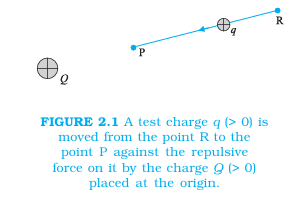
Moving a test charge
- Test charge: Take small enough not to disturb the source charge configuration; alternatively, keep the source charge fixed.
- External force: Move slowly so it does not accelerate; at each instant, the applied force balances the electric force: .
- Work and energy: The external work is stored as potential energy. The electric force does the opposite work during this displacement.
- Example: Bringing like charges closer requires external work against their repulsion, increasing the test charge’s potential energy.
Path independence and the zero of energy
- Path independence: Electrostatic work between two points depends only on those points, a defining feature of a conservative force.
- Energy reference: Potential energy is defined only up to an additive constant; only differences in potential energy are physically significant.
- Convenient zero: Set potential energy to zero at infinity. Then the energy at equals the external work required to bring the charge from infinity to .
Do not treat the absolute value of potential energy as uniquely fixed: the chosen zero is arbitrary, while potential-energy differences are meaningful.
How is the potential-energy difference between two points defined?
Why is electrostatic potential energy independent of the path?
Quick recap
- Coulomb force is conservative, like gravitational and spring forces.
- For slow motion without acceleration, the external force balances the electric force.
- The external work from to equals the change in potential energy.
- Electrostatic work is path-independent.
- Only potential-energy differences are physically significant; the zero level is a choice.
- With , potential energy at a point equals the work required to bring the charge there from infinity.
Electrostatic Potential
Electrostatic Potential and Potential Difference
Electrostatic potential difference — The potential difference between two points is the external work done per unit positive test charge in moving it between them.
For a test charge moved from to , use the external work .
Reference and significance
- Reference: Potential is commonly set to zero at infinity; then is the external work per unit positive charge brought from infinity.
- Test charge: Use an infinitesimal test charge so the given charge configuration is not disturbed.
- Motion: The external force is equal and opposite to the electrostatic force at every point along the path.
- Physical significance: Potential differences are physically significant; the value of potential depends on the chosen reference.
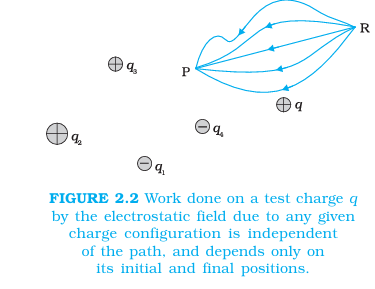
Potential Due to a Point Charge
Potential due to a point charge — With potential zero at infinity, the potential at distance from a point charge is .
Key points
- Field: At distance from , the electric field is radial; its magnitude is .
- Work path: Electrostatic work is path-independent, so the work can be calculated along the radial path from infinity.
- Sign: Potential is positive for positive and negative for negative Q; its sign matches the source charge.
- Distance dependence: The magnitude of potential varies as , while the field magnitude varies as .
For a unit positive test charge, external work from infinity equals the potential at the point.
When potential at infinity is zero, the external work to bring charge to a point of potential is .
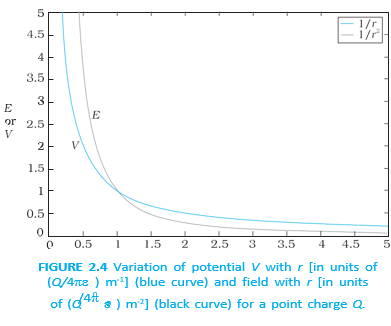
Example
- Given: and .
- Potential: Using , .
- Work: For , .
- Path: The work is path-independent; a displacement perpendicular to the radial direction contributes zero work.
Do not confuse potential with work: potential is work per unit charge, while the work to bring charge from infinity is .
What is the potential due to a point charge at distance ?
Quick recap
- Potential difference: for motion from to .
- Reference: With potential zero at infinity, potential equals external work per unit positive charge brought from infinity.
- Point charge: .
- Sign: Potential is positive for positive and negative for negative .
- Distance: Potential magnitude varies as ; electric field magnitude varies as .
- Work: Bringing charge from infinity requires external work , independent of path.
Potential Due to an Electric Dipole
Far-Field Potential of a Dipole
Electric dipole — A pair of equal and opposite charges, and , separated by a small distance ; its net charge is zero.
Dipole moment and potential
- Dipole moment: Its magnitude is and its direction is from to .
- Superposition: The dipole potential is the algebraic sum of the potentials due to its two charges.
- Geometry: For a point at distance and angle from the dipole moment, the charge distances are and .
- Far-field condition: When , retain only first-order terms in ; then and .
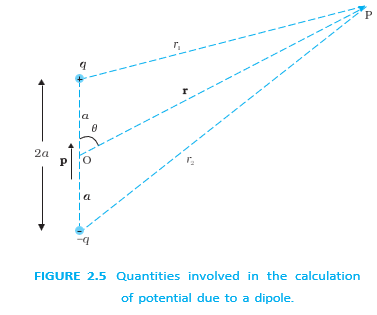
Special directions and properties
- Dipole axis: At , ; at , .
- Equatorial plane: At , the potential is zero.
- Angular dependence: Unlike a point charge's potential, dipole potential depends on both and the angle between and ; it is symmetric about the dipole axis.
- Distance dependence: At large distances, dipole potential falls as , whereas point-charge potential falls as .
- Point dipole: The dipole-potential expression is exact for a point dipole at the origin; for a finite dipole it is an approximation valid when .
Dipole potential: angle and distance
Remember : angle sets the sign and value, while distance gives the fall-off.
Potential Due to a System of Charges
Superposition of potential — The total potential at a point due to several charges is the algebraic sum of the potentials due to each charge.
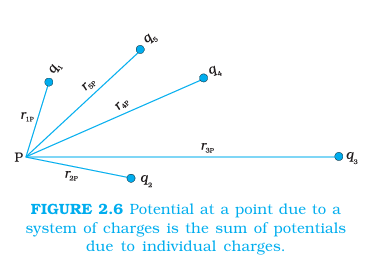
Continuous charge distributions
- Method: Divide the distribution into small charge elements and sum their potential contributions by integration.
- Volume charge density: For density , the potential at position is , taking zero potential at infinity.
Uniformly Charged Spherical Shell
| Region | Potential |
|---|---|
| Outside, | ; the shell acts as if its total charge were concentrated at its centre. |
| Inside, | The electric field is zero, so the potential is constant and equals the surface value: . |
| At the surface, | . |
Example: Finding Points of Zero Potential
Charges and are separated by
- Set-up: Let be the coordinate in centimetres measured from the positive charge, with the negative charge at .
- Between the charges: Set the signed contributions to zero: , giving .
- Beyond the negative charge: Use distances and : , giving .
- On the other side of the positive charge: No zero-potential point is possible there because both charge contributions have the same sign.
Why is the potential of a dipole zero in its equatorial plane?
State the far-field potential of a dipole and its distance dependence.
Quick recap
- A dipole has charges and separated by , with directed from negative to positive.
- For , dipole potential is .
- Potential is positive on the positive dipole axis, negative on the opposite axis, and zero in the equatorial plane.
- Potentials from multiple charges add algebraically; continuous distributions require integration.
- A charged spherical shell has constant potential inside, equal to its surface potential.
- For the example charges, zero potential occurs from the positive charge between them and from it beyond the negative charge.
Equipotential Surfaces
Meaning and Properties of Equipotential Surfaces
Equipotential surface — A surface on which the electric potential is the same at every point.
Potential depends only on distance from the charge, so a constant gives a constant-potential surface.
Key properties
- Point charge: Its equipotential surfaces are concentric spheres centred on the charge.
- Work: Moving a test charge between points on the same equipotential surface requires no work because the potential difference is zero.
- Field direction: The electric field is perpendicular to an equipotential surface at every point.
- Reason: A tangential field component would require work to move a charge along the surface, contradicting its constant potential.
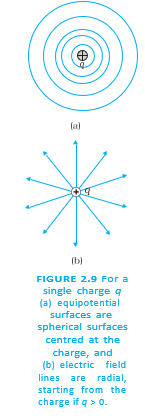
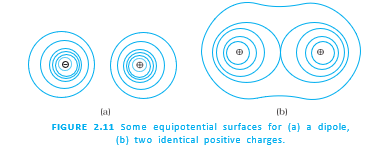
| Configuration | Equipotential surface pattern |
|---|---|
| Single point charge | Concentric spheres centred on the charge |
| Uniform field along the x-axis | Planes perpendicular to the x-axis, parallel to the y-z plane |
| Dipole or two identical positive charges | Each charge configuration has its characteristic equipotential pattern |
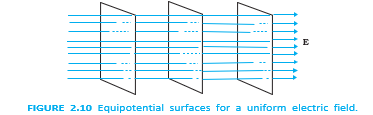
Relation Between Electric Field and Potential
Potential change across nearby surfaces
- Setup: Nearby equipotential surfaces and have potentials and ; their perpendicular separation is .
- Work: Moving a unit positive charge from to against the field requires work .
- Potential difference: This work per unit charge is .
- Direction: Potential decreases along the electric field; therefore the field points from higher potential to lower potential.
The electric field points from higher potential to lower potential—not from lower to higher—and is normal to equipotential surfaces.
Why is the electric field perpendicular to an equipotential surface?
Quick recap
- An equipotential surface has the same potential at every point.
- A point charge has concentric spherical equipotential surfaces.
- In a uniform field along the x-axis, equipotentials are planes parallel to the y-z plane.
- The electric field is perpendicular to equipotential surfaces.
- Potential decreases in the direction of the electric field.
- For nearby surfaces, .
Potential Energy of a System of Charges
Potential Energy of Two Charges
At a point a distance from , the potential is:
For charges and separated by distance :
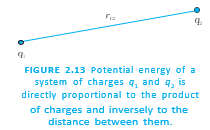
| Point | Like charges | Unlike charges |
|---|---|---|
| Product | ||
| Force | Repulsive | Attractive |
| Potential energy | Positive; external work is needed to bring them together from infinity. | Negative; external work is needed to separate them to infinity. |
Potential Energy of Three Charges
Assembly in stages
- First charge: Bringing from infinity requires no work.
- Second charge: Bringing to its position contributes .
- Third charge: Bring into the potential created by both and ; its contribution is .
- Total: Add the work for each stage; every distinct pair contributes once.
For three charges with pairwise separations , , and :
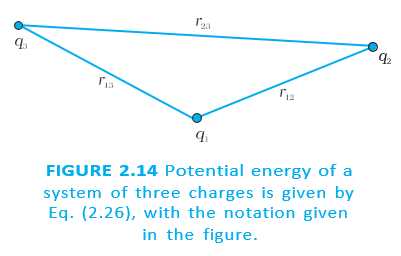
For any number of point charges, sum the potential-energy contribution of every distinct pair exactly once.
Why is the potential energy of a system of charges independent of the order in which they are assembled?
Write the expression for the potential energy of three point charges.
Quick recap
- Potential energy equals the external work needed to assemble charges from infinity.
- For two charges, .
- Like charges have positive potential energy; unlike charges have negative potential energy.
- Electrostatic work is path-independent, so assembly order does not change the final energy.
- For several charges, add the energy contribution of every distinct pair once.
Potential Energy in an External Field
Potential Energy of a Single Charge
External electric field — A field produced by sources other than the charge(s) whose potential energy is being calculated.
Single charge in an external field
- Assumption: The charge being studied does not significantly affect the external sources; these may be fixed or sufficiently distant.
- External potential: is the work per unit positive charge required to bring it from infinity to , with at infinity.
- Scope: Calculate energy of the specified charge(s), not the energy of the sources producing the external field.
- Energy: Bringing charge from infinity to position stores work as potential energy.
Use the external potential at the charge's position.
Electron volt
- Definition: One electron volt is the energy gained by a charge of magnitude across a potential difference of .
- Conversion: ; energy gained across is .
- Larger units: , , , and .
- Use: Electron volts are commonly used in atomic, nuclear, and particle physics.
Potential Energy of Two Charges in an External Field
Assembling two charges
- First charge: Bringing from infinity to requires work .
- Second charge: Bringing to requires work against both the external field and the field of .
- External-field work: The contribution for is .
- Mutual interaction: The charge-pair contribution is , where is their separation.
- Total: Add all assembly work contributions, using superposition.
Includes each charge's interaction with the external potential and the mutual interaction.
Example: two charges
- No external field: For , , and , their energy is .
- Separation: Work required to take them infinitely far apart is .
- External field: For , the external potential is (zero at infinity). With and both charges at radius , the total energy is .
Potential Energy of a Dipole in an External Field
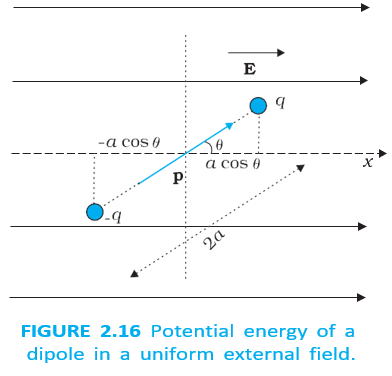
Dipole torque and work
- Net force: A dipole in a uniform electric field experiences zero net force.
- Torque: It experiences torque that tends to align its dipole moment with the field; no torque acts when they are parallel or antiparallel.
- Slow rotation: An external torque can rotate the dipole from to at infinitesimal angular speed; its work becomes potential energy.
- Work: .
Taking the zero of potential energy at .
Reference level and energy interpretation
- Zero reference: At , the work contributions for and in the uniform field cancel, so by the chosen convention.
- Alignment: is minimum when is parallel to and maximum when antiparallel.
- Constant term: Applying the two-charge formula also includes the dipole's mutual interaction energy, a constant for a fixed dipole; dropping it leaves .
Example: heat released as dipoles align
- Total dipole moment: For one mole with molecular dipole moment , .
- Energy change: In a field of , dipoles initially at to the new field have ; after aligning, .
- Heat released: The decrease in potential energy is , released as heat (assuming complete polarization).
Write the potential energy of a charge in an external potential.
Give the total potential energy of two charges in an external field.
State the potential energy of a dipole in a uniform field and its minimum-energy orientation.
Quick recap
- A charge in an external potential has energy .
- One electron volt equals .
- Two-charge energy includes both external-field contributions and their mutual interaction.
- Work required to assemble a charge configuration equals its potential energy.
- A dipole in a uniform field experiences torque but no net force.
- Dipole energy is , with minimum energy when aligned with the field.
Electrostatics of Conductors
Conductors and Mobile Charges
Conductor — A conductor contains mobile charge carriers; in electrostatic equilibrium, zero electric field inside it is a defining property.
Charge carriers
- Metals: Outer electrons move freely within the metal, but are not free to leave it; they move randomly and drift opposite to an applied electric field.
- Metal ions: Positive ions, made of nuclei and bound electrons, remain fixed in position.
- Electrolytes: Both positive and negative ions carry charge; their motion is affected by the electric field and chemical forces.
| Conductor | Mobile charge carriers |
|---|---|
| Metallic | Electrons |
| Electrolytic | Positive and negative ions |
Electrostatic Properties of Conductors
Electrostatic equilibrium — A conductor is in electrostatic equilibrium when charges are stationary, with no current inside or along its surface.
Electric field inside a conductor
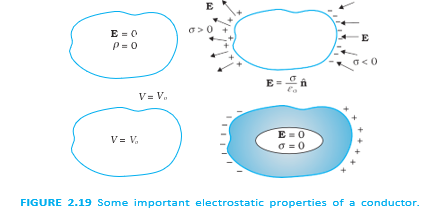
- Result: In electrostatic equilibrium, the electric field is zero everywhere inside a conductor, whether it is neutral or charged.
- Reason: If a field remained, free charges would feel a force and drift; they redistribute until the internal field vanishes.
Electric field at the surface
- Direction: At every point on a charged conductor’s surface, the electrostatic field is normal to the surface; its tangential component is zero.
- Reason: A tangential field would exert a force on surface charges and make them move.
- Uncharged surface: Where the surface charge density is zero, the field is zero even at the surface.
Excess charge resides on the surface
- Result: In electrostatic equilibrium, there is no net excess charge in the conductor’s interior; any excess charge resides on its surface.
- Gauss’s law: A small closed surface wholly inside the conductor has zero field and hence zero flux, so it encloses zero net charge.
- Conclusion: Since the enclosed volume can be made arbitrarily small, there is no excess charge at any point inside the conductor.
The net electric flux through a closed surface equals the enclosed charge divided by the permittivity of free space.
Potential of a conductor
- Result: The entire volume and surface of a conductor are at the same electrostatic potential.
- Reason: The field is zero inside and has no tangential component on the surface, so moving a test charge within the conductor or along its surface requires no work.
- Multiple conductors: Each conductor has a constant potential, but different conductors may have different potentials.
- Just outside: The normal field may cause the potential to differ between the surface and a point just outside it.
Electric Field Just Outside a Charged Conductor
Pillbox derivation
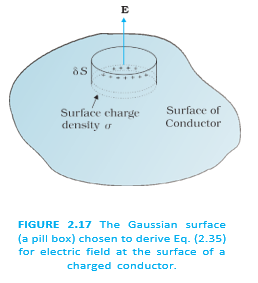
- Gaussian surface: Take a very short pillbox across the conductor’s surface, with cross-sectional area .
- Flux: The field inside is zero; the side flux is negligible, so only the outer face contributes to the flux.
- Enclosed charge: The pillbox encloses charge ; Gauss’s law gives the field magnitude .
- Direction: The field points outward for positive surface charge and inward for negative surface charge.
Here is surface charge density, is the permittivity of free space, and is the outward unit normal.
Electrostatic Shielding
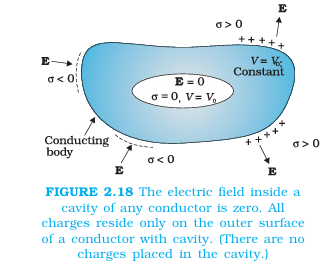
Electrostatic shielding — A charge-free cavity inside a conductor has zero electric field, regardless of the conductor’s charge or external electric fields.
- Charge distribution: With no charge inside the cavity, any excess or externally induced charge resides on the conductor’s outer surface.
- Shielding effect: External electric influences do not produce a field inside the cavity, whatever its size or shape.
- Use: Conducting enclosures can protect sensitive instruments from external electrical influence.
Applications and Everyday Examples
- Comb and paper: A charged comb polarises molecules in paper, causing attraction. Rain or wet hair reduces friction, so the comb may not charge enough to attract paper bits.
- Aircraft tyres: Slightly conducting tyres carry frictional charge to the ground, reducing charge build-up and the risk of sparks or fire.
- Fuel vehicles: A metallic rope touching the ground discharges static charge during motion, reducing the danger of sparks near inflammable material.
- Bird on a power line: A bird touching only one wire has little potential difference across its body, so little current flows. A grounded person touching the wire bridges a potential difference and can receive a fatal shock.
Quick recap
- Equilibrium: Zero electric field inside a conductor is a defining property of electrostatic equilibrium.
- Surface field: At a charged surface, the field is normal and .
- Charge: A conductor has no net excess charge in its interior; excess charge resides on its surface.
- Potential: A conductor’s volume and surface are at the same potential.
- Shielding: The field in a charge-free cavity of a conductor is zero, even with external fields present.
- Applications: Grounding drains static charge; current through a body requires a potential difference.
Dielectrics and Polarisation
Dielectrics and Molecular Polarisation
Dielectric — A non-conducting substance with no, or a negligible number of, freely moving charge carriers.
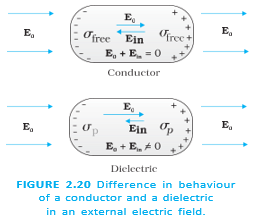
| Point | Conductor | Dielectric |
|---|---|---|
| Charge response | Free charges move and redistribute. | Charges cannot move freely; molecules become polarised. |
| Induced field | Opposes the external field and cancels it inside in electrostatic equilibrium. | Opposes the external field but only reduces the net field; the amount depends on the dielectric. |
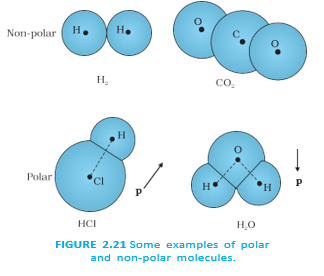
| Point | Non-polar molecule | Polar molecule |
|---|---|---|
| Charge centres | Positive and negative charge centres coincide. | Positive and negative charge centres are separated, even without an external field. |
| Permanent dipole moment | Absent; examples: and . | Present; examples: and . |
How Molecules Become Polarised
- Non-polar molecules: The external field shifts positive and negative charges in opposite directions. The shift stops when the field force is balanced by the molecule’s restoring force, inducing a dipole.
- Polar molecules: Their permanent dipoles are randomly oriented by thermal agitation without an external field, so the total dipole moment is zero.
- Alignment: An applied field tends to align permanent dipoles, producing a net dipole moment along the field; thermal agitation disrupts this alignment.
- Competing energies: Polarisation by alignment depends on dipole potential energy in the applied field, which promotes alignment, competing with thermal energy, which disrupts it.
- Additional effect: Polar molecules can also acquire induced dipole moments, but alignment is generally the more important effect.
- Polarity matters: Molecular polarity affects boiling point, solubility and interactions between molecules.
Linear isotropic dielectric — A dielectric in which the induced dipole moment is along the electric field and proportional to its strength.
Polarisation () — The electric dipole moment per unit volume of a dielectric.
Here, is the electric susceptibility, a constant characteristic of the dielectric medium.
Bound Surface Charges in a Polarised Dielectric
- Inside the slab: Neighbouring dipoles’ charges largely neutralise one another, so a small bulk volume has no net charge, though it has a net dipole moment.
- At the surfaces: Dipole ends remain unneutralised on the faces normal to the field, producing surface charge densities and .
- Field effect: These bound surface charges create a field opposing the applied field, reducing the total field inside the dielectric.
- Charge type: The induced surface charges are bound charges, not freely moving charges.
Capacitors and Capacitance
Capacitor — A system of two conductors separated by an insulator; usually, the conductors carry equal and opposite charges.
- Charge and potential: The conductors usually carry and , with potential difference . The capacitor’s charge means the charge on either conductor; its total charge is zero.
- Potential difference: is the work done per unit positive charge in moving a test charge from conductor 2 to conductor 1 against the field.
- Charging: A battery can charge the conductors by connecting them to its two terminals.
- Single-conductor case: A single conductor can act as a capacitor if the other conductor is considered to be at infinity.
- Proportionality: The electric field between the conductors is proportional to ; therefore, the potential difference is also proportional to .
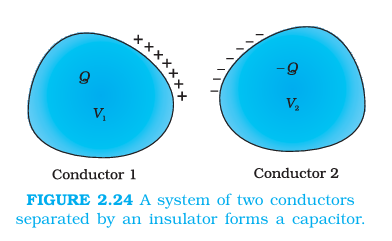
Capacitance () — The constant ratio of the charge on a capacitor to the potential difference between its conductors.
For a given capacitor, is independent of and . It depends on conductor shape, size and separation, and on the intervening dielectric.
Units and Practical Significance
- SI unit: The farad, .
- Submultiples: Common units are , and .
- Storage: For the same charge, a larger capacitance gives a smaller potential difference; it can store more charge at a relatively low potential difference.
- Applications: Capacitors store charge and are important components in many AC circuits.
Dielectric strength — The maximum electric field a dielectric can withstand without breakdown of its insulating property.
Breakdown and Charge Leakage
- Breakdown: A sufficiently strong field can ionise air; the resulting charges move to oppositely charged conductors and partly neutralise the capacitor.
- Air: Its dielectric strength is about .
- Example: Across a gap of about , this field corresponds to a potential difference of about .
- Design implication: To store a large charge without significant leakage, the capacitor must keep its potential difference and field below the dielectric breakdown limit.
How does an external electric field polarise polar and non-polar molecules?
Define capacitance and state what it depends on.
Quick recap
- Dielectrics have negligible free charge carriers; their polarisation reduces, but does not cancel, the field inside.
- Non-polar molecules acquire induced dipoles; polar molecules mainly polarise through alignment of permanent dipoles.
- Thermal energy disrupts polar-dipole alignment, while dipole potential energy in the applied field promotes it.
- For a linear isotropic dielectric, polarisation is ; it produces bound surface charges.
- A capacitor usually has equal and opposite charges, and its capacitance is .
- Capacitance depends on conductor geometry and the dielectric; exceeding dielectric strength can cause breakdown and leakage.
The Parallel Plate Capacitor
Electric Field Between Parallel Plates
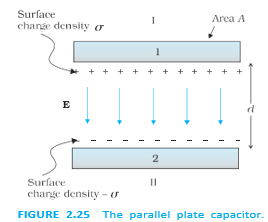
| Region | Result | Reason |
|---|---|---|
| Outside the plates | Fields from the two plates cancel. | |
| Between the plates | Fields from the two plates add. |
Field at Plate Edges
- Fringing: For finite plates, field lines bend outward near the edges, so the field is not perfectly uniform there.
- Approximation: When , fringing can be ignored sufficiently far from the edges; the field is approximately uniform between the plates.
Capacitance in Vacuum
For vacuum between the plates.
Use for two parallel plates with vacuum between them.
Scale and Units
- Example: For and , , or .
- Farad: ; one farad is a very large capacitance in practice.
- Large-area example: At separation , obtaining would require —roughly a square on each side.
Effect of a Dielectric
The dielectric reduces the electric field and potential difference for a given free charge.
The permittivity of the medium is .
Dielectric Summary
- Permittivity: ; for vacuum, and .
- Capacitance increase: Inserting a dielectric fully increases capacitance by the factor .
- Generality: The relation also applies to other capacitor geometries when the dielectric fully fills the relevant space.
Dielectric Slab Partially Filling the Gap
Here is the capacitance when the gap is entirely vacuum.
Derive the capacitance of a parallel-plate capacitor in vacuum.
What happens to capacitance when a dielectric fully fills the space between the plates?
Quick recap
- For large parallel plates, the field is approximately zero outside and uniform between them: .
- The vacuum potential difference is and the capacitance is .
- Fringing makes the field non-uniform near finite plate edges.
- A fully inserted dielectric reduces the field and potential for fixed charge and gives .
- The medium permittivity is , with for a dielectric.
- For a slab of thickness , the capacitance becomes .
Combination of Capacitors
Equivalent capacitance — The equivalent capacitance is that of a single capacitor with the same overall charge–voltage relationship as a combination of capacitors.
For a combination with total charge and potential difference , use this relation to define its effective capacitance.
Capacitors in Series
Key features
- Same charge: Each capacitor carries the same charge magnitude, , on its plates.
- Voltage adds: The total potential difference is the sum of the individual voltage drops: .
- Why charge is equal: Charge redistributes until the connecting conductor has no net charge and no electric field within it.
- Equivalent capacitance: Reciprocal capacitances add; the equivalent capacitance is less than the smallest individual capacitance.
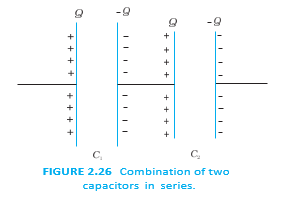
Use for any number of capacitors connected in series.
Capacitors in Parallel
Key features
- Same potential difference: Every capacitor is connected across the same two points, so each has voltage .
- Charge adds: The total charge is the sum of the charges on the individual capacitors.
- Individual charges: Each capacitor has ; charges need not be equal.
- Equivalent capacitance: Capacitances add directly, so the equivalent capacitance is greater than the largest individual capacitance.
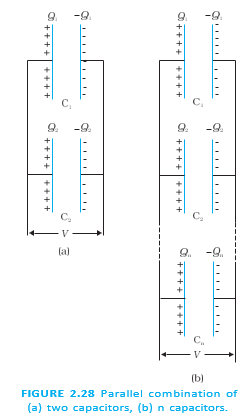
Use for any number of capacitors connected in parallel.
| Feature | Series | Parallel |
|---|---|---|
| Same for each capacitor | Charge magnitude, | Potential difference, |
| Quantity that adds | Potential differences | Charges |
| Equivalent capacitance | ||
| Relative size of equivalent capacitance | Less than the smallest individual capacitance | Greater than the largest individual capacitance |
Do not swap the rules: series capacitors have equal charge and reciprocal capacitances add; parallel capacitors have equal voltage and capacitances add directly.
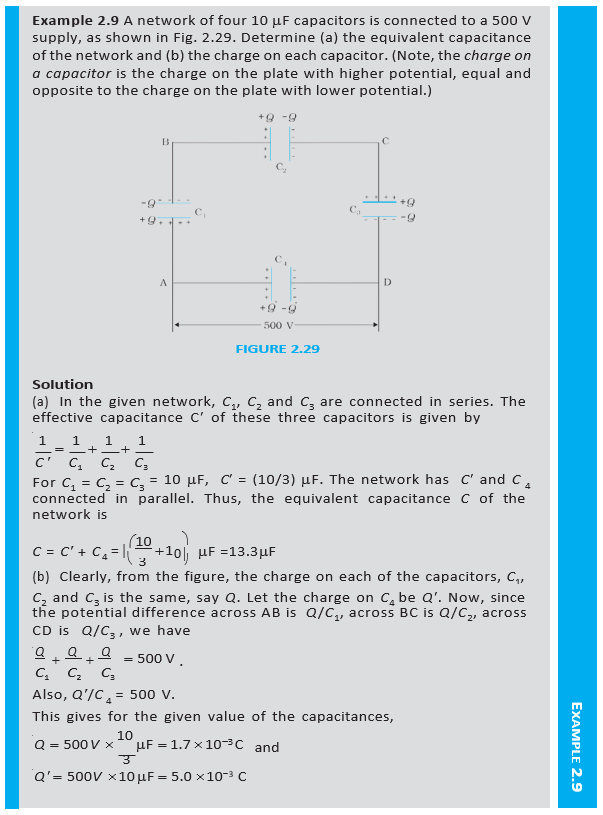
Why is the charge magnitude the same on every capacitor in a series combination?
State the equivalent capacitance formulas for series and parallel combinations.
Quick recap
- In series, all capacitors carry the same charge magnitude.
- In series, voltage drops add and reciprocal capacitances add.
- The equivalent capacitance in series is less than the smallest individual capacitance.
- In parallel, every capacitor has the same potential difference.
- In parallel, charges and capacitances add directly.
- The equivalent capacitance in parallel exceeds the largest individual capacitance.
- Effective capacitance is defined by .
Energy Stored in a Capacitor
Building Charge on a Capacitor
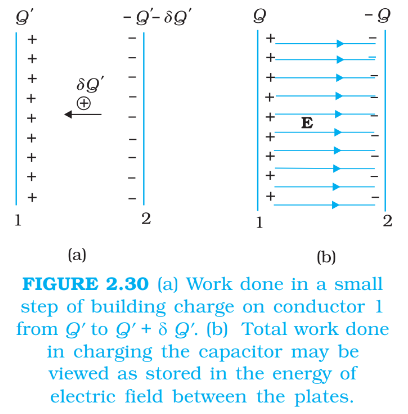
Use any equivalent form, with the potential difference across the capacitor.
Nature of the Stored Energy
- Conservative force: Electrostatic force is conservative, so the work done in charging becomes the system’s potential energy.
- Path independence: The final stored energy does not depend on how the capacitor’s charge configuration was built up.
- Discharge: When the capacitor discharges, its stored energy is released.
Energy in the Electric Field
Parallel-Plate Capacitor
- Field region: For plates of area separated by distance , the electric field occupies the volume between them.
- Charge density: The surface charge density is , and the field between the plates is .
- Field-energy view: The capacitor’s energy can be expressed in terms of the field and the volume between the plates.
Electric-field energy density — Energy density is the energy stored per unit volume of space.
The result applies to electric fields produced by any charge configuration, not only parallel-plate capacitors.
State the equivalent expressions for the energy stored in a capacitor.
Give the expression for electric-field energy density and state its scope.
Quick recap
- Charging a capacitor requires external work to transfer charge between its conductors.
- The charging work is stored as electrostatic potential energy.
- Capacitor energy is .
- Stored energy is released when the capacitor discharges.
- For a parallel-plate capacitor, field energy is .
- Electric-field energy density is and is generally applicable.
Summary
Electrostatic Force, Work and Potential
For an external agency moving charge from to .
Electrostatic potential — The external work done per unit charge in bringing a charge from infinity to a point.
For a point charge at the origin, choosing potential at infinity to be zero.
Potential Due to Dipoles and Charge Distributions
Electric dipole moment — For charges and , the dipole moment points from the negative charge to the positive charge.
For dipole moment at the origin; for a dipole pair separated by , this applies when .
Superposition principle for potential — The total potential due to several charges is the algebraic sum of the potential due to each charge separately.
At point , is the distance between charge and .
Equipotential Surfaces
- Equipotential surface: A surface on which the electric potential is the same at every point.
- Electric field: It is perpendicular to an equipotential surface and points in the direction of the steepest decrease in potential.
Potential Energy of Charges and Dipoles
is the distance between charges and .
Use only the external potential in the charge formula; the dipole formula applies in a uniform field.
Do not include a charge’s own potential in : its potential at its own location is undefined and becomes infinite.
Conductors in Electrostatic Equilibrium
is the outward unit normal and is the surface charge density.
| Region | Electric field | Electric potential |
|---|---|---|
| Inside | Constant | |
| Across the surface | Discontinuous: zero inside and just outside | Continuous |
| At the surface | Just outside, directed along |
Electrostatic Shielding
- Outside to cavity: A conductor shields an empty cavity from external electrical influences.
- Cavity to outside: Shielding is not reciprocal; charges inside the cavity can affect the exterior field.
Capacitance and Parallel-Plate Capacitors
The conductors carry charges and , with potential difference .
is the area of each plate and is the plate separation.
Dielectrics and Polarisation
is the vacuum capacitance and is the dielectric constant.
Combining Capacitors
| Point | Series | Parallel |
|---|---|---|
| Shared quantity | Same magnitude of charge on each capacitor | Same potential difference across each capacitor |
| Equivalent capacitance | Reciprocals add | Capacitances add |
Energy Stored in a Capacitor
Equivalent expressions in terms of capacitance , charge and voltage .
Energy per unit volume in a region with electric field .
Dimensions and Units
| Quantity | Symbol | Dimensions | SI unit | Key note |
|---|---|---|---|---|
| Potential | or | volt () | Potential difference is physically significant | |
| Capacitance | farad () | |||
| Polarisation | Dipole moment per unit volume | |||
| Dielectric constant | Dimensionless | No unit | Dimensionless |
Important Electrostatic Clarifications
- Dipole in a field: Torque causes a dipole to oscillate about the field direction; a dissipative mechanism is needed to damp the oscillations and align it eventually.
- Self-potential: The potential due to a point charge at its own location is undefined because it is infinite.
Why is the electric field perpendicular to an equipotential surface?
How does inserting a dielectric affect a capacitor?
State the electric-field and potential properties of a conductor in electrostatic equilibrium.
Quick recap
- Electrostatic force is conservative; external work moving charge between points is times the potential difference.
- Potential is defined relative to a reference; point-charge potentials add by superposition, and dipole potential depends on .
- The electric field is perpendicular to equipotential surfaces and points toward decreasing potential.
- A conductor has zero internal field, constant potential, and surface charge; an empty cavity is shielded from external fields.
- Capacitance depends on conductor geometry; dielectrics increase it, series capacitances combine reciprocally, and parallel capacitances add.
- Capacitor energy is ; vacuum field-energy density is .
Physics — ALL CHAPTERS
1
Electric Charges And Fields
2
Electrostatic Potential And Capacitance
3
Current Electricity
4
Moving Charges And Magnetism
5
Magnetism And Matter
6
Electromagnetic Induction
7
Alternating Current
8
Electromagnetic Waves
1
Ray Optics And Optical Instruments
2
Wave Optics
3
Dual Nature Of Radiation And Matter
4
Atoms
5
Nuclei
6
Semiconductor Electronics: Materials, Devices And Simple Circuits