Class 8 . Social Science . Exploring Society India and Beyond Part I . The Parliamentary System Legislature and Executive
Chapter 6: The Parliamentary System: Legislature and Executive
Ch 6
Social Science
Class 8
Introduction
Introduction
Constitution and popular participation
- Constitution: Drafted after independence, it sets out the foundational principles for governing India.
- Universal Adult Franchise: Every adult citizen has the right to vote, regardless of social or economic background, gender, race, or religion.
- Representation: Citizens directly elect representatives to the Lok Sabha.
- Government formation: A majority group among elected Lok Sabha representatives forms the government.
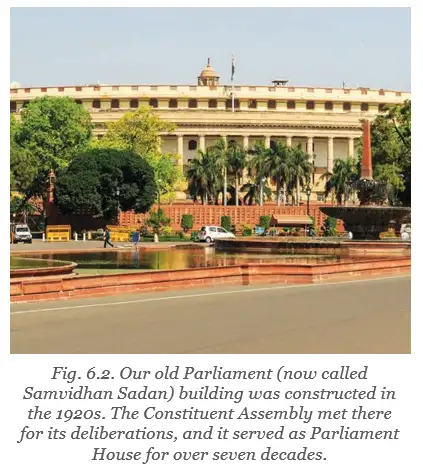
Parliament — India’s supreme legislative body, made up of elected representatives, which makes laws and controls and guides the government.
How people’s consent shapes government
- Adult citizens vote → elect Lok Sabha representatives.
- A majority group among the elected representatives forms the government.
- Parliament makes laws and controls and guides the government → government functions with the people’s consent.
Lok Sabha milestones
- 1952The first Lok Sabha was formed.
- June 2024The 18th Lok Sabha was constituted; there had been 17 Lok Sabhas before it.
- Universal Adult Franchise
- The right of every adult citizen to vote without discrimination.
- Lok Sabha
- The house whose members are directly elected by the people.
- Parliament
- India’s supreme law-making body, which also guides and controls the government.
Quick recap
- The Constitution establishes foundational principles for governing India.
- Universal Adult Franchise gives every adult citizen the right to vote.
- Citizens directly elect Lok Sabha representatives.
- A majority group among elected representatives forms the government.
- Parliament makes laws and controls and guides the government.
- The 18th Lok Sabha was constituted in June 2024.
Composition of the Parliament of India
Parliament and Its Two Houses
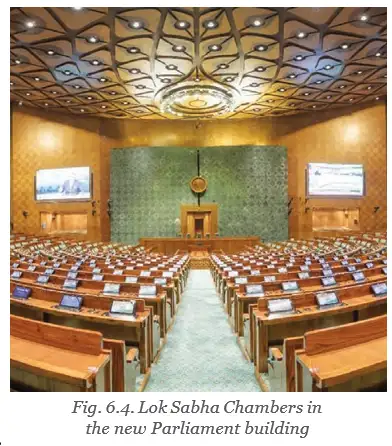
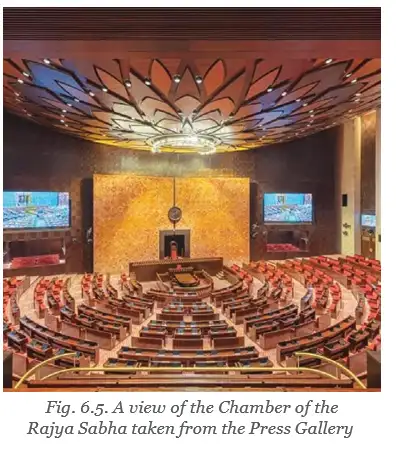
- Bicameral system
- A legislature made up of two Houses.
- Universal adult suffrage
- The right of all adult citizens to vote.
- Federalism
- A system that distributes power among central, state and local governments.
Why India Has Two Houses
- Bicameralism: India has two Houses because one directly elected House was considered insufficient to meet the challenges of governing the country.
- Federalism: The Rajya Sabha represents the states and helps balance national unity with local interests.
Presiding Officers and Their Work
- Presiding officers: Each House has an officer who keeps debates orderly and ensures that members follow parliamentary rules.
- Lok Sabha: Members elect the Speaker to conduct its sessions and maintain discipline.
- Rajya Sabha: The Vice President of India presides as its Chairperson.
The Sengol

Language Access in Parliament
- Language access: Simultaneous interpretation helps members follow parliamentary discussions in multiple Indian languages.
- Languages: Six languages—Bodo, Dogri, Maithili, Manipuri, Urdu and Sanskrit—were added to the 12 languages already supported.
Parliament and the Union Executive
Why does India have a bicameral Parliament?
How are the Lok Sabha and Rajya Sabha members chosen?
Who presides over each House, and to whom is the Council of Ministers responsible?
Quick recap
- Parliament consists of the President, Lok Sabha and Rajya Sabha.
- Lok Sabha members are directly elected; Rajya Sabha members are elected indirectly.
- The two Houses support federal representation and balance state interests with national unity.
- The Lok Sabha Speaker and the Vice President preside over the Lok Sabha and Rajya Sabha respectively.
- The Sengol symbolises transfer of power and righteous rule.
- The Union Executive implements laws, and its Council of Ministers is collectively responsible to the Lok Sabha.
Legislative Functions of the Parliament
Main functions of Parliament
- Four broad functions: Constitutional functions, lawmaking, executive accountability and financial accountability.
- Scope of this lecture: It explains constitutional functions and lawmaking in detail.
Constitutional functions
Constitutional functions — Parliament’s responsibilities for upholding the Constitution’s core values and carrying out key constitutional tasks.
Values and responsibilities upheld by Parliament
- Democracy: Enables parliamentary democracy through universal adult suffrage.
- Separation of powers: Respects the division of powers among the legislature, executive and judiciary.
- Federalism: Helps ensure the federal system of government.
- Rights and principles: Upholds Fundamental Rights and Directive Principles of State Policy through laws and policies.
- Other key tasks: Parliament participates in electing the President and Vice-President and amending the Constitution.
Lawmaking
Bill — A draft of a proposed law that must be approved by Parliament before it can become law.
Act — A law passed by Parliament and given the President’s assent.
How a bill becomes a law
- Purpose: Making laws is one of the legislature’s primary responsibilities.
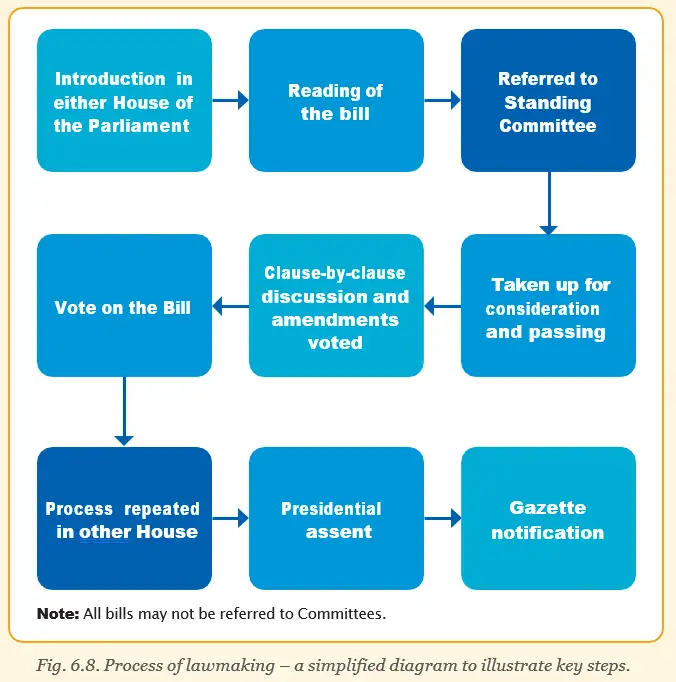
- Process: A bill is introduced, examined and discussed; after parliamentary approval and the President’s assent, it becomes an Act.
- Publication: Legal documents and official information are announced in the Gazette.
Bill to law
- Bill introduced in Parliament
- Bill read, discussed and scrutinised; a committee may recommend changes
- Parliament passes the bill
- President gives assent → bill becomes an Act
- Act is announced through the Gazette
- Standing Committee
- A continuing committee of MPs that scrutinises government work, makes recommendations and asks questions; its members may change.
- Reading
- A stage of considering a bill before discussion; MPs today read the bill before debating it.
- Clause
- A part of a bill that sets out a specific detail, such as the age group covered by the RTE Act.
- Gazette
- An official government publication for legal documents and other official information.
- Money Bill
- A bill about financial matters such as taxation or government borrowing; it can be introduced only in the Lok Sabha, with the President’s prior recommendation.
Development of the Right to Education
- Constitution-making periodThe idea of education was reflected in the Directive Principles; the Constitution makers intended it to be implemented within a decade after Independence.
- Early 1990sA court argument claimed that education was part of the Fundamental Right to Life because it is essential to a meaningful life.
- 2002The 86th Constitutional Amendment Act established Article 21A, requiring the state to provide free and compulsory education to children aged 6–14.
- 2008The RTE bill was tabled in the Rajya Sabha; a committee examined it and suggested modifications. Funding schools, infrastructure and teachers was a major debate.
- August 2009After the 2009 elections, the new government pursued the bill. It passed in the Lok Sabha and received the President’s assent, becoming an Act.
Significance of the RTE Act
- Legal access: Created legal pathways for children to attend school.
- Support: Helped enable new school construction and the provision of free books and uniforms.
A bill is not yet a law: it is a proposal. It becomes an Act after parliamentary passage and the President’s assent.
What is a Standing Committee, and what does it do?
What is a Money Bill, and where can it be introduced?
Quick recap
- Parliament’s four broad functions are constitutional work, lawmaking, executive accountability and financial accountability.
- It upholds democracy, separation of powers, federalism, Fundamental Rights and Directive Principles.
- A bill is a proposed law; after approval and the President’s assent, it becomes an Act.
- A Standing Committee examines bills or government work and can recommend changes.
- The RTE Act followed a long path, becoming law in August 2009.
- A Money Bill can be introduced only in the Lok Sabha, with the President’s prior recommendation.
Executive Accountability
How the Executive Is Held Accountable
Parliamentary Checks on the Executive
- Question Hour: A regular period, usually the first hour of a parliamentary sitting, when MPs question ministers about government policies and actions.
- Ministerial replies: Ministers must provide explanations, helping the Lok Sabha scrutinise the Executive.
- Committees: Parliamentary committees, which may include MPs from different parties, examine ministries and ask them to explain their policies and work.
Committee Review: Ayush Departments
How Committee Oversight Works
- Committee reviews a ministry’s work
- Committee makes recommendations
- Government or ministry replies with its action or explanation
- Parliament can assess whether concerns have been addressed
Financial Accountability
- Budget: Parliament approves and monitors government spending through the annual budget.
- Public funds: It examines how money is distributed among ministries, and the government must provide timely, accurate information.
The President
- Role: The President is the Head of State and the nominal head of the Union Executive.
- Functions: The President appoints the Prime Minister and other ministers, summons Parliament and gives assent to bills.
- Advice and discretion: The Council of Ministers aids and advises the President; in certain situations, such as when no party has a clear majority, the President may exercise discretion.
The Prime Minister and Council of Ministers
Civil Servants and Ministerial Responsibility
- Civil servants: Permanent officials, also called administrators or bureaucrats, help implement laws and policies under ministers’ direction.
- Ministerial responsibility: A minister may accept moral responsibility for events within their ministry, even without being directly at fault.
- Example: In 1956, Railway Minister Lal Bahadur Shastri resigned after a train accident, taking moral responsibility for what happened in his ministry.
| Point | Legislature | Executive |
|---|---|---|
| Composition | Parliament consists of the President, Lok Sabha and Rajya Sabha. | The Union Executive consists of the President, Vice-President and Council of Ministers headed by the Prime Minister. |
| Main role | Makes laws and oversees the Executive. | Enforces laws made by the Legislature. |
| Bills | Can introduce some bills. | Initiates most bills brought to Parliament. |
| Accountability | Questions the Executive and seeks explanations; parliamentary committees can examine ministries. | Provides information and explanations about its decisions and actions. |
| Public finances | Approves government expenses through the budget and monitors spending. | Prepares and implements the budget approved by Parliament. |
| Working with committees | Consults parliamentary committees. | May consult committees when needed and manages day-to-day matters. |
The Executive and Legislature overlap because ministers are generally members of Parliament, but their functions differ: the Legislature makes laws and checks government, while the Executive runs government and implements laws.
- Question Hour
- A parliamentary period when MPs question ministers about government policies and actions.
- Collective responsibility
- The Council of Ministers is jointly answerable to the Lok Sabha for government decisions.
- Civil servants
- Permanent officials who help ministers implement laws and policies.
- Financial accountability
- Parliament’s approval and monitoring of government revenue and expenditure.
How does the Lok Sabha hold the Executive accountable?
What is the difference between the roles of the Legislature and the Executive?
Why does Parliament monitor government expenditure?
Quick recap
- The Prime Minister and Council of Ministers run the government and are collectively responsible to the Lok Sabha.
- Question Hour and parliamentary committees require ministers to explain government decisions and policies.
- Parliament recommends action and reviews government responses, as in the Ayush department report.
- Parliament approves the annual budget and monitors government spending.
- The President is the nominal head of the Executive; the Prime Minister leads the government in practice.
- The Legislature makes laws and oversees the Executive, while the Executive implements laws and manages government.
The Judiciary - Role of Checks and Balances
The Judiciary and Its Role
Judiciary — The branch of government that interprets and applies laws, resolves disputes, and protects people’s fundamental rights.
Key responsibilities
- Courts: The Judiciary functions through a system of courts.
- Constitutional guardian: It ensures government organs act within the Constitution.
- Disputes and rights: It interprets laws, resolves disputes, and safeguards fundamental rights.
Checks and Balances
How the Judiciary checks government
- Parliament’s laws: The Judiciary can check whether laws passed by Parliament violate the Constitution.
- Executive actions: It can intervene if the Constitution is violated while laws are being implemented.
- Purpose: Separation of powers and checks and balances help prevent any one organ from becoming too powerful.
Checks among the organs
- Legislature makes laws and questions the Executive about its work.
- Executive implements laws and provides the Legislature with information and explanations.
- Judiciary checks that laws and government actions follow the Constitution.
Legislative and Executive Functions at the State Level
State government
- Parallel structure: Each state has legislative and executive organs, similar to the Union Government.
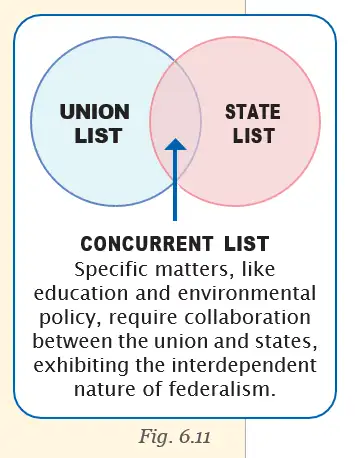
- MLAs: Members of Legislative Assembly make laws on subjects in the State List and Concurrent List.
Union, State, and Concurrent Lists
| List | Legislating authority | Key point |
|---|---|---|
| Union List | Union Government | Subjects on which the Union can legislate exclusively. |
| State List | State Governments | Subjects on which states can legislate exclusively. |
| Concurrent List | Both Union and State Governments | If the Union legislates on a Concurrent List subject, states must follow its law. |
Example
- Right to Education (RTE) Act: Education is in the Concurrent List, and the Act applies throughout India.
Parallel Structure of Union and State Governments
| Aspect | Legislature | Executive |
|---|---|---|
| Composition | Parliament: the President, Lok Sabha, and Rajya Sabha. | The President, Vice-President, and Council of Ministers headed by the Prime Minister. |
| Main role | Makes laws and oversees the Executive. | Enforces laws made by the Legislature. |
| Bills | Can introduce some bills in Parliament. | Introduces most bills in Parliament. |
| Accountability | Questions the Executive and seeks explanations. | Provides information and explanations about decisions and actions. |
| Government spending | Sanctions government-related expenses. | Prepares and implements the budget approved by Parliament. |
| Committees | Consults different Parliamentary committees. | Handles day-to-day matters independently and may consult committees when required. |
| Other function | The Council of Ministers aids and advises the President on important matters, including calling sessions of Parliament. |
Structure of State Legislatures
| Type | Houses | States |
|---|---|---|
| Unicameral | One house: Vidhan Sabha (Legislative Assembly). | Most states. |
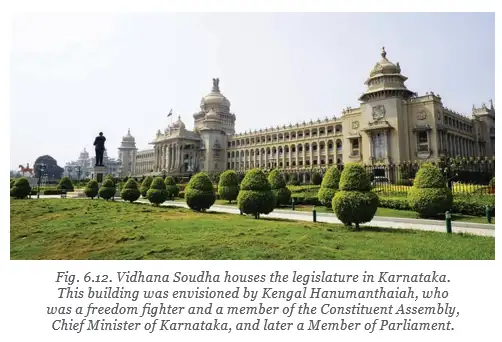
| Bicameral | Two houses: Vidhan Sabha and Vidhan Parishad (Legislative Council, the upper house). | Andhra Pradesh, Bihar, Karnataka, Maharashtra, Telangana, and Uttar Pradesh. |
- Separation of powers
- Distribution of government responsibilities among the Legislature, Executive, and Judiciary.
- Checks and balances
- Ways the organs of government limit and oversee one another so no organ becomes too powerful.
- Unicameral
- A legislature with one house.
- Bicameral
- A legislature with two houses.
How does the Judiciary check the Legislature and Executive?
What is the difference between a unicameral and a bicameral state legislature?
Quick recap
- The Judiciary interprets laws, resolves disputes, and protects fundamental rights.
- It checks laws passed by Parliament and the Executive’s implementation of laws against the Constitution.
- Checks and balances prevent any one government organ from becoming too powerful.
- MLAs make laws on State List and Concurrent List subjects.
- Concurrent List subjects can be legislated on by both levels; states must follow Union law on these subjects.
- State legislatures may be unicameral or bicameral; the Vidhan Sabha is the Legislative Assembly and the Vidhan Parishad is the upper house.
Challenges to the Effective Functioning of the Legislatures
Role and working of legislatures
What legislatures do
- Law-making: Parliament and State Assemblies enact laws.
- Oversight: They examine administrative processes and seek explanations from the Executive.
- Public business: They approve budgets and discuss policies, development plans, international relations and public grievances.
- Intended role: Legislatures should provide space for thoughtful debate and make laws in the public interest.
Sessions and sittings
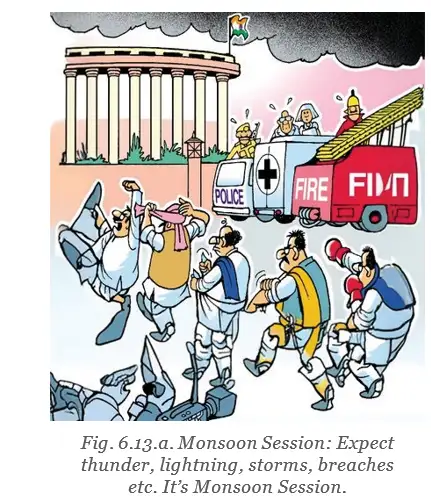
- Sessions: Parliament usually meets three times a year: Budget, Monsoon and Winter Sessions.
- Sittings: Each session is made up of sittings for discussing proposed laws and governance, and questioning Executive decisions.
- Working hours: Parliament usually sits for six hours a day; hours may be extended for urgent business. State Assemblies follow similar schedules.
Legislative productivity — The proportion of scheduled time for which the Lok Sabha or Rajya Sabha actually functions.
| Lok Sabha | Sessions | Sittings |
|---|---|---|
| 1st (1952–1957) | 14 | 677 |
| 2nd (1957–1962) | 16 | 567 |
| 10th (1991–1996) | 16 | 423 |
| 13th (1999–2004) | 14 | 356 |
What the figures suggest
- Trend: The number of Lok Sabha sittings fell across the periods shown, from 677 in the 1st Lok Sabha to 356 in the 13th.
- Caution: Sitting counts show time available for legislative work, but do not by themselves measure how effectively that time was used.
Challenges and their effects
Key challenges
- Attendance and conduct: Members may be regularly absent or act and communicate in an uncooperative manner.
- Debates: Important discussions may lose quality or become angry and biased instead of addressing public concerns.
- Disruptions: Question Hour and other proceedings may be interrupted.
- Legislative delay: Disrupted debates can shorten sessions; some bills may take years to be discussed and passed.
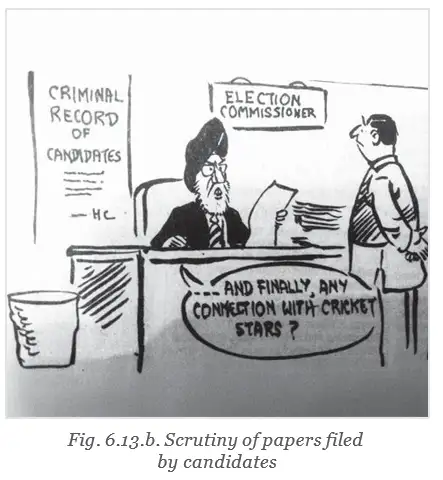
- Public concern: Sections of society are concerned that many Lok Sabha representatives have criminal cases against them.
How disruptions weaken legislative work
- Absence, uncooperative conduct or disruptions
- Less time for Question Hour, debate and scrutiny
- Lower productivity and reduced quality of discussion
- Delayed bills and weaker oversight of the Executive
Rajya Sabha productivity figures cited in 2021
- 2004–2014Rajya Sabha productivity was about 78%.
- Since 2014Productivity had declined to about 65%, according to M. Venkaiah Naidu's 2021 statement.
- 2018Productivity was 35.75%, described in the statement as the lowest ever, under the impact of disruptions.
- 2021Naidu reported that four of the 11 sessions he presided over had productivity of 6.80%, 27.30%, 28.90% and 29.55%.
Why low productivity matters
- Lost opportunity: The Rajya Sabha cannot fully debate legislation, scrutinise government action or represent public concerns when it does not function as scheduled.
- Democratic impact: Repeated disruptions weaken the legislature’s role as a forum for discussion and accountability.
Strengthening legislatures
The media and citizens’ participation
- Media: It helps communicate the concerns of the electorate and can draw attention to issues in a democracy.
- Stay informed: Follow issues that affect society and understand public policies.
- Participate: Share views in public discussions, including digital consultations offered by government departments during policymaking.
- Engage constructively: Discuss policies with elected representatives and take part in public debate.
- Future leadership: Young leaders, diverse voices, technology and informed voting can help make legislatures more connected to the people.
Protecting democracy through political change
- Atal Bihari Vajpayee’s message: Governments and parties may change, but the nation must endure and its democracy must remain strong.
- Importance: Leaders and citizens should protect democratic values and institutions regardless of who holds political power.
- Session
- A period when Parliament meets; it contains a number of sittings.
- Sitting
- A meeting of the legislature within a session.
- Productivity
- Actual functioning time compared with scheduled time.
- Question Hour
- A parliamentary period for members to question the government.
How do disruptions affect the effective functioning of a legislature?
How can citizens help strengthen Parliament and State Assemblies?
Quick recap
- Legislatures make laws, approve budgets, debate public issues and hold the Executive accountable.
- Parliament usually holds Budget, Monsoon and Winter Sessions, with sittings generally lasting six hours a day.
- Productivity compares actual functioning time with scheduled time.
- Absenteeism, uncooperative conduct, poor debate and disruptions reduce productivity and delay legislative work.
- Low productivity limits debate, scrutiny and representation of public concerns; media helps convey the electorate’s concerns.
- Informed citizens can strengthen democracy through participation, constructive engagement and voting, while protecting democratic values through changes of government.
Summary
Institutions and Their Roles
| Institution | Main role |
|---|---|
| Legislature | Makes laws. |
| Executive | Implements laws. |
| Judiciary | Ensures that laws follow the Constitution. |
Representation, Accountability and Balance
How the Parliamentary System Works
- Shared power: India’s parliamentary system distributes power, encourages debate and holds leaders accountable.
- People’s voice: Parliament represents the people and reflects the federal spirit of Indian democracy.
- Centre and states: Government structures at both levels balance representation, responsibility and national unity.
- Checks and balances: Institutions limit and oversee one another to protect citizens’ rights and democratic values.
- Effective functioning: Parliament needs to work efficiently and productively to support the country’s progress.
Division of Responsibilities
- Legislature makes laws
- Executive implements laws
- Judiciary ensures that laws follow the Constitution
- Legislature
- The branch of government that makes laws.
- Executive
- The branch of government that carries out laws.
- Judiciary
- The branch that ensures laws follow the Constitution.
- Checks and balances
- Controls among institutions that help prevent misuse of power.
- Federal spirit
- The sharing of representation and responsibilities between the Centre and the states.
Quick recap
- The Legislature makes laws, the Executive implements them and the Judiciary ensures laws follow the Constitution.
- Parliament represents the people and reflects India’s federal spirit.
- Structures at the Centre and in the states balance representation, responsibility and unity.
- Debate and accountability are important features of India’s parliamentary system.
- Checks and balances protect citizens’ rights and democratic values.
- Efficient parliamentary functioning supports the country’s progress.