Class 8 . Social Science . Exploring Society India and Beyond Part I . The Rise of the Marathas
Chapter 3: The Rise of the Marathas
Ch 3
Social Science
Class 8
Introduction
European Traders and Maratha Concerns
Ramachandrapant Amatya’s View
- European trading groups: The Portuguese, English, Dutch, French and Danes are named in the text.
- Amatya’s warning: He viewed these traders as seeking territory and the spread of their religion, not trade alone.
- Military strength: He identified naval power and gunpowder as their chief weapons.
- Suggested response: He advised controlling their trade and not allowing them to build strong buildings.
- Ramachandrapant Amatya
- Maratha statesman whose advice on European traders is quoted in this lecture.
- Ādnyāpatra
- The work containing this advice, dated 1715.
- Pan-Indian power
- A power whose influence extends across a large part of the Indian subcontinent.
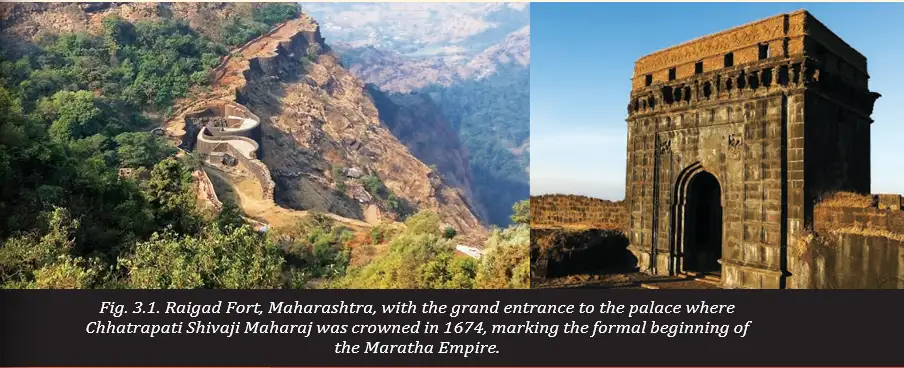
Raigad Fort and Shivaji Maharaj
- Raigad Fort: Shivaji Maharaj was crowned here in 1674.
- Chapter period: The timeline covers major events in Shivaji’s life and the rise of the Marathas from 1630 to 1707.
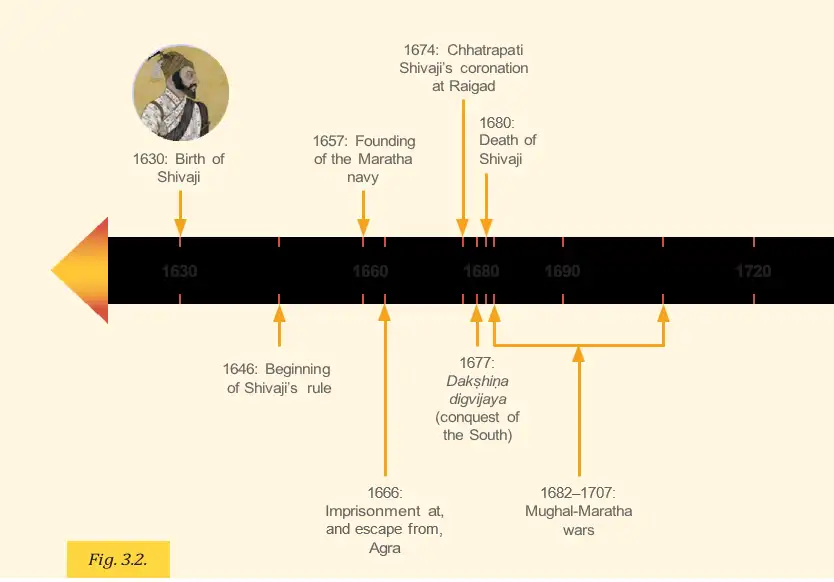
Dates Mentioned
- 1630–1707Period covered by the timeline of Shivaji’s life and the rise of the Marathas.
- 1674Shivaji Maharaj was crowned at Raigad Fort.
- 1715Date given for Ramachandrapant Amatya’s Ādnyāpatra.
Questions Guiding the Chapter
- Rise: Who were the Marathas, and how did they become the largest pan-Indian power before the British took over?
- Governance: What were some features of Maratha governance?
- Legacy: What impact did the Maratha Empire leave on Indian history?
Quick recap
- European traders named include the Portuguese, English, Dutch, French and Danes.
- Amatya warned that European traders sought territory and religious expansion as well as trade.
- He identified naval power and gunpowder as their chief weapons and advised controlling trade and preventing the building of strong buildings.
- Shivaji Maharaj was crowned at Raigad Fort in 1674.
- The chapter’s timeline covers 1630–1707 and introduces questions about Maratha power, governance and legacy.
Who are the Marathas?
The Marathas and Marathi
Marathas — A people native to the Deccan plateau, especially present-day Maharashtra, associated with the Marathi language.
- Marathi: The language associated with the Marathas has a rich, continuous literary history from the 12th century.
- Political rise: The Marathas later emerged as a powerful political force that changed India’s history.
Literary history — The historical development of prose or poetry in a particular language.
Political Changes in Maharashtra
- 7th–17th centuriesBhakti traditions spread as many people sought spiritual upliftment through devotion.
- 12th century onwardMarathi developed a rich and continuous literary history.
- 13th centuryThe Yadava dynasty ruled most of Maharashtra, with Devagiri as its capital.
- Early 14th centuryThe Khilji Sultanate from Delhi overcame the Yadava dynasty.
- 17th centurySome Maratha chiefs unsuccessfully attempted to establish sovereignty before Shivaji rose to power.
- Yadava capital: Devagiri is present-day Daulatabad.
Bhakti and Maharashtra’s Cultural Foundation
Bhakti — Devotion to the divine or to a particular deity.
- Bhakti path: From the 7th to the 17th centuries, many seekers chose devotion for spiritual upliftment rather than relying only on external rituals.
- Devotional literature: Saints from diverse sections of society composed songs and poetry in languages used by ordinary people, helping their messages spread widely.
- Maharashtra’s saints: Dnyaneshwar, Namdev, Tukaram and Ramdas became popular.
- Accessible teachings: Saints helped translate the Upanishads and Bhagavad Gita into Marathi, making their ideas accessible to more people.
- Wider influence: Some saints promoted social organisation and political awareness, much like the Sikh gurus.
- Cultural foundation: These traditions helped Marathi society develop a shared cultural base that later supported Maratha political organisation.
From Bhakti Culture to Political Unity
- Devotional ideas in Marathi → teachings reach wider sections of society
- Shared cultural foundation → stronger social organisation and political awareness
- Cultural foundation → helps the Marathas organise as a political power
Early Attempts at Sovereignty
- 17th-century chiefs: Some Maratha chiefs made early attempts to establish sovereignty, but they were unsuccessful.
- Shivaji: The Marathas were brought together as a political power after Shivaji rose to prominence.
How did the Bhakti movement help lay the foundation for Maratha political power?
Quick recap
- The Marathas are native to the Deccan, especially Maharashtra, and are associated with Marathi.
- Marathi has a rich, continuous literary history from the 12th century.
- The Yadavas ruled much of Maharashtra from Devagiri before the Khilji Sultanate overcame them in the early 14th century.
- Bhakti saints spread devotional teachings through songs and poetry in popular languages.
- Maharashtra’s saints helped translate the Upanishads and Bhagavad Gita into Marathi; some promoted social organisation and political awareness, like the Sikh gurus.
- A shared cultural foundation helped the Marathas organise politically; early sovereignty attempts failed until Shivaji brought them together.
Foundation of Maratha Power and the Rise of Shivaji Part-1
Shivaji’s Early Life and Swarajya
Early life
- 1630Shivaji was born into the Bhonsle clan to Shahji and Jijabai.
Growing up in Pune
- Shahji Served the Deccan sultanates and was often away from his family.
- Upbringing Shivaji grew up in Shahji’s jāgīr at Pune under Jijabai and trusted officials, receiving education and guidance.
- Local conditions Infighting among the Deccan sultans caused hardship for ordinary people in the Pune region.
- Age 16 Shivaji began military campaigns, first taking neglected or unoccupied forts in the Pune region and strengthening their defences.
- Swarajya His vision developed into a sovereign kingdom with political, economic and cultural dimensions.
Jāgīr — Land granted by a ruler, usually to a noble or soldier for service, from which the holder could collect taxes for personal needs or service to the ruler.
The Maratha Navy and Guerrilla Warfare
Building a navy
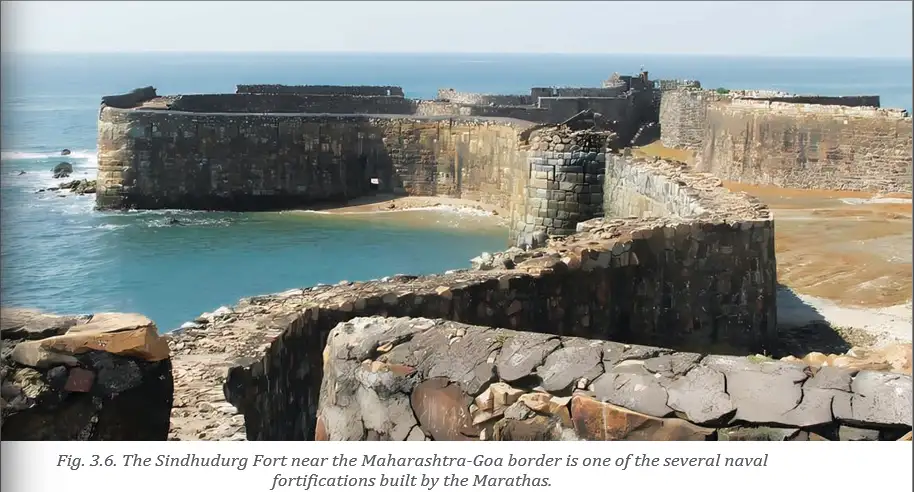
- Need As Shivaji’s kingdom reached the west coast, he established a navy to protect access to coastal resources.
- Significance Establishing a Maratha navy was a revolutionary development for the time.
- Comparison Bijapur’s Adil Shahi rulers maintained merchant ships but had no full-time navy to protect the coast; Mughal use of a navy was very limited.
- Result The Maratha Navy developed a reputation for its exploits.
| Power | Naval force |
|---|---|
| Marathas | Established a navy to secure access to coastal resources. |
| Bijapur Sultanate | Had merchant ships, but no full-time navy to protect the coast. |
| Mughal Empire | Made very limited use of a navy. |
Guerrilla warfare — A way of fighting in which small groups use speed, surprise and knowledge of the terrain to defeat larger armies.
Afzal Khan’s defeat
- Shivaji’s successes drew the hostility of the Bijapur Sultanate.
- Bijapur sent veteran general Afzal Khan to confront Shivaji.
- Shivaji and his advisers arranged a one-on-one meeting near Pratapgad Fort, among thick forests.
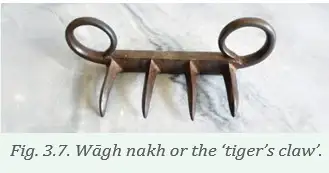
- Shivaji killed Afzal Khan; Maratha forces hidden in the mountains routed Khan’s army using guerrilla attacks.
Wāgh nakh — A small, tiger-claw-shaped weapon associated with Shivaji’s killing of Afzal Khan in close combat.
Conflict with the Mughals
Shaista Khan’s invasion and Shivaji’s raid
- Mughal nobleman Shaista Khan invaded Shivaji’s territories with a large army and attacked for three years.
- Shivaji raided Shaista Khan’s camp at night with only a few soldiers.
- The daring raid resembles a modern-day surgical strike.
- Shaista Khan barely escaped, lost a few fingers and soon left Maharashtra.
Surgical strike — A military attack aimed at a specific target while causing no or minimal damage to other people or infrastructure.
The sack of Surat and Mughal response
- After the prolonged attacks by Shaista Khan, Shivaji retaliated by sacking Surat, a wealthy Mughal port city in present-day Gujarat.
- The raid yielded treasure worth almost one crore rupees; Shivaji spared religious places and the house of charitable man Mohandas Parekh.
- Shivaji sacked Surat again a few years later; the London Gazette reported his demand for money from European diplomatic agents.
- The attack damaged Mughal prestige, so Aurangzeb sent Rajput general Jai Singh to defeat Shivaji.
Treaty of Purandar
- Defeat Shivaji had to concede defeat at Purandar Fort, near Pune, and agree to a treaty with Jai Singh.
- Terms Shivaji gave up a sizeable part of his kingdom, and his son Sambhaji entered Mughal service.
Agra and Shivaji’s Escape
From the Agra court to escape
- Jai Singh persuaded Shivaji to visit Aurangzeb’s court at Agra.
- Shivaji was made to stand before Aurangzeb and a Mughal general he had previously defeated; insulted, he stormed out.
- Aurangzeb placed Shivaji under house arrest.
- Shivaji began sending gifts of fruits and sweets in large baskets to holy men and Mughal generals; guards eventually stopped checking them.
- Shivaji and Sambhaji hid in the baskets and escaped. Aurangzeb was never able to capture Shivaji again.
- Swarajya
- Shivaji’s vision of a sovereign kingdom with political, economic and cultural dimensions.
- Jāgīr
- Land granted by a ruler for service, with the right to collect its taxes.
- Guerrilla warfare
- Small-group fighting that relies on speed, surprise and knowledge of the terrain.
- Wāgh nakh
- A small weapon shaped like a tiger’s claw.
- Surgical strike
- An attack on a specific target with minimal collateral damage.
What made Shivaji’s guerrilla warfare effective against larger forces?
What were the main terms of the treaty Shivaji made after his defeat at Purandar?
Quick recap
- Shivaji was born in 1630 to Shahji and Jijabai and grew up in the Pune jāgīr.
- At 16, he began capturing and fortifying neglected forts; his goal grew into Swarajya.
- The Marathas established a navy to secure the west coast and used guerrilla warfare against larger forces.
- Shivaji defeated Afzal Khan near Pratapgad and later raided Shaista Khan’s camp in an attack resembling a modern surgical strike.
- He sacked Surat, then had to surrender territory under the treaty of Purandar.
- After being placed under house arrest at Agra, Shivaji and Sambhaji escaped hidden in gift baskets.
Foundation of Maratha Power and the Rise of Shivaji Part-2
Coronation and the Rājyābhiṣheka Era
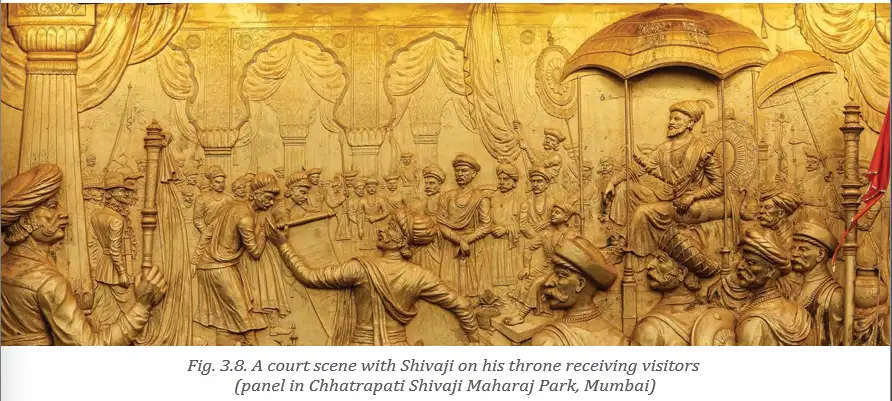
Southern Conquest
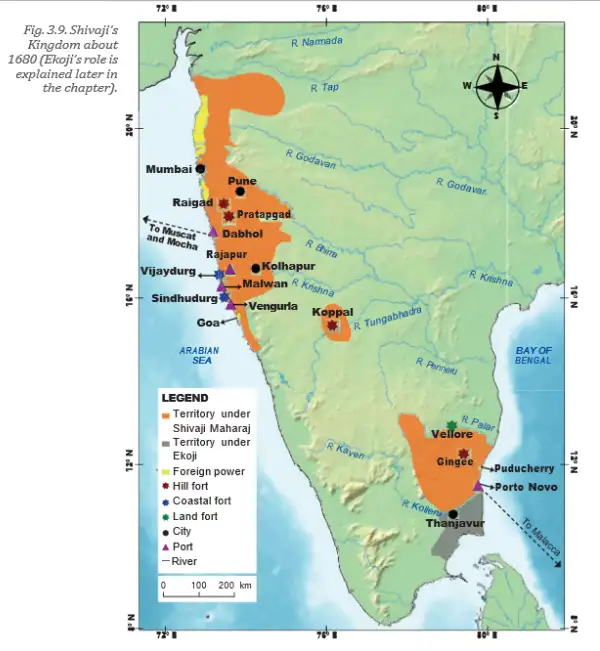
Why the Southern Extension Mattered
- Shivaji conquered parts of northern Tamil Nadu and Karnataka
- The Maratha kingdom expanded south
- The expanded territory provided strategic depth
- The Marathas were better positioned to withstand Mughal invasion
Shivaji’s Stand Against Slave Trading
- Slave trading: Shivaji forbade the Dutch from trading slaves while he was in the South.
- Concern for his subjects: His stand challenged the abuse of Indians and showed his care for their welfare.
Death and Legacy
- Rājyābhiṣheka shaka
- The era Shivaji began after his coronation.
- Dakṣiṇa-digvijaya
- Shivaji’s campaign of conquest in the South.
- Strategic depth
- Territorial space that strengthens a kingdom’s ability to resist invasion.
- Bundelkhand
- The region where Chhatrasal established an independent kingdom, in parts of present-day Uttar Pradesh and Madhya Pradesh.
Where and when was Shivaji crowned, and what title did he take?
What was the importance of Shivaji’s southern conquest?
Name two ways Shivaji’s legacy influenced others.
Quick recap
- Shivaji was crowned at Raigad in 1674 and began the Rājyābhiṣheka shaka.
- His formal coronation title was ‘Shri Raja Shiva Chhatrapati’.
- The dakṣiṇa-digvijaya extended Maratha power into parts of northern Tamil Nadu and Karnataka.
- The southern territories strengthened the Marathas against Mughal invasion.
- Shivaji forbade Dutch slave trading in the South, showing concern for his subjects.
- His legacy inspired Chhatrasal and the poet Bhushan.
The Marathas after Shivaji
The Mughal–Maratha Conflict
Sambhaji and Rajaram
- Succession: Shivaji’s sons were Sambhaji and Rajaram. Sambhaji became Chhatrapati after Shivaji’s death.
- Mughal campaign: The Marathas were the main obstacle to Mughal control of the Deccan. Aurangzeb conquered Bijapur (Adil Shahi) and Golconda (Qutb Shahi).
- Sambhaji’s death: Aurangzeb captured, brutally tortured and executed Sambhaji, then captured Raigad, the Maratha capital.
- Rajaram: He became Chhatrapati and fled to Gingee, in present-day Tamil Nadu, spreading the conflict to south India.
Maratha Resistance and Expansion
Resistance to the Mughals
- Fortresses: Marathas defended their forts staunchly and often gained the upper hand in battles and skirmishes.
- Aurangzeb’s failure: He could not leave the Deccan and died without subduing the Marathas.
- Tarabai: Rajaram’s queen led large-scale Maratha advances into Mughal territories.
- Outcome: The Marathas became a strong contender to the Mughals and eventually conquered large parts of India.
Changing Maratha Government
| Point | Shivaji’s time | Later period |
|---|---|---|
| Structure | Centralised state | More decentralised; nominally centred on the Chhatrapati |
| Power | Authority centred on the ruler | Chiefs gained power and autonomy; the Peshwa became highly influential, even over the Chhatrapati |
Peshwa — The Maratha prime minister; the title comes from a Persian term.
Peshwas and the Costs of Expansion
- Peshwas: Bajirao I and his son Nanasaheb Peshwa were instrumental in the Marathas’ expansion across India.
- Rule: The Marathas generally ruled the large territories they controlled well.
- Loss of discipline: More powerful, autonomous chiefs sometimes caused indiscipline and abuse, unlike Shivaji’s values.
- Bengal: A ten-year Maratha campaign inflicted cruelty and devastation on ordinary people.
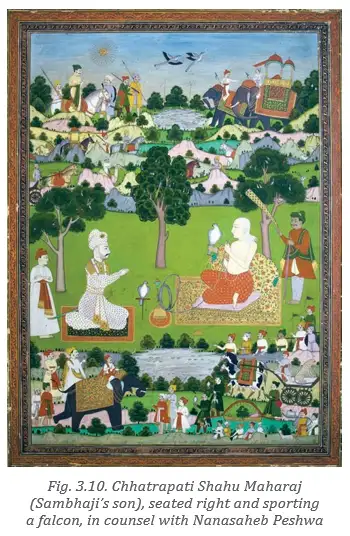
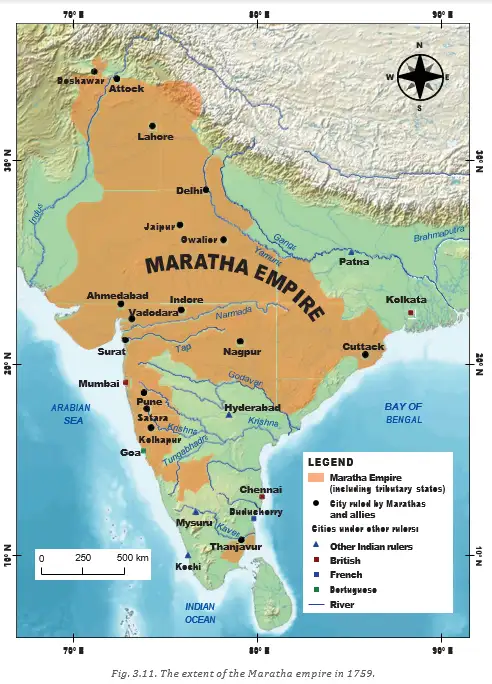
Northern Expansion and the British
Northward Expansion and Recovery
- Northern reach: The Marathas briefly controlled Lahore, Attock and Peshawar (in present-day Pakistan) and fought the Afghans.
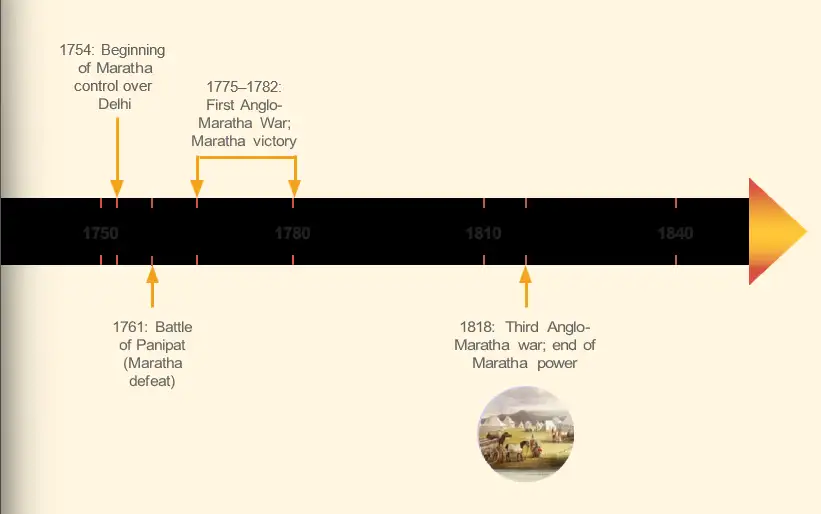
- Panipat: They suffered a disastrous defeat in 1761 but recovered quickly under Peshwa Madhavrao I.
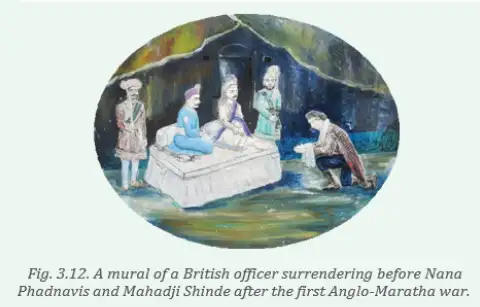
- Delhi: Led by Mahadji Shinde (also called Mahadji Scindia), they recaptured Delhi in 1771 and controlled it until the British captured it about three decades later.
Key Dates
- 1759The map shows the extent of the Maratha Empire.
- 1761The Marathas suffered a disastrous defeat at Panipat.
- 1771Mahadji Shinde led the recapture of Delhi.
- 1775–1818Three Anglo-Maratha Wars were fought.
The End of Maratha Power
- In the latter half of the 18th century, the Marathas were the British’s chief rivals in India.
- Three Anglo-Maratha Wars were fought between 1775 and 1818.
- Growing internal disunity, combined with British organisational and technological superiority, helped the British defeat the Marathas.
- British power in India grew substantially from defeating the Marathas, more than from defeating the Mughals or any other power.
Nana Phadnavis and an Anti-British Alliance
- Nana Phadnavis: A powerful official under the Peshwas, credited with organising the first pan-Indian anti-British alliance.
- Former adversaries: He united with Hyder Ali of Mysore and the Nizam of Hyderabad.
- Chhatrapati
- The Maratha ruler; the state remained nominally centred on this office.
- Peshwa
- The Maratha prime minister, who became highly influential in the later state.
- Anglo-Maratha Wars
- The three wars between the Marathas and the British from 1775 to 1818.
Why was Aurangzeb unable to subdue the Marathas?
What changes took place in the Maratha state after Shivaji?
Why did the British succeed in ending Maratha power?
Quick recap
- After Sambhaji was executed and Raigad captured, Rajaram continued the struggle from Gingee.
- Maratha resistance outlasted Aurangzeb; Tarabai later led advances into Mughal territories.
- The state became decentralised, with powerful chiefs and increasingly influential Peshwas.
- After the 1761 Panipat defeat, the Marathas recovered and recaptured Delhi in 1771.
- The Anglo-Maratha Wars (1775–1818) ended Maratha power amid internal disunity and British advantages.
- Nana Phadnavis is credited with organising the first pan-Indian anti-British alliance.
Maratha Administration
Civilian Administration under Shivaji
Centralised administration
- Centralisation: Shivaji kept authority under the king and reduced officials’ ability to become independently powerful.
- Appointments and pay: He abolished hereditary government posts and land assignments; officials received salaries from the state treasury.
- Transfers: Officials were periodically transferred so that none could gain enough power to dictate terms to the king.
- Soldiers’ families: Widows of soldiers killed in battle received pensions, and their sons could be offered military posts.
Ruler’s duties and values
- Protection of subjects: Shivaji instructed officials not to mistreat people or seize their property by force.
- Care for livelihoods and nature: His letter required permission before cutting forest trees needed for the navy and forbade cutting useful mango and jackfruit trees.
- Values shown: The letter reflects compassion, respect for people’s property and livelihoods, restraint in using power, and concern for long-term resources.
Council of ministers
- Ashta Pradhan Mandal: Shivaji appointed a council of eight ministers to assist him in governing the kingdom.
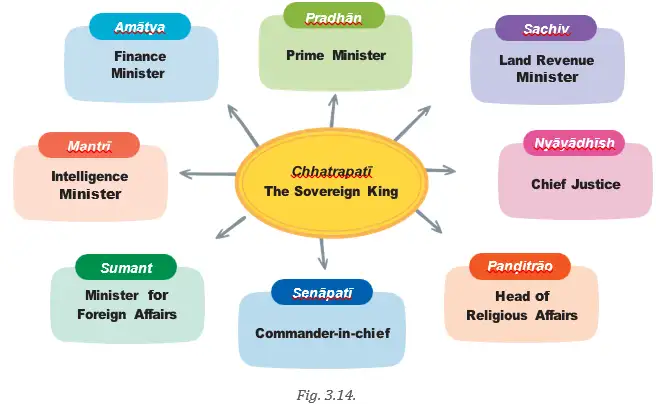
Taxes and Relations with Other Provinces
| Tax | Rate | Meaning |
|---|---|---|
| Chauth | 25 per cent | A tax collected from provinces not directly under Maratha rule. |
| Sardeshmukhi | An additional 10 per cent | Collected in addition to chauth. |
Arrangement with the taxed provinces
- Marathas collected chauth and sardeshmukhi from provinces, including areas in the Deccan and north India.
- In return, they provided protection and did not interfere in those provinces’ internal administration.
- Mughal treaties approved this arrangement; over time, some provinces became part of the Maratha Empire.
Maratha Coinage
Coinage and cultural identity
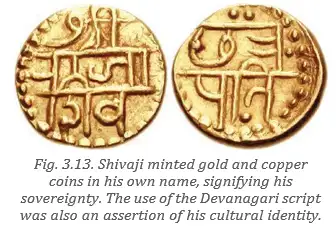
- Mughal influence: In the 18th century, Marathas often used the popular Mughal style of coinage while adding their own cultural symbols.
- Gaṇapatī-Pantapradhān rupee: This rare coin was minted in the early 19th century by the Patwardhans, generals under the Peshwa.
- Inscriptions: The coin used both Devanagari and Persian scripts; one side invoked Gaṇapati, while the other expressed loyalty to the Peshwa, also called Pantapradhān.
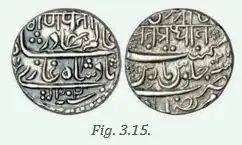
Periods in Maratha Coinage
- 18th centuryMarathas often adopted the popular Mughal coinage style and added their own cultural symbols.
- Early 19th centuryThe Patwardhans minted the Gaṇapatī-Pantapradhān rupee.
- Ashta Pradhan Mandal
- Shivaji’s council of eight ministers.
- Chauth
- A 25 per cent tax levied on provinces outside direct Maratha rule.
- Sardeshmukhi
- An additional 10 per cent tax collected alongside chauth.
- Pantapradhan
- A title used for the Peshwa; it also appeared on the Gaṇapatī-Pantapradhān rupee.
How did Shivaji limit the independent power of government officials?
What did Marathas provide in return for chauth and sardeshmukhi?
What does the Gaṇapatī-Pantapradhān rupee reveal about Maratha coinage?
Quick recap
- Administration: Shivaji centralised authority and reduced reliance on hereditary officials and land assignments.
- Officials: Salaries from the treasury and regular transfers helped limit officials’ power.
- Care: Shivaji protected subjects from mistreatment and supported families of soldiers killed in battle.
- Council: The Ashta Pradhan Mandal consisted of eight ministers who assisted Shivaji.
- Taxes: Chauth was 25 per cent; sardeshmukhi was an additional 10 per cent, collected in return for protection and non-interference.
- Coinage: Maratha coins used cultural symbols, sometimes alongside the popular Mughal style.
Military Administration
The Maratha Armed Forces
Three branches and military reforms
- Branches: The Maratha armed forces consisted of infantry, cavalry and navy.
- European methods: In the 18th century, the Marathas recognised the effectiveness of disciplined European-style troops and artillery, and tried to recruit and raise such forces.
- Mahadji Shinde: He had a large European-style army.
| Type | Who paid for horses and equipment? |
|---|---|
| Bārgīrs | The state |
| Shiledārs | The soldiers themselves |
Weapons and Forts
Weapons
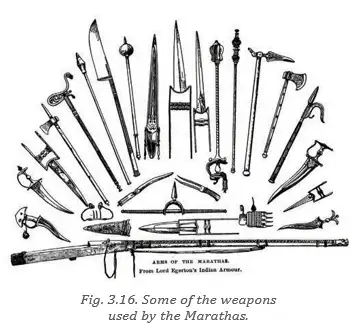
- Preferred weapons: Maratha soldiers mainly used swords and lances, but also used guns in sizable numbers.
- Rockets: Rockets were used in campaigns from Shivaji’s time; by 1770, metal-tube rockets were also in use.
Forts — Strategic strongholds that helped protect Maratha territory and support military operations.
Why forts mattered
- Shivaji’s strategy: He controlled and built many forts, making them central to Maratha power.
- Strategic role: Forts helped control important routes and sheltered the army during guerrilla warfare.
- Defence: In the *Ādnyāpatra*, finance minister Ramachandrapant Amatya described forts as the core of the state. He argued that they protected the kingdom from invasion and helped it survive decades of attack, including Aurangzeb’s onslaught.
Maritime Supremacy
The Maratha navy and European naval power
- Shivaji’s navy: He created a navy to secure the west coast.
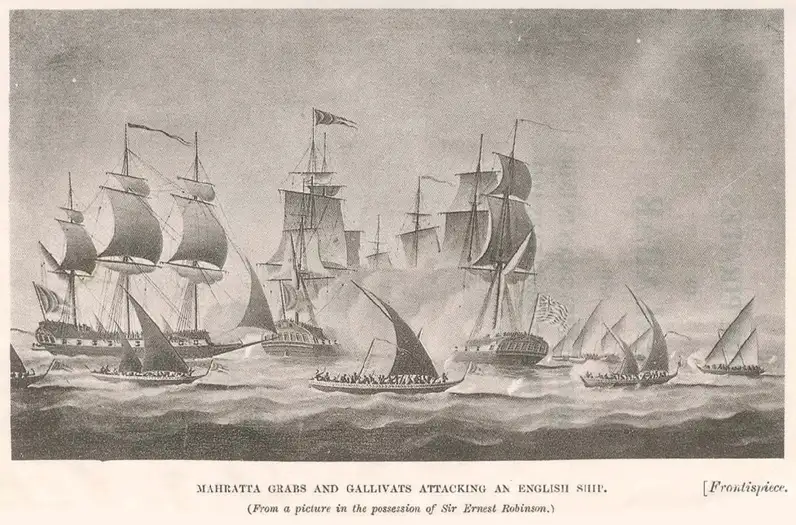
- Kanhoji Angre: In the 18th century, he led the Marathas to victories in many naval battles by using local geography and effective tactics.
- Technology: Maratha ships were less technologically advanced than European ships, but the Marathas used their tactical skill to challenge European naval power.
- Cartaz passes: Europeans charged for naval trade passes, called *cartaz* in Portuguese, and confiscated ships that sailed without them.
- Maratha response: The Marathas began demanding passes from Europeans too. Europeans expressed their frustration by calling Kanhoji Angre a ‘pirate’.
Maratha ships at Muscat
- 1665: Four ships from Shivaji’s fleet reached Muscat, the capital of Oman. The ruler captured the ships and arrested their crews, then prepared to attack Shivaji’s coastal possessions.
- Outcome: After hearing that Shivaji’s navy had more than 100 ships, the ruler withdrew his ships into the harbour.
- Bārgīrs
- Cavalry soldiers whose horses and equipment were paid for by the state.
- Shiledārs
- Cavalry soldiers who paid for their own horses and equipment.
- Cartaz
- A Portuguese term for the naval trade pass Europeans required ships to purchase.
How did forts support Maratha military power?
How did the Marathas challenge European control of naval trade?
Quick recap
- The Maratha armed forces comprised infantry, cavalry and navy; cavalry included state-funded bārgīrs and self-funded shiledārs.
- Marathas used swords, lances, guns and rockets; metal-tube rockets were in use by 1770.
- Forts controlled routes, sheltered troops and helped defend the kingdom against invasions.
- In the 18th century, Mahadji Shinde had a large European-style army, while Kanhoji Angre led successful naval campaigns.
- The Marathas challenged European cartaz demands by requiring passes from Europeans themselves.
- In 1665, the report that Shivaji’s navy had more than 100 ships caused the ruler of Muscat to withdraw into the harbour.
Judicial system
Judicial System
How justice was administered
- Panchayat: A local gathering of officials and prominent men; it was the main body that delivered justice.
- Appeals: A person dissatisfied with a verdict could appeal to a Maratha chief.
- Kotwal: In prominent towns such as Pune and Indore, the kotwal (police) helped maintain law and order.
- Moderation: The Maratha judicial system was considered efficient and used the death penalty sparingly.
- Panchayat
- A local gathering of officials and prominent men that delivered justice.
- Kotwal
- The police or officer responsible for maintaining law and order in a town.
Trade Networks
Trade and transport
- Maritime trade: Shivaji encouraged trade and took part in foreign sea trade; he and his officials owned ships.
- Distant ports: Maratha ships sailed to Mocha in Yemen, Muscat in Oman, and Malacca in Malaysia.
- Cargo: Ships carried goods such as gold and textiles.
- Land and river transport: Roads were built and maintained; bridges crossed rivers and streams, while ferries supported river transport in 18th-century Odisha.
Cultural Revival
Shivaji’s cultural contributions
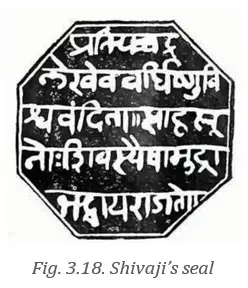
- Swarajya and the seal: Shivaji’s seal carried a Sanskrit inscription in Devanagari, unlike the Persian seals then commonly used. Its message presented his authority as growing like the new moon and serving the people’s welfare.
- Language: Shivaji commissioned the *Rājya-Vyavahāra-Koṣha*, giving Sanskrit equivalents for Persian words used in diplomacy and reducing foreign loanwords in Maratha official language.
- Religion and arts: He was a devout Hindu who respected other religions; he rebuilt desecrated temples and supported Sanskrit and Marathi literature, religious institutions, and traditional arts.
- Maratha identity: His saffron-coloured flag was adopted by all Marathas.
- Wider significance: Shivaji showed that powerful empires could be defeated and that the Marathas could establish, expand, and govern their own empire.
The Mighty Maratha Women
| Leader | Role and contributions |
|---|---|
| Tarabai | After her husband Rajaram’s death, she ruled in the early 18th century. With Aurangzeb and the Mughal army in the Deccan, she organised large Maratha armies to invade Mughal territories in the north. Her strategy and determination helped preserve Maratha independence and made her a key architect of northward expansion. |
| Ahilyabai Holkar | A Holkar ruler in central India around present-day Indore, she governed wisely for 30 years despite losing her husband and son. She cared for ordinary people and built or restored temples, ghats, wells, and roads across India. |
| Ahilyabai’s legacy | She rebuilt the Kashi Vishwanath temple in Varanasi, destroyed by Aurangzeb, and the Somnath temple in Gujarat, destroyed by Mahmud of Ghazni. She also promoted the Maheshwar weaving industry and traditional handloom crafts. |
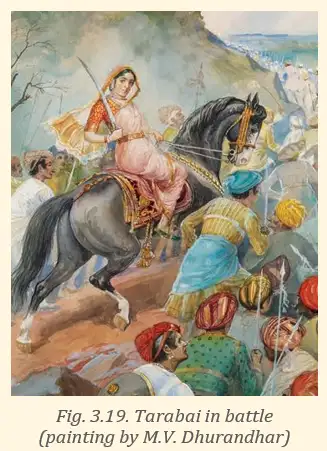
Maratha Women in the 18th Century
- Early 18th centuryTarabai ruled after Rajaram’s death and led Maratha resistance and expansion.
- 18th centuryAhilyabai Holkar governed the Holkar state for 30 years and supported public works, temples, and crafts.
Scripts and Regional Cultural Support
Continuing cultural influence
- Modi script: A cursive form of Devanagari, it was the main script used by the Marathas for correspondence.
- Bhonsles of Nagpur: They strongly supported local culture and traditions.
- Jagannath worship: With Maratha support, worship of Jagannath at Puri in Odisha was revived after interruptions during Mughal rule.
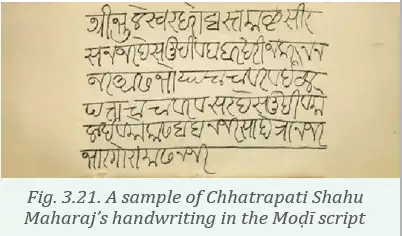
How did the Maratha judicial system deliver justice and maintain law and order?
What were Shivaji’s main contributions to language and culture?
State one major contribution each of Tarabai and Ahilyabai Holkar.
Quick recap
- Panchayats delivered justice; appeals could go to Maratha chiefs, and kotwals maintained town order.
- Shivaji encouraged maritime trade, with ships sailing to ports including Mocha, Muscat, and Malacca.
- Shivaji’s Sanskrit-inscribed seal and language policies supported Swarajya and Marathi use in diplomacy.
- Tarabai led resistance against the Mughals and helped expand Maratha influence northward.
- Ahilyabai Holkar governed for 30 years and supported temples, infrastructure, public welfare, and handloom crafts.
- The Modi script was used for Maratha correspondence, while the Bhonsles of Nagpur supported regional traditions.
In focus: Thanjavur
Maratha Rule and Culture in Thanjavur
Syncretic culture — A culture shaped by the interaction of different cultural influences.
Ekoji and Thanjavur
- Ekoji: Shivaji’s half-brother conquered the Thanjavur region, in present-day Tamil Nadu, beginning Maratha rule there.
- Cultural contribution: Thanjavur’s Maratha rulers supported the arts and helped foster a rich, innovative syncretic culture.
- Rulers as artists: Many Maratha rulers were themselves poets and dramatists.
Beginning of Maratha Rule
- Late 17th centuryEkoji conquered the Thanjavur region, beginning Maratha rule there.
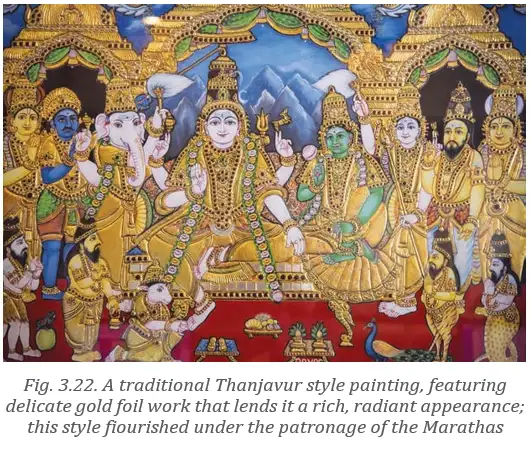
| Culture | Connection to Thanjavur |
|---|---|
| Tamil | Local culture |
| Telugu | Culture of the former rulers |
| Marathi | Culture of the current rulers |
Serfoji II’s Contributions
Learning, Arts, Medicine, and Historical Records
- Languages and literature: Serfoji II knew many Indian and European languages. His Marathi play *Devendra Kuravanji* describes world geography as it was known at the time.
- Music and dance: He patronised musicians. Modern Carnatic music took shape during his reign, as did the early stages of Bharatanatyam.
- Medicine: He established Dhanwantari Mahal, which offered free treatment using both Indian and Western medicine.
- Printing: He started a printing press—the first such example in India established by a native ruler.
- Historical record: He had the history of the Bhonsle family inscribed on the walls of the Brihadishwara temple at Thanjavur.
- Inscription: The temple record is one of the largest single inscriptions in India and preserved the family’s history for posterity.
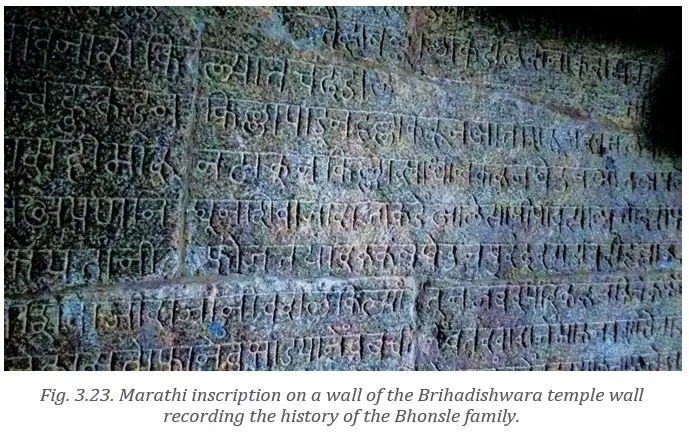
Thanjavur’s Multilingual Culture
- Cultural interaction: Tamil, Telugu, and Marathi influences interacted freely in Thanjavur.
- Result: The region developed a multilingual culture shaped by local, former-ruler, and current-ruler traditions.
The Maratha Legacy
Political and Cultural Legacy
- Political challenge: Maratha rule challenged Mughal dominance and established the largest Indian empire before the British took over the Subcontinent, controlling much of central and northern India.
- Administration: The Marathas established an efficient system of governance.
- Traditions: They revived local Hindu traditions without religious discrimination.
- Ideal: Their struggle against oppressive rule and foreign power was driven by the ideal of Swarājya, or self-rule.
Swarājya and the Freedom Movement
- The Maratha struggle against oppressive rule and foreign power was driven by the ideal of Swarājya.
- Later, this ideal inspired many Indians to believe that they could govern themselves.
- This belief planted early seeds for India’s freedom movement.
- Patronage
- Support given by rulers to artists, musicians, or other cultural work.
- Swarājya
- The ideal of self-rule.
Describe Serfoji II’s contributions to Thanjavur.
How did different cultures shape Thanjavur?
Quick recap
- Ekoji’s conquest of Thanjavur in the late 17th century began Maratha rule there.
- Thanjavur Maratha rulers patronised the arts and fostered an innovative culture shaped by Tamil, Telugu, and Marathi influences.
- Serfoji II supported musicians; modern Carnatic music took shape and early Bharatanatyam developed during his reign.
- Serfoji established Dhanwantari Mahal, started a printing press, and preserved Bhonsle family history in a temple inscription.
- The Marathas challenged Mughal dominance, built an efficient administration, and revived local Hindu traditions without religious discrimination.
- The ideal of Swarājya later inspired Indians to believe they could govern themselves and helped plant early seeds for the freedom movement.
Summary
Rise and Expansion
The Maratha Kingdom
- Founder: Chhatrapati Shivaji Maharaj founded the Maratha kingdom in the 17th century.
- Resistance: Decades of resistance to Mughal power gave the Marathas valuable experience.
- Expansion: This experience helped the Marathas expand across India in the 18th century.
Maratha Power
- 17th centuryShivaji Maharaj founded the Maratha kingdom, which resisted Mughal power.
- 18th centuryThe Marathas expanded across India, drawing on experience gained through resistance.
Strengths and Legacy
Key Features and Impact
- Forts: Hundreds of forts formed the core of the Maratha state and strengthened strategic control over regions.
- Navy: The formidable Maratha navy resisted European naval supremacy for a considerable time, despite lacking access to the latest technology.
- British conquest: The British effectively captured India from the Marathas more than from any other Indian power.
- Cultural influence: Maratha rule encouraged cultural confidence, revival and innovation in different parts of India.
Resistance and Expansion
- Decades of resistance to Mughal power
- Experience gained through resistance
- Expansion across India in the 18th century
- Maratha kingdom
- The kingdom founded by Chhatrapati Shivaji Maharaj in the 17th century.
- Forts
- Strategic strongholds central to Maratha state power and regional control.
- Maratha navy
- A formidable naval force that resisted European naval supremacy for a time.
- Cultural revival
- Renewed cultural confidence and innovation encouraged by Maratha influence.
How did the Marathas strengthen and expand their power?
Quick recap
- Chhatrapati Shivaji Maharaj founded the Maratha kingdom in the 17th century.
- Resistance to Mughal power helped prepare the Marathas for expansion across India in the 18th century.
- Hundreds of forts were central to Maratha state power and regional control.
- The Maratha navy resisted European naval supremacy despite limited access to modern technology.
- The British effectively captured India from the Marathas more than from any other Indian power.
- Maratha influence supported cultural confidence, revival and innovation across India.