Class 8 . Social Science . Exploring Society India and Beyond Part I . Universal Franchise and India S Electoral System
Chapter 5: Universal Franchise and India’s Electoral System
Ch 5
Social Science
Class 8
Universal Adult Franchise
Meaning and Core Principle
- Franchise / suffrage
- The right to vote.
- Constituency
- An area whose voters elect a representative to a legislative body.
- System
- A group of interconnected or interdependent elements working together for a common purpose or function.
Voting Rights and Eligibility
- Equal vote: Every Indian citizen aged 18 or above has one vote of equal value, regardless of caste, religion, gender, education or income.
- Eligibility: Citizens must be registered as voters in their constituency; no one may vote on another person’s behalf.
- Voting rights: A person found guilty of certain serious crimes may be barred from voting.
Managing Elections
- Election management: India needs an extensive, well-organised process to conduct elections freely and fairly across the country.
- Election Commission: The Election Commission of India organises elections and oversees the electoral process.
Why Universal Franchise Matters
- Equal voice: Universal franchise gives every eligible citizen an equal opportunity to influence decisions by choosing representatives.
- Inclusive democracy: Voting rights do not depend on wealth, education, caste, religion or gender, helping make democracy representative of all citizens.
Historical Context and Key Dates
Key Dates
- 1947India’s literacy rate was about 14% overall and 8% among women.
- 1971Women in Switzerland gained the right to vote; India had granted women voting rights from the beginning.
- 1988India lowered the minimum voting age from 21 to 18.
- 2024About 980 million voters were eligible to vote in the Lok Sabha election across 543 constituencies.
What is universal adult franchise?
What conditions must a person meet to vote in India?
Quick recap
- Universal adult franchise gives every Indian citizen aged 18 or above the right to vote.
- Each eligible voter has one vote, and all votes have equal value.
- Article 326 applies adult suffrage to Lok Sabha, state and union territory assembly, and local elections.
- Voters must register in their constituency; no one may vote on another person’s behalf.
- A voter may be barred if found guilty of certain serious crimes.
- India adopted universal franchise from the outset, including voting rights regardless of gender or literacy.
Bridging Barriers, Enabling Participation: Ensuring Universal Franchise
Voting and Democratic Participation
- People’s choice: Voting allows citizens to express their will and choose representatives in a democracy.
- Inclusive participation: Every eligible citizen should be able to take part freely and fairly in elections.
Organising Elections Across India
Why Election Access Measures Matter
- India’s large size and varied geography create difficulties in reaching every voter.
- Difficulties in reaching voters can become barriers to casting a vote.
- The ECI uses access measures to help eligible citizens participate.
Measures to Make Voting Accessible
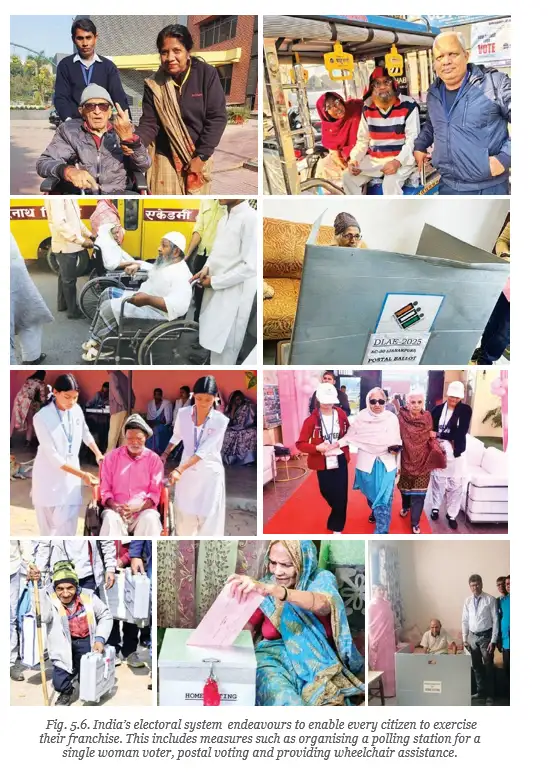
Voter Participation
- Voter turnout: About 34 per cent of eligible voters did not vote in the 2024 elections.
- Informed choices: Voter awareness and responsible participation help strengthen democracy.
An Earlier Selection Process
Key Dates and Periods
- 10th centuryUttaramerur inscriptions recorded a public, transparent process for selecting representatives.
- 2024Home voting was introduced for elderly people and people with disabilities; about 34% of eligible voters did not vote.
- Franchise
- The right to vote in an election.
- Eligible voter
- A citizen who meets the requirements to vote.
- Postal voting
- A way of casting a vote by post, available to specified categories of voters.
- Accessibility measure
- A support or arrangement that helps voters overcome barriers to voting.
Why does India need special measures to make elections accessible?
Name four measures that help make voting accessible.
Quick recap
- Voting allows eligible citizens to express their choice and is central to democratic participation.
- India’s size, voter population and geographic diversity make election organisation complex.
- The ECI uses measures such as remote-area polling, home voting, postal voting and assistive support.
- About 34% of eligible voters did not vote in the 2024 elections.
- The 10th-century Uttaramerur inscriptions describe a public process for selecting representatives.
Election for Class Representative - Grade 8, Suryodaya School
The Class Representative Election
Class representative — A class representative speaks for the class in meetings, helps organise events and connects students with teachers and school authorities.
| Candidate | Main proposal |
|---|---|
| Ahmed | Improve cleanliness in classrooms and the playground |
| Gurmat | Support learning through peer coaching and mutual support |
| Ravi | Make more timetable space for music, theatre and visual art |
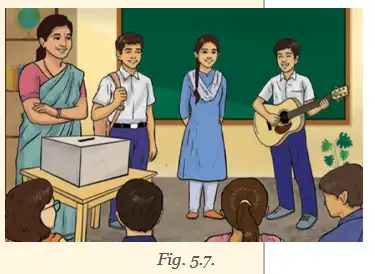
Campaigning and election arrangements
- Campaigning: Ahmed used posters, Gurmat used the noticeboard and spoke to classmates, and Ravi performed music at lunchtime.
- Election Officer: Ms. Usha explained the rules and organised the election to make the process fair and transparent.
- Secret ballot: Voting booths kept each student's choice private; no one could know who they voted for.
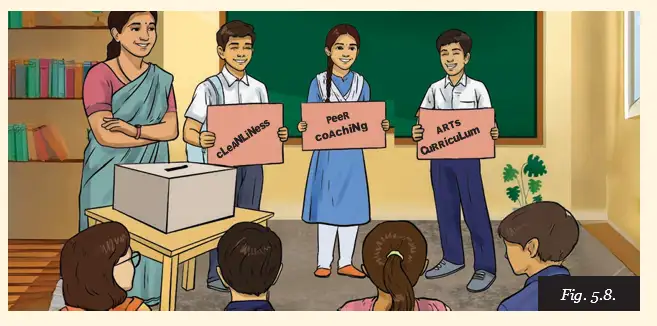
Voting, Results and NOTA
Voting and counting
- Ballot paper: Each student marked an X beside one candidate; a Braille ballot enabled Neha to participate.
- Sealing ballots: After voting, Ms. Usha collected the ballot papers in a box and sealed it until counting.
- Witness: Ms. Sheeba from another class witnessed the counting.
- Invalid ballot: One unmarked ballot was declared invalid.
- Reported results: Ahmed received 8 votes, Gurmat 12 and Ravi 10; Gurmat, with the most votes, became Class Representative.
- After the result: Gurmat promised to fulfil her commitments; Ahmed and Ravi congratulated her and offered support.
NOTA — NOTA means “None of the Above”; it lets voters reject all listed candidates if they are dissatisfied with every option.
Why NOTA matters
- Purpose: NOTA communicates that voters want better choices.
- Effect on result: In this caselet, NOTA does not change the election result.
Elections in India
| Point | Lok Sabha election | State/UT legislative assembly election |
|---|---|---|
| Representatives chosen | Citizens elect representatives to the Lok Sabha, the lower house of Parliament. | Voters elect representatives from their constituencies to the legislative assembly of their state or Union Territory where they are registered. |
| Main focus | Issues affecting the entire country. | Primarily regional issues. |
Election authorities
- Election Commission of India (ECI): Oversees elections such as those for the Lok Sabha and state/Union Territory legislative assemblies.
- State Election Commissions: Manage elections to gram panchayats and urban local bodies.
Why is a secret ballot important?
What is the difference between Lok Sabha and state/UT assembly elections?
Why was a Braille ballot important in the class election?
Quick recap
- A class representative speaks for classmates, organises events and connects students with school authorities.
- Fair elections use clear rules, private secret ballots and accessible voting options.
- An unmarked ballot was invalid; Gurmat received the most votes and was elected Class Representative.
- NOTA lets voters reject all listed candidates and signals dissatisfaction, but does not change the result here.
- Citizens elect Lok Sabha representatives to address national issues and state/UT assembly representatives to address regional issues.
- The ECI oversees Lok Sabha and state/UT assembly elections; State Election Commissions manage local-body elections.
Election Commission of India - A Brief introduction
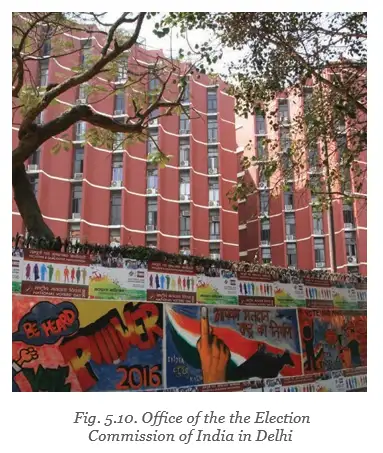
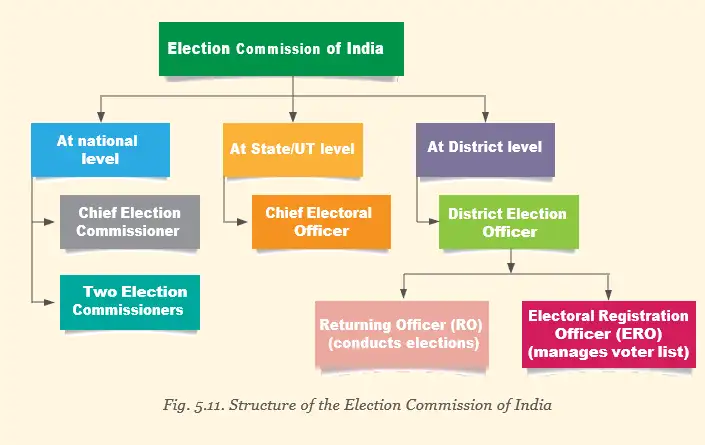
Role and responsibilities of the ECI
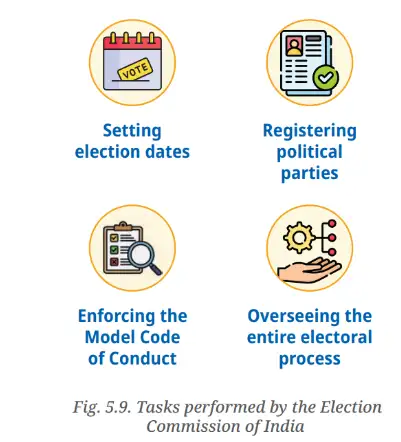
Key election dates
- 1950The Election Commission of India was established.
- 1951–1952Independent India held its first general elections.
Managing the electoral process
Elections across India
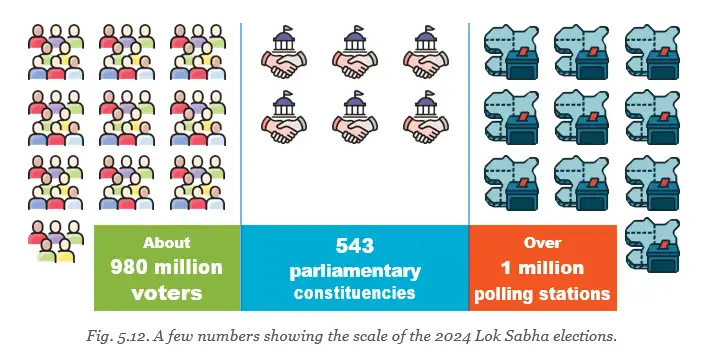
- Scale: Conducting elections across India is a large and complex task; the ECI continually upgrades its capacity to manage them efficiently.
- Similar process: State Assembly elections follow a process similar to Lok Sabha elections.
- Timing: Elections happen at different times, with regular periodicity; several polls may take place in different parts of India each year.
- Election staff: Many people are deployed to assist, including teachers.
Reserved Lok Sabha constituencies
- Scheduled Castes: 84 Lok Sabha constituencies are reserved for persons from Scheduled Castes.
- Scheduled Tribes: 47 Lok Sabha constituencies are reserved for persons from Scheduled Tribes.
Managing elections at a national scale
- A very large electorate and many constituencies → elections require extensive organisation.
- Extensive organisation → many polling stations and election staff are needed.
- Technology and coordinated election officials → help monitor and manage the process.
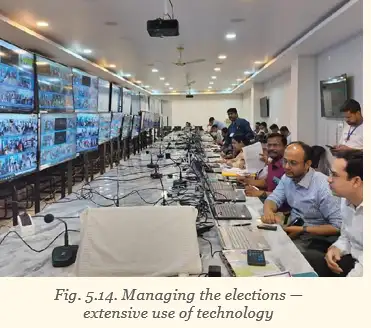
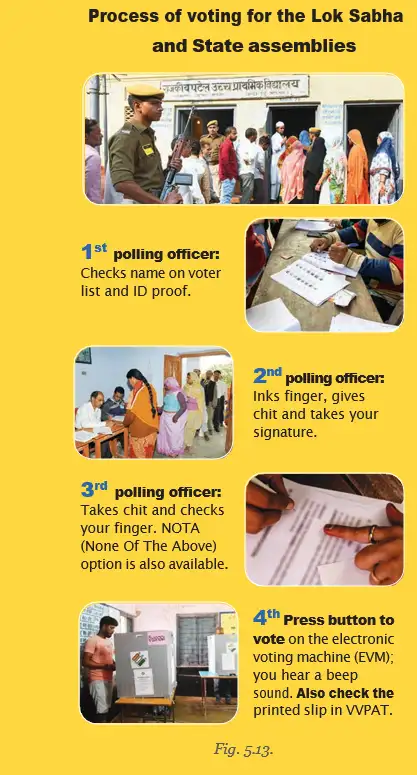
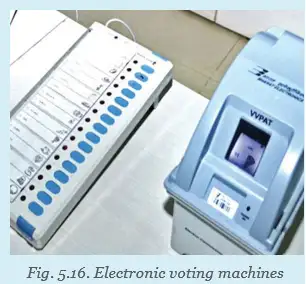
Voting technology: EVMs and VVPAT
- Electronic Voting Machine (EVM)
- A machine used to cast and record votes electronically.
- Voter Verifiable Paper Audit Trail (VVPAT)
- A system that produces a paper record so voters can check that their electronic vote was cast correctly.
Why VVPAT matters
- Verification: VVPAT lets voters verify their votes using a physical paper record.
- Backup: The paper record can support verification and recounting if there is a dispute or electronic system failure.
- Wider use: With ECI support, India’s EVM and VVPAT systems have been used in countries such as Namibia and Bhutan; other countries have studied the technology and received training from India.
Quick recap
- ECI: Independent constitutional body established in 1950 to conduct free and fair elections.
- Responsibilities: Conduct elections, set dates, register political parties, enforce the Model Code of Conduct, and oversee elections.
- First general elections: Held in independent India in 1951–1952.
- 2024 Lok Sabha scale: About 980 million voters, 543 constituencies and over 1 million polling stations.
- Reserved seats: 84 Lok Sabha constituencies for Scheduled Castes and 47 for Scheduled Tribes.
- Technology: EVMs record votes electronically; VVPAT provides a paper record for verification and recounting.
- Staffing: Elections require many workers, including teachers, and are held at different times throughout the country.
Model Code of Conduct (MCC)
Model Code of Conduct (MCC) — A set of dos and don’ts for political parties, leaders and candidates to help ensure free and fair elections.
Main Rules of the MCC
- Government resources: The party in power must not use government resources for election purposes.
- New announcements: New schemes or projects that could influence voters must not be announced during the election period.
- Candidate conduct: Candidates should act with restraint so elections remain peaceful.
- Bribery: Offering gifts in return for votes is punishable.
Examples of Election Complaints
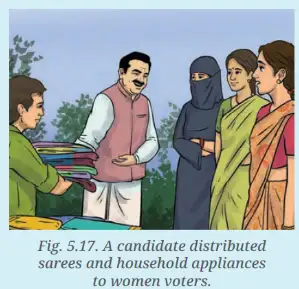
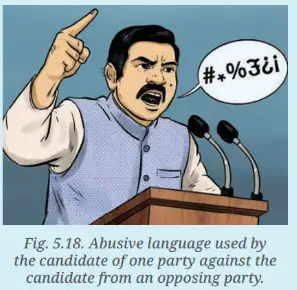
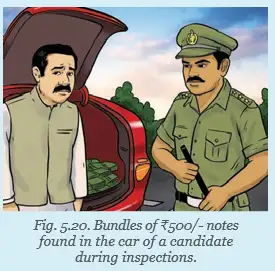
Adoption and Enforcement
Development of the MCC
- 1960The MCC was adopted in Kerala and voluntarily approved by representatives of major political parties.
- 1962The Election Commission of India (ECI) circulated the MCC to political parties during the general elections.
- 1990T.N. Seshan became Chief Election Commissioner.
- From 1991The ECI became proactive in ensuring that the MCC was observed.
T.N. Seshan’s Reforms
- Campaigning: He worked to ensure campaigning followed precise rules.
- Voter identification: Voter IDs were introduced to help eliminate proxy voting.
- Election spending: He ensured strict vigilance over candidates’ spending.
- Impact: His reforms helped make Indian elections fairer and more transparent.
- MCC
- Rules and guidelines for parties and candidates during elections.
- ECI
- The Election Commission of India, which circulates and helps enforce the MCC.
- Proxy voting
- Voting on behalf of another voter; voter IDs help prevent it.
How does the MCC help ensure free and fair elections?
Name three election reforms associated with T.N. Seshan.
Quick recap
- The MCC sets election dos and don’ts for political parties, leaders and candidates.
- The party in power must not use government resources to influence elections.
- Candidates should act with restraint; gifts offered in return for votes are punishable.
- The MCC was adopted in Kerala in 1960 and circulated by the ECI during the 1962 general elections.
- The ECI became proactive in MCC enforcement from 1991.
- T.N. Seshan’s reforms included campaign rules, voter IDs and strict monitoring of candidate spending.
Understanding Elections in India — A Very Brief Overview
Elections to the Lok Sabha and State Legislative Assemblies
Levels and elected representatives
- Elections: Often called the “Festival of Democracy”, elections let citizens choose representatives freely, fairly and responsibly.
- Parliamentary system: India has elections at national, state and local levels.
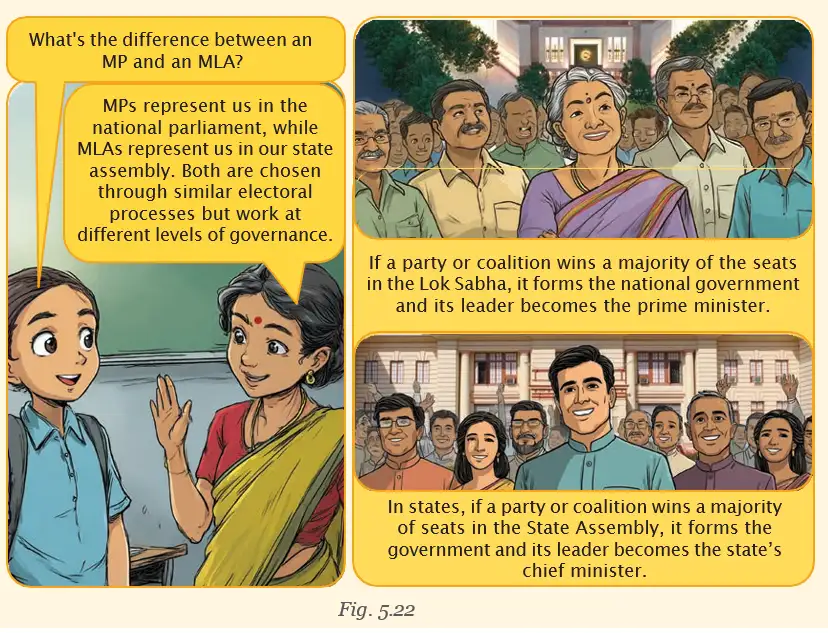
- Lok Sabha: India is divided into 543 constituencies for Lok Sabha elections; elected representatives are Members of Parliament (MPs).
- State assemblies: Elected representatives are Members of Legislative Assembly (MLAs). Assemblies may also be called Vidhan Sabha or Niyama Sabha.
- Local bodies: Elections are also held for city- and village-level bodies.
First-Past-the-Post (FPTP) — The candidate who receives the most votes in a constituency wins, even without receiving more than 50 per cent of the votes.
FPTP example
- Example: Gurmat won with 12 out of 33 votes because this was the highest vote count, even though it was less than half of all votes.
Forming governments
- National level: The party or coalition winning a majority of Lok Sabha seats forms the national government; its leader typically becomes Prime Minister.
- State level: The leader of the majority party in the state assembly becomes Chief Minister.
- Coalition: Two or more political parties working together.
Elections to local bodies
- State Election Commission: It plays an important role in conducting grassroots elections to local bodies.
- Coordination: It works in consultation with the Election Commission of India (ECI) on these matters.
- Franchise: Universal adult franchise and other constitutional provisions for direct elections also apply to local elections.
Election to the Rajya Sabha
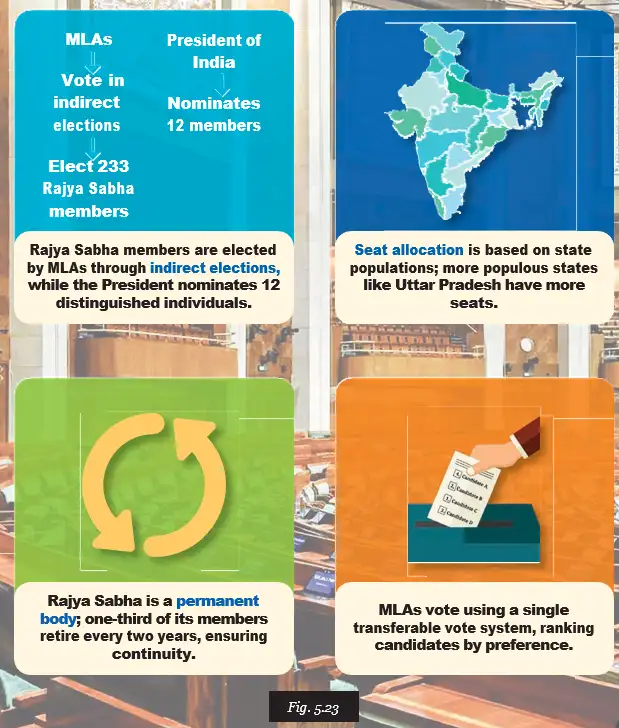
Indirect election — An election in which representatives are chosen by other elected representatives rather than directly by voters.
| Membership | How chosen |
|---|---|
| 233 members | Elected by elected members of state legislative assemblies (MLAs) |
| 12 members | Nominated by the President of India |
| 245 members in total | Total membership of the Rajya Sabha |
Seats, terms and voting
- Seat allocation: States have different numbers of Rajya Sabha seats based on population; Uttar Pradesh has more seats than Arunachal Pradesh.
- Permanent House: The Rajya Sabha, also called the Council of States, is never dissolved.
- Term: Each member serves six years; one-third of members retire every two years and are replaced through elections.
- Voting system: MLAs elect members using the single transferable vote system, which helps ensure fair representation for smaller states.
- Coalition
- Two or more political parties working together.
- Dissolution
- Expiry or termination when a term ends or for another constitutional reason.
- Rajya Sabha
- The Council of States; the permanent House of Parliament.
- Single transferable vote
- The voting system used by MLAs in Rajya Sabha elections, intended to support fair representation for smaller states.
How does the First-Past-the-Post system determine the winner?
How are Rajya Sabha members chosen, and how long do they serve?
Quick recap
- India follows a parliamentary system and holds elections at national, state and local levels.
- Voters elect MPs to the Lok Sabha and MLAs to state legislative assemblies; Rajya Sabha members are also MPs.
- Under FPTP, the candidate with the most votes wins, even without a majority of all votes; Gurmat won with 12 out of 33 votes.
- A majority party or coalition forms the national government; its leader typically becomes Prime Minister, while the majority party’s state leader becomes Chief Minister.
- The Rajya Sabha has 245 members: 233 elected by MLAs and 12 nominated by the President.
- The Rajya Sabha is permanent; members serve six years, and one-third retire every two years.
Election of the President of India
Election of the President
Electoral College — The group of representatives who elects the President of India.
Who votes for the President?
- Members of Parliament: Elected MPs from the Lok Sabha and Rajya Sabha.
- State representatives: Elected MLAs from the states, and from the Legislative Assemblies of Delhi and Puducherry.
- Not direct election: Common people do not vote directly; elected representatives choose the President on their behalf.
| Excluded group | Examples / details |
|---|---|
| Nominated members | Nominated Rajya Sabha members and nominated members of State Legislative Assemblies |
| Legislative Council members | Both elected and nominated members in states with bicameral legislatures |
| Nominated UT members | Nominated members of the Delhi and Puducherry assemblies |
Voting method and representation
- Method: The President is elected using the single transferable vote system.
- Balance: The system aims to include support from both the Union and state levels.
- Unequal vote value: Voting and counting rules are designed so more populous states have a greater say.
- Reason for excluding nominated members: The electoral college is based on elected representatives, giving the President indirect democratic legitimacy.
Election of the Vice President
| Point | President | Vice President |
|---|---|---|
| Who elects? | Elected MPs from both Houses and elected MLAs from states, Delhi and Puducherry | Elected and nominated members of both Houses of Parliament |
| Voting method | Single transferable vote | Single transferable vote |
| Key difference | Includes elected MLAs; nominated members are excluded | Includes nominated as well as elected MPs; MLAs do not vote |
Vice President’s role
- Rajya Sabha: The Vice President is its chairperson.
- When the President cannot serve: The Vice President steps in to perform the President’s functions.
Challenges and the Way Forward
| Challenge | Way forward |
|---|---|
| Growing influence of money in elections | Voters should make informed, thoughtful choices. |
| Candidates with criminal records | Voters need information to assess candidates responsibly. |
| Voter apathy, especially in urban areas | Education and awareness campaigns should encourage informed participation. |
Strengthening democracy
- Shared responsibility: Media, education and awareness campaigns can help people—especially young voters—understand the value of voting wisely.
- Vigilant voters: An informed and alert electorate is a strong safeguard for democracy.
- Responsible choice: Ask questions about candidates and cast an informed vote.
- Electoral College
- The representatives who elect the President or Vice President.
- Single transferable vote
- The voting system used to elect both the President and Vice President.
- Voter apathy
- Lack of interest or participation in voting.
Why do common people not directly elect the President?
State one difference between the Electoral Colleges for the President and Vice President.
Quick recap
- The President is elected indirectly by an Electoral College, not directly by the public.
- The President’s Electoral College includes elected MPs and elected MLAs from states, Delhi and Puducherry.
- Nominated members and Legislative Council members do not vote in the presidential election.
- Both presidential and vice-presidential elections use the single transferable vote system.
- The Vice President’s Electoral College includes elected and nominated members of both Houses of Parliament.
- Money in elections, candidates with criminal records and voter apathy are key electoral challenges.
- Informed, vigilant voters help protect democracy.
Summary
Universal Adult Franchise and Voting
Core ideas
- Universal adult franchise is a cornerstone of Indian democracy.
- Voting is both a right and a responsibility; every voter should take it seriously.
- Voter awareness helps people make informed use of their right to vote.
- Participation of all eligible voters should be facilitated.
- Challenges to democracy require voters to remain vigilant and aware.
Election Commission of India
Election Commission of India (ECI) — The ECI is the constitutional body responsible for conducting elections in India.
Role of the ECI
- Scope: The ECI oversees elections throughout the country.
- Includes: Its responsibilities cover elections for the President and Vice-President.
- Universal adult franchise
- The principle that all eligible adults can vote.
- Voter awareness
- Understanding the importance and responsible use of the right to vote.
- Election Commission of India
- The constitutional body that conducts and oversees elections in India.
- Voter vigilance
- Alertness to challenges that may affect Indian democracy.
Quick recap
- Universal adult franchise is a foundation of Indian democracy.
- Voting is a right as well as a responsibility.
- Voter awareness supports informed participation.
- The participation of every eligible voter should be facilitated.
- The constitutional ECI conducts and oversees elections, including those for the President and Vice-President.
- Voters must stay vigilant and aware of democratic challenges.