Class 9 . Mathematics . Ganita Manjari . Exploring Algebraic Identities
Chapter 4: Exploring Algebraic Identities
Ch 4
Mathematics
Class 9
Visualising Identities
A Pattern in Consecutive Squares
The pattern
- Result: For three consecutive square numbers, add the first and third, then subtract twice the middle; the result is always .
- General form: The squares are , , and ; the pattern is .
- Example: For , the calculation is .
Visualising the Square of a Sum
Square of a sum — The square of a sum is the product of a binomial by itself: .
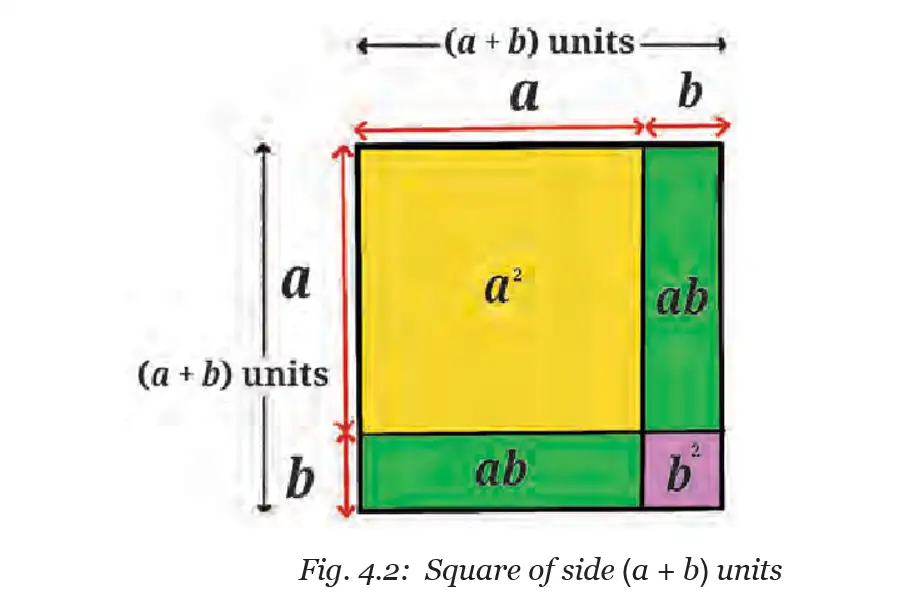
The whole square has area . Its four parts have areas , , , and , so .
Use this identity to expand the square of any binomial sum.
Why the identity works for all numbers
- Write the square as a product.
- Use the distributive property.
- Expand and combine the equal middle terms.
Expand .
- Expand by identifying the two terms.
- Substitute into the identity.
- Simplify each term.
Identities and Equations
Algebraic identity — An algebraic identity is an equality that is true for every allowed value of its variables.
| Point | Identity | Equation |
|---|---|---|
| Truth | True for all values of the variables. | May be true only for particular values. |
| Example | holds for all . | holds only when or . |
Number values do not restrict the identity
- All values: The distributive-property proof establishes the identity for all numbers, including negative and rational values.
- Check: For and , both and equal .
Comparing and
The difference between the expressions is ; therefore the sign of determines which is larger.
| Condition | Comparison |
|---|---|
Do not assume ; the missing middle term is .
Using the Identity in Calculations
Expand or evaluate a binomial square
- Identify the two terms as and .
- Substitute them into the identity .
- Simplify the squares and the middle product.
Evaluate using an identity.
Compare and when and .
For three consecutive squares , find the first-plus-third minus twice the middle.
Quick recap
- For consecutive squares, first plus third minus twice the middle is always .
- The square-of-a-sum identity is .
- The identity follows by multiplication and the distributive property, so it holds for all number values.
- An identity is true for all variable values; an equation may hold only for particular values.
- The comparison between and is determined by the sign of .
- Use the identity to expand binomials and simplify numerical squares.
Factorisation of Algebraic Expressions Using Identities
Factorising with the Perfect-Square Identity
Perfect-square trinomial — A trinomial matching the expansion of a squared binomial can be factorised as that binomial squared.
If the first and last terms are squares and the middle term is twice their square roots multiplied together, the trinomial is a perfect square.
Recognising the pattern
- Check the ends: Identify whether the first and last terms are squares.
- Check the middle: Confirm it equals twice the product of the square roots of the end terms.
- Common factor: Take it out first if all terms share one; then factor the remaining trinomial.
Use this pattern after matching the terms to the identity.
Factor a perfect-square trinomial
- Take out any common factor.
- Identify the square roots of the first and last terms as the two binomial terms.
- Verify that the middle term is twice their product, then write the squared binomial.
Factorise .
- Factor out the common factor 2.
- Recognise the remaining terms as a perfect square.
- Apply the positive square identity.
More identity matches
- Example: because the middle term is .
- Example: because the middle term is .
The Negative Square Identity and Its Uses
Negative square identity — The square of a difference expands into the square of the first term, minus twice their product, plus the square of the second term.
Replacing with in the positive square identity gives the expansion below.
Key applications
- Consecutive squares: For three consecutive numbers , the sum of the outside squares minus twice the middle square is always .
- Area model: A square of side split into lengths and has a smaller square of area and two rectangles of areas and .
- Subtract areas: Removing those two rectangles from the large square gives .
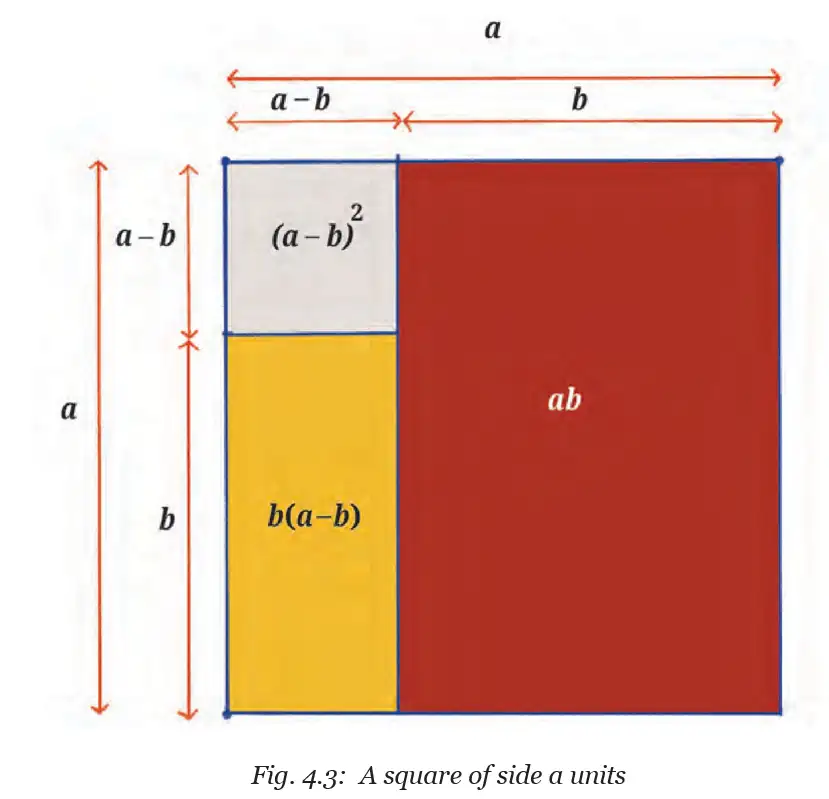
Use this identity to expand a difference squared or to calculate squares near a convenient round number.
Calculate a square using a nearby number
- Express the number as a convenient number minus a small amount.
- Substitute into the negative square identity.
- Evaluate and simplify the terms.
Calculate using an identity.
- Write 29 as a difference from 30.
- Apply the negative square identity.
- Calculate.
Factorise .
Factorise .
Find the sum of the squares of the smallest and largest of three consecutive numbers, then subtract twice the middle square.
Quick recap
- Match to to factor a perfect-square trinomial.
- Take out a common factor before checking for a perfect-square pattern.
- Use for differences and nearby-number calculations.
- For three consecutive numbers, .
- The square-area model also derives the identity for .
More Identities
Square of the Sum of Three Numbers
For any terms , , and , the square of their sum is the sum of their squares plus twice the sum of their pairwise products.
Use to expand or evaluate the square of a three-term sum.
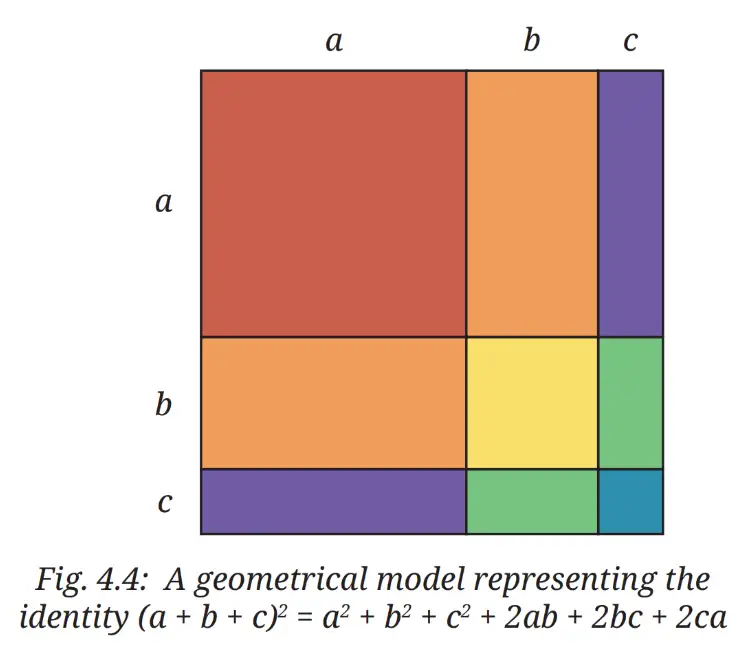
Expand a Three-Term Square
- Write the square of each term.
- Find each distinct pairwise product and double it.
- Add the squares and doubled pairwise products.
Evaluate using an algebraic identity.
- Write as a sum of three convenient numbers.
- Apply the square-of-a-trinomial identity.
- Evaluate and add the terms.
Do not omit a pairwise product or double only one overall: the three cross terms are , , and .
Difference of Squares and Quick Square Calculations
The difference of two squares factors as ; rearranging gives a useful expression for .
Use this form to calculate a square by choosing a convenient value of .
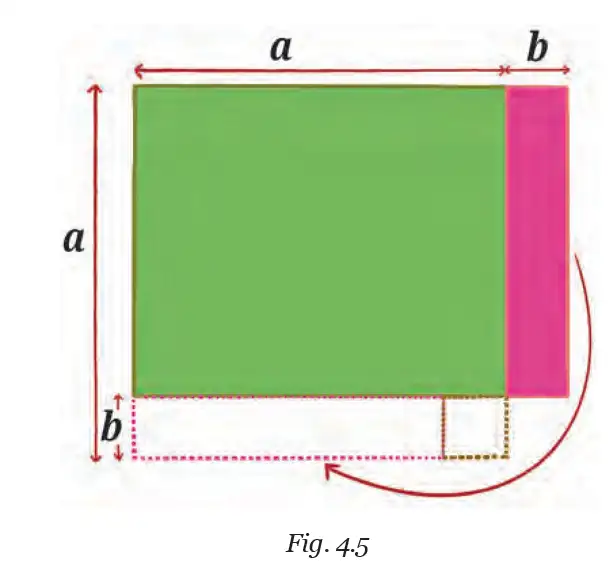
Calculate a Square Using the Rearranged Identity
- Choose a convenient so that and are easy to multiply.
- Multiply the sum and difference.
- Add the square of the chosen value of .
Evaluate using the rearranged difference-of-squares identity.
- Choose to make both factors round tens.
- Multiply the factors and add .
Three Square Identities
Historical Note
- In CE, Śrīdharācārya proposed using as a method for quickly calculating squares.
Evaluate using the rearranged difference-of-squares identity.
Evaluate using a suitable identity.
Expand .
Quick recap
- Expand a three-term square by adding each term's square and twice every pairwise product.
- The trinomial identity is .
- The difference-of-squares identity is .
- Rearrange it as to simplify square calculations.
- Choose to make the sum and difference easy to multiply.
- Śrīdharācārya proposed this quick-square method in CE.
Factorisation Using Algebra Tiles
Multiplying and factoring with algebra tiles
Algebra tiles — Algebra tiles are area pieces used to represent terms and visualise multiplication or factorisation.
Tile meanings
- Square tile: Its area represents .
- Rectangular tile: Its area represents .
- Unit tile: Its area represents .
- Area model: The total tile area gives the product; a rectangle's side lengths give its factors.
The product of a rectangle's side lengths equals the sum of the areas of the tiles inside it: .
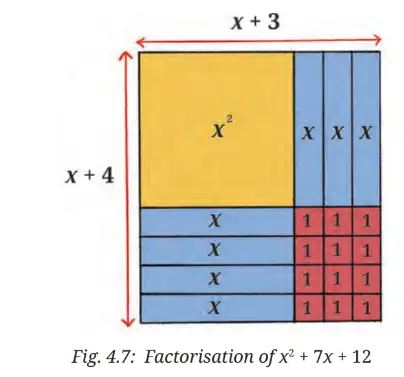
Reading the tile arrangement
- Split the middle term: The is represented as : three -tiles go beside the square tile and four go below it.
- Arrange the units: The unit tiles form a -by- array.
- Read the dimensions: The completed rectangle has side lengths and .
- Reverse the view: The same arrangement shows both multiplication and factorisation.
The area model gives the identity in either direction.
Factor a trinomial with tiles
- For , look for two positive factors of whose sum is ; this method applies when such factors exist.
- Split the middle term using those two numbers.
- Arrange the square, -tiles and unit tiles into a rectangle.
- Read the rectangle's dimensions as the two binomial factors.
Factorise using an area model.
- Find two factors of that add to .
- Split the middle term and group the tile areas into a rectangle.
- The rectangle's side lengths give the factors.
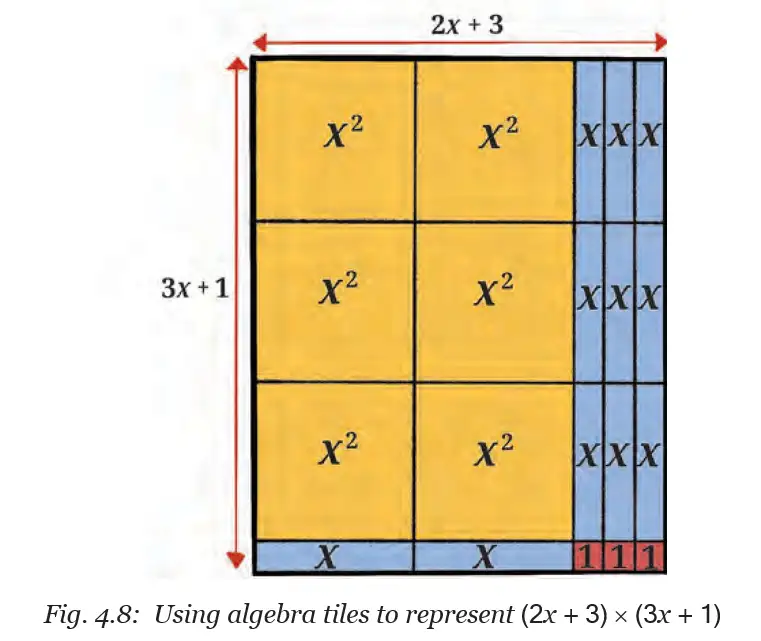
For constants and , multiplying two binomials gives a square term, a combined middle term and a constant term.
Use the distributive property; the cross-products form the coefficient of .
The two cross-products are and .
Example of the general area model
- Square-area tiles: .
- Cross-area tiles: .
- Unit tiles: .
- Total area: .
Find the product of and using the area model.
Factorise using tiles.
Expand using the distributive property.
Do not choose factors of the constant term alone: for , the two factors must also add to . Positive factors only work when such a pair exists.
Quick recap
- An -tile, an -tile and a unit tile have areas , and .
- A rectangle's tile areas add to its area, while its side lengths give the factors.
- For , positive factors of can split the middle term when they add to .
- .
- .
Factorisation Without Using Algebra Tiles
Factorising Monic Quadratics by Splitting the Middle Term
Factorisation by sum and product — Writing a quadratic expression as a product of two linear factors by finding two numbers with a required sum and product.
For a monic quadratic, if is the coefficient of and is the constant term, then the quadratic factors as .
Key points
- Find two numbers whose sum is the coefficient of and whose product is the constant term.
- Split the middle term using those two numbers; the quadratic becomes a product of binomials.
- Check signs: a positive product means the numbers have the same sign; a negative sum then makes both negative.
- Remember the factors are when the chosen numbers are and .
Use when the coefficient of is .
Sum-product method
- Identify the coefficient of and the constant term.
- Find a pair of numbers with that sum and product.
- Write the factors using the pair.
- Expand the factors to check the result.
Factorise .
- Factorise the expression by finding two numbers with sum and product .
- Use those numbers to split the middle term.
- Group and factor each pair.
- Take out the common binomial factor.
Do not choose numbers only because their product matches the constant; their sum must also match the coefficient of .
Combining Algebraic Identities
Equivalent identity forms — An expression can be rearranged or factored in different ways while remaining equal to the same algebraic expression.
Both routes are valid: expand the square first, or factor the sum and difference first. They give the same result.
Show that the two forms and are equal.
- Factor the product using the difference-of-squares identity.
- Replace the product of conjugate binomials.
- Expand to check that the alternative route gives the same result.
Factorise .
Factorise .
Show that .
Quick recap
- For , find two numbers whose sum is and product is .
- The matching numbers give the factors .
- For a positive product and negative sum, both selected numbers are negative.
- Check both the sum and product before splitting the middle term.
- The identity lets you combine or rearrange expressions.
Finding New Identities
Cubes of a Sum and Difference
Cube identities — Identities that expand the cube of a sum or difference into four terms.
In the sum expansion, all terms are positive. In the difference expansion, signs alternate.
Volume interpretation
- Cube of side can be divided into two cubes and six cuboids.
- Two cubes have volumes and .
- Six cuboids comprise three with volume and three with volume .
- Total volume is .
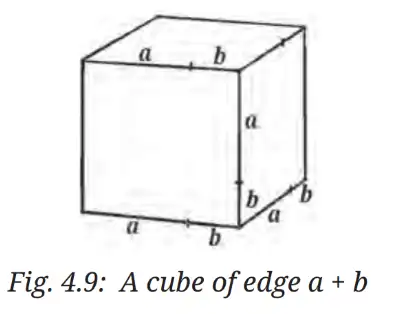
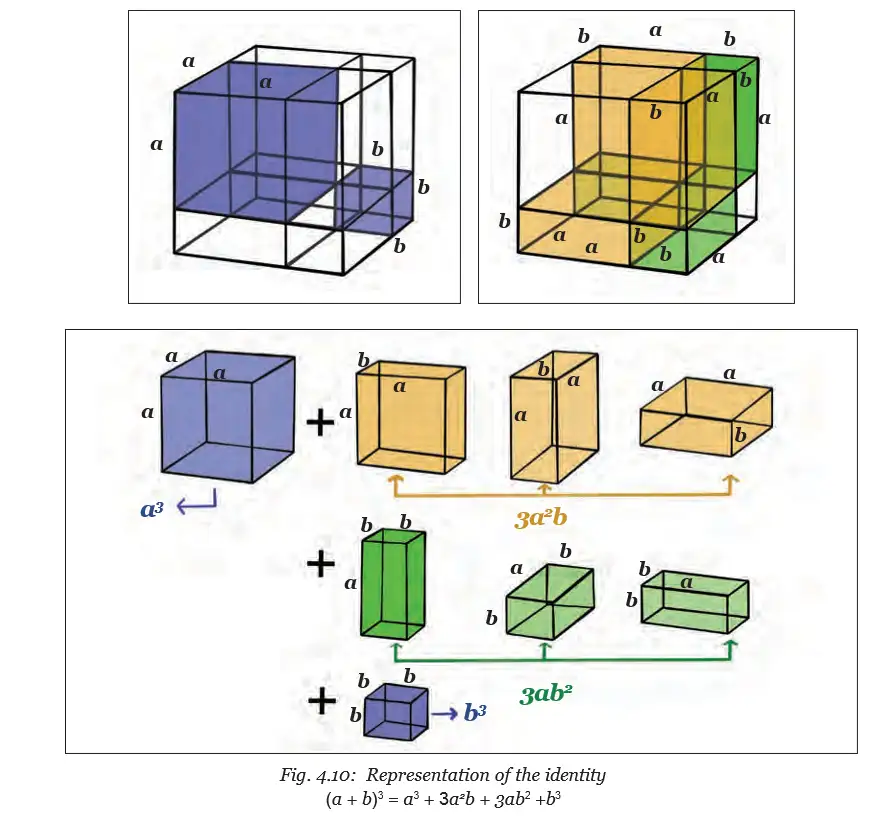
Use these to expand a cube or recognise an expression as a perfect cube.
Recognising a perfect cube
- Compare the first and last terms with the cubes of two expressions.
- Check that the middle terms match the cube identity.
- Use the signs to choose the sum or difference identity.
Find the side of a cube whose volume is .
- Rewrite each term to match the cube-of-a-sum pattern.
- Match the two expressions being added.
- The expression is the cube of the cube's side.
Do not give every term in a negative sign: the signs alternate, giving .
Cubic Factorisation Identities and Common Factors
Difference of cubes — A difference of two cubes factors into a difference of the bases times a quadratic expression.
The middle signs in the quadratic factors are opposite to the sign between the cubes.
The factor in higher powers
- Square: , so is a factor.
- Fourth power: .
- Fifth power: .
- General fact: is a factor of for any positive integer .
This general factorisation shows why is a factor of .
Simplify .
- Group the product and cancel equal positive and negative terms.
- The mixed terms cancel.
Identity for Three Variables
Three-variable cubic identity — This identity connects the sum of three cubes to the sum, pairwise products and product of three variables.
Multiplying the left-hand factors causes the mixed terms to cancel, leaving the three cubes and .
Use this to find when the sum and sum of squares are known.
Finding the sum of three cubes
- Find the pairwise-product sum from the square of the sum.
- Substitute the known sum, pairwise-product sum and product into the cubic identity.
Three numbers have sum , product , and sum of squares . Find the sum of their cubes.
- Use the square-of-a-sum relation to find the pairwise-product sum.
- Apply the three-variable cubic identity with the given sum and product.
- Evaluate to obtain the sum of the cubes.
Write in the form and identify and .
Factorise .
If , and , find .
Quick recap
- Expand with positive terms and with alternating signs.
- Use cube identities to recognise perfect-cube expressions.
- Factor and using their standard identities.
- is a factor of for every positive integer .
- Use the three-variable identity and the square-of-a-sum relation to find sums of cubes.
Simplifying Rational Expressions
Simplifying Rational Expressions by Factorisation
Simplifying a rational expression — Simplifying a rational expression means cancelling common factors in its factored numerator and denominator while retaining the original denominator restrictions.
For , , provided the original denominator is non-zero.
Choose numbers whose sum is the coefficient of and whose product is the constant term.
Simplify by factorisation
- Factor the numerator and denominator completely.
- Record values that make the original denominator zero.
- Cancel only common factors, then state the simplified expression and restrictions.
Simplify , assuming the denominator is non-zero.
- Factor the numerator using two numbers with sum and product .
- Factor out from the denominator, then factor the quadratic using numbers with sum and product .
- The original denominator is non-zero only when . Cancel the common factor .
Do not cancel parts of sums: factor first, and cancel only a factor common to the entire numerator and denominator. Keep restrictions from the original denominator.
Using Factorisation to Find Rectangle Dimensions
Area model — An area model expresses a rectangle's area as the product of its length and breadth; factoring the area polynomial gives possible dimensions.
If a rectangle has area and this factors as , its dimensions can be and .
Use the product of length and breadth to represent the total area.
Find dimensions from an area polynomial
- Add the areas of the pieces to form the total area polynomial.
- Factor the polynomial by finding two numbers with the required sum and product.
- Read the two factors as the rectangle's dimensions.
A square of side , eight rectangles of dimensions by , and fifteen unit squares form a rectangle. Find its dimensions.
- Add the areas of one square of side , eight -by- strips, and fifteen unit squares.
- Find two numbers with sum and product , then factor the area.
- The factors give the rectangle's dimensions.
Solving a Geometric Problem with a Quadratic Equation
Quadratic equation — A quadratic equation is an equation whose highest power of the variable is ; factorising it can reveal its solutions.
If , then or ; in a measurement problem, reject any solution that is not physically possible.
For length , breadth , and area , form the equation before solving.
Solve a measurement problem
- Represent the unknown measurement with a variable and express the other measurement in terms of it.
- Use the area formula to form a quadratic equation and write it in standard form.
- Factor, apply the zero-product property, and reject values that make a dimension negative or impossible.
A rectangular pool has breadth m less than its length and area . Find its dimensions.
- Let the pool's length be metres; its breadth is metres. Use the given area.
- Split the middle term using numbers with product and sum , then factor by grouping.
- The possible lengths are and ; reject because a length cannot be negative.
- Find the breadth from .
A quadratic may have a negative root, but a physical length or breadth cannot be negative; check each solution against the context.
Simplify , assuming the denominator is non-zero.
A rectangle has length units, breadth units, and area square units. Find its dimensions.
Quick recap
- Factor the numerator and denominator before simplifying; cancel common factors, not terms.
- Keep every restriction imposed by the original denominator.
- Factor an area polynomial to identify possible rectangle dimensions.
- Translate geometric relationships into a quadratic equation and factor it.
- Use the zero-product property, then reject solutions that are not physically possible.
Summary
Identity — An identity is an equation that is true for every permitted value of its variables.
Why identities are useful
- Visualisation: Geometrical models and algebra tiles can illustrate identities; tiles can also help visualise factorising quadratic expressions.
- Expansion and factorisation: Identities provide quick ways to expand products or factor expressions.
- Calculation: They help simplify calculations, such as squaring numbers and evaluating products.
- Rational expressions: Factor the numerator and denominator, then cancel common non-zero factors.
Key identities
Use these to expand squares or factor a difference of squares.
Use these to expand products; the second identity also gives the general coefficient pattern.
The sum and difference of cubes identities are useful for factorisation.
Applying identities
Simplifying a rational algebraic expression
- Factor the numerator and denominator using suitable identities.
- Identify and cancel factors common to the numerator and denominator.
- State restrictions that make any cancelled denominator factor non-zero.
Simplify .
- Factor the numerator and denominator.
- Cancel the common factor, noting that the original denominator is zero when .
Do not cancel terms across addition or subtraction; cancel only common factors. Keep the restriction that makes a cancelled denominator factor non-zero.
Expand .
Factor .
Simplify and state the restriction on .
Quick recap
- An identity is true for every permitted value of its variables.
- Geometrical models and algebra tiles can help visualise identities and quadratic factorisation.
- Identities make expansion, factorisation and numerical calculations more efficient.
- Know the square, binomial-product, cube and sum-of-three-cubes identities.
- In rational expressions, cancel common factors only and retain denominator restrictions.
Formula sheet
Mathematics — ALL CHAPTERS
1
Orienting Yourself: The Use of Coordinates
2
Introduction to Linear Polynomials
3
The World of Numbers
4
Exploring Algebraic Identities
5
I’m Up and Down, and Round and Round
6
Measuring Space: Perimeter and Area
7
The Mathematics of Maybe: Introduction to Probability
8
Predicting What Comes Next: Exploring Sequences and Progression