Class 9 . Mathematics . Ganita Manjari . Predicting What Comes Next Exploring Sequences and Progression

Chapter 8: Predicting What Comes Next: Exploring Sequences and Progression

Ch 8

Mathematics

Class 9

Lecture 1

Introduction to Sequences

Reference video · Lecture 1Introduction to Sequences

Sequences and Terms

Read a Sequence

  1. Read the terms from left to right.
    a1,a2,a3,…a_1,a_2,a_3,\ldots
  2. Count each term’s position, starting at 11.
    1,2,3,…1,2,3,\ldots
  3. Check whether the list ends or continues.
    finite or infinite\text{finite or infinite}
Worked example

How many terms are in 6,12,24,48,966,12,24,48,96, and is it finite or infinite?

  1. In the sequence 6,12,24,48,966,12,24,48,96, count the terms in order.
    6→1,12→2,24→3,48→4,96→56\to 1,\quad 12\to 2,\quad 24\to 3,\quad 48\to 4,\quad 96\to 5
  2. There are five listed terms, so the sequence is finite.
    5 terms5\text{ terms}
Answer: It has 55 terms and is finite.

Patterns in Familiar Number Sequences

Common Number Sequences
SequencePattern or ruleTerm formula
Natural numbers: 1,2,3,4,…1,2,3,4,\ldotsAdd 11 each time.tn=nt_n=n
Odd numbers: 1,3,5,7,…1,3,5,7,\ldotsAdd 22 each time.tn=2n−1t_n=2n-1
Triangular numbers: 1,3,6,10,15,…1,3,6,10,15,\ldotsAdd the next natural number; each term is a running sum.Tn=1+2+⋯+n=n(n+1)2T_n=1+2+\cdots+n=\frac{n(n+1)}{2}
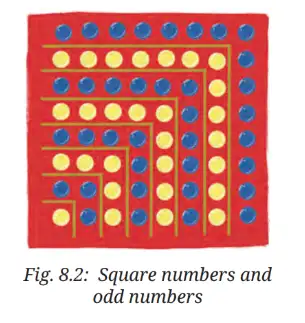
Square numbers: 1,4,9,16,25,…1,4,9,16,25,\ldotsThe terms are squares; successive differences are odd numbers.Sn=n2=1+3+⋯+(2n−1)S_n=n^2=1+3+\cdots+(2n-1)
Differences in Familiar Sequences

For the displayed terms, consecutive natural numbers differ by 11, odd numbers by 22, triangular numbers by 2,3,4,5,…2,3,4,5,\ldots, and square numbers by 3,5,7,9,…3,5,7,9,\ldots.

ΔTn=n+1,ΔSn=2n+1\Delta T_n=n+1,\qquad \Delta S_n=2n+1
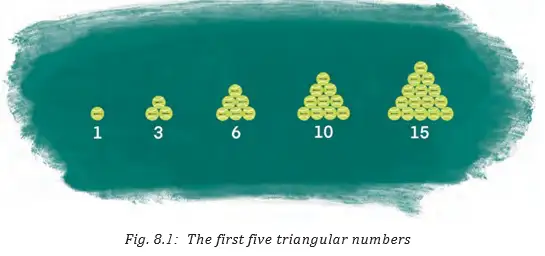
Dot arrangements represent the first five triangular numbers: 1,3,6,10,15.
Dot arrangements represent the first five triangular numbers: 1,3,6,10,151,3,6,10,15.
Successive odd-number groups build square dot arrangements.

Recognise a Number Pattern

  1. Compare consecutive terms to find their differences.
    an+1−ana_{n+1}-a_n
  2. Check whether the differences are constant or follow a pattern.
    1,2,3,…or3,5,7,…1,2,3,\ldots\quad\text{or}\quad 3,5,7,\ldots
  3. Use the rule to generate terms or identify a sum representation.
    Tn=1+2+⋯+nT_n=1+2+\cdots+n
Worked example

Find the sixth triangular number and show the odd-number sum for the sixth square number.

  1. The sixth triangular number is the sum of the first six natural numbers.
    T6=1+2+3+4+5+6T_6=1+2+3+4+5+6
  2. Evaluate the sum, or use the triangular-number formula.
    T6=6(6+1)2=21T_6=\frac{6(6+1)}{2}=21
  3. The sixth square number is the sum of the first six odd numbers.
    S6=1+3+5+7+9+11=36S_6=1+3+5+7+9+11=36
Answer: T6=21T_6=21 and S6=36S_6=36.

Term Notation and Other Sequences

Definition

Term Notation — The symbol tnt_n denotes the term in position nn of a sequence.

Using Term Symbols

  • Position and value: In the odd-number sequence, t1=1t_1=1, t2=3t_2=3, t3=5t_3=5, so t4=7t_4=7.
  • Different sequences: Use different letters, such as tnt_n, sns_n, or unu_n, to distinguish sequences.
  • Possible terms: Terms may be fractions, negative integers, or other real numbers; the position nn remains a positive integer.
  • Decreasing example: 1,12,13,14,…1,\frac12,\frac13,\frac14,\ldots has unit fractions in decreasing order.
  • Negative-term example: −7,−3,1,5,9,…-7,-3,1,5,9,\ldots increases by 44 each time.
Triangular-Number Terms
Tn=n(n+1)2T_n=\frac{n(n+1)}{2}

Use this to find the term at position nn in the triangular-number sequence.

Use Term Notation

  1. Identify the sequence and its term rule.
    Tn=n(n+1)2T_n=\frac{n(n+1)}{2}
  2. Substitute the required position for nn.
    n=5n=5
  3. Evaluate to find the term’s value.
    T5=5(6)2T_5=\frac{5(6)}{2}
Worked example

Find t5t_5 for the triangular-number sequence.

  1. Use the triangular-number rule to find the fifth term.
    T5=5(5+1)2T_5=\frac{5(5+1)}{2}
  2. Evaluate the expression.
    T5=302=15T_5=\frac{30}{2}=15
Answer: t5=T5=15t_5=T_5=15.
Practice

Continue 1,4,7,10,13,…1,4,7,10,13,\ldots for four more terms, then find the first ten partial sums.

Hint: The terms increase by 33; add each new term to the previous running total.
Key step: The next four terms are 16,19,22,2516,19,22,25.
Solution: Partial sums: 1,5,12,22,35,51,70,92,117,1451,5,12,22,35,51,70,92,117,145.
Practice

Write t5,t6,t7,t8t_5,t_6,t_7,t_8 for the triangular-number sequence.

Hint: Continue by adding the next natural number each time.
Key step: Tn=n(n+1)2T_n=\frac{n(n+1)}{2}.
Solution: t5=15, t6=21, t7=28, t8=36t_5=15,\ t_6=21,\ t_7=28,\ t_8=36.
Practice

Describe the rule and find the next two terms: −7,−3,1,5,9,…-7,-3,1,5,9,\ldots.

Hint: Compare consecutive terms.
Key step: Each term increases by 44.
Solution: The rule is to add 44; the next terms are 13,1713,17.

Quick recap

  • A sequence is an ordered list; each item is a term with a position.
  • A sequence is finite if it ends and infinite if it continues indefinitely.
  • Natural numbers add 11; odd numbers add 22.
  • Triangular numbers are running sums of natural numbers: Tn=n(n+1)2T_n=\frac{n(n+1)}{2}.
  • Square numbers are sums of consecutive odd numbers: n2=1+3+⋯+(2n−1)n^2=1+3+\cdots+(2n-1).
  • tnt_n names the term at position nn; terms themselves may be negative or fractional.
Lecture 2

Explicit Rule for a Sequence

Reference video · Lecture 2Explicit Rule for a Sequence

Finding a Term Directly

Term from an Explicit Rule
an=f(n)a_n=f(n)

Use this when the position is known and the term is required.

Evaluating an Explicit Rule

  1. Identify the position number requested.
  2. Substitute that number for nn in the explicit rule.
  3. Simplify to get the term.
Worked example

Find the 5353rd, 108108th and 11701170th odd numbers using un=2n−1u_n=2n-1.

  1. Find the 5353rd, 108108th and 11701170th terms of the odd-number sequence.
  2. Use the rule for odd numbers.
    un=2n−1u_n=2n-1
  3. Substitute n=53n=53.
    u53=2(53)−1=105u_{53}=2(53)-1=105
  4. Substitute n=108n=108.
    u108=2(108)−1=215u_{108}=2(108)-1=215
  5. Substitute n=1170n=1170.
    u1170=2(1170)−1=2339u_{1170}=2(1170)-1=2339
Answer: The terms are 105105, 215215 and 23392339.

Checking a Number or Finding Its Position

Testing Whether a Number Is a Term
an=ka_n=k

Set the explicit rule equal to the given number, then check whether the resulting position is a natural number.

Testing Membership or Finding Position

  1. Write the explicit rule equal to the number being checked.
  2. Solve the equation for nn.
  3. If nn is a natural number, the number is a term in position nn; otherwise, it is not a term.
Worked example

Which position does 137137 occupy in the odd-number sequence un=2n−1u_n=2n-1?

  1. Find the position of 137137 in the odd-number sequence.
  2. Set the rule equal to the given number.
    2n−1=1372n-1=137
  3. Solve for the position.
    2n=138,n=692n=138,\quad n=69
  4. Since 6969 is a natural number, 137137 is a term of the sequence.
Answer: 137137 is the 6969th term.
⚠ Common mistake

Do not accept a number as a term just because the equation has a solution; the solution for the position must be a natural number.

Practice

For tn=3n−7t_n=3n-7, find the first, second, third, 1212th, 1818th and 5050th terms.

Hint: Substitute each requested position into tn=3n−7t_n=3n-7.
Key step: t1=−4t_1=-4, t2=−1t_2=-1, and t3=2t_3=2.
Solution: The terms are −4,−1,2,29,47,143-4,-1,2,29,47,143.
Practice

For sn=5n−2s_n=5n-2, find the first six terms, the 100100th term and the 10001000th term.

Hint: Substitute n=1,2,3,4,5,6,100,1000n=1,2,3,4,5,6,100,1000 into the rule.
Key step: s1=3s_1=3 and the rule increases by 55 for each next position.
Solution: The first six terms are 3,8,13,18,23,283,8,13,18,23,28; s100=498s_{100}=498 and s1000=4998s_{1000}=4998.
Practice

For sn=5n−2s_n=5n-2, determine whether 308308 and 471471 are terms. If they are, give their positions.

Hint: Set 5n−25n-2 equal to each number and check whether the solution is a natural number.
Key step: 5n−2=3085n-2=308 gives n=62n=62; 5n−2=4715n-2=471 gives n=94.6n=94.6.
Solution: 308308 is the 6262nd term. 471471 is not a term because 94.694.6 is not a natural-number position.

Quick recap

  • An explicit rule calculates a term directly from its position number.
  • For odd numbers, un=2n−1u_n=2n-1; for square numbers, an=n2a_n=n^2.
  • To find a term, substitute its position number into the rule.
  • To test membership or find position, set the rule equal to the number and solve for nn.
  • A number is a sequence term only when its position is a natural number.
Lecture 3

Recursive Rule for a Sequence

Reference video · Lecture 3Recursive Rule for a Sequence

Recursive Rules Using the Previous Term

One-term recurrence

When each term is found from the previous term, the starting value and the recurrence together determine the sequence. For n≥2n\geq 2, a common form is an=f(an−1)a_n=f(a_{n-1}).

Example of a One-Term Recursive Rule
t1=1,tn=tn−1+3(n≥2)t_1=1,\quad t_n=t_{n-1}+3\quad(n\geq 2)

The sequence begins with 11 and adds 33 to the previous term.

Generate Terms from a Recursive Rule

  1. Write down the given starting term or terms.
  2. Apply the recurrence to find the next term.
  3. Repeat using the newest term and continue until the required position.
Worked example

Find the first four terms and decide whether 133133 is a term of the sequence.

  1. Given u1=1u_1=1 and un=2un−1+3u_n=2u_{n-1}+3 for n≥2n\geq 2, generate the first four terms and decide whether 133133 is a term.
  2. Use the rule to find the second term.
    u2=2u1+3=2(1)+3=5u_2=2u_1+3=2(1)+3=5
  3. Use the second term to find the third.
    u3=2u2+3=2(5)+3=13u_3=2u_2+3=2(5)+3=13
  4. Use the third term to find the fourth.
    u4=2u3+3=2(13)+3=29u_4=2u_3+3=2(13)+3=29
  5. Continue the sequence to check whether 133133 occurs.
    u5=2(29)+3=61,u6=2(61)+3=125,u7=2(125)+3=253u_5=2(29)+3=61,\quad u_6=2(61)+3=125,\quad u_7=2(125)+3=253
Answer: The first four terms are 1,5,13,291,5,13,29. Since the sequence goes from 125125 to 253253, 133133 is not a term.

Recursive Rules Using Previous Terms

Multi-term recurrence

A recursive rule may use two or more earlier terms; the starting values must be supplied for each earlier term used.

Virahanka–Fibonacci Recurrence
V1=1,V2=2,Vn=Vn−1+Vn−2(n≥3)V_1=1,\quad V_2=2,\quad V_n=V_{n-1}+V_{n-2}\quad(n\geq 3)

Each term is the sum of the previous two terms.

Worked example

Generate the sequence and find the two terms after 3434.

  1. Start with V1=1V_1=1 and V2=2V_2=2; add the previous two terms each time.
  2. Find the third and fourth terms.
    V3=V2+V1=2+1=3,V4=V3+V2=3+2=5V_3=V_2+V_1=2+1=3,\quad V_4=V_3+V_2=3+2=5
  3. Continue to the sixth term.
    V5=5+3=8,V6=8+5=13V_5=5+3=8,\quad V_6=8+5=13
  4. Continue the sequence through 3434 and find the next two terms.
    V7=13+8=21,V8=21+13=34,V9=34+21=55,V10=55+34=89V_7=13+8=21,\quad V_8=21+13=34,\quad V_9=34+21=55,\quad V_{10}=55+34=89
Answer: The next two terms are 5555 and 8989.
Practice

For s1=3s_1=3 and sn=sn−1(sn−1−1)s_n=s_{n-1}(s_{n-1}-1) for n≥2n\geq 2, find the first four terms.

Hint: Substitute each newly calculated term into the recurrence.
Key step: s2=3(3−1)=6s_2=3(3-1)=6; then use 66 and 3030 in turn.
Solution: s1=3s_1=3, s2=6s_2=6, s3=6(6−1)=30s_3=6(6-1)=30, and s4=30(30−1)=870s_4=30(30-1)=870. The first four terms are 3,6,30,8703,6,30,870.
Practice

The Virahanka–Fibonacci sequence begins 1,2,3,5,8,13,21,341,2,3,5,8,13,21,34. Find the next two terms.

Hint: Add the two immediately preceding terms to obtain each new term.
Key step: Use 21+3421+34 for the next term, then add that result to 3434.
Solution: 21+34=5521+34=55 and 34+55=8934+55=89. The next two terms are 5555 and 8989.

Quick recap

  • A recursive rule gives terms using earlier terms and requires starting value(s).
  • A one-term recurrence uses the immediately previous term to generate the next.
  • A multi-term recurrence can use two or more earlier terms.
  • The Virahanka–Fibonacci sequence starts 1,21,2 and adds the previous two terms.
  • Generate a sequence step by step, using each calculated term in the next substitution.
Lecture 4

Arithmetic Progressions

Reference video · Lecture 4Arithmetic Progressions

Recognising an Arithmetic Progression
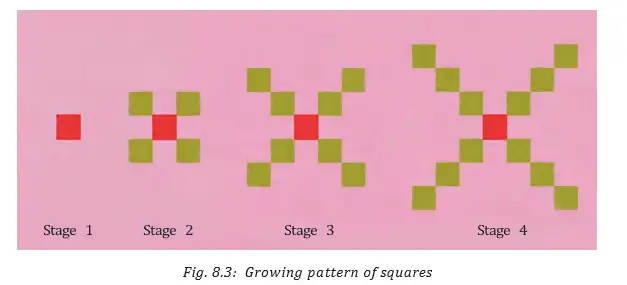
A growing square pattern across Stages 1–4.

Growing-square pattern

  • Square counts: The first stages contain 1,5,9,13,…1, 5, 9, 13, \ldots squares; each stage adds 44 squares.
  • Pattern rule: Stage nn has 1+(n−1)×4=4n−31+(n-1)\times4=4n-3 squares.
  • First six counts: 1,5,9,13,17,211, 5, 9, 13, 17, 21.
Definition

Arithmetic progression (AP) — A sequence is an AP if the difference between every pair of consecutive terms is constant.

Common difference

The fixed difference between consecutive terms is the common difference, denoted by dd. For an AP, tn+1−tn=dt_{n+1}-t_n=d for every valid nn.

d=t2−t1d=t_2-t_1

Examples and direction

  • Increasing AP: 1,5,9,13,…1, 5, 9, 13, \ldots has d=4d=4.
  • Decreasing AP: 11,7,3,−1,−5,…11, 7, 3, -1, -5, \ldots has d=−4d=-4.
  • Test: If the consecutive differences are not all equal, the sequence is not an AP.
General form of an AP
a, a+d, a+2d, a+3d,…, a+(n−1)da,\ a+d,\ a+2d,\ a+3d,\ldots,\ a+(n-1)d

aa is the first term and dd is the common difference.

Explicit rule for the nth term
tn=a+(n−1)dt_n=a+(n-1)d

Use this rule to find the term at position nn directly.

Finding the nth term

  1. Identify the first term and calculate the common difference.
    a=t1,d=t2−t1a=t_1,\qquad d=t_2-t_1
  2. Substitute aa and dd into the explicit rule.
    tn=a+(n−1)dt_n=a+(n-1)d
  3. Simplify the expression to get the nth-term rule.
    tn=a+(n−1)dt_n=a+(n-1)d

Visualising an AP

Square counts by stage
Stage numberNumber of squares
1111
2255
3399
441313
551717
nn4n−34n-3
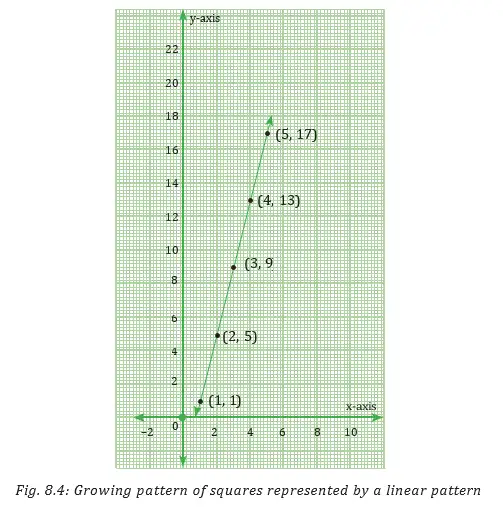
The ordered pairs for the square pattern lie on a straight line.

Graph of an AP

  • Ordered pairs: Pair each term number xx with its term value yy; for the square pattern these include (1,1),(2,5),(3,9),(4,13),(5,17)(1,1), (2,5), (3,9), (4,13), (5,17).
  • Observation: These points lie on a straight line when plotted.
Recursive rule for an AP
t1=a,tn=tn−1+d(n≥2)t_1=a,\qquad t_n=t_{n-1}+d\quad(n\ge2)

Start with the first term, then add the common difference to obtain each next term.

Square-pattern recurrence

  • Rule: t1=1t_1=1 and tn=tn−1+4t_n=t_{n-1}+4 for n≥2n\ge2; repeatedly adding 44 gives 1,5,9,13,…1, 5, 9, 13, \ldots.
Worked example

What is the total taxi fare for travelling 10 km?

  1. A taxi charges a fixed booking fee of Rs. 200 plus Rs. 40 per kilometre. The first few fares are Rs. 240, Rs. 280, Rs. 320, so the sequence is an AP.
    a=240,d=40a=240,\qquad d=40
  2. Write the fare after nn kilometres using the nth-term formula.
    tn=240+(n−1)40=200+40nt_n=240+(n-1)40=200+40n
  3. Substitute n=10n=10 to find the fare for 1010 kilometres.
    t10=200+40(10)=600t_{10}=200+40(10)=600
Answer: The fare for 1010 km is Rs. 600.
Practice

Verify that 2,5,8,11,…2, 5, 8, 11, \ldots is an AP and find its nth term. What do its term-number/term-value points do when plotted?

Hint: Find the constant difference and substitute the first term and difference into tn=a+(n−1)dt_n=a+(n-1)d.
Key step: a=2a=2 and d=3d=3.
Solution: The differences are all 33, so it is an AP. tn=2+3(n−1)=3n−1t_n=2+3(n-1)=3n-1. Its ordered pairs lie on a straight line.
Practice

Find the nth terms of (i) 12,52,92,132,…\frac12, \frac52, \frac92, \frac{13}{2}, \ldots and (ii) 1.5,3.5,5.5,7.5,…1.5, 3.5, 5.5, 7.5, \ldots.

Hint: For each sequence, identify aa and dd, then use tn=a+(n−1)dt_n=a+(n-1)d.
Key step: Both sequences have common difference 22.
Solution: (i) tn=12+2(n−1)=4n−32t_n=\frac12+2(n-1)=\frac{4n-3}{2}. (ii) tn=1.5+2(n−1)=2n−0.5t_n=1.5+2(n-1)=2n-0.5.
Practice

Write recursive rules for 2,5,8,11,…2, 5, 8, 11, \ldots and −5,−1,3,7,…-5, -1, 3, 7, \ldots.

Hint: For each AP, give its first term and add its common difference at each step.
Key step: The common differences are 33 and 44, respectively.
Solution: For 2,5,8,…2, 5, 8, \ldots: t1=2t_1=2, tn=tn−1+3t_n=t_{n-1}+3 for n≥2n\ge2. For −5,−1,3,…-5, -1, 3, \ldots: t1=−5t_1=-5, tn=tn−1+4t_n=t_{n-1}+4 for n≥2n\ge2.

Quick recap

  • An AP has the same difference between every pair of consecutive terms.
  • The first term is aa and the common difference is dd.
  • The explicit rule is tn=a+(n−1)dt_n=a+(n-1)d.
  • The recursive rule is t1=at_1=a and tn=tn−1+dt_n=t_{n-1}+d for n≥2n\ge2.
  • Plotting term number against term value for an AP gives points on a straight line.
  • A fixed fee plus a constant charge per kilometre produces an AP of fares.
Lecture 5

Sum of the First n Natural Numbers

Reference video · Lecture 5Sum of the First n Natural Numbers

Pairing the Sum

Sum of the First n Natural Numbers
Sn=1+2+⋯+n=n(n+1)2S_n=1+2+\cdots+n=\frac{n(n+1)}{2}

Use this to find the total of the first nn natural numbers.

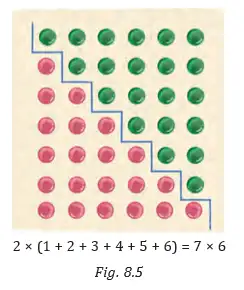
Two copies of 1+2+3+4+5+6 form a 7×6 rectangle, so twice the sum equals 7×6.
Two copies of 1+2+3+4+5+61+2+3+4+5+6 form a 7×67\times6 rectangle, so twice the sum equals 7×67\times6.

Sum of Consecutive Numbers

Sum from a to b
a+(a+1)+⋯+b=(b−a+1)(a+b)2a+(a+1)+\cdots+b=\frac{(b-a+1)(a+b)}{2}

Use for consecutive integers including both endpoints.

Finding a Consecutive-Number Sum

  1. Identify the first and last terms, aa and bb.
    a, ba,\ b
  2. Find the number of terms.
    b−a+1b-a+1
  3. Multiply the term count by the average of the endpoints.
    (b−a+1)(a+b)2\frac{(b-a+1)(a+b)}{2}
Worked example

Find 25+26+⋯+5825+26+\cdots+58.

  1. Find the number of integers from 2525 through 5858.
    58−25+1=3458-25+1=34
  2. Add the first and last terms.
    25+58=8325+58=83
  3. Multiply the count by the endpoint average.
    34×832=17×83=1411\frac{34\times83}{2}=17\times83=1411
Answer: 14111411

Triangular Numbers

nth Triangular Number
tn=n(n+1)2t_n=\frac{n(n+1)}{2}

Use to find the triangular number at position nn.

Practice

Find S50S_{50}.

Hint: Substitute n=50n=50 into Sn=n(n+1)2S_n=\frac{n(n+1)}{2}.
Key step: S50=50×512S_{50}=\frac{50\times51}{2}.
Solution: S50=25×51=1275S_{50}=25\times51=1275.
Practice

Find S1000S_{1000}.

Hint: Use the first-nn natural numbers formula.
Key step: S1000=1000×10012S_{1000}=\frac{1000\times1001}{2}.
Solution: S1000=500×1001=500500S_{1000}=500\times1001=500500.
Practice

Find the 1717th triangular number.

Hint: Use tn=n(n+1)2t_n=\frac{n(n+1)}{2}.
Key step: t17=17×182t_{17}=\frac{17\times18}{2}.
Solution: t17=153t_{17}=153.

Quick recap

  • Reversing and adding the sum gives 2Sn=n(n+1)2S_n=n(n+1).
  • The sum of the first nn natural numbers is Sn=n(n+1)2S_n=\frac{n(n+1)}{2}.
  • The sum from aa to bb is (b−a+1)(a+b)2\frac{(b-a+1)(a+b)}{2}.
  • The number of consecutive terms from aa to bb is b−a+1b-a+1.
  • The nnth triangular number is tn=n(n+1)2t_n=\frac{n(n+1)}{2}.
Lecture 6

Geometric Progressions Part-1

Reference video · Lecture 6Geometric Progressions Part-1

Geometric Progressions and Their Terms (GP)
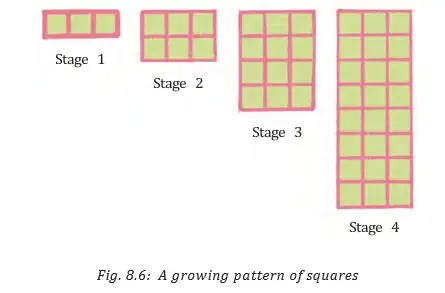
A growing pattern of square grids across four stages.
Definition

Geometric progression (GP) — A sequence in which the ratio of each term to the term immediately before it is constant.

Recognising a GP

  • Common ratio: For consecutive terms, divide the later term by the earlier one; in a GP, every such ratio is the same.
  • General form: A GP with first term aa and common ratio rr is a,ar,ar2,ar3,…a, ar, ar^2, ar^3, \ldots.
  • Examples: 1,2,4,8,…1,2,4,8,\ldots has r=2r=2; 1,3,9,27,…1,3,9,27,\ldots has r=3r=3; 1,−1,1,−1,…1,-1,1,-1,\ldots has r=−1r=-1.
  • Growing square pattern: The stage counts 3,6,12,24,…3,6,12,24,\ldots double at every step; the next two counts are 4848 and 9696.
Constant-ratio property

A sequence of nonzero consecutive terms is a GP when the ratios of successive terms are equal: t2t1=t3t2=⋯=r\frac{t_2}{t_1}=\frac{t_3}{t_2}=\cdots=r.

Nth term and recursive rule
tn=arn−1,t1=a,tn=rtn−1 (n≥2)t_n=ar^{n-1},\qquad t_1=a,\quad t_n=rt_{n-1}\ (n\ge 2)

Use the first formula for the term at position nn; the recursive rule generates each term from the previous one.

Common ratio
r=tn+1tnr=\frac{t_{n+1}}{t_n}

For consecutive terms, calculate the later term divided by the earlier term.

How to check whether a sequence is a GP

  1. Divide each term after the first by the term immediately before it.
    r1=t2t1,r2=t3t2,…r_1=\frac{t_2}{t_1},\quad r_2=\frac{t_3}{t_2},\quad \ldots
  2. Compare the ratios: if all are equal, the sequence is a GP; that shared value is rr.
  3. Use the first term aa and common ratio rr in the nth-term formula.
    tn=arn−1t_n=ar^{n-1}
Worked example

Check whether 5,154,4516,13564,…5,\frac{15}{4},\frac{45}{16},\frac{135}{64},\ldots is a GP and find its nth term.

  1. Check whether 5,154,4516,13564,…5,\frac{15}{4},\frac{45}{16},\frac{135}{64},\ldots is a GP and find its nth term.
  2. Find the ratios of consecutive terms.
    t2t1=15/45=34,t3t2=45/1615/4=34,t4t3=135/6445/16=34\frac{t_2}{t_1}=\frac{15/4}{5}=\frac{3}{4},\quad \frac{t_3}{t_2}=\frac{45/16}{15/4}=\frac{3}{4},\quad \frac{t_4}{t_3}=\frac{135/64}{45/16}=\frac{3}{4}
  3. The ratios are equal, so the sequence is a GP with first term a=5a=5 and common ratio r=34r=\frac{3}{4}.
  4. Substitute these values into the nth-term formula.
    tn=5(34)n−1t_n=5\left(\frac{3}{4}\right)^{n-1}
Answer: It is a GP with common ratio 34\frac{3}{4} and nth term tn=5(34)n−1t_n=5\left(\frac{3}{4}\right)^{n-1}.
⚠ Common mistake

Do not subtract consecutive terms to test for a GP; compare their quotients. A constant difference indicates an arithmetic pattern, not necessarily a GP.

Practice

Check each sequence for a GP and give its common ratio and nth term: (i) 2,10,50,250,…2,10,50,250,\ldots; (ii) 4,83,169,3227,…4,\frac{8}{3},\frac{16}{9},\frac{32}{27},\ldots; (iii) 3,−32,34,−38,…3,-\frac{3}{2},\frac{3}{4},-\frac{3}{8},\ldots.

Hint: Find the ratio of each term to the preceding term, then use tn=arn−1t_n=ar^{n-1}.
Key step: The common ratios are 55, 23\frac{2}{3}, and −12-\frac{1}{2}, respectively.
Solution: All three are GPs. (i) a=2a=2, r=5r=5: tn=2⋅5n−1t_n=2\cdot5^{n-1}. (ii) a=4a=4, r=23r=\frac{2}{3}: tn=4(23)n−1t_n=4\left(\frac{2}{3}\right)^{n-1}. (iii) a=3a=3, r=−12r=-\frac{1}{2}: tn=3(−12)n−1t_n=3\left(-\frac{1}{2}\right)^{n-1}.
Practice

Write a recursive rule for the sequence generated by tn=3×10n−1t_n=3\times10^{n-1}.

Hint: Identify the first term and the constant multiplier between consecutive terms.
Key step: The first term is 33 and each next term is 1010 times the previous term.
Solution: t1=3t_1=3 and tn=10tn−1t_n=10t_{n-1} for n≥2n\ge2.

Quick recap

  • A GP has the same ratio between every pair of consecutive terms.
  • The common ratio is r=tn+1tnr=\frac{t_{n+1}}{t_n}.
  • A GP has general form a,ar,ar2,…a,ar,ar^2,\ldots.
  • Its nth term is tn=arn−1t_n=ar^{n-1}.
  • Its recursive rule is t1=at_1=a and tn=rtn−1t_n=rt_{n-1} for n≥2n\ge2.
  • For the pattern 3,6,12,24,…3,6,12,24,\ldots, tn=3⋅2n−1t_n=3\cdot2^{n-1}.
Lecture 7

Geometric Progressions Part-2

Reference video · Lecture 7Geometric Progressions Part-2

The Sierpiński Triangle

Definition

Fractal — A fractal is a shape or pattern that repeats similar forms at different scales; the Sierpiński triangle is a fractal.

How the Pattern Develops

  • Start: Stage 00 is one filled equilateral triangle.
  • Each stage: Divide every black triangle into 44 equal smaller triangles and remove the central one.
  • Result: Each black triangle becomes 33 smaller black triangles.
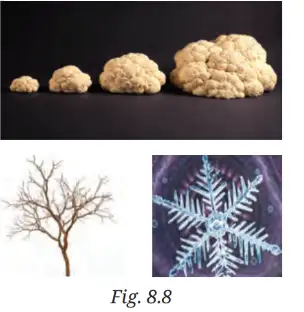
  • Natural patterns: Fractal-like forms occur in branching trees, cauliflower or broccoli, snowflakes, and coastlines.
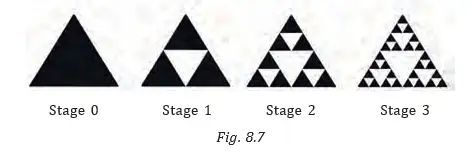
Stages 0–3 show the triangle pattern becoming increasingly subdivided.
Triangle Count and Black Area
Stage nnBlack trianglesBlack area when Stage 00 area is 11
001111
113334\frac{3}{4}
2299(34)2\left(\frac{3}{4}\right)^2
332727(34)3\left(\frac{3}{4}\right)^3
448181(34)4\left(\frac{3}{4}\right)^4
55243243(34)5\left(\frac{3}{4}\right)^5

Geometric Progressions in the Pattern

Definition

Geometric progression (GP) — A sequence in which each term after the first is obtained by multiplying the previous term by the same constant number, called the common ratio.

Stage Patterns

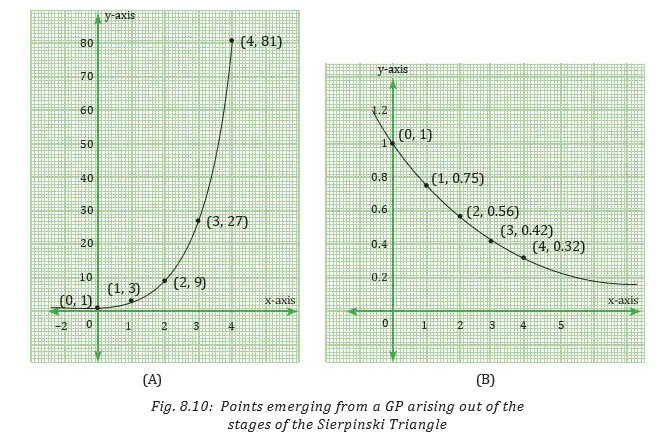
The triangle counts 1,3,9,27,…1,3,9,27,\ldots form a GP with common ratio 33. The black areas 1,34,(34)2,…1,\frac{3}{4},\left(\frac{3}{4}\right)^2,\ldots form a GP with common ratio 34\frac{3}{4}. The count triples each stage, while the area is multiplied by 34\frac{3}{4} each stage.

Count and Area at Stage nn
Tn=3nAn=(34)nT0=1,Tn=3Tn−1 (n≥1)A0=1,An=34An−1 (n≥1)\begin{aligned}T_n&=3^n\\A_n&=\left(\frac{3}{4}\right)^n\\T_0&=1,\quad T_n=3T_{n-1}\ (n\geq 1)\\A_0&=1,\quad A_n=\frac{3}{4}A_{n-1}\ (n\geq 1)\end{aligned}

The original triangle is Stage 00; the area formula assumes its area is 11 square unit.

Finding the Count and Area at a Stage

  1. Identify the stage number, counting the initial triangle as Stage 00.
    nn
  2. Find the number of black triangles using the count rule.
    Tn=3nT_n=3^n
  3. Find the black area using the area rule and the original area.
    An=(34)nA_n=\left(\frac{3}{4}\right)^n
Worked example

Find the count and area at Stage 55.

  1. Find the number of black triangles and black area at Stage 55, if the Stage 00 area is 11 square unit.
    n=5n=5
  2. Substitute n=5n=5 into the triangle-count formula.
    T5=35=243T_5=3^5=243
  3. Substitute n=5n=5 into the area formula.
    A5=(34)5=2431024A_5=\left(\frac{3}{4}\right)^5=\frac{243}{1024}
Answer: There are 243243 black triangles, and their total area is 2431024\frac{243}{1024} square units.
Long-Term Behaviour

As nn increases, Tn=3nT_n=3^n grows without bound, while An=(34)nA_n=\left(\frac{3}{4}\right)^n approaches 00.

⚠ Common mistake

Do not treat Stage 11 as the starting stage: the original triangle is Stage 00, so T0=A0=1T_0=A_0=1 and the exponent is the stage number.

Examples of repeating natural patterns include branching forms and snowflakes.
Practice

How many black triangles are there at Stage 44?

Hint: Use the triangle-count formula with n=4n=4.
Key step: T4=34T_4=3^4.
Solution: T4=34=81T_4=3^4=81. There are 8181 black triangles.
Practice

If the Stage 00 area is 11 square unit, what is the black area at Stage 33?

Hint: Each stage retains 34\frac{3}{4} of the previous black area.
Key step: A3=(34)3A_3=\left(\frac{3}{4}\right)^3.
Solution: A3=(34)3=2764A_3=\left(\frac{3}{4}\right)^3=\frac{27}{64} square units.

Why do the triangle count and black area change in opposite ways?

Answer: Each black triangle produces 33 smaller black triangles, multiplying the count by 33. The total black area retains only 34\frac{3}{4} of its previous value at each stage, so it decreases.

Quick recap

  • The Sierpiński triangle is a fractal formed by repeatedly removing the central part of subdivided black triangles.
  • A GP is generated by multiplying each term by the same constant number, called the common ratio.
  • The number of black triangles at Stage nn is Tn=3nT_n=3^n.
  • The black area at Stage nn is An=(34)nA_n=\left(\frac{3}{4}\right)^n of the original area.
  • The triangle count grows without bound, while the black area approaches 00.
  • Fractals repeat similar forms at different scales and occur in natural patterns.
Lecture 8

Geometric Progressions Part-3

Reference video · Lecture 8Geometric Progressions Part-3

Visualising a Geometric Progression
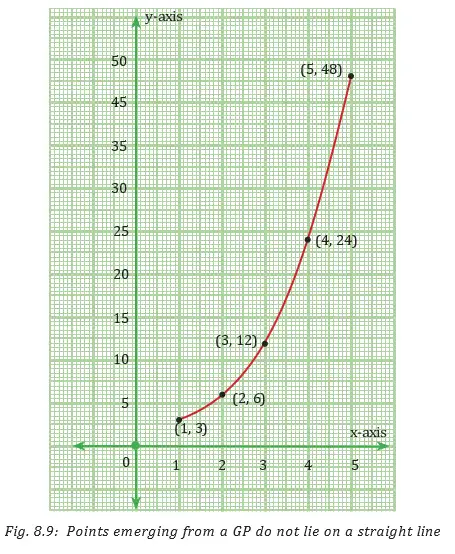
The plotted GP points (1,3), (2,6), (3,12), (4,24), and (5,48) do not lie on a straight line.
The plotted GP points (1,3)(1,3), (2,6)(2,6), (3,12)(3,12), (4,24)(4,24), and (5,48)(5,48) do not lie on a straight line.
Graphs illustrate an increasing GP of powers of 3 and a decreasing GP with ratio 0.75.
Graphs illustrate an increasing GP of powers of 33 and a decreasing GP with ratio 0.750.75.
Term of a GP
Tn=arn−1T_n = a r^{n-1}

Use this rule to find the term at stage nn.

Worked example

Find the number of squares at stage 66.

  1. For the square pattern, the first term is 33 and the common ratio is 22.
    a=3,r=2a=3,\quad r=2
  2. Substitute the stage number n=6n=6 into the GP term rule.
    T6=3×26−1T_6=3\times 2^{6-1}
  3. Evaluate the power and multiply.
    T6=3×32=96T_6=3\times 32=96
Answer: 9696 squares.

A Bouncing Ball as a Decreasing GP

Bounce Height
Hn=24(34)nH_n=24\left(\frac{3}{4}\right)^n

For the nnth bounce from an initial height of 2424 feet:

Worked example

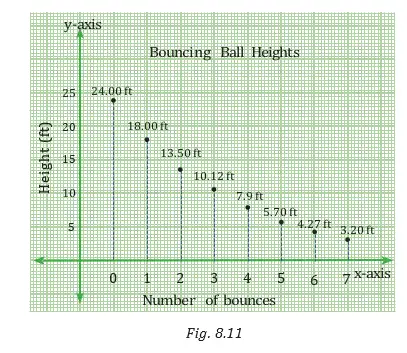
A ball is dropped from 2424 feet and each rebound is 34\frac{3}{4} of the previous height. Find the first five bounce heights and the first bounce below one-sixth of the starting height.

  1. The first bounce height is 1818 feet, with common ratio 34\frac{3}{4}.
    a=18,r=34a=18,\quad r=\frac{3}{4}
  2. Generate the first five bounce heights by multiplying each height by 34\frac{3}{4}.
    18,18(34)=13.5,13.5(34)=10.125,10.125(34)=7.59375,7.59375(34)=5.695312518,\quad 18\left(\frac{3}{4}\right)=13.5,\quad 13.5\left(\frac{3}{4}\right)=10.125,\quad 10.125\left(\frac{3}{4}\right)=7.59375,\quad 7.59375\left(\frac{3}{4}\right)=5.6953125
  3. Find the height after bounce 66 and compare it with 44 feet.
    H6=24(34)6≈4.2715>4H_6=24\left(\frac{3}{4}\right)^6\approx 4.2715>4
  4. Find the height after bounce 77; it is below 44 feet.
    H7=24(34)7≈3.2036<4H_7=24\left(\frac{3}{4}\right)^7\approx 3.2036<4
Answer: The first five bounce heights are 1818, 13.513.5, 10.12510.125, 7.593757.59375, and 5.69531255.6953125 feet. The ball first goes below 44 feet after bounce 77.
The bouncing-ball graph shows the maximum height decreasing after each bounce.
⚠ Common mistake

Do not count the initial 2424-foot drop as the first bounce: the first bounce height is 1818 feet. For the nnth bounce, use 24(34)n24\left(\frac{3}{4}\right)^n.

Practice

The square pattern starts with 33 squares and doubles at every stage. How many squares are at stage 88?

Hint: Use Tn=3×2n−1T_n=3\times 2^{n-1}.
Key step: T8=3×27T_8=3\times 2^7.
Solution: T8=3×128=384T_8=3\times 128=384 squares.
Practice

A ball is dropped from 3232 feet and rebounds to 34\frac{3}{4} of its previous height. What is its height after the fourth bounce?

Hint: Use Hn=32(34)nH_n=32\left(\frac{3}{4}\right)^n.
Key step: Substitute n=4n=4.
Solution: H4=32(34)4=10.125H_4=32\left(\frac{3}{4}\right)^4=10.125 feet.

Quick recap

  • A GP has a constant ratio between consecutive terms.
  • The square pattern has Tn=3×2n−1T_n=3\times 2^{n-1} squares at stage nn.
  • The plotted points of a growing GP need not lie on a straight line.
  • A GP with ratio between 00 and 11 decreases towards 00.
  • For the bouncing ball, Hn=24(34)nH_n=24\left(\frac{3}{4}\right)^n.
  • The seventh bounce is the first below one-sixth of the original 2424-foot height.
Lecture 9

Summary

Reference video · Lecture 9Summary

Sequences and Rules

Definition

Sequence — An ordered list of numbers whose entries are called terms.

Types of Rules

  • General rule: A rule that generates the terms of a sequence.
  • Explicit formula: Uses the position number nn to calculate a term directly.
  • Recursive formula: Defines a term using one or more previous terms; it must include the required starting term(s).
General Rule Notation
tn=f(n),tn=Fn(t1,t2,…,tn−1)t_n=f(n),\qquad t_n=F_n(t_1,t_2,\ldots,t_{n-1})

The recursive rule can depend on one or several earlier terms.

Identify a Sequence Rule

  1. Check whether a term can be calculated from its position or requires earlier terms.
  2. For a recursive rule, state the starting term or terms and the recurrence.
Worked example

Give explicit and recursive rules for 4,7,10,13,…4,7,10,13,\ldots.

  1. For 4,7,10,13,…4,7,10,13,\ldots, the first term is 44 and the common increase is 33.
    a=4,d=3a=4,\qquad d=3
  2. Write the explicit rule using the position number.
    tn=4+3(n−1)=3n+1t_n=4+3(n-1)=3n+1
  3. Write the recursive rule with its starting term.
    t1=4,tn=tn−1+3(n≥2)t_1=4,\qquad t_n=t_{n-1}+3\quad(n\geq 2)
Answer: Explicit: tn=3n+1t_n=3n+1. Recursive: t1=4t_1=4, tn=tn−1+3t_n=t_{n-1}+3 for n≥2n\geq 2.

Triangular Numbers

Definition

Triangular number sequence — A sequence whose nnth term is the sum of the first nn natural numbers.

Key Properties

  • Terms: 1,3,6,10,15,…1,3,6,10,15,\ldots
  • Pattern: Each term adds the next natural number: 11, then 1+21+2, then 1+2+31+2+3, and so on.
  • Connection: The triangular-number formula also gives the sum of the first nn natural numbers.
Triangular Number and Sum
tn=1+2+⋯+n=n(n+1)2t_n=1+2+\cdots+n=\frac{n(n+1)}{2}

Use this to find the nnth triangular number or the sum 1+2+⋯+n1+2+\cdots+n.

Find a Triangular Number

  1. Substitute the position number for nn.
    tn=n(n+1)2t_n=\frac{n(n+1)}{2}
  2. Multiply the consecutive numbers, then divide by 22.
Worked example

Find the fifth triangular number.

  1. Substitute n=5n=5 into the formula.
    t5=5(5+1)2t_5=\frac{5(5+1)}{2}
  2. Simplify.
    t5=302=15t_5=\frac{30}{2}=15
Answer: The fifth triangular number is 1515.

Arithmetic Progressions

Definition

Arithmetic progression (AP) — A sequence in which each term after the first is obtained by adding the same fixed number, called the common difference.

Key Properties

  • Common difference: Subtract a term from the next term; the result is always dd.
  • General form: a,a+d,a+2d,a+3d,…a,a+d,a+2d,a+3d,\ldots
  • Position: The nnth term is reached by adding dd a total of n−1n-1 times.
AP Common Difference and nth Term
d=tn−tn−1,tn=a+(n−1)dd=t_n-t_{n-1},\qquad t_n=a+(n-1)d

Here, aa is the first term and dd is the common difference.

Find an AP Term

  1. Identify the first term and subtract consecutive terms to find the common difference.
    a=t1,d=t2−t1a=t_1,\qquad d=t_2-t_1
  2. Substitute aa, dd, and the required position into the nth-term formula.
    tn=a+(n−1)dt_n=a+(n-1)d
Worked example

Find the sixth term of the AP 5,8,11,…5,8,11,\ldots.

  1. For the AP 5,8,11,…5,8,11,\ldots, identify the first term and common difference.
    a=5,d=8−5=3a=5,\qquad d=8-5=3
  2. Substitute into the formula for the sixth term.
    t6=5+(6−1)(3)t_6=5+(6-1)(3)
  3. Evaluate.
    t6=5+15=20t_6=5+15=20
Answer: The sixth term is 2020.

Geometric Progressions and Fractals

Definition

Geometric progression (GP) — A sequence in which each term after the first is obtained by multiplying the previous term by the same fixed number, called the common ratio.

Key Properties

  • Common ratio: Divide a term by the preceding term to find the constant multiplier.
  • General form: a,ar,ar2,ar3,…a,ar,ar^2,ar^3,\ldots
  • Fractals: Repeated-stage attributes of the Sierpiński triangle and Sierpiński square carpet can form geometric progressions.
GP Common Ratio and nth Term
r=tntn−1,tn=arn−1r=\frac{t_n}{t_{n-1}},\qquad t_n=ar^{n-1}

Here, aa is the first term and rr is the common ratio.

Find a GP Term

  1. Identify the first term and divide consecutive terms to find the common ratio.
    a=t1,r=t2t1a=t_1,\qquad r=\frac{t_2}{t_1}
  2. Substitute aa, rr, and the required position into the nth-term formula.
    tn=arn−1t_n=ar^{n-1}
Worked example

Find the fifth term of the GP 2,6,18,…2,6,18,\ldots.

  1. For the GP 2,6,18,…2,6,18,\ldots, identify the first term and common ratio.
    a=2,r=62=3a=2,\qquad r=\frac{6}{2}=3
  2. Substitute into the formula for the fifth term.
    t5=2(3)5−1t_5=2(3)^{5-1}
  3. Evaluate.
    t5=2(81)=162t_5=2(81)=162
Answer: The fifth term is 162162.
Practice

Find the eighth triangular number.

Hint: Use the formula for the sum of the first nn natural numbers.
Key step: Substitute n=8n=8 into tn=n(n+1)2t_n=\frac{n(n+1)}{2}.
Solution: t8=8(9)2=36t_8=\frac{8(9)}{2}=36.
Practice

Find the tenth term of the AP 7,11,15,…7,11,15,\ldots.

Hint: Identify aa and dd, then use the AP nth-term formula.
Key step: Here, a=7a=7 and d=4d=4.
Solution: t10=7+(10−1)(4)=43t_{10}=7+(10-1)(4)=43.
Practice

Find the sixth term of the GP 3,6,12,…3,6,12,\ldots.

Hint: Divide consecutive terms to find the common ratio.
Key step: Here, a=3a=3 and r=2r=2.
Solution: t6=3(2)6−1=96t_6=3(2)^{6-1}=96.

Quick recap

  • A sequence is an ordered list; explicit rules use position, while recursive rules use previous terms.
  • A recursive rule may depend on multiple earlier terms and needs the appropriate starting term(s).
  • The nnth triangular number and the sum of the first nn natural numbers are both n(n+1)2\frac{n(n+1)}{2}.
  • An AP adds a constant common difference: tn=a+(n−1)dt_n=a+(n-1)d.
  • A GP multiplies by a constant common ratio: tn=arn−1t_n=ar^{n-1}.
  • Repeated-stage attributes of Sierpiński fractals can form geometric progressions.

Formula sheet

Triangular-Number Terms
Tn=n(n+1)2T_n=\frac{n(n+1)}{2}
Term from an Explicit Rule
an=f(n)a_n=f(n)
Testing Whether a Number Is a Term
an=ka_n=k
Example of a One-Term Recursive Rule
t1=1,tn=tn−1+3(n≥2)t_1=1,\quad t_n=t_{n-1}+3\quad(n\geq 2)
Virahanka–Fibonacci Recurrence
V1=1,V2=2,Vn=Vn−1+Vn−2(n≥3)V_1=1,\quad V_2=2,\quad V_n=V_{n-1}+V_{n-2}\quad(n\geq 3)
General form of an AP
a, a+d, a+2d, a+3d,…, a+(n−1)da,\ a+d,\ a+2d,\ a+3d,\ldots,\ a+(n-1)d
Explicit rule for the nth term
tn=a+(n−1)dt_n=a+(n-1)d
Recursive rule for an AP
t1=a,tn=tn−1+d(n≥2)t_1=a,\qquad t_n=t_{n-1}+d\quad(n\ge2)
Sum of the First n Natural Numbers
Sn=1+2+⋯+n=n(n+1)2S_n=1+2+\cdots+n=\frac{n(n+1)}{2}
Sum from a to b
a+(a+1)+⋯+b=(b−a+1)(a+b)2a+(a+1)+\cdots+b=\frac{(b-a+1)(a+b)}{2}
nth Triangular Number
tn=n(n+1)2t_n=\frac{n(n+1)}{2}
Nth term and recursive rule
tn=arn−1,t1=a,tn=rtn−1 (n≥2)t_n=ar^{n-1},\qquad t_1=a,\quad t_n=rt_{n-1}\ (n\ge 2)
Common ratio
r=tn+1tnr=\frac{t_{n+1}}{t_n}
Count and Area at Stage nn
Tn=3nAn=(34)nT0=1,Tn=3Tn−1 (n≥1)A0=1,An=34An−1 (n≥1)\begin{aligned}T_n&=3^n\\A_n&=\left(\frac{3}{4}\right)^n\\T_0&=1,\quad T_n=3T_{n-1}\ (n\geq 1)\\A_0&=1,\quad A_n=\frac{3}{4}A_{n-1}\ (n\geq 1)\end{aligned}
Term of a GP
Tn=arn−1T_n = a r^{n-1}
Bounce Height
Hn=24(34)nH_n=24\left(\frac{3}{4}\right)^n
General Rule Notation
tn=f(n),tn=Fn(t1,t2,…,tn−1)t_n=f(n),\qquad t_n=F_n(t_1,t_2,\ldots,t_{n-1})
Triangular Number and Sum
tn=1+2+⋯+n=n(n+1)2t_n=1+2+\cdots+n=\frac{n(n+1)}{2}
AP Common Difference and nth Term
d=tn−tn−1,tn=a+(n−1)dd=t_n-t_{n-1},\qquad t_n=a+(n-1)d
GP Common Ratio and nth Term
r=tntn−1,tn=arn−1r=\frac{t_n}{t_{n-1}},\qquad t_n=ar^{n-1}

Mathematics — ALL CHAPTERS

1

Orienting Yourself: The Use of Coordinates

View

2

Introduction to Linear Polynomials

View

3

The World of Numbers

View

4

Exploring Algebraic Identities

View

5

I’m Up and Down, and Round and Round

View

6

Measuring Space: Perimeter and Area

View

7

The Mathematics of Maybe: Introduction to Probability

View

8

Predicting What Comes Next: Exploring Sequences and Progression

View