Class 9 . Mathematics . Ganita Manjari . Measuring Space Perimeter and Area
Chapter 6: Measuring Space: Perimeter and Area
Ch 6
Mathematics
Class 9
Perimeter of a Shape
Relay-track staggers
- Stagger: Runners in outer lanes start ahead because their curved route is longer than the route in an inner lane.
- Purpose: The stagger compensates for the extra distance on the curves, giving runners an equal total race distance.
Perimeter of shapes
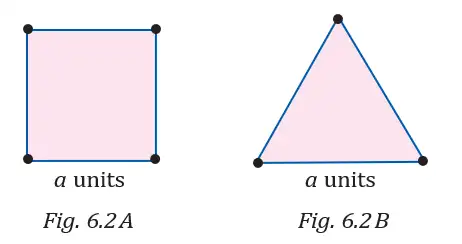
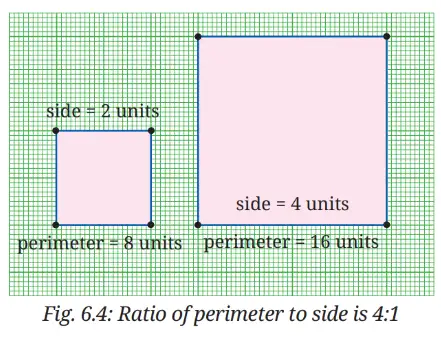
For a square, the perimeter-to-side ratio is ; for an equilateral triangle, it is . These ratios remain fixed as the side lengths change.
Finding a polygon’s perimeter
- Identify the lengths of the sides along the boundary.
- Add the side lengths, or use the formula for the shape.
- Write the result in linear units.
Find the perimeter of a rectangle with length 8 cm and width 5 cm.
- Use the rectangle perimeter formula for length 8 cm and width 5 cm.
- Substitute and simplify.
Perimeter of a circle
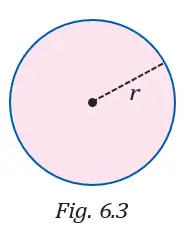
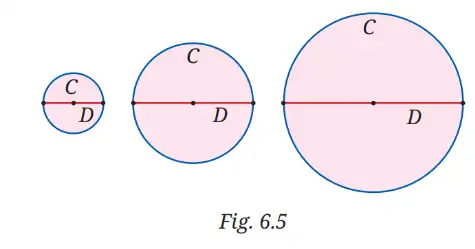
An equilateral triangle has side length 9 cm. Find its perimeter.
A square has side length 6 cm. Find its perimeter.
Quick recap
- Perimeter is the total length around a shape’s border.
- Use for a square, for an equilateral triangle, and for a rectangle.
- For squares and equilateral triangles, the perimeter-to-side ratios are and , respectively.
- A circle’s perimeter is called its circumference.
- The ratio of a circle’s circumference to its diameter is constant for all circles: .
- The stagger is the distance between the starting points of adjacent relay lanes.
Perimeter of a Circle -The C/D Ratio
The Circumference-to-Diameter Ratio
C/D ratio — For a circle with circumference and diameter , the C/D ratio is .
For every circle, the ratio of circumference to diameter is the same constant, .
Use this relationship to find the ratio or estimate the circumference.
Estimating the C/D Ratio with Thread
- Measure the reel’s diameter, , as accurately as possible.
- Wrap a thin thread tightly around the reel for turns, then measure its total length, .
- Divide the total length by to estimate one circumference, then divide by .
Estimate the C/D ratio using the given measurements.
- A reel has diameter . The thread used for turns measures . Estimate its C/D ratio.
- Apply the thread-estimate formula.
Do not divide the thread’s total -turn length by alone. First divide by to estimate one circumference, then divide by .
Geometric Approximations of Pi
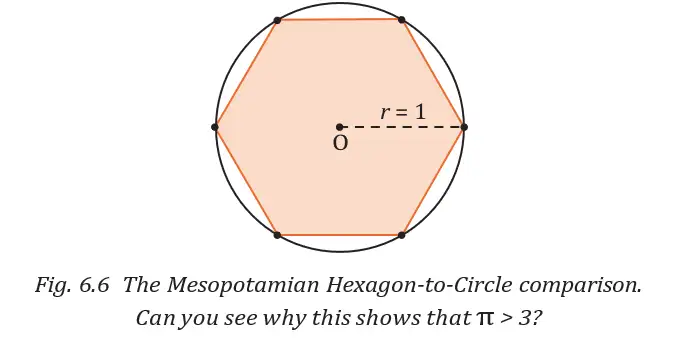
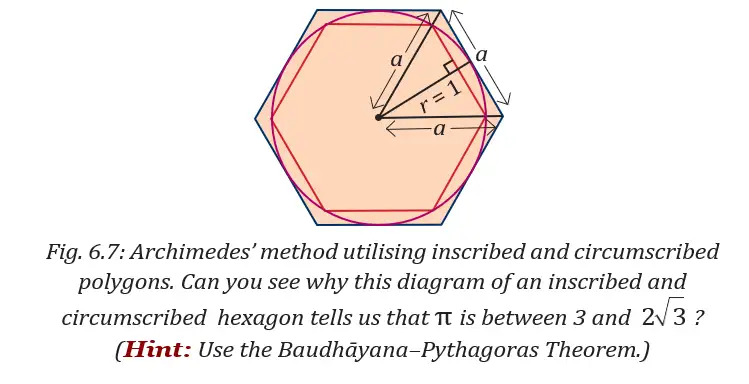
| Person / period | Contribution |
|---|---|
| Mesopotamia, c. BCE | Used as an approximation for . |
| Archimedes, c. BCE | Used inscribed and circumscribed polygons to show . With -sided polygons, he obtained . |
| Ptolemy, c. CE | Used for in astronomical tables. |
| Liu Hui, CE; Zu Chongzhi, CE | Liu Hui’s circle-cutting method helped prepare the way for Zu’s polygon approximation using up to sides. Zu gave (Yuelü) and (Milü). |
| Zu Chongzhi’s | It remained the world’s most accurate approximation for over years. No rational fraction with denominator below is closer to . |
| Āryabhaṭa, CE | Gave and called it asanna, meaning ‘approaching’ or ‘approximate’; this indicates that cannot be given exactly as one simple fraction. |
| Brahmagupta, CE | Suggested . It is less accurate, but convenient in calculations and became influential in the Arab world and medieval Europe. |
| Mādhava of Sangamagrāma | Found an exact infinite-series formula for and calculated it to decimal places, . His shift from polygon geometry to infinite series helped give rise to calculus. |
| Later developments | Important contributors to improved series and calculations included Nīlakaṇṭha (c. ), Machin (), Ramanujan () and the Chudnovsky brothers (). Their algorithms have enabled calculations of to hundreds of trillions of digits. |
| William Jones, ; Leonhard Euler | Jones used , the first Greek letter of perimetros (‘perimeter’), for the C/D ratio. Euler later popularised the symbol. |
Mādhava’s Exact Infinite Series
The alternating series gives the exact value of as its limit.
Thread measuring is used for turns around a reel of diameter . Estimate the C/D ratio.
Archimedes’ bounds are . Write the bounds as decimals to decimal places.
- is the constant ratio for every circle.
- Fractions such as and decimals such as are approximations; Mādhava’s infinite series expresses exactly.
Quick recap
- The C/D ratio is constant for all circles: .
- For thread turns of total length and diameter , estimate the ratio with .
- Inscribed and circumscribed polygons give lower and upper bounds for .
- Important approximations include , and ; remained the most accurate known value for over years.
- Mādhava’s exact series is and helped give rise to calculus.
- William Jones used in , drawing on the Greek word perimetros (‘perimeter’); Euler popularised the symbol.
π Is Irrational
Rational and Irrational Numbers
Irrational number — A number that cannot be written as a ratio of two integers; its decimal expansion is non-terminating and non-repeating.
A rational number terminates or eventually repeats in decimal form. An irrational number continues forever without a repeating pattern.
Here, and are integers, and the denominator must be non-zero.
π Is Irrational
- Proof: In 1761, Lambert proved that is irrational; a proof requires more advanced mathematics.
Approximations of π
These fractions are close to , not equal to it.
Choosing the correct equality symbol
- Use an approximation symbol when a fraction is close to an irrational number.
- Do not use an exact-equality sign for that approximation.
Is exactly equal to ?
- Write the commonly used fraction as an approximation to pi.
- Since pi is irrational, it cannot equal this fraction exactly.
Do not write . Write because the fraction is close to, but not equal to, .
Is rational or irrational?
Which is the closer approximation to : or ?
Quick recap
- A rational number can be written as , where and are integers and .
- Rational decimals terminate or eventually repeat; irrational decimals do neither.
- is irrational, so its decimal expansion continues without a repeating pattern.
- is a useful approximation to , but it is not equal to .
- is a closer approximation to than .
- , but .
Length of an Arc of a Circle
Arc Length
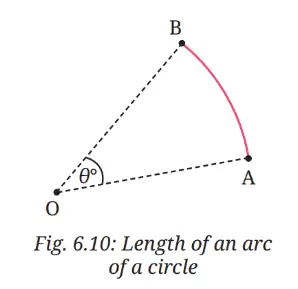
Use when the central angle is measured in degrees.
Here, is the diameter and is the radius.
Finding an arc length
- Identify the radius and the central angle in degrees.
- Substitute them into the arc-length formula.
- Simplify and include the unit of length.
Find the length of an arc of a circle with radius cm that subtends at the centre.
- Find the arc length for radius cm and central angle .
- Substitute in the formula and simplify.
- Using gives the length.
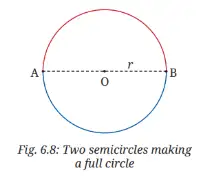
Do not confuse the semicircular arc length with the full perimeter of a semicircle, which also includes its diameter.
A 400 m Athletics Track
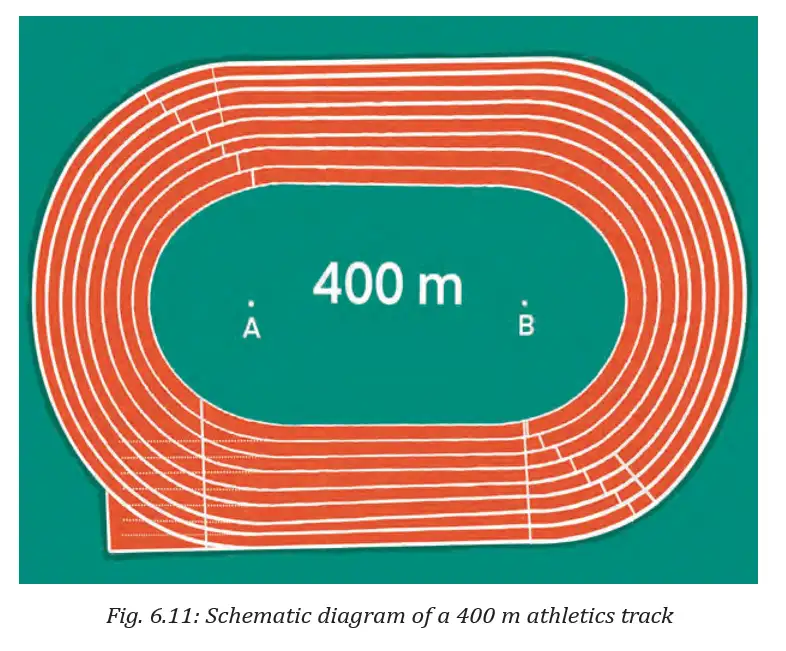
If adjacent lanes differ in radius by , the outer lane’s extra distance over the two curved ends is the circumference difference . Equal lane widths therefore require equal staggers between each adjacent pair.
For this track, the two semicircles make one circumference.
Calculating one lap
- Add the lengths of the two straight sections.
- Use the radius of the runner’s path to find the curved distance.
- Add the straight and curved distances.
Calculate one lap for a runner whose path is m from the inner border.
- The two straight sections total m. The running path radius is m.
- The two semicircles together have the circumference of a circle of radius m.
- Add the straight and curved portions.
A circle has radius cm. Find the arc length subtended by at its centre.
The lane width is m. Find the extra distance covered on the curved ends by a runner in the second lane compared with the first lane. Would the same stagger be needed between the second and third lanes?
Quick recap
- A circle’s circumference is .
- An arc subtending has length .
- A semicircular arc is and a quarter-circle arc is .
- Two semicircular track ends together contribute one circumference.
- The curved-distance difference between adjacent lanes is times their radius difference.
- Equal lane widths require equal stagger distances.
Problems, Puzzles, and Paradoxes on Perimeter
Perimeter of the Boundary of Two Intersecting Circles
Boundary perimeter — The perimeter of the shape formed by two intersecting circles is the total length of the arcs on its outer boundary.
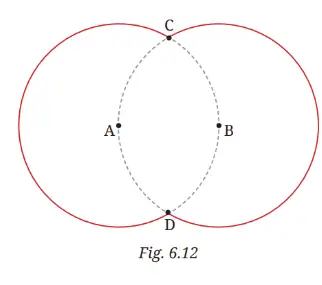
Since , triangle is equilateral. The corresponding central angle for each inner arc is , so each outer boundary arc subtends and is of a full circle.
Use this when each circle passes through the centre of the other; the perimeter consists of two arcs, each measuring of a circumference.
Finding the outer perimeter
- Use the radii and the distance between the centres to identify the relevant triangle.
- Find the angle of each outer arc and its fraction of a full circumference.
- Add the lengths of the two outer arcs.
Find the outer-boundary perimeter for two such circles of radius cm.
- Two circles of radius cm each pass through the centre of the other. Find the perimeter of their outer boundary.
- Each outer arc is two-thirds of a circumference.
- Add the two equal outer arcs.
Do not count the arcs inside the overlap. Each outer arc is of a circumference, not .
Comparing Paths Made of Semicircles
Semicircle path length — A path made of semicircles has length equal to the sum of the lengths of its semicircular arcs.
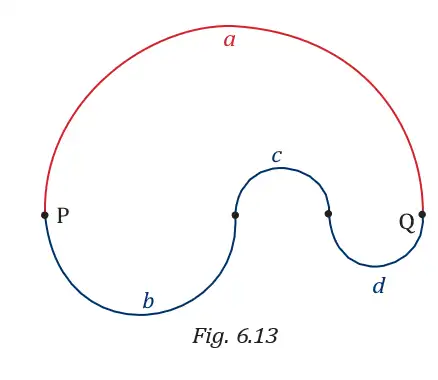
If one path is a semicircle with radius and the other uses semicircles with radii , , and over the same total distance , then . Therefore, , making the two arc-path lengths equal.
A semicircle of radius has arc length . For paths spanning the same total distance, the sum of the semicircle radii is the same.
Comparing semicircle paths
- Write each semicircle's arc length as times its radius.
- Express the shared endpoint distance using the semicircle diameters on each path.
- Equate the radius sums and multiply by to compare the arc lengths.
Compare the lengths of the two paths.
- A semicircle path has radius cm. A second path consists of three semicircles with radii cm, cm, and cm. Compare their lengths.
- Find the first path's length.
- Add the radii for the second path, then multiply by .
- The paths have equal lengths.
Do not compare only the number or apparent size of the semicircles. Compare the sum of their radii, since each arc length is times its radius.
Two circles of radius cm pass through each other's centres. Find the perimeter of the outer boundary.
One path is a semicircle of radius cm. Another uses semicircles of radii cm, cm, and cm. Compare their lengths.
Quick recap
- For two equal circles passing through each other's centres, each outer arc is of a circumference.
- The perimeter of that two-circle boundary is .
- A semicircle of radius has arc length .
- A semicircle's diameter equals twice its radius.
- For semicircle paths over the same endpoint distance, the sums of the radii are equal, so the path lengths are equal.
Area of a Rectangle and Parallelogram
Area and the Rectangle
Area — Area measures the amount of space occupied by a two-dimensional region.
Area units
- Unit square: A square with side length unit has area square unit, written .
- Units: Area is measured in square units, such as or .
The area of a rectangle is the product of the lengths of two adjacent sides.
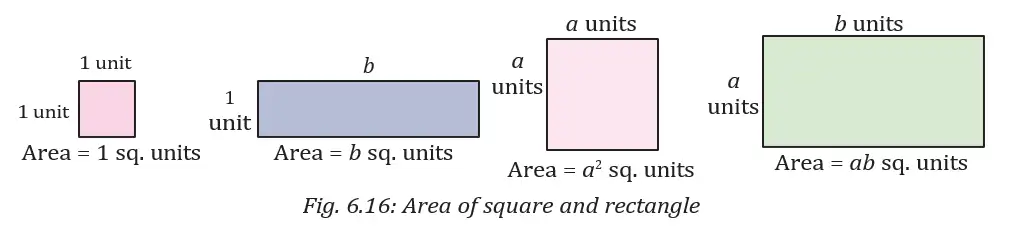
Use when the lengths of the rectangle’s two adjacent sides are known.
Find a rectangle’s area
- Identify the two side lengths.
- Multiply the side lengths and give the result in square units.
Find the area of a rectangle with length cm and breadth cm.
- A rectangle has length cm and breadth cm. Substitute the side lengths.
- Multiply to find the area.
Area of a Parallelogram
Height of a parallelogram — The height corresponding to a base is the perpendicular distance between the parallel lines containing that base and its opposite side.
A parallelogram has the same area as a rectangle with the same base and perpendicular height.
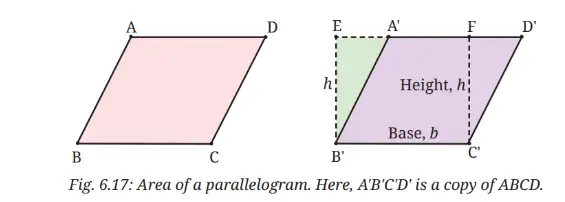
Why the formula works
- Rearrangement: A triangular piece can be moved from one end to form a rectangle without changing the area.
- Thin parallelogram: The perpendicular foot may fall outside the base segment, so the simple rearrangement may not work directly.
- Equal-area construction: Choose on near and on the extension of so that . Then is a parallelogram.
- Area preserved: Since , the added and removed triangles have equal area; repeat this construction as needed.
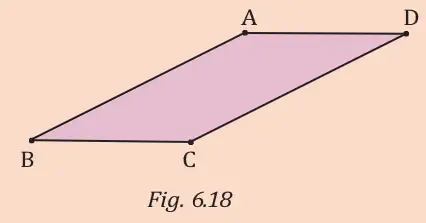
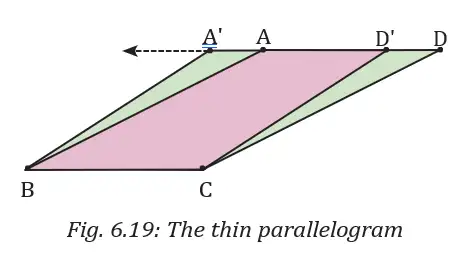
Use the height perpendicular to the chosen base, not a sloping side.
Keeping both side lengths fixed does not fix a parallelogram’s area: changing the angle between adjacent sides changes its perpendicular height and therefore its area.
Find a parallelogram’s area
- Choose a base and identify its corresponding perpendicular height.
- Multiply the base by that height and state the result in square units.
Find the area of a parallelogram with base cm and height cm.
- A parallelogram has base cm and corresponding height cm. Substitute these values.
- Multiply to find the area.
Do not multiply the two sloping side lengths to find a parallelogram’s area; use base times corresponding perpendicular height.
A rectangle measures m by m. Find its area.
A parallelogram has base cm and corresponding perpendicular height cm. Find its area.
Quick recap
- Area measures the space occupied by a plane region and is expressed in square units.
- Rectangle area is the product of its adjacent sides: .
- Parallelogram area is base times corresponding perpendicular height: .
- A parallelogram can be rearranged into a rectangle without changing its area.
- For a thin parallelogram, the perpendicular foot may lie outside the base segment; equal-area triangle transfers handle this case.
- The side lengths alone do not determine a parallelogram’s area because changing the angle changes its height and area.
Area of a Triangle
Area of a Triangle
Base and perpendicular height — A triangle’s height is the perpendicular distance from the opposite vertex to the line containing the chosen base.
Key points
- Area formula: A triangle’s area is half the product of its base and corresponding perpendicular height.
- Any side can be the base: Use the height perpendicular to that chosen side.
- Obtuse triangles: The perpendicular height may fall outside the triangle, so extend the base line when needed.
- Reason: Two congruent copies of a triangle form a parallelogram; one triangle has half its area.
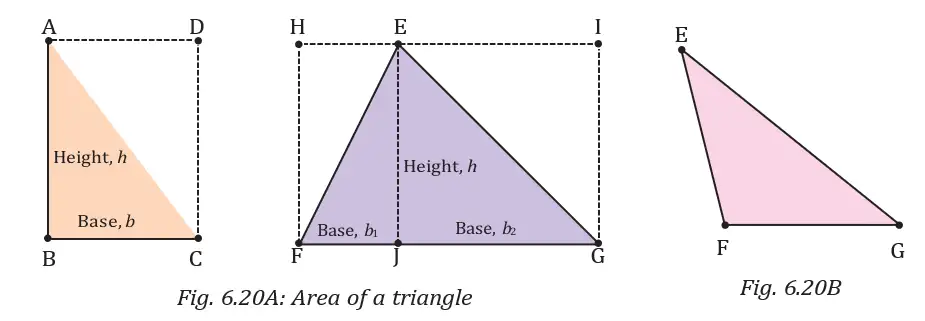
Use the base and its corresponding perpendicular height.
Finding a triangle’s area
- Choose a side as the base.
- Find the perpendicular height corresponding to that base.
- Substitute the base and height into the area formula.
- Write the answer in square units.
Find the area of a triangle with base 12 cm and height 5 cm.
- A triangle has base 12 cm and perpendicular height 5 cm. Substitute into the formula.
- Multiply and simplify.
Do not use a sloping side as the height: the height must meet the chosen base at a right angle.
Median of a Triangle
Median — A median is the line segment joining a vertex of a triangle to the midpoint of the opposite side.
A median divides a triangle into two triangles with equal areas. The two smaller triangles have equal bases and the same perpendicular height, even though they need not be congruent.
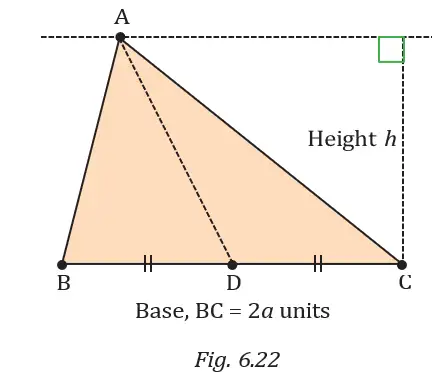
Using the median area theorem
- A median meets the opposite side at its midpoint, so the two base segments are equal.
- The triangles formed by the median share the same perpendicular height.
- Equal bases and equal heights give equal areas.
A triangle has base 14 cm and height 9 cm. Find the area of each triangle formed by its median to that base.
- A triangle has base 14 cm and height 9 cm. Its median divides the base into equal parts.
- Find the area of either half.
Find the area of a triangle with base 15 m and perpendicular height 8 m.
A median divides a triangle into two parts. If one part has area 24 cm², what is the area of the whole triangle?
Why does a median divide a triangle into two equal-area triangles?
- Triangle area is half the product of a base and its perpendicular height.
- A median always splits a triangle into equal areas, not necessarily congruent shapes.
Quick recap
- Triangle area is , where is perpendicular to base .
- For an obtuse triangle, the perpendicular height may fall outside the triangle.
- Two congruent copies of a triangle form a parallelogram, explaining the half-area formula.
- A median joins a vertex to the midpoint of the opposite side.
- A median makes two equal-area triangles because their bases and heights are equal.
- The two triangles formed by a median need not be congruent.
Heron’s formula Part-1
Heron’s Formula
Find the area of a triangle with sides , , and units.
- Find the semi-perimeter.
- Substitute the side lengths and semi-perimeter.
- Simplify the expression under the square root.
| Triangle | Heron’s formula | Check using base and height |
|---|---|---|
| Equilateral, side | ; . | Pythagoras gives ; hence . |
| Isosceles, equal sides , base | ; . | The altitude is ; hence . |
| Right triangle, sides | ; square units. | , so it is right-angled; square units. |
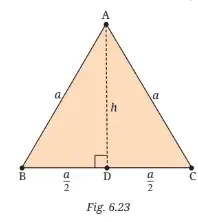
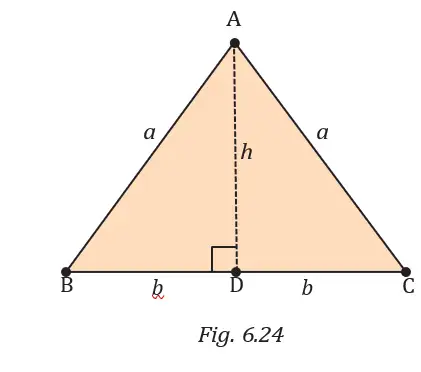
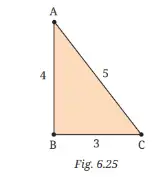
Useful Notes
- Proof idea: Heron’s formula can be proved using the Baudhāyana–Pythagoras theorem and .
- Symbol: means “therefore.”
Find the area of an equilateral triangle with side units using Heron’s formula.
An isosceles triangle has equal sides units and base units. Find its area using Heron’s formula.
Area Formulas Using Circles
Circumcircle — The unique circle passing through the three vertices of a triangle; its radius is the circumradius .
Incircle — The unique circle inside a triangle that touches all three sides; its radius is the inradius .
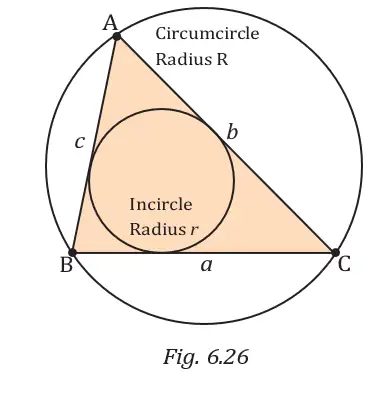
For a triangle with sides , circumradius , inradius , and semi-perimeter , these formulas give its area.
Use when the three side lengths and circumradius are known.
Use when the inradius and semi-perimeter are known; the semi-perimeter can be found from the side lengths.
Do not use with only the three side lengths known: this formula also needs the inradius (or enough information to determine it).
- Heron’s formula finds area from the three side lengths and their semi-perimeter.
- The circumcircle passes through all three vertices; the incircle touches all three sides.
- Circle formulas: and .
Quick recap
- The semi-perimeter is .
- Heron’s formula is .
- For an equilateral triangle of side , .
- For an isosceles triangle with equal sides and base , .
- The circumcircle passes through the vertices; the incircle touches all three sides.
- The circle-based formulas are and .
Heron’s formula Part-2
Area of a Cyclic Quadrilateral
Cyclic quadrilateral — A quadrilateral is cyclic if all four of its vertices lie on one circle.
Why the cyclic condition matters
- Side lengths alone: They do not determine the area of a general quadrilateral; rhombi with the same side lengths can have different areas.
- Extra information: A general quadrilateral needs more information, such as an angle, a diagonal, or the angle between its diagonals.
- Cyclic condition: Knowing that a quadrilateral is cyclic allows its area to be found from its four side lengths.
For a cyclic quadrilateral with side lengths and semi-perimeter , the area is . Brahmagupta discovered this formula in 628 CE.
Use for the area of a cyclic quadrilateral when its four side lengths are known.
Applying Brahmagupta’s formula
- Check that the quadrilateral is cyclic and identify its side lengths.
- Calculate the semi-perimeter.
- Substitute the side lengths and semi-perimeter into the area formula.
Important cyclic quadrilaterals
- Rectangle: Every rectangle is cyclic, so Brahmagupta’s formula applies.
- Isosceles trapezium: Every isosceles trapezium is cyclic, so the formula also applies to it.
Verify Brahmagupta’s formula for a rectangle and an isosceles trapezium.
- For a rectangle with sides , calculate its semi-perimeter.
- Substitution gives the usual rectangle area.
- For an isosceles trapezium with parallel sides , equal legs , and height , its semi-perimeter is:
- Applying Brahmagupta’s formula and simplifying gives:
- By the Baudhāyana–Pythagoras theorem, the height is . Thus this equals the usual trapezium area.
Special Cases and Generalisation
Special case and generalisation — A special case is obtained from a general result by adding a condition; the broader result is a generalisation of that special case.
Examples
- Square from rectangle: Setting in gives the square formula ; the square’s perimeter formula is likewise a special case of the rectangle’s.
- Algebraic identity: Setting in the three-variable identity gives the two-variable identity.
- Generalisation: Moving from a more restricted situation to one that covers a wider range is a key process in mathematics.
The first identity is the special case of the second obtained by setting .
An isosceles right-angled triangle is a special case of a right-angled triangle; setting its two equal legs to in the Baudhāyana–Pythagoras theorem gives .
Find the hypotenuse of an isosceles right triangle whose equal legs have length .
- Start with the Baudhāyana–Pythagoras theorem for a right triangle.
- For an isosceles right triangle, its two legs are equal.
- Substitute and solve for the positive hypotenuse.
Brahmagupta’s Formula Generalises Heron’s Formula
Viewing a triangle as a special quadrilateral
- Degenerate quadrilateral: A triangle with sides can be treated as a cyclic quadrilateral with its fourth side ; two vertices coincide.
- Cyclic condition: Any three non-collinear points lie on a circle, so this triangle-based quadrilateral is cyclic.
- Semi-perimeter: Setting leaves the same semi-perimeter as the triangle.
Putting in Brahmagupta’s formula gives Heron’s formula for a triangle.
Deriving Heron’s formula
- Represent the triangle as a cyclic quadrilateral with its fourth side equal to zero.
- Its semi-perimeter equals the triangle’s semi-perimeter.
- Substitute into Brahmagupta’s area formula.
- Rearrange the factors to obtain Heron’s formula.
Show how Heron’s formula follows from Brahmagupta’s formula.
- Treat a triangle with sides as a cyclic quadrilateral with .
- Compute its semi-perimeter.
- Apply Brahmagupta’s formula and simplify the zero-side factor.
A cyclic quadrilateral has side lengths . Find its area.
A rectangle has sides and . Verify its area using Brahmagupta’s formula.
What condition turns a triangle into a special case of Brahmagupta’s formula, and what formula results?
Quick recap
- Side lengths alone do not determine the area of a general quadrilateral.
- For a cyclic quadrilateral, , where .
- Brahmagupta discovered the cyclic quadrilateral area formula in 628 CE.
- Rectangles and isosceles trapeziums are cyclic; Brahmagupta’s formula agrees with their standard area formulas.
- A special case follows from a general result by imposing an extra condition.
- The Baudhāyana–Pythagoras theorem gives for an isosceles right triangle.
- Setting in Brahmagupta’s formula gives Heron’s formula for a triangle.
Squaring a Rectangle
Squaring a shape — Constructing a square whose area equals the area of a given shape.
Baudhāyana’s construction
- Goal: For a rectangle with sides and , where , construct a square of area .
- Source: This construction is attributed to Baudhāyana in the Śulbasūtra, dated around BCE.
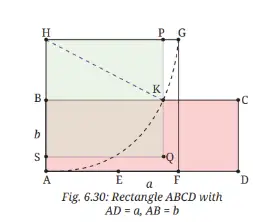
Construct the equal-area square
- For rectangle , take and , with .
- Mark on so that ; then locate the midpoint of .
- Construct square with as a side and on produced.
- With centre , draw an arc through to meet at .
- Through , draw a line parallel to to meet at .
- Construct square with as a side; it has the same area as the rectangle.
Why the construction works
The constructed square has side and area , equal to the rectangle’s area.
Key lengths and reasoning
- Midpoint: Since and , .
- Radius: and , so .
- Offset: .
- Right triangle: In right-angled triangle , is the hypotenuse and ; apply Pythagoras to find .
This identity gives the rectangle’s area from the constructed lengths.
What is the side length of the square equal in area to a rectangle measuring units by units?
- For a rectangle with sides units and units, identify its area.
- Use the construction identity to find the square’s area.
- Take the positive length for the side of the square.
Find the side length of the square equal in area to a rectangle with sides units and units.
A triangle has base units and perpendicular height units. Describe how to construct a square equal in area to it.
Do not use as the final square’s side. It is an intermediate length; the required side is .
Quick recap
- Squaring a rectangle means constructing a square with the same area.
- For sides , the required square has area and side length .
- Baudhāyana’s construction uses a midpoint, a square, an arc, and a right triangle.
- The key identity is .
- A triangle can be squared by first replacing it with an equal-area rectangle.
Area of a Circle Part-1
Why Area Scales with Perimeter Squared
Area of a circle — The area is the size of the region enclosed by the circle.
For a given shape, the ratio of perimeter squared to area stays constant as the shape is scaled. The constant depends on the shape, not its size.
Examples of the ratio
- Square: If the side is , then and , so .
- Equilateral triangle: If the side is , then and , so .
- Circle: This suggests that is also a fixed constant, where is circumference and is area.
Early Approximations
Historical circle-area estimates
- Babylonians (before 1500 BCE): Measured the ratio as approximately , giving .
- Ancient Egyptians (around 1500 BCE): Used , where is the diameter; with , this becomes .
- Baudhāyana Śulbasūtra (around 800 BCE): Contains the same approximation, obtained through a geometric construction.
- Archimedes (around 250 BCE): Established that the exact constant is , giving . Greek mathematicians knew the constant existed but did not know its exact value.
The Circle-Area Formula
A regular polygon’s area equals half its perimeter multiplied by the radius of its inscribed circle.
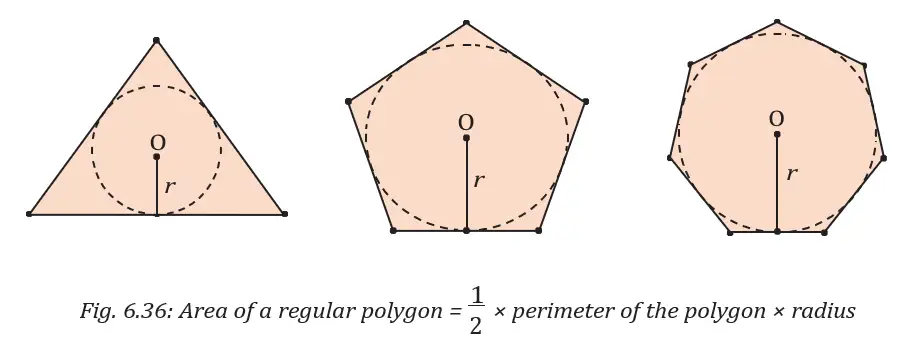
Polygon limit argument
- Increase the number of sides of a regular polygon → it approaches a circle.
- The polygon’s perimeter approaches the circle’s circumference, .
- Using in the limit gives .
Sector rearrangement explanation
- Rearrange: Cut the circle into many narrow sectors and alternate their directions.
- As sectors become smaller: The curved edges approach straight lines, forming a parallelogram-like shape.
- Dimensions: Its base approaches half the circumference, ; its height is .
- Area: Base times height gives .
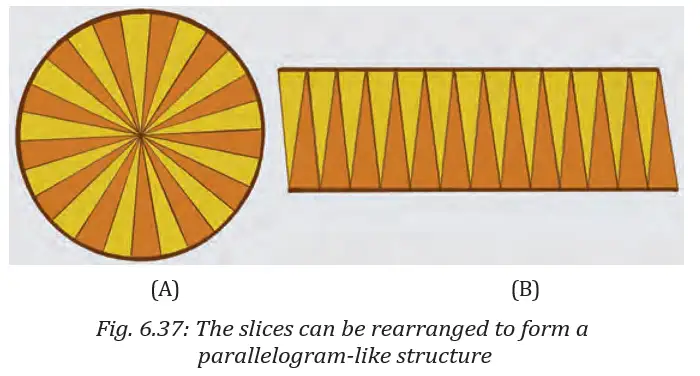
Use the radius ; equivalently, use the diameter .
Finding the area from a radius or diameter
- Identify the given radius; if the diameter is given, halve it.
- Substitute the radius into the circle-area formula.
- Evaluate using the required value of and write the answer in square units.
Find the area of a circle with radius cm, using .
- Find the area of a circle with radius cm, using .
- Substitute the radius.
- Simplify.
Do not square the diameter in without adjusting the formula; if using diameter, use . Always give area in square units.
Find the area of a circle whose diameter is cm. Use .
A circle has radius cm. Find its area in terms of .
Quick recap
- For a fixed shape, perimeter squared divided by area is unchanged by scaling.
- The area of a circle is ; in terms of diameter, .
- The formula follows from for regular polygons as they approach a circle.
- Rearranged narrow sectors form an approximate parallelogram with base and height .
- The Babylonian estimate was ; the Egyptian estimate was .
Area of a Circle Part-2
Sectors of a Circle
Sector of a circle — A sector is the region bounded by an arc and the two radii joining the arc’s endpoints to the centre.
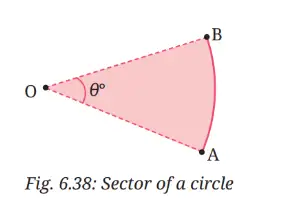
Symmetry and Special Sectors
- Semicircle: A diameter divides the circle into two equal semicircular discs; each has half the circle’s area.
- Quarter-circle: Two perpendicular radii divide the circle into four equal regions; each has one-quarter of the circle’s area.
- Symmetry: Reflection and rotational symmetry explain why equal central angles enclose equal areas.
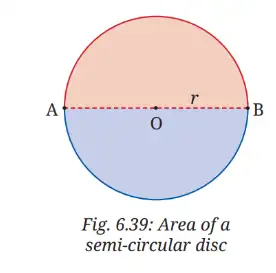
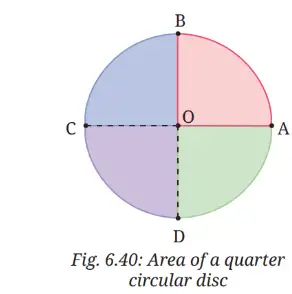
A sector’s area is the same fraction of the circle’s area as its central angle is of .
Use when the central angle is measured in degrees; is the circle’s radius.
These follow by taking the appropriate fraction of the circle’s area.
Finding the Area of a Sector
- Identify the radius and central angle.
- Find the fraction of a full turn represented by the angle.
- Multiply this fraction by the area of the full circle.
Find the area of a sector with radius cm and central angle .
- Find the area of a sector with radius cm and central angle .
- Substitute the radius and angle, then simplify.
Segments of a Circle
Segment of a circle — A segment is the region bounded by an arc and the chord joining the arc’s endpoints.
| Point | Sector | Segment |
|---|---|---|
| Boundary | An arc and two radii | An arc and its chord |
Find the area of a quarter-circle with radius cm.
Find the area of a sector with radius cm and central angle .
Find the area of a semicircle with radius cm.
Quick recap
- A sector is bounded by an arc and two radii.
- A sector with central angle has area .
- A semicircle has area .
- A quarter-circle has area .
- A segment is bounded by an arc and its chord.
Summary
Pi, Circumference and Area of a Circle
Find a circle’s circumference and area
- Identify the radius and choose a suitable value of .
- Substitute the radius into the circumference and area formulas.
- Give circumference in units and area in square units.
Find the circumference and area of a circle with radius cm.
- For a circle of radius cm, use .
- Calculate its circumference.
- Calculate its area.
Arc Length and Area of a Sector
Find an arc length and sector area
- Identify the radius and central angle .
- Multiply the full circumference and full-circle area by the fraction of the circle.
- Report arc length in units and sector area in square units.
Find the arc length and sector area for a sector of radius cm.
- Use cm, , and .
- Find the arc length.
- Find the sector area.
Area of a Triangle
Find a triangle’s area
- If a perpendicular height is known, use the base-height formula.
- If only the sides are known, calculate the semiperimeter.
- Substitute and the three sides into Heron’s formula.
Find the area of a triangle with sides , , and units.
- A triangle has sides , , and units; its base and corresponding height are and units.
- Find its area using base and height.
- Check using Heron’s formula, with semiperimeter .
Area of a Cyclic Quadrilateral
Use Brahmagupta’s formula
- Find the semiperimeter from the four side lengths.
- Substitute the semiperimeter and side lengths into the formula.
- Give the result in square units.
Find the area of a cyclic quadrilateral with side lengths , , , and units.
- A cyclic quadrilateral has four sides of length units, so its semiperimeter is units.
- Apply Brahmagupta’s formula.
Find the circumference and area of a circle with diameter cm. Use .
Find the area of a triangle with sides , , and units.
Find the arc length of a sector in a circle of radius cm. Use .
Quick recap
- is the circumference-to-diameter ratio of every circle and is irrational.
- Circle circumference is ; circle area is .
- Arc length and sector area are the corresponding full-circle measures multiplied by .
- Triangle area is or .
- For a cyclic quadrilateral, Brahmagupta’s formula is .
Formula sheet
Mathematics — ALL CHAPTERS
1
Orienting Yourself: The Use of Coordinates
2
Introduction to Linear Polynomials
3
The World of Numbers
4
Exploring Algebraic Identities
5
I’m Up and Down, and Round and Round
6
Measuring Space: Perimeter and Area
7
The Mathematics of Maybe: Introduction to Probability
8
Predicting What Comes Next: Exploring Sequences and Progression