Class 9 . Mathematics . Ganita Manjari . I M Up and Down and Round and Round
Chapter 5: I’m Up and Down, and Round and Round
Ch 5
Mathematics
Class 9
Definition
Circle and Its Definition
For a circle with centre and radius , every point on the circle satisfies .
If is on a circle with centre , then is the radius. Every point on that circle is the same distance from .
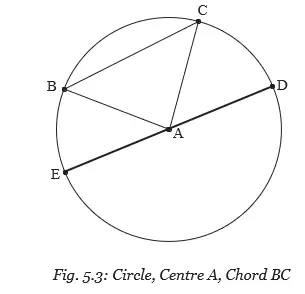
Chords, Diameters, and the Central Angle
Identify parts of a circle
- Locate the fixed point that is the centre.
- A segment from the centre to the circle is a radius; its length is the radius of the circle.
- A segment joining two points on the circle is a chord; if it passes through the centre, it is a diameter.
- The segments from the centre to a chord’s endpoints form the central angle.
In a circle with centre , chord passes through . Identify the chord, diameter, and central angle.
- In a circle with centre , chord passes through . Identify the chord, diameter, and central angle.
- Since joins two points on the circle, it is a chord; because it passes through the centre, it is also a diameter.
- The radii to the endpoints form the central angle.
A circle has centre and radius cm. What is the distance from to any point on the circle?
In a circle with centre , points and lie on the circle. What is called if it passes through ?
Do not confuse the radius with its length: the radius can mean the segment from the centre to the circle or the distance measured by that segment.
Quick recap
- A circle is the locus of points in a plane at a fixed distance from one point.
- The fixed point is the centre; the fixed distance is the radius.
- Every point on a circle is equally distant from its centre.
- A chord joins two points on a circle.
- A chord through the centre is a diameter.
- A chord’s endpoints and the centre form a central angle.
Symmetries of a Circle
Rotational and Reflection Symmetry
Rotational symmetry of a circle — A circle has complete rotational symmetry: rotation through any angle leaves it looking unchanged.
Circle symmetry
- Reflection: Every diameter is a line of reflection symmetry because it divides the circle into matching halves.
- Number of reflection axes: A circle has infinitely many; each diameter gives one.
| Shape | Rotations mapping it onto itself, including the original position | Lines of reflection symmetry |
|---|---|---|
| Circle | Every angle | Infinitely many: all diameters |
| Square | 4 positions: every | 4 |
| Regular pentagon | 5 positions: every | 5 |
| Regular hexagon | 6 positions: every | 6 |
Circles Through Two Fixed Points
A point is equidistant from two distinct points and if and only if it lies on the perpendicular bisector of .
Centres of circles through two points
- Why: A circle through and has a centre equidistant from both, so its centre lies on the perpendicular bisector of .
- Converse: Every point on that perpendicular bisector is equidistant from and ; using it as centre gives a circle through both points.
- Number: There are infinitely many circles through two distinct points, since the perpendicular bisector has infinitely many points.
- Midpoint case: The midpoint of is also a possible centre. The resulting circle has radius , and is its diameter.
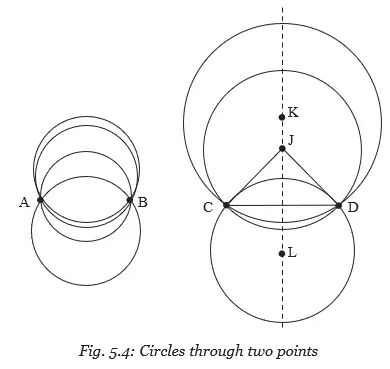
If the distance between the points is , every possible radius is at least . The minimum occurs when the centre is the midpoint; there is no largest radius.
How radius changes
- In the formula: is the distance of the centre from the midpoint of the segment; as increases, the radius increases.
- Appearance: A circle with a larger radius is less curved near the fixed points.
Circles Through Three Points
Collinear and non-collinear points
- Collinear case: No circle can pass through three distinct collinear points; a straight line can meet a circle at no more than two points.
- Non-collinear case: Exactly one circle passes through any three non-collinear points.
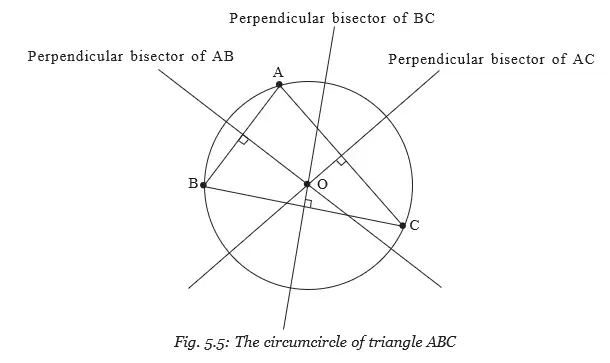
There is a unique circle through three non-collinear points , , and . Its centre is the intersection of the perpendicular bisectors of the sides of .
Construct the circle through three non-collinear points
- Find the perpendicular bisectors of two sides, such as and .
- Mark their intersection as ; it is equidistant from , , and .
- Draw the circle centred at with radius .
Circumcentre and circumcircle — The centre of the circle through a triangle’s three vertices is its circumcentre; that circle is its circumcircle.
Triangle and circumcircle
- Circumscribe: The circumcircle circumscribes the triangle because it passes through all three vertices.
- Inscribed: The triangle is inscribed in its circumcircle.
- Uniqueness: The perpendicular bisectors meet at one point, so each triangle has only one circumcentre and one circumcircle.
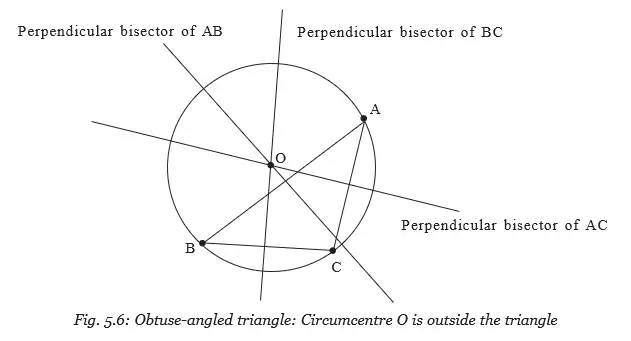
| Triangle | Circumcentre position |
|---|---|
| Acute-angled | Inside the triangle |
| Obtuse-angled | Outside the triangle |
| Right-angled | At the midpoint of the hypotenuse |
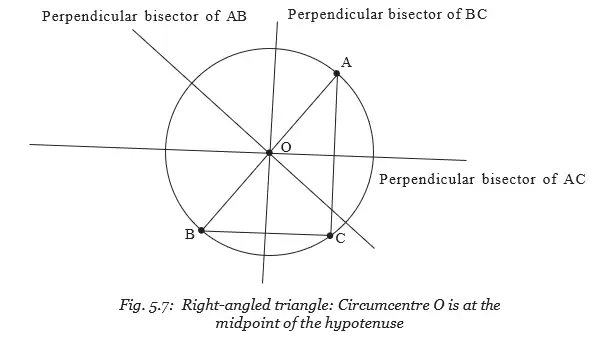
Find the circumcentre and circumradius of the triangle with vertices , , and .
- Find the circumcentre and circumradius of the triangle with vertices , , and .
- The triangle is right-angled at , so its hypotenuse joins to .
- The circumcentre is the midpoint of the hypotenuse.
- The circumradius is half the hypotenuse length.
For two points and that are units apart, state the locus of possible centres and the smallest possible radius of circles through them.
Can a circle pass through three distinct collinear points? Give the reason.
A right triangle has hypotenuse length cm. Where is its circumcentre, and what is its circumradius?
Quick recap
- A circle is unchanged by rotation through any angle; every diameter is a reflection axis.
- A point is equidistant from two fixed points exactly when it lies on their perpendicular bisector.
- Infinitely many circles pass through two distinct points; the smallest has the segment as diameter.
- Three distinct collinear points do not lie on one circle; three non-collinear points determine exactly one circle.
- The circumcentre is the intersection of a triangle’s perpendicular bisectors, and its circumcircle passes through all three vertices.
- The circumcentre is inside an acute triangle, outside an obtuse triangle, and at the hypotenuse midpoint in a right triangle.
Chords and the Angles They Subtend
Chords and central angles
- Chord: A line segment joining two points on a circle is a chord.
- Central angle: The angle formed at the centre by joining the chord’s endpoints to the centre is the angle subtended by that chord.
- Radius: Every segment from the centre to a point on the circle has the same length.
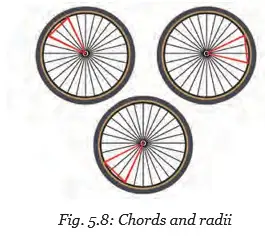
Equal chords and central angles
Equal chords subtend equal angles — In the same circle, chords of equal length form equal angles at the centre.
If in the same circle with centre , then .
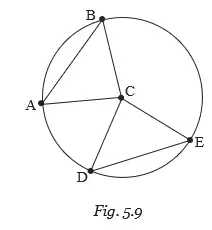
Why it works
- Radii: , so and .
- Third side: The chords are equal: .
- Congruence: by SSS; therefore the corresponding central angles are equal.
Use when the chords lie in the same circle.
Prove the central angles equal
- Join the chord endpoints to the centre.
- Use equality of radii and the given equality of chords.
- Apply SSS congruence, then equate the corresponding central angles.
If two chords in the same circle are equal, what can be concluded about their central angles?
- In a circle with centre , suppose . Prove that the angles at the centre are equal.
- The four segments from to the circle are radii, so the corresponding pairs of sides are equal.
- The triangles are congruent by SSS.
- Corresponding angles are equal.
Equal central angles and chords
Chords with equal central angles — In the same circle, chords that form equal angles at the centre have equal lengths.
If in the same circle with centre , then .
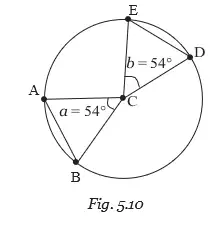
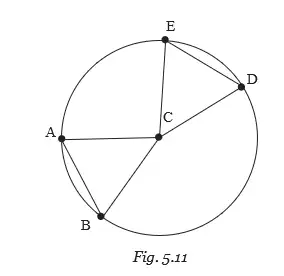
Why it works
- Radii: and .
- Included angle: is given.
- Congruence: by SAS; therefore the corresponding chords are equal.
Use when the angles are at the centre of the same circle.
Prove the chords equal
- Join the chord endpoints to the centre.
- Identify equal radii and the given equal central angles.
- Apply SAS congruence, then equate corresponding sides.
If two central angles in the same circle are equal, what can be concluded about their chords?
- In a circle with centre , suppose . Prove that .
- The corresponding sides from the centre are radii and hence equal.
- The triangles are congruent by SAS.
- Their corresponding chords are equal.
In a circle with centre , chords and are equal. If , find .
In a circle with centre , . If cm, find .
Quick recap
- A chord joins two points on a circle; its central angle is formed at the centre.
- Equal chords in the same circle subtend equal central angles.
- Use equal radii and equal chords with SSS to prove the equal-chords result.
- Equal central angles in the same circle subtend equal chords.
- Use equal radii and the included equal angles with SAS to prove the converse.
- Chord length and central angle correspond in both directions for chords of the same circle.
Midpoints and Perpendicular Bisectors of Chords
Centre-to-chord relationships
For a chord and centre , these two results work in opposite directions.
Apply the chord relationship
- Identify the circle’s centre, the chord, and the point where the centre-line meets the chord.
- If the point is the chord’s midpoint, conclude that the centre-line is perpendicular to the chord.
- If the centre-line is perpendicular to the chord, conclude that it bisects the chord.
Find the two parts of the chord.
- In a circle with centre , is perpendicular to chord . If cm, find and .
- The perpendicular from the centre to a chord bisects the chord.
- Split the chord equally and calculate each half.
Do not assume any line from the centre to a chord is perpendicular. The midpoint condition is required for Theorem 4; perpendicularity is required for Theorem 5.
In a circle, is the midpoint of chord . What is the angle between and ?
A perpendicular from the centre of a circle meets a chord of length cm. Find the length of each part of the chord.
Quick recap
- The line from a circle’s centre to the midpoint of a chord is perpendicular to the chord.
- A perpendicular from the centre to a chord bisects the chord.
- The midpoint result follows from congruent triangles and a straight angle.
- The perpendicular-bisector result follows from RHS congruence of right triangles.
- A chord cut by the centre’s perpendicular is divided into two equal parts.
Distance of Chords from the Centre
Equal Chords Are Equidistant from the Centre
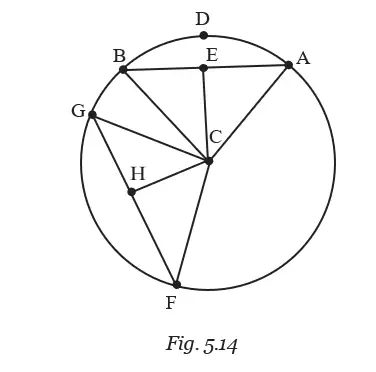
Chords of equal length in a circle are equidistant from its centre.
Two proof routes
- SSS route: and are radii, while is given. Thus by SSS; corresponding altitudes give .
- RHS route: Since the perpendicular from the centre bisects a chord, . Also, and . Hence by RHS, so .
Find the distance .
- In a circle with centre , chords and are equal. Their perpendicular distances from are and cm. Find .
- Equal chords are equidistant from the centre.
Two chords of a circle have lengths cm and cm. The distance of the first chord from the centre is cm. Find the distance of the second chord.
Longer Chords Are Closer to the Centre
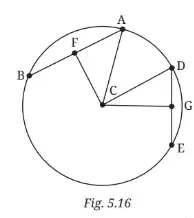
If in a circle with centre , then the perpendicular distance from to is less than the perpendicular distance from to .
For a circle of radius , a chord of length at perpendicular distance from the centre satisfies this right-triangle relation.
Compare Chord Lengths and Distances
- Drop perpendiculars from the centre to both chords; each perpendicular bisects its chord.
- Use the given chord comparison to compare the half-chords.
- Apply Pythagoras in the two right triangles, using equal radii.
- The longer half-chord leaves a smaller squared distance from the centre.
Which chord is closer to the centre?
- A circle has radius cm. Find the distances from its centre to chords of lengths cm and cm.
- For the cm chord, its half-length is cm. Use the right-triangle relation.
- For the cm chord, its half-length is cm.
Two chords in the same circle are cm and cm long. The longer chord is cm from the centre. Which chord is farther from the centre?
Do not measure chord distance along an arbitrary segment; it is always the perpendicular distance from the centre to the chord.
- Equal chords are equidistant from the centre.
- Among unequal chords, the longer chord is nearer to the centre.
- The diameter is the longest chord and has distance from the centre.
Quick recap
- The distance from the centre to a chord is measured perpendicularly.
- The perpendicular from the centre to a chord bisects it.
- Equal chords in the same circle are equidistant from the centre.
- A longer chord is closer to the centre than a shorter chord.
- A chord of length , radius and distance satisfies .
- The diameter is the greatest chord; its distance from the centre is .
Angles Subtended by an Arc Part-1
Arcs of a Circle
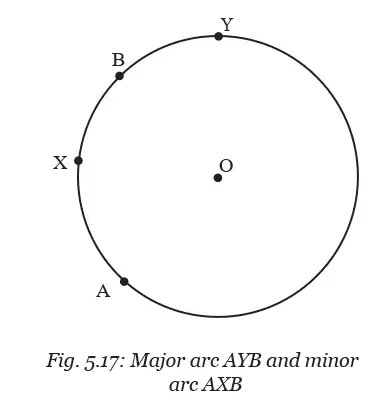
| Point | Minor arc | Major arc |
|---|---|---|
| Size | The smaller arc between the endpoints | The larger arc between the endpoints |
| Central angle | Less than | Greater than |
| Diameter endpoints | Both arcs are semicircles of | Both arcs are semicircles of |
- An arc subtending exactly at the centre is a semicircle.
Angle Subtended at the Centre
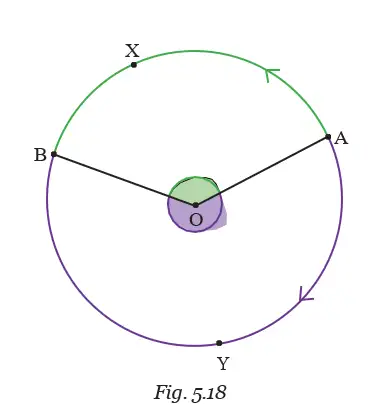
The central angles subtended by the minor and major arcs with the same endpoints make one full turn.
Use this relationship when the central angle for one of the arcs is known.
Classify an Arc Using Its Central Angle
- Identify the arc’s endpoints and the corresponding angle at the centre.
- Measure the angle swept along the given arc.
- Classify the arc: below is minor, above is major, and equal to is a semicircle.
The minor arc subtends an angle of at the centre. Find the angle subtended by the major arc .
- The minor arc subtends at the centre.
- The angles for the two arcs with endpoints and add to a full turn.
- Subtract the minor-arc angle from .
Do not automatically use the smaller angle for every arc: a major arc subtends the reflex angle, greater than . If the endpoints are a diameter’s endpoints, both arcs subtend .
An arc subtends an angle of at the centre. Is it a minor arc or a major arc?
The major arc subtends at the centre. Find the angle subtended by the minor arc .
Quick recap
- An arc is a connected part of a circle’s circumference between two endpoints.
- Two endpoints normally define a minor and a major arc; diameter endpoints define two equal semicircles.
- A minor arc subtends less than at the centre.
- A major arc subtends more than at the centre.
- The central angles for the two arcs with the same endpoints sum to .
- An arc subtending is a semicircle.
Angles Subtended by an Arc Part-2
Angle Subtended by an Arc at the Circumference
- Inscribed angle: The angle subtended by an arc at a point on the circle outside that arc is called an angle at the circumference.
- Central-angle theorem: An arc subtends an angle at the centre that is twice the angle it subtends at any point on the remaining circumference.
- Same arc: The angle subtended by an arc is the same at every point on the circumference outside that arc.
- Diameter: A diameter subtends a right angle, or 90°, at any point on the circle.
Quick recap
- For an arc , choose a point on the circumference outside that arc to form the inscribed angle.
- The angle at the centre is twice the angle subtended by the same arc at the circumference.
- For a fixed arc, all eligible circumference angles are equal.
- A diameter subtends a right angle at every other point on the circle.
Concyclicity of Points
Concyclic Points
Use this criterion when the two points lie on the same side of the segment.
Test for concyclicity
- Check that the two points are on the same side of the segment joining the other two points.
- Compare the angles subtended by that segment.
- If the angles are equal, conclude that all four points lie on one circle.
If and lie on the same side of , and , , what can you conclude?
- Suppose and are on the same side of , and the angles subtended by are equal.
- The equal-angle condition is satisfied, and the points are on the required same side.
- Therefore, the four points lie on one circle.
Opposite Angles of a Cyclic Quadrilateral
For cyclic quadrilateral , both pairs of opposite angles are supplementary.
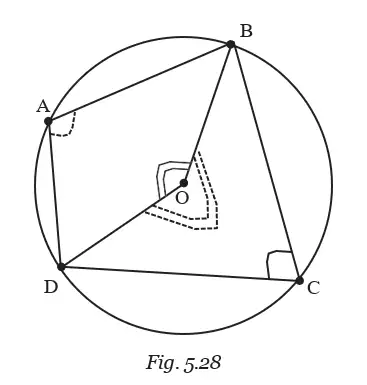
Find a missing angle in a cyclic quadrilateral
- Identify the angle opposite the unknown angle.
- Use the fact that opposite angles sum to .
- Subtract the known angle from .
In cyclic quadrilateral , find if .
- In a cyclic quadrilateral, suppose one angle is .
- The opposite angles are supplementary.
- Find the opposite angle.
Converse: A Supplementary Pair Makes a Cyclic Quadrilateral
A single pair of opposite supplementary angles is enough to establish cyclicity.
Prove a quadrilateral is cyclic
- Choose a pair of opposite angles.
- Add their measures and check whether the sum is .
- If the sum is , conclude the quadrilateral is cyclic.
A quadrilateral has and . What does this imply?
- Suppose a quadrilateral has opposite angles measuring and .
- Check their sum.
- By the converse, the quadrilateral is cyclic.
A cyclic quadrilateral has angles , , , and . Can it be drawn?
In a quadrilateral, and . Is it cyclic?
Quick recap
- Points on one circle are concyclic.
- Equal angles subtended by the same segment at points on the same side imply concyclicity.
- A cyclic quadrilateral has supplementary opposite angles.
- In a cyclic quadrilateral, and .
- If one pair of opposite angles of a quadrilateral sums to , the quadrilateral is cyclic.
Summary
Circles and Symmetry
- Reflection symmetry: Every diameter is a line of reflection symmetry of a circle.
- Rotational symmetry: A circle looks unchanged when rotated through any angle about its centre.
Circles Through Given Points
Finding the Circumcentre
- Draw the perpendicular bisectors of two sides of the triangle.
- Their intersection is the circumcentre.
- With the circumcentre as centre and its distance to any vertex as radius, draw the circumcircle.
Chords and Their Distances from the Centre
- Perpendicular bisector: The line from the centre to the midpoint of a chord is perpendicular to the chord; a perpendicular from the centre also bisects the chord.
- Distance from the centre: Equal chords are equidistant from the centre, and the longer of two unequal chords is closer to the centre.
Angles Subtended by Arcs and Chords
Use these relations for angles subtended by the same arc or by a diameter.
Concyclic Points and Cyclic Quadrilaterals
For cyclic quadrilateral , either pair of opposite angles is supplementary.
In cyclic quadrilateral , if , find .
- In cyclic quadrilateral , let . Find .
- Opposite angles of a cyclic quadrilateral are supplementary.
- Substitute the known angle and solve.
A central angle subtended by an arc is . Find the angle subtended by the same arc at a point on the remaining circle.
A perpendicular from the centre meets a chord of length cm. Find the lengths of the two parts of the chord.
In a quadrilateral, one pair of opposite angles is and . What can be concluded?
Do not reverse the arc-angle relation: the central angle is twice the angle at the circumference, not the other way around.
Quick recap
- A circle has reflection symmetry about every diameter and rotational symmetry through any angle about its centre.
- Two points determine a perpendicular bisector on which all possible circle centres lie; three non-collinear points determine one circumcircle.
- Equal chords have equal central angles and equal distances from the centre; the longer of two unequal chords is nearer the centre.
- A perpendicular from the centre bisects a chord, and the line from the centre to a chord’s midpoint is perpendicular to it.
- An arc’s central angle is twice its angle at the circumference; a diameter subtends a right angle.
- Opposite angles of a cyclic quadrilateral sum to , and the converse also holds.
Formula sheet
Mathematics — ALL CHAPTERS
1
Orienting Yourself: The Use of Coordinates
2
Introduction to Linear Polynomials
3
The World of Numbers
4
Exploring Algebraic Identities
5
I’m Up and Down, and Round and Round
6
Measuring Space: Perimeter and Area
7
The Mathematics of Maybe: Introduction to Probability
8
Predicting What Comes Next: Exploring Sequences and Progression