Class 9 . Mathematics . Ganita Manjari . The World of Numbers
Chapter 3: The World of Numbers
Ch 3
Mathematics
Class 9
The Dawn of Mathematics: The Human Need to Count
Counting and Natural Numbers
The counting numbers begin at .
Compare two groups by matching
- Put one pebble in the pot for every cow that leaves.
- Remove one pebble for every cow that returns.
- Check whether any pebbles remain.
If 12 cattle leave and 11 return, how many pebbles remain?
- Find the difference between the cattle that leave and return.
- Interpret the remaining pebble as one missing cow.
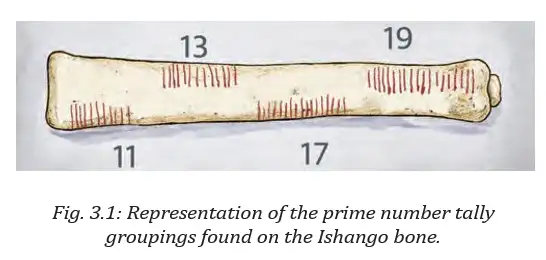
Early Number Records in Africa
Trade, Large Numbers and the Indian Number System
The exponent tells how many factors of are multiplied.
Evaluate a power of 10
- Multiply 10 by itself as many times as the exponent indicates.
- Write the resulting value.
Evaluate .
- Expand the power as three factors of 10.
- Multiply the factors.
A group of 15 cattle leaves and 13 return. How many pebbles remain, and what do they indicate?
What is notable about the Ishango Bone?
What are the largest powers of 10 named in the Vedic texts and the Lalitavistara, and what are their names?
Quick recap
- One-to-one correspondence matches each object in one group with exactly one in another to compare quantities.
- Natural numbers are used for counting: .
- The Lebombo Bone has 29 notches and dates to approximately 35,000 years ago; the Ishango Bone dates to around 20,000 BCE.
- The Ishango Bone's groupings include 11, 13, 17 and 19, and the bone records indicate that number concepts are tens of thousands of years old.
- Indus Valley standardised weights and measures supported trade, while Vedic texts and the Lalitavistara named very large powers of 10.
- The decimal place-value system used today was perfected in the Indian subcontinent, and its development helped pave the way for zero.
The Revolution of ŚHUNYA: When Nothing Became
From Śhūnyatā to Zero
Śūnya (zero) — A number representing nothing; unlike a mere placeholder, it can be used in arithmetic operations.
Philosophical idea and mathematical development
- Śūnyatā means emptiness or nothingness; the Upanishads and Buddhist literature discussed it from well before the 7th century BCE.
- Meditation: Śūnyatā was described as a goal of meditation—stilling the mind by emptying it of vṛttis (mental fluctuations).
- Patañjali: the Yoga Sutras, around the 3rd century BCE, connect śūnyatā with control of the mind, body and senses.
- Development: the philosophical idea of emptiness provided a framework for accepting nothingness, which entered fields including architecture, literature and linguistics before mathematics.
- Mathematical stages: zero appeared in the mathematical work of Āryabhaṭa and was later given explicit arithmetic rules by Brahmagupta.
- Earlier placeholders: Babylonians and Mayans used symbols to mark empty place-value columns, but did not treat nothing as an operational number.
Zero Becomes an Operational Number
Key milestones
- Bakhśhāli Manuscript: dated to the early centuries CE, it shows a dot (bindu) used as a symbol for zero.
- Brahmagupta: in the Brāhmasphuṭasiddhānta (628 CE), he defined zero as the result of subtracting a number from itself: .
- Key change: zero became a fully usable number when arithmetic rules were assigned to it.
For any number , adding zero or subtracting zero leaves it unchanged; multiplying it by zero gives zero.
Use these rules to simplify expressions involving zero.
Applying the zero rules
- Identify the operation involving zero.
- Apply the matching rule.
- Write the simplified result.
Simplify .
- Simplify the expression using the zero rules.
- Adding zero leaves the number unchanged.
- Subtracting the same number gives zero, and multiplying by zero gives zero.
- Combine the results.
Do not confuse a placeholder with an operational number: a placeholder marks an empty place-value column, while zero also follows arithmetic rules such as and .
Simplify .
Find and state the zero rule used.
Quick recap
- Śūnyatā means emptiness; śūnya is the mathematical zero.
- The Upanishads and Buddhist literature discussed śūnyatā from well before the 7th century BCE, including stilling the mind’s vṛttis in meditation.
- Babylonians and Mayans used empty-place placeholders, but not zero as an operational number.
- The Bakhśhāli Manuscript used a dot (bindu) to represent zero.
- Zero appeared in mathematical work including Āryabhaṭa’s, before Brahmagupta formalised its rules.
- Brahmagupta defined zero as in 628 CE; rules include , and .
Integers: Expanding the Horizon
Integers and the Number Line
Integers in context
- Positive integers: Represent fortunes or assets; a fortune is called Dhana.
- Negative integers: Represent debts or amounts owed; a debt is called Riṇa.
- Zero: Lies between negative and positive integers; it represents neither a fortune nor a debt.
- Number line: Negative integers lie to the left of zero, and positive integers lie to the right.
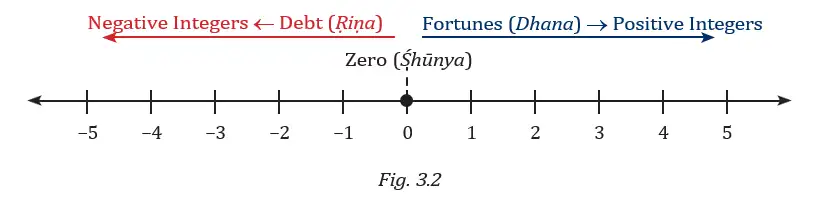
The dots show that integers continue without end in both directions.
Arithmetic of Integers
For addition, same-sign numbers combine their magnitudes and keep their sign; different-sign numbers subtract magnitudes and keep the sign of the number with greater magnitude. For multiplication, same signs give a positive product and different signs give a negative product.
Key operation facts
- Addition: A fortune plus a fortune is a fortune; a debt plus a debt is a debt.
- Subtraction: Subtracting a larger number from a smaller number can give a negative result.
- Zero: Subtracting zero leaves the number unchanged.
- Multiplication: A debt times a fortune is a debt; a debt times a debt is a fortune.
Here, and are positive numbers.
Why is a negative times a negative positive?
- Interpretation: A negative can represent a debt, while multiplying by a negative can represent removing that debt.
- Result: Removing four debts of each leaves a gain of .
Apply integer sign rules
- For addition, combine magnitudes; keep the common sign if signs match, or use the sign of the greater magnitude if they differ.
- For subtraction, evaluate the difference and use a negative result when the smaller number is subtracted from the larger number.
- For multiplication, same signs give a positive result and different signs give a negative result.
- Check whether the answer makes sense using the fortune-and-debt interpretation.
Evaluate .
- Evaluate the product of two debts.
- The signs match, so the product is positive; multiply the magnitudes.
- Removing four debts of each is a gain of .
Do not assume a negative sign always makes the answer negative: multiplying two negative numbers gives a positive product.
Evaluate .
Evaluate .
Quick recap
- Integers include negative whole numbers, zero, and positive whole numbers; their set is .
- Positive integers can represent fortunes (Dhana), while negative integers can represent debts (Riṇa).
- On the number line, negatives are left of zero and positives are right of zero.
- Adding numbers with the same sign combines their magnitudes and keeps that sign.
- In multiplication, same signs give a positive product and different signs give a negative product.
- Subtracting a larger number from a smaller number can give a negative result.
Filling the Spaces: Fractions and Rational Numbers
Fractions and Rational Numbers
Fraction — A fraction represents a part of a whole.
Rational number — A rational number is any number that can be written as , where and .
Key facts
- Notation: The set of rational numbers is denoted by , from “quotient.”
- Non-zero denominator: cannot be zero because division by zero is undefined.
- Includes integers: Natural numbers, whole numbers and integers are rational; for example, and .
- Negative fractions: The minus sign may appear before the fraction, in the numerator or in the denominator: .
- Additive inverse: The additive inverse of a rational number is its negative; for example, the inverse of is .
Equivalent Representations
A rational number has many fraction representations. Multiplying or dividing the numerator and denominator by the same non-zero integer gives an equivalent fraction.
Simplest form
- Equivalent fractions: For example, .
- Lowest terms: Reduce by dividing out common factors until the numerator and denominator are co-prime.
- Number-line label: One reduced fraction represents all equivalent fractions; for example, represents .
Reduce a fraction
- Find a common factor of the numerator and denominator.
- Divide both by the common factor and repeat until they are co-prime.
Write in lowest terms.
- Divide the numerator and denominator by their common factor, .
- The resulting numerator and denominator are co-prime.
Equality and Operations
For division, the divisor must be non-zero.
Properties of rational numbers
- Addition and subtraction: Use equivalent fractions to make the denominators equal before combining numerators.
- Commutative operations: Addition and multiplication are commutative; subtraction and division are not generally commutative.
- Distributive law: Multiplication distributes over addition: .
- Closure: Rational numbers are closed under addition, subtraction and multiplication, and under division by a non-zero rational number.
Add or subtract fractions
- Find a common denominator, preferably the least common multiple of the denominators.
- Rewrite each fraction with denominator , then add or subtract the numerators.
- Reduce the result if possible.
Calculate .
- Rewrite both fractions with denominator .
- Add the numerators.
Representing Rational Numbers on the Number Line
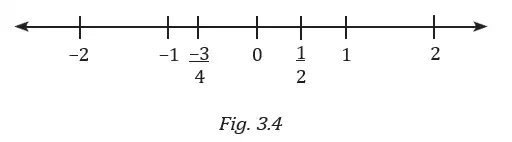
Number-line representation
- Origin: The point is the origin; positive numbers lie to its right and negative numbers to its left.
- Unit interval: The distance between consecutive integers is one unit, and integers are equally spaced.
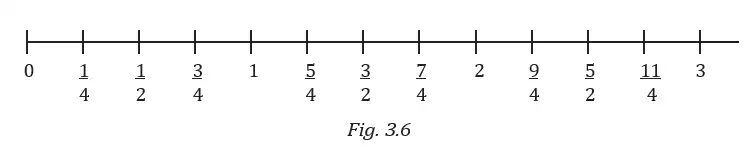
- Proper fractions: Divide the unit interval into as many equal parts as the denominator, then count the numerator's parts from .
- Fractions greater than one: Locate the integer part, then the remaining fractional part; for example, lies between and .
Plot a rational number
- Divide each unit interval into equal parts according to the denominator.
- From , move the required number of parts right for a positive number and left for a negative number.
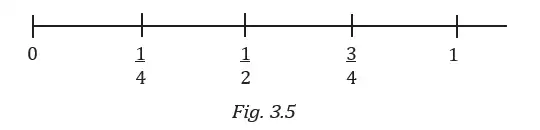
Describe how to locate on the number line.
- Divide the interval from to into four equal parts.
- The third mark to the right of represents the fraction.
Absolute Value and Distance
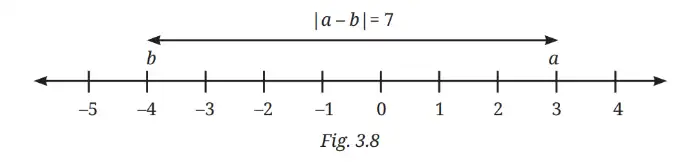
Absolute value — The absolute value is the distance of the rational number from on the number line.
Absolute value is always non-negative; the distance between two rational numbers is the absolute difference of their coordinates.
Find .
- Take the absolute value of the negative number.
- The result is its non-negative distance from .
Density of Rational Numbers
Density — Rational numbers are dense: between any two distinct rational numbers, there is another rational number.
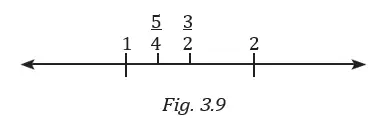
If are rational numbers, their average is rational and lies strictly between them. Repeatedly taking averages shows there are infinitely many rational numbers between any two distinct rational numbers.
Find a rational number between and .
- Take the average of the endpoints.
- Simplify; the result lies between and .
Calculate .
Write as a mixed number and state the consecutive integers it lies between.
Find a rational number between and .
Quick recap
- A rational number has the form with and ; the set is denoted by .
- Equivalent fractions represent the same rational number; reduce by cancelling common factors.
- Use common denominators to add or subtract; multiply directly and divide by the reciprocal of a non-zero divisor.
- Rational numbers are closed under addition, subtraction and multiplication, and division by a non-zero rational number.
- On the number line, the denominator sets equal subdivisions and the numerator sets how many parts to count from zero.
- Absolute value is distance from zero, and the distance between and is .
- The average of two distinct rational numbers is another rational number between them, so rational numbers are dense.
Irrational Numbers
Irrational Numbers and the Proof for √2
Irrational number — A number that cannot be written as a ratio of two integers is irrational.
Key ideas
- Rational number: Can be expressed as , where are integers and .
- Irrational examples: and cannot be expressed as such a fraction.
- Number line: Rational and irrational numbers both have positions on the number line.
For a right triangle with perpendicular sides and hypotenuse , . A unit square therefore has diagonal length .
Use the Pythagorean theorem on its two sides.
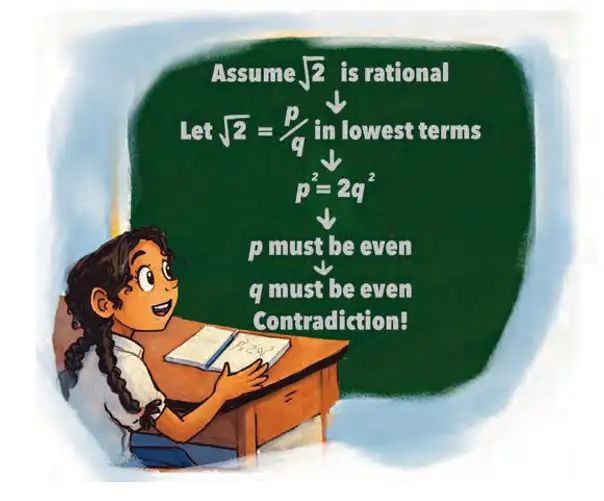
Proof by contradiction for √2
- Assume the opposite: write in simplest form, with .
- Square and rearrange to obtain an even square for ; hence is even. Put .
- Substitute . This makes even, so is also even.
- Both and are even, contradicting that was in simplest form. Therefore is irrational.
Prove that is irrational.
- Assume , where and are coprime integers and .
- Squaring gives , so is even and therefore is even. Let .
- Substitution gives , so is even too.
- This contradicts coprimality: both integers have factor . Hence the assumption is false.
Do not assume that and are merely integers: choosing the fraction in simplest form is essential for the contradiction.
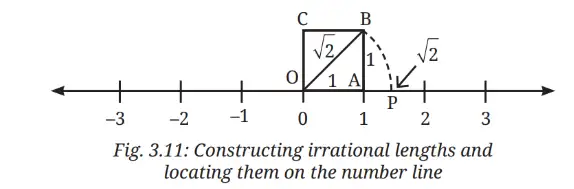
Constructing Lengths of the Form √n
Geometric construction of √n — A right-triangle construction produces a segment of length for a positive integer .
Construct and mark √n
- Mark a unit segment on the number line and erect a perpendicular at its endpoint.
- To construct the next root length, use the current length as one leg and a unit segment as the perpendicular leg.
- Repeat the right-triangle step until the hypotenuse has length .
- Set a compass to that hypotenuse and transfer the length from the origin onto the number line.
Construct and mark a segment of length .
- Start with a unit segment. Construct a right triangle with legs and ; its hypotenuse is .
- Use and a perpendicular unit segment as the legs of the next right triangle.
- The new hypotenuse has length . Transfer this length from the origin onto the number line with a compass.
π and an Infinite Series
π — The number is the ratio of a circle's circumference to its diameter, and it is irrational.
The alternating sum approaches as more terms are added.
Key ideas
- Approximation: is a close approximation to , not an exact fraction.
- Infinite sum: Its value is the limit approached by the partial sums as more terms are added.
- Why one fraction is insufficient: Since is irrational, no single fraction gives its exact value.
Use the first three terms of the series to form a partial sum for .
- Take the first three terms inside the brackets.
- Combine the fractions and multiply by .
Prove that is irrational using contradiction.
Describe how to construct a segment of length and mark it on the number line.

Quick recap
- An irrational number cannot be expressed as for integers with .
- A unit square has diagonal , which is irrational.
- Proof by contradiction assumes the claim's opposite and derives an impossibility.
- Right triangles and a compass can construct and locate lengths such as on the number line.
- is the ratio of circumference to diameter and is irrational.
- The alternating infinite series for approaches its value through successive partial sums.
Real Numbers: Decimals and Cyclic Patterns
Real Numbers and Decimal Expansions
Real numbers — Real numbers consist of all rational and irrational numbers.
The real number set combines the rational numbers with the irrational numbers.
Rational decimal expansions
- Terminating decimal stops when the division reaches a remainder of ; for example, .
- Repeating decimal has a digit or block that repeats forever; for example, .
- Long division has only finitely many possible remainders. If a non-zero remainder repeats, all following digits repeat.
- Rational numbers have decimal expansions that terminate or eventually repeat.
For a rational number, long division either reaches remainder or eventually repeats a remainder. In the second case, the decimal digits repeat from that point onward.
Why does the decimal expansion of repeat?
- Divide by ; the non-zero remainders cycle back to the first remainder.
- Only six non-zero remainders are possible, so a remainder must recur.
Predicting Whether a Rational Decimal Terminates
Lowest terms — A fraction is in lowest terms when its numerator and denominator have no common factor other than .
For in lowest terms, the decimal terminates exactly when the prime factors of are only and .
Using the denominator test
- First reduce the fraction to lowest terms; only then factor its denominator.
- Terminating: the reduced denominator has the form , where are non-negative integers.
- Non-terminating repeating: the reduced denominator has a prime factor other than or .
- Reason: a denominator containing only s and s can be multiplied by a suitable number to become a power of .
Classify a rational decimal
- Reduce the fraction to lowest terms.
- Find the prime factors of the denominator.
- Apply the criterion: only factors and means terminating; any other prime means repeating.
Determine whether has a terminating decimal expansion.
- Factor the denominator of .
- Make the denominator a power of .
Converting Terminating Decimals to Fractions
Terminating decimal — A terminating decimal can be written as a fraction over a power of , then simplified.
For decimal places, place the digits over and reduce.
Convert a terminating decimal
- Write the decimal digits over the matching power of .
- Reduce the fraction to lowest terms.
Convert to the form .
- There are two decimal places, so write the number over .
- Simplify by dividing numerator and denominator by .
Converting Pure Repeating Decimals
Pure repeating decimal — A pure repeating decimal has its repeating block begin immediately after the decimal point.
Conversion idea
- Shift one full cycle by multiplying by , where is the number of repeating digits.
- Subtract the original equation from the shifted one to cancel the repeating decimal.
For an -digit repeating block represented by the integer , multiply and subtract.
Convert a pure repeating decimal
- Set the repeating decimal equal to .
- Multiply by , where is the length of the repeating block.
- Subtract and solve for .
Convert to the form .
- Let the decimal be and shift by two places.
- Subtract the first equation from the second.
- Solve and simplify.
Converting General Repeating Decimals
General repeating decimal — A general repeating decimal has non-repeating digits after the decimal point before its repeating block begins.
Convert a general repeating decimal
- Let the number be and multiply by to shift past the non-repeating digits.
- Multiply by a further to shift one full cycle of repeating digits.
- Subtract the shifted equations and solve for .
Here, is the number of non-repeating digits, is the number of repeating digits, is the integer formed through the first repeat block, and is the integer formed before that block.
Examples of general repeating decimals
- One non-repeating digit: gives and ; hence and .
- Two non-repeating, one repeating digit: gives and ; hence .
Convert to the form .
- Let the decimal be ; two digits do not repeat, so shift past them.
- Shift one complete two-digit repeating block.
- Subtract, then reduce the fraction.
Cyclic Numbers
Cyclic number — A cyclic number has multiples whose digits appear as cyclic rearrangements of its digits.
The repeating block is the cyclic number associated with .
| Multiplier | Product |
|---|---|
Irrational Decimals and Non-Unique Representations
Irrational number — An irrational number cannot be written as a ratio of integers; its decimal expansion is non-terminating and non-repeating.
| Number type | Decimal behaviour |
|---|---|
| Rational | Terminating or eventually repeating |
| Irrational | Non-terminating and non-repeating |
Examples and equivalent decimal forms
- Irrational examples: and ; neither decimal terminates or repeats.
- Non-unique form: every terminating decimal has an equivalent form ending in repeating s.
- Examples: and ; the repeating- form is not smaller.
A decimal with infinitely many s equals the corresponding terminating decimal.
Show that .
- Let the repeating decimal equal .
- Multiply by and subtract the original equation.
- Solve to find its exact value.
Practice
Does have a terminating or repeating decimal expansion?
Convert to the form .
Is rational or irrational? Use its decimal expansion to justify your answer.
Quick recap
- A rational decimal terminates or eventually repeats; an irrational decimal neither terminates nor repeats.
- For a reduced fraction, the decimal terminates exactly when the denominator has only prime factors and .
- Convert a terminating decimal by placing its digits over a power of and reducing.
- Convert a repeating decimal by shifting the decimal and subtracting to cancel its repeating part.
- The repeating block of is the cyclic number .
- A terminating decimal has an equivalent form ending in repeating s; for example, .
Conclusion: The Never-Ending Journey
The Real Number System
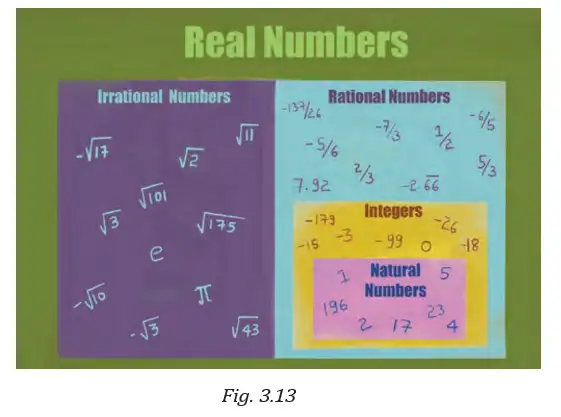
The number sets are nested as . Rational and irrational numbers are disjoint, and together form the real numbers. Between any two distinct real numbers lie infinitely many rational numbers and irrational numbers.
Use these relationships to show how the number sets combine.
Classifying a number
- Check whether the number can be written as a ratio of integers.
- If it can, classify it as rational; if not, classify it as irrational.
- Place it in the larger set or sets that contain it, such as the integers and real numbers.
Which number sets contain ?
- Classify .
- Its decimal expansion is non-terminating and non-repeating, so it is irrational.
- Irrational numbers are real numbers.
Do not assume every non-terminating decimal is irrational: a repeating decimal is rational. Irrational decimals are non-terminating and non-repeating.
Beyond the Real Number Line
A preview of imaginary numbers
- No real square root: The square of any real number is non-negative, so no real number has square .
- Imaginary unit: A new number is defined by ; therefore .
- Beyond this chapter: Imaginary numbers are used in areas such as electrical engineering and quantum mechanics.
Classify as rational or irrational, and state whether it is real.
Classify as rational or irrational, and state whether it is real.
Which of these sets contain : ?
Quick recap
- Natural numbers are contained in the integers, which are contained in the rational numbers.
- Rational numbers have terminating or repeating decimal expansions.
- Irrational numbers have non-terminating, non-repeating decimal expansions.
- Rational and irrational numbers together form the real numbers on a continuous number line.
- The imaginary unit satisfies and lies beyond the real number system.
Summary
Natural Numbers, Zero and Integers
- Natural numbers: Counting numbers , developed from the need to count.
- Zero: Brahmagupta formalised zero as a number and described rules for arithmetic with it.
- Integers: The set includes zero and positive and negative whole numbers.
- Positive and negative numbers: Brahmagupta described positive numbers as fortunes (dhana) and negative numbers as debts (riṇa).
Formula sheet
Mathematics — ALL CHAPTERS
1
Orienting Yourself: The Use of Coordinates
2
Introduction to Linear Polynomials
3
The World of Numbers
4
Exploring Algebraic Identities
5
I’m Up and Down, and Round and Round
6
Measuring Space: Perimeter and Area
7
The Mathematics of Maybe: Introduction to Probability
8
Predicting What Comes Next: Exploring Sequences and Progression