Class 10 . Mathematics . Mathematics . Areas Related to Circles
Chapter 11: Areas Related To Circles
Ch 11
Mathematics
Class 10
Areas Of Sector And Segment Of A Circle
Sectors and Segments
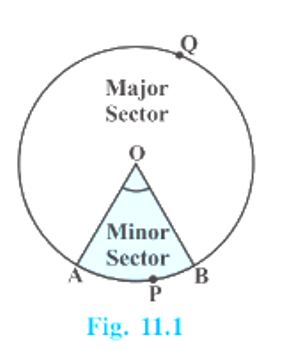
Sector — A sector is the part of a circle enclosed by two radii and their corresponding arc.
Minor and Major Sectors
- Minor sector: The smaller region; its central angle is less than .
- Major sector: The larger region; its central angle is when the minor angle is .
- Convention: “Sector” means the minor sector unless the major sector is specified.
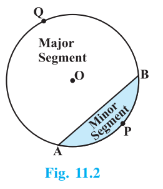
Segment — A segment is the part of a circle enclosed by a chord and its corresponding arc.
Minor and Major Segments
- Minor segment: The smaller region between a chord and its minor arc.
- Major segment: The larger region between the same chord and its major arc.
- Convention: “Segment” means the minor segment unless the major segment is specified.
Area of a Sector and Length of an Arc
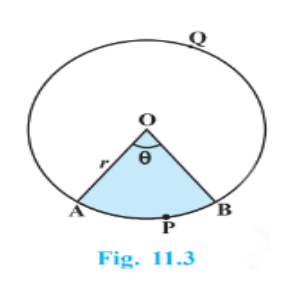
A sector with central angle is the fraction of the full circle; its arc is the same fraction of the circumference.
Use for a sector of radius and central angle in degrees.
Use for the arc corresponding to a sector of radius and angle in degrees.
Finding Sector Area or Arc Length
- Identify the radius and central angle in degrees.
- For area, use the fraction of the full circle’s area.
- For arc length, use the same fraction of the circumference.
- For a major sector or major arc, replace by .
Find the areas of the minor and corresponding major sectors of a circle with radius cm and central angle . Use .
- For radius cm and angle , calculate the minor-sector area using .
- Simplify to find the minor-sector area.
- The major-sector angle is ; subtract the minor area from the circle’s area.
Area of a Segment
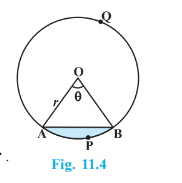
The area of a minor segment equals the area of its sector minus the area of the triangle formed by the two radii and the chord.
For the triangle formed by radii and a chord, use base times perpendicular height divided by .
Major Regions
- Major sector area: Circle area minus minor-sector area.
- Major segment area: Circle area minus minor-segment area.
Finding a Segment Area
- Calculate the corresponding sector area using the central angle.
- Find the area of the triangle between the radii and chord, using a perpendicular height if needed.
- Subtract the triangle area from the sector area.
Using a Perpendicular from the Centre
- Isosceles triangle: Since , the perpendicular from to chord bisects the chord and the central angle.
- For central angle : Each half-angle is ; use right-triangle trigonometry to find the height and half-chord.
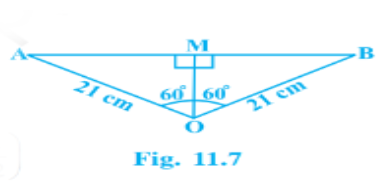
Find the minor-segment area when the circle has radius cm and central angle . Use .
- The sector angle is and its radius is cm.
- Drop perpendicular to chord . It bisects both the chord and the angle, so .
- Use cosine to find the height .
- Use sine to find half the chord, then double it.
- Find triangle area and subtract it from the sector area.
Do not confuse arc length with sector area: use for the full circumference and for the full area. For a segment, subtract the triangle area from the sector area.
Find the length of an arc subtending at the centre of a circle of radius cm.
Find the area of a sector of a circle with radius cm. Use .
A minor segment has a sector area of and triangle area of . Find the segment area.
Quick recap
- A sector is bounded by two radii and an arc; a segment is bounded by a chord and an arc.
- Unless specified otherwise, sector and segment refer to the minor regions.
- Sector area is .
- Arc length is .
- Minor-segment area equals sector area minus the corresponding triangle area.
- Major sector or segment area equals the full circle area minus the corresponding minor-region area.
Formula sheet
Mathematics — ALL CHAPTERS
1
Real Numbers
2
Polynomials
3
Pair Of Linear Equations In Two Variables
4
Quadratic Equations
5
Arithmetic Progressions
6
Triangles
7
Coordinate Geometry
8
Introduction To Trigonometry
9
Some Applications Of Trigonometry
10
Circles
11
Areas Related To Circles
12
Surface areas And Volumes
13
Statistics
14
Probability