Class 10 . Mathematics . Mathematics . Quadratic Equations
Chapter 4: Quadratic Equations
Ch 4
Mathematics
Class 10
Introduction & Quadratic Equations
Quadratic Equations and Standard Form
Use this form to identify a quadratic equation; must not be zero.
Write an Equation in Standard Form
- Simplify both sides and collect like terms.
- Move all terms to one side so the other side is zero.
- Arrange in descending powers and check that the squared-term coefficient is non-zero.
Form a quadratic equation for the hall's breadth.
- A prayer hall has area . If its breadth is metres, its length is metres.
- Use area = length breadth.
- Expand and move all terms to one side.
- This is quadratic because the coefficient of is .
Representing Situations with Quadratic Equations
When two quantities are expressed using , translate their stated product into an equation.
Model a Real-Life Situation
- Define the unknown quantity as .
- Write each related quantity in terms of .
- Use the given condition to form an equation.
- Simplify into standard form and verify it is degree .
Form quadratic equations for the marble and toy-production situations.
- Marbles: let John initially have marbles; Jivanti has . After each loses , their numbers are and .
- Their remaining product is ; expand and rearrange.
- Toys: let be the number made. Each toy costs Rs. , so the total cost is Rs. .
- Set quantity times unit cost equal to total cost and rearrange.
Deciding Whether an Equation Is Quadratic
After simplification, the equation must have a non-zero coefficient of and no higher-degree terms.
Test an Equation
- Expand all brackets.
- Cancel and combine like terms on both sides.
- Rearrange to make one side zero.
- Classify the simplified equation by its degree.
Classify each equation as quadratic or not quadratic after simplifying.
- Expand and rearrange .
- Cancel the squared terms in .
- Expand and rearrange .
- Expand both cubes in ; the cubic terms cancel.
Do not classify an equation by its appearance before simplifying: equal highest-power terms can cancel, leaving a lower-degree equation.
A rectangle has breadth metres and length metres. Its area is . Form a quadratic equation for .
Is a quadratic equation?
Quick recap
- Definition: A quadratic equation simplifies to , where are real and .
- Degree: An equation is quadratic when is a degree- polynomial.
- Modelling: Define the unknown, express related quantities, and translate the given condition into an equation.
- Hall: The area condition gives .
- Marbles and toys: Their equations are and .
- Classification: Simplify before checking degree; terms can cancel and change the equation's degree.
Solution Of A Quadratic Equation By Factorisation
Roots and factorisation
If a product is zero, at least one factor must be zero. Thus, implies or .
Solve by factorisation
- If needed, rearrange the equation into the form .
- Split the middle term so the two terms have a product equal to and a sum equal to (including the signs).
- Group terms and factorise into two linear factors.
- Set each factor to zero and solve the resulting linear equations.
- Check the roots by substituting them into the original equation.
Find the roots of by factorisation.
- Solve by splitting the middle term.
- Factor by grouping.
- Set each factor equal to zero.
- Solve both linear equations.
Useful factorisation patterns
- Two distinct factors: , so its roots are and .
- Repeated factor: , so the same root occurs twice.
Nature of roots and the discriminant
Use this formula to find roots; real roots occur when .
When , both roots coincide at .
Find the discriminant of and state the nature of its roots.
- For , identify the coefficients.
- Calculate the discriminant.
- Since the discriminant is negative, there are no real roots.
Quick discriminant checks
- Negative discriminant: For , , so there are no real roots.
- Zero discriminant: For , and both roots are .
Applications of quadratic equations
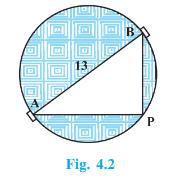
Apply Pythagoras’ theorem, then solve for the valid positive distance.
Solve by factorisation.
A hall has breadth m and length m. If its area is m, find its dimensions.
A pole on the boundary of a circular park is m farther from gate than gate . The gates are opposite ends of a diameter m long. Is this possible, and what are the distances?
Do not keep a negative root as a physical length or distance. Also, when , the equation has two equal real roots—not no roots.
Quick recap
- A root is a value that satisfies the quadratic equation; it is also a zero of its quadratic polynomial.
- Factorise into linear factors, set each factor to zero, and solve.
- The discriminant is .
- : two distinct real roots; : two equal real roots; : no real roots.
- The quadratic formula is when .
- For real-world problems, reject roots that cannot represent the quantity, such as a negative length.
Formula sheet
Mathematics — ALL CHAPTERS
1
Real Numbers
2
Polynomials
3
Pair Of Linear Equations In Two Variables
4
Quadratic Equations
5
Arithmetic Progressions
6
Triangles
7
Coordinate Geometry
8
Introduction To Trigonometry
9
Some Applications Of Trigonometry
10
Circles
11
Areas Related To Circles
12
Surface areas And Volumes
13
Statistics
14
Probability