Coordinates: An ordered pair (x, y) identifies the position of a point on the coordinate plane.
Coordinate geometry: It uses algebra to study geometric figures and applies in fields such as physics, engineering, navigation and art.
Distance Along the Axes and the Pythagorean Theorem
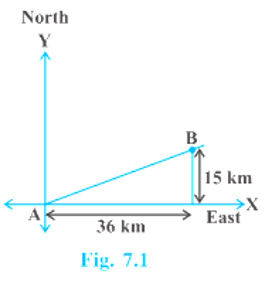
A right-triangle representation of the eastward and northward distances between two towns.
Distance Formula
Distance formula
For points P(x1,y1) and Q(x2,y2), the distance is calculated using the Pythagorean theorem and is unchanged if the points are swapped.
PQ=(x2−x1)2+(y2−y1)2=(x1−x2)2+(y1−y2)2
Distance between two points
PQ=(x2−x1)2+(y2−y1)2
Use for any two points on the coordinate plane.
Finding a distance
Write the coordinates of the two points in matching order.
P(x1,y1),Q(x2,y2)
Substitute the coordinate differences into the distance formula.
PQ=(x2−x1)2+(y2−y1)2
Simplify and take the positive square root.
PQ≥0
Worked example
Find the distance between P(4,6) and Q(6,8).
Find the coordinate differences for P(4,6) and Q(6,8).
Δx=6−4=2,Δy=8−6=2
Apply the distance formula.
PQ=(6−4)2+(8−6)2
Simplify to obtain the distance.
PQ=4+4=8=22
Answer:22 units.
Using Distance to Study Figures and Points
Key applications
Right triangle: For P(3,2), Q(−2,−3) and R(2,3), PQ2=50, PR2=2 and QR2=52; hence the triangle is right-angled at P.
Square: For A(1,7), B(4,2), C(−1,−1) and D(−4,4), each side is 34 and each diagonal is 68; the quadrilateral is a square.
Collinear points: For A(3,1), B(6,4) and C(8,6), AB=32, BC=22 and AC=52, so AB+BC=AC and the points are collinear.
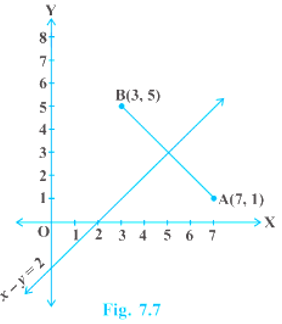
Equidistant locus: If P(x,y) is equidistant from A(7,1) and B(3,5), then PA2=PB2 simplifies to x−y=2. This line is the perpendicular bisector of AB.
Point on the y-axis: A point has form (0,y). If it is equidistant from A(6,5) and B(−4,3), equating squared distances gives y=9, so the point is (0,9).
The line of points equidistant from two fixed points is their perpendicular bisector.
Practice
Classify the triangle with vertices P(3,2), Q(−2,−3) and R(2,3).
Hint: Find the three squared side lengths and compare them.
Key step:PQ2=50, PR2=2 and QR2=52.
Solution:PQ2+PR2=50+2=52=QR2, so the points form a right triangle with the right angle at P.
Practice
Show that A(1,7), B(4,2), C(−1,−1) and D(−4,4) are vertices of a square.
Hint: Find the four side lengths and check one right angle using the converse of Pythagoras’ theorem.
Key step:AB=BC=CD=DA=34 and AD2+DC2=AC2.
Solution:AD2+DC2=34+34=68=AC2, so the angle at D is 90∘. Since all four sides are equal, ABCD is a square.
Practice
Find the point on the y-axis equidistant from A(6,5) and B(−4,3).
Hint: Let the point be (0,y) and equate the squared distances.
Key step:36+(5−y)2=16+(3−y)2.
Solution:36+(5−y)2=16+(3−y)2 gives 4y=36, hence y=9. The point is (0,9).
⚠ Common mistake
Do not use a signed coordinate difference as the distance: square both coordinate differences, add them, and take the positive square root.
Quick recap
The abscissa is the x-coordinate, measured from the y-axis; the ordinate is the y-coordinate, measured from the x-axis.
Points on the x-axis have form (x,0); points on the y-axis have form (0,y).
The distance formula comes from the Pythagorean theorem: PQ=(x2−x1)2+(y2−y1)2.
The distance from the origin to (x,y) is x2+y2.
Distance comparisons help classify triangles and squares and test collinearity.
Points equidistant from two fixed points lie on their perpendicular bisector; a later chapter objective is to find coordinates dividing a segment in a given ratio.
Internal division — A point P divides AB internally when it lies between A and B; the ratio is written PA:PB=m1:m2.
How the formula follows
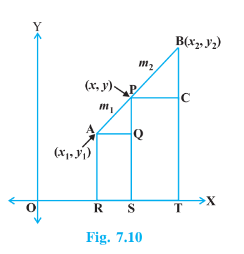
Similar triangles: Perpendicular projections from A, P and B to the axes give similar triangles.
Coordinate ratios: The horizontal and vertical distances give m2m1=x2−xx−x1=y2−yy−y1.
Weighted coordinates: Solving these ratios weights each endpoint by the opposite segment's ratio.
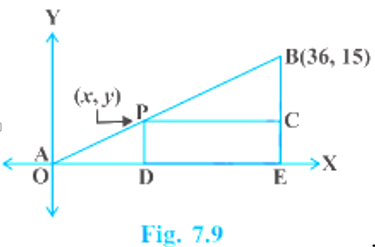
A point P lies on the segment from O to B(36,15), with its coordinate projections shown.
Illustration
Given: If A=O=(0,0), B=(36,15) and OP:PB=1:2, then P divides AB in the ratio 1:2.
Result: Applying the section formula gives P=(12,5).
Similar-triangle construction used to derive the internal section formula.
Internal section formula
If P divides the line segment joining A(x1,y1) and B(x2,y2) internally in the ratio PA:PB=m1:m2, its coordinates are given by the formula below.
(m1+m2m1x2+m2x1,m1+m2m1y2+m2y1)
Section formula for ratio k:1
(k+1kx2+x1,k+1ky2+y1)
Substitute m1=k and m2=1 when the internal ratio is k:1.
Applying the section formula
Identify the endpoint coordinates and write the ratio in the order PA:PB.
Use the coefficient of B with m1 and the coefficient of A with m2.
Simplify the x- and y-coordinates separately to obtain the ordered pair.
Worked example
Find the point dividing the segment joining (4,−3) and (8,5) internally in the ratio 3:1.
Find the point dividing the segment from (4,−3) to (8,5) internally in the ratio 3:1.
A=(4,−3),B=(8,5),m1=3,m2=1
Substitute into the internal section formula.
(3+13(8)+1(4),3+13(5)+1(−3))
Simplify both coordinates.
(428,412)=(7,3)
Answer:(7,3)
⚠ Common mistake
Keep the ratio order consistent: if PA:PB=m1:m2, the coefficient of B is m1 and the coefficient of A is m2.
Midpoint Formula
Definition
Midpoint — The midpoint divides a line segment into two equal parts, so it divides the segment in the ratio 1:1.
Midpoint formula
(2x1+x2,2y1+y2)
For endpoints A(x1,y1) and B(x2,y2), average the corresponding coordinates.
Worked example
Find the midpoint of (2,3) and (8,7).
Find the midpoint of (2,3) and (8,7).
A=(2,3),B=(8,7)
Average the corresponding coordinates.
(22+8,23+7)
Simplify.
(5,5)
Answer:(5,5)
Applications of the Section Formula
Finding an unknown ratio
Let the ratio be m1:m2 and use the section formula for the known point.
Equate the corresponding coordinates and solve for the ratio.
Check the ratio in the other coordinate equation.
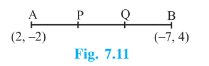
The segment is divided into three equal parts at P and Q.
Trisection and axis intersections
Trisection: The two trisection points divide AB in ratios 1:2 and 2:1.
Example: For A=(2,−2) and B=(−7,4), the trisection points are (−1,0) and (−4,2).
Axis condition: A point on the y-axis has x=0; set the section-formula x-coordinate to zero to find the ratio.
Example: The y-axis divides the segment from (5,−6) to (−1,−4) in the ratio 5:1, at (0,−313).
Parallelogram diagonal property
The diagonals of a parallelogram bisect each other, so their midpoints are equal. Equate the midpoint coordinates to find an unknown vertex coordinate.
midpoint(AC)=midpoint(BD)
Practice
In what ratio does (−4,6) divide the segment joining A=(−6,10) and B=(3,−8)?
Hint: Let the ratio be m1:m2 and use the x-coordinate in the section formula.
Key step:−4=m1+m23m1−6m2 gives 7m1=2m2.
Solution: Thus m1:m2=2:7. Checking the y-coordinate gives 2+7−8(2)+10(7)=6, so the ratio is correct.
Practice
Find the trisection points of the segment joining (2,−2) and (−7,4).
Hint: Apply the section formula with ratios 1:2 and 2:1.
Key step: Use (m1,m2)=(1,2) for the first point and (2,1) for the second.
Solution: The trisection points are (−1,0) and (−4,2).
Practice
The points A=(6,1), B=(8,2), C=(9,4) and D=(p,3) are consecutive vertices of a parallelogram. Find p.
Hint: The diagonals AC and BD have the same midpoint.
Key step: Equate the midpoint x-coordinates: 26+9=28+p.
Solution: Solving gives p=7; both midpoint y-coordinates equal 25.
External Division
Definition
External division — If P lies on line AB outside the segment AB and PA:PB=m1:m2, then P divides AB externally.
⚠ Common mistake
The section formula given here applies only to internal division, where P lies between A and B. External division means P lies on line AB outside the segment; its formula is studied in higher classes.
Distance Formula Recap
Distance between two points
PQ=(x2−x1)2+(y2−y1)2
For points P(x1,y1) and Q(x2,y2):
Distance from the origin
OP=x2+y2
The distance of P(x,y) from the origin O is:
Quick recap
For internal division with PA:PB=m1:m2, use (m1+m2m1x2+m2x1,m1+m2m1y2+m2y1).
For ratio k:1, the coordinates are (k+1kx2+x1,k+1ky2+y1).
The midpoint formula is (2x1+x2,2y1+y2).
The trisection points divide a segment in ratios 1:2 and 2:1.
External division means P lies on line AB outside the segment, with PA:PB=m1:m2.
On the y-axis, the x-coordinate is zero; parallelogram diagonals share the same midpoint.
The distance between two points is (x2−x1)2+(y2−y1)2; from the origin it is x2+y2.