Lecture 1
Introduction & Trigonometric Ratios
Reference video · Lecture 1 Introduction & Trigonometric Ratios
Introduction and Applications
Definition Trigonometry — The branch of mathematics that studies relationships between the sides and angles of triangles.
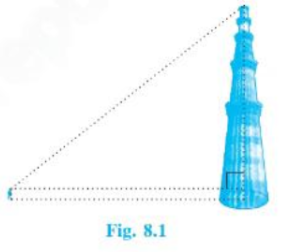
Why trigonometry is useful Applications: Right triangles can model situations such as finding a tower's height, a river's width, or a balloon's altitude.Use: Trigonometric relationships help find unknown distances or heights without measuring them directly.Scope: This lecture defines ratios for acute angles in right triangles. The chapter will also define ratios for 0 ∘ 0^\circ 0 ∘ 90 ∘ 90^\circ 9 0 ∘ A tower and a line of sight form a right-triangle model for finding height. Sides Relative to an Acute Angle
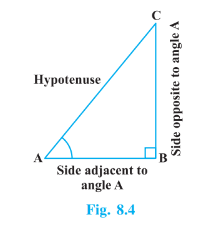
Naming the sides Hypotenuse: The side opposite the right angle; it is the longest side.Opposite side: The side directly across from the angle being considered.Adjacent side: The side next to the angle being considered, other than the hypotenuse.Angle matters: Opposite and adjacent sides change when the reference angle changes; the hypotenuse does not.
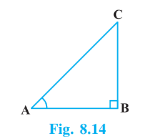
Side names in right triangle
A B C ABC A B C (right angle at
B B B )
Reference angle Opposite Adjacent Hypotenuse A A A B C BC B C A B AB A B A C AC A C C C C A B AB A B B C BC B C A C AC A C
Right triangle showing the hypotenuse and the opposite and adjacent sides for angle A A A Trigonometric Ratios
Definition Trigonometric ratios — Ratios of the sides of a right triangle defined with respect to one of its acute angles.
Reciprocal and quotient relationships Cosecant, secant and cotangent are the reciprocals of sine, cosine and tangent. Tangent is sine divided by cosine, and cotangent is cosine divided by sine.
cosec A = 1 sin A , sec A = 1 cos A , cot A = 1 tan A tan A = sin A cos A , cot A = cos A sin A \cosec A=\frac{1}{\sin A},\quad \sec A=\frac{1}{\cos A},\quad \cot A=\frac{1}{\tan A}\\
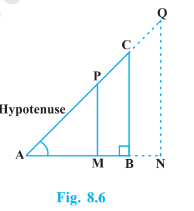
\tan A=\frac{\sin A}{\cos A},\quad \cot A=\frac{\cos A}{\sin A} cosec A = sin A 1 , sec A = cos A 1 , cot A = tan A 1 tan A = cos A sin A , cot A = sin A cos A Ratios are fixed for a given angle For a fixed acute angle, trigonometric ratios do not depend on the size of the right triangle. Triangles with the same acute angle are similar, so corresponding side lengths are proportional.
A M A B = A P A C = M P B C \frac{AM}{AB}=\frac{AP}{AC}=\frac{MP}{BC} A B A M = A C A P = B C M P Similar right triangles formed along the same sloping line preserve the ratios for angle A A A
Finding other ratios from one known ratio Use the known ratio to assign convenient proportional side lengths. Find the remaining side using Pythagoras theorem; all side lengths are positive.A C 2 = A B 2 + B C 2 AC^2=AB^2+BC^2 A C 2 = A B 2 + B C 2 Substitute the side lengths into the six ratio definitions and simplify.
Worked example
If sin A = 1 3 \sin A=\frac{1}{3} sin A = 3 1
Given sin A = 1 3 \sin A=\frac{1}{3} sin A = 3 1 k k k 3 k 3k 3 k k > 0 k>0 k > 0 B C = k , A C = 3 k BC=k,\quad AC=3k B C = k , A C = 3 k Find the adjacent side using Pythagoras theorem.A B 2 = ( 3 k ) 2 − k 2 = 8 k 2 , A B = 2 2 k AB^2=(3k)^2-k^2=8k^2,\quad AB=2\sqrt{2}\,k A B 2 = ( 3 k ) 2 − k 2 = 8 k 2 , A B = 2 2 k Calculate cosine and tangent.cos A = 2 2 3 , tan A = 1 2 2 = 2 4 \cos A=\frac{2\sqrt{2}}{3},\quad \tan A=\frac{1}{2\sqrt{2}}=\frac{\sqrt{2}}{4} cos A = 3 2 2 , tan A = 2 2 1 = 4 2 Take reciprocals to obtain the remaining ratios.cosec A = 3 , sec A = 3 2 2 = 3 2 4 , cot A = 2 2 \cosec A=3,\quad \sec A=\frac{3}{2\sqrt{2}}=\frac{3\sqrt{2}}{4},\quad \cot A=2\sqrt{2} cosec A = 3 , sec A = 2 2 3 = 4 3 2 , cot A = 2 2 Answer: cos A = 2 2 3 , tan A = 2 4 , cosec A = 3 , sec A = 3 2 4 , cot A = 2 2 \cos A=\frac{2\sqrt{2}}{3},\;\tan A=\frac{\sqrt{2}}{4},\;\cosec A=3,\;\sec A=\frac{3\sqrt{2}}{4},\;\cot A=2\sqrt{2} cos A = 3 2 2 , tan A = 4 2 , cosec A = 3 , sec A = 4 3 2 , cot A = 2 2 .
⚠ Common mistake Do not treat sin A \sin A sin A A A A A A A cosec A = 1 / sin A \cosec A=1/\sin A cosec A = 1/ sin A sin − 1 A \sin^{-1}A sin − 1 A
★ Remember Notation: sin 2 A \sin^2 A sin 2 A ( sin A ) 2 (\sin A)^2 ( sin A ) 2 Angle symbol: θ \theta θ
Practice
In a right triangle, the sides opposite and adjacent to angle A A A 5 5 5 12 12 12 13 13 13
Hint: Apply each definition using opposite
= 5 =5 = 5 , adjacent
= 12 =12 = 12 and hypotenuse
= 13 =13 = 13 .
Key step: tan A = 5 12 \tan A=\frac{5}{12} tan A = 12 5 ; the reciprocal ratios are
cosec A = 13 5 \cosec A=\frac{13}{5} cosec A = 5 13 ,
sec A = 13 12 \sec A=\frac{13}{12} sec A = 12 13 and
cot A = 12 5 \cot A=\frac{12}{5} cot A = 5 12 .
Solution: sin A = 5 13 , cos A = 12 13 , tan A = 5 12 , cosec A = 13 5 , sec A = 13 12 , cot A = 12 5 \sin A=\frac{5}{13},\;\cos A=\frac{12}{13},\;\tan A=\frac{5}{12},\;\cosec A=\frac{13}{5},\;\sec A=\frac{13}{12},\;\cot A=\frac{12}{5} sin A = 13 5 , cos A = 13 12 , tan A = 12 5 , cosec A = 5 13 , sec A = 12 13 , cot A = 5 12 .
Practice
If cos A = 3 5 \cos A=\frac{3}{5} cos A = 5 3 sin A \sin A sin A tan A \tan A tan A
Hint: Let adjacent side
= 3 k =3k = 3 k and hypotenuse
= 5 k =5k = 5 k , then use Pythagoras theorem.
Key step: A B = 3 k AB=3k A B = 3 k and
A C = 5 k AC=5k A C = 5 k give
B C = 4 k BC=4k B C = 4 k .
Solution: sin A = 4 5 , tan A = 4 3 \sin A=\frac{4}{5},\quad \tan A=\frac{4}{3} sin A = 5 4 , tan A = 3 4 .
Quick recap
Trigonometry relates triangle sides and angles and can help find inaccessible heights or distances. For a chosen acute angle, identify the opposite side, adjacent side and hypotenuse. The six ratios are sine, cosine, tangent, cosecant, secant and cotangent. Cosecant, secant and cotangent are reciprocals of sine, cosine and tangent. For a fixed angle, the ratios stay constant across similar right triangles. Use Pythagoras theorem and positive side lengths to find missing sides. This lecture defines ratios for acute angles; the chapter extends them to 0 ∘ 0^\circ 0 ∘ 90 ∘ 90^\circ 9 0 ∘
Lecture 2
Remark ( Trigonometric Ratios )
Reference video · Lecture 2 Remark ( Trigonometric Ratios )
Trigonometric ratios and their range
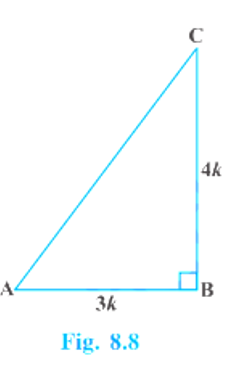
Right triangle with perpendicular sides 3 k 3k 3 k 4 k 4k 4 k
Worked example
Given tan A = 4 3 \tan A=\frac{4}{3} tan A = 3 4
Given tan A = 4 3 \tan A=\frac{4}{3} tan A = 3 4 4 k 4k 4 k 3 k 3k 3 k B C A B = 4 3 , B C = 4 k , A B = 3 k \frac{BC}{AB}=\frac{4}{3},\quad BC=4k,\quad AB=3k A B B C = 3 4 , B C = 4 k , A B = 3 k Use the Pythagorean theorem to find the hypotenuse.A C = ( 4 k ) 2 + ( 3 k ) 2 = 5 k AC=\sqrt{(4k)^2+(3k)^2}=5k A C = ( 4 k ) 2 + ( 3 k ) 2 = 5 k Substitute the side lengths into the ratio definitions.sin A = 4 5 , cos A = 3 5 , tan A = 4 3 \sin A=\frac{4}{5},\quad \cos A=\frac{3}{5},\quad \tan A=\frac{4}{3} sin A = 5 4 , cos A = 5 3 , tan A = 3 4 Take reciprocals to obtain the remaining ratios.cot A = 3 4 , cosec A = 5 4 , sec A = 5 3 \cot A=\frac{3}{4},\quad \cosec A=\frac{5}{4},\quad \sec A=\frac{5}{3} cot A = 4 3 , cosec A = 4 5 , sec A = 3 5 Answer: sin A = 4 5 , cos A = 3 5 , cot A = 3 4 , cosec A = 5 4 , sec A = 5 3 \sin A=\frac{4}{5},\ \cos A=\frac{3}{5},\ \cot A=\frac{3}{4},\ \cosec A=\frac{5}{4},\ \sec A=\frac{5}{3} sin A = 5 4 , cos A = 5 3 , cot A = 4 3 , cosec A = 4 5 , sec A = 3 5 .
Equal sines of acute angles
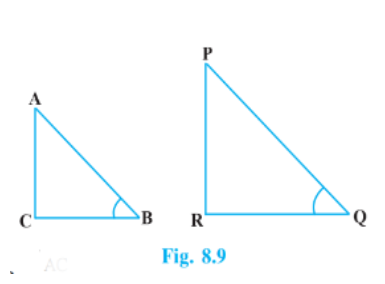
Equal sines imply equal acute angles For acute angles B B B Q Q Q sin B = sin Q \sin B=\sin Q sin B = sin Q B = Q B=Q B = Q
sin B = sin Q ⟹ B = Q \sin B=\sin Q\ \Longrightarrow\ B=Q sin B = sin Q ⟹ B = Q Right triangles with corresponding acute angles marked at B B B Q Q Q
Worked example
If acute angles B B B Q Q Q sin B = sin Q \sin B=\sin Q sin B = sin Q B = Q B=Q B = Q
Let sin B = sin Q \sin B=\sin Q sin B = sin Q A C B ACB A C B P R Q PRQ P R Q A C A B = P R P Q \frac{AC}{AB}=\frac{PR}{PQ} A B A C = P Q P R Let the common scale factor be k k k A C P R = A B P Q = k \frac{AC}{PR}=\frac{AB}{PQ}=k P R A C = P Q A B = k Apply Pythagoras’ theorem to the remaining sides.B C = A B 2 − A C 2 , Q R = P Q 2 − P R 2 , B C Q R = k BC=\sqrt{AB^2-AC^2},\quad QR=\sqrt{PQ^2-PR^2},\quad \frac{BC}{QR}=k B C = A B 2 − A C 2 , QR = P Q 2 − P R 2 , QR B C = k All three pairs of corresponding sides are proportional, so the triangles are similar and corresponding angles are equal.A C P R = A B P Q = B C Q R ⟹ △ A C B ∼ △ P R Q ⟹ B = Q \frac{AC}{PR}=\frac{AB}{PQ}=\frac{BC}{QR}\quad\Longrightarrow\quad \triangle ACB\sim\triangle PRQ\quad\Longrightarrow\quad B=Q P R A C = P Q A B = QR B C ⟹ △ A C B ∼ △ P R Q ⟹ B = Q Answer: The side ratios show that the two right triangles are similar; hence their corresponding acute angles are equal, so
B = Q B=Q B = Q .
The identity sin 2 θ + cos 2 θ = 1 \sin^2\theta+\cos^2\theta=1 sin 2 θ + cos 2 θ = 1
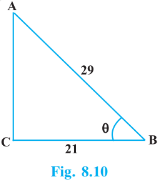
Right triangle with hypotenuse 29 29 29 θ \theta θ 21 21 21 θ \theta θ B B B
Worked example
A right triangle has hypotenuse 29 29 29 θ \theta θ 21 21 21 cos 2 θ + sin 2 θ \cos^2\theta+\sin^2\theta cos 2 θ + sin 2 θ cos 2 θ − sin 2 θ \cos^2\theta-\sin^2\theta cos 2 θ − sin 2 θ
In a right triangle, the hypotenuse is 29 29 29 θ \theta θ 21 21 21 opposite = 29 2 − 21 2 = ( 29 − 21 ) ( 29 + 21 ) = 20 \text{opposite}=\sqrt{29^2-21^2}=\sqrt{(29-21)(29+21)}=20 opposite = 2 9 2 − 2 1 2 = ( 29 − 21 ) ( 29 + 21 ) = 20 Find the sine and cosine of θ \theta θ sin θ = 20 29 , cos θ = 21 29 \sin\theta=\frac{20}{29},\quad \cos\theta=\frac{21}{29} sin θ = 29 20 , cos θ = 29 21 Add their squares.cos 2 θ + sin 2 θ = 21 2 + 20 2 29 2 = 1 \cos^2\theta+\sin^2\theta=\frac{21^2+20^2}{29^2}=1 cos 2 θ + sin 2 θ = 2 9 2 2 1 2 + 2 0 2 = 1 Subtract the squares in the order shown.cos 2 θ − sin 2 θ = 21 2 − 20 2 29 2 = 41 841 \cos^2\theta-\sin^2\theta=\frac{21^2-20^2}{29^2}=\frac{41}{841} cos 2 θ − sin 2 θ = 2 9 2 2 1 2 − 2 0 2 = 841 41 Answer: cos 2 θ + sin 2 θ = 1 \cos^2\theta+\sin^2\theta=1 cos 2 θ + sin 2 θ = 1 and
cos 2 θ − sin 2 θ = 41 841 \cos^2\theta-\sin^2\theta=\frac{41}{841} cos 2 θ − sin 2 θ = 841 41 .
Verifying 2 sin A cos A = 1 2\sin A\cos A=1 2 sin A cos A = 1 tan A = 1 \tan A=1 tan A = 1
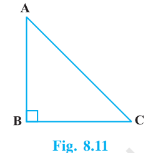
Right triangle with the right angle at B B B
Worked example
In a right triangle, if tan A = 1 \tan A=1 tan A = 1 2 sin A cos A = 1 2\sin A\cos A=1 2 sin A cos A = 1
Given tan A = 1 \tan A=1 tan A = 1 k k k B C A B = 1 , B C = A B = k \frac{BC}{AB}=1,\quad BC=AB=k A B B C = 1 , B C = A B = k Use Pythagoras’ theorem to find the hypotenuse.A C = k 2 + k 2 = k 2 AC=\sqrt{k^2+k^2}=k\sqrt{2} A C = k 2 + k 2 = k 2 Calculate the sine and cosine.sin A = k k 2 = 1 2 , cos A = k k 2 = 1 2 \sin A=\frac{k}{k\sqrt{2}}=\frac{1}{\sqrt{2}},\quad \cos A=\frac{k}{k\sqrt{2}}=\frac{1}{\sqrt{2}} sin A = k 2 k = 2 1 , cos A = k 2 k = 2 1 Substitute into the required expression.2 sin A cos A = 2 ( 1 2 ) ( 1 2 ) = 1 2\sin A\cos A=2\left(\frac{1}{\sqrt{2}}\right)\left(\frac{1}{\sqrt{2}}\right)=1 2 sin A cos A = 2 ( 2 1 ) ( 2 1 ) = 1 Answer: 2 sin A cos A = 1 2\sin A\cos A=1 2 sin A cos A = 1 .
Finding ratios from a side difference
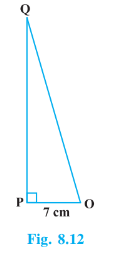
Right triangle with right angle at P P P O P = 7 OP=7 O P = 7
Worked example
In right triangle O P Q OPQ O P Q P P P O P = 7 OP=7 O P = 7 O Q − P Q = 1 OQ-PQ=1 O Q − P Q = 1 sin Q \sin Q sin Q cos Q \cos Q cos Q
Let P Q = x PQ=x P Q = x O Q − P Q = 1 OQ-PQ=1 O Q − P Q = 1 O Q = x + 1 OQ=x+1 O Q = x + 1 O P = 7 OP=7 O P = 7 P Q = x , O Q = x + 1 , O P = 7 PQ=x,\quad OQ=x+1,\quad OP=7 P Q = x , O Q = x + 1 , O P = 7 Apply Pythagoras’ theorem and cancel x 2 x^2 x 2 ( x + 1 ) 2 = x 2 + 7 2 ⟹ 2 x + 1 = 49 (x+1)^2=x^2+7^2\quad\Longrightarrow\quad 2x+1=49 ( x + 1 ) 2 = x 2 + 7 2 ⟹ 2 x + 1 = 49 Solve for the two sides.x = 24 , P Q = 24 , O Q = 25 x=24,\quad PQ=24,\quad OQ=25 x = 24 , P Q = 24 , O Q = 25 For angle Q Q Q O P OP O P P Q PQ P Q sin Q = O P O Q = 7 25 , cos Q = P Q O Q = 24 25 \sin Q=\frac{OP}{OQ}=\frac{7}{25},\quad \cos Q=\frac{PQ}{OQ}=\frac{24}{25} sin Q = O Q O P = 25 7 , cos Q = O Q P Q = 25 24 Answer: P Q = 24 PQ=24 P Q = 24 cm,
O Q = 25 OQ=25 O Q = 25 cm; therefore
sin Q = 7 25 \sin Q=\frac{7}{25} sin Q = 25 7 and
cos Q = 24 25 \cos Q=\frac{24}{25} cos Q = 25 24 .
⚠ Common mistake Do not interchange the opposite and adjacent sides: for angle Q Q Q O P OP O P P Q PQ P Q O Q OQ O Q
Practice
If tan A = 5 12 \tan A=\frac{5}{12} tan A = 12 5
Hint: Use legs
5 k 5k 5 k and
12 k 12k 12 k , then apply Pythagoras’ theorem.
Key step: The hypotenuse is
13 k 13k 13 k .
Solution: From the
5 5 5 -
12 12 12 -
13 13 13 triangle:
sin A = 5 13 \sin A=\frac{5}{13} sin A = 13 5 ,
cos A = 12 13 \cos A=\frac{12}{13} cos A = 13 12 ,
cot A = 12 5 \cot A=\frac{12}{5} cot A = 5 12 ,
sec A = 13 12 \sec A=\frac{13}{12} sec A = 12 13 , and
cosec A = 13 5 \cosec A=\frac{13}{5} cosec A = 5 13 .
Practice
If sin θ = 8 17 \sin\theta=\frac{8}{17} sin θ = 17 8 cos θ \cos\theta cos θ sin 2 θ + cos 2 θ = 1 \sin^2\theta+\cos^2\theta=1 sin 2 θ + cos 2 θ = 1
Hint: Treat
8 8 8 as the opposite side and
17 17 17 as the hypotenuse.
Key step: The adjacent side is
17 2 − 8 2 = 15 \sqrt{17^2-8^2}=15 1 7 2 − 8 2 = 15 .
Solution: cos θ = 15 17 \cos\theta=\frac{15}{17} cos θ = 17 15 , and
( 8 17 ) 2 + ( 15 17 ) 2 = 64 + 225 289 = 1 \left(\frac{8}{17}\right)^2+\left(\frac{15}{17}\right)^2=\frac{64+225}{289}=1 ( 17 8 ) 2 + ( 17 15 ) 2 = 289 64 + 225 = 1 .
Practice
In a right triangle, the hypotenuse exceeds one leg by 1 1 1 5 5 5
Hint: Let the shorter leg be
x x x cm and the hypotenuse be
x + 1 x+1 x + 1 cm.
Key step: Solve
( x + 1 ) 2 = x 2 + 25 (x+1)^2=x^2+25 ( x + 1 ) 2 = x 2 + 25 .
Solution: 2 x + 1 = 25 2x+1=25 2 x + 1 = 25 , so
x = 12 x=12 x = 12 . The sides are
5 5 5 cm,
12 12 12 cm, and
13 13 13 cm.
Quick recap
The hypotenuse is longest, so sine and cosine of an acute angle are each between 0 0 0 1 1 1 Use the six side-ratio definitions; tangent is opposite over adjacent, and its reciprocal is cotangent. For acute angles, equal sine values imply equal angles. sin 2 θ + cos 2 θ = 1 \sin^2\theta+\cos^2\theta=1 sin 2 θ + cos 2 θ = 1 If tan A = 1 \tan A=1 tan A = 1 2 sin A cos A = 1 2\sin A\cos A=1 2 sin A cos A = 1 For a hypotenuse–leg difference, set the hypotenuse to x + d x+d x + d
Lecture 3
Trigonometric Ratios Of Some Specific Angles
Reference video · Lecture 3 Trigonometric Ratios Of Some Specific Angles
Trigonometric Ratios of 45 ∘ 45^\circ 4 5 ∘
Definition 45 ∘ 45^\circ 4 5 ∘ 45 ∘ 45^\circ 4 5 ∘
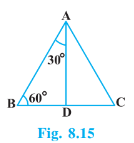
Isosceles right triangle A B C ABC A B C B B B Side relationship If A B = B C = a AB=BC=a A B = B C = a A C = a 2 AC=a\sqrt{2} A C = a 2
Trigonometric Ratios of 30 ∘ 30^\circ 3 0 ∘ 60 ∘ 60^\circ 6 0 ∘
Definition 30 ∘ 30^\circ 3 0 ∘ 60 ∘ 60^\circ 6 0 ∘ 30 ∘ 30^\circ 3 0 ∘ 60 ∘ 60^\circ 6 0 ∘ 90 ∘ 90^\circ 9 0 ∘
An altitude in an equilateral triangle forms two congruent right triangles. Side relationship For an equilateral triangle of side 2 a 2a 2 a a a a a 3 a\sqrt{3} a 3 2 a 2a 2 a
Ratios of 0 ∘ 0^\circ 0 ∘ 90 ∘ 90^\circ 9 0 ∘
Definition Endpoint angle values — At 0 ∘ 0^\circ 0 ∘ 90 ∘ 90^\circ 9 0 ∘
Endpoint behaviour At 0 ∘ 0^\circ 0 ∘ The opposite side approaches zero and the adjacent side approaches the hypotenuse; hence sin 0 ∘ = 0 \sin0^\circ=0 sin 0 ∘ = 0 cos 0 ∘ = 1 \cos0^\circ=1 cos 0 ∘ = 1 At 90 ∘ 90^\circ 9 0 ∘ The adjacent side approaches zero and the opposite side approaches the hypotenuse; hence sin 90 ∘ = 1 \sin90^\circ=1 sin 9 0 ∘ = 1 cos 90 ∘ = 0 \cos90^\circ=0 cos 9 0 ∘ = 0 Undefined ratios: A ratio with denominator zero is not defined, so cot 0 ∘ \cot0^\circ cot 0 ∘ cosec 0 ∘ \operatorname{cosec}0^\circ cosec 0 ∘ tan 90 ∘ \tan90^\circ tan 9 0 ∘ sec 90 ∘ \sec90^\circ sec 9 0 ∘
Standard Trigonometric Ratios
Ratio 0 ∘ 0^\circ 0 ∘ 30 ∘ 30^\circ 3 0 ∘ 45 ∘ 45^\circ 4 5 ∘ 60 ∘ 60^\circ 6 0 ∘ 90 ∘ 90^\circ 9 0 ∘ sin A \sin A sin A 0 0 0 1 2 \frac{1}{2} 2 1 1 2 \frac{1}{\sqrt{2}} 2 1 3 2 \frac{\sqrt{3}}{2} 2 3 1 1 1 cos A \cos A cos A 1 1 1 3 2 \frac{\sqrt{3}}{2} 2 3 1 2 \frac{1}{\sqrt{2}} 2 1 1 2 \frac{1}{2} 2 1 0 0 0 tan A \tan A tan A 0 0 0 1 3 \frac{1}{\sqrt{3}} 3 1 1 1 1 3 \sqrt{3} 3 Not defined cosec A \operatorname{cosec} A cosec A Not defined 2 2 2 2 \sqrt{2} 2 2 3 \frac{2}{\sqrt{3}} 3 2 1 1 1 sec A \sec A sec A 1 1 1 2 3 \frac{2}{\sqrt{3}} 3 2 2 \sqrt{2} 2 2 2 2 Not defined cot A \cot A cot A Not defined 3 \sqrt{3} 3 1 1 1 1 3 \frac{1}{\sqrt{3}} 3 1 0 0 0
Trend from 0 ∘ 0^\circ 0 ∘ 90 ∘ 90^\circ 9 0 ∘ As A A A 0 ∘ 0^\circ 0 ∘ 90 ∘ 90^\circ 9 0 ∘ sin A \sin A sin A 0 0 0 1 1 1 cos A \cos A cos A 1 1 1 0 0 0
Applying Standard Ratios
Find an Unknown Side in a Right Triangle Identify the given angle and label its opposite side, adjacent side, and hypotenuse. Choose the ratio containing the known and required sides. Let p p p b b b h h h sin A = p h , cos A = b h , tan A = p b \sin A=\frac{p}{h},\quad \cos A=\frac{b}{h},\quad \tan A=\frac{p}{b} sin A = h p , cos A = h b , tan A = b p Substitute the standard-angle value and solve; use Pythagoras' theorem to check if useful.h 2 = p 2 + b 2 h^2=p^2+b^2 h 2 = p 2 + b 2
Worked example
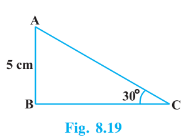
In right triangle A B C ABC A B C B B B A B = 5 cm AB=5\text{ cm} A B = 5 cm ∠ C = 30 ∘ \angle C=30^\circ ∠ C = 3 0 ∘ B C BC B C A C AC A C
In right triangle A B C ABC A B C ∠ B = 90 ∘ \angle B=90^\circ ∠ B = 9 0 ∘ A B = 5 cm AB=5\text{ cm} A B = 5 cm ∠ C = 30 ∘ \angle C=30^\circ ∠ C = 3 0 ∘ B C BC B C A C AC A C tan C = A B B C = 1 3 \tan C=\frac{AB}{BC}=\frac{1}{\sqrt{3}} tan C = B C A B = 3 1 Use the tangent ratio to find the adjacent side B C BC B C 5 B C = 1 3 ⟹ B C = 5 3 c m \frac{5}{BC}=\frac{1}{\sqrt{3}}\quad\Longrightarrow\quad BC=5\sqrt{3}\,\mathrm{cm} B C 5 = 3 1 ⟹ B C = 5 3 cm Use the sine ratio to find the hypotenuse A C AC A C sin C = A B A C = 1 2 ⟹ 5 A C = 1 2 ⟹ A C = 10 c m \sin C=\frac{AB}{AC}=\frac{1}{2}\quad\Longrightarrow\quad \frac{5}{AC}=\frac{1}{2}\quad\Longrightarrow\quad AC=10\,\mathrm{cm} sin C = A C A B = 2 1 ⟹ A C 5 = 2 1 ⟹ A C = 10 cm Check the hypotenuse using Pythagoras' theorem.A C = A B 2 + B C 2 = 25 + 75 = 10 c m AC=\sqrt{AB^2+BC^2}=\sqrt{25+75}=10\,\mathrm{cm} A C = A B 2 + B C 2 = 25 + 75 = 10 cm Answer: B C = 5 3 cm BC=5\sqrt{3}\text{ cm} B C = 5 3 cm and
A C = 10 cm AC=10\text{ cm} A C = 10 cm .
Right triangle with A B = 5 cm AB=5\text{ cm} A B = 5 cm ∠ C = 30 ∘ \angle C=30^\circ ∠ C = 3 0 ∘
Find an Angle from Side Ratios or Trigonometric Equations Match the known side ratio or trigonometric value to a standard angle.sin 30 ∘ = 1 2 \sin30^\circ=\frac{1}{2} sin 3 0 ∘ = 2 1 For a right triangle, use the fact that its two acute angles sum to 90 ∘ 90^\circ 9 0 ∘ ∠ A + ∠ C = 90 ∘ \angle A+\angle C=90^\circ ∠ A + ∠ C = 9 0 ∘ For a pair of angle equations, solve them together by addition or subtraction.A − B = x , A + B = y A-B=x,\quad A+B=y A − B = x , A + B = y
Practice
In right triangle P Q R PQR P QR Q Q Q P Q = 3 cm PQ=3\text{ cm} P Q = 3 cm P R = 6 cm PR=6\text{ cm} P R = 6 cm ∠ Q P R \angle QPR ∠ QP R ∠ P R Q \angle PRQ ∠ P R Q
Hint: Use the sine ratio for angle
R R R , then use the sum of the acute angles.
Key step: sin R = P Q P R = 1 2 \sin R=\frac{PQ}{PR}=\frac{1}{2} sin R = P R P Q = 2 1 .
Solution: ∠ P R Q = 30 ∘ \angle PRQ=30^\circ ∠ P R Q = 3 0 ∘ and
∠ Q P R = 60 ∘ \angle QPR=60^\circ ∠ QP R = 6 0 ∘ .
Practice
If sin ( A − B ) = 1 2 \sin(A-B)=\frac{1}{2} sin ( A − B ) = 2 1 cos ( A + B ) = 1 2 \cos(A+B)=\frac{1}{2} cos ( A + B ) = 2 1 0 ∘ < A + B ≤ 90 ∘ 0^\circ<A+B\leq90^\circ 0 ∘ < A + B ≤ 9 0 ∘ A > B A>B A > B A A A B B B
Hint: Use the standard-angle table to determine
A − B A-B A − B and
A + B A+B A + B .
Key step: A − B = 30 ∘ A-B=30^\circ A − B = 3 0 ∘ and
A + B = 60 ∘ A+B=60^\circ A + B = 6 0 ∘ .
Solution: Adding gives
2 A = 90 ∘ 2A=90^\circ 2 A = 9 0 ∘ , so
A = 45 ∘ A=45^\circ A = 4 5 ∘ ; subtracting gives
2 B = 30 ∘ 2B=30^\circ 2 B = 3 0 ∘ , so
B = 15 ∘ B=15^\circ B = 1 5 ∘ .
⚠ Common mistake Do not confuse a ratio that equals zero with one that is undefined: division by zero is undefined, so tan 90 ∘ \tan90^\circ tan 9 0 ∘ cot 0 ∘ \cot0^\circ cot 0 ∘
Quick recap
In a 45 ∘ 45^\circ 4 5 ∘ 2 \sqrt{2} 2 A bisected equilateral triangle has side ratio 1 : 3 : 2 1:\sqrt{3}:2 1 : 3 : 2 30 ∘ 30^\circ 3 0 ∘ 60 ∘ 60^\circ 6 0 ∘ Know the six trigonometric ratios for 0 ∘ 0^\circ 0 ∘ 30 ∘ 30^\circ 3 0 ∘ 45 ∘ 45^\circ 4 5 ∘ 60 ∘ 60^\circ 6 0 ∘ 90 ∘ 90^\circ 9 0 ∘ sin A \sin A sin A 0 0 0 1 1 1 cos A \cos A cos A 1 1 1 0 0 0 A A A 0 ∘ 0^\circ 0 ∘ 90 ∘ 90^\circ 9 0 ∘ A trigonometric ratio and a standard-angle value can determine missing sides or angles in a right triangle. Ratios involving division by zero are undefined.
Lecture 4
Trigonometric Identities
Reference video · Lecture 4 Trigonometric Identities
Trigonometric Ratios and Identities
Ratios: In a right triangle, sin A = opposite hypotenuse \sin A=\frac{\text{opposite}}{\text{hypotenuse}} sin A = hypotenuse opposite cos A = adjacent hypotenuse \cos A=\frac{\text{adjacent}}{\text{hypotenuse}} cos A = hypotenuse adjacent tan A = opposite adjacent \tan A=\frac{\text{opposite}}{\text{adjacent}} tan A = adjacent opposite Reciprocals: cosec A = 1 sin A \cosec A=\frac{1}{\sin A} cosec A = s i n A 1 sec A = 1 cos A \sec A=\frac{1}{\cos A} sec A = c o s A 1 cot A = 1 tan A \cot A=\frac{1}{\tan A} cot A = t a n A 1 Quotient relations: tan A = sin A cos A \tan A=\frac{\sin A}{\cos A} tan A = c o s A s i n A cot A = cos A sin A \cot A=\frac{\cos A}{\sin A} cot A = s i n A c o s A Identities: sin 2 A + cos 2 A = 1 \sin^2 A+\cos^2 A=1 sin 2 A + cos 2 A = 1 1 + tan 2 A = sec 2 A 1+\tan^2 A=\sec^2 A 1 + tan 2 A = sec 2 A 1 + cot 2 A = cosec 2 A 1+\cot^2 A=\cosec^2 A 1 + cot 2 A = cosec 2 A Use: Knowing one trigonometric ratio of an acute angle allows the other ratios to be found using these relations and the Pythagorean theorem.