Class 10 . Mathematics . Mathematics . Some Applications of Trigonometry
Chapter 9: Some Applications Of Trigonometry
Ch 9
Mathematics
Class 10
Heights And Distances
Line of Sight, Elevation and Depression
Line of sight — The line joining an observer’s eye to the point being viewed is the line of sight.
Angles made with the horizontal
- Angle of elevation: The angle between the horizontal through the observer’s eye and the line of sight to an object above eye level.
- Angle of depression: The angle between the horizontal through the observer’s eye and the line of sight to an object below eye level.
- Horizontal reference: Draw a horizontal through the observer’s eye before marking either angle.
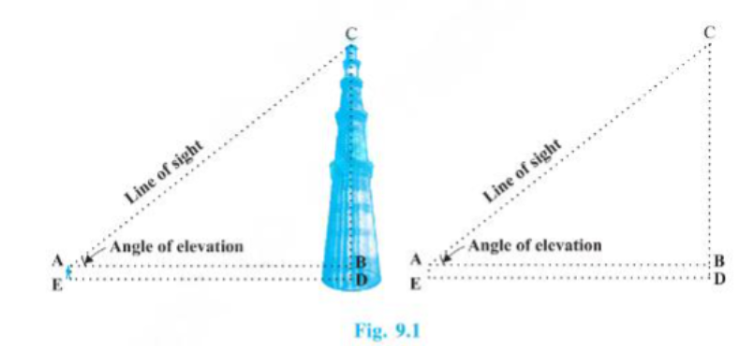
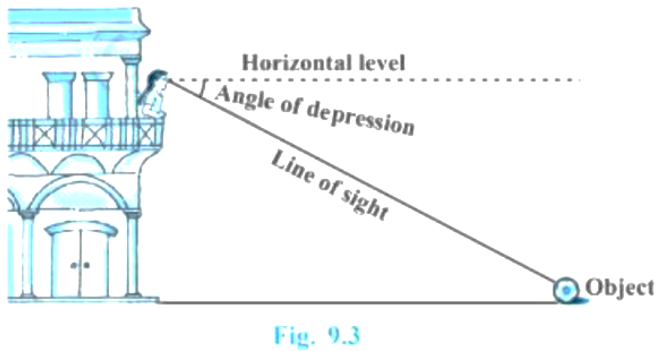
When horizontal lines are parallel, the angle of depression at one point equals the corresponding angle of elevation at the other, by alternate interior angles.
Using Trigonometry to Find Heights and Distances
Height-and-distance application — Trigonometric ratios in right triangles are used to find inaccessible heights, lengths or horizontal distances.
Setting up common applications
- Known data: A typical problem gives a horizontal distance, an angle of elevation or depression, and sometimes the observer’s eye height.
- Eye height: Find the rise above eye level first, then add the observer’s height to obtain the object’s total height.
- Ladder: The ladder is the hypotenuse; use sine to find its length and tangent or cotangent to find its ground distance.
- Two observations: Form a right-triangle equation for each angle and solve the equations together.
- Shadow: The Sun’s altitude is the angle of elevation from the shadow tip to the top; use tangent for each shadow length.
- Depression or river problems: Use the horizontal distance and vertical difference in each right triangle; add horizontal segments when finding a total width.
For an angle , identify the opposite, adjacent and hypotenuse sides relative to that angle.
- , , and .
- and .
Set up and solve a height-or-distance problem
- Sketch and label the vertical object, horizontal ground, observer and line of sight.
- Mark the right angle and the given angle of elevation or depression.
- Choose a ratio that relates the known side or sides to the required side.
- Solve for the required length, then add or subtract eye or object heights if needed.
- State the answer with units and check that it is the requested quantity.
Find the height of a tower if the angle of elevation from a point 15 m from its foot is .
- A tower is viewed from a point m from its foot; the angle of elevation is . Let its height be .
- Substitute the standard value of the tangent.
- Solve for the height.
Further standard applications
- Chimney and eye height: From m away, a elevation gives rise above the observer’s m eye level as m; chimney height m.
- Building and flagstaff: For a m building viewed at , distance m. A elevation to the flag top gives flagstaff length m.
- River width: At m above the banks, depressions of and give horizontal segments m and m; width m.
Do not include the observer’s eye height in the triangle’s vertical rise unless the triangle starts at the ground. Find the rise above eye level first, then add the eye height for the object’s total height.
An electrician must reach a point 1.3 m below the top of a 5 m pole. The ladder makes an angle of with the horizontal. Find the ladder length and the distance of its foot from the pole. Use .
A tower’s shadow is 40 m longer when the Sun’s altitude is than when it is . Find the tower’s height.
From the top of a multistorey building, the angles of depression to the top and bottom of a nearby 8 m building are and , respectively. Find the taller building’s height and the distance between the buildings.
Quick recap
- The line of sight joins the observer’s eye to the point viewed.
- Elevation is measured upward from the horizontal; depression is measured downward.
- With parallel horizontal lines, corresponding elevation and depression angles are equal.
- Choose a trigonometric ratio based on the known and required sides of the right triangle.
- For total object height, add the observer’s eye height to the rise above eye level.
- For changing shadows, use for each Sun angle.
Formula sheet
Mathematics — ALL CHAPTERS
1
Real Numbers
2
Polynomials
3
Pair Of Linear Equations In Two Variables
4
Quadratic Equations
5
Arithmetic Progressions
6
Triangles
7
Coordinate Geometry
8
Introduction To Trigonometry
9
Some Applications Of Trigonometry
10
Circles
11
Areas Related To Circles
12
Surface areas And Volumes
13
Statistics
14
Probability