Class 10 . Mathematics . Mathematics . Real Numbers
Chapter 1: Real Numbers
Ch 1
Mathematics
Class 10
Introduction
What this chapter studies
Main ideas
- Euclid’s division algorithm writes a positive integer as divisor × quotient + remainder, with the remainder smaller than the divisor; it is used to find HCF.
- Fundamental Theorem of Arithmetic states that each composite number has a unique prime factorization, apart from the order of factors.
- Applications of prime factorization include finding HCF and LCM, proving the irrationality of numbers such as , and , and determining the decimal nature of rational numbers.
For positive integers, the remainder is non-negative and smaller than the divisor.
Fundamental Theorem of Arithmetic
Prime factorization — Writing a composite number as a product of prime numbers.
Every composite number can be expressed as a product of primes, and this factorization is unique except for the order of the prime factors.
Key points
- Repeated factors are written as powers; for example, .
- Uniqueness means the primes and their exponents are fixed, regardless of the order in which the factors are written.
- Example: .
- Further application: the prime factorization of the denominator of a rational number reveals whether its decimal expansion terminates or repeats.
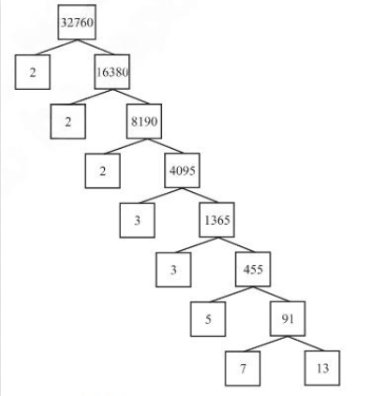
Find the prime factorization of .
- Write 32760 as a product of prime factors, then collect repeated factors as powers.
Using prime factorization
Divisibility and trailing zeros
- Divisibility by 10 requires both prime factors and , since .
- Powers of 4 have only the prime factor : . Therefore, no positive integer power of ends in zero.
For the HCF, use the smallest exponents of common primes; for the LCM, use the greatest exponents of every prime present.
This product relation applies to two positive integers.
Finding HCF and LCM by prime factorization
- Express each number as a product of prime powers.
- For the HCF, multiply common primes using their smallest exponents.
- For the LCM, multiply every prime present using its greatest exponent.
Find the HCF and LCM of and , of and , and of , and using prime factorization.
- For 6 and 20, factor both numbers and take the smallest common and greatest overall powers.
- For 96 and 404, use their prime factorizations to find the HCF, then use the two-number product relation for the LCM.
- For 6, 72 and 120, use the smallest powers common to all three for the HCF and the greatest powers of all present primes for the LCM.
Do not use for three or more numbers; this identity is stated for two positive integers.
Can end in the digit zero for any positive integer ?
Find the HCF and LCM of and using prime factorization.
Find the HCF and LCM of , , and .
Quick recap
- Euclid’s division algorithm writes with .
- Every composite number has a unique prime factorization apart from factor order.
- A number ending in zero must contain both prime factors and .
- For HCF, take common primes with their smallest exponents.
- For LCM, take all primes present with their greatest exponents.
- For two positive integers, .
Revisiting Irrational Numbers
Irrational Numbers and Prime Factorisation
If a prime divides , then divides ; this follows from the uniqueness of prime factorisation.
Use this result when a prime divides a squared integer.
Proving Square Roots of Primes Are Irrational
For every prime number , is irrational. The proof assumes it is rational and derives a contradiction to the fraction being in lowest terms.
Proof by contradiction for
- Assume is rational and write it as a fraction in lowest terms, with .
- Square and rearrange to show that divides , hence divides .
- Substitute to show that also divides .
- Both numerator and denominator are divisible by , contradicting that the fraction is in lowest terms.
Prove that is irrational.
- Assume, for contradiction, that is rational and express it in lowest terms.
- Square and rearrange; the prime-divisibility property implies that divides .
- Put and substitute to deduce that divides as well.
- This contradicts , so the assumption is false.
Do not assume the numerator and denominator are coprime without justification: reduce the fraction first, then use the contradiction with lowest terms.
Operations Involving Rational and Irrational Numbers
Combining a rational number with an irrational number in the stated ways gives an irrational result.
| Operation | Result |
|---|---|
| Rational irrational | Irrational |
| Non-zero rational irrational | Irrational |
| Irrational divided by a non-zero rational, or non-zero rational divided by an irrational | Irrational |
Prove an expression is irrational
- Assume the expression is rational.
- Rearrange to make the known irrational number equal to a rational expression.
- Use the contradiction to reject the assumption.
Show that is irrational.
- Assume that is rational, so it can be written as for integers with .
- Rearrange to express as a rational number.
- This contradicts the irrationality of ; therefore the assumption is false.
Prove that is irrational.
Show that is irrational.
Quick recap
- A number is irrational if it cannot be written as for integers with .
- Prime factorisation is unique apart from the order of the prime factors.
- For prime , implies .
- For every prime , is irrational; prove it by contradiction using a lowest-terms fraction.
- A rational number added to or subtracted from an irrational number gives an irrational result.
- Multiplying or dividing an irrational number by a non-zero rational number gives an irrational result.
Formula sheet
Mathematics — ALL CHAPTERS
1
Real Numbers
2
Polynomials
3
Pair Of Linear Equations In Two Variables
4
Quadratic Equations
5
Arithmetic Progressions
6
Triangles
7
Coordinate Geometry
8
Introduction To Trigonometry
9
Some Applications Of Trigonometry
10
Circles
11
Areas Related To Circles
12
Surface areas And Volumes
13
Statistics
14
Probability