Class 10 . Mathematics . Mathematics . Triangles
Chapter 6: Triangles
Ch 6
Mathematics
Class 10
Introduction & Similar Figures
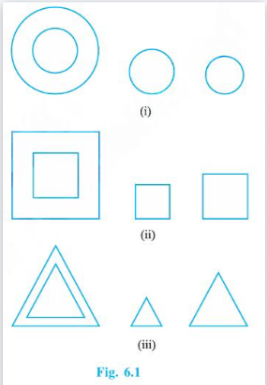
Congruent and Similar Figures
Where Similarity Is Used
- Indirect measurement Similarity allows heights or distances that are difficult to measure directly—such as a mountain's height or the distance to the Moon—to be found from measurable lengths.
- Scaled images Photographs, maps and building blueprints can preserve shape while changing size.
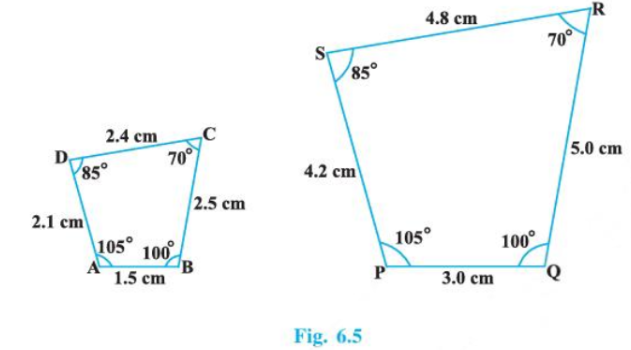
Similarity of Polygons
Use corresponding vertices in matching order. The common side ratio is the scale factor from one polygon to the other.
Examples and Scale Changes
- Photographs Prints from the same negative have the same shape but may have different sizes; corresponding lengths change by one common scale factor and corresponding angles stay equal.
- Example scale factor Enlarging a 35 mm image to 45 mm gives a length scale factor of from the smaller image to the larger one; reducing reverses the ratio.
- Projection A shadow or projection from a point can enlarge a figure while keeping corresponding points on the same rays and preserving its shape.

How to Test Whether Polygons Are Similar
- Check that the polygons have the same number of sides and identify the corresponding vertices.
- Compare all corresponding angles; they must be equal.
- Compare corresponding side lengths; every ratio must be the same.
- Conclude that the polygons are similar only if both angle and side conditions hold.
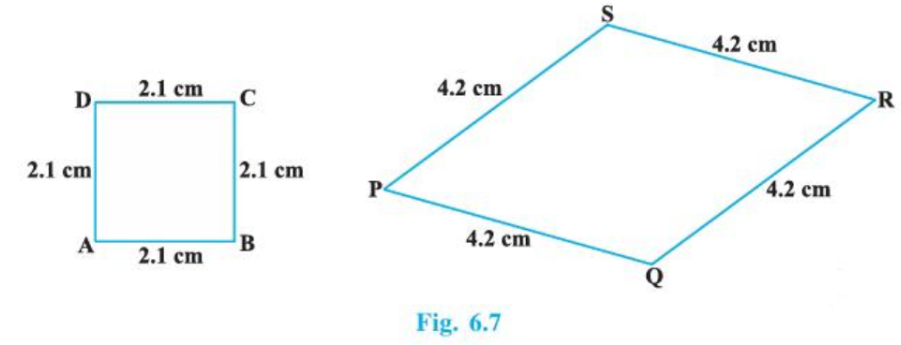
Are a square with side length 2.1 cm and a rhombus with side length 4.2 cm similar?
- A square has side length 2.1 cm and a rhombus has side length 4.2 cm. Their corresponding sides are proportional.
- A square has four right angles, but a rhombus does not necessarily have four right angles; the corresponding angles are not all equal.
- Since the angle condition fails, the quadrilaterals are not similar, despite their proportional sides.
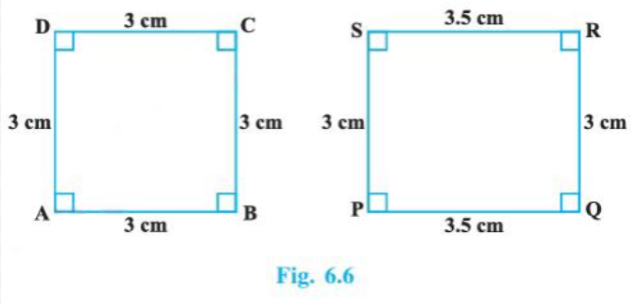
Do not decide polygons are similar from equal angles or proportional sides alone. Both conditions must hold.
Two photographs have corresponding lengths 35 mm and 55 mm. What is the scale factor from the smaller print to the larger print?
All corresponding angles of two polygons are equal, but their corresponding side ratios are not all equal. Are the polygons similar?
Quick recap
- Similar figures have the same shape; their sizes may differ.
- All congruent figures are similar, but similar figures need not be congruent.
- All circles, all squares and all equilateral triangles are similar within each shape type.
- Similar polygons have equal corresponding angles and proportional corresponding sides.
- The common ratio of corresponding side lengths is the scale factor or representative fraction.
- Neither equal angles alone nor proportional sides alone is enough to prove polygon similarity.
Similarity Of Triangles
Similarity and Equiangular Triangles
If , corresponding angles are equal and corresponding sides are proportional.
Basic Proportionality Theorem (Thales Theorem)
If a line parallel to one side of a triangle intersects the other two sides, it divides those sides in the same ratio. In , if lies on , lies on , and , then .
Why BPT works
- Area ratios: because the triangles share the same altitude to .
- Area ratios: because the triangles share the same altitude to .
- Equal areas: because they share base and lie between the same parallels, and .
- Conclusion: Combining these area relations gives .
Apply BPT
- Identify the triangle and the segment parallel to one of its sides.
- Write the ratio of the two parts on one side equal to the ratio on the other side.
- Substitute the known lengths and solve for the required quantity.
Converse of the Basic Proportionality Theorem
If a line divides two sides of a triangle in the same ratio, then it is parallel to the third side. In , if lies on , lies on , and , then .
Converse proof idea
- Assume: Draw with on ; BPT gives .
- Compare: The given ratio implies .
- Conclude: Adding to both ratios gives , so and . Therefore, .
Use the converse of BPT
- Check that the two sides are divided in the same ratio.
- Apply the converse to conclude that the joining segment is parallel to the third side.
- Use parallel-line angle properties or BPT as needed.
If a line parallel to meets and at and , prove that .
- In , . Prove that .
- Apply BPT to the two sides.
- Take reciprocals and add to both sides.
- Use and .
- Take reciprocals to obtain the required result.
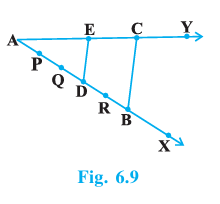
In trapezium , . Points and lie on and , with . Prove that .
In , lies on and lies on . If and , prove that is isosceles.
Do not mix up the ratios: match corresponding side segments in the same order, such as .
Quick recap
- Similar triangles have equal corresponding angles and proportional corresponding sides.
- Equiangular triangles have the same ratios of corresponding sides.
- BPT: a line parallel to one side divides the other two sides proportionally.
- Converse of BPT: equal division ratios imply that the joining line is parallel to the third side.
- BPT can be proved using area ratios and equal areas between the same parallels.
Criteria For Similarity Of Triangles
Similarity and Correspondence
- Similarity: Similar triangles have the same shape; their sizes may differ.
- Correspondence: Match vertices in the correct order to identify equal angles and proportional sides.
- Notation: The symbol means “is similar to”; for example, .
AA, SSS and SAS Similarity Criteria
If two angles of one triangle are respectively equal to two angles of another triangle, the triangles are similar; the third angles are equal by the angle-sum property.
If the three sides of one triangle are proportional to the three corresponding sides of another triangle, the triangles are similar and their corresponding angles are equal.
If one angle of a triangle equals one angle of another triangle and the sides including those angles are proportional, the triangles are similar.
Test triangles for similarity
- Mark the corresponding vertices and sides from the diagram or given information.
- Check two angle pairs (AA), three side ratios (SSS), or two side ratios with the included angle (SAS).
- Write the triangles in the matching vertex order and state the criterion.
Find from the given side lengths and angles.
- In and , let , , , , , and . Also, and . Find .
- The ratios show that , , and ; therefore use the vertex order .
- Since corresponds to , find using the angle sum.
Do not use an arbitrary vertex order or an SAS angle that is not included between the compared sides. Match corresponding parts consistently before applying a criterion.
Applications of Similarity
If and the lines and intersect at , prove that .
If and the lines and intersect at , prove that and .
If and are medians of similar triangles and , prove that and .
- AA: Two corresponding angle pairs are enough.
- SSS: All three corresponding side ratios must match.
- SAS: Use proportional sides around the equal included angle.
- Correspondence: Correct vertex order is essential for every angle or side conclusion.
Quick recap
- Similar triangles have equal corresponding angles and proportional corresponding sides.
- For triangles, AA, SSS or SAS alone proves similarity; for polygons, both angle and side conditions are required.
- Write corresponding vertices in the correct order before using side or angle relationships.
- Use AA with parallel-line or shared-angle facts, SSS with three side ratios, and SAS with proportional sides around an equal included angle.
- Corresponding medians of similar triangles have the same ratio as corresponding sides.
- After proving similarity, use matching angles and side ratios to solve lengths and angles.
Summary
Similar Figures and Triangles
- Similar figures: They have the same shape but need not have the same size; congruent figures are always similar.
- Polygons: Similar polygons have equal corresponding angles and proportional corresponding sides.
- Triangles: Triangle similarity is used to compare lengths and solve geometric problems, including indirect measurement.
Basic Proportionality Theorem
In , lies on and lies on . If , what can you conclude?
- Similarity: Check matching corresponding angles or proportional corresponding sides using an appropriate criterion.
- BPT: Parallel to one side gives equal side-division ratios; equal ratios imply parallelism by the converse.
Quick recap
- Similar figures have the same shape; their sizes may differ.
- Congruent figures are similar, but the converse is not always true.
- Similar polygons have equal corresponding angles and proportional corresponding sides.
- Triangle similarity criteria are AA, AAA, SSS, SAS and RHS.
- BPT gives proportional division of two sides when a line is parallel to the third side.
- The converse of BPT establishes parallelism from equal side-division ratios.
Formula sheet
Mathematics — ALL CHAPTERS
1
Real Numbers
2
Polynomials
3
Pair Of Linear Equations In Two Variables
4
Quadratic Equations
5
Arithmetic Progressions
6
Triangles
7
Coordinate Geometry
8
Introduction To Trigonometry
9
Some Applications Of Trigonometry
10
Circles
11
Areas Related To Circles
12
Surface areas And Volumes
13
Statistics
14
Probability