Class 10 . Mathematics . Mathematics . Polynomials
Chapter 2: Polynomials
Ch 2
Mathematics
Class 10
Introduction
Polynomials, Degree, and Types
The leading coefficient must be non-zero for the polynomial to have the stated degree.
Identify the Degree
- Write the expression in descending powers and combine like terms.
- Check that the powers of the variable are non-negative integers.
- Find the highest power with a non-zero coefficient; this is the degree.
Find the degree and type of .
- Find the degree and type of the polynomial.
- The highest power of with a non-zero coefficient is .
- Therefore, it is a cubic polynomial.
Values and Zeroes of a Polynomial
Use this formula when the polynomial is and .
Evaluate a Polynomial or Find a Zero
- To find a value, substitute the given number for the variable.
- To test whether is a zero, calculate .
- For a linear polynomial, solve the equation obtained by setting it equal to zero.
Is a zero of ?
- Evaluate at .
- Simplify the substituted expression.
- Since the value is zero, is a zero of the polynomial.
Geometrical Meaning of Zeroes
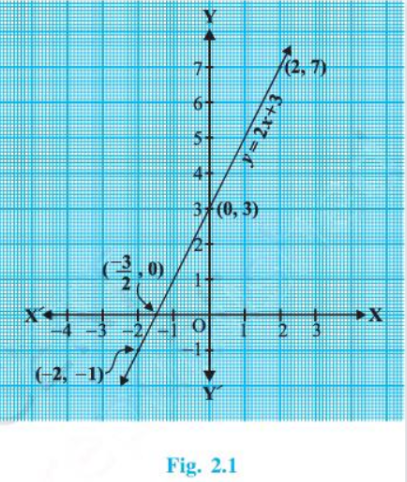
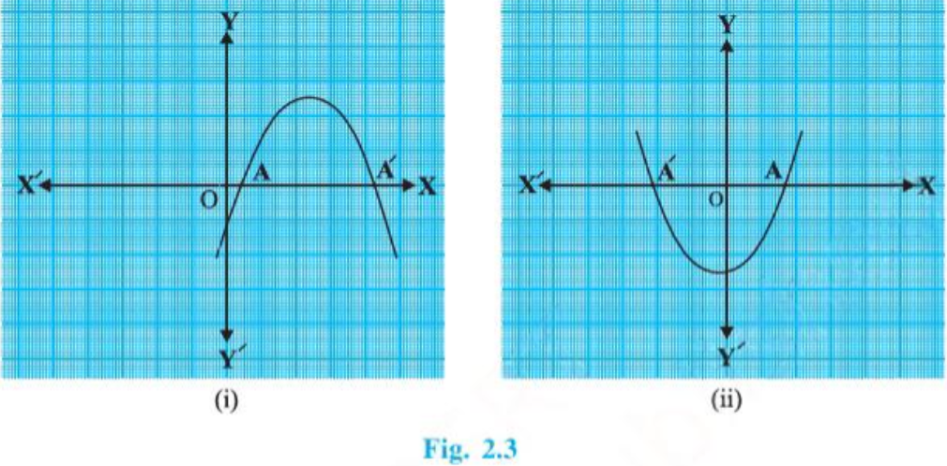
A polynomial of degree has at most zeroes. Graphically, its graph can meet the -axis at no more than points.
Examples of Polynomial Graphs
- Quadratic The graph of crosses the -axis at and .
- Cubic For , the zeroes are , , and .
- Repeated zero The polynomial has only the zero ; the graph meets the axis there.
- Factored example Since , its zeroes are and .
- Graph-count example The six graphs in the lecture have, respectively, , , , , , and zeroes; count their -axis intersections.
How many zeroes does have, and what are they?
- Find the zeroes of by factoring.
- Factor the difference of squares.
- Set each factor equal to zero; these values are the graph's -intercepts.
Relations Between Zeroes and Coefficients
For with zeroes and :
For with zeroes , , and :
Check the quadratic coefficient relations for .
- For , the zeroes are and .
- Their sum agrees with .
- Their product agrees with .
Find the degree and type of .
How many zeroes does have?
A quadratic polynomial has zeroes and . Find the sum and product of its zeroes.
Quick recap
- The degree is the highest power of the variable with a non-zero coefficient.
- Degree , , and polynomials are called linear, quadratic, and cubic.
- is a zero of exactly when .
- The zeroes are the -coordinates where the graph meets the -axis.
- A degree- polynomial has at most zeroes.
- Quadratic and cubic zeroes satisfy specific sum and product relations with their coefficients.
Relationship Between Zeroes And Coefficients Of A Polynomial
Quadratic Polynomials
Quadratic polynomial — A quadratic polynomial has the form , where .
If the zeroes of are and , then their sum is and their product is .
Use these to check zeroes or construct a polynomial from their sum and product.
If the zeroes have sum and product , one suitable polynomial is ; any non-zero multiple also works.
Find zeroes and verify the relationships
- Factor the quadratic polynomial.
- Read the zeroes from the factors.
- Calculate their sum and product, then compare with the coefficient ratios.
Find the zeroes of and verify the coefficient relationships.
- Factor the polynomial to find its zeroes.
- Compare the sum of the zeroes with the negative ratio of the linear and quadratic coefficients.
- Compare the product of the zeroes with the ratio of the constant and quadratic coefficients.
Do not reverse the signs: the sum is , while the product is .
Cubic Polynomials
Cubic polynomial — A cubic polynomial has the form , where .
If the zeroes of are , and , their sum, pairwise-product sum and product are related to the coefficients as shown.
The pairwise-product sum includes all three products taken two zeroes at a time.
Verify cubic zeroes and relationships
- Check that each proposed value makes the polynomial equal to zero, or factor the polynomial.
- Calculate the sum of the three zeroes and compare with the coefficient ratio.
- Calculate the three pairwise products and their sum.
- Calculate the product of all three zeroes and compare with the constant-term ratio.
Verify that , and are the zeroes of , and check the coefficient relationships.
- Factor the polynomial; this shows that the proposed values are its zeroes.
- Use the coefficients , , and to verify the sum.
- Add the products taken two at a time and compare with .
- Multiply all three zeroes and compare with .
Find the zeroes of and verify the relationships with its coefficients.
Write a quadratic polynomial whose zeroes have sum and product .
For , the zeroes are , and . Verify the three cubic relationships.
Quick recap
- For , the sum of zeroes is and their product is .
- If quadratic zeroes have sum and product , one polynomial is .
- For , the sum of zeroes is .
- The cubic pairwise-product sum is .
- The product of the three cubic zeroes is .
Formula sheet
Mathematics — ALL CHAPTERS
1
Real Numbers
2
Polynomials
3
Pair Of Linear Equations In Two Variables
4
Quadratic Equations
5
Arithmetic Progressions
6
Triangles
7
Coordinate Geometry
8
Introduction To Trigonometry
9
Some Applications Of Trigonometry
10
Circles
11
Areas Related To Circles
12
Surface areas And Volumes
13
Statistics
14
Probability