Class 12 Commerce . Economics . Indian Economic Development . Employment Growth Informalisation and Other Issues
Chapter 6: Employment : Growth, Informalisation And Other Issues
Ch 6
Economics
Class 12 Commerce
Introduction
Work and Its Importance
Why people work
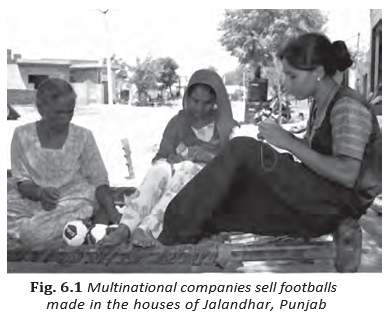
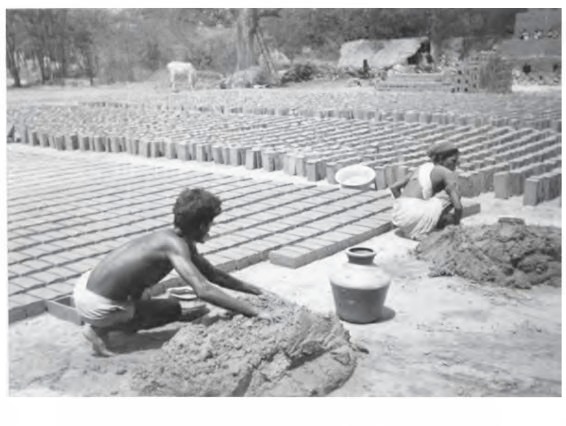
- Variety of work: People work on farms, in factories, banks and shops, as well as at home; home-based work ranges from handicrafts to IT programming.
- Changing workplaces: Technology enables factory goods to be produced at home, including in villages. During 2020–21, millions delivered products and services through work-from-home.
- Livelihood: Work provides a means of earning a living; inherited wealth does not give the same sense of contribution as working.
- Personal and social value: Employment can build self-worth, meaningful connections and accomplishment through supporting dependants.
- National contribution: People engaged in economic activities contribute to national income and the country's development.
- Gandhi’s view: Mahatma Gandhi objected not to machinery itself, but to the craze for labour-saving machinery when it leaves people without work.
- Education and training: Gandhi also stressed learning and training through varied kinds of work, including craft.
Why study workers and employment?
- Employment quality: Studying workers reveals the nature and quality of jobs in a country.
- Human resources: Information about workers helps a country plan its human resources.
- National income: It helps assess the contributions made by different industries and sectors.
- Social issues: It can help address exploitation of marginalised groups and child labour.
Workers and Employment
- Economic activity
- An activity that contributes to the country's gross national product.
- Worker
- A person engaged in an economic activity, whether paid by an employer or self-employed.
- Workforce
- The people engaged in economic activities and counted as workers.
- GDP
- The total money value of final goods and services produced within a country in a year.
- GNP
- GDP adjusted by adding the country's net earnings from foreign transactions.
Who counts as a worker?
- Economic contribution: Farmers produce food and industrial raw materials; textile workers turn cotton into cloth; transport workers move goods. These activities contribute to national output.
- Broad definition: Anyone engaged in an economic activity counts as a worker, regardless of their position or level of work.
- Temporary absence: Workers remain counted if temporarily unable to work because of illness, injury, disability, bad weather, festivals, or social and religious events.
- Helpers: People who assist the main workers are also workers.
- Employment status: Workers include both employees paid by an employer and self-employed people.
Net earnings from foreign transactions are positive if export value exceeds import value, negative if import value exceeds export value, and zero if their values are equal.
Employment patterns and workforce in India
- Duration and wages: Some people work throughout the year; others find work for only a few months. Many workers do not receive fair wages.
- Counting workers: Estimates include people engaged in economic activities, including those who may not receive wages directly.
- Rural share: About two-thirds of the workforce lived in rural areas, reflecting that most of India's population lived there.
- Gender composition: Men made up about 77% of workers; women made up the rest. The figures include child labourers of both sexes.
- Women’s share: Women accounted for about one-fourth of the rural workforce and one-fifth of the urban workforce.
Reference periods in the lecture
- 2017–18India had a workforce of about 471 million people.
- 2020–21During the Covid-19 pandemic, millions delivered products and services through work-from-home arrangements.
Unpaid work and the counting of women workers
- Work performed: Women often cook, fetch water and fuelwood, and take part in farm labour.
- Why work may be missed: These activities may bring no cash or grain payment, or no payment at all, so women doing them may not be classified as workers.
- Economic viewpoint: Economists argue that women doing such productive work should also be counted as workers.
Who is counted as a worker?
Why may women's work be undercounted?
Quick recap
- Work provides livelihoods, personal fulfilment and a contribution to national development.
- Gandhi criticised the pursuit of labour-saving machinery when it deprives people of work, and supported education through varied work including craft.
- Economic activities contribute to GNP; GNP equals GDP plus net earnings from foreign transactions.
- Workers include employees, self-employed people, helpers and people temporarily absent from work.
- India's workforce was about 471 million in 2017–18, with roughly two-thirds in rural areas.
- Women’s work may be undercounted when productive activities receive no direct payment.
Participation of People In Employment
Worker-Population Ratio
Worker-population ratio — The percentage of a population that is working and contributing to the production of goods and services.
Population — The total number of people residing in a particular locality at a particular point of time.
Meaning
- Use: It indicates the extent of people’s participation in a country’s economic activities.
- Higher ratio: A greater proportion of the population is engaged in work.
- Medium or low ratio: A large share of the population is not directly involved in economic activities.
Divide the number of workers by the total population and multiply by 100.
Participation in India, 2017–2018
| Group | Total | Rural | Urban |
|---|---|---|---|
| Men | 52.1 | 51.7 | 53.0 |
| Women | 16.5 | 17.5 | 14.2 |
| All persons | 34.7 | 35.0 | 33.9 |
Rural and Urban Participation
- Overall: About 35 out of every 100 people in India were workers.
- Rural–urban difference: The ratio was about 35% in rural areas and 34% in urban areas.
- Rural education and work: Many rural people do not attend schools, colleges, or training institutions; some leave studies midway to join the workforce.
- Urban education and jobs: A considerable section of urban residents can continue studying and seek jobs suited to their qualifications and skills; urban areas offer varied employment opportunities.
- Economic pressure: Rural residents may be unable to stay at home without working because their economic conditions do not allow it.
Gender Differences in Work Participation
Men’s and Women’s Participation
- Gender gap: Men’s worker-population ratio is much higher than women’s in both rural and urban areas.
- Urban women: About 14 out of every 100 urban women participate in economic activities.
- Rural women: About 18 out of every 100 rural women participate in the employment market.
- Family income: Families may discourage women from taking jobs when male members earn high incomes.
Why Women’s Work Is Underestimated
- A narrow definition of work counts only recognised economic activities.
- Unpaid household and family-farm work is often excluded from this definition.
- Women’s contributions to maintaining households and farms go uncounted as productive work.
- The recorded number of women workers is therefore underestimated.
What does the worker-population ratio indicate?
Why may the recorded number of women workers be underestimated?
Quick recap
- The worker-population ratio measures the share of people working in the population.
- Population is the total number of people residing in a particular locality at a particular point of time.
- In 2017–2018, India’s overall ratio was 34.7%; it was 35.0% in rural areas and 33.9% in urban areas.
- Men had much higher participation rates than women.
- Women’s participation was 17.5% in rural areas and 14.2% in urban areas.
- Unpaid household and family-farm work is often excluded, causing women’s work to be undercounted.
Self-employed and Hired Workers
Why Employment Status Matters
- Employment status: It reveals an important aspect of the quality of employment.
- Workplace role: A worker’s status shows their attachment to the job and their authority over the enterprise and co-workers.
Main Categories of Workers
Employment Patterns by Gender
Rural and Urban Employment Patterns
Name and define the three employment-status categories.
Why is self-employment more common in rural areas?
Quick recap
- Employment status helps indicate job quality, job attachment and authority at work.
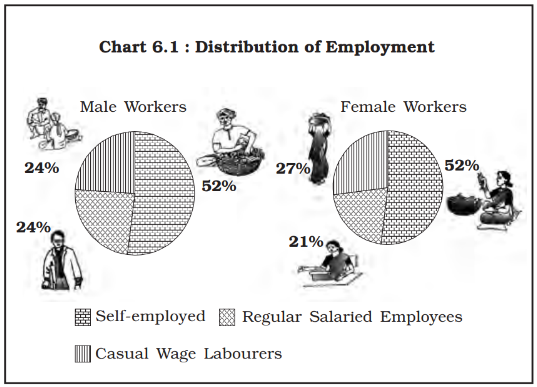
- India’s workforce is about 52 per cent self-employed, 25 per cent casual wage labourers and 23 per cent regular salaried employees.
- Self-employment is the largest work category for both men and women.
- Casual wage work accounts for about 24–27 per cent and is slightly more common among women.
- Regular salaried work accounts for 23 per cent of male workers and 21 per cent of female workers.
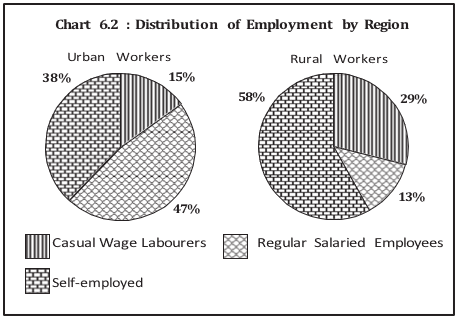
- Rural areas have more self-employed and casual workers; urban areas have more regular salaried workers.
Employment In Firms, Factories And Offices
How Employment Is Classified
Industrial divisions — Economic activities are grouped into eight industrial divisions, which are combined into three broad sectors.
| Major sector | Industrial divisions included |
|---|---|
| Primary | Agriculture; mining and quarrying |
| Secondary | Manufacturing; electricity, gas and water supply; construction |
| Service (tertiary) | Trade; transport and storage; services |
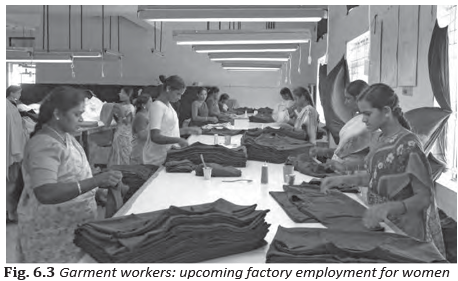
Employment shifts during development
- Economic development shifts workers from agriculture and related activities towards industry and services.
- Workers also move from rural to urban areas.
- At a later stage, the service sector expands rapidly and industry's share of total employment begins to decline.
| Sector | Rural | Urban | Men | Women | Total |
|---|---|---|---|---|---|
| Primary | 59.8 | 6.6 | 40.7 | 57.1 | 44.6 |
| Secondary | 20.4 | 34.3 | 26.5 | 17.7 | 24.4 |
| Tertiary/service | 19.8 | 59.1 | 32.8 | 25.2 | 31.0 |
| Total | 100.0 | 100.0 | 100.0 | 100.0 | 100.0 |
What the 2017–18 distribution shows
- Overall: The primary sector employs the largest share of workers (44.6%); services employ 31.0% and the secondary sector 24.4%.
- Rural workers: About 60% are in the primary sector; around 20% each work in secondary and service activities.
- Urban workers: Services employ about 60%; the secondary sector employs roughly one-third. Agriculture is not a major urban source of work.
- Women and men: Both are concentrated in the primary sector, but more strongly so among women (57.1%) than men (40.7%). Men have substantial employment in both secondary and service sectors.
Growth and Changing Structure of Employment
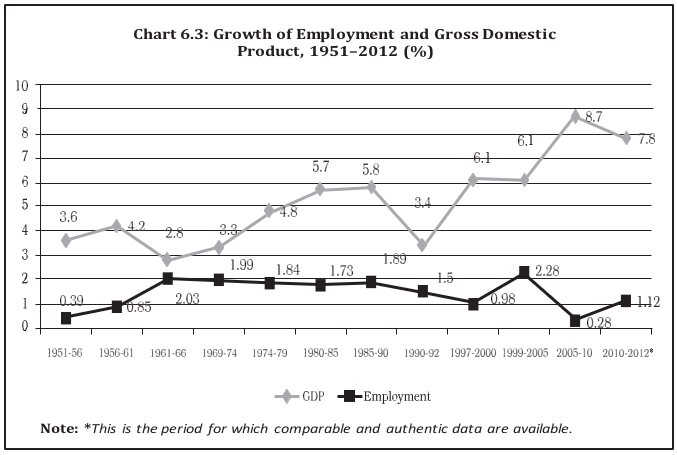
GDP growth and employment growth
- Development goals: Planned development aimed to expand national output and employment.
- 1950–2010: India's GDP grew positively and faster than employment, although GDP growth fluctuated. Employment growth remained at no more than 2%.
- From the late 1990s: Employment growth declined to levels seen in the early planning period, while the gap between GDP and employment growth widened.
Jobless growth — A situation in which output of goods and services increases without a corresponding rise in employment.
| Category | 1972–73 | 1983 | 1993–94 | 2011–12 | 2017–18 |
|---|---|---|---|---|---|
| Primary sector | 74.3 | 68.6 | 64.0 | 48.9 | 44.6 |
| Secondary sector | 10.9 | 11.5 | 16.0 | 24.3 | 24.4 |
| Services | 14.8 | 16.9 | 20.0 | 26.8 | 31.0 |
| Sector total | 100.0 | 100.0 | 100.0 | 100.0 | 100.0 |
| Self-employed | 61.4 | 57.3 | 54.6 | 52.0 | 52.2 |
| Regular salaried employees | 15.4 | 13.8 | 13.6 | 18.0 | 22.8 |
| Casual wage labourers | 23.2 | 28.9 | 31.8 | 30.0 | 25.0 |
| Status total | 100.0 | 100.0 | 100.0 | 100.0 | 100.0 |
Structural changes in employment
- Sector shift: Between 1972–73 and 2011–12, the primary-sector share fell from 74.3% to 48.9%; secondary rose from 10.9% to 24.3%, and services from 14.8% to 26.8%.
- 2017–18: The primary-sector share fell further to 44.6%, services rose to 31.0%, and the secondary-sector share was nearly unchanged at 24.4%.
- Self-employment: It remained the largest employment status, accounting for 52.2% of workers in 2017–18.
- Recent status pattern: Between 2011–12 and 2017–18, regular salaried employment rose from 18.0% to 22.8%, while casual wage work fell from 30.0% to 25.0%.
Casualisation of the workforce — The shift from self-employment and regular salaried work towards casual wage work, observed especially from 1972–73 to 1993–94.
Employment status: key implications
- Casual work: Casualisation makes workers highly vulnerable because their work status is insecure.
- Long-term pattern: Self-employment remained the main source of employment even as its share declined.
- Recent change: By 2017–18, regular salaried employment had increased moderately and casual work's share had decreased.
What is jobless growth?
How did India's workforce distribution by sector change between 1972–73 and 2011–12?
What is casualisation of the workforce?
Quick recap
- The primary sector includes agriculture and mining; the secondary sector includes manufacturing, utilities and construction; services form the tertiary sector.
- In 2017–18, primary work remained the largest employment source overall, while urban workers were concentrated in services.
- Women were more concentrated in primary-sector work than men.
- GDP growth exceeded employment growth in 1950–2010; the widening gap from the late 1990s is called jobless growth.
- The workforce shifted away from primary work towards secondary and service activities over time.
- Casualisation rose up to 1993–94, while by 2017–18 regular salaried work had risen and casual work's share had fallen.
Informalisation of Indian Workforce
Formal and Informal Workforce
Formal-sector establishment — Any public-sector establishment or private-sector establishment employing 10 or more hired workers.
Informal sector — All other enterprises and the workers employed in them; it is also called the unorganised sector.
Who belongs to each sector?
- Other names: Formal and informal sectors are also known as the organised and unorganised sectors, respectively.
- Formal workers: People working in formal-sector establishments; labour laws help protect their rights.
- Informal workers: Include farmers, agricultural labourers, small-enterprise owners and workers, and self-employed people without hired workers.
- Casual workers: Non-farm casual wage workers serving more than one employer—such as construction and headload workers—are also informal workers.
- Development goal: Planning expected industrialisation to shift surplus agricultural workers into better-livelihood jobs; after 70 years, more than half the workforce still depended mainly on farming.
| Point | Formal sector | Informal sector |
|---|---|---|
| Employment conditions | More likely to provide regular income, higher wages and job security. | Income is often irregular; workers may be dismissed without compensation. |
| Protection | Labour laws and social security can protect workers; trade unions bargain for wages and benefits. | Workers generally lack government protection, regulation and social-security benefits. |
| Examples and features | Public establishments and private establishments with at least 10 hired workers. | Includes farming, small enterprises, self-employment and casual work; enterprises may use outdated technology and keep no accounts. |
Employment quality and social security
- Social security: Formal workers may receive maternity benefits, provident fund, gratuity and pension.
- Trade unions: Formal-sector workers may organise and negotiate with employers for better wages and social-security measures.
- Employment quality: Economists argue that the quality of employment has deteriorated over time; private-sector workers may receive lower pay than public-sector workers doing similar work.
- Informal living conditions: Many informal workers live in slums or are squatters, alongside insecure work and income.
- Formal sector
- Organised sector comprising all public establishments and private establishments with at least 10 hired workers.
- Informal sector
- Unorganised sector comprising other enterprises and their workers.
- Social security
- Benefits that help protect workers against risks, including maternity, illness and old age.
- Informalisation
- The movement of workers into informal employment, which generally offers less security and protection.
Formal-Sector Employment and Workforce Distribution
Formal-sector employment
- Data collection: The Union Ministry of Labour collects formal-sector employment information through employment exchanges across India.
- Major employer: In 2012, the public sector employed about 18 million of the 30 million formal-sector workers.
- Gender: Women made up about one-sixth of formal-sector workers in 2012.
- Trend: Economists reported a decline in formal-sector employment following reforms initiated in the early 1990s.
Divide the formal-sector workforce by the total workforce, then multiply by 100.
Workforce distribution in 2011–12
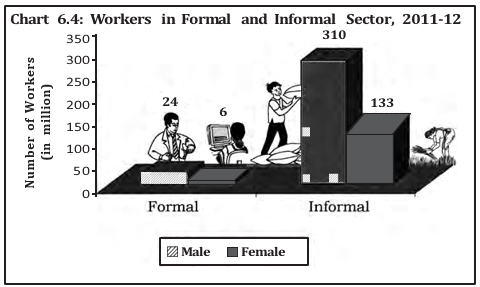
- Total workforce: India had about 473 million workers, of whom about 30 million were in the formal sector.
- Sector shares: is about formal-sector workers; the remaining were in the informal sector.
- Women’s share: Women constituted about of formal-sector workers and of informal-sector workers.
- Informal-sector conditions: Workers often lack regular income and protection; enterprises may use outdated technology and keep no accounts.
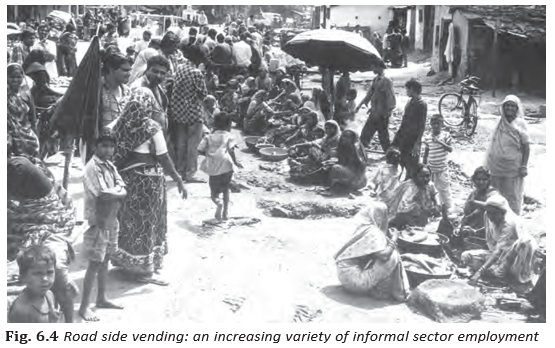
Attention to the Informal Sector
- Growing attention: From the late 1970s, developing countries including India focused more on informal enterprises and workers because formal-sector employment was not growing.
- ILO and government action: Following efforts by the International Labour Organisation (ILO), the Indian government initiated modernisation of informal enterprises and social-security measures for informal workers.
Informalisation in Ahmedabad
Textile-Mill Closures and Their Effects
- Before closures: More than 60 textile mills employed about 150,000 workers, many with secure jobs, living wages, social-security coverage and a strong trade union.
- Closures: Mills began closing across India in the early 1980s; in Ahmedabad, closures unfolded over about 10 years.
- Job losses: Approximately 80,000 permanent and more than 50,000 non-permanent workers lost their jobs and were pushed into the informal sector.
- Consequences: Recession and public disturbances, including communal riots, followed. Many workers fell from middle-class security into poverty; alcoholism and suicides were widespread, and some children left school to work.
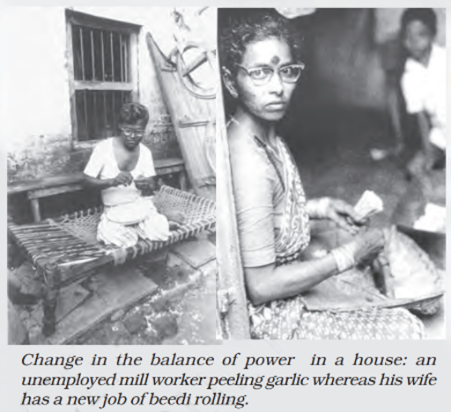
Ahmedabad: Mill Closures to Household Hardship
- Textile mills close over time.
- Permanent and non-permanent workers lose secure jobs.
- Many workers are pushed into informal employment and poverty.
- Families face severe hardship; some children leave school to work.
- Alcoholism and suicides become widespread.
Key Periods
- Late 1970sDeveloping countries, including India, gave increased attention to informal enterprises and workers.
- Early 1980sTextile mills began closing across India; Ahmedabad's closures unfolded over about 10 years.
- Early 1990sEconomic reforms were followed by a decline in formal-sector employment, according to economists.
- 2011–12About 6% of workers were in the formal sector and 94% in the informal sector; women made up about 20% and 30% of those groups respectively.
- 2012About 18 million of the 30 million formal-sector workers were employed by the public sector.
How are formal- and informal-sector establishments distinguished?
What does the workforce distribution in 2011–12 show?
How did Ahmedabad’s textile-mill closures affect workers and families?
Quick recap
- Formal (organised) establishments include all public workplaces and private establishments with at least 10 hired workers.
- Informal (unorganised) workers commonly lack regular income, job security, government protection and social-security benefits.
- In 2011–12, about 6% of workers were in the formal sector and 94% in the informal sector.
- Women formed about 20% of formal workers and 30% of informal workers in 2011–12.
- Formal-sector employment declined following reforms begun in the early 1990s; attention to informal work increased from the late 1970s.
- Ahmedabad’s textile-mill closures displaced many workers into informal work and poverty.
Unemployment
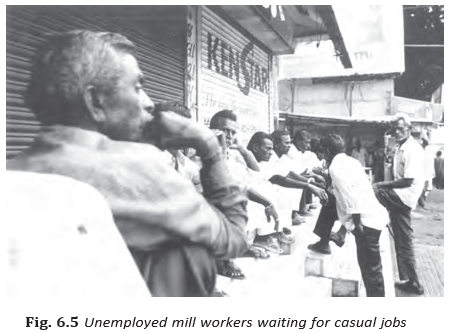
Unemployment — A situation in which people who lack work seek employment or are willing and available to work under the prevailing conditions of work and remuneration.
Sources of Unemployment Data
| Source | Data provided |
|---|---|
| Census of India | Unemployment information collected through the Census reports. |
| National Statistical Office (NSO) | Reports on the employment and unemployment situation, and annual Periodic Labour Force Survey (PLFS) reports. |
| Directorate General of Employment and Training | Registration data from employment exchanges. |
- Use of data: These sources may give different unemployment estimates, but help describe the unemployed and the forms of unemployment in India.
Types of Unemployment
Open unemployment — A condition in which people who are willing and able to work cannot find a job.
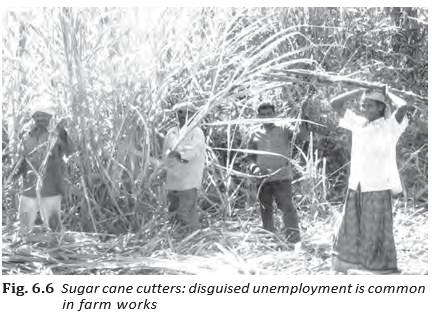
Disguised unemployment — A situation in which more people are employed than are needed, so some workers can be removed without reducing output.
Seasonal unemployment — Unemployment that occurs when work is available only during particular seasons of the year.
Employment initiatives
- Government role: Central and State governments take measures to generate employment and support a decent living for low-income families.
- Economic pressure: People in India may be unable to remain completely unemployed for long and can be forced to accept unpleasant, dangerous, or unhealthy work.
- Open unemployment
- Willing workers cannot find employment.
- Disguised unemployment
- More workers are engaged than production requires.
- Seasonal unemployment
- Work is unavailable during certain seasons.
- PLFS
- Periodic Labour Force Survey; an annual NSO source of employment and unemployment data.
Distinguish between disguised and seasonal unemployment.
Name the main sources of unemployment data in India.
Quick recap
- Unemployment involves a lack of work alongside seeking work or willingness and availability to work.
- The Census, NSO reports and surveys, and employment-exchange registration provide unemployment data.
- Open unemployment occurs when willing workers cannot find jobs.
- Disguised unemployment involves more workers than are required; it was widespread in Indian agriculture.
- Seasonal unemployment results from work being available only during part of the year.
- Governments generate employment to support decent living, especially for low-income families.
Government And Employment Generation
Government employment programmes
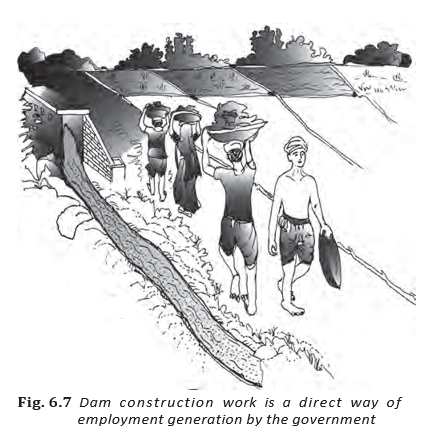
- Government role: Since Independence, the Union and State governments have helped generate employment and create opportunities for work.
- Purpose: Government initiatives support employment and help improve people’s livelihoods, particularly in rural areas.
Direct and indirect employment
How government output can generate indirect jobs
- Government enterprise increases production
- Private firms receive more raw materials or inputs
- Private firms expand output
- Employment opportunities increase in those firms
Employment-generation programmes
- Objectives: These programmes aim to reduce poverty by providing employment and essential services.
- Support: They include initiatives for health, education, drinking water, nutrition, housing, sanitation and rural roads.
- Asset creation: Some programmes provide assistance to acquire income-generating assets and develop community or degraded lands.
Changes in employment and the workforce
Outsourcing and changes in work
- A large firm finds it profitable to close some specialist departments
- It contracts many small, separate tasks to small enterprises or specialist individuals
- Work may be done remotely, including from other countries or from home
- Work arrangements become more informal, often with limited social security
- Direct employment
- Employment provided directly by government departments or enterprises.
- Indirect employment
- Employment created when government activity raises production and hiring in other businesses.
- Outsourcing
- Contracting work once done within a firm to external businesses or specialists.
- Informalisation
- A shift towards less formal employment, often with limited social-security protection.
Workforce facts from the chapter recap
Distinguish between direct and indirect employment generation by the government.
What does MGNREGA promise, and to whom?
Quick recap
- MGNREGA (2005) guarantees 100 days of wage employment to rural households volunteering for unskilled manual work.
- Government generates employment directly as an employer and indirectly by supporting private-sector expansion.
- Employment programmes combine job creation with services, asset support and rural infrastructure development.
- New service-sector work and outsourcing have changed workplaces, but many jobs are informal and offer limited social security.
- Rapid GDP growth has not been accompanied by a comparable rise in employment opportunities, encouraging government initiatives, especially in rural areas.
Economics — ALL CHAPTERS
1
Indian Economy On The Eve Of Independence
2
Indian Economy 1950–1990
3
Liberalisation, Privatisation And Globalisation: An Appraisal
4
Human Capital Formation In India
5
Rural Development
6
Employment : Growth, Informalisation And Other Issues
7
Environment and Sustainable Development
8
Comparative Development Experiences of India And Its Neighbours
1
Introduction
2
National Income Accounting
3
Money and Banking
4
Determination of Income and Employment
5
Government Budget and the Economy
6
Open Economy Macroeconomics