Class 12 Commerce . Economics . Indian Economic Development . Rural Development
Chapter 5: Rural Development
Ch 5
Economics
Class 12 Commerce
Introduction
Why Rural Development Matters
Rural India and national progress
- Livelihood: Agriculture is the main source of livelihood in rural areas.
- Population dependence: More than two-thirds of India’s population depends on agriculture, which has not become productive enough to support them adequately.
- Poverty: One-fourth of rural India lives in abject poverty; many rural poor lack basic necessities.
- National development: Broad progress requires village development, not only the growth of cities and industries.
Meaning and Scope of Rural Development
Rural development — Comprehensive action to develop areas of the village economy that lag behind in overall development.
| Area | Key requirements |
|---|---|
| Human resources | Literacy—especially female literacy—education, skill development, health, sanitation and public health. |
| Land and local resources | Land reforms and development of the productive resources available in each locality. |
| Infrastructure | Electricity, irrigation, credit, marketing, transport, village and feeder roads, agricultural research and extension, and information dissemination. |
| Poverty reduction and living conditions | Improve living conditions for weaker sections and expand access to productive employment. |
What rural development enables
- Higher productivity: Provide people in farm and non-farm work with means to increase productivity.
- Diversification: Expand non-farm employment, such as food processing, so rural livelihoods are not limited to agriculture.
- Essential services: Prioritise affordable healthcare, sanitation at homes and workplaces, and education for all.
Agriculture and Rural Development Challenges
Key trends
- Uneven shift: Agriculture’s share of GDP declined, but the population dependent on agriculture showed no significant change.
- Slower growth: After economic reforms began, agriculture grew at about 3% per year during 1991–2012, slower than in earlier years.
- Recent volatility: In 2014–15, GVA growth in agriculture and allied sectors was less than 1%.
Factors contributing to rural distress
- Public investment declined from 1991 onward; scholars identify this as a major reason for weaker agricultural performance.
- Inadequate infrastructure further constrains rural production and development.
- Few alternative jobs in industry and services limit workers’ options.
- Increasing casualisation of employment adds to insecurity.
- Together, these pressures contribute to growing distress among farmers.
Agriculture: selected trends
- Since 1991Public investment declined; scholars identify this as a major reason for weaker agricultural performance.
- 1991–2012Agriculture grew at about 3% per year after the initiation of reforms.
- 2014–15GVA growth in agriculture and allied sectors was less than 1%.
Key Issues in Rural India
Topics for understanding rural development
- Credit and marketing: Rural credit and marketing systems are crucial aspects of rural India.
- Agricultural diversification: Broadening rural livelihoods beyond farming is an important issue.
- Organic farming: Its role in promoting sustainable development is a key topic.
- Rural development
- Comprehensive action to improve lagging areas of the village economy.
- Agricultural diversification
- Broadening rural livelihoods beyond farming, including non-farm work such as food processing.
- GVA
- Gross Value Added; the measure used here to report growth in agriculture and allied sectors.
- Casualisation of employment
- A growing reliance on casual work, which can make employment less secure.
What does rural development include?
State two trends showing the challenges faced by agriculture.
Quick recap
- Rural development is comprehensive action to improve lagging areas of the village economy.
- It covers human resources, land and local resources, infrastructure, poverty reduction and employment.
- Rural productivity must rise, and livelihoods should diversify into non-farm activities.
- Affordable healthcare, sanitation and education are essential for rapid rural development.
- Agriculture’s GDP share fell, while dependence on the sector remained broadly unchanged.
- Declining public investment, weak infrastructure, few alternative jobs and casualisation contribute to rural distress.
- Credit and marketing systems, agricultural diversification and organic farming’s role in sustainable development are key rural issues.
Credit and Marketing In Rural Areas
Why Rural Credit Is Needed
Shift in Rural Lending
- Green Revolution: It brought major changes to the credit system and shifted rural credit towards production-oriented lending.
Rural Credit Institutions and SHGs
- Rural credit: Timely, affordable loans provide capital for agriculture and non-farm activities.
- Formal institutions: Commercial banks, regional rural banks, cooperatives and land development banks form the multi-agency rural banking system.
- NABARD: Set up in 1982 as the apex body coordinating institutions involved in rural finance.
Self-Help Groups and Micro-credit
SHG Participation
- May 2019Nearly 6 crore women in India were members of 54 lakh women’s SHGs.
Kudumbashree: A Women’s Community Programme
- Kudumbashree: A women-oriented, community-based poverty reduction programme implemented in Kerala.
- Thrift and credit society: Started in 1995 as a small savings bank to encourage savings among poor women.
- Achievement: Its societies mobilised ₹1 crore in thrift savings and became among Asia’s largest informal banks by participation and savings.
Rural Banking: Benefits and Challenges
- Benefits: Rural banking expanded access to credit and loans, supporting farm and non-farm output, income and employment.
- Food security: Banking and agricultural credit helped farmers meet production needs, contributing to increased food production and buffer stocks.
- Challenges: Weak deposit mobilisation, ineffective loan recovery and chronically high agricultural loan defaults have affected some formal institutions.
Jan-Dhan Yojana and Financial Inclusion
- Financial inclusion: Jan-Dhan Yojana encourages all adults to open bank accounts, with no minimum balance requirement.
- Account benefits: Holders can receive accidental insurance cover of ₹1–2 lakh and overdraft facilities of up to ₹10,000.
- Direct transfers: Wages, old-age pensions and other government social security payments can be transferred to bank accounts.
- Reach: More than 50 crore people opened accounts, mobilising over ₹2,00,000 crore and encouraging thrift.
Quick recap
- Rural credit bridges the gap between farmers’ initial expenses and later income.
- Social banking and a multi-agency approach expanded after 1969; NABARD was established in 1982.
- SHGs pool small savings to provide members with micro-credit and have helped empower women.
- Kudumbashree began its thrift and credit society in Kerala in 1995 and mobilised Rs. 1 crore in savings.
- Rural banking supported production and food security but faced weak deposit mobilisation and loan recovery; its promotion took a backseat after reforms.
- Jan-Dhan Yojana widened account access, enabled direct transfers and helped banks mobilise funds.
Agricultural Market System
Meaning and Need for Agricultural Marketing
- Agricultural marketing: The process of assembling, storing, processing, transporting, packaging, grading and distributing farm commodities.
- Market channels: These channels enable food grains, vegetables, fruits and other produce to reach consumers in different places.
Problems Faced by Farmers
- Faulty weighing: Traders often used inaccurate weights when buying produce from farmers.
- Price manipulation: Farmers lacked market-price information and were often compelled to sell at low prices.
- Storage shortage: Inadequate storage prevented farmers from holding produce for sale when prices improved; more than 10 per cent of farm goods are wasted due to lack of storage.
Government Measures to Improve Agricultural Marketing
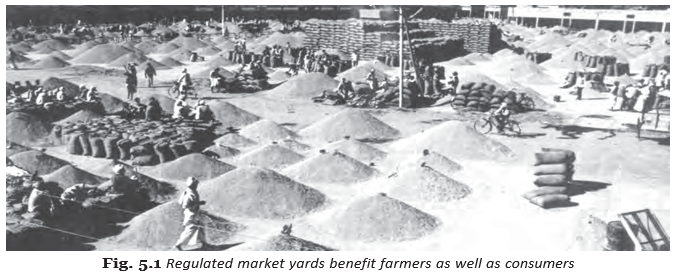
Government Intervention and Private Trade
- Private trade predominates: Moneylenders, rural political elites, big merchants and rich farmers handle a large share of agricultural products.
- Why intervention remains important: The large role of private traders makes regulation and farmer protection necessary.
- Commercialisation debate: Some scholars argue that commercialising agriculture can raise farmers’ incomes if government intervention is restricted; this is a debated view.
Emerging Alternative Marketing Channels
- Direct marketing: Farmers can sell produce directly to consumers, helping increase their incomes.
- Examples: Apni Mandi in Punjab, Haryana and Rajasthan; Hadapsar Mandi in Pune; Rythu Bazars in Andhra Pradesh and Telangana; and Uzhavar Sandies in Tamil Nadu.
Contract Farming and Company Alliances
Agricultural Marketing Reforms
- 2020The Indian Parliament passed three laws to reform agricultural marketing. Some farmers supported the reforms, while others opposed them; the laws remained under debate.
Name the four main government measures to improve agricultural marketing.
How can contract farming benefit farmers, and what is its key concern?
Quick recap
- Agricultural marketing covers the movement of produce from farms to consumers through multiple market channels.
- Farmers have faced unfair weighing, manipulated accounts, poor price information and inadequate storage.
- Government measures include market regulation, infrastructure, cooperatives, MSP, FCI buffer stocks and PDS.
- Private traders still handle a large share of agricultural produce, making intervention important.
- Direct-sale markets include Apni Mandi, Hadapsar Mandi, Rythu Bazars and Uzhavar Sandies.
- Contract arrangements may provide inputs and assured prices, but their effect on small farmers’ incomes is a key question.
- Three agricultural marketing laws passed in 2020 were supported by some farmers and opposed by others.
Diversification Into Productive Activities
Why Rural Livelihoods Need Diversification
| Dimension | What changes | Examples |
|---|---|---|
| Cropping pattern | The mix of crops grown changes | Growing different crops |
| Workforce | Workers shift from farming to allied or non-farm work | Livestock, poultry, fisheries, processing and tourism |
Why Diversification Is Needed
- Dependence on farming alone → greater risk to livelihoods.
- Farm employment is concentrated in the Kharif season → fewer jobs in Rabi, especially where irrigation is inadequate.
- Seasonal gaps and an overcrowded agricultural sector → need for supplementary work beyond crop farming.
- Allied and non-farm work → reduced risk, more productive and sustainable livelihoods, and potentially higher rural incomes.
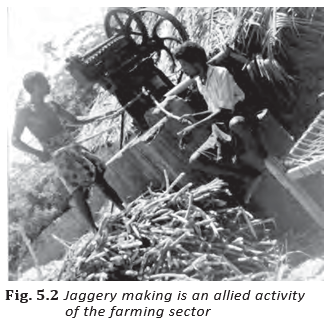
Non-Farm Employment and Women’s Work
| Segment | Examples | Key feature |
|---|---|---|
| Dynamic sectors | Agro-processing, food processing, leather and tourism | Have stronger growth linkages |
| Traditional home-based activities | Pottery, crafts and handlooms | Have potential but often lack infrastructure and other support; many remain low-productivity activities |
Gender and Rural Employment
- Employment pattern: Many rural women work in agriculture, while men have generally sought non-farm jobs.
- Changing role: Women have increasingly entered non-farm employment and income-generating work.
Tamil Nadu Women in Agriculture (TANWA)
- Late 1980sTANWA began in Tamil Nadu to train women in modern agricultural techniques and organic farming.
TANWA and Women’s Income Generation
- Aim: Encourage women to raise agricultural productivity and family income through training.
- Example: A trained Farm Women’s Group in Tiruchirapalli made and sold vermicompost.
- Group savings: Farm Women’s Groups used savings and microcredit systems like mini-banks.
- Small enterprises: Savings supported mushroom cultivation, soap-making, doll-making and other household income activities.
Animal Husbandry
Animal husbandry — The raising and care of livestock as part of farming and rural livelihoods.
Role and Productivity of Livestock
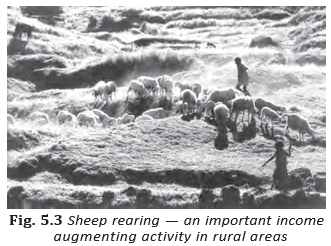
- Mixed farming: Rural households commonly combine crops with cattle, goats and fowl.
- Benefits: Livestock adds income stability, food security, transport, fuel and nutrition without disrupting other food production.
- Employment: The sector provides livelihoods to over 70 million small and marginal farmers, including landless labourers; many women also work in it.
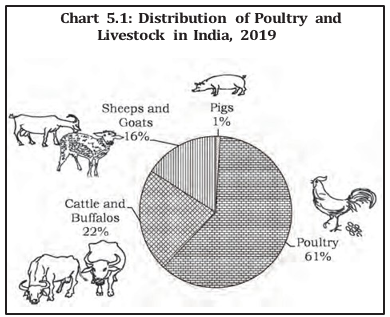
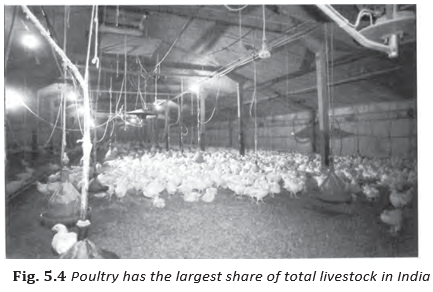
- Livestock distribution: Poultry has the largest share at 61%; camels, asses, horses, ponies and mules form the smallest ‘other animals’ group.
- Productivity challenge: Despite its large livestock population, India’s livestock productivity is low compared with other countries.
- Support needed: Better technology and animal breeds, veterinary care and credit can improve productivity and sustainable livelihoods.
Livestock and Dairy Facts
- 1951–2016Milk production in India increased about tenfold, mainly due to Operation Flood.
- 2019India had about 303 million cattle, including 110 million buffaloes.
Dairy Cooperatives and Livestock Products
- Operation Flood: Farmers pool milk, which is graded by quality, processed and marketed to urban centres through cooperatives.
- Farmer benefit: Cooperative marketing helps assure farmers a fair price and income from milk.
- Success: Gujarat’s milk-cooperative system became a model adopted by other states.
- Major milk-producing states: Gujarat, Madhya Pradesh, Uttar Pradesh, Andhra Pradesh, Maharashtra, Punjab and Rajasthan.
- Other products: Meat, eggs, wool and other by-products are additional productive activities.
Fisheries
Fisheries — Fishing and related production from inland waters or marine waters such as seas and oceans.
| Aspect | Key facts |
|---|---|
| Sources | Inland waters include rivers, lakes, ponds and streams; marine sources are seas and oceans. |
| Production value | Inland fisheries contribute about 65%; marine fisheries contribute 35%. |
| GDP contribution | Fish production accounts for 0.9% of India’s total GDP. |
| Major states | West Bengal, Andhra Pradesh, Kerala, Gujarat, Maharashtra and Tamil Nadu. |
| Recent trend | Fish production has increased substantially. |
Challenges and Women’s Role in Fisheries
- Community challenges: Many fishing families face poverty, underemployment, low per-capita earnings, limited mobility to other sectors, illiteracy and indebtedness.
- Women’s work: Though women are generally not involved in active fishing, they form about 60% of export-marketing workers and 40% of internal-marketing workers.
- Credit support: Cooperatives and self-help groups (SHGs) can help fisherwomen meet marketing working-capital needs.
- Sustainability: Overfishing and pollution need regulation; welfare programmes should be designed for long-term livelihood security.
Horticulture
Horticulture — The cultivation of fruits, vegetables, tuber crops, flowers, medicinal and aromatic plants, spices and plantation crops.
Importance, Employment and Support
- Contribution: Horticulture provides nearly one-third of the value of agricultural output and about 6% of India’s GDP.
- Production position: India is a world leader in mangoes, bananas, coconuts, cashew nuts and several spices; it is the world’s second-largest producer of fruits and vegetables.
- Livelihoods: Horticulture supports food and nutrition needs, creates employment and has improved the livelihoods of many farmers, including disadvantaged groups.
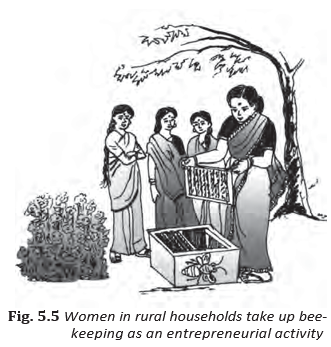
- Rural jobs: Flower harvesting, nursery work, hybrid-seed production, tissue culture, propagation of fruits and flowers, and food processing can provide remunerative work for women.
- Growth needs: Electricity, cold storage, marketing links, small-scale processing units and better technology are needed to strengthen horticulture.
Information Technology and Other Livelihood Options
How IT Can Support Rural Development
- Food security: Information and software tools can help governments identify vulnerable areas and predict food insecurity so preventive action can be taken.
- Farm information: IT can spread information on new technologies, prices, weather and soil conditions for different crops.
- Employment: IT applications have potential to generate jobs in rural areas.
- Limit: IT does not independently cause change; it can help release the knowledge and creative potential within society.
Saansad Adarsh Gram Yojana (SAGY)
- October 2014The Government of India introduced SAGY, asking Members of Parliament to identify and develop villages in their constituencies.
- By 2016MPs were expected to develop one village each as a model village.
- By 2019MPs were expected to develop two additional villages each; the scheme aimed to cover over 2,500 villages.
SAGY: Main Features
- Population: Selected villages were to have 3,000–5,000 people in the plains or 1,000–3,000 in hilly areas.
- Eligibility: The village could not be the MP’s own village or the village of the MP’s spouse.
- MP’s role: Facilitate a village development plan and motivate villagers to participate.
- Priorities: Develop infrastructure and support health, nutrition and education.
- Allied activities
- Farming-linked activities such as livestock rearing, poultry and fisheries.
- Non-farm employment
- Rural work outside crop cultivation and other direct farming activities.
- Operation Flood
- A cooperative system for pooling, grading, processing and marketing farmers’ milk.
- SHG
- A self-help group through which members save and can access credit collectively.
- SAGY
- Saansad Adarsh Gram Yojana, a scheme for MPs to support village development.
What are the two dimensions of diversification, and why is it needed?
How does Operation Flood benefit dairy farmers?
State the importance of fisheries and key challenges faced by fishing communities.
Quick recap
- Diversification changes cropping patterns and/or shifts workers into allied and non-farm activities.
- It reduces dependence on seasonal, risky farm employment and can increase rural income.
- Livestock provides varied benefits and jobs; better breeds, technology, veterinary care and credit can raise productivity.
- Fisheries and horticulture support livelihoods, but require sustainable resource management, credit and infrastructure.
- TANWA, cooperatives and SHGs help women gain skills, save and access income opportunities or credit.
- IT supports farm information, food-security planning and rural employment; SAGY promotes planned village development.
Sustainable Development and Organic Farming
Organic Farming and Sustainable Development
Organic agriculture — A whole system of farming that restores, maintains and enhances ecological balance.
Why eco-friendly farming is needed
- Conventional farming relies heavily on chemical fertilisers and toxic pesticides.
- Effects: chemicals can enter food and water, harm livestock, deplete soil and damage natural ecosystems.
- Sustainable development needs eco-friendly technologies that protect the environment while supporting production.
Organic Food and Its Benefits
Organic food market
- Demand: interest in organically grown food is increasing worldwide, partly to improve food safety.
- Market presence: many countries have about 10 per cent of their food system under organic farming; some retail chains and supermarkets have green status to sell organic food.
- Price: organic foods may command prices around 10–100 per cent higher than conventional foods.
| Benefits | Challenges |
|---|---|
| Replaces costly inputs such as HYV seeds, chemical fertilisers and pesticides with cheaper, locally produced organic inputs. | Farmers need awareness and willingness to adopt new methods; inadequate infrastructure and marketing are major barriers. |
| Can improve returns on investment and generate export income as demand for organic crops rises. | Yields may be lower than in modern farming in the initial years, making the transition difficult for small and marginal farmers. |
| Studies across countries report higher nutritional value; produce is pesticide-free and environmentally sustainable. | Produce may have more blemishes and a shorter shelf life; the choice of off-season crops is limited. |
| Requires more labour than conventional farming, making it a potentially attractive option for India. | Appropriate agricultural policies and better marketing support are needed to encourage adoption. |
Organic cotton in Maharashtra
- 1995Kisan Mehta of the NGO Prakruti proposed growing cotton organically, although cotton was a major user of chemical pesticides.
- LaterGermany's accredited agency AGRECO tested the produce and found it to be of high quality.
- At presentAbout 130 farmers have committed 1,200 hectares to organic cotton grown to International Federation of Organic Agriculture Movement standards.
Why organic farming can benefit small farmers
- Landholding pattern: about 78 per cent of Indian farmers are marginal farmers owning less than 0.8 hectare each; together, they account for 20 per cent of cultivable land.
- Long-run gains: organic farming can be more profitable for these farmers through lower input costs and soil conservation.
Sustainable Rural Development
Rural development — A plan of action to develop rural areas that lag behind in socio-economic development.
Building a more vibrant rural sector
- Without significant change, rural areas may remain socio-economically backward.
- Diversify into dairying, poultry, fisheries, vegetables and fruits.
- Link rural production centres with urban and export markets.
- Higher returns and broader livelihood options can support rural development.
Support needed for rural development
- Infrastructure: improve banking and access to credit, marketing, storage, transport and communications.
- Policy and dialogue: use farmer-friendly agricultural policies and maintain dialogue between farmers' groups and state agricultural departments.
- Environment and development: treat them as connected concerns; rural communities should choose eco-friendly technologies suited to local conditions.
- Learning by doing: learn from and adapt successful rural development practices tested in similar conditions elsewhere in India.
- Organic agriculture
- A farming system that restores, maintains and enhances ecological balance.
- Sustainable development
- Development that supports production and livelihoods while protecting the environment.
- Diversification
- Expanding rural work beyond crop farming into activities such as livestock, fisheries, vegetables and fruits.
- Learning by doing
- Applying and adapting successful practices through experience in suitable local conditions.
State the main benefits and challenges of organic farming.
Why is organic farming considered suitable for India?
Quick recap
- Rural development is a plan of action for rural areas lagging behind in socio-economic development.
- Organic farming protects ecological balance and reduces reliance on chemical fertilisers and toxic pesticides.
- Its benefits include lower local input costs, possible export earnings, pesticide-free produce and environmental sustainability.
- Lower initial yields, infrastructure and marketing gaps, shorter shelf life and limited off-season crops can constrain organic farming.
- Diversification and stronger links to urban and export markets can broaden rural livelihoods and improve returns.
- Credit, banking, marketing, farmer-friendly policies and locally suitable eco-friendly technologies support sustainable rural development.
Economics — ALL CHAPTERS
1
Indian Economy On The Eve Of Independence
2
Indian Economy 1950–1990
3
Liberalisation, Privatisation And Globalisation: An Appraisal
4
Human Capital Formation In India
5
Rural Development
6
Employment : Growth, Informalisation And Other Issues
7
Environment and Sustainable Development
8
Comparative Development Experiences of India And Its Neighbours
1
Introduction
2
National Income Accounting
3
Money and Banking
4
Determination of Income and Employment
5
Government Budget and the Economy
6
Open Economy Macroeconomics