Class 12 Commerce . Economics . Introductory Macro Economics . Introduction
Chapter 1: Introduction
Ch 1
Economics
Class 12 Commerce
Introduction to Macroeconomics
Macroeconomics: The Economy as a Whole
- Macroeconomics: Studies the economy as a whole, including overall output, prices and employment.
- Focus: It addresses broad economic questions and differs from microeconomics, which studies individual markets and decision-makers.
Aggregate Analysis and Representative Goods
- Aggregate analysis: Examines economy-wide output, prices and employment rather than each individual good or market.
- Representative goods: A single imaginary good, or a few broad categories of goods, can simplify the study of overall economic patterns.
Why Macroeconomics Also Studies Sectors
- Sectoral perspective: An economy can be understood through the relationships and interdependence among its distinct sectors.
- Why it matters: Sectoral analysis can reveal economic effects that an economy-wide view alone may overlook.
Economic Agents and the Need for Macroeconomics
- Economic agents: Individuals and institutions make decisions about consumption, production, spending and other economic activities.
- Need for macroeconomics: Individual market decisions can have aggregate effects, while public goals and market limitations may require economy-wide analysis and policy.
Macroeconomic Decision-Makers and Public Goals
- Microeconomics
- Study of individual economic agents and markets.
- Macroeconomics
- Study of the economy’s aggregate conditions and outcomes.
- Aggregate
- A combined, economy-wide measure.
- Economic agent
- An individual or institution that makes economic decisions.
- Inflation
- A general rise in prices.
How does macroeconomics use a representative good, and what is one limitation of this approach?
Quick recap
- Macroeconomics studies aggregate output, prices and employment across the economy.
- It relates overall production and employment to prices, interest rates, wages and profits.
- A representative good simplifies analysis when economic variables move in similar directions.
- Sectoral analysis is needed when differences or relationships between sectors matter.
- Economic agents include consumers, producers, governments, corporations and banks.
- The State and public institutions use policy to pursue collective goals and may modify market outcomes.
Emergence Of Macroeconomics
How Macroeconomics Emerged
Macroeconomics — The study of the economy as a whole, including how its different sectors depend on one another.
| Point | Classical tradition | Keynes’ approach |
|---|---|---|
| View of employment and production | Workers willing to work would find jobs; factories would operate at full capacity. | Examined the possibility of lasting unemployment and underused production. |
| Focus | Did not focus on the economy as one interdependent whole. | Studied the whole economy and the connections between its sectors. |
Key Events
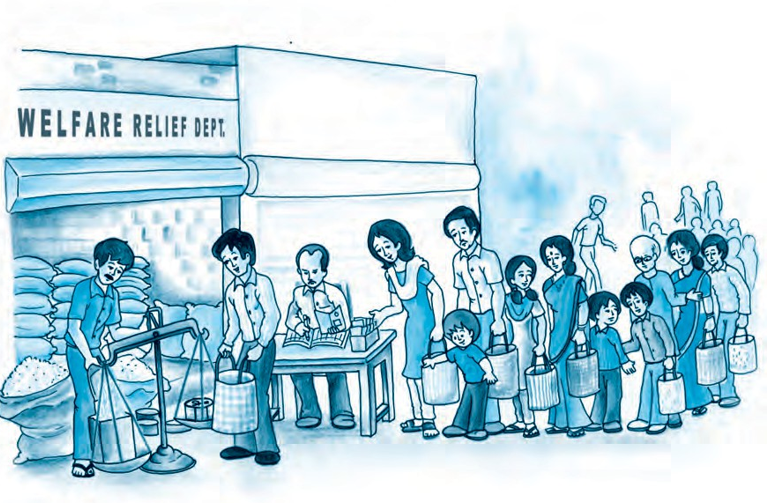
- 1929 and the following yearsThe Great Depression brought a sharp fall in output and employment, low demand, idle factories and widespread job losses.
- 1929–1933In the United States, unemployment rose from 3 per cent to 25 per cent, while aggregate output fell by about 33 per cent.
- 1936John Maynard Keynes published The General Theory of Employment, Interest and Money; its approach helped establish macroeconomics as a separate branch.
Here, is the number of people not working but seeking jobs, and is the number of people working. The denominator includes people working or seeking jobs.
The Capitalist Economy and Its Production
Capitalist economy — An economy where most production is privately owned, goods are made for sale in markets, and labour services are bought for wages.
Firms and Production
- Firm: A production unit organised to hire labour and use capital and land to make goods or services for sale and profit.
- Entrepreneur: The person or people who control major decisions, organise production and bear much of the enterprise’s risk.
- Inputs: Capital may be supplied by the entrepreneur or borrowed; production also uses land and labour. Natural resources can be consumed as raw materials or used as fixed resources such as plots of land.
- Market motive: Firms produce output to sell it; uncertain prices can reduce the profit earned.
| Recipient / use | Payment or return |
|---|---|
| Land | Rent |
| Capital | Interest |
| Labour | Wages |
| Entrepreneur | Profit |
| Expansion of production | Investment expenditure, such as buying machinery or building factories |
Production, Income and Investment
- Entrepreneur organises capital, land and labour → firm produces output.
- Firm sells output in the market → earns revenue.
- Revenue pays rent, interest and wages → remaining income is profit.
- Profit may fund machinery or factories → productive capacity can expand.
| Point | Capitalist production | Many peasant or tribal settings |
|---|---|---|
| Ownership and organisation | Production is mainly organised by private enterprises. | Peasant production may be organised by families; tribal land may be held collectively. |
| Labour | Wage labour is hired in the market. | Family members often do the work; wage labour may be uncommon. |
| Purpose of production | Output is made mainly for sale in the market. | A significant share may be consumed by the family rather than sold. |
| Capital growth | Profits may be reinvested to expand productive capacity. | Many peasant farms do not significantly increase their capital stock. |
Scope of the Analysis
- Historical spread: Capitalist countries emerged only in roughly the last three to four hundred years; only a limited number of countries strictly fit the description.
- Applicability: The book’s analysis is based on a capitalist economy, so it does not fully describe economies where production is mainly for family use, wage labour is rare, or land is collectively owned.
- Mixed presence: Developing countries may still contain many production units organised on capitalist principles.
The Four Sectors of the Economy
| Sector | Main role and links |
|---|---|
| Firms | Hire wage labour and use capital and land to produce goods and services for sale; seek profit and face risk. |
| Government (State) | Makes and enforces laws, delivers justice, may produce goods and services, collects taxes and spends on public infrastructure, education and health. |
| Households | Individuals or groups making consumption decisions jointly; they consume, save and pay taxes, and provide demand for firms’ products. |
| External sector | Connects the domestic economy to the rest of the world through trade and capital flows. |
Household Income and External Links
- Household income: People may earn wages in firms, salaries in government departments, or profits as firm owners; they may also receive rent by leasing land or interest by lending capital.
- Exports: Goods sold by the domestic economy to the rest of the world.
- Imports: Goods bought by the domestic economy from the rest of the world.
- Capital flows: Foreign capital may enter the domestic economy, or domestic capital may be invested abroad.
- Aggregate output
- The total output produced by an economy.
- Wage labour
- Labour services sold in exchange for wages.
- Investment expenditure
- Spending that raises productive capacity, such as buying machinery or building factories.
- Revenue
- Money earned by selling output.
- Profit
- The entrepreneur’s remaining earning after other factor payments.
What events led economists to develop macroeconomics as a separate branch?
Name the three main characteristics of a capitalist economy.
Quick recap
- Macroeconomics studies the economy as a whole and the links between its sectors.
- The Great Depression challenged the classical assumption of full employment and full-capacity production.
- Keynes’s 1936 book helped establish macroeconomics as a distinct branch.
- Capitalist production uses capital, land and labour; revenue is distributed as rent, interest, wages and profit.
- The four sectors are firms, government, households and the external sector.
- Households provide consumption demand and earn income in several ways; external links include trade and capital flows.
Summary & Key Concepts
Macroeconomics and Microeconomics
| Point | Macroeconomics | Microeconomics |
|---|---|---|
| Focus | Aggregate economic variables and the economy as a whole | Particular sectors or individual parts of the economy |
| Interlinkages | Studies links between different sectors | Often examines a sector assuming the rest of the economy remains unchanged |
Emergence of Macroeconomics
- 1930sMacroeconomics emerged as a separate subject, associated with John Maynard Keynes.
- The Great DepressionThe severe economic crisis in developed countries inspired Keynes's writings.
Scope and Economic Sectors
- Economic model: The discussion mainly focuses on how a capitalist economy works; it may not fully describe a developing country's economy.
- Four sectors: Macroeconomics views the economy as households, firms, government and the external sector.
Key Concepts
- Economic agents or units
- Individuals or organisations that take part in economic activity, such as households, firms and government.
- Inputs
- Resources used in producing goods and services.
- Output
- Goods and services produced by an economy or firm.
- Means of production
- Resources and assets used to produce goods and services.
- Capitalist economy
- An economy in which production is mainly organised through privately owned firms and market exchange.
- External sector
- The part of the economy connected with other countries through trade and other transactions.
| Term | Meaning |
|---|---|
| Four factors of production | Land, labour, capital and entrepreneurship—the main resources used in production. |
| Land | A factor of production referring to natural resources. |
| Labour | Human effort used in producing goods and services. |
| Capital | Produced assets used to make other goods and services. |
| Entrepreneurship | The organisation and coordination of production, including decision-making and risk-taking. |
| Wage labour | Work performed in return for wages. |
| Wage rate | Payment per unit of labour, such as per hour or day. |
| Rate of interest | The price paid for borrowing money or the return received for lending it. |
| Profits | The income remaining to a firm after its costs are paid. |
| Investment expenditure | Spending on capital goods that add to productive capacity. |
| Term | Meaning |
|---|---|
| Economy | A system in which people and organisations produce, distribute and use goods and services. |
| Households | Economic units that consume goods and services and supply factors such as labour. |
| Firms | Organisations that use inputs to produce goods and services. |
| Capitalist firms | Firms that operate within a capitalist economy, generally producing for sale and earning profits. |
| Government | The public authority that participates in the economy and provides public services. |
| Exports | Goods and services sold to other countries. |
| Imports | Goods and services purchased from other countries. |
| Unemployment rate | A measure of the share of the labour force that is unemployed and seeking work. |
| Capitalist | A person or owner who invests capital in production, often through ownership of a firm. |
What distinguishes macroeconomics from microeconomics?
Name the four sectors used to view an economy in macroeconomics.
Quick recap
- Macroeconomics studies aggregate variables and interconnections among economic sectors.
- Microeconomics focuses on particular parts of the economy, usually treating other parts as unchanged.
- Macroeconomics became a separate subject in the 1930s, associated with Keynes and inspired by the Great Depression.
- The four sectors are households, firms, government and the external sector.
- The lecture mainly discusses capitalist economies; this perspective may not fully capture developing economies.
- Land, labour, capital and entrepreneurship are the four factors of production.
Economics — ALL CHAPTERS
1
Indian Economy On The Eve Of Independence
2
Indian Economy 1950–1990
3
Liberalisation, Privatisation And Globalisation: An Appraisal
4
Human Capital Formation In India
5
Rural Development
6
Employment : Growth, Informalisation And Other Issues
7
Environment and Sustainable Development
8
Comparative Development Experiences of India And Its Neighbours
1
Introduction
2
National Income Accounting
3
Money and Banking
4
Determination of Income and Employment
5
Government Budget and the Economy
6
Open Economy Macroeconomics