Class 12 Commerce . Economics . Introductory Macro Economics . Open Economy Macroeconomics
Chapter 6: Open Economy Macroeconomics
Ch 6
Economics
Class 12 Commerce
Introduction
Open and Closed Economies
- Closed economy: Has no economic linkages with the rest of the world.
- Open economy: Interacts with other countries through international economic relationships.
International Linkages
- Linkages: Countries connect through output, financial and labour markets.
- Focus: Open economy analysis chiefly considers trade in goods and services and international financial transactions.
Foreign Trade and Aggregate Demand
How Foreign Trade Affects Domestic Aggregate Demand
- Residents buy foreign goods → spending leaves the domestic circular flow → leakage reduces domestic aggregate demand.
- Foreigners buy domestic goods → spending enters the domestic circular flow → injection increases domestic aggregate demand.
Currency in International Transactions
- Cross-border payments: International purchases require a means of payment accepted by buyers and sellers in different countries.
- Currency confidence: A currency is more likely to be accepted internationally when users trust that its purchasing power will remain stable.
Convertibility and the International Monetary System
- Convertibility: Governments have sought confidence in their currencies by promising conversion at a fixed price into another asset, often gold or another national currency.
- Credibility: The promise depends on the ability to convert freely in unlimited amounts and on the price at which conversion occurs.
- International monetary system: Its arrangements address these issues and help maintain stability in international transactions.
Foreign Exchange Rate
Do not confuse: Imports and exports affect domestic aggregate demand in opposite ways—imports are a leakage, while exports are an injection.
How do imports and exports affect domestic aggregate demand?
What is an exchange rate?
Quick recap
- An open economy interacts with other countries; a closed economy has no international linkages.
- International linkages include output, financial and labour markets; this chapter focuses on output and financial markets.
- Imports are a leakage that lowers domestic aggregate demand, while exports are an injection that raises it.
- International use of a national currency relies on confidence in the stability of its purchasing power.
- Convertibility commitments depend on unlimited conversion and a credible fixed conversion price.
- The exchange rate is the price of one currency in terms of another.
The Balance Of Payments
Balance of Payments (BoP) — A record of transactions in goods, services and assets between a country’s residents and the rest of the world over a specified period, usually one year.
Main BoP accounts
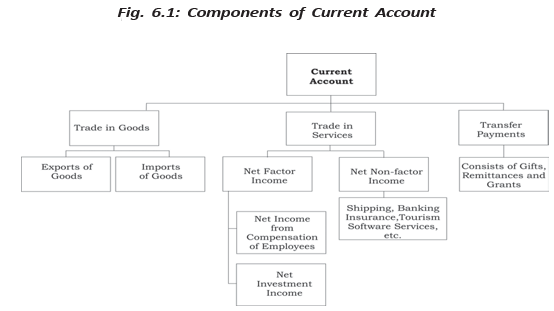
- Current account: Records trade in goods and services, and transfer payments.
- Capital account: Records international transactions involving assets.
Current Account
Components and effects
- Goods: Includes exports and imports of physical goods.
- Services: Includes factor income and non-factor income transactions.
- Transfer payments: Receipts received without providing goods or services in return; examples include gifts, remittances and grants from governments or private citizens abroad.
- Imports: Payments for foreign goods become income abroad and reduce domestic demand for goods and services.
- Exports: Sales to foreign countries bring income into the country and add to aggregate domestic demand.
| Position | Relationship | Meaning |
|---|---|---|
| Surplus | Receipts > payments | The country is a lender to other countries. |
| Balanced | Receipts = payments | Current-account receipts equal payments. |
| Deficit | Receipts < payments | The country is a borrower from other countries. |
Components of the Current Account Balance
- Balance of Trade (BOT): Difference between the value of goods exports and goods imports during a given period.
- Balance on invisibles: Net difference between exports and imports of invisibles.
Measures the difference between goods exports and goods imports.
| Position | Goods exports and imports | BoP entry |
|---|---|---|
| Balanced BOT | Exports = imports | Goods exports are credit; imports are debit. |
| BOT surplus (trade surplus) | Exports > imports | Exports exceed imports. |
| BOT deficit (trade deficit) | Imports > exports | Imports exceed exports. |
Invisibles
- Meaning: Invisibles are cross-border services, transfers and income flows.
- Factor income: Net international earnings on factors of production, such as labour, land and capital.
- Non-factor income: Net sales of service products, such as shipping, banking, tourism and software services.
Capital Account
Capital Account — Records international transactions involving assets—forms in which wealth is held, such as money, stocks, bonds and government debt.
| Transaction | BoP entry | Example |
|---|---|---|
| Purchase of foreign assets | Debit; foreign exchange flows out | An Indian buys a UK car company. |
| Sale of domestic assets to foreigners | Credit; foreign exchange flows in | Shares of an Indian company are sold to a Chinese customer. |
Capital Account Components
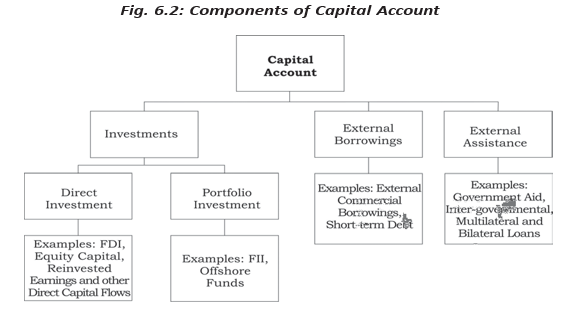
- Investments: Foreign Direct Investments (FDIs) and Foreign Institutional Investments (FIIs).
- Other components: External borrowings and external assistance.
| Position | Relationship | Examples |
|---|---|---|
| Balanced | Capital inflows = capital outflows | Inflows include foreign loans and sale of assets; outflows include loan repayments and purchases of foreign assets. |
| Surplus | Capital inflows > capital outflows | More capital enters than leaves. |
| Deficit | Capital inflows < capital outflows | More capital leaves than enters. |
Distinguish between a trade surplus and a current-account surplus.
How are purchases and sales of assets recorded in the capital account?
Quick recap
- The BoP records residents’ transactions with the rest of the world, usually over one year.
- The current account covers goods, services and transfer payments; the capital account covers asset transactions.
- Current-account receipts greater than payments mean a surplus and lender position; receipts below payments mean a deficit and borrower position.
- BOT compares goods exports with goods imports; exports are credit entries and imports are debit entries.
- Invisibles include services, transfers and income flows; services may be factor or non-factor income.
- Capital inflows exceeding outflows create a surplus; inflows below outflows create a deficit.
Balance of Payments Surplus and Deficit
Financing a Current Account Deficit
Balance of payments equilibrium — A current account deficit financed entirely by net capital inflows, without any change in official reserves, is in balance of payments equilibrium.
How a deficit is financed
- Current account deficit: The country spends more on transactions with the rest of the world than it receives.
- Financing: A country can borrow abroad or sell assets to foreign buyers; both produce a net capital inflow.
- Equilibrium condition: When there is no reserve movement, the current account deficit is matched by a capital account surplus.
- Official reserve sale: The central bank can sell foreign exchange to cover a BoP deficit, reducing its reserves.
- Monetary authority: The monetary authorities are the ultimate financiers of any BoP deficit and recipients of any BoP surplus.
A capital account surplus finances a current account deficit.
Overall balance and reserves
- Overall deficit: In physical terms, an official reserve decrease can finance a BoP deficit; a reserve increase is associated with a surplus.
- Exchange-rate regime: Official reserve transactions are more relevant under fixed exchange rates than under floating exchange rates.
- Sign convention in the source table: A deficit is shown as overall balance and reserve change ; a surplus as overall balance and reserve change .
| Position | Overall balance | Reserve change (source convention) |
|---|---|---|
| Deficit | ||
| Balanced BoP | ||
| Surplus |
Do not confuse the source table’s reserve-change sign convention with the physical movement of reserves: a reserve sale reduces the country’s foreign-exchange reserves and finances a deficit.
Autonomous and Accommodating Transactions
| Point | Autonomous transactions | Accommodating transactions |
|---|---|---|
| Why they occur | For reasons independent of the BoP position, such as earning profit. | To bridge the gap caused by autonomous transactions. |
| BoP label | Above the line | Below the line |
| Relationship to BoP | Their receipts and payments determine whether the BoP is in surplus or deficit. | Their size depends on the resulting BoP gap. |
| Example | International transactions undertaken independently of the BoP gap. | Official reserve transactions used to bridge the gap. |
Surplus or deficit from autonomous transactions
- Surplus: Autonomous receipts are greater than autonomous payments.
- Deficit: Autonomous receipts are less than autonomous payments.
- Accommodating items: These reflect the net consequences of autonomous transactions and include official reserve transactions.
Errors and Omissions
Errors and omissions — An adjustment item that reflects international transactions that are difficult to record accurately.
Why it is included
- Purpose: It accounts for recording and measurement gaps in international transactions.
- Accounts in this presentation: BoP entries include the current account, capital account, and errors and omissions; reserve changes are also shown.
BPM6 Account Classification
Change in classification
- Earlier presentation: Transactions were divided into current and capital accounts.
- BPM6: The IMF’s sixth-edition Balance of Payments and International Investment Position Manual classifies transactions into current, financial, and capital accounts.
- Main change: Most transactions involving financial assets, such as bonds and equity shares, are placed in the financial account.
- RBI practice: The Reserve Bank of India publishes accounts under both the old and revised systems. The RBI’s manual on India’s BoP was published in September 2010.
India’s Sample Balance of Payments
| Item | Million USD |
|---|---|
| Exports of goods | 150 |
| Imports of goods | 240 |
| Trade balance | |
| Net invisibles: non-factor services | 30 |
| Net invisibles: income | |
| Net invisibles: transfers | 32 |
| Total net invisibles | 52 |
| Current account balance | |
| Capital account balance | 41.15 |
| Errors and omissions | 3.15 |
| Overall balance | 0 |
| Reserves change | 0 |
| Capital account item | Million USD |
|---|---|
| External assistance (net) | 0.15 |
| External commercial borrowings (net) | 2 |
| Short-term debt | 10 |
| Banking capital (net) | 15 |
| Of which: non-resident deposits (net) | 9 |
| Foreign investments (net) | 19 |
| Of which: FDI (net) | 13 |
| Of which: portfolio investment (net) | 6 |
| Other flows (net) | |
| Total capital account balance | 41.15 |
Reading the sample
- Trade balance: Exports minus imports give , a trade deficit.
- Current account: The trade deficit plus net invisibles gives , a current account deficit.
- Capital account: Its surplus is million USD; its listed components sum to this amount.
- Overall result: ; the overall BoP balances and reserves do not change.
- Interpretation: The table shows a trade deficit and current account deficit offset by a capital account surplus and errors and omissions.
How can a current account deficit be financed?
Distinguish autonomous from accommodating transactions.
Why are errors and omissions included in the BoP?
Quick recap
- A current account deficit is financed by net capital inflows, reserve use, or both.
- A deficit financed entirely by capital inflows with no reserve movement is BoP equilibrium.
- Autonomous transactions are above the line; accommodating transactions are below the line and bridge the BoP gap.
- Errors and omissions account for international transactions that are not recorded accurately.
- India’s sample has a current account deficit of million USD, offset by capital inflows and errors and omissions for an overall balance of zero.
- Under BPM6, transactions are classified into current, financial, and capital accounts; most financial-asset transactions belong to the financial account.
The Foreign Exchange Market
Foreign exchange market — The market where the currencies of different countries are traded for one another.
How the market works
- Purpose: It enables people and businesses to obtain foreign currency for international payments.
- Participants: Commercial banks, foreign-exchange brokers, other authorised dealers and monetary authorities.
- Global network: The market is worldwide; trading centres stay in close, continuous contact, and participants may deal in more than one market.
- Example: An Indian tourist visiting London needs pounds to pay for her stay.
Foreign Exchange Rate
Foreign exchange rate (Forex rate) — The price of one currency expressed in terms of another currency.
Role and example
- Link: The exchange rate connects the currencies of different countries.
- Comparison: It allows international costs and prices to be compared.
- Example: If USD 1 costs Rs. 50, the exchange rate is Rs. 50 per US dollar.
Simplifying assumption
- Two-country model: To simplify the determination of the exchange rate, assume India and the USA are the only countries; only one exchange rate needs to be determined.
Demand for Foreign Exchange
Reasons for demand
- Imports: To purchase goods and services from other countries.
- Gifts and transfers: To send money or gifts abroad.
- Foreign assets: To purchase financial assets in another country.
- Price effect: A rise in the price of foreign exchange makes foreign goods costlier in rupees, reducing imports and therefore reducing demand for foreign exchange, other things remaining constant.
Supply of Foreign Exchange
Sources and price effect
- Exports: Foreigners buy domestic goods and services, bringing foreign currency into the home country.
- Transfers received: Foreign currency flows in when foreigners send gifts or make transfers.
- Foreign investment: Foreigners buy assets of the home country.
- Price effect: A rise in the foreign-exchange price lowers the cost, in US dollars, of Indian products for foreign buyers. Exports and the supply of foreign exchange may therefore increase, other things remaining constant.
- Qualification: The actual change in supply depends on several factors, particularly the elasticity of demand for exports and imports.
Why may a rise in the price of foreign exchange increase its supply?
Quick recap
- The foreign exchange market trades the currencies of different countries.
- Its participants include commercial banks, brokers, authorised dealers and monetary authorities; it operates as a connected worldwide market.
- The exchange rate is the price of one currency in terms of another; it links currencies and helps compare international prices and costs.
- In the simplified model, India and the USA are the only countries, so there is one exchange rate to determine.
- Demand for foreign exchange comes from imports, gifts or transfers sent abroad, and purchases of foreign assets.
- Foreign exchange flows in through exports, transfers received and foreign purchases of domestic assets.
- A higher foreign-exchange price tends to reduce import-related demand and may increase export-related supply; the supply response depends partly on elasticity.
Determination of the Exchange Rate
Exchange-Rate Systems
- Exchange-rate systems: Countries use different arrangements to determine the value of their currencies against others.
- Main types: The systems are flexible, fixed and managed floating, differing in the roles of market forces and government intervention.
Flexible Exchange Rate
Flexible (floating) exchange rate — An exchange rate determined by the demand for and supply of foreign currency in the market.
Market Equilibrium
- Equilibrium: The exchange rate is set where demand for foreign currency equals its supply; the market determines both the rate and the quantity exchanged.
- No intervention: In a completely flexible system, the central bank does not intervene in the foreign-exchange market.
- Quotation used here: An exchange rate of Rs. 50 per dollar means one dollar costs Rs. 50.
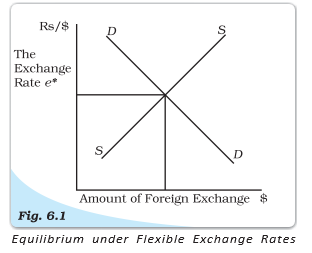
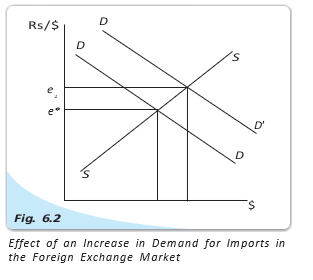
Higher Demand for Foreign Currency
- Greater demand for foreign goods or services, such as travel abroad, increases demand for foreign currency.
- The demand curve for dollars shifts right.
- The exchange rate rises from Rs. 50 to Rs. 70 per dollar.
- A dollar now costs more rupees: the rupee depreciates against the dollar, while the dollar appreciates against the rupee.
| Point | Depreciation | Appreciation |
|---|---|---|
| Meaning for the domestic currency | Its value falls relative to foreign currency. | Its value rises relative to foreign currency. |
| Rupees per dollar | Rises; more rupees are needed for one dollar. | Falls; fewer rupees are needed for one dollar. |
Speculation
Speculation — Buying or holding foreign currency in expectation of a future gain from its appreciation.
How Expectations Affect the Exchange Rate
- Investors expect the pound to rise from Rs. 80 to Rs. 85 per pound.
- They buy pounds now, expecting to sell them later for more rupees.
- For example, 1,000 pounds bought for Rs. 80,000 could later be sold for Rs. 85,000, giving an expected gain of Rs. 5,000.
- Present demand for pounds rises, increasing the current rupee price of a pound; the expectation can help make itself true.
Interest Rates and the Exchange Rate
Interest-rate differential — The difference between interest rates in two countries; it can influence short-run exchange-rate movements.
Higher Interest Rates Abroad
- Assume equally safe bonds pay 8% in country A and 10% in country B: the differential is 2 percentage points.
- Investors shift funds towards country B, buying its currency and selling country A's currency.
- Demand for A's currency falls and its supply in the foreign-exchange market rises.
- Country A's currency depreciates; country B's currency appreciates.
- General result: A rise in domestic interest rates often attracts funds and leads to appreciation of the domestic currency.
- Assumption: Investors can buy bonds issued by foreign governments without restrictions.
Income and the Exchange Rate
Rising Domestic Income
- Higher income raises consumer spending, including spending on imports.
- More imports increase demand for foreign currency.
- The domestic currency tends to depreciate.
Income Growth at Home and Abroad
- Higher foreign income: Can raise domestic exports, increasing the supply of foreign currency.
- Net effect: The domestic currency may or may not depreciate; the result depends on whether imports or exports grow faster.
- Faster domestic aggregate-demand growth: Often causes depreciation because imports tend to grow faster than exports, shifting demand for foreign currency more than its supply.
Exchange Rates in the Long Run
Purchasing Power Parity (PPP) theory — In the long run, exchange rates adjust so that the same product costs the same in different countries when prices are converted into a common currency, apart from transport-cost differences.
PPP: Assumptions and Example
- Trade conditions: PPP reasoning assumes no trade barriers such as tariffs or import quotas.
- Initial comparison: A shirt costing 8 US dollars in the US and Rs. 400 in India implies an exchange rate of Rs. 50 per US dollar.
- If the rate is Rs. 60 per dollar: The US shirt costs Rs. 480 in India, while the Indian shirt costs Rs. 400; buyers would favour the Indian shirt.
- If the rate is below Rs. 50 per dollar: The converted US price would be lower, directing shirt purchases towards the US.
- After price rises: If Indian prices rise by 20% and US prices by 50%, the shirts cost Rs. 480 and 12 US dollars. Equal prices imply 12 US dollars = Rs. 480, or Rs. 40 per dollar; the dollar has depreciated relative to the rupee.
Fixed Exchange Rates
Fixed exchange rate — An exchange rate that the government sets and maintains at a chosen level.
Maintaining a Rate Above Market Equilibrium
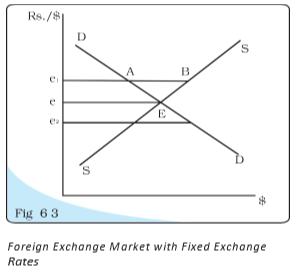
- Suppose the market rate is Rs. 50 per dollar and the government fixes a higher rate, such as Rs. 70 per dollar, to make the rupee cheaper for foreigners and encourage exports.
- At the higher rate, the supply of dollars exceeds demand.
- The RBI buys the excess dollars, supplying rupees in return, and can maintain the fixed rate through intervention.
- As long as it buys excess dollars, the RBI accumulates foreign-exchange reserves.
When the Fixed Rate Is Below Equilibrium
- Excess demand: At a rate such as , demand for dollars exceeds supply.
- Use of reserves: The government must sell dollars from its past holdings to meet that demand.
- If dollars are unavailable: Failure to meet excess demand may lead to a black market for dollars.
| Point | Devaluation | Revaluation |
|---|---|---|
| Meaning | Government raises the fixed exchange rate, making domestic currency cheaper. | Government lowers the fixed exchange rate, making domestic currency costlier. |
| Exchange-rate example | Rupees per dollar rise. | Rupees per dollar fall. |
- Depreciation
- A fall in a currency's value under a flexible exchange-rate system.
- Appreciation
- A rise in a currency's value under a flexible exchange-rate system.
- Speculation
- Holding foreign currency in expectation of a gain from future appreciation.
- Purchasing Power Parity (PPP)
- Long-run theory that exchange rates adjust to equalise prices of the same product across countries.
- Devaluation
- A government-imposed increase in the exchange rate under a fixed system, making domestic currency cheaper.
- Revaluation
- A government-imposed decrease in the exchange rate under a fixed system, making domestic currency costlier.
How does an increase in demand for foreign currency affect a flexible exchange rate?
How can higher interest rates in one country affect exchange rates?
Distinguish between depreciation and devaluation.
Quick recap
- Flexible exchange rates are determined by demand and supply; central banks do not intervene in a completely flexible system.
- More demand for foreign currency raises its domestic-currency price and depreciates the domestic currency.
- Speculation and interest-rate differences can shift currency demand and affect exchange rates.
- Rising domestic income can raise imports and demand for foreign currency; the export-import balance determines the overall effect.
- PPP predicts long-run exchange-rate adjustment to reflect differences in price levels, subject to trade and transport conditions.
- In a fixed system, the government uses foreign-exchange intervention to maintain its chosen rate.
- Devaluation raises the fixed exchange rate; revaluation lowers it.
Merits and Demerits of Flexible and Fixed Exchange Rate Systems
Fixed Exchange Rate System
Fixed exchange rate — An exchange rate between currencies kept at a specified level and adjusted only infrequently.
Credibility and speculative attacks
- Credibility: People must believe the government can maintain the exchange rate at its announced level.
- BoP deficit: The government may use official foreign exchange reserves to cover the gap.
- Risk: If reserves seem inadequate, people may doubt the government’s ability to defend the rate and expect devaluation.
- Speculative attack: Aggressive buying of a currency, driven by expected devaluation, can force the government to devalue it.
- Historical context: Fixed rates were vulnerable to speculative attacks before the collapse of the Bretton Woods System.
Flexible Exchange Rate System
Flexible (floating) exchange rate — An exchange rate determined by demand and supply in the foreign exchange market without central bank intervention.
Advantages
- Policy flexibility: The government does not have to defend a particular exchange rate.
- Lower reserve need: The country does not need to maintain large foreign exchange reserves to defend a set rate.
- Automatic BoP adjustment: Exchange-rate movements help correct balance of payments surpluses and deficits.
- Monetary independence: The country can conduct monetary policy without intervening to maintain a fixed rate.
| Point | Fixed system | Flexible system |
|---|---|---|
| How the rate is maintained | Government commits to a specified level | Market demand and supply determine the rate |
| Reserves and intervention | Reserves may be used to cover BoP gaps and defend the rate | No need to maintain large reserves to defend a set rate |
| BoP adjustment | May require government intervention | Exchange-rate movements automatically help adjust imbalances |
| Monetary policy | Intervention to maintain the rate can limit independence | Greater independence in conducting monetary policy |
Depreciation — A decrease in the domestic currency’s value under floating exchange rates; the exchange rate rises.
Devaluation — An official decrease in the domestic currency’s value under fixed or pegged exchange rates.
| Point | Depreciation | Devaluation |
|---|---|---|
| Exchange-rate system | Flexible | Fixed or pegged |
| How the currency loses value | Through market forces | Through official government action |
Managed Floating Exchange Rate System
Managed floating — A system in which market forces determine the exchange rate, but the central bank sometimes intervenes to influence it.
How managed floating works
- Shift to the system: Without a formal international agreement, the world moved towards managed floating.
- Mixed system: It combines the market-based flexibility of floating rates with intervention associated with fixed rates.
- Another name: Managed floating is also called dirty floating.
- Intervention: Central banks buy or sell foreign currencies to moderate exchange-rate movements when they consider it appropriate.
- Reserve transactions: Official reserve transactions are not equal to zero because the central bank intervenes.
What is a speculative attack on a currency?
State two advantages of a flexible exchange rate system.
Why are official reserve transactions non-zero under managed floating?
Quick recap
- A fixed exchange rate depends on confidence that the government can maintain its announced level.
- BoP deficits may drain official reserves and weaken confidence in a fixed rate.
- Expected devaluation can trigger a speculative attack that forces the government to devalue.
- Flexible rates need fewer reserves to defend a rate and help adjust BoP imbalances automatically.
- Flexible rates give countries greater independence in conducting monetary policy.
- Managed floating, also called dirty floating, combines market determination with occasional central-bank intervention.
- The world moved towards managed floating without a formal international agreement; official reserve transactions are non-zero under it.
Economics — ALL CHAPTERS
1
Indian Economy On The Eve Of Independence
2
Indian Economy 1950–1990
3
Liberalisation, Privatisation And Globalisation: An Appraisal
4
Human Capital Formation In India
5
Rural Development
6
Employment : Growth, Informalisation And Other Issues
7
Environment and Sustainable Development
8
Comparative Development Experiences of India And Its Neighbours
1
Introduction
2
National Income Accounting
3
Money and Banking
4
Determination of Income and Employment
5
Government Budget and the Economy
6
Open Economy Macroeconomics