Class 12 Commerce . Economics . Indian Economic Development . Environment and Sustainable Development
Chapter 7: Environment and Sustainable Development
Ch 7
Economics
Class 12 Commerce
Environment — Definition And Functions
Why the Environment Matters to the Economy
- Development and environment: Economic development has often come at the cost of environmental quality.
- Sustainable development: Understanding the environment’s contribution to the economy helps identify a more sustainable path.
Meaning and Components of the Environment
Environment — The environment is the totality of planetary resources and inheritance, including all biotic and abiotic factors and their interactions.
| Component | Meaning | Examples |
|---|---|---|
| Biotic | Living elements | Birds, animals, plants, forests and fisheries |
| Abiotic | Non-living elements | Air, water, land, rocks and sunlight |
Studying the Environment
- Interrelationship: Environmental study examines how biotic and abiotic components influence one another.
Functions and Carrying Capacity
Carrying capacity — The environment’s ability to sustain its functions without interruption under the demands placed on it.
Absorptive capacity — The environment’s ability to absorb waste and degradation.
| Function | Meaning or example |
|---|---|
| Supply resources | Provides renewable and non-renewable resources. |
| Assimilate waste | Absorbs waste generated by production and consumption. |
| Sustain life | Supports life through genetic and biological diversity. |
| Provide aesthetic services | Offers scenery and other aesthetic benefits. |
| Type | Meaning | Examples |
|---|---|---|
| Renewable | Can be used without being exhausted, provided the supply can continue. | Forest trees and ocean fish |
| Non-renewable | Becomes exhausted through extraction and use. | Fossil fuels |
When Environmental Carrying Capacity Is Exceeded
- Resource extraction exceeds the resource’s rate of regeneration.
- Waste generation exceeds the environment’s absorptive capacity.
- The environment can no longer perform its functions effectively.
- Its life-sustaining function is threatened, creating an environmental crisis.
Environmental Stress and Its Costs
Sources and Effects of Environmental Stress
- Population growth in developing countries and high consumption and production in developed countries raise environmental demand.
- Overuse and misuse exhaust resources, while waste exceeds the environment’s capacity to absorb it.
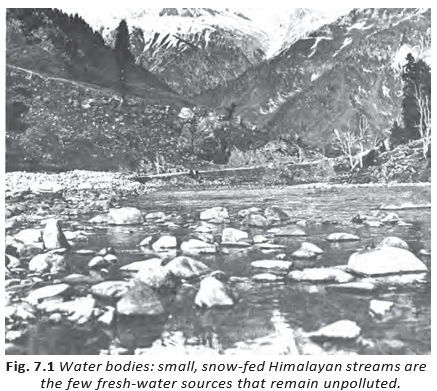
- Rivers and aquifers become polluted or dry up, making water an economic good.
- Resource depletion leads to greater spending on technology and research to find new resources.
- Degraded air and water increase respiratory and water-borne diseases, raising health costs.
Wider Economic Burden
- Water pollution: The lecture reports that 70% of India’s water is polluted.
- Global problems: Global warming and ozone depletion add to governments’ financial commitments.
- Opportunity cost: The benefits forgone because of environmental damage are high.
Global Warming
Global warming — A gradual rise in the average temperature of Earth’s lower atmosphere, largely caused in recent times by increased greenhouse gases.
Causes of Global Warming
- Burning coal and petroleum releases carbon dioxide and other greenhouse gases.
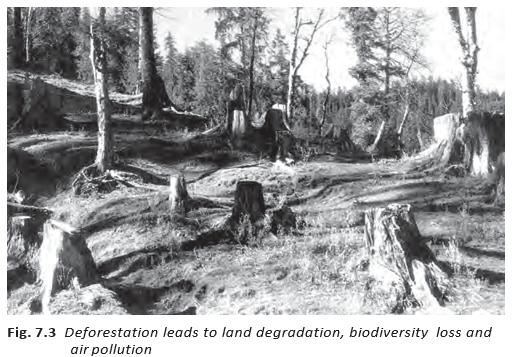
- Deforestation reduces carbon dioxide absorption and increases its atmospheric concentration.
- Animal waste releases methane; increased cattle production also contributes to deforestation and fossil-fuel use.
- Higher concentrations of heat-absorbing gases, including carbon dioxide and methane, warm Earth’s surface.
Evidence and Consequences
- Atmospheric gases: Since pre-industrial levels, carbon dioxide concentration rose by 31% and methane concentration by 149%.
- Temperature and sea level: Over the past century, atmospheric temperature rose by 1.1°F (0.6°C) and sea level rose several inches.
- Long-term impacts: Melting polar ice causes sea-level rise and coastal flooding; reduced snowmelt can disrupt drinking-water supplies.
- Ecological and health impacts: Disappearing ecological niches can cause species extinction; tropical storms and tropical diseases may become more frequent.
Global Warming: Key Dates
- Since 1750Atmospheric carbon dioxide and methane concentrations have risen above pre-industrial levels.
- 1997The Kyoto climate agreement called on industrialised nations to reduce greenhouse-gas emissions.
Ozone Depletion
Ozone depletion — A reduction in the amount of ozone in the stratosphere.
Causes and Effects of Ozone Depletion
- Chlorine and bromine compounds reach the stratosphere and reduce ozone.
- Sources include CFCs used in air-conditioners, refrigerators and aerosol propellants, and halons used in fire extinguishers.
- Other ozone-depleting chemicals include carbon tetrachloride and trichloroethane (methyl chloroform).
- Less ozone allows more harmful ultraviolet radiation to reach Earth.
- UV exposure can cause skin cancer, reduce phytoplankton production, harm aquatic organisms and affect terrestrial plant growth.
Ozone Depletion: Key Dates
- 1979–1990An approximately 5% reduction in the ozone layer was detected.
International Response
- Montreal Protocol: Adopted to ban CFCs and other ozone-depleting chemicals, including carbon tetrachloride, trichloroethane and halons.
- Importance of ozone: The ozone layer blocks most harmful wavelengths of ultraviolet light from reaching Earth.
Why Environmental Problems Became Critical
| Point | Earlier conditions | Present pressures |
|---|---|---|
| Demand and supply | Demand for environmental resources and services was below their supply. | Demand has risen while supply is limited by overuse and misuse. |
| Resource use | Extraction was below the rate of resource regeneration. | Extraction for production and consumption exceeds regeneration for some resources. |
| Waste | Pollution remained within the environment’s absorptive capacity. | Waste generation places excessive pressure on that capacity. |
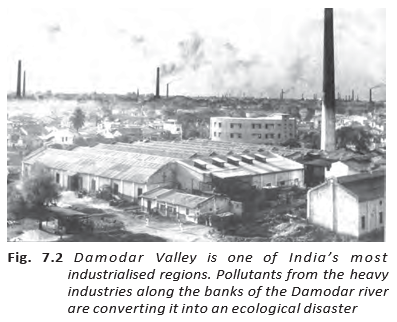
| Main context | Population was smaller and industrialisation had not expanded on the same scale. | Population growth and industrialisation have increased resource demand and pollution. |
Shift to an Environmental Crisis
- Population growth and industrialisation increase production and consumption needs.
- Demand for resources rises beyond their rates of regeneration.
- Waste and pollution increase beyond the environment’s absorptive capacity.
- Environmental resources and services become scarce, making pollution and waste critical problems.
- Biotic
- Living components of the environment.
- Abiotic
- Non-living components of the environment.
- Carrying capacity
- The level of environmental demand that can be supported without disrupting its functions.
- Absorptive capacity
- The environment’s ability to absorb waste and degradation.
- Global warming
- A gradual rise in the average temperature of Earth’s lower atmosphere.
- Ozone depletion
- A reduction in stratospheric ozone.
What are the four functions of the environment?
When does environmental stress become an environmental crisis?
What causes ozone depletion, and what are two effects?
Quick recap
- The environment includes interacting biotic and abiotic components.
- It supplies resources, assimilates waste, sustains life and provides aesthetic services.
- Environmental functions are maintained only while resource use and waste stay within carrying capacity.
- Resource depletion and pollution create economic, health and ecological costs.
- Greenhouse gases drive global warming; chlorine and bromine compounds contribute to ozone depletion.
- Population growth and industrialisation have increased environmental demand beyond regeneration and absorption limits.
State of India’s Environment
India’s Natural Resources and Environmental Priorities
| Point | Poverty-induced pressure | Affluence and industrial growth |
|---|---|---|
| Environmental threat | Degradation linked to dependence on natural resources | Pollution and environmental risks linked to consumption and industry |
| Wider issue | Pressure on land, forests and other resources | Pollution associated with expanding industries and urbanisation |
Forest Protection: Chipko and Appiko
Appiko: Community Action to Protect Forests
- Chipko Movement: The Himalayan movement aimed to protect forests; Appiko in Karnataka used the same tree-hugging idea.
- Meaning: Appiko means “to hug”; people hugged trees to stop their felling.
- Event: On 8 September 1983, 160 men, women and children hugged trees in Salkani forest, Sirsi district, to stop woodcutters.
- Vigil: Volunteers guarded the forest for six weeks and left after officials assured them that felling would follow the district working plan and be scientific.
- Impact: The protest saved 12,000 trees, and the movement spread to adjoining districts within months.
- Local safeguards sought: Consult local people before marking trees; do not fell trees within 100 metres of a water source or on slopes of 30 degrees or more.
- Community needs: Forest allocation to industries may create jobs, but must also consider the daily needs of local people who depend on forests.
Appiko Movement
- 8 September 1983People hugged trees in Salkani forest to stop felling; volunteers kept watch for six weeks.
- Within monthsAppiko spread to adjoining districts after the protest saved 12,000 trees.
Effects of Indiscriminate Tree Felling
- Trees are felled for fuelwood and industry; in Uttar Kanara, bamboo was wiped out after a paper mill was established.
- Broad-leaved trees that shielded soil from rain are removed.
- Soil washes away, leaving bare laterite and little vegetation.
- Rivers and streams dry sooner, and rainfall becomes erratic.
- Previously unfamiliar diseases and insects begin attacking crops.
Land Degradation
Pressure on Land and Forests
- Population pressure: India supports about of the world’s human population and of its livestock on only of the world’s geographical area.
- Competing land uses: Forestry, agriculture, pastures, settlements and industries all demand land, intensifying pressure on this finite resource.
- Forest land per person: India has only hectare per person, compared with a requirement of hectare to meet basic needs.
- Excess felling: Forest felling exceeds the permissible limit by about 15 million cubic metres.
Soil Erosion and Nutrient Loss
- Erosion rate: India loses about 5.3 billion tonnes of soil each year.
- Annual nutrient loss: Erosion removes about 0.8 million tonnes of nitrogen, 1.8 million tonnes of phosphorus and 26.3 million tonnes of potassium each year.
- Government estimate: The Government of India estimates total annual nutrient loss due to erosion at 5.8–8.4 million tonnes.
Pollution Control Boards
Establishment of Pollution Control Boards
- 1974The Central Pollution Control Board was set up to address water and air pollution.
Air Pollution and Industrialisation
Growth in Motor Vehicles
- 1951India had about 3 lakh motor vehicles.
- 2016Two-wheelers and cars accounted for about 85% of registered vehicles.
- 2019The number of motor vehicles had risen to about 30 crores.
Sustainable Development
State four major functions of pollution control boards.
List key causes of land degradation in India.
Why are vehicular emissions a serious urban air-pollution concern?
Quick recap
- India has diverse natural resources, but development and competing uses put pressure on finite land, forests and water.
- Environmental priorities include land degradation, biodiversity loss, urban air pollution, freshwater management and solid waste.
- The Chipko and Appiko movements used tree-hugging protests to protect forests; Appiko saved 12,000 trees and spread locally.
- Land degradation results from unsustainable extraction, poor management, resource pressure and poverty.
- Soil erosion causes large annual losses of soil and essential plant nutrients.
- The CPCB and state boards set standards, monitor pollution, inspect industries and support research and public awareness.
- Development must conserve resources and protect the environment for future generations to avoid environmental and economic crises.
Sustainable Development
Meaning and Need for Sustainable Development
Sustainable development — Development that meets present needs without compromising the ability of future generations to meet their own needs.
Core idea
- Interdependence: The economy depends on the environment, while economic activity also affects it.
- Long-term view: Development that damages the environment undermines the life-support systems on which people depend.
- Quality of life: Future generations should have the potential for an average quality of life at least as high as the present generation’s.
- International emphasis: The United Nations Conference on Environment and Development (UNCED) highlighted the concept.
Needs, Poverty and Fair Distribution
Why needs matter
- Resource distribution: Meeting everyone’s needs requires resources to be distributed more fairly; this makes sustainable development a moral issue.
- Our Common Future: The report described the aim as meeting everyone’s basic needs and giving everyone the opportunity to pursue a better life.
- Poor majority: Sustainable development particularly focuses on meeting the basic needs of the poor and reducing absolute poverty.
- Barbier’s emphasis: Edward Barbier linked sustainable development to improving poor people’s material living standards, measurable through income, education, healthcare, sanitation and water supply.
- Secure livelihoods: Development should provide lasting, reliable livelihoods while minimising resource depletion, environmental damage, cultural disruption and social instability.
- Economic growth: Agriculture, manufacturing, power and services should grow to meet needs such as employment, food, energy, water and housing.
Needs and Sustainable Livelihoods
- Fairer access to resources
- Basic needs and opportunities are extended to all, especially poor people
- Absolute poverty falls and secure livelihoods improve
- Development proceeds while limiting environmental and social harm
Responsibility to Future Generations
Intergenerational responsibility
- Brundtland Commission: Emphasised protecting the interests of future generations.
- Moral obligation: The present generation should hand over the planet in good order and bequeath a better environment to future generations.
- Quality-of-life assets: Leave the next generation a stock of quality-of-life assets no less than the stock inherited by the present generation.
| Requirement | Meaning |
|---|---|
| Conserve natural assets | Protect natural resources and environmental assets. |
| Preserve regenerative capacity | Maintain the ability of natural ecological systems to renew themselves. |
| Avoid transferring burdens | Do not impose additional costs or risks on future generations. |
Herman Daly’s Guidelines
Five requirements for sustainable development
- Population: Keep human population within the environment’s carrying capacity—the limit it can support. Like a ship’s Plimsoll line, this marks a safe load limit.
- Technology: Make technological progress input-efficient, rather than increasingly dependent on resource inputs.
- Renewable resources: Do not extract them faster than they can regenerate.
- Non-renewable resources: Do not deplete them faster than renewable substitutes can be created.
- Pollution: Correct inefficiencies caused by pollution.
| Resource type | Sustainable-use condition |
|---|---|
| Renewable | Rate of extraction must not exceed rate of regeneration. |
| Non-renewable | Rate of depletion must not exceed the rate at which renewable substitutes are created. |
Do not confuse sustainable development with stopping development: it seeks development that meets needs while conserving environmental capacity and protecting future generations.
Sustainable Development Goals
UN Sustainable Development Goals (SDGs)
- Purpose: The United Nations formulated 17 SDGs to guide sustainable development.
- Target year: The goals were intended to be achieved by 2030.
SDG Timeline
- 2015The United Nations formulated 17 Sustainable Development Goals.
- 2030Target year set for achieving the SDGs.
- Carrying capacity
- The maximum human scale or population that the environment can support.
- Regenerative capacity
- The ability of natural ecological systems to renew resources and functions.
- Absolute poverty
- Severe deprivation that sustainable development seeks to reduce, particularly among the poor.
- Intergenerational equity
- The responsibility to avoid reducing the environmental and quality-of-life assets available to future generations.
Define sustainable development.
State Herman Daly’s guidelines for sustainable development.
Why is meeting basic needs central to sustainable development?
Quick recap
- The economy and environment depend on one another; development must protect the systems that sustain life.
- Sustainable development meets present needs without limiting future generations’ ability to meet theirs.
- Fair distribution and secure livelihoods for all—especially the poor—are central to the concept.
- Development should conserve natural assets, preserve ecological regeneration and avoid passing costs or risks to the future.
- Daly’s guidelines cover population, efficient technology, sustainable resource use and pollution-related inefficiencies.
- The present generation should bequeath a better environment and no less quality-of-life assets to future generations.
- The UN formulated 17 SDGs in 2015, with 2030 as their target year.
Strategies for Sustainable Development
Non-conventional Sources of Energy
Non-conventional energy — Energy sources such as wind and solar power that can reduce dependence on conventional thermal and large hydroelectric power.
Why shift to cleaner energy?
- Thermal power: Releases carbon dioxide, a greenhouse gas, and produces fly ash that can pollute land and water if not managed properly.
- Hydroelectric projects: Can submerge forests and disrupt natural water flows in catchment areas and river basins.
- Alternatives: Wind and solar power can help meet energy needs with fewer environmental impacts.
Cleaner Fuels for Households and Transport
| Point | LPG | Gobar gas |
|---|---|---|
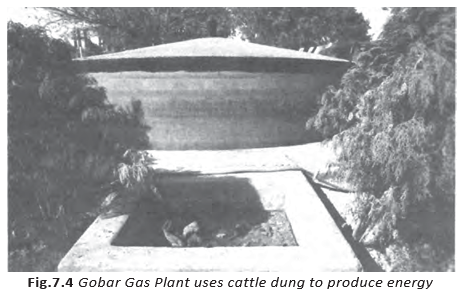
| Use | Subsidised LPG provides a cleaner household fuel. | Cattle dung is fed into a plant to produce fuel gas. |
| Environmental benefit | Reduces indoor pollution and minimises energy wastage. | Uses dung productively and reduces reliance on wood and other biomass. |
| Useful by-product | — | Leftover slurry is a good organic fertiliser and soil conditioner. |
Why replace wood and dung cakes?
- Traditional biomass fuels: Their use can contribute to deforestation, reduced green cover, wasted cattle dung and air pollution.
- Support: Subsidies for LPG and easy loans or subsidies for gobar gas plants encourage cleaner alternatives.
CNG in Urban Areas
- Compressed Natural Gas (CNG): Its use in Delhi’s public transport significantly reduced air pollution and improved air quality.
- Spread: Many other Indian cities have also adopted CNG.
Wind Power
Wind power — Electricity generated when wind turns turbines, especially in areas with consistently high wind speeds.
- Environmental impact: Wind turbines generate electricity without significant adverse effects on the environment.
- Cost: The initial investment is high, but the benefits can outweigh and absorb this cost.
Solar Power through Photovoltaic Cells
Photovoltaic cells — Cells made from special materials that capture solar energy and convert it into electricity.
- Solar resource: India receives abundant sunlight; it is already used for drying, warmth and photosynthesis.
- Remote access: Solar electricity is especially useful where grid connections are unavailable or too costly.
- Environmental benefit: Solar power generation through photovoltaic cells is pollution-free.
- National and global effort: India is working to expand solar power and leads the International Solar Alliance (ISA).
Mini-hydel Plants
Mini-hydel plant — A small-scale plant that uses flowing streams to turn turbines and generate electricity, often for local use.
How mini-hydel power works
- Perennial mountain stream flows
- Stream turns small turbines
- Turbines generate electricity for local needs
Advantages
- Local impact: They generally do not change the local land-use pattern and can meet nearby electricity demand.
- Lower transmission needs: Local generation can reduce the need for large transmission towers and cables, avoiding transmission losses.
Traditional Knowledge and Practices
- Traditional approach: Indian practices in agriculture, healthcare, housing and transport were closely connected to the environment.
- Modern shift: Moving away from these practices has contributed to environmental damage and loss of rural heritage.
- Medicinal plants: India has about 15,000 plant species with medicinal properties; around 8,000 are regularly used in different treatment systems.
- Healthcare systems: Ayurveda, Unani, Tibetan and folk traditions are again valued, including for chronic health problems.
- Herbal products: Many cosmetics use herbal ingredients; these products are generally more environment-friendly, relatively free from side effects, and involve less large-scale industrial and chemical processing.
Biocomposting
Why return to compost?
- Over-reliance on chemical fertilisers and neglect of compost
- Damage to productive land and chemical contamination of surface and groundwater
- Rising demand for irrigation
- Renewed use of organic-waste compost to improve soil sustainably
Biocomposting — The conversion of organic waste into compost that enriches soil and can act as a soil conditioner.
- Organic waste: Compost can be made from different types of organic waste; cattle dung is also valued as fertiliser and soil conditioner.
- Vermicomposting: Earthworms convert organic matter into compost faster than ordinary composting.
- Waste reduction: Composting reduces the quantity of waste that civic authorities must dispose of.
Biopest Control
Impacts of excessive chemical pesticides
- Intensive pesticide use to increase crop yields
- Pesticide residues contaminate food products
- Soil, surface water and groundwater become polluted
- Contamination can also affect milk, meat and fish
Environment-friendly pest control
- Neem: Plant-based pest-control chemicals from neem are used as alternatives to synthetic pesticides.
- Cropping practices: Mixed cropping and growing different crops on the same land in successive years help control pests.
- Natural predators: Snakes prey on rats and mice; owls, peacocks and other birds, as well as lizards, help control pests and insects.
- Conservation: Protecting these animals and birds helps maintain natural pest control around farms.
Sustainable Development: The Overall Goal
Sustainable development — A development approach that supports lasting progress and non-declining welfare for everyone.
- Core idea: It is a shift in development thinking that connects human welfare with environmental protection.
- Strategies in this lecture: Cleaner energy and fuels, traditional knowledge, organic composting and biological pest control.
- Photovoltaic cells
- Devices that convert captured solar energy into electricity.
- Mini-hydel plant
- A small plant that generates electricity from flowing water.
- Biocomposting
- Making compost from organic waste.
- Vermicomposting
- Using earthworms to speed up the conversion of organic matter into compost.
- Biopest control
- Controlling pests through plant-based products, cropping practices and natural predators.
Explain how a gobar gas plant supports sustainable development.
State two advantages of mini-hydel plants.
Quick recap
- Thermal power produces greenhouse-gas emissions and fly ash; large hydro projects can submerge forests and disrupt water flows.
- LPG, gobar gas and CNG are cleaner fuel options for households and transport.
- Wind, solar photovoltaic cells and mini-hydel plants offer alternatives with lower environmental impacts.
- Traditional knowledge and medicinal plant-based practices can support environment-friendly development; herbal products are relatively free from side effects.
- Biocomposting, especially vermicomposting, recycles organic waste and improves soil.
- Neem, crop diversity and natural predators provide alternatives to excessive chemical pesticide use.
- Sustainable development aims for lasting progress and non-declining welfare for all.
Conclusion
Development and Environmental Pressure
- Development: Economic growth raises the production of goods and services to meet the needs of a rising population.
- Environmental pressure: Increasing demand and overuse of resources have put pressure on the environment, whose supply is now limited.
Sustainable Development
- Meaning: Sustainable development meets present needs without compromising future generations’ ability to meet their own needs.
- Goal: It promotes lasting development and non-declining welfare while protecting the environment.
Environment, Development and India
| Threat | Main link |
|---|---|
| Poverty-induced degradation | Environmental damage associated with poverty. |
| Pollution from affluence and industry | Pollution associated with affluent consumption and a rapidly growing industrial sector. |
What is sustainable development?
Quick recap
- Economic development increases environmental pressure as production and resource demand rise.
- Environmental-resource demand has increased, while supply is limited by overuse and misuse.
- The environment supplies resources, assimilates wastes, sustains life and provides aesthetic services.
- Population growth, affluent consumption and production contribute to environmental stress.
- India faces both poverty-induced degradation and pollution linked to affluence and industrial growth.
- Conservation, ecosystem regeneration and protecting future generations are central to sustainable development.
Economics — ALL CHAPTERS
1
Indian Economy On The Eve Of Independence
2
Indian Economy 1950–1990
3
Liberalisation, Privatisation And Globalisation: An Appraisal
4
Human Capital Formation In India
5
Rural Development
6
Employment : Growth, Informalisation And Other Issues
7
Environment and Sustainable Development
8
Comparative Development Experiences of India And Its Neighbours
1
Introduction
2
National Income Accounting
3
Money and Banking
4
Determination of Income and Employment
5
Government Budget and the Economy
6
Open Economy Macroeconomics