Class 12 Commerce . Economics . Indian Economic Development . Liberalisation Privatisation and Globalisation an Appraisal
Chapter 3: Liberalisation, Privatisation And Globalisation: An Appraisal
Ch 3
Economics
Class 12 Commerce
Introduction
India’s Mixed Economy and Its Record
- Mixed economy: Since independence, India combined features of capitalist and socialist systems.
- Record: The approach is credited with growth in savings, industrial diversification and agricultural output, but also criticised for excessive regulation that hampered growth.
The 1991 Economic Crisis
- Crisis: In 1991, India faced an external debt crisis, soaring prices of essential goods and a severe shortage of foreign exchange.
- Urgency: Foreign exchange reserves could finance imports for less than two weeks, prompting a major change in economic policy.
Background: Causes of the Crisis
How the Crisis Developed
- High development and other expenditure, with weak revenue growth
- Persistent deficits financed through borrowing
- Rapid import growth without matching export growth, alongside inefficient spending
- Unsustainable borrowing, rising essential-goods prices and falling foreign exchange reserves
- Inability to finance imports and debt interest, with no willing lenders
The 1991 Response and the New Economic Policy
Two Groups of Economic Reforms
Background to the Reforms
- 1980sInefficient economic management contributed to the origins of the financial crisis.
- Late 1980sExpenditure exceeded revenue by unsustainable margins; prices rose, imports outpaced exports and foreign exchange reserves fell.
- 1991India faced a severe external-payment crisis, received a loan of 7 billion dollars and announced the New Economic Policy.
- External debt
- Money borrowed from lenders outside the country that must be repaid.
- Balance of payments
- A country’s record of economic transactions with the rest of the world.
- Stabilisation measures
- Short-term reforms to address balance-of-payments weaknesses and inflation.
- Structural reforms
- Long-term reforms intended to improve efficiency and international competitiveness.
What were the main causes of India’s 1991 economic crisis?
How did stabilisation measures differ from structural reforms?
Quick recap
- India adopted a mixed economy after independence; scholars differ on its economic record.
- The 1991 crisis involved external-debt difficulties, rapidly falling reserves and rising essential-goods prices.
- Weak revenue, high expenditure, inefficient spending and imports outpacing exports contributed to the crisis.
- India received a loan of 7 billion dollars from the World Bank and IMF and accepted conditions to open the economy.
- The 1991 NEP aimed to increase competition and remove barriers to firms’ entry and growth.
- Reforms were grouped into short-term stabilisation measures and long-term structural reforms.
Liberalization
Liberalisation — The removal or easing of government restrictions on economic activities to open up sectors and support growth.
Background and scope
- Reason: Rules intended to regulate economic activity had become obstacles to growth and development.
- Early measures: Some liberalisation steps were taken in the 1980s in industrial licensing, trade policy, technology, fiscal policy and foreign investment.
- 1991 reforms: Reforms initiated in 1991 were more comprehensive and focused on industry, finance, taxation, foreign exchange, trade and investment.
Deregulation of the Industrial Sector
| Area | Earlier control | Reform after 1991 |
|---|---|---|
| Industrial licensing | Permission was needed to start or close a firm and decide its output. | Licensing was abolished for almost all industries, with specified exceptions. |
| Public and private sectors | Private firms were barred from many industries. | Only part of atomic energy generation and some core railway activities remain reserved for the public sector. |
| Small-scale industries | Some goods could be produced only by small-scale units. | Many goods were dereserved, allowing larger firms to produce them. |
| Prices and distribution | Government controlled prices and distribution of selected industrial products. | Market forces determine prices in most industries. |
Industries still requiring licensing
- Exceptions: Alcohol, cigarettes, hazardous chemicals, industrial explosives, electronics, aerospace, and drugs and pharmaceuticals.
Financial Sector Reforms
Financial sector — The sector comprising financial institutions and markets, including commercial and investment banks, stock exchanges and foreign exchange markets.
Role of the RBI and reform direction
- Regulator: The Reserve Bank of India (RBI) regulates banks and other financial institutions.
- RBI controls: It sets norms such as how much money banks retain, interest rates and lending to different sectors.
- Reform aim: Shift the RBI’s role from regulator towards facilitator, giving financial institutions greater freedom to decide matters without prior consultation.
- Safeguard: The RBI retains certain managerial controls to protect account-holders and the nation.
Key financial reforms
- Bank ownership: Private-sector banks, both Indian and foreign, were established.
- Foreign investment: The limit on foreign investment in banks was raised to around 74%.
- Branch decisions: Banks meeting specified conditions can open branches without RBI approval and rationalise existing branch networks.
- Funding: Banks were permitted to raise resources from India and abroad.
- Market investors: Foreign Institutional Investors (FIIs), such as merchant bankers, mutual funds and pension funds, can invest in Indian financial markets.
Tax Reforms
Fiscal policy — The government’s taxation and public expenditure policies, which are addressed by tax reforms.
| Point | Direct taxes | Indirect taxes |
|---|---|---|
| Levied on | Incomes of individuals and profits of business enterprises. | Commodities and goods. |
| Reform direction | Individual income-tax rates and corporation-tax rates were gradually reduced. | Reforms aimed to support a common national market for goods and commodities. |
Tax-reform goals and GST
- Lower direct taxes: High income-tax rates were considered a cause of tax evasion; moderate rates can encourage saving and voluntary disclosure of income.
- Simplification: Tax procedures were simplified and rates substantially lowered to improve compliance.
- GST framework: A constitutional amendment in 2016 empowered the Union and State Governments to make laws imposing Goods and Services Tax (GST).
- Expected GST effects: Generate additional government revenue, reduce tax evasion and support “one nation, one tax and one market.”
Foreign Exchange Reforms
Exchange-rate reforms
- 1991 balance-of-payments crisis led to the immediate devaluation of the rupee against foreign currencies.
- Devaluation increased the inflow of foreign exchange.
- Reform direction moved exchange-rate determination away from direct government control.
- Market-based rates are now generally determined by the demand and supply of foreign exchange.
Trade and Investment Policy Reforms
Aims and earlier trade controls
- Aims: Increase international competitiveness, foreign investment and technology inflows; improve local-industry efficiency and encourage modern technology.
- Earlier protection: Quantitative restrictions on imports, tight import controls and high tariffs were used to protect domestic industries.
- Effect of controls: These policies reduced efficiency and competitiveness, contributing to slow manufacturing growth.
| Reform | What changed |
|---|---|
| Quantitative restrictions | Restrictions on imports and exports were dismantled. |
| Tariffs | Tariff rates were reduced. |
| Import licensing | Licensing was removed except for hazardous and environmentally sensitive industries. |
| Import restrictions | Restrictions on manufactured consumer goods and agricultural-product imports were fully removed from April 2001. |
| Export duties | Export duties were removed to improve the international competitiveness of Indian goods. |
What was the main purpose of financial sector reforms?
How did tax reforms seek to improve tax compliance?
State three major trade policy reforms.
Quick recap
- Liberalisation eases government restrictions to open sectors and support economic growth.
- Industrial reforms largely ended licensing, public-sector reservations, small-scale reservations and administered prices.
- Financial reforms increased private and foreign participation while shifting the RBI towards a facilitator role.
- Tax reforms reduced and simplified taxes; GST was enabled by a 2016 constitutional amendment.
- The rupee was devalued in 1991, and exchange rates are generally shaped by foreign-exchange demand and supply.
- Trade reforms reduced tariffs and licensing and dismantled quantitative import and export restrictions.
Privatization
Meaning and Methods of Privatisation
- Privatisation: The government transfers ownership or management of a government-owned enterprise to the private sector.
- Methods: It can occur through government withdrawal from ownership and management, or through the outright sale of a public sector company.
Disinvestment and Its Aims
- Disinvestment: The government sells part of its equity in a public sector enterprise to the public.
- Aims: It was intended to improve financial discipline and modernisation by making private capital and managerial capabilities available to public enterprises.
Autonomy and Public Enterprise Status
- Special status: The government designates selected public enterprises as Maharatnas, Navratnas or Miniratnas.
- Autonomy: These enterprises receive greater operational, financial and managerial freedom to make decisions and run their businesses.
Purpose of PSEs and Debate over Disinvestment
- PSE
- Public sector enterprise; an enterprise owned or controlled by the government.
- Disinvestment
- Sale of part of a public sector enterprise’s equity to the public.
- FDI
- Foreign direct investment.
- Managerial autonomy
- Freedom for an enterprise to make operational, financial and management decisions.
What is privatisation, and what is disinvestment?
Why did the government grant selected PSEs greater autonomy?
What criticism do some scholars make of disinvestment, and what later policy did the government adopt?
Quick recap
- Privatisation transfers government ownership or management to the private sector through withdrawal or outright sale.
- Disinvestment means selling part of a PSE’s equity to the public.
- Disinvestment was intended to promote financial discipline and modernisation; private capital and management were expected to improve performance.
- The government expected privatisation to encourage FDI inflows.
- Maharatna, Navratna and Miniratna status gives selected PSEs greater autonomy.
- PSEs were established to support self-reliance, infrastructure, employment and affordable quality products.
- Some scholars criticised disinvestment; the government later chose to retain PSEs in the public sector and support their expansion.
Globalization
Meaning of Globalisation
Globalisation — The process of integrating a country’s economy with the world economy and increasing interdependence across economic, social and geographical boundaries.
- Interdependence: Events in one country can affect people and economic activity far away.
- Borderless world: Globalisation creates networks and links that cross national boundaries.
- Scope: It involves more than trade; it connects economic, social and geographical activity.
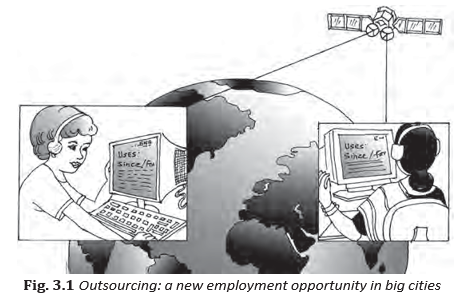
Outsourcing
Outsourcing — When a company obtains services from an external provider, often in another country, instead of providing them within the company.
Why outsourcing to India has grown
- Technology: Fast communication and information technology make it possible to transfer digitised text, voice and visual data across borders in real time.
- Cost and skills: Low wage rates and skilled workers in India offer companies services at lower cost with reasonable skill and accuracy.
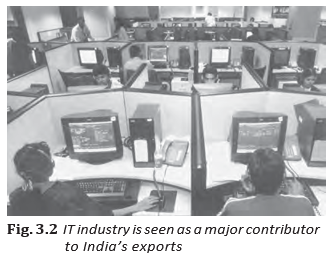
- Common services: Call centres/BPO, record keeping, accountancy, banking, music recording, film editing, book transcription, clinical advice and teaching.
- Typical pattern: Companies in developed countries contract services to providers in India; multinational and smaller firms both do this.
How outsourcing works
- A company contracts an external service provider.
- The service is performed in another location, often in a different country.
- Telecommunications and the Internet transmit the digital work between countries.
World Trade Organisation (WTO)
World Trade Organisation (WTO) — The global organisation established to administer trade rules and agreements among member countries.
Formation of global trade institutions
- 1948The General Agreement on Tariffs and Trade (GATT) was established with 23 countries.
- 1995The WTO was founded as the successor organisation to GATT.
WTO’s role and aims
- Rule-based trade: Aims to prevent nations from imposing arbitrary trade restrictions and to provide equal trading opportunities.
- Broader trade: Covers goods and services and supports bilateral and multilateral international trade.
- Market access: WTO agreements seek to reduce tariff and non-tariff barriers and widen access to markets.
- Other aims: Expand production and trade in services, use world resources optimally and protect the environment.
India and the WTO
- Role: India has advocated fair global rules, regulations and safeguards, including the interests of developing countries.
- Commitments: India has liberalised trade by removing quantitative restrictions on imports and reducing tariff rates.
| View | Main point |
|---|---|
| Stated aim | Trade rules and market access should apply fairly across member countries. |
| Scholars’ criticism | Much international trade occurs among developed nations; developing countries may have to open markets while facing restricted access to developed-country markets. |
| Agricultural trade concern | Developing countries argue that they are disadvantaged when developed countries maintain agricultural subsidies while challenging subsidies in developing countries. |
GDP Growth and Major Sectors
| Sector | 1980–91 | 1992–2001 | 2002–07 | 2007–12 | 2012–13 | 2013–14 | 2014–15 |
|---|---|---|---|---|---|---|---|
| Agriculture | 3.6 | 3.3 | 2.3 | 3.2 | 1.5 | 4.2 | −0.2* |
| Industry | 7.1 | 6.5 | 9.4 | 7.4 | 3.6 | 5 | 7.0* |
| Services | 6.7 | 8.2 | 7.8 | 10 | 8.1 | 7.8 | 9.8* |
| Total | 5.6 | 6.4 | 7.8 | 8.2 | 5.6 | 6.6 | 7.4 |
- Reading the data: Services recorded the highest growth among the three sectors in 2007–12 and in each of 2012–13, 2013–14 and 2014–15.
- Note: Asterisked figures for 2014–15 are Gross Value Added (GVA) figures. GVA is estimated from GDP by adding production subsidies and subtracting indirect taxes.
- Source: Economic Survey, various years, Ministry of Finance, Government of India.
Global Expansion of Indian Companies
| Company | Global presence |
|---|---|
| ONGC Videsh | ONGC’s subsidiary for oil and gas exploration and production; projects in 16 countries. |
| Tata Steel | Established in 1907; among the world’s top ten steel companies; operates in 26 countries and sells in 50; employs nearly 50,000 people abroad. |
| HCL Technologies | One of India’s top five IT companies; offices in 31 countries and about 15,000 employees abroad. |
| Dr Reddy’s Laboratories | Grew from a small supplier to Indian companies into a global business with manufacturing plants and research centres across the world. |
- Globalisation
- Increasing integration and interdependence among countries.
- Outsourcing
- Contracting services to an external provider, often abroad.
- Tariff barrier
- A trade restriction imposed through duties on imports.
- Non-tariff barrier
- A trade restriction other than an import duty.
- GVA
- Gross Value Added; here, estimated from GDP by adding production subsidies and subtracting indirect taxes.
Why has India become an important destination for outsourcing?
State the main aims of the WTO.
Quick recap
- Globalisation links national economies and societies, creating greater worldwide interdependence.
- Outsourcing shifts services to external providers; India benefits from skilled labour, lower wages and modern communications.
- The WTO succeeded GATT in 1995 and promotes rule-based trade and wider market access.
- India has reduced import restrictions and tariffs while advocating for developing countries’ interests.
- Critics argue that WTO trade rules and market access may operate unevenly between developed and developing countries.
- Indian companies, including ONGC Videsh, Tata Steel, HCL Technologies and Dr Reddy’s, have expanded internationally.
Indian Economy During Reforms: An Assessment
Economic Growth and Sectoral Performance
Economic growth — Economic growth is measured by the growth of Gross Domestic Product (GDP).
GDP and Sectoral Performance
- Overall growth: After 1991, GDP grew rapidly and continually for two decades.
- GDP growth rate: It rose from 5.6% during 1980–91 to 8.2% during 2007–12.
- Agriculture: Growth declined during the reform period; after high growth in 2013–14, it turned negative in the following year.
- Industry: Growth fluctuated and fell steeply in 2012–13, then returned to positive growth in subsequent years.
- Services: Growth increased and became the main driver of GDP growth. In 2014–15, it grew by 9.8%, faster than overall GDP.
- 2012–15 setback: The growth rates of different sectors slowed compared with the post-1991 performance.
Openness, Investment and External Performance
- Foreign investment: The opening of the economy led to a rapid rise in foreign direct investment (FDI) and foreign institutional investment (FII).
- Foreign exchange reserves: Reserves increased substantially, making India one of the world's largest reserve holders.
- Exports: Since 1991, India has become a successful exporter of auto parts, pharmaceutical goods, engineering goods, IT software and textiles.
- Prices: Rising prices have also been kept under control.
Foreign Investment and Reserves
- 1990–91Foreign investment was about US6 billion.
- 2017–18Foreign investment, including FDI and FII, reached about US30 billion.
- 2018–19Foreign exchange reserves reached about US413 billion.
Concerns About Reform Outcomes
- Unresolved challenges: Reforms have been criticised for not adequately addressing employment, agriculture, industry, infrastructure development and fiscal management.
- Employment: Despite higher GDP growth, reform-led growth has not generated sufficient employment opportunities.
Reforms in Agriculture
- Public investment: Since 1991, public investment in agriculture—especially infrastructure—has fallen. Infrastructure includes irrigation, power, roads, market linkages, research and extension.
- Green Revolution support: These forms of public investment had played a crucial role in the Green Revolution.
- Input costs: Partial removal of the fertiliser subsidy raised production costs, severely affecting small and marginal farmers.
- Policy changes: Lower import duties, low minimum support prices and the lifting of quantitative restrictions on agricultural imports exposed Indian farmers to greater international competition.
- Production shift: Export-oriented policies encouraged cash crops for export over food grains for the domestic market, putting pressure on food-grain prices.
Effects of Agricultural Reforms
- Lower public investment in agricultural infrastructure → reduced support for production and market links.
- Partial removal of the fertiliser subsidy → higher production costs → a greater burden on small and marginal farmers.
- Lower import duties and removal of quantitative restrictions → greater international competition for Indian farmers.
- Export-oriented policies → shift towards cash crops and away from domestic food-grain production → pressure on food-grain prices.
- FDI
- Foreign direct investment: investment made in a country by foreign entities.
- FII
- Foreign institutional investment: investment by foreign financial institutions.
- Foreign exchange reserves
- Foreign-currency assets held by a country's monetary authorities.
- Quantitative restrictions
- Limits on the quantity or volume of goods that may be imported.
State two positive outcomes of the reform period and two major criticisms.
How did reform-related policy changes affect Indian agriculture?
Quick recap
- GDP grew rapidly and continually for two decades after 1991; growth rose from 5.6% in 1980–91 to 8.2% in 2007–12.
- Services became the main driver of GDP growth, while agriculture slowed and industrial growth fluctuated.
- Foreign investment and foreign exchange reserves increased greatly after the economy opened.
- India became a successful exporter of auto parts, pharmaceuticals, engineering goods, IT software and textiles; rising prices were kept under control.
- Reforms were criticised for insufficient employment generation and for leaving key development challenges unresolved.
- Agriculture faced lower public investment, higher input costs and increased international competition.
- Export-oriented production favoured cash crops over food grains, putting pressure on food-grain prices.
Reforms in Industry
Industrial Growth and Global Competition
Industrial slowdown — A period of slower industrial growth, often linked to reduced demand and inadequate investment.
Main pressures on industry
- Cheaper imports replaced demand for some domestic products and increased competition for Indian manufacturers.
- Weak infrastructure investment, including inadequate power supply, restricted industrial production.
- Globalisation increased the movement of foreign goods and services, potentially putting local industries and employment in developing countries under pressure.
- Unequal market access can occur when developing countries open their markets but face non-tariff barriers in developed countries.
| India | United States |
|---|---|
| Removed all quota restrictions on its textile and clothing exports. | Retained quota restrictions on textile imports from India and China. |
Disinvestment in Public Sector Enterprises
Disinvestment — The government sells part of its ownership in public sector enterprises (PSEs) to raise funds.
Disinvestment targets and achievements
- 1991–92The target was Rs. 2,500 crore; the government raised Rs. 3,040 crore, exceeding the target.
- 2017–18The target was about Rs. 1,00,000 crore and achievement was about Rs. 1,00,057 crore.
Concerns about disinvestment
- Undervaluation: Critics argue that PSE assets were sold to private buyers below their value, causing a loss to the government.
- Use of proceeds: Disinvestment revenue was used to cover government revenue shortfalls rather than develop PSEs or build social infrastructure.
- Efficiency debate: Selling government assets does not by itself ensure that the enterprises become more efficient.
Reforms and Fiscal Policy
How reforms affected public revenue and spending
- Tax reductions were intended to increase revenue and curb tax evasion, but did not increase government tax revenue.
- Lower tariffs reduced the scope for raising revenue through customs duties.
- Tax incentives for foreign investors further narrowed the scope for tax revenue.
- Reduced revenue and limits on public expenditure constrained developmental and welfare spending, especially in social sectors.
Globalisation: Benefits and Criticisms
| Point | Supporters | Critics |
|---|---|---|
| Opportunity and markets | It offers access to global markets and advanced technology, and may help large firms in developing countries become international players. | It can be a strategy for developed countries to expand their markets in other countries. |
| Effects on people and countries | Greater integration can create new economic opportunities. | It may weaken the welfare and identity of people in poorer countries and widen economic disparities among nations and people. |
Findings in the Indian context
- Inequality: Some studies link the crisis of the early 1990s to deep-rooted inequalities and argue that reforms, based on an externally advised policy package, aggravated them.
- Uneven gains: Income and consumption gains were concentrated among high-income groups.
- Sectoral concentration: Growth was concentrated in selected services—telecommunications, IT, finance, entertainment, travel and hospitality, real estate, and trade—rather than agriculture and industry, which support millions of livelihoods.
The Sircilla Powerloom Tragedy
Power reforms and weavers’ livelihoods
- Power-sector reforms in some states ended subsidised electricity and sharply raised tariffs.
- Higher power costs and power cuts increased pressure on small powerloom industries.
- Workers’ wages depended on how much cloth they produced, so power cuts reduced production and wages.
- The livelihood crisis in Sircilla, Andhra Pradesh, culminated in 50 powerloom workers committing suicide.
Wider Context of the 1991 Reforms
- Globalisation
- Integration of a country’s economy with the world economy; it grew through liberalisation and privatisation policies.
- Outsourcing
- A growing activity in both industrial and service sectors.
- World Trade Organization (WTO)
- Its objective is to establish a rules-based trade regime for optimum use of world resources.
- Disinvestment
- Sale of part of the government’s ownership in PSEs.
Crisis and reform measures
- 1991 crisis: Declining foreign exchange, rising imports without matching export growth, and high inflation prompted policy change; pressure also came from the World Bank and IMF.
- Domestic reforms: Major changes were made in the industrial and financial sectors, alongside a reduced public-sector role through disinvestment and greater private-sector participation.
- External reforms: These included foreign-exchange deregulation and import liberalisation.
Quick recap
- The 1991 crisis involved declining foreign exchange, imports rising faster than exports, and high inflation; World Bank and IMF pressure also shaped the policy shift.
- Reforms covered domestic industry and finance, disinvestment and private-sector participation, plus external-sector foreign-exchange deregulation and import liberalisation.
- Disinvestment targets were met or exceeded in 1991–92 and 2017–18, but critics cite asset undervaluation and the use of proceeds to cover revenue shortfalls.
- Tax cuts did not raise tax revenue as intended; lower customs duties and investor incentives also narrowed revenue, limiting development and welfare spending.
- Globalisation integrates a country’s economy with the world economy; supporters emphasise market and technology access, while critics warn of inequality and harms to poorer groups.
- Outsourcing is growing in industry and services, and the WTO seeks a rules-based trade regime for optimum use of world resources.
- Reforms have not benefited agriculture; public investment in agriculture declined, while growth slowed in agriculture and industry and rose in services. Industrial growth was also held back by cheaper imports and inadequate infrastructure.
Economics — ALL CHAPTERS
1
Indian Economy On The Eve Of Independence
2
Indian Economy 1950–1990
3
Liberalisation, Privatisation And Globalisation: An Appraisal
4
Human Capital Formation In India
5
Rural Development
6
Employment : Growth, Informalisation And Other Issues
7
Environment and Sustainable Development
8
Comparative Development Experiences of India And Its Neighbours
1
Introduction
2
National Income Accounting
3
Money and Banking
4
Determination of Income and Employment
5
Government Budget and the Economy
6
Open Economy Macroeconomics