SOLUTIONS
2022 BOARD EXAM
CBSE Class 12 Humanities Economics Board Paper 2022 — Set 1 Solutions
2022
Economics
Class 12 Humanities
CBSE EXAMINATION PAPER-2022
ECONOMICS
(Solved)
General Instructions :
Read the following instructions carefully and follow them :
- This question paper contains 17 questions. All questions are compulsory.
- This question paper is divided into 4 sections.
- Section A – questions number 1 to 1 are case based questions
- Section B – questions number 2 to 9 are short answer type i
- Section C – questions number 10 to 13 are short answer type ii
- Section D – questions number 14 to 17 are long answer
- There is no overall choice given in the question paper. However, an internal choice has been provided in few questions.
- Use of calculator is NOT allowed.
Section A
Read the following test carefully and answer, Q. No.-12 and 13, given below:
Chinese Economy Risks Deeper Slowdown than Markets Realise (Bloomberg, 24th October, 2021)
China's Economy risks slowdown faster than global investors realise. It is pushing to cut its dependence on real-estate. It has started regulating sectors from education to technology, as it is facing power shortage and the pandemic.
Many economists have warned that the GDP growth rate will fall to 8.2% this year and to below 5% in the next year.
China is now planning to stabilise debt growth, curb inequality and channelise resources into hi-tech manufacturing. Data released in last week already showed a sharp slowdown in third quarter GDP growth to 4.9% from 7.9% in the previous quarter. There is more pain likely to come as electricity shortage persist, while new COVID-19 infections are expected to rise in coming days.
Even before the pandemic hit, China was surprising economists with slower-than-expected growth rate caused by the easing off debt risks. China's Premier Li Keqiang, announced in March a growth target of "above 6%" in the coming financial year.
China has signalled, in recent weeks that it could loosen some policies like telling banks to pick up the pace of mortgage lending as a short term stimulus. Governor of People's Bank of China Yi Gang, recently said he sees an expansion of about 8% for this year.
China's slowdown comes as the global recovery from COVID-19 risks looses momentum. Among those at risks from falling investments in China are commodity exporters like Australia, South Africa, Chile, Peru and Brazil. Slower trades could also hit countries like Malaysia, Singapore and Thailand.
The other risk is that China's policy-makers may struggle to flick the switch back to growth model if they feel that's needed. Economists noted that the electricity shortages that are crimping industrial production will make it harder to cushion growth by boosting investment in infrastructure. That kind of policy could only work next year once the power crunch eases.
(1) Discuss briefly any two measures, which you may suggest as an economic advisor to the government of China.
(2) State and discuss any two reasons that exhibit slowdown in the Chinese economy.
Section B
Using a suitable example, distinguish between positive externalities and negative externalities.
(a) Positive Externalities: These are benefits enjoyed by third parties due to an economic activity. For example, if a person plants trees in a locality, it improves air quality and provides aesthetic value to others. This is a positive externality because others get benefits without paying for it.
(b) Negative Externalities: These are costs imposed on third parties due to an economic activity. For instance, a factory releasing pollution into the air harms the health of nearby residents. This is a negative externality as others suffer harm without being compensated.
In summary, positive externalities bring unpriced benefits to others, while negative externalities impose unpriced costs to others.
Using a suitable example, distinguish between stock variables and flow variables.
Flow Variables: Flow variables are measured over a period of time. They represent quantities that occur or are measured within a time interval. For example, the amount of water flowing into the tank per minute from a tap is a flow variable.
In the example of a tank being filled with water, the water present in the tank at a particular time is the stock, whereas the rate at which water is coming in per minute is the flow. Thus, stock variables tell us the quantity at a point in time, and flow variables tell us how much quantity changes over time.
Justify the following statement with valid argument:
'At higher levels of income people generally have lower Marginal Propensity to Consume (MPC).
State any two harmful effects of Global warming.
1. Melting of polar ice caps leading to a rise in sea levels, which causes floods and loss of habitat for many species.
2. Increase in the frequency and intensity of tropical storms and extreme weather events causing damage to life and property.
State any two advantages of 'sustainable development'.
1. It helps conserve natural resources for future generations by promoting the responsible use and management of resources.
2. It minimises environmental problems like pollution and deforestation, ensuring a healthier and balanced ecosystem for both present and future generations.
Calculate equilibrium level of income for a hypothetical economy, for which it is given that:
(i) Autonomous Investments (I) = 2,500 crores, and
(ii) Consumption Function; C = 1000 +0.8Y
where C= Consumption and Y = Income
Given:
(i) I = 2,500 crores
(ii) Consumption function C = 1000 + 0.8Y
Aggregate Demand, AD = C + I = 1000 + 0.8Y + 2500 = 3500 + 0.8Y
At equilibrium, Y = AD, so:
Y = 3500 + 0.8Y
Subtract 0.8Y from both sides:
Y - 0.8Y = 3500
0.2Y = 3500
Divide both sides by 0.2:
Y = 3500 / 0.2 = 17500 crores
Therefore, the equilibrium level of income is 17,500 crores.
Calculate, change in Income (△Y) for a hypothetical economy, for which it is given that:
(i) Marginal Propensity to Consume (MPC) = 0.75, and
(ii) Change in Investments (△I) = 20,000 crores.
MPC (m) = 0.75
Change in Investment (△I) = 20,000 crores
Formula to find change in income (△Y):
△Y = 1 / (1 - MPC) * △I
Substituting the values,
△Y = 1 / (1 - 0.75) * 20,000
△Y = 1 / 0.25 * 20,000
△Y = 4 * 20,000 = 80,000 crores
Explanation:
The change in income is calculated using the investment multiplier formula where the multiplier = 1 / (1 - MPC). This formula shows that when investment increases by 20,000 crores and MPC is 0.75, the income increases by 80,000 crores. Hence, the change in income (△Y) is 80,000 crores.
In any country, as the income rises the composition of infrastructure requirements changes significantly.'
Do you agree with the given statement? Support your answer with suitable argument.
When income is low, basic infrastructure needs such as roads, electricity, water supply, and sanitation are prioritized to support fundamental living conditions and agricultural activities. As income rises, the demand shifts towards more advanced infrastructure such as educational institutions, healthcare facilities, advanced transport systems, banking, marketing, and communication networks. This is because higher income creates higher expectations for quality of life and supports growth in the industrial and service sectors. Also, improvement in infrastructure leads to higher human capital development, which in turn contributes to further income growth. Thus, there is a dynamic relationship where rising income changes the type and quality of infrastructure required for sustained economic growth and development.
Section C
Estimate the value of Nominal Gross Domestic Product (GDP) for a hypothetical economy. The values of Real Gross Domestic Product (GDP) and Price Index are given as₹ 500 crores and 125 respectively.
Formula: Nominal GDP = (Real GDP * Price Index) / 100.
Substituting the values:
Nominal GDP = (500 * 125) / 100 = ₹ 625 crores.
Explanation: Nominal GDP is the value of goods and services at current prices. Since the Price Index is 125, prices have increased by 25% compared to the base year. By adjusting Real GDP with the Price Index, we estimate the Nominal GDP. Hence, the Nominal GDP of the hypothetical economy is ₹ 625 crores.
Giving valid reasons explain, which of the following will not be included in the estimation of National Income of India?
(i) Purchase of shares of Sethi Ltd. by an investor in the Bombay Stock Exchange.
(ii) Salaries paid by Indian Embassy situated at Japan, to the local workers.
(iii) Depreciation on capital assets charged by firms.
(b) Salaries paid by the Indian Embassy in Japan to local workers are part of income generated by India abroad and are included in National Income as factor income from abroad.
(c) Depreciation is a cost of using capital goods but does not represent a new production of goods or services, so depreciation is excluded from National Income but included in Gross Domestic Product (GDP) to calculate Net Domestic Product (NDP).
Compare and analyse the health status of India and Sri Lanka, on the basis of any two indicators from the given schedule:
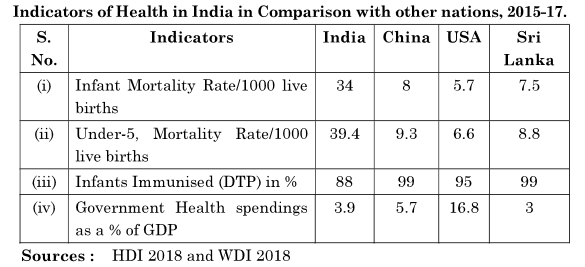
To compare the health status of India and Sri Lanka, we will consider two important indicators: Life Expectancy at Birth and Infant Mortality Rate.
1. Life Expectancy at Birth: Life expectancy indicates the average number of years a person is expected to live. According to recent data, Sri Lanka has a higher life expectancy compared to India. This suggests that healthcare services, nutrition, sanitation, and overall living conditions in Sri Lanka are relatively better, allowing people to live longer.
2. Infant Mortality Rate (IMR): IMR is the number of infant deaths per 1000 live births. A lower IMR is a positive sign of good health infrastructure and care for children. Sri Lanka has a significantly lower infant mortality rate than India, indicating better maternal and child health care systems.
Analysis:
Both indicators show that Sri Lanka has a better health status as compared to India. Sri Lanka's success can be attributed to its effective healthcare policies and focus on public health. However, India has improved over the years but still faces challenges in healthcare accessibility and quality.
In conclusion, while India is progressing, Sri Lanka currently enjoys better health outcomes based on these two indicators.
Using a hypothetical example, elaborate the working of investment multiplier in an economy.
The investment multiplier shows how an initial increase in autonomous investment causes a greater total increase in national income. Suppose the marginal propensity to consume (mpc) is 0.8 and the government decides to invest 100 crores.
Initial investment = 100 crores
First round: People consume 80 crores (100 * 0.8) and save 20 crores.
Second round: From the 80 crores consumed, 80% will be spent again = 64 crores.
Third round: From 64 crores, again 80% will be spent = 51.2 crores.
This process continues, increasing total output beyond the initial investment.
The multiplier formula is 1 / (1 - mpc) = 1 / (1 - 0.8) = 5.
Total increase in income = Investment * multiplier = 100 * 5 = 500 crores.
Therefore, an initial investment of 100 crores raises the total income by 500 crores, showing the multiplier effect in an economy.
Section D
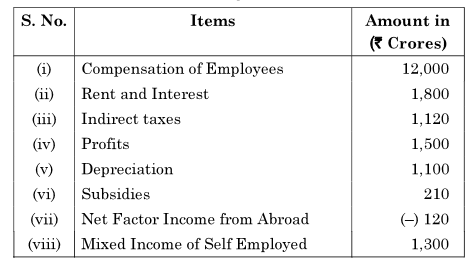
(i) From the following data, calculate the value of Gross National Product at Factor Cost (GNPFC):
(ii) Distinguish between Rent and Royalty.
(ii) The difference between Rent and Royalty is as follows:
Rent: Rent is the income earned by the owner of land or property for its use. It is fixed or agreed amount paid periodically for the use of land, building or other fixed assets.
Royalty: Royalty is the payment made to the owner for the use of natural resources, patents, copyrights or trademarks. It is usually a percentage of output or sales and depends on the usage of the resource or intellectual property.
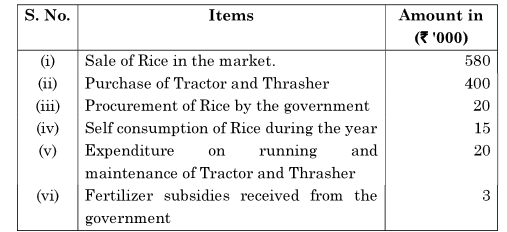
(i) Calculate the value of 'Net Value Added at Factor Cost' (NVAFc) using the given data:
(ii) Distinguish between ‘value of output’ and ‘value addition’.
India has been dealing with the problem of Deficient Demand, since the imposition of Covid lockdown in March 2020'.
State and discuss any two monetary policy measures to combat the situation of Deficient Demand in India.
(a) Reduction in Repo Rate: The RBI reduced the repo rate, which is the rate at which banks borrow money from the central bank. A lower repo rate reduces the cost of borrowing for banks, which in turn reduces interest rates for businesses and consumers. This encourages more borrowing and spending, thereby increasing demand in the economy.
(b) Reduction in Cash Reserve Ratio (CRR): The RBI lowered the CRR, which is the percentage of total deposits that banks must keep as reserves with the RBI. Lower CRR means banks have more funds to lend, increasing liquidity in the market. This helps in boosting investment and consumption, supporting higher demand.
These monetary policy interventions aimed to increase money supply, reduce borrowing costs and stimulate economic activity to counter the deficient demand caused by the pandemic related lockdowns.
(i) In the recent past the Government of India has taken vital steps to revive and popularise Indian System of Medicine (ISM).
Do you agree with the given statement? Justify your answer with valid reasons.
(ii) 'Casualization of workforce has became a perennial problem of the Indian economy. Justify the given statement with valid arguments.
Paper Details
CBSE Board Exam 2022
Class
Class 12 Humanities
Subject
Economics
Year
2022
Set
Set 1
Other Years — Economics