QUESTION PAPER
2024 BOARD EXAM
CBSE Class 12 Humanities Economics Board Paper 2024 — Set 1
2024
Economics
Class 12 Humanities
CBSE EXAMINATION PAPER-2024
ECONOMICS
(Solved)
General Instructions :
Read the following instructions carefully and follow them :
- This question paper contains 41 questions. All questions are compulsory.
- This question paper is divided into 5 sections.
- Section A – questions number 1 to 2 are case based questions
- Section B – questions number 3 to 22 are multiple choice questions
- Section C – questions number 23 to 28 are short answer type i
- Section D – questions number 29 to 36 are short answer type ii
- Section E – questions number 37 to 41 are long answer
- There is no overall choice given in the question paper. However, an internal choice has been provided in few questions.
- Use of calculator is NOT allowed.
Section A
Read the following text carefully :
In order to address two major environmental concerns in India, viz. water and air pollution, the government set up the Central Pollution Control Board (CPCB) in 1974. This was followed by states establishing their own state level boards to address all the environmental concerns. They investigate, collect and disseminate information relating to water,air and land pollution, lay down standards for sewage/trade effluent and emissions. These boards provide technical assistance to governments in promoting cleanliness of streams and wells by prevention, control and abatement of water pollution, and improve the quality of air and to prevent, control or abate air pollution in the country.
These boards also carry out and sponsor investigation and researchrelating to problems of water and air pollution and for their prevention, control or abatement.They organize, through mass media, a comprehensive mass awareness programme for the same. The PCBs prepare manuals, codes and guidelines relating to treatment and disposal of sewage and trade effluents.
They assess the air quality through regulation of industries. In fact, state boards, through their district level officials, periodically inspect every industry under their jurisdiction to assess the adequacy of treatment measures provided to treat the effluent and gaseous emissions. It also provides background air quality data needed for industrial siting
and town planning.
The pollution control boards collect, collate and disseminate technical and statistical data relating to water pollution. They monitor the quality of water in 125 rivers (including the tributaries), wells, lakes, creeks, ponds, tanks, drains and canals.
On the basis of the given text and common understanding, answer the following questions
(1) State any two concerns owing to which the Central Pollution Control Board (CPCB) was established.
(2) Explain any two functions performed by the Central Pollution Control Board (CPCB).
(3) Elaborate any two strategies to ensure sustainable development as adopted by India.
Read the following text carefully from The Economic Times' dated 8th June, 2023:
"The Reserve Bank of India's (RBI's) rate setting panel unanimously decided to keep the benchmark lending rate unchanged at 6-5%. The committee voted to remain focused on the withdrawal of accommodating monetary policy."
On the basis of given text and common understanding, answer the following questions:
(1) Identify and discuss the economic issue indicated in the above text.
(2) Discuss the likely consequence on money supply if the rate setting panel would have decreased the said rate.
Section B
Read the following statements carefully:
Statement 1: If in an economy the level of income increases (Y), it will always proportionately increase the level of consumption (C).
Statement 2: Marginal Propensity to Consume (MPC) and Marginal Propensity to Save (MPS) are always equal to each other.
In the light of the given statements, choose the correct alternative from the following:
Identify the correct equation from the following:
Read the following statements Assertion (A) and Reason (R). Choose the correct alternative given below:
Assertion (A): Full employment situation refers to absence of involuntary unemployment.
Reason (R): Under full employment situation, all the willing and able-bodied people get employment at the prevailing wage rate.
"As per the National Stock Exchange (NSE) data, dated 9th June, 2023, there was a net selling off worth ₹309 crore by Foreign Institutional Investors (FIIs) over the period of one month i.e., 9th May, 2023-9th June, 2023."
The above mentioned transactions will be recorded on __________ side of __________ account of Balance of Payments of India.
(Choose the correct alternative to fill in the blanks)
Identify the incorrect feature(s) of money supply (M1) from the following:
(i) It is measured at a point of time.
(ii) It does not include stock of money held by the government.
(iii) It is always the currency in the hands of the Central Bank of a nation.
Alternatives :
Total consumption expenditure by households under Keynesian Economics is a combination of __________ and __________.
Choose the correct alternative to fill in the blanks)
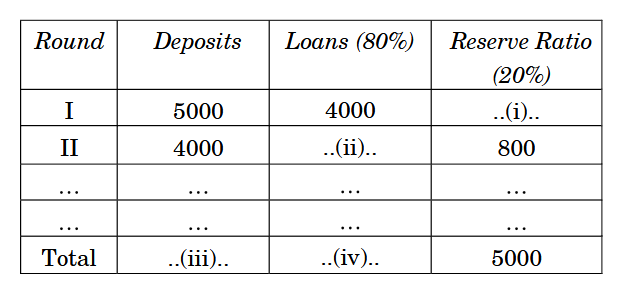
Find the missing figures and choose the correct alternative:
Alternatives :
Surplus in Balance of Payments (BOP) refers to the excess of __________.
(Choose the correct alternative to fill in the blank)
Suppose for a hypothetical economy :
C = 100 + 0·75Y (where C = Consumption and Y = Income)
I0 = 400 (I0 = Autonomous Investment)
Value of Investment Multiplier (K) would be ____________.
Choose the correct alternative to fill in the blank)
Suppose, the Balance of Trade of an imaginary economy shows a favourable balance of ₹ 500 crore. The values of merchandise exports are ₹ 1200 crore and transfer payments are ₹ 400 crore.
The value of merchandise imports would be ₹ __________ crore.
(Choose the correct alternative to fill in the blank)
Read the following statements Assertion (A) and Reason (R). Choose the correct alternative given below :
Assertion (A) : The excessive regulation of permit license raj prevented certain private firms from becoming fairly competitive.
Reason (R) : Private sector wasted huge amounts in obtaining licenses rather than on improving the product quality and international competitiveness.
Alternatives :
In the decade of the 1970s, Pakistan nationalized its ________ industries.
(Choose the correct alternative to fill in the blank)
Read the following statements carefully :
Statement 1 : Under the colonial rule, basic infrastructure (like railways, post and telegraph etc.) was developed.
Statement 2 : The real motive behind the infrastructural development in India was to strengthen the British interests.
In the light of the given statements, choose the correct alternative from the following :
Identify which of the following alternatives indicate the incorrect components combination of Agriculture Marketing System :
Read the following statements Assertion (A) and Reason (R). Choose the correct alternative given below :
Assertion (A) : World Trade Organization (WTO) is expected to establish the rule-based trading regime, to avoid unilaterally placed arbitrary restrictions by member nations.
Reason (R) : It is imperative to enlarge world production and ensure optimum utilization of world resources along with environmental protection.
Alternatives :
Read the following statements Assertion (A) and Reason (R). Choose the correct alternative given below :
Assertion (A) : China has used the market mechanism to create additional social and economic opportunities for its citizens.
Reason (R) : Social infrastructure creation by the government has brought positive results in human development indicators in China.
Alternatives :
Identify from the following alternatives the incorrect objectives of regulated agriculture market :
(i) To make the marketing system efficient and effective for farmers to get best price of their products.
(ii) To discourage improvement of marketing infrastructure for farmers.
(iii) To prevent exploitation of farmers.
(iv) To discourage farmers from improving quality and quantity of their produce.
Alternatives :
Economic reforms were introduced in India and Pakistan in the years ___________ and ____________, respectively.
(Choose the correct alternative to fill in the blanks)
Read the following statements carefully :
Statement 1 : As per the National Sample Survey Organization (NSSO), unemployment is a situation in which all those who, owing to lack of work, are not working, but are seeking work from prospective employers. They express their willingness/availability to work under the prevailing conditions of work and remuneration.
Statement 2 : Disguised Unemployment is generally a massive problem in a highly populated country like India. In the light of the given statements, choose the correct alternative from the following :
Identify which of the following is not a member nation of G20 :
Section C
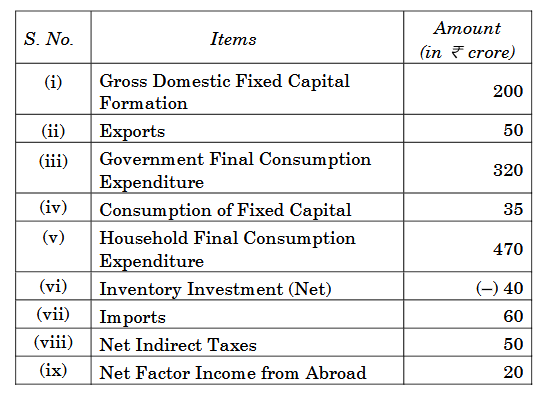
On the basis of the data given below for an imaginary economy, estimate the value of Net Domestic Product at Factor Cost (NDP-FC):
(i) Elaborate the concept of Externalities with the help of suitable example.
(ii) Define Operating Surplus.
Elaborate the reasons owing to which the private sector was regulated under the Industrial Policy Resolution, 1956.
In India, National Education Policy 2020 has stressed a lot on in-service training of the teachers
(i) Identify the source of Human Capital Formation (HCF) indicated in the aforesaid statement.
(ii) Elaborate the likely impacts of this source on the economic development of India.
"During the colonial period, the occupational structure showed lopsided movements."
Do you agree with the given statement? Justify your answer with valid arguments.
Section D
(i) Elaborate the need to promote women’s education in India.
(ii) Mention any two examples of diversification activities in the non-agro processing industries.
a) State any two problems faced by farmers during the initial years of organic farming.
(b) “In the current situation, Information Technology plays a vital role in achieving food security in a nation like India.”
Justify the given statement.
State and elaborate whether the following statements are true or false, with valid arguments :
(i) In the recent past, the Government of India has taken crucial steps, like Jan-Dhan Yojana, for efficient allocation of financial resources.
(ii) Worker population ratio is an indicator, used for analyzing the employment situation in a nation.
(a) "United Nations Department of Economic and Social Affairs indicated that India has overtaken China as the world's most populous country in the month of April 2023."
Explain the consequences of one-child policy adopted by China in the 1970s.
(b) Discuss the impacts of Special Economic Zones (SEZs) on the economic growth of China.
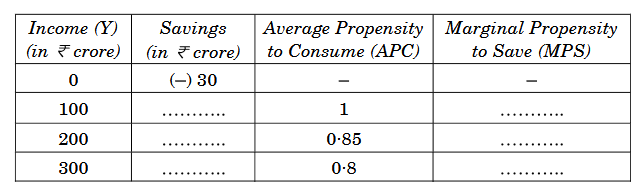
Complete the following table. Construct/Express the Consumption function at ₹ 200 crore level of income.
Justify the following statements with valid arguments :
(a) The Central Bank is the sole currency issuing authority of an economy.
(b) Money serves as a measure of standard of deferred payments.
"In an economy, ex-ante Aggregate Supply is less than ex-ante Aggregate Demand."
Explain its impact on the level of output, income and employment.
Read the following text carefully from “The Economic Times” dated 8th June, 2023 :
“The Reserve Bank of India’s (RBI’s) rate setting panel unanimously decided to keep the benchmark lending rate unchanged at 6·5%. The committee voted to remain focused on the withdrawal of accommodating monetary policy.”
On the basis of given text and common understanding, answer the following questions :
(a) Identify and discuss the economic issue indicated in the above text.
(b) Discuss the likely consequence on money supply if the rate setting panel would have decreased the said rate.
Section E
(i) "Under the liberalisation measures taken by the Government of India, regulation of industrial sector was extremely crucial."
Reject or support the given statement with valid arguments.
(ii) "Despite the implementation of Green Revolution, 65 per cent of India's population continued to be engaged in the agriculture sector till the 1990s."
Justify the given statement with valid explanation.
(i) "Every coin has two sides debate over farm subsidies is one such classic example of the same."
Justify the given statement with two arguments each in favour of and against the continuation of the farm subsidies.
(ii) State the importance of "Growth with equity" as the objective of Indian economic planning.
(a) Discuss briefly the concept of circular flow of income in a two-sector model.
(b)"Real Gross Domestic Product (GDP) is a better indicator economic growth of a nation as compared to the Nominal Gross Domestic (GDP).
Do you agree with the given statement ? Justify your answer with a valid hypothetical numerical example.
Classify the following as Revenue receipts or Capital receipts. Give valid arguments in support of your answer :
(i) Interest received on loan.
(ii) Disinvestment receipts from the sale of a government company.
(iii) Financial assistance by the Government of USA for promoting girl education in India.
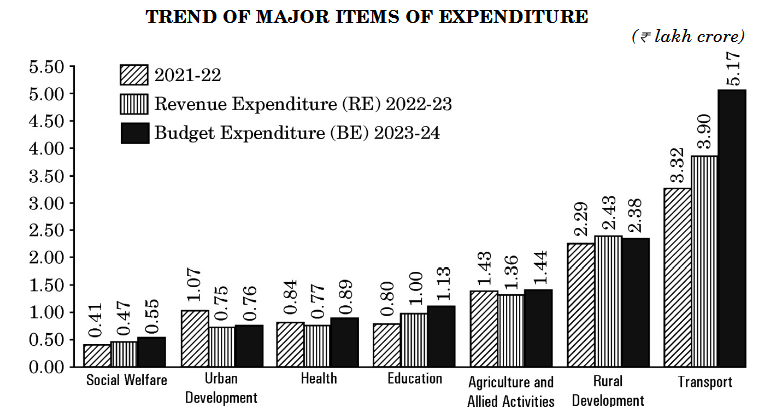
(i) Study the following chart carefully and analyse the changing trends in the government expenditure on :
(I) Transport
(II) Rural Development
(III) Distinguish between fiscal deficit and revenue deficit .
Paper Details
CBSE Board Exam 2024
Class
Class 12 Humanities
Subject
Economics
Year
2024
Set
Set 1
Other Years — Economics