QUESTION PAPER
2025 BOARD EXAM
CBSE Class 12 Humanities Economics Board Paper 2025 — Set 1
2025
Economics
Class 12 Humanities
CBSE EXAMINATION PAPER-2025
ECONOMICS
(Solved)
General Instructions :
Read the following instructions carefully and follow them :
- This question paper contains 43 questions. All questions are compulsory.
- This question paper is divided into 5 sections.
- Section A – questions number 1 to 2 are case based questions
- Section B – questions number 3 to 24 are multiple choice questions
- Section C – questions number 25 to 30 are short answer type i
- Section D – questions number 31 to 39 are short answer type ii
- Section E – questions number 40 to 43 are long answer
- There is no overall choice given in the question paper. However, an internal choice has been provided in few questions.
- Use of calculator is NOT allowed.
Section A
Read the following text carefully :
Agro-startups and rural enterprises are becoming increasingly vital for rural development in India. They address the critical challenges faced by rural sector in India. These ventures bring in technological innovations such as precision farming, IT-based monitoring system and data-driven decision making tools that enhance productivity and resource efficiency. By streamlining supply chains and creating direct market linkages, they ensure better pricing for farmers and reduce dependency on traditional intermediaries. Such enterprises contribute actively to employment generation in the rural areas. The government has demonstrated a continuous policy and financial support for agri-startups and entrepreneurs through various programs like RKVY-RAFTAAR, the Agriinfrastructure fund and Agri-SURE.
On the basis of given text and common understanding, answer the following questions :
(1) Explain, how agro-startups address the critical challenges faced by the agricultural sector.
(2) Comment on the role of government in supporting agro-startups and entrepreneurs in India.
Read the following text carefully :
Union Food and Consumer Affairs Minister said that the Central Government has taken many proactive steps in the past few years to control retail prices of food items. He said that the government aims to keep inflation under control without compromising the country's economic growth. Retail inflation inched up to a three-month high of 5.55% in November 2023 driven by higher food prices. Inflation has been declining since August 2023, when it touched 6.83%. 140 new price monitoring centres had been set up by the Central Government to keep a close watch on wholesale and retail prices of essential commodities.
The Government has banned the export of many food items like wheat, broken rice, non-basmati white rice, onions etc. It has also reduced import duties on edible oils and pulses to boost domestic supply and control price rise.
On the basis of the given text and common understanding, answer the following questions :
(1) Mention the number of new price monitoring centres set up by government.
(2) State any two proactive measures taken by government to boost domestic supply and reduction in prices.
(3) Explain any one monetary measure used to control inflation.
Section B
In the context of Current Account transactions of Balance of Payment, identify the incorrect statement from the following. (Choose the correct option)
Read the following statements carefully:
Statement-1: Managed floating exchange rate system is an amalgamation of fixed and flexible exchange rate systems.
Statement-2: Managed floating exchange rate system is also known as 'hybrid system'.
In the light of the given statements, choose the correct option frorm the following :
Irfaan (a student) borrows ₹80,000 to finance his college fee. He plans to begin repaying the loan six months after his graduation, making payments over a span of ten years.
Based on above text, identify the indicated function of money. (Choose the correct option)
Suppose, the saving curve of an economy makes an intercept at a negative value of 50 crores. In the economy, 20% of an increase in income is saved.
In the light of above context, identify the value of investment multiplier (K).
Read the following statements : Assertion (A) and Reason (R). Choose the correct option from those given below :
Assertion (A) : Public goods are those goods that are collectively consumed by the public.
Reason (R) : Public goods are excludable and rivalrous in nature.
Suppose, the value of Average Propensity to Consume (APC) is 0.8 and National Income is 4,000 crores, the value of saving would be₹_______crores. (Choose the correct option to fill up the blank)
In the context of the Commercial Banks, which of the following statements are correct ? (Choose the correct option)
(I) Deposits received are liabilities for Commercial Banks.
(Il) They are creator of credit in the economy.
(Ill) They accept deposits from general public.
(IV) They accept deposits on behalf of Reserve Bank of India.
If a country exports goods worth of ₹ 600 crores and imports goods worth of ₹ 450 crores, the value of Balance of Trade of the country would be ⎯⎯⎯⎯⎯⎯⎯of ₹ ⎯⎯⎯⎯⎯⎯⎯ crores.
⎯⎯⎯⎯⎯⎯ sector was the primary focus of the Great Leap Forward in China. 1 (Fill up the blank with correct option)
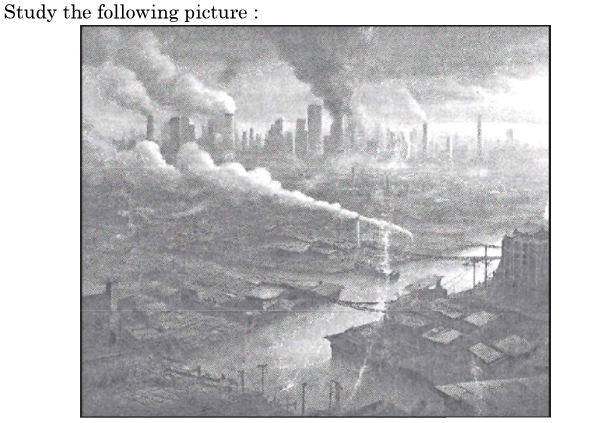
Study the following picture :
Identify and select, the recent phenomenon in which demand for resources surpasses their supply.
Identify, which of the following is NOT one of the strategies for Sustainable Development.
Read statements carefully :
Statement-I : Hired workers may be regular salaried workers or casual workers.
Statement-2 : Regular salaried employment is a major source of employment in rural areas in India.
In the light of the given statements, choose the correct option from the following
From the terms given below in Column-I and Column-Il, choose the correct pair of statements :
(i) Subsidies | (a) Maximum quantity of goods that can be imported |
(ii) Land ceiling | (b) Element of IPR 1956 |
(iii)Small Scale Industries | (c) Land to the tiller |
(iv) Modernisation as a goal of five year plan | (d) Change in social outlook |
It is short-term unemployment occurring, as people transit between jobs." On the basis of given definition, identify the type of unemployment indicated.
(Choose the correct option)
Read statements carefully : Assertion (A) and Reason (R). Choose the correct option from those given below :
Assertion (A) : Prior to economic reforms, public investment in social infrastructure by China resulted in better Human Development Indicators (HDI).
Reason (R) : China is ahead of India and Pakistan on many Human Development Indicators (H DI).
India is NOT a member of which of the following regional/global economic grouping ?
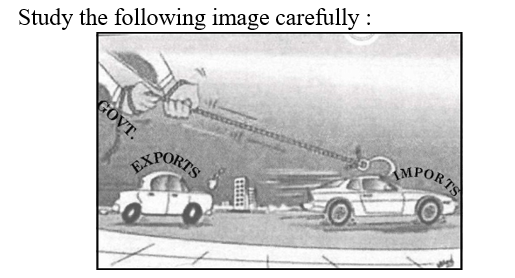
Study the following image carefully :
⎯⎯⎯⎯⎯⎯⎯ Identify, the trade practice that has successfully replaced foreign goods with domestic production .
Read the following statements carefully . Assertion (A) and Reason (R). Choose the correct option from those given below :
Assertion (A) : Human capital formation increases the rate of participation of population to economic activities and leads to economic growth.
Reason (R) : Rate of participation of people refers to the percentage of people engaged in production process of a country.
From the following terms given in Column-I, match the correct pair of meaning given in Column -II:
Column-I | Column -II |
|---|---|
(a) Human Development Indicator | (i) Rule of Law |
(b) Demographic Indicator | (ii) Constitutional Protection |
(c) Special Economic Zone | (iii) Generation of additional economic activities |
(d) Commune System | (iv) Collective industrialisation |
⎯⎯⎯⎯⎯⎯⎯ refers to a trade policy aimed at reducing reliance on imported goods by encouraging domestic production.
From the items given in Column-I and Column-II, choose the correct pair.
Column-I | Column-II |
|---|---|
(a ) Income from Property | (i) Old age pension |
(b) Income from Entrepreneurship | (ii) Profit |
(c) Mixed Income | (iii) Rent free accommodation from an employer |
(d) Compensation of Employees | (iv) Interest from capital |
From the set of terms given in Column-I and Column-Il, choose the correct pair :
Column-I | Column-Il, |
|---|---|
(a) Non-tax Revenue | (i) Goods and Services Tax |
(b) Indirect Tax | (ii) Free-rider |
(c) Capital expenditure | (iii) Borrowings |
(d) Private goods | (iv) Rivalrous in nature |
Section C
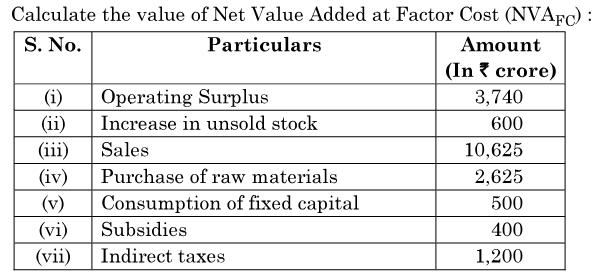
Calculate the value of Net Value Added at Factor Cost (NVAFD :
Distinguish between Net Factor Income from Abroad (NFIA) and Net Exports (X — M).
"The Government had launched Incredible India Campaign to promote tourism in various parts of the country." Elaborate the impact of this campaign on foreign exchange reserves and Balance of Payment of India.
"Cooperatives have received a setback during the recent past". Justify the given statement with valid explanation.
Trace the relationship between Human capital and Economic growth.
Explain the reasons behind less number of regular salaried employees in rural areas as compared to urban areas.
Section D
Under the Ayushmaan Bharat Scheme, the government provides free medical treatment to the poorer section of the society.
Identify and explain the nature of budget expenditure and its objective, indicated in the given statement.
Suppose in an economy, primary deposits are ₹500, if the Reserve Ratio is 25%. Estimate the total deposits created and the total lending by the banking system.
In an economy ; C = 200 + 0.75 Y (where C is consumption expenditure and Y is National Income). Investment expenditure is ₹4,000 Crore. 4 Calculate the following :
(i) Equilibrium level of income.
(ii) Total consumption expenditure at equilibrium income level.
Explain the adjustment mechanism in case ex-ante savings are greater than ex-ante investments.
Describe briefly a rationale behind choosing 'Self-reliance' as a planning objective for the Indian economy.
Explain how, Goods and Services Tax (GST) has simplified the multiplicity of taxes on goods and services.
Describe the path of developmental initiatives taken by Pakistan for its economic development.
(a) Bio-pesticides help to reduce the ill-impacts of green revolution on soil and water bodies while promoting sustainable development. Justify the given statement with valid explanation.
(b) Define Absorptive capacity.
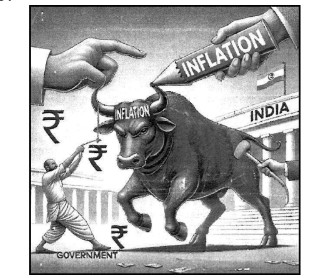
(i)The macro-economic issue indicated in the image is inflation. Steps that the Government of India may take to control inflation are:
(ii) Define open market operation
Section E
(i) Distinguish between :
(1) Tariff and non-tariff barriers
(2) Bilateral and multilateral trade
(ii) Small -Scale Industries required a shield against large scale industries.
In the light of given statement, elaborate the steps initiated by the government in this direction.
Giving valid reasons, state whether the following statements are true or false.
(i) India followed unbalanced growth during the colonial rule.
(ii) The economic policies implemented in India between 1950 -1990's sought to promote regional equality.
(iii) India has become a favourable destination of outsourcing, in post 1991 period.
(i) Explain any two precautions to be adopted while estimating National Income by Expenditure method.
(ii) Higher Gross Domestic Product (GDP) always means higher per capita availability of goods in the economy.
Defend or refute the given statement as the index of welfare of the people of that country.
(i) Distinguish between Stock and flow variables, using suitable examples.
(ii) Explain the components of 'Profit' as per Income Method of estimating National Income (NNPFC).
Paper Details
CBSE Board Exam 2025
Class
Class 12 Humanities
Subject
Economics
Year
2025
Set
Set 1
Other Years — Economics