QUESTION PAPER
2024 BOARD EXAM
CBSE Class 12 Humanities Economics Board Paper 2024 — Set 3
2024
Economics
Class 12 Humanities
CBSE EXAMINATION PAPER-2024
ECONOMICS
(Solved)
General Instructions :
Read the following instructions carefully and follow them :
- This question paper contains 44 questions. All questions are compulsory.
- This question paper is divided into 5 sections.
- Section A – questions number 1 to 5 are case based questions
- Section B – questions number 6 to 25 are multiple choice questions
- Section C – questions number 26 to 31 are short answer type i
- Section D – questions number 32 to 39 are short answer type ii
- Section E – questions number 40 to 44 are long answer
- There is no overall choice given in the question paper. However, an internal choice has been provided in few questions.
- Use of calculator is NOT allowed.
Section A
(1) Assertion (A): Voluntarily unemployed people are those able-bodied people who are not willing to work at the prevailing wage rate. Reason (R): There exists zero involuntary unemployment at full employment level of equilibrium.
[1 Mark](1) Statement 1: Reserve ratio and Credit creation process are inversely related. Statement 2: Central Bank of an economy performs the vital function of controlling the credit creation process. Choose the correct alternative from the following:
[1 Mark](1) Assertion (A): The agricultural sector under British rule was primarily the base of the sectoral growth of India. Reason (R): British rulers wanted to take maximum advantage of the Indian agricultural output, for growth of industries in England.
[1 Mark](1) State the meaning of green growth and net zero emissions.
[2 Marks](2) Discuss briefly the interconnection between green growth and net zero emissions.
[3 Marks](3) Illustrate any one factor to promote net zero emission.
[1 Mark]Read the following text carefully :
In the contemporary world with a lot of sustainable development concerns, green growth and net zero emissions are two important concepts which are generally discussed together. These two concepts are essential for the future of the Earth, as by working together on them we can create a more sustainable future for ourselves and for the generations to come. Green growth refers to, the economic growth that is achieved in a way that minimizes environmental impact, whereas, net zero emission is the state of achieving balance between anthropogenic emission of greenhouse gases and removal of such emissions.
There exists a robust connection between the two concepts :
(1) Green growth can help to reduce greenhouse gas emissions, which is essential for achieving net zero emissions.
(2) Green growth can help to create jobs and boost economic growth, which can help to make it more affordable for countries to invest in net zero emissions technology.
A nation can do a lot to promote these two factors together, like :
(a) Investing in renewable energy sources which do not produce greenhouse gases.
(b) Adopting energy efficient measures, such as insulation and other such appliances which can help to reduce energy consumption.
(c) Altering transportation habits, like adopting walking, biking and using public transportation as they are lower-carbon ways to travel.
On the basis of the given text and common understanding, answer the following questions :
(1) State the meaning of green growth and net zero emissions.
(2) Discuss briefly the interconnection between green growth and net zero emissions.
(3) Illustrate any one factor to promote net zero emission.
Section B
Read the following statements : Assertion (A) and Reason (R). Choose the correct alternative from those given below :
Assertion (A) : Voluntarily unemployed people are those able bodied people who are not willing to work at the prevailing wage rate.
Reason (R) : There exists zero involuntary unemployment at full employment level of equilibrium.
Alternatives :
Identify which of the following statements is incorrect with reference to an economy.
Inflationary gap in an economy may exist when _________ at full employment level. (Choose the correct alternative to fill in the blank)
According to the Reserve Bank of India's RBI's Statistical Supplement released on 19th May, 2023 :
" India's foreign exchange reserves grew for the third straight week and reached near an approximate level of $ 600 Billion "
The above situation will _________ the __________ side of Balance of Payments account of India. (Choose the correct alternative to fill in the blanks)
Read the following statements carefully :
Statement 1 : Reserve ratio and Credit creation process are inversely related.
Statement 2 : Central Bank of an economy performs the vital function of controlling the credit creation process.
In light of the given statements, choose the correct alternative from the following :
In order to discourage any fall in Aggregate Demand, the Government of India may _________ the _________.
(Choose the correct alternative to fill in the blanks)
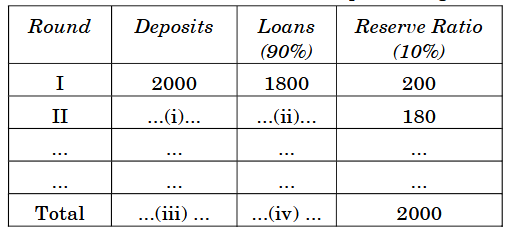
Choose the correct alternative to complete the given schedule :
Alternatives :
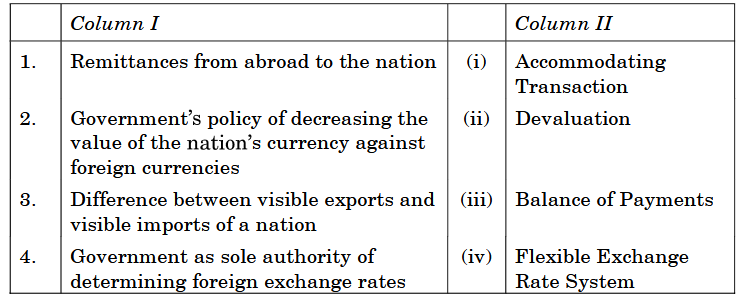
Identify the correct pair of statements given in Column I with the related terms in Column II :
Alternatives :
Read the following statements carefully :
Statement 1 : Constant rate of change of consumption (△C) with respect to change in income ( △Y), is the reason for the straight line consumption curve.
Statement 2 : Marginal rate of change between consumption and income is defined as Average Propensity to Consume (APC).
In the light of the given statements, choose the correct alternative from the following :
Read the following statements : Assertion (A) and Reason (R). Choose the correct alternative from those given below :
Assertion (A) : In case of an unfavourable Balance of Trade, the Current Account of the nation may be in surplus.
Reason (R) : Net invisible receipts of a nation can exceed the Net visible receipts.
Alternatives :
Read the following statements : Assertion (A) and Reason (R). Choose the correct alternative from those given below :
Assertion (A) : The agricultural sector under the British rule was primarily the base of the sectoral growth of India.
Reason (R) : British rulers wanted to take maximum advantage of the Indian agricultural output, for growth of industries in England.
Alternatives :
Identify which of the following alternatives are not true with reference to the Chinese economy.
(i) In 1958, communes were established.
(ii) In the foreign sector, Special Economic Zones (SEZ) were set up.
(iii) Better health facilities reduced mortality rate in China.
Alternatives :
Which of the following is/are not an objective of regulated agricultural market ?
(i) To discourage improvement of marketing infrastructure for farmers.
(ii) To make marketing systems efficient and effective for farmers to get best price for their products.
(iii) To discourage farmers to improve the quantity and quality of their produce.
Alternatives :
Read the following statements carefully :
Statement 1 : Land ceiling was one of the Government policies to promote equity in the agriculture sector.
Statement 2 : Land reforms resulted in abolition of the Zamindari system in the post independence period.
In light of the given statements, choose the correct alternative from the following :
Read the following statements : Assertion (A) and Reason (R). Choose the correct alternative given below :
Assertion (A) : Goods and Services Tax (GST) was implemented by the Government of India on 8th November, 2016.
Reason (R) : GST was introduced to implement a unified indirect tax system in India.
Alternatives :
Identify which of the following is not a member nation of G20.
Production of varied forms of crops against one specialised crop is called diversification of ___________.
(Choose the correct alternative to fill in the blank)
Identify which of the following is not a Human Development Indicator (HDI).
Read the following statements carefully :
Statement 1 : Human development is based on the idea that education and health are integral to human well-being.
Statement 2 : Human capital treats humans as a means to an end.
In light of the given statements, choose the correct alternative from the following :
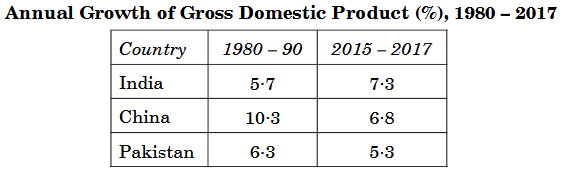
On the basis of the data given below, identify the incorrect statement with reference to annual growth of GDP (%) :
Alternatives :
Section C
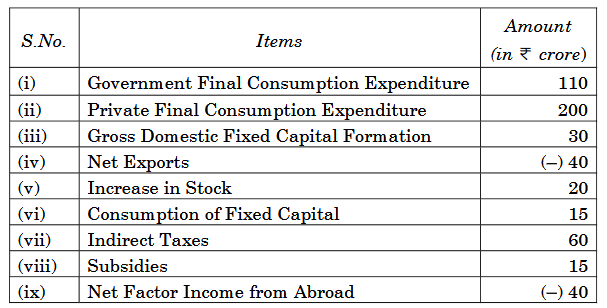
On the basis of the given data, estimate the value of National Income:
State any three precautions to be taken while estimating National Income by Expenditure Method.
"Trade and Investment Policy of India had undergone comprehensive changes in the post reforms period of 1991."
Do you agree with the given statement ? Justify your answer with any two valid arguments.
Discuss any two salient features of Indian industrial sector during the period of 1950-1990.
"In India, National Education Policy 2020 has stressed a lot on in-service training of the teachers."
(i) Identify the source of Human Capital Formation (HCF) indicated in the aforesaid statement.
(ii) Elaborate the likely impacts of this source on the economic development of India.
Section D
"Open market operations by Reserve Bank of India (RBI) help in regulating money supply in the economy."
Justify the given statement with valid arguments."
Elaborate the 'Government's Bank and Advisor function of the Central Bank of a nation.
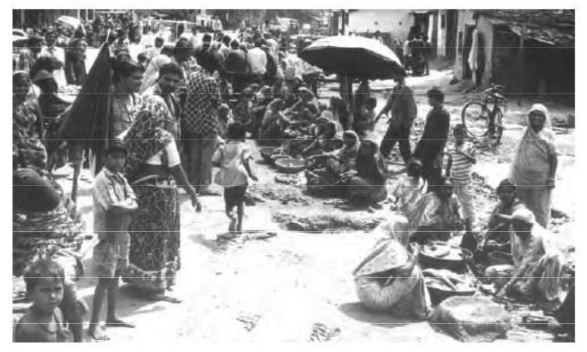
Study the given image carefully :
Identify the situation depicted in the image and suggest the impact of the indicated situation in the Indian economy.
Note: The following question is for the Visually Impaired Candidates only in lieu of Q. No. 32
State and elaborate whether the following statements are true or false, with valid arguments :
(i) Organic Farming has essentially become the need of the hour.
(ii) In the recent past, the Government of India has taken crucial steps, like Jan-Dhan Yojana, for efficient allocation of financial resources.
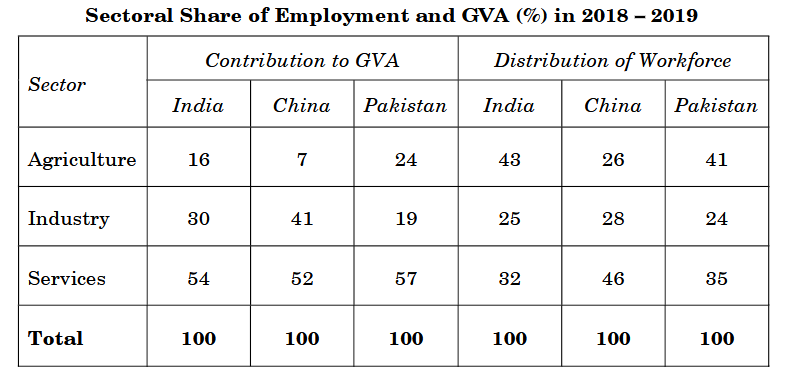
From the given data, compare and analyse India and China's sectoral contribution towards Gross Value Added (GVA).
(i) Define worker - population ratio and describe its usefulness.
(ii) State the meaning of Disguised Unemployment'.
(a) For a hypothetical economy, the government incurs an additional investment expenditure of ₹ 5,000 crore. Assuming that the Marginal Propensity to Save (MPS) becomes half from its present level of 20%, estimate the change in income due to this fall in Marginal Propensity to Save (MPS).
(b) State the meaning of autonomous investment .
Section E
(i) Every coin has two sides debate over farm subsidies is one such classic example of the same
Justify the given statement with two arguments each in favour of and against the continuation of the farm subsidies.
(ii) State the importance of "Growth with equity" of Indian economic planning.
"The real motive behind infrastructural development in India was to strengthen the British interests."
Do you agree with the given statement ? Justify your answer with valid arguments.
(ii) Navratna policy has facilitated the maintenance, promotion and disinvestment of Public Sector Undertakings (PSUs).
Justify the given statement with valid explanation.
(i) Explain the concept of circular flow of income in a two-sector economy.
(ii) Gross Domestic Product (GDP) and sum of Gross Value Added (GVA) in an economy are always equal
Justify the given statement with valid arguments.
(i) Gross Domestic Product (GDP) Deflator is represented by the ratio of Real GDP and Nominal GDP."
Do you agree with the given statement ? Justify your answer with valid arguments and a hypothetical numerical example.
(ii) State the meaning of 'Income from Property and Entrepreneurship'.
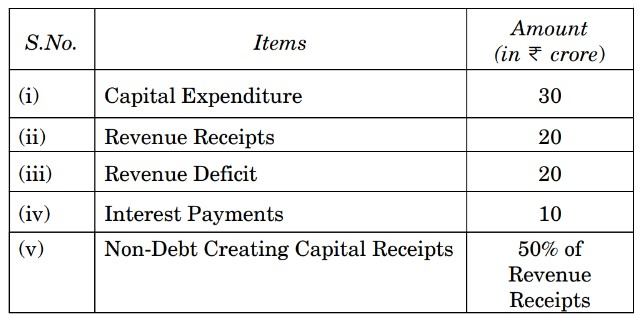
(a) On the basis of the given information, calculate the values of the following :
(i) Fiscal Deficit
(ii) Primary Deficit
(b) State any two examples of private goods.
(c) Distinguish between ‘Public Provision’ and ‘Public Production’.
Paper Details
CBSE Board Exam 2024
Class
Class 12 Humanities
Subject
Economics
Year
2024
Set
Set 3
Other Years — Economics