Section B
[2 Marks]
Answer: Consumption goods are products that are purchased and used by consumers to satisfy immediate needs and wants. These goods include items like food, clothing, and personal electronics, which are consumed directly. In contrast, capital goods are assets used by businesses to produce goods and services. They include machinery, tools, and buildings, which are not consumed directly but help in the production process. The key difference is in their usage; consumption goods fulfill immediate consumer needs, while capital goods are used to generate future economic output.
Key Points: Consumption goods satisfy immediate consumer needs - Capital goods are used in production - Examples include food and clothing for consumption goods, machinery and tools for capital goods - Consumption goods are typically short-term use, while capital goods provide long-term benefits.
[2 Marks]
Answer: Stock and flow variables are fundamental concepts in economics. A stock variable is a quantity measured at a specific point in time, while a flow variable is measured over a period of time. The population of India as on 31st March, 2021, is classified as a stock variable because it represents the total number of people at a specific date, indicating a snapshot in time. In contrast, the domestic income of the Indian economy during the fiscal year 2020-21 is a flow variable because it measures the total income generated over that entire year, indicating an accumulation of value generated through economic activities over time.
Key Points: Stock variable definition; Flow variable definition; Explanation of population as a stock variable; Explanation of domestic income as a flow variable.
[2 Marks]
Answer: To find the Marginal Propensity to Save (MPS), we first need to know the relationship between Marginal Propensity to Consume (MPC) and MPS. The MPC can be derived from the consumption function, which is 0.8 in this case. Since MPS + MPC = 1, we calculate MPS as follows: MPS = 1 - MPC = 1 - 0.8 = 0.2. Therefore, the MPS is 0.2. Next, to find the Break-Even Point, we set consumption (C) equal to income (Y): 100 + 0.8Y = Y. Rearranging gives us 100 = Y - 0.8Y, which simplifies to 100 = 0.2Y, leading to Y = 100/0.2 = 500. Thus, the Break-Even Point income is 500.
Key Points: MPC is derived from the consumption function; MPS = 1 - MPC; MPS calculated as 0.2; Break-Even Point occurs where C = Y; Solve the equation 100 + 0.8Y = Y.
[2 Marks]
Answer: To calculate the equilibrium level of income, we need to identify when savings (S) equals investment (I). In a simple economy, investment is often considered constant. For the given saving function, we set S = I. Assuming a typical investment level of I = 100, we can substitute and solve for Y. Setting S = 100 provides the equation: 100 = 60 + 0.1Y. Rearranging, we get 0.1Y = 40, leading to Y = 400. Thus, the equilibrium level of income is 400.
Key Points: 1. Identify that equilibrium occurs when savings equal investment. 2. Set S = I to establish the equation. 3. Substitute the investment value into the saving function. 4. Rearrange the equation to solve for Y.
[2 Marks]
Answer: When planned savings exceed planned investments in an economy, it indicates that households and businesses are saving more than what is being invested in productive activities. This situation can lead to a reduction in overall demand for goods and services, as fewer investments often translate to lower production levels. Consequently, firms may reduce their output in response to diminished demand, leading to potential layoffs and increased unemployment. The economy experiences a slowdown as investments are essential for growth, and insufficient investment can hinder job creation and overall economic stability.
Key Points: 1. Higher planned savings result in lower investments. 2. Reduced demand for goods and services follows. 3. Decrease in output as firms cut production. 4. Increased unemployment due to layoffs. 5. Economic slowdown due to insufficient investment.
[2 Marks]
Answer: The statement that workers in the formal sector earn more than those in the informal sector is generally true. Formal sector jobs typically offer higher wages due to structured pay scales, benefits, and job security. Employees in the formal sector have access to health insurance, retirement plans, and paid leave, which are often lacking in the informal sector. Additionally, formal employment often requires higher qualifications, leading to better-trained workers and consequently higher productivity, which can justify their higher wages. In contrast, informal sector jobs usually operate outside regulatory frameworks, resulting in lower pay and lack of job security. Overall, the disparity in earnings between these sectors reflects differences in job stability, benefits, and overall working conditions.
Key Points: Formal sector offers higher wages-benefits and job security-qualifications and productivity differences
[2 Marks]
Answer: I agree that economic development in India has generated significant environmental concerns. Rapid industrialization has led to increased pollution, deforestation, and depletion of natural resources. For instance, the expansion of urban areas has directly contributed to air and water pollution, impacting public health. Additionally, the reliance on fossil fuels for energy has heightened greenhouse gas emissions, exacerbating climate change. Sustainable development practices need to be implemented to balance economic growth with environmental preservation, ensuring a healthier future.
Key Points: Rapid industrialization leading to pollution-Deforestation and resource depletion-Impact on public health and climate change-Need for sustainable development practices
[2 Marks]
Answer: Impact on Output and Employment: When planned savings fall short of planned investments, it means that investment demand exceeds the amount households are willing to save. In this case, aggregate demand increases because investments are higher than savings. As a result, producers respond to this higher demand by increasing output. This leads to an increase in production and consequently, employment rises to meet the higher output levels.
In summary, if planned savings are less than planned investments, the economy experiences an expansion in output and employment due to increased demand for goods and services.
Key Points: Planned savings less than planned investments leads to higher aggregate demand - Output increases as producers supply more goods - Employment goes up to meet increased production demand
Section C
[3 Marks]
Answer: India and Pakistan, despite their numerous differences, have adopted similar development strategies focusing on industrialization and agricultural reform. Firstly, both nations prioritized industrialization as a strategy for economic growth. India implemented the Public Sector Undertaking (PSU) model, promoting large-scale industries, while Pakistan focused on developing its textile and manufacturing sectors. Secondly, agricultural reform has been a cornerstone for both countries. India introduced the Green Revolution in the 1960s, enhancing productivity through hybrid seeds and irrigation. Similarly, Pakistan also embraced agricultural technology and input optimization to improve crop yields. These strategies reflect their attempts to strengthen economic foundations and ensure food security.
Key Points: Industrialization strategies in both countries; Public Sector Undertakings in India vs textile focus in Pakistan; Agricultural reforms like Green Revolution in India and technology enhancement in Pakistan.
[3 Marks]
Answer: The investment multiplier (K) measures the effect of an initial change in investment on the overall level of income in an economy. It is calculated using the formula K = 1 / (1 - MPC). Given that MPC is 0.5, the multiplier becomes K = 1 / (1 - 0.5) = 2. When the change in investment (I) is 4,000 crore, the total increase in income is K * I, which results in an increase of 2 * 4000 crore = 8,000 crore. This demonstrates how initial investments can lead to greater economic activity through increased consumption as incomes rise.
Key Points: Definition of investment multiplier, Calculation of K using the formula, Impact of change in investment on overall income, Example using given values, Explanation of how income increases consumption.
[3 Marks]
Answer: In the late 1970s, China's population growth rate significantly declined largely due to the implementation of the one-child policy in 1979. This policy aimed to control the swelling population to promote economic growth and resource management. The government enforced strict measures, including incentives for families with one child and penalties for those who had more. This reduction in the birth rate led to an aging population, labor shortages, and potential social imbalances. Moreover, while it contributed to rapid economic development, it also raised challenges related to gender imbalance and future workforce sustainability. In contrast, India’s population continued to grow due to various factors, such as a lack of stringent population control policies, cultural preferences for larger families, and slower economic development.
Key Points: one-child policy-rapid economic growth-aging population impacts-labor shortages-gender imbalance
[3 Marks]
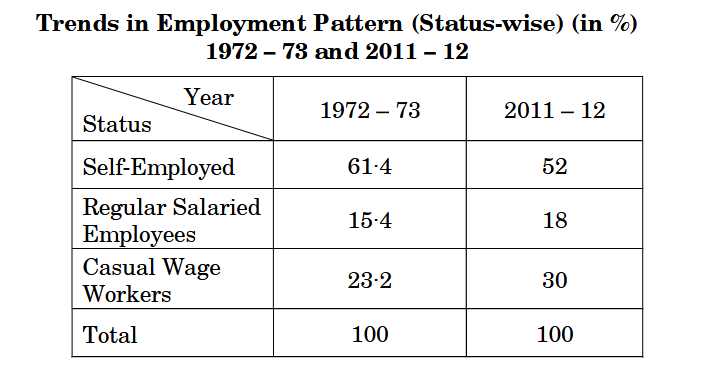
Answer: The workforce distribution in India is categorized based on various statuses such as agricultural, industrial, and service sectors. A significant portion of the workforce is engaged in agriculture, reflecting the rural dependence on farming for livelihood. However, the industrial sector has seen growth, with an increase in employment opportunities creating a shift towards urbanization. Moreover, the service sector has emerged as a major contributor to the economy, absorbing a considerable number of workers, particularly in urban areas. Comparing these sectors, while agriculture remains predominant, its percentage is steadily declining as more individuals find jobs in industrial and service sectors. This shift indicates changing economic dynamics and highlights the importance of policies that support employment training in emerging sectors. Additionally, disparities in workforce distribution can lead to imbalances in rural and urban employment opportunities, affecting economic stability and growth in different regions.
Key Points: workforce distribution categories - agriculture, industry, and services - rural dependence on agriculture - industrial growth and urbanization - significant employment in the service sector - declining agricultural workforce percentage - economic dynamics changes - need for employment training in emerging sectors - rural and urban employment disparities
[3 Marks]
Answer: Circular Flow of Income
The circular flow of income explains how money moves in an economy through different phases.
Phase 1: Factor Market - Households provide factors of production (like labor, land, capital) to firms and receive income in return as wages, rent, and profits.
Phase 2: Goods and Services Market - Firms produce goods and services and sell them to households. Households spend their income to buy these goods and services.
Phase 3: Income Flow - The income earned by households from firms is then used to buy goods and services, creating a continuous flow of money.
Thus, money flows from households to firms and back in a circular manner, showing the interdependence between production and consumption in an economy.
Key Points: Households provide factors of production to firms - Firms pay income to households - Households buy goods and services from firms - Continuous circular flow of income and expenditure
[3 Marks]
Answer: Given: Real GDP = 300 crore, Price Index = 110 (Base year = 100)
Formula: Nominal GDP = (Price Index / 100) * Real GDP
Substituting the values:
Nominal GDP = (110 / 100) * 300 crore = 1.1 * 300 crore = 330 crore
Therefore, the Nominal GDP is 330 crore.
Key Points: Real GDP - Price Index - Nominal GDP calculation using formula
Section D
[5 Marks]
Answer: Deficient demand refers to a situation in an economy where the aggregate demand for goods and services is insufficient to purchase the total output produced at full employment. This leads to unemployment, unused resources, and can result in deflation. When there is deficient demand, consumers and businesses are not willing to spend, leading to a contraction in economic activity. The government can play a crucial role in correcting deficient demand through fiscal policy, particularly by increasing public spending. By injecting funds into the economy, the government can stimulate demand for goods and services. This can be achieved through various means like building infrastructure, funding education, and investing in healthcare. Increased government spending not only creates direct jobs but also enhances consumer confidence, as individuals and businesses are likely to increase their spending in response to the government’s actions. Moreover, when the government spends, it can lead to a multiplier effect where every dollar spent generates additional economic activity, causing a ripple effect throughout the economy. In addition to this, tax cuts can also be implemented to increase disposable income among citizens, further boosting demand. Overall, an active government spending policy is essential for revitalizing an economy facing deficient demand.
Key Points: Definition of deficient demand-economic conditions leading to unemployment-importance of government spending as a corrective measure-multiplicative effect of government spending-impact on consumer confidence and overall economic activity
[5 Marks]
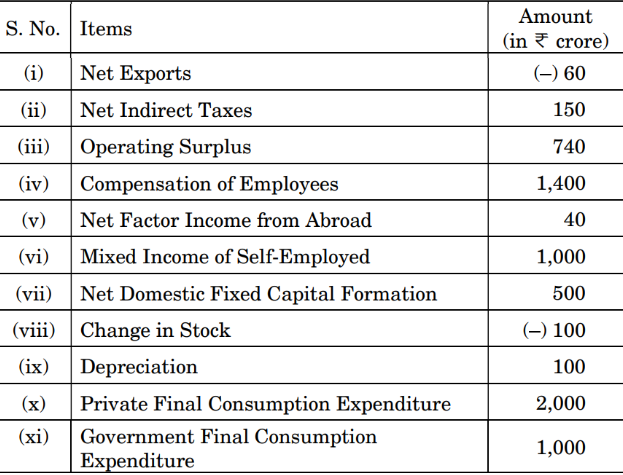
Answer: To demonstrate that National Income (NI) remains consistent when calculated through both the Income Method and Expenditure Method, we begin by understanding their definitions. The Income Method calculates NI by summing total factor payments made to the factors of production, including wages, rent, interest, and profits. In contrast, the Expenditure Method sums total expenditures on final goods and services produced within a country, which encompasses consumption, investment, government spending, and net exports.
Both methods fundamentally represent the same economic activity—production leading to income generation and subsequent expenditure. For instance, when households receive wages (Income Method), they use this income to purchase goods and services (Expenditure Method). Therefore, the aggregates derived from both methods equate to the same NI.
Furthermore, when analyzing a numerical example wherein total outputs are quantified, expenditures equal the total income generated by these outputs, validating that both methods yield identical NI figures. Differences may arise in measurement and timing, but under standard conditions, both methods converge to the same national income, underscoring their equivalency in economic analysis.
Key Points: Definitions of Income Method and Expenditure Method; Explanation of how both methods represent the same activity; Examples of factor payments and expenditures; Importance of understanding the equivalency in calculating National Income; Mention of numerical examples supporting the equivalency
[5 Marks]
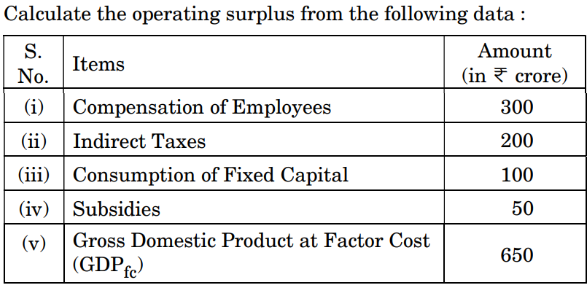
Answer: (i) Calculation of Operating Surplus:
Operating Surplus is calculated as:
Operating Surplus = Net Domestic Product at Market Price - Compensation of employees - Mixed income of self-employed
To calculate operating surplus, subtract the total payments to labor and self-employed from Net Domestic Product at Market Price.
(ii) Three main components of Net Factor Income from Abroad:
1. Net Income from Compensation of Employees: This is the difference between the earnings that residents receive for work done abroad and the earnings that foreign workers receive within the domestic country.
2. Net Investment Income: This includes income earned from investments made abroad minus income earned by foreign investors within the domestic economy. It covers interest, dividends, and profits.
3. Other Factor Incomes: This comprises other income items such as rents or royalties earned from abroad minus those paid to the rest of the world for the use of domestic resources.
These components together contribute to the Net Factor Income from Abroad, which when added to GDP gives the Gross National Product (GNP).
Key Points: Operating Surplus calculation method - Net Income from Compensation of Employees explained - Net Investment Income explained