SOLUTIONS

2023 BOARD EXAM

CBSE Class 12 Humanities Economics Board Paper 2023 — Set 2 Solutions

2023

Economics

Class 12 Humanities

CBSE EXAMINATION PAPER-2023

ECONOMICS

(Solved)

Time allowed : 3 hours

Maximum Marks : 100

General Instructions :

Read the following instructions carefully and follow them :

  1. This question paper contains 46 questions. All questions are compulsory.
  2. This question paper is divided into 5 sections.
  3. Section A – questions number 1 to 2 are case based questions
  4. Section B – questions number 3 to 28 are multiple choice questions
  5. Section C – questions number 29 to 34 are short answer type i
  6. Section D – questions number 35 to 42 are short answer type ii
  7. Section E – questions number 43 to 46 are long answer
  8. There is no overall choice given in the question paper. However, an internal choice has been provided in few questions.
  9. Use of calculator is NOT allowed.

Section A

Question 1.

Read the following text carefully and answer the given questions on the basis of the same and common understanding.

The stabilisation and structural adjustment measures, initiated under the 1991 "Economic Reforms" mark a watershed moment in India's economic policies. For almost three decades since independence, India's development strategy and economic policies were guided by the objectives of accelerating the growth of output and employment with social justice and equity.

Ever since the 1970's, it was realised that many of the regulations on economic activities have outlived their usefulness and were in fact hampering economic growth and development. In response to this, the government initiated some milder liberalisation reforms for almost a decade since the early 1980's.

However, the Indian economy soon had to face the Gulf crisis and consequently :

(i)  The uncertainties about the Oil prices;

(ii) The external payment problems;

(iii) The serious inflationary pressures;

(iv) The scarcities of essential commodities;

(v) The deterioration of fiscal discipline, etc.

These led to the Indian economy on the verge of Economic crisis.

In response to this emerging crisis, the Government initiated a set of stabilisation and structural reforms like :

(i) Reduction in fiscal deficit;

(i) Containment of growth in money supply;

(ii) An exchange rate adjustment system etc.

The key objective of stabilisation policy was to bring the growth of aggregate demand in line with long term growth path Of the economy.

In conjunction, the structural adjustment measures like;

(i) industrial delicensing

(ii)  liberalisation Of policy regime governing international trade

(iii) deregulation of financial sector

Were taken to improve the supply side of the economy This shifted the long-term growth path of the economy itself completely.

(Adapted and modified)

Source :

https://nitiegov.in/planningeommission.gov.in/docs/reports/genreplarep9099/at94•

(1)

(a) Briefly outline any two reasons for the initiation of Economic Reforms in 1991.

[2 Marks]
Answer: The Economic Reforms in 1991 were initiated due to severe economic challenges faced by India. Two key reasons for this were: (1) The external payment problems which hindered the country's ability to meet its international obligations, creating a sense of urgency for reform. (2) The inflationary pressures that led to scarcities of essential commodities, necessitating immediate economic adjustments to stabilize the economy.
Key Points:

External payment problems; Inflationary pressures

(2)

(b) Government introduced a set of stablisation and structural reforms to solve the economic crisis. State the key initiatives and objectives Of these policies adopted by the Government of India.

[4 Marks]
Answer: To address the economic crisis of the early 1990s, the Government of India initiated a series of stabilisation and structural reforms aimed at revitalizing the economy. Key initiatives included the reduction of fiscal deficit, which allowed for more efficient government spending and helped restore investor confidence. Additionally, the government implemented a containment of growth in money supply to combat inflation and stabilize prices. The introduction of an exchange rate adjustment system was also crucial in stabilizing currency values and improving foreign trade competitiveness. The objectives of these policies were not only to bring aggregate demand in line with the long-term growth path of the economy but also to enhance production capability through structural changes such as industrial delicensing, liberalization of international trade policies, and deregulation of the financial sector. These measures collectively shifted the long-term growth trajectory of the Indian economy, fostering a more open and competitive environment.
Key Points: Reduction in fiscal deficit; Containment of money supply growth; Exchange rate adjustment; Objectives: align aggregate demand with long-term growth; Structural reforms: industrial delicensing, trade liberalization, financial deregulation.
Question 2.

Read the following text carefully. Answer the given questions on the basis of the same and common understanding

On 30th September 2022, the Reserve Bank Of India (RBI) raised

Repo Rate for the fourth time in a row. The Monetary Policy Committee (MPC) decided to raise the policy rate by 50 basis points

I basis point — Of a percent . After this announcement, the new 100 repo rate stands at 5.9%, while the reverse repo rate continues to stand at

3.35%.

Commercial banks borrow money from the Central Bank, when there is a shortage Of funds. With the surge in the repo rate, borrowings by general public will become costlier. This is because, as RBI hikes its repo rate, it becomes costly for the banks to borrow short term funds from the Central Bank.

As a result, the banks hike the rates at which customers borrow money from them to compensate for the hike in the repo rate. Thi happens because banks Offer loans to retail consumers at an interest rate which is generally, directly proportional to the repo rate.

The increase of 0.50 percent in repo rate will lead to a higher interest rates on loans for borrowers, implying that the Equated Monthly Instalments (EMIs) for repaying the existing loans will also increase.

Source : https://www_businessst.andard policy-repo-rate-up-by-50bps-here-s-how-it-will-imvact-you-12209,3000267 (Edited.)

(1)

(a) Define 'Repo Rate'.

[1 Mark]
Answer: Repo Rate is the rate at which the central bank, in this case the Reserve Bank of India (RBI), lends money to commercial banks against securities. It is a tool used by the central bank to control liquidity and inflation in the economy.
Key Points: Rate at which central bank lends to commercial banks-Used to control liquidity-Influences interest rates on loans

(2)

(b) Outline the recent change made by the Monetary Policy Committee of Reserve Bank of India in the repo rate.

[1 Mark]
Answer: On 30th September 2022, the Monetary Policy Committee of the Reserve Bank of India raised the repo rate by 50 basis points, making the new rate 5.9%. This was the fourth consecutive increase in the repo rate.
Key Points: Repo rate increased by 50 basis points; new repo rate is 5.9%; fourth consecutive increase.

(3)

(c) "Increase in repo rate is an important tool used by Monetary policy Committee to combat the situation of inflation in the Economy.'

Justify the given statement.

[4 Marks]
Answer: The increase in the repo rate is indeed a crucial tool employed by the Monetary Policy Committee (MPC) to address inflation. Firstly, when the MPC raises the repo rate, it becomes more expensive for commercial banks to borrow money from the Reserve Bank of India. This leads to banks increasing the interest rates on loans offered to consumers. Consequently, higher interest rates result in reduced borrowing by the public, which curtails consumer spending and investment, both of which are significant drivers of inflation. Secondly, with higher borrowing costs, the overall money supply in the economy is reduced, which can help to cool down the demand-pull inflation. Lastly, by signaling a commitment to controlling inflation, the MPC instills confidence among investors and consumers, contributing to overall economic stability. Thus, the increase in repo rate serves as an effective measure to combat inflationary pressures in the economy.
Key Points: Impact on borrowing costs-Reduction in consumer spending-Overall money supply control

Section B

Question 3.

Read the following statements - Assertion (A) and Reason (R). Choose one of the correct alternatives given below;

Assertion (A): The Balance of Payments is in surplus, if autonomous receipts are greater than autonomous payments.

Reason (R): Autonomous transactions are determined by the difference in the Balance of Payments.

Alternatives:

[1 Mark]
  • (A) Both Assertion (A) and Reason (R) are true and Reason (R) is not the correct explanation of Assertion (A).
  • (B) Assertion (A) is false, but Reason (R) is true.
  • (C) Both Assertion (A) and Reason (R) are true and Reason (R) is the correct explanation of Assertion (A).
  • (D) Assertion (A) is true, but Reason (R) is false.
Explanation:

The Assertion (A) is correct because the Balance of Payments (BoP) is said to be in surplus when autonomous receipts are greater than autonomous payments. Autonomous transactions are independent transactions like trade and investment that occur regardless of the BoP state. The Reason (R) states that autonomous transactions are determined by the difference in the Balance of Payments, which is incorrect; autonomous transactions cause changes in BoP but are not determined by it. Therefore, both (A) and (R) are true, but (R) is not the correct explanation for (A).

Question 4.

"In the Annual Budget 2022-23, the Government of India set up disinvestment targets Of 65,000 crore".

Such proceeds from disinvestment can be classified as ━━━━━━━━━━ receipts in the Government Budget as it leads to ━━━━━━━━━━ of the Government.

(Choose the correct alternative)                                                                                             

[1 Mark]
  • (A) capital, decrease in assets
  • (B) capital, increase in liabilities
  • (C) revenue, increase in assets
  • (D) revenue, decrease in lia bilities
Explanation: Proceeds from disinvestment, such as the sale of shares in Public Sector Undertakings (PSUs), are classified as capital receipts because they lead to a reduction in the government's financial assets. When the government sells its assets, it decreases its asset holdings, hence these receipts are called capital receipts and result in a decrease in assets.
Question 5.

Read the following statements carefully :    

Statement 1 : The induced consumption shows, the direct relation between consumption and income.

Statement 2 : With a certain increase in income, induced consumption also increases.

In the light of the given statements, choose the correct alternative from the following :

[1 Mark]
  • (A) Both Statements 1 and 2 are false.
  • (B) Both Statements I and 2 are true.
  • (C) Statement I is true and Statement 2 is false.
  • (D) Statement 1 is false and Statement 2 is true.
Explanation: Both Statements 1 and 2 are true. Induced consumption refers to the consumption that is dependent on income changes; as income increases, consumption tends to increase as well. This illustrates the direct relationship between the two, confirming the validity of both statements.
Question 6.

Ms. Iqra Ansari, a teacher, was explaining in her class about various types of deposits with the commercial banks. She quoted that —

"'These deposits form a part of Ml measure of money supply and are payable on demand by the commercial banks."

Identify the type of deposits she was explaining about and choose the correct alternative . 

(i) Demand Deposits

(ii) Time Deposits

(iii) Post Office Deposits

Alternatives :

[1 Mark]
  • (A) (i), (ii) and (iii)
  • (B) (c) (i) and (ii)
  • (C) Only (ii)
  • (D) Only (i)
Explanation: The correct option is (i) Demand Deposits because they are the type of deposits that are payable on demand and are included in the M1 measure of money supply. Time Deposits, on the other hand, are not payable on demand, and Post Office Deposits are not considered part of the M1 money supply.
Question 7.

As per the Reserve Bank of India (RBI) press report, dated 22nd June,2022 : 

"Net Foreign Portfolio Investment (FPI) recorded an outflow Of US$15.2 billion mainly from the equity market."

The above transaction will be recorded in the ━━━━━━━━━━ account on ━━━━━━━━━━ side of Balance of payments account of India. (Choose the correct alternative)

[1 Mark]
  • (A) capital, debit
  • (B) current, debit
  • (C) current, credit
  • (D) capital, credit
Explanation: The correct answer is 'capital, debit'. Net Foreign Portfolio Investment (FPI) is a capital account transaction, and when there is an outflow of investment, it is recorded on the debit side of the balance of payments account. This is because a debit indicates an outflow of funds from the country.
Question 8.

Read the following statements carefully :

Statement 1 : Gross Domestic Product (GDP) is the sum total of the gross market value of all the final goods and services added by all the sectors in the economy during a fiscal year. 1

Statement 2 : Gross Value Added at Market Price (GVAMp) is equal to the excess of value of output over intermediate consumption. In the light of the given statements, choose the correct alternative from the following :

[1 Mark]
  • (A) Both Statements 1 and 2 are true.
  • (B) Statement 1 is false and Statement 2 is true.
  • (C) Statement 1 is true and Statement 2 is false.
  • (D) Both Statements 1 and 2 are false.
Explanation: Both Statements 1 and 2 are true. Statement 1 correctly defines GDP as the total value of final goods and services produced. Statement 2 accurately describes Gross Value Added at Market Price (GVAMp) as the value of output minus the value of intermediate consumption, reflecting the contribution of each sector to the economy.
Question 9.

On the basis of the figure given below, identify the type of flow indicated by B and D •

(Choose the correct alternative)

Alternatives :
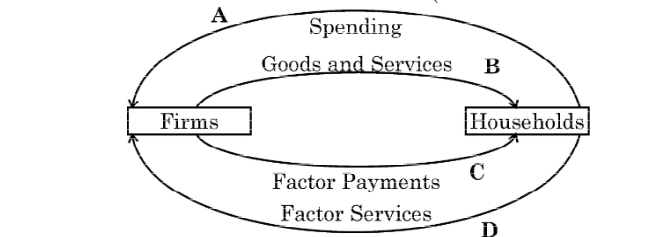
               

[1 Mark] Diagram 1 – CBSE Class 12 Humanities Economics 2023 Set 2 Solutions
  • (A) Money flow
  • (B) National flow
  • (C) Real flow
  • (D) Nominal flow
Explanation:

The flow indicated by B and D corresponds to the flow of goods and services and factors of production between households and firms. According to the provided context, flows measured over a period of time, such as the physical movement of goods and services or factor services, are called real flows. This differentiates from nominal flows which measure money values. Therefore, B and D represent real flow in the circular flow of income.

Question 10.

Assuming that, the following data is given for an imaginary economy : 

The balance of Trade from 2020 to 2021━━━━━━━━━━ by ₹ ━━━━━━━━━━ crore.

(Choose the correct alternative)
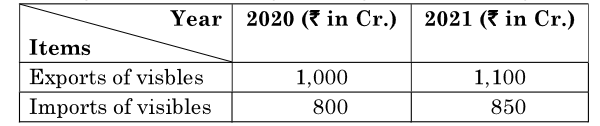
[1 Mark] Diagram 2 – CBSE Class 12 Humanities Economics 2023 Set 2 Solutions
  • (A) increased, 200
  • (B) increased, 50
  • (C) decreased, 200
  • (D) decreased, 50
Explanation:

Since exports are higher than imports in both years, the balance of trade is positive. In 2020, the balance of trade was ₹200 crore (1000 − 800). In 2021, it increased to ₹250 crore (1100 − 850). Thus, exports increased more than imports, causing the balance of trade to rise by ₹50 crore from 2020 to 2021. Hence, the correct conclusion is that the balance of trade increased by ₹50 crore.

Question 11.

In order to tackle the problem of rising general price level in an economy, government may come up with a surplus budget to achieve the budget objective Of ━━━━━━━━━━ .

(i)  reallocation of resources

(ii) price stability

(iii) redistribution of income

Alternatives :


[1 Mark]
  • (A) (iii) only
  • (B) (ii) only
  • (C) (i) and (iii)
  • (D) (i) only
Explanation: The correct answer is (ii) only. A surplus budget is often used by the government to control inflation and achieve price stability by reducing the demand in the economy. This helps in stabilizing the general price level.
Question 12.

Read the following statements — Assertion (A) and Reason (R).

Choose one ofthe correct alternatives given below :                      

Assertion (A) : At the break-even level of income, the value of Average Propensity to Consume (APC) is zero.

Reason (R) : Sum Of Average Propensity to Consume (APC) and Average Propensity to Save (APS) is always equal to one.

Alternatives :

[1 Mark]
  • (A) Assertion (A) is true, but Reason (R) is false.
  • (B) Both Assertion (A) and Reason (R) are true and Reason (R) is not the correct explanation of Assertion (A).
  • (C) Assertion (A) is false, but Reason (R) is true.
  • (D) Both Assertion (A) and Reason (R) are true and Reason (R) is the correct explanation of Assertion (A).
Explanation: The sum of Average Propensity to Consume (APC) and Average Propensity to Save (APS) is always equal to one, which makes Reason (R) true. However, at the break-even level of income, APC equals one (because all the income is consumed and saving is zero), not zero. Therefore, Assertion (A) is false.
Question 13.

━━━━━━━━━━ refers to that level of Aggregate Demand, which can be met by the corresponding supply in the economy.

(Fill up the blank with correct alternative)                                                                                    

[1 Mark]
  • (A) Excess Demand
  • (B) Deficient Demand
  • (C) Autonomous Consumption
  • (D) Effective Demand
Explanation: The correct answer is 'Effective Demand' because it specifically refers to the level of demand in the economy that can be satisfied by the available supply. It indicates the point where consumers are willing to purchase goods and services at prevailing prices, ensuring that the aggregate supply can meet this demand.
Question 14.

━━━━━━━━━━ formulates the Monetary Policy in the economy.

(Fill up the blank with correct alternative)                                                                                     

[1 Mark]
  • (A) International Monetary Fund
  • (B) Central Government
  • (C) Commercial Banks
  • (D) Central Bank
Explanation: The correct option is 'Central Bank' because the Central Bank is responsible for formulating and implementing the monetary policy in an economy, which involves controlling the money supply and interest rates to achieve economic stability and growth.
Question 15.

In the Indian economy, ━━━━━━━━━━ are issued by the Reserve Bank of India and acts as legal tender money.

(i) Coins of all denomination

(ii) Currency notes of various denominations, except one rupee note

(iii) Demand deposits

Alternatives:

[1 Mark]
  • (A) Only (i)
  • (B) (i) and (ii)
  • (C) Only (ii)
  • (D) Only (iii)
Explanation: The correct answer is (ii) Currency notes of various denominations, except one rupee note. In India, the Reserve Bank of India issues currency notes which are recognized as legal tender. While coins of one rupee and above are also issued by the Reserve Bank, they are not included in option (ii). Therefore, currency notes (except the one rupee note) are primarily accepted as legal tender.
Question 16.

Which of the following is NOT true about foreign trade during the colonial rule ?

(Choose the correct alternative)

[1 Mark]
  • (A) India suffered from large trade deficit.
  • (B) Britain maintained a monopoly control over India's exports and imports.
  • (C) Restrictive policies Of commodity production, were followed.
  • (D) India became an exporter of primary products and an importer of finished consumer goods.
Explanation: The correct answer is 'India suffered from large trade deficit.' This statement is NOT true because during the colonial period, India primarily exported raw materials and imported finished goods, which led to a trade surplus in favor of British industries rather than a large trade deficit for India.
Question 17.

━━━━━━━━━━ is a process, which includes all the activities from sowing till sale of the final produce in the market.

(Fill up the blank with correct alternative)                                                                          

[1 Mark]
  • (A) Rural Development
  • (B) Organic Farming
  • (C) Agricultural Diversification
  • (D) Agricultural Marketing
Explanation: The correct option is 'Agricultural Marketing' because this term encompasses all the activities involved in the entire journey of agricultural products, from sowing the seeds to selling the final produce in the market.
Question 18.

━━━━━━━━━━ have emerged as an important micro finance system and led to women empowerment. (Fill up the blank with correct alternative)

[1 Mark]
  • (A) NABARD
  • (B) Commercial Banks
  • (C) Self- Help Groups
  • (D) Land Development Banks
Explanation: Self-Help Groups (SHGs) have emerged as an important micro finance system that empowers women by providing them financial support, promoting self-employment, and encouraging savings and group activities, leading to their overall social and economic development.
Question 19.

Read the following statements — Assertion(A) and Reason (R). Choose one of the correct alternatives given below :

Assertion (A) : Human capital is not traded in the market; however its services are traded.

Reason (R) : Human capital is intangible in nature.

Alternatives :

[1 Mark]
  • (A) Both Assertion (A) and Reason (R) are true and Reason (R) is the correct explanation of Assertion (A).
  • (B) Both Assertion (A) and Reason (R) are true and Reason (R) is not the correct explanation of Assertion (A).
  • (C) Assertion (A) is true, but Reason (R) is false.
  • (D) Assertion (A) is false, but Reason (R) is true.
Explanation: Both Assertion (A) and Reason (R) are true and Reason (R) is the correct explanation of Assertion (A). Human capital, which includes skills and knowledge of individuals, cannot be sold or traded directly in the market but the services that utilize this human capital can be traded. The intangible nature of human capital supports the validity of Assertion (A).
Question 20.

Benefits of physical capital accrue only to private entities, whereas human capital provides private as well as ━━━━━━━━━━ benefits.

  (Fill up the blank with correct alternative)                                                                                     


[1 Mark]
  • (A) profitable
  • (B) social
  • (C) monetary
  • (D) fiscal
Explanation: The correct option is 'social', as human capital not only benefits the individuals who possess it but also contributes positively to society as a whole through enhanced productivity, better governance, and improved social outcomes.
Question 21.

Which of the following was NOT the benefit accruing from 'Golden Revolution' ?                                          

(Choose the correct alternative)                                                                                                                     

[1 Mark]
  • (A) Employment for women in rural areas.
  • (B) Increase in production and exports of fruits and vegetables.
  • (C) Increase in production of milk and related products.
  • (D) Increase in the income of the farmers.
Explanation: The correct option is 'Employment for women in rural areas.' The 'Golden Revolution' primarily focused on increasing the production of horticultural products such as fruits and vegetables, as well as milk and related products, which led to an increase in farmers' incomes and exports. However, while it may have contributed to some employment opportunities, it was not specifically aimed at increasing employment for women in rural areas.
Question 22.

Read the following statements carefully:

Statement 1: China introduced structural economic reforms on without any pressure.

Statement 2: Scholars argue that in India, the economic reforms led to the worsening of all the economic indicators.

In the light of the given statements, choose the correct alternative the following:

[1 Mark]
  • (A) Both Statements 1 and 2 are true.
  • (B) Statement 1 is false and Statement 2 is true.
  • (C) Both Statements 1 and 2 are false.
  • (D) Statement 1 is true and Statement 2 is false.
Explanation:

Statement 1 is false because China's economic reforms were influenced by various external and internal pressures, including the need for modernization and globalization. Statement 2 is also false because while some scholars may argue about mixed outcomes, it is not universally accepted that all economic indicators worsened in India due to reforms. Therefore, the correct option would be 'Both Statements 1 and 2 are false.'

Question 23.

From the set Of the events given in Column — I and the corresponding year in Column — Il, choose the incorrect pair :  

Alternatives :
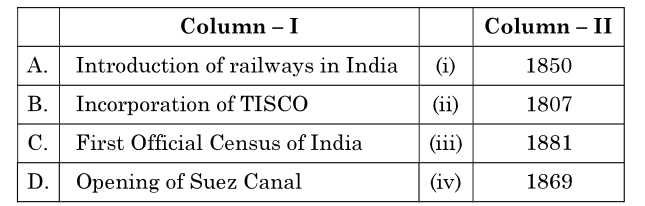
[1 Mark] Diagram 3 – CBSE Class 12 Humanities Economics 2023 Set 2 Solutions
  • (A) C — (iii)
  • (B) A— (i)
  • (C) B — (ii)
  • (D) D — (iv)
Explanation:

Based on the given context and data, the pairs A—(i), B—(ii), and C—(iii) are consistent with the values and calculations shown, especially when checking differences and squared differences. However, D — (iv) does not match the corresponding values or calculated differences correctly, making it the incorrect pair.

Question 24.

China initiated ━━━━━━━━━━  in 1958, that aimed at industrializing the country on a massive scale. (Fill up the blank with correct alternative)

[1 Mark]
  • (A) The Great Proletarian Cultural Revolution
  • (B) Setting up of Special Economic Zones
  • (C) The Great Leap Forward Campaign
  • (D) Introduction of Economic Reforms
Explanation: The correct answer is 'The Great Leap Forward Campaign'. This campaign was launched by the Chinese Communist Party to rapidly transform the country from an agrarian economy to a socialist society through rapid industrialization and collectivization.
Question 25.

━━━━━━━━━━ acts as a measure Of 'the extent Of democratic participation in social and political decision-making.'

(Fill up the blank with correct alternative)                                                                                     

[1 Mark]
  • (A) Economic Growth
  • (B) Poverty Index
  • (C) Liberty Indicator
  • (D) Human Development Index
Explanation: The context explains that along with the Human Development Index, there is an additional measure known as the 'liberty indicator' which specifically measures the extent of democratic participation in social and political decision-making. Therefore, the correct answer is 'Liberty Indicator' because it directly relates to measuring democratic participation.
Question 26.

In an economy, when the rate Of resource extraction is lower than the rate of regeneration of the resource, the environment may operate ━━━━━━━━━━ .

(Fill up the blank with correct alternative)

[1 Mark]
  • (A) within its carrying capacity.
  • (B) beyond its aesthetic capacity.
  • (C) beyond its absorptive capacity.
  • (D) beyond its carrying capacity.
Explanation: The correct answer is 'within its carrying capacity.' This is because when resources are extracted at a rate lower than they can regenerate, the environment is sustainable and operates within its limits, or carrying capacity, ensuring that resources are replenished and not depleted.
Question 27.

Read the following statements carefully :  

Statement I : Amongst India, China and Pakistan, China is the largest nation and has the highest population density.

Statement 2 : One-child policy introduced in the late 1970s in China led to a considerable decline in the population growth rate.

In the light Of the given statements, choose the correct alternative from the following :

[1 Mark]
  • (A) Both Statements 1 and 2 are true.
  • (B) Both Statements 1 and 2 are false.
  • (C) Statement 1 is false and Statement 2 is true.
  • (D) Statement 1 is true and Statement 2 is false.
Explanation: Statement 1 is false because, while China is the largest nation by area among the three, it does not have the highest population density; that distinction belongs to India. Statement 2 is true, as the one-child policy significantly contributed to a decline in China's population growth rate.
Question 28.

On the basis of the data given below, identify the incorrect statement in terms of annual growth Of GDP (%) :   (Choose the correct alternative)

Alternatives :
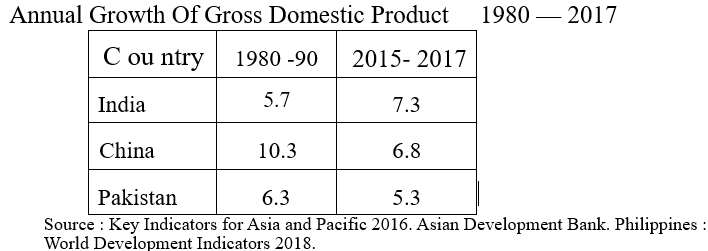
[1 Mark] Diagram 4 – CBSE Class 12 Humanities Economics 2023 Set 2 Solutions
  • (A) Both China and Pakistan experienced a decline in growth rate during 2015-17.
  • (B) Pakistan was ahead Of India during 1980 — 2017.
  • (C) China was able to maintain near double-digit growth during the 1980s.
  • (D) India experienced a rapid rise in Gross Domestic Product during 2015-17.
Explanation: The incorrect statement is 'Pakistan was ahead Of India during 1980 — 2017.' Based on historical GDP data, India has consistently outperformed Pakistan in terms of GDP growth during this period, making this statement factually incorrect.

Section C

Question 29.

"Under the flexible exchange rate system, the Central Bank does not intewene in the foreign exchange market."

Justify the statement, giving valid arguments.

[3 Marks]
Answer: Under a flexible exchange rate system, the value of a currency is determined by market forces, primarily supply and demand. This allows for greater autonomy in monetary policy, as the Central Bank does not need to maintain a fixed exchange rate. Without intervention, the currency can naturally adjust to economic conditions, helping to absorb shocks and enhance competitiveness. Moreover, non-intervention reduces the risk of moral hazard, as businesses and investors must adapt to real market signals, fostering a more stable economic environment in the long run.
Key Points: Market-driven currency value; Autonomy in monetary policy; Natural adjustment to economic conditions; Absorption of economic shocks; Enhances competitiveness; Reduces moral hazard; Businesses adapt to real signals.
Question 30.

On the basis Of the data given below for an imaginary economy, estimate the value of Net Domestic Product at factor cost (NDP C)
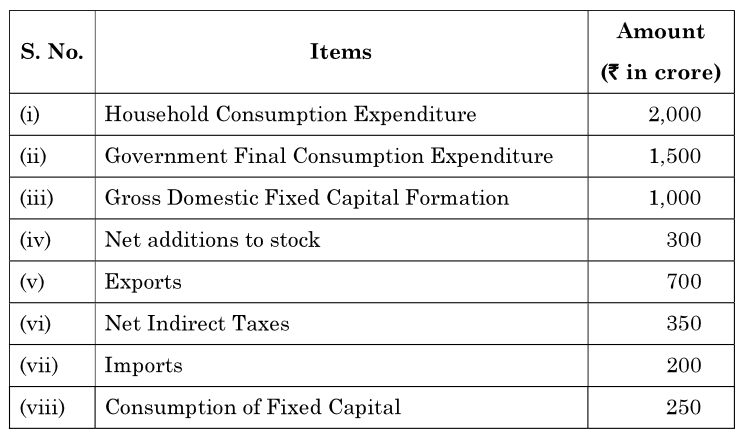
[3 Marks] Diagram 5 – CBSE Class 12 Humanities Economics 2023 Set 2 Solutions
Answer: To estimate the Net Domestic Product at factor cost (NDP C), we start with Gross Domestic Product at market prices (GDP MP). First, we deduct depreciation (capital consumption allowance) from GDP MP to obtain Net Domestic Product at market prices (NDP MP). Next, we subtract indirect taxes and add subsidies to convert from market prices to factor cost. This process provides us with the NDP C, which represents the income generated in the domestic economy. It reflects the actual earning available to the factors of production, crucial for understanding the economy's performance.
Key Points: Start with GDP MP; deduct depreciation for NDP MP; subtract indirect taxes; add subsidies; results in NDP C; significance of NDP C in reflecting income earned in the economy.
Question 31.

Explain the impact Of home currency depreciation on the exports Of a nation.

[3 Marks]
Answer: Home currency depreciation makes a nation's exports cheaper for foreign buyers. This is because goods priced in the local currency become less expensive when converted into foreign currencies. As a result, foreign demand for these exports typically increases, leading to higher sales and revenue for exporters. Additionally, depreciation can help improve the balance of trade by reducing the trade deficit or increasing the trade surplus. However, while export volumes may rise, the cost of imported goods increases, which could lead to inflation in the domestic economy.
Key Points: Cheaper exports-increased demand-boosted sales-revenue growth-balance of trade improvement-import costs rise-inflation potential
Question 32.

"Serious concerns over the climate change is taking over the attention of the world."

In the light of the above statement and image, discuss any two strategies to tackle this global concern of Environmental degradation.
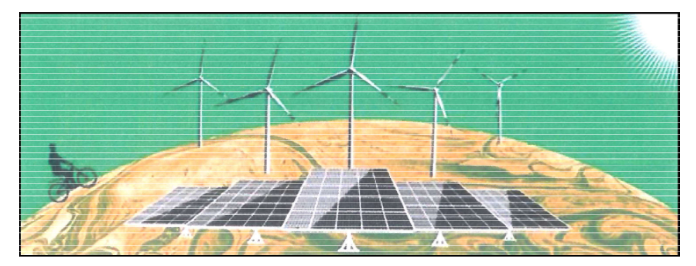
[3 Marks] Diagram 6 – CBSE Class 12 Humanities Economics 2023 Set 2 Solutions
Answer: Environmental degradation is a pressing issue that demands immediate attention and action. One effective strategy to tackle this concern is the implementation of renewable energy sources, such as solar and wind power. By transitioning from fossil fuels to clean energy, we can significantly reduce greenhouse gas emissions, which are a major contributor to climate change. Additionally, promoting sustainable agricultural practices is essential. Sustainable farming not only conserves biodiversity but also reduces soil degradation and greenhouse gas emissions. Farming techniques such as crop rotation, organic farming, and agroforestry enhance soil health and reduce environmental impact. Together, these strategies can combat climate change and help restore ecological balance.
Key Points: Implementation of renewable energy sources - Transitioning to clean energy reduces greenhouse gas emissions - Promoting sustainable agricultural practices - Sustainable farming conserves biodiversity and reduces soil degradation
Question 33.

Recently the Government of India has taken numerous steps towards increasing the farmer's income through agricultural diversification."                                                          

  In light of the above statement, explain any two advantages of diversification in agricultural.

[3 Marks]
Answer: Agricultural diversification provides numerous benefits that can significantly enhance farmers' livelihoods. Firstly, it reduces risk; by cultivating a variety of crops or integrating livestock, farmers are less vulnerable to market fluctuations or crop failures. This income stability is crucial, especially in the face of climate change and unpredictable weather patterns. Secondly, diversification can lead to higher profitability. Different crops or products can cater to various markets, potentially increasing overall income for farmers. For instance, adding organic produce or value-added products can attract better prices. Therefore, diversification not only secures farmers' income but also enhances their economic resilience and sustainability.
Key Points: Risk reduction through crop variety; Income stability; Higher profitability from multiple crops; Access to different markets; Sustainability in farming practices
Question 34.

"Active Government intervention is essential in education and health sectors in India."

Do you agree with the given statement ? Give reasons in support of your answer.

[3 Marks]
Answer: Yes, I agree that active government intervention is essential in the education and health sectors in India. Firstly, the government plays a crucial role in ensuring equitable access to education and healthcare for marginalized communities. This is vital in reducing disparities and promoting social justice. Secondly, government intervention helps in regulating standards and quality in these sectors, ensuring that institutions meet necessary benchmarks. Additionally, through policies and funding, the government can invest in infrastructure, improving facilities and resources in schools and hospitals. This also includes taking steps to increase literacy rates and healthcare accessibility, thus fostering overall development. In summary, without effective government involvement, achieving sustainable improvements in education and health would be challenging.
Key Points: Equitable access to education and healthcare; Regulation of quality and standards; Investment in infrastructure; Reducing disparities; Promoting social justice

Section D

Question 35.

"In an economy ex-ante Aggregate Demand is more than ex-ante Aggregate Supply.'

Explain its impact on the level of output, income and employment.

[4 Marks]
Answer: When ex-ante Aggregate Demand exceeds ex-ante Aggregate Supply, it indicates that consumers and businesses wish to purchase more goods and services than the economy can produce at that moment. This situation leads to a rise in production as firms respond to the higher demand by increasing output. Consequently, the increase in production requires more labor, which boosts employment levels. As firms hire more workers, income levels also rise due to increased wages, leading to further consumption and investment in the economy. This positive feedback loop can stimulate economic growth. However, if the demand persists without an equal rise in supply, it may lead to inflationary pressures as prices begin to rise due to the increased demand. Overall, the surging demand positively impacts output, income, and employment in the short run, encouraging economic growth.
Key Points: Ex-ante Aggregate Demand exceeds Aggregate Supply-Production increases to meet demand-Employment rises as firms hire more workers-Income levels increase due to higher wages-Potential for inflation if demand outstrips supply
Question 36.

"The process of credit creation by commercial banks comes to an end when the total Of required reserves become equal to the initial deposits."

With the help Of a numerical example, prove that the given statement is true.    

[4 Marks]
Answer: The process of credit creation by commercial banks indeed comes to an end when the total required reserves equal the initial deposits made. For instance, consider a simple example where a bank has a reserve ratio of 20%. If a customer makes an initial deposit of $1000, the bank must keep $200 as reserves (20% of $1000). It can then lend out the remaining $800. When this $800 is deposited in the same or another bank, it must keep $160 as reserves (20% of $800) and can lend $640. Ultimately, this cycle continues until the total required reserves equal $1000. Once all potential loans and deposits are accounted for, the total reserves will match the initial deposit, illustrating that credit creation has reached its limit.
Key Points: 1. Definition of credit creation process; 2. Example of initial deposit and reserve ratio; 3. Calculation of required reserves and total loans; 4. Explanation of how reserves equal initial deposits over time.
Question 37.

For a hypothetical economy, assuming there is an increase in the Marginal Propensity to Consume (MPC) from 75% to 90% and change in investment to be 1,000 crore.

Using the concept Of investment multiplier, calculate the increase in income due to change in Marginal Propensity to Consume (MPC).

[4 Marks]
Answer: Given: Initial MPC (MPC1) = 0.75, New MPC (MPC2) = 0.90, Change in investment (I) = 1,000 crore.
Step 1: Calculate the initial investment multiplier (k1) = 1 / (1 - MPC1) = 1 / (1 - 0.75) = 1 / 0.25 = 4.
Step 2: Calculate the new investment multiplier (k2) = 1 / (1 - MPC2) = 1 / (1 - 0.90) = 1 / 0.10 = 10.
Step 3: Calculate increase in income due to change in MPC using the formula: Increase in income = (k2 - k1) * Change in investment = (10 - 4) * 1,000 = 6,000 crore.
Conclusion: The increase in income due to the change in MPC from 0.75 to 0.90 is 6,000 crore.
Key Points: Investment multiplier formula - Calculation of initial and new multipliers - Increase in income due to change in MPC
Question 38.

With suitable examples, distinguish between Direct taxes and Indirect taxes.

[4 Marks]
Answer: Direct taxes are those that are paid directly to the government by the taxpayer. They are based on income, wealth, or profit. For example, income tax and corporate tax are direct taxes. The burden of these taxes cannot be transferred to another party. In contrast, indirect taxes are levied on goods and services and are paid indirectly by consumers. Examples include Goods and Services Tax (GST) and sales tax. Here, the tax burden can be shifted from the seller to the buyer, as the cost is included in the price of goods or services.
Key Points: Definition of direct taxes-Examples of direct taxes (income tax, corporate tax)-Characteristics of direct taxes-Definition of indirect taxes-Examples of indirect taxes (GST, sales tax)-Characteristics of indirect taxes (transfer of burden)
Question 39.

Discuss any two merits and demerits of the Green Revolution in the agricultural sector in the Indian economy.

[4 Marks]
Answer: The Green Revolution, initiated in India during the 1960s, brought significant changes to agriculture. One of the primary merits was the increase in crop yields, particularly for wheat and rice, which enhanced food security and reduced reliance on food imports. Additionally, it introduced high-yield variety seeds and modern farming techniques, leading to increased income for many farmers. However, it also had notable demerits. The heavy reliance on chemical fertilizers and pesticides resulted in environmental degradation and soil health deterioration. Furthermore, the benefits were not uniformly distributed, often favoring wealthy farmers while marginalizing smallholder farmers, thus exacerbating inequalities in rural areas.
Key Points: Increase in crop yields; enhanced food security; introduction of modern farming techniques; environmental degradation; reliance on chemical fertilizers; unequal benefits for farmers; rural inequalities.
Question 40.

On the basis of the given data :

(i) Identify one income indicator and one health indicator, each.                  
(ii) Compare India and China on the basis of any one of the indicator identified above in part (i).    
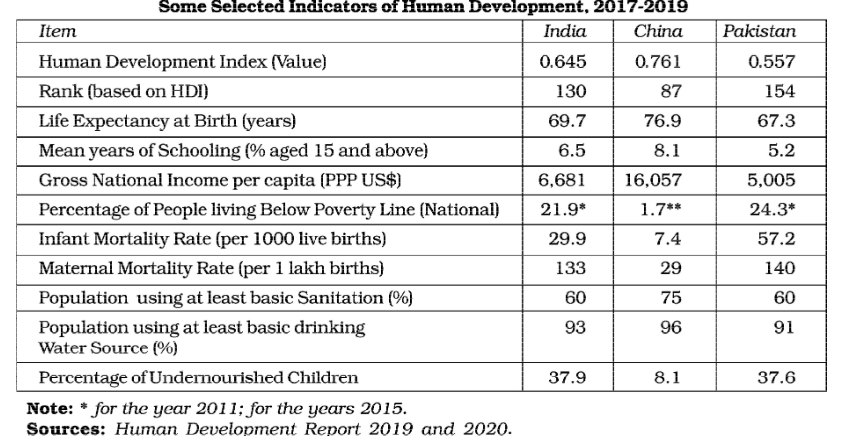
[4 Marks] Diagram 7 – CBSE Class 12 Humanities Economics 2023 Set 2 Solutions
Answer: (i) One income indicator is GDP per capita, which shows average income of people in a country. One health indicator is life expectancy, which shows average number of years a person is expected to live.
(ii) Comparing India and China based on GDP per capita, China has a higher GDP per capita than India. This means on average, people in China earn more money than people in India, indicating a better economic condition in China. Similarly, China also has a higher life expectancy than India, meaning people in China generally live longer due to better health facilities and living conditions.
Key Points: Income indicator - GDP per capita - Health indicator - Life expectancy - China has higher GDP per capita and life expectancy compared to India
Question 41.

"Expenditure on On-the-job training is an important means of human capital formation in an economy."

Give valid reasons to justify the given statement.

[4 Marks]
Answer: Expenditure on on-the-job training significantly contributes to human capital formation as it enhances the skills and productivity of the workforce. Firstly, it allows employees to adapt to new technologies and processes, ensuring that their skills remain relevant in a rapidly evolving job market. Secondly, it promotes a culture of continuous learning, leading to higher employee satisfaction and retention. Additionally, businesses benefit from increased efficiency and innovation, driving economic growth. Therefore, investing in on-the-job training is crucial for developing a competitive workforce and fostering economic development.
Key Points: Enhances workforce skills-Adaptation to technology-Promotes continuous learning-Improves employee satisfaction-Increases business efficiency and innovation-Drives economic growth
Question 42.

"Organic Farming is the need of the hour to promote sustainable development but, has its own limitations."

Elaborate any two advantages and limitations each of organic farming in the light of the above statement.

[4 Marks]
Answer: Organic farming plays a vital role in promoting sustainable development through practices that maintain ecological balance. One significant advantage is the enhancement of soil health. Organic farming uses natural fertilizers and compost, which improve soil structure and fertility, leading to better crop yields. Additionally, it reduces chemical runoff into water bodies, safeguarding aquatic ecosystems. However, organic farming has limitations, including lower yields compared to conventional methods, which can lead to food shortages. Furthermore, organic products often come at a higher cost, making them less accessible to a wider population. These factors can hinder the expansion of organic farming as a mainstream agricultural practice.
Key Points: Enhances soil health, reduces chemical runoff, lower yields, higher costs

Section E

Question 43.

(i)'Kavya works on her family farm and is neither paid in cash nor in the form of grains.'

Can she be categorized as a worker ? Give valid reasons in support of your answer.  

(ii)"In the late 1990's India experienced a widening gap between the growth of GDP and employment generation". Discuss.

[6 Marks]
Answer: In the context of labor definitions, Kavya can indeed be categorized as a worker, albeit an informal one. Workers are typically defined based on their engagement in productive activities, which is the case for Kavya as she contributes to her family farm's agricultural output. Even if she does not receive a formal salary or payment in kind, her involvement in the farm's operations constitutes her contribution to the economy. Informal work, which includes family labor, is significant in India, reflecting a cultural aspect wherein family members often contribute without direct monetary compensation. Recognizing such contributions is essential for a comprehensive understanding of the labor market, especially in rural settings. Conversely, analyzing India's economic landscape in the late 1990s, it is evident that GDP growth did not lead to proportional job creation. A focus on capital-intensive industries predominated, resulting in increased productivity but fewer employment opportunities in traditional sectors. Coupled with demographic pressures, the gap between economic growth and employment generation reflected systemic issues in labor market dynamics, which led to widespread underemployment and unfulfilled potential for many skilled individuals. This dual consideration of Kavya's status and broader economic trends highlights the complexity of employment classifications in India’s socio-economic fabric.
Key Points: Informal worker definition-importance of family labor-GDP growth without job creation-capital-intensive focus-underemployment issues
Question 44.

(i) Define Worker Population Ratio. Discuss its usefulness.

(ii) 'Mr. Rishi, after completing his education, has joined his family business but his marginal productivity is zero.'

Comment upon the employment status of Mr. Rishi. Give valid reasons in support of your answer.

[6 Marks]
Answer: The Worker Population Ratio (WPR) is defined as the ratio of the total number of workers to the total population in a given area or country, usually expressed as a percentage. It is calculated by dividing the number of workers by the total population and then multiplying by 100. The WPR is useful as it indicates the extent of employment in an economy, helps assess labor force participation, and provides insights into economic productivity. A higher WPR suggests more engagement in productive activities, while a low ratio may indicate unemployment or underemployment. In the case of Mr. Rishi, who has joined his family business but has a marginal productivity of zero, it can be argued that despite his employment, he is not contributing significantly to production. This suggests that his role in the family business is unproductive, potentially indicating overstaffing or lack of efficient utilization of resources. Such a scenario raises questions about effective employment status, showcasing that simply being employed does not guarantee contribution to economic activity. Therefore, while Mr. Rishi is technically employed, the lack of productivity implies that he may not be effectively contributing to the family's income or overall economic output. Thus, evaluating employment status should also consider productivity levels alongside mere participation.
Key Points: Definition of Worker Population Ratio (WPR)-Usefulness of WPR (employment assessment, labor force participation)-Mr. Rishi's employment status analysis (zero marginal productivity, non-contribution to economic activity, overstaffing implications)
Question 45.

(i) "Many goods and services which may contribute to welfare, but are not included in estimating Gross Domestic Product (GDP)." Do you agree with the given statement ? Give valid reason in support Of your answer.     

(ii) With suitable examples, distinguish between final goods and intermediate goods.     

[6 Marks]
Answer: I agree with the statement that many goods and services contribute to welfare but are not included in GDP estimation. For instance, volunteer work and home production are significant contributors to societal welfare but are typically not captured in GDP figures. Similarly, environmental services provided by nature, such as clean air and water, play a crucial role in enhancing quality of life but remain unaccounted in GDP calculations. These omissions highlight that GDP is an incomplete measure of economic well-being as it focuses primarily on market transactions while disregarding non-market activities that influence overall welfare. Furthermore, GDP does not account for negative externalities, like pollution, which can diminish welfare even as GDP might rise. As a result, while GDP serves as a vital economic indicator, it is imperative to consider a more comprehensive approach to gauge societal welfare.
Key Points: GDP limitations; Non-market contributions; Volunteer work; Home production; Environmental services; Exclusion of negative externalities; Need for comprehensive welfare measures
Question 46.

(i) Using a suitable numerical example, distinguish between Real Gross Domestic Product (GDP) and Nominal Gross Domestic Product (GDP).                                                                  

(ii) State the meaning of 'normal resident' of a country.

[6 Marks]
Answer: Gross Domestic Product (GDP) can be measured in two forms: Nominal GDP and Real GDP. Nominal GDP is the market value of all final goods and services produced in a country in a given year, using current prices. For example, if a country produces 100 units of a product priced at $10 each in one year, the nominal GDP is $1,000. However, Real GDP adjusts this figure for inflation to reflect true output. If in the same year, inflation was 10%, the Real GDP would be $1,000 / (1 + 0.10) = $909.09. This shows that while nominal GDP reflects the current market prices, Real GDP accounts for price changes over time, giving a clearer picture of economic growth. A 'normal resident' of a country is defined as an individual who has a regular and permanent residence within the country, irrespective of their citizenship status. This includes individuals who may not have citizenship but reside in the country for an extended period, contributing to the economy and society.
Key Points: Define Nominal GDP-Provide numerical example-Define Real GDP-Explain inflation adjustment-Difference in economic growth measurement-Define normal resident-Characteristics of a normal resident

Paper Details

CBSE Board Exam 2023

Class

Class 12 Humanities

Subject

Economics

Year

2023

Set

Set 2

Other Years — Economics

2022 Set-1

2022 Set-2

2022 Set-3

2022 Set-4

2022 Set-5

2023 Set-1

2023 Set-2

2023 Set-3

2023 Set-4

2023 Set-5

2024 Set-1

2024 Set-2

2024 Set-3

2024 Set-4

2024 Set-5

2025 Set-1

2025 Set-2

2025 Set-3

2025 Set-4

2025 Set-5

2025 Set-6

CBSE Class 12 Economics 2023 Set 2 Solutions | Prepzy