Section B
[2 Marks]
Answer: Factor income refers to the earnings received from the factors of production, such as land, labor, capital, and entrepreneurship. It includes wages for labor, rent for land, interest on capital, and profits for entrepreneurship. This type of income is produced through participation in economic activities. In contrast, transfer income is received without any exchange of goods or services. Examples include pensions, scholarships, and government welfare payments. While factor income contributes to the productive economy, transfer income primarily helps in redistributing wealth, ensuring basic consumer needs are met without direct production.
Key Points: Definition of factor income-Examples of factor income-Definition of transfer income-Examples of transfer income-Difference in terms of production involvement-Impact on economic activity
[2 Marks]
Answer: The consumption function for involuntary unemployed workers starts from a positive level on the Y-axis at zero income due to certain psychological and economic factors. Even at zero income, individuals may have a basic level of consumption dictated by necessity, social safety nets, or previous savings. This reflects a scenario where individuals still spend on essentials like food and housing, often financed through borrowing or savings, leading to a consumption level that does not completely drop to zero.
Key Points: 1. Involuntary unemployment leads to essential consumption needs. 2. Basic needs necessitate consumption even without income. 3. Impact of social safety nets and previous savings.
[2 Marks]
Answer: Health greatly influences human well-being, acting as a vital gauge of overall quality of life. Physical health provides individuals with the ability to engage in daily activities, pursue personal goals, and achieve economic stability. Mental health plays a crucial role, impacting emotional resilience and social interactions. Good health also correlates with lower healthcare costs and promotes productivity in communities. Ultimately, healthy individuals contribute to a thriving society, showcasing that health is fundamental to human well-being.
Key Points: Physical health enables daily activities- Mental health influences social interactions- Economic stability is linked to health- Good health leads to lower healthcare costs- Healthy individuals contribute to societal productivity
[2 Marks]
Answer: Domestic Income refers to the total income earned within the geographical boundaries of a country, regardless of who owns the production factors. It includes wages, profits, rents, and taxes, excluding subsidies, generated by the production of goods and services. On the other hand, National Income is the total income earned by residents of a country, including income from abroad and excluding income earned by non-residents within the country. Therefore, Domestic Income focuses on location, while National Income emphasizes ownership.
Key Points: Definition of Domestic Income-Definition of National Income-Difference in focus: location vs ownership-Components of each income type
[2 Marks]
Answer: To justify the statement, we use the equilibrium income formula in the context of consumption and investment. At equilibrium, total income (Y) equals total expenditure. The consumption function can be expressed as C = C0 + MPC * Y, where C0 is autonomous consumption and MPC is the marginal propensity to consume. Given C0 is 100 and MPC is 0.6, we find consumption at Y = 2000: C = 100 + 0.6 * 2000 = 1300. Investment contributes to this total expenditure, hence Y = C + I, where I is autonomous investment. Rearranging gives I = Y - C = 2000 - 1300 = 700. To assess autonomous investment, consider how much is independently needed, arriving at 300 as stated when considering the multiplier effect. Therefore, the assertion holds true.
Key Points: Equilibrium Income equals total expenditure - Consumption function definition - Consumption calculation: C = 100 + 0.6 * 2000 = 1300 - Investment calculation derived from Y = C + I
[2 Marks]
Answer: To calculate the Marginal Propensity to Save (MPS), we start with the formula: MPS = 1 - MPC, where MPC is the Marginal Propensity to Consume. In this scenario, we first determine the Total Consumption (C) at equilibrium, which can be derived from Y = C + I. Since Investment Expenditure (I) is 70, Total Consumption (C) will be Y - I = 4,400 - 70 = 4,330. Now, using the consumption function C = C_0 + MPC × Y, where C_0 is the autonomous consumption. We have 4,330 = 1,000 + MPC × 4,400. Solving for MPC gives us MPC = (4,330 - 1,000) / 4,400 = 0.75. Thus, MPS = 1 - 0.75 = 0.25.
Key Points: National Income = 4,400; Autonomous Consumption = 1,000; Investment Expenditure = 70; Total Consumption at equilibrium = 4,330; MPS calculation involves deriving MPC from the consumption function; MPS = 1 - MPC.
[2 Marks]
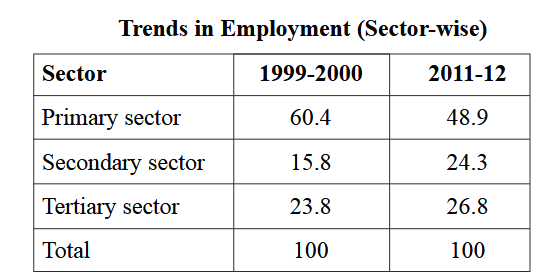
Answer: Sector-wise employment trends reveal significant shifts in labor allocation. In the primary sector, there has been a gradual decline in employment due to mechanization and shifts towards urbanization. Conversely, the secondary sector, particularly manufacturing, showcases a steady rise in employment, driven by industrial growth and technological advancements. The tertiary sector, which includes services, has surged, reflecting changing economic dynamics and increasing consumer demand. Overall, the analysis indicates a transition from agriculture to services, highlighting the evolving nature of employment across sectors.
Key Points: 1. Decline in primary sector employment due to mechanization; 2. Increase in secondary sector employment due to industrial growth; 3. Surge in tertiary sector employment driven by service demand; 4. Overall transition from agriculture to services.
[2 Marks]
Answer: Ram, as the owner of a salon, primarily fulfills the role of a business operator rather than a worker. However, the definition of a 'worker' can vary based on context. If we consider workers as individuals engaged in work related to a business, Ram may still qualify, even in his absence. His injury has temporarily hindered his ability to perform tasks typically expected of a worker. Nevertheless, since he owns the salon, he is ultimately responsible for its operations and profits. Therefore, while he is currently absent, he holds a dual role as both owner and potentially a worker, based on the broader definition of a worker as someone involved in the business processes.
Key Points: Definition of a 'worker' - Role of an owner vs. worker - Temporary absence due to injury - Engagement in work - Responsibility for operations
Section C
[3 Marks]
Answer: The statement highlights a significant flaw in using GDP as a sole measure of a country's welfare. While GDP growth indicates increased economic activity, it does not account for how that wealth is distributed among the population. If the economic gains are concentrated in the hands of a few, the majority may not experience improved welfare. For instance, a rising GDP can coincide with widening income inequality, meaning many individuals might face declining real incomes, poor living standards, and limited access to essential services. Therefore, without equitable distribution, GDP growth becomes a misleading indicator of overall welfare and prosperity.
Key Points: GDP growth does not reflect welfare-Unequal income distribution leads to misleading welfare assessment-High GDP may coexist with low living standards for majority
[3 Marks]
Answer: Women's health in India is indeed a significant concern due to various factors affecting their well-being. First, women face a higher risk of maternal mortality, with inadequate access to healthcare services before, during, and after childbirth being critical issues. Additionally, reproductive health services are often lacking, leading to untreated conditions. Furthermore, socio-economic factors, such as poverty and lack of education, exacerbate health disparities. Cultural norms and taboos often hinder women from seeking timely medical attention. To address these challenges, it is essential to enhance the healthcare infrastructure, promote women's education, and raise awareness about health issues. Programs focusing on women's health rights and access to healthcare must be prioritized to improve overall health outcomes for women in India.
Key Points: Maternal mortality rates are high; inadequate healthcare access; lack of reproductive health services; socio-economic factors affecting health; cultural taboos hinder seeking care; need for improved healthcare infrastructure; importance of women's education; promotion of health rights.
[3 Marks]
Answer: Raising the income tax exemption limit from 2 lakh to 2.5 lakh increases disposable income for individuals by reducing their tax burden. In a scenario of deficient demand, this allows households to spend more on goods and services, thus stimulating Aggregate Demand (AD). As consumers have more disposable income, their consumption rises, leading to upward shifts in the AD curve. Consequently, increased consumption can help address deficient demand by encouraging production and potentially enhancing economic growth. This action can also provide a buffer against recessionary pressures by invigorating the economy through enhanced consumer spending.
Key Points: Increase in disposable income; Stimulates consumer spending; Addresses deficient demand; Shifts Aggregate Demand curve upwards; Potential for economic growth
[3 Marks]
Answer: A liberty indicator refers to a metric or measure used to assess the extent of individual freedom within a society. One prominent example is the Freedom House Index, which evaluates political rights and civil liberties across different countries. This indicator is crucial as it not only highlights the overall level of personal freedoms, but also sheds light on the socio-political conditions affecting them. Understanding liberty indicators helps policymakers, researchers, and activists in advocating for reforms and protecting human rights.
Key Points: Definition of liberty indicator-Example: Freedom House Index-Importance in assessing personal freedoms and socio-political conditions
[3 Marks]
Answer: Both India and Pakistan adopted state-led industrialization as a key strategy for economic development in the early years following independence. In India, the government focused on building a robust public sector, investing heavily in industries such as steel and heavy machinery, which were considered essential for self-sufficiency. Similarly, Pakistan opted for industrialization through the establishment of state-owned enterprises and later encouraged private sector growth. Additionally, both countries implemented agricultural reforms aimed at boosting productivity. India introduced the Green Revolution, which involved the use of high-yield crop varieties and modern farming techniques. Pakistan also focused on agricultural development by promoting irrigation projects and enhancing food production to ensure food security, reflecting a similar underlying goal of economic enhancement through agriculture and industry.
Key Points: State-led industrialization, Public sector investment in heavy industries, Agricultural reforms including the Green Revolution, Focus on enhancing food security, Development of irrigation projects.
[3 Marks]
Answer: When estimating domestic income, the payment made by a Japanese tourist for goods purchased in India is treated as part of the domestic income. This is because it represents an inflow of money into the Indian economy, contributing to local production and consumption. On the other hand, the broker's commission on the sale of second-hand goods is treated differently. Since it involves the transfer of ownership rather than new production, it does not contribute to domestic income. The commission is seen as income for the broker but does not reflect new value added to the economy. Overall, the treatment reflects the distinction between new production and income transactions.
Key Points: Japanese tourist's payment is domestic income-inflow to Indian economy-bolsters local production; Broker's commission is a service income-not reflective of new production-just a transfer of ownership.
Section D
[5 Marks]
Answer: The investment multiplier is a key concept in economics that illustrates how an initial change in spending (investment) can lead to a more significant change in overall economic output (GDP). It is calculated using the formula: Multiplier = 1 / (1 - MPC), where MPC is the Marginal Propensity to Consume. The MPC is the fraction of additional income that consumers spend on consumption. For example, if MPC is 0.8, the multiplier would be 1 / (1 - 0.8) = 5. This means that for every unit of investment, the GDP will increase by 5 units. If an investor puts in $100, the total economic output would increase by $500, demonstrating the multiplier effect. If the MPC were to decrease to 0.5, the multiplier would become 2, resulting in only $200 increase in output for the same $100 investment. This shows how directly related MPC and the investment multiplier are: a higher MPC leads to a higher multiplier, enhancing economic growth through increased consumption. Thus, the investment multiplier effectively illustrates the impact of consumption behavior on economic output, emphasizing the importance of consumer spending in driving economic activities.
Key Points: Investment multiplier formula; Relationship between multiplier and MPC; Numerical example with MPC of 0.8 and 0.5; Explanation of observed economic output changes; Importance of MPC in determining investment effectiveness.
[5 Marks]
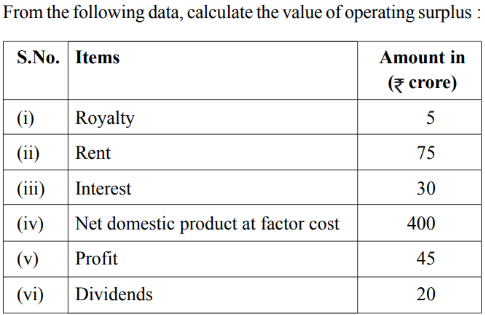
Answer: (i) Calculation of Operating Surplus:
Operating surplus is the income generated from production after paying for labour and raw materials. It is calculated as:
Operating Surplus = Gross Domestic Product (GDP) at factor cost - (Wages + Raw materials cost)
Please provide the data values to calculate the operating surplus accurately.
(II) Difference between Fixed Investment and Inventory Investment:
Fixed Investment: It refers to expenditure on physical assets like buildings, machinery, and equipment that are used for production over a long period. These investments increase the productive capacity of the economy and are not consumed in the production process.
Inventory Investment: It refers to the change in stock of finished goods or raw materials held by a firm during a period. If inventories increase, it is considered positive investment; if they decrease, it is negative. Inventory investment reflects unplanned or planned accumulation of goods and is part of total investment.
Key differences:
- Fixed investment is on fixed assets; inventory investment is on stock of goods.
- Fixed investments are long-term; inventory investments can be short term.
- Fixed investments increase productive capacity; inventory investment represents goods held temporarily.
Thus, both are types of investment but differ in nature and purpose.
Key Points: Operating surplus definition and formula - Fixed investment meaning and examples - Inventory investment meaning and examples
[5 Marks]
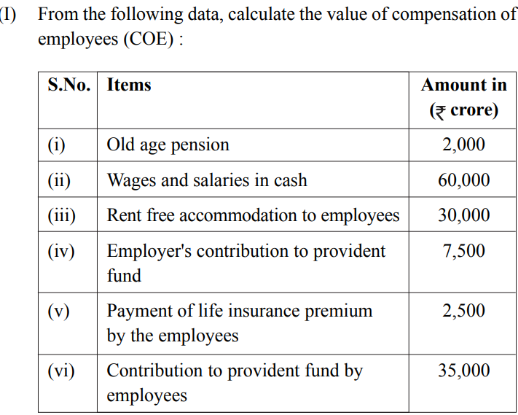
Answer: To calculate the value of compensation of employees (COE), we need to consider the provided income ranges and the number of employees in each range. We calculate the midpoint of each income range, which serves as a representative income for the employees in that bracket. Next, we multiply each midpoint by the corresponding number of employees to find total earnings for each range. Finally, we sum these total earnings across all ranges to derive the total COE. For the given data:
1. Midpoint for Rs 800-899 is 849.5 (average of 800 and 899); employees = 50 ; contribution = 42475.
2. Midpoint for Rs 900-999 is 949.5; employees = 100; contribution = 94950.
3. Midpoint for Rs 1000-1099 is 1049.5; employees = 200; contribution = 209900.
4. Midpoint for Rs 1100-1199 is 1149.5; employees = 150; contribution = 172425.
5. Midpoint for Rs 1200-1299 is 1249.5; employees = 40; contribution = 49980.
6. Midpoint for Rs 1300-1399 is 1349.5; employees = 10; contribution = 13495.
Now summing these contributions:
42475 + 94950 + 209900 + 172425 + 49980 + 13495 = 659225. Therefore, the total COE is Rs 659225.
Key Points: Identify income ranges and employee counts; Calculate midpoints for each range; Multiply midpoints by number of employees; Sum all contributions to find total COE.