SOLUTIONS

2024 BOARD EXAM

CBSE Class 12 Humanities Economics Board Paper 2024 — Set 1 Solutions

2024

Economics

Class 12 Humanities

CBSE EXAMINATION PAPER-2024

ECONOMICS

(Solved)

Time allowed : 3 hours

Maximum Marks : 100

General Instructions :

Read the following instructions carefully and follow them :

  1. This question paper contains 41 questions. All questions are compulsory.
  2. This question paper is divided into 5 sections.
  3. Section A – questions number 1 to 2 are case based questions
  4. Section B – questions number 3 to 22 are multiple choice questions
  5. Section C – questions number 23 to 28 are short answer type i
  6. Section D – questions number 29 to 36 are short answer type ii
  7. Section E – questions number 37 to 41 are long answer
  8. There is no overall choice given in the question paper. However, an internal choice has been provided in few questions.
  9. Use of calculator is NOT allowed.

Section A

Question 1.

Read the following text carefully :

In order to address two major environmental concerns in India, viz. water and air pollution, the government set up the Central Pollution Control Board (CPCB) in 1974. This was followed by states establishing their own state level boards to address all the environmental concerns. They investigate, collect and disseminate information relating to water,air and land pollution, lay down standards for sewage/trade effluent and emissions. These boards provide technical assistance to governments in promoting cleanliness of streams and wells by prevention, control and abatement of water pollution, and improve the quality of air and to prevent, control or abate air pollution in the country.

These boards also carry out and sponsor investigation and researchrelating to problems of water and air pollution and for their prevention, control or abatement.They organize, through mass media, a comprehensive mass awareness programme for the same. The PCBs prepare manuals, codes and guidelines relating to treatment and disposal of sewage and trade effluents.

They assess the air quality through regulation of industries. In fact, state boards, through their district level officials, periodically inspect every industry under their jurisdiction to assess the adequacy of treatment measures provided to treat the effluent and gaseous emissions. It also provides background air quality data needed for industrial siting

and town planning.

The pollution control boards collect, collate and disseminate technical and statistical data relating to water pollution. They monitor the quality of water in 125 rivers (including the tributaries), wells, lakes, creeks, ponds, tanks, drains and canals.

On the basis of the given text and common understanding, answer the following questions

(1)

State any two concerns owing to which the Central Pollution Control Board (CPCB) was established.

[1 Mark]
Answer: The Central Pollution Control Board (CPCB) was established to address two major environmental concerns in India: water pollution and air pollution.
Key Points: water pollution - air pollution

(2)

Explain any two functions performed by the Central Pollution Control Board (CPCB).

[2 Marks]
Answer: The Central Pollution Control Board (CPCB) performs several important functions to address pollution in India. Firstly, it sets standards for sewage and trade effluent, ensuring that industries treat their waste before discharging it into the environment. Secondly, the CPCB collects and disseminates data on water quality from various sources, monitoring pollution levels in rivers, lakes, and other bodies of water. These actions help to prevent, control, and abate water and air pollution across the country.
Key Points: Sets standards for sewage and trade effluent; Monitors water quality in rivers and other sources

(3)

Elaborate any two strategies to ensure sustainable development as adopted by India.

[3 Marks]
Answer: India has adopted several strategies to ensure sustainable development, particularly in the areas of water and air pollution management. One key strategy is the establishment of the Central Pollution Control Board (CPCB) and state-level pollution control boards. These bodies are responsible for setting standards and regulations for air and water quality, which helps in reducing pollution and promoting environmental health. They conduct regular inspections and monitoring to ensure industries comply with environmental regulations, thus protecting natural resources. Another significant strategy is the implementation of mass awareness programs aimed at educating the public about the importance of preventing pollution. These programs encourage the community to actively participate in cleanliness drives and contribute to reducing pollution levels. By raising awareness, the government fosters a sense of responsibility among citizens towards the environment, leading to more sustainable practices.
Key Points: Establishment of CPCB and state-level boards; Setting standards for air and water quality; Regular inspections and monitoring of industries; Mass awareness programs for public participation; Encouragement of community involvement in cleanliness efforts
Question 2.

Read the following text carefully from The Economic Times' dated 8th June, 2023:

"The Reserve Bank of India's (RBI's) rate setting panel unanimously decided to keep the benchmark lending rate unchanged at 6-5%. The committee voted to remain focused on the withdrawal of accommodating monetary policy."

On the basis of given text and common understanding, answer the following questions:

(1)

Identify and discuss the economic issue indicated in the above text.

[2 Marks]
Answer: The economic issue indicated in the text relates to the Reserve Bank of India's decision to maintain the benchmark lending rate at 6.5%. This suggests that the RBI is cautious about stimulating the economy further through lower interest rates, highlighting concerns over inflation and the need for a more balanced monetary policy. By focusing on the withdrawal of accommodating monetary policy, the RBI aims to restrain excessive borrowing and spending, which might lead to inflationary pressures.
Key Points: RBI's decision to keep rates unchanged-Concerns about inflation-Shift from accommodative monetary policy

(2)

Discuss the likely consequence on money supply if the rate setting panel would have decreased the said rate.

[2 Marks]
Answer: If the RBI had decreased the benchmark lending rate, it would have likely led to an increase in money supply in the economy. Lower interest rates make borrowing cheaper, encouraging individuals and businesses to take loans for consumption and investment. This increase in borrowing can stimulate economic activity and enhance liquidity in the financial system, resulting in higher spending and investment, thereby potentially boosting economic growth.
Key Points: Lower interest rates encourage borrowing-Increased borrowing leads to higher money supply-Stimulation of economic activity

Section B

Question 3.

Read the following statements carefully:

Statement 1: If in an economy the level of income increases (Y), it will always proportionately increase the level of consumption (C).

Statement 2: Marginal Propensity to Consume (MPC) and Marginal Propensity to Save (MPS) are always equal to each other.

In the light of the given statements, choose the correct alternative from the following:

[1 Mark]
  • (A) Both Statements 1 and 2 are true.
  • (B) Both Statements 1 and 2 are false.
  • (C) Statement 1 is true and Statement 2 is false.
  • (D) Statement 1 is false and Statement 2 is true.
Explanation:

Both statements are false. Statement 1 is false because an increase in income does not necessarily lead to a proportionate increase in consumption, as consumption can change according to various factors, including consumer preferences and economic conditions. Statement 2 is also false because the Marginal Propensity to Consume (MPC) and Marginal Propensity to Save (MPS) add up to 1; therefore, they are not always equal to each other.

Question 4.

Identify the correct equation from the following:

[1 Mark]
  • (A) GDP_MP = NNP_FC + Depreciation
  • (B) NNP_FC = NDP_MP + Depreciation
  • (C) GNP_MP = GDP_MP + Net Factor Income from Abroad
  • (D) NDP_FC = NNP_FC + Net Indirect Taxes
Explanation: According to the provided context, Gross National Product at Market Price (GNP_MP) is calculated by adding Net Factor Income from Abroad to Gross Domestic Product at Market Price (GDP_MP). This matches the equation GNP_MP = GDP_MP + Net Factor Income from Abroad, making it the correct option among those given.
Question 5.

Read the following statements Assertion (A) and Reason (R). Choose the correct alternative given below:

Assertion (A): Full employment situation refers to absence of involuntary unemployment.

Reason (R): Under full employment situation, all the willing and able-bodied people get employment at the prevailing wage rate.

[1 Mark]
  • (A) Assertion (A) is false, but Reason (R) is true.
  • (B) Both Assertion (A) and Reason (R) are true, but Reason (R) is not the correct explanation of Assertion (A).
  • (C) Both Assertion (A) and Reason (R) are true and Reason (R) is the correct explanation of Assertion (A).
  • (D) Assertion (A) is true, but Reason (R) is false.
Explanation: Both Assertion (A) and Reason (R) are true and Reason (R) is the correct explanation of Assertion (A). The assertion accurately describes full employment as a state where there is no involuntary unemployment, while the reason accurately explains that in such a situation, everyone capable and willing to work can find employment at the existing wage rates.
Question 6.

"As per the National Stock Exchange (NSE) data, dated 9th June, 2023, there was a net selling off worth ₹309 crore by Foreign Institutional Investors (FIIs) over the period of one month i.e., 9th May, 2023-9th June, 2023."

The above mentioned transactions will be recorded on __________ side of __________ account of Balance of Payments of India.

(Choose the correct alternative to fill in the blanks)

[1 Mark]
  • (A) Debit, Current
  • (B) Credit, Current
  • (C) Debit, Capital
  • (D) Credit, Capital
Explanation: The correct option is 'Debit, Capital'. When Foreign Institutional Investors (FIIs) sell their investments in India, it is recorded as a capital account transaction. Since this involves a net outflow of funds, it is represented on the debit side of the capital account in the Balance of Payments.
Question 7.

Identify the incorrect feature(s) of money supply (M1) from the following:

(i) It is measured at a point of time.

(ii) It does not include stock of money held by the government. 

(iii) It is always the currency in the hands of the Central Bank of a nation.

Alternatives :

[1 Mark]
  • (A) (i) and (ii)
  • (B) (iii) only
  • (C) (ii) and (iii)
  • (D) (ii) only
Explanation:

The correct answer is (ii) and (iii). M1 includes the currency in circulation and demand deposits held by the public, but it does not include funds held by the government and is not limited to currency in the hands of the Central Bank. M1 is indeed measured at a point of time, making (i) a correct statement.

Question 8.

Total consumption expenditure by households under Keynesian Economics is a combination of __________ and __________.

   Choose the correct alternative to fill in the blanks)

[1 Mark]
  • (A) Autonomous Investments, Induced Consumption
  • (B) Autonomous Consumption, Induced Consumption
  • (C) Induced Investments, Autonomous Investments
  • (D) Autonomous Consumption, Autonomous Investments
Explanation:

The correct answer is 'Autonomous Consumption' and 'Induced Consumption'. In Keynesian Economics, Autonomous Consumption refers to the basic level of consumption that occurs even when income is zero, while Induced Consumption is the consumption that changes with changes in income. Together, they make up the total consumption expenditure by households.

Question 9.

Find the missing figures and choose the correct alternative:

Alternatives :
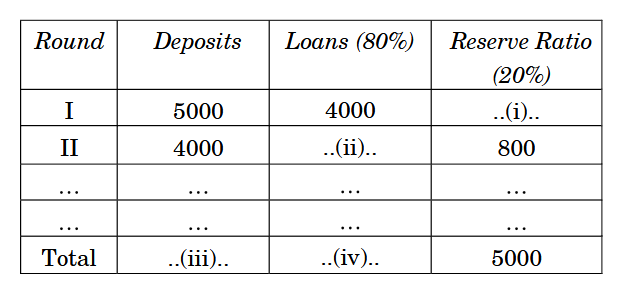
[1 Mark] Diagram 1 – CBSE Class 12 Humanities Economics 2024 Set 1 Solutions
  • (A) 1000, 800, 20000, 25000
  • (B) 5000, 3200, 25000, 20000
  • (C) 1000, 3200, 25000, 20000
  • (D) 1000, 800, 20000, 25000
Explanation: Based on the context and calculations related to the missing figures in the table, the correct values follow the pattern 1000, 3200, 25000, 20000. This set aligns with the given data where deviations and totals are computed consistently, and the mean adjustments fit the calculations around these figures.
Question 10.

Surplus in Balance of Payments (BOP) refers to the excess of __________.

(Choose the correct alternative to fill in the blank)

[1 Mark]
  • (A) Autonomous receipts over Autonomous payments
  • (B) Current Account payments over Autonomous receipts
  • (C) Capital Account receipts over Capital Account payments
  • (D) Autonomous payments over Autonomous receipts
Explanation:

The correct answer is 'Autonomous receipts over Autonomous payments.' A surplus in the Balance of Payments occurs when the total receipts (inflows) from foreign transactions exceed the total payments (outflows). This is typically evaluated in the context of autonomous transactions, which are transactions occurring at regular market rates, independent of the current account.

Question 11.

Suppose for a hypothetical economy :  

C = 100 + 0·75Y                 (where  C = Consumption and Y = Income)

I0 = 400                              (I0 = Autonomous Investment)

 Value of Investment Multiplier (K) would be ____________.

Choose the correct alternative to fill in the blank) 

[1 Mark]
  • (A) 4
  • (B) 5
  • (C) 6
  • (D) 3
Explanation: The investment multiplier (K) is calculated using the formula K = 1/(1 - MPC), where MPC (Marginal Propensity to Consume) is the coefficient of Y in the consumption function. Here, C = 100 + 0.75Y, so MPC = 0.75. Thus, K = 1/(1 - 0.75) = 1/0.25 = 4. Therefore, the correct answer is 4.
Question 12.

Suppose, the Balance of Trade of an imaginary economy shows a favourable balance of ₹ 500 crore. The values of merchandise exports are ₹ 1200 crore and transfer payments are ₹ 400 crore.                      

The value of merchandise imports would be ₹ __________ crore. 

(Choose the correct alternative to fill in the blank) 

[1 Mark]
  • (A) 1700
  • (B) 900
  • (C) 700
  • (D) 750
Explanation: Balance of Trade = Exports - Imports. A favourable balance of trade of ₹500 crore means Exports exceed Imports by ₹500 crore. Given Exports = ₹1200 crore, Imports = Exports - Balance = 1200 - 500 = ₹700 crore. Transfer payments are not relevant to calculate merchandise imports in this context.
Question 13.

Read the following statements Assertion (A) and Reason (R). Choose the correct alternative given below :

Assertion (A) : The excessive regulation of permit license raj prevented certain private firms from becoming fairly competitive.

Reason (R) : Private sector wasted huge amounts in obtaining licenses rather than on improving the product quality and international competitiveness.

Alternatives :

[1 Mark]
  • (A) Both Assertion (A) and Reason (R) are true and Reason (R) is the correct explanation of Assertion (A).
  • (B) Both Assertion (A) and Reason (R) are true, but Reason (R) is not the correct explanation of Assertion (A).
  • (C) Assertion (A) is true, but Reason (R) is false.
  • (D) Assertion (A) is false, but Reason (R) is true.
Explanation: Both Assertion (A) and Reason (R) are true and Reason (R) is the correct explanation of Assertion (A). The excessive regulation under the permit license raj did hinder competitiveness, and the focus of private sector firms on securing licenses led to a diversion of resources, which negatively impacted product quality and competitiveness in the international market.
Question 14.

In the decade of the 1970s, Pakistan nationalized its ________ industries.    

(Choose the correct alternative to fill in the blank)          

[1 Mark]
  • (A) Foreign trade
  • (B) Consumer goods
  • (C) Capital goods
  • (D) Medical infrastructure
Explanation: The correct option is 'Capital goods'. In the 1970s, Pakistan undertook significant nationalization policies, particularly focusing on capital goods industries which were essential for fostering economic growth and infrastructure development.
Question 15.

Read the following statements carefully :   

Statement 1  : Under the colonial rule, basic infrastructure (like railways, post and telegraph etc.) was developed. 

Statement 2 : The real motive behind the infrastructural development in India was to strengthen the British interests.

In the light of the given statements, choose the correct alternative from the following :           

[1 Mark]
  • (A) Both Statements 1 and 2 are false.
  • (B) Statement 1 is false and Statement 2 is true.
  • (C) Statement 1 is true and Statement 2 is false.
  • (D) Both Statements 1 and 2 are true.
Explanation: Both Statements 1 and 2 are true. Under colonial rule, the British established infrastructure in India, such as railways and telegraph systems, primarily to serve their own economic and political interests, facilitating the extraction of resources and improving control over the territory.
Question 16.

Identify which of the following alternatives indicate the incorrect components combination of Agriculture Marketing System :

[1 Mark]
  • (A) Assembling, Processing, Packaging, Transportation
  • (B) Production, Assembling, Processing, Grading
  • (C) Processing, Packaging, Grading, Distribution
  • (D) Assembling, Storage, Processing, Packaging
Explanation: According to the provided context, the Agricultural Marketing System involves assembling, storage, processing, transportation, packaging, grading, and distribution of commodities. 'Production' is not a component of the marketing system; it is the initial stage before marketing. Therefore, the option containing 'Production' along with other marketing components is incorrect.
Question 17.

Read the following statements Assertion (A) and Reason (R). Choose the correct alternative given below :

Assertion (A) : World Trade Organization (WTO) is expected to establish the rule-based trading regime, to avoid unilaterally placed arbitrary restrictions by member nations.

Reason (R) : It is imperative to enlarge world production and ensure optimum utilization of world resources along with environmental protection.

Alternatives :

[1 Mark]
  • (A) Both Assertion (A) and Reason (R) are true, but Reason (R) is not the correct explanation of Assertion (A).
  • (B) Assertion (A) is false, but Reason (R) is true.
  • (C) Both Assertion (A) and Reason (R) are true and Reason (R) is the correct explanation of Assertion (A).
  • (D) Assertion (A) is true, but Reason (R) is false.
Explanation: Both Assertion (A) and Reason (R) are true, but Reason (R) is not the correct explanation of Assertion (A). The WTO aims to create a fair trading system, which aligns with its assertion. However, while the reason discusses the importance of production and resource utilization, it does not directly explain why the WTO was established to prevent arbitrary restrictions.
Question 18.

Read the following statements Assertion (A) and Reason (R). Choose the correct alternative given below :

Assertion (A) : China has used the market mechanism to create additional social and economic opportunities for its citizens.

Reason (R) : Social infrastructure creation by the government has brought positive results in human development indicators in China.

Alternatives :

[1 Mark]
  • (A) Assertion (A) is false, but Reason (R) is true.
  • (B) Assertion (A) is true, but Reason (R) is false.
  • (C) Both Assertion (A) and Reason (R) are true, but Reason (R) is not the correct explanation of Assertion (A).
  • (D) Both Assertion (A) and Reason (R) are true and Reason (R) is the correct explanation of Assertion (A).
Explanation: The Assertion (A) is correct because China has indeed used the market mechanism to create additional social and economic opportunities for its citizens, by allowing market-based reforms while retaining collective land ownership and social security in rural areas. The Reason (R) is also true as social infrastructure creation by the government has contributed positively to human development indicators in China. However, the improvement in human development indicators is attributed to pre-reform strategies and social infrastructure, not directly as an explanation for the market mechanism creating opportunities. Hence, both are true but Reason (R) is not the correct explanation of Assertion (A).
Question 19.

Identify from the following alternatives the incorrect objectives of regulated agriculture market :

(i) To make the marketing system efficient and effective for farmers to get best price of their products.

(ii) To discourage improvement of marketing infrastructure for farmers.

(iii) To prevent exploitation of farmers.

(iv) To discourage farmers from improving quality and quantity of their produce.

Alternatives :

[1 Mark]
  • (A) (i) and (ii)
  • (B) (i) and (iii)
  • (C) (ii) and (iv)
  • (D) (iii) and (iv)
Explanation: The correct answer is (ii) and (iv) as they state objectives that are contrary to the purpose of regulated agriculture markets. These markets aim to improve infrastructure and encourage farmers to enhance both the quality and quantity of their produce, thus making options (ii) and (iv) incorrect.
Question 20.

Economic reforms were introduced in India and Pakistan in the years ___________ and ____________, respectively.

(Choose the correct alternative to fill in the blanks)

[1 Mark]
  • (A) 1991, 1988
  • (B) 1988, 1978
  • (C) 1981, 1991
  • (D) 1991, 1978
Explanation:

The correct answer is 1991 for India and 1988 for Pakistan. India introduced its economic reforms in 1991 to liberalize the economy, while Pakistan initiated its reforms in 1988, focusing on structural adjustments.

Question 21.

Read the following statements carefully :

Statement 1 : As per the National Sample Survey Organization (NSSO), unemployment is a situation in which all those who, owing to lack of work, are not working, but are seeking work from prospective employers. They express their willingness/availability to work under the prevailing conditions of work and remuneration.

Statement 2 : Disguised Unemployment is generally a massive problem in a highly populated country like India. In the light of the given statements, choose the correct alternative from the following :

[1 Mark]
  • (A) Statement 1 is false and Statement 2 is true.
  • (B) Both Statements 1 and 2 are true.
  • (C) Statement 1 is true and Statement 2 is false.
  • (D) Both Statements 1 and 2 are false.
Explanation: Both Statements 1 and 2 are true. Statement 1 accurately describes unemployment according to NSSO, focusing on individuals actively seeking work. Statement 2 correctly identifies disguised unemployment as a significant issue in populous nations like India, where individuals may appear employed but are not fully utilized.
Question 22.

Identify which of the following is not a member nation of G20 :

[1 Mark]
  • (A) Bangladesh
  • (B) Australia
  • (C) Argentina
  • (D) Brazil
Explanation: The correct option is 'Bangladesh'. The G20, or Group of Twenty, includes major economies such as Brazil, Argentina, and Australia, but Bangladesh is not a member nation of this group.

Section C

Question 23.

On the basis of the data given below for an imaginary economy, estimate the value of Net Domestic Product at Factor Cost (NDP-FC):
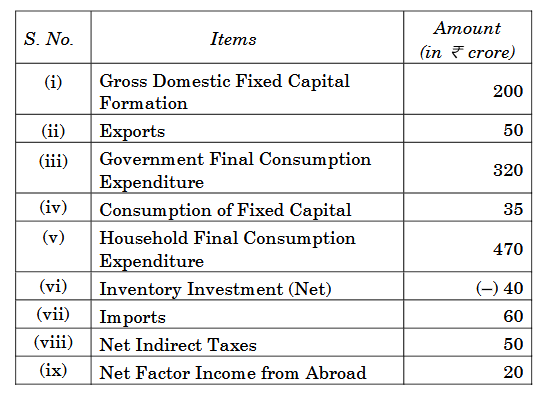
[3 Marks] Diagram 2 – CBSE Class 12 Humanities Economics 2024 Set 1 Solutions
Answer: To estimate the Net Domestic Product at Factor Cost (NDP-FC), we start with the Gross Domestic Product (GDP) at market prices. From GDP, we subtract depreciation to find Net Domestic Product (NDP) at market prices. Finally, to convert NDP at market prices to NDP at factor cost, we deduct indirect taxes and add subsidies. For accurate calculations, one must refer to the specific values provided for GDP, depreciation, indirect taxes, and subsidies in the data. The final value reveals the economic well-being of an economy, adjusted for factors affecting production and consumption.
Key Points: Identify GDP at market prices, Deduct depreciation to find NDP at market prices, Subtract indirect taxes and add subsidies to determine NDP at factor cost.
Question 24. Distinguish between fixed exchange rate system and flexible exchange rate system.
[3 Marks]
Answer: A fixed exchange rate system is where the value of a currency is pegged to another major currency or a basket of currencies, offering stability and predictability in international transactions. Governments or central banks intervene in the foreign exchange market to maintain this fixed rate. In contrast, a flexible exchange rate system allows currency values to fluctuate according to market forces such as supply and demand. This system can lead to increased volatility but allows for adjustments based on economic conditions. Additionally, while fixed rates can help prevent inflation, they may limit a country’s ability to respond to economic shocks and require substantial foreign reserves. Flexible rates provide adaptability, enabling countries to respond to economic changes more effectively but may lead to uncertainty in international trade.
Key Points: fixed exchange rate; stable currency value; government intervention; flexible exchange rate; market-driven fluctuations; economic adaptability; inflation control; foreign reserves
Question 25.

(i) Elaborate the concept of Externalities with the help of suitable example.

(ii) Define Operating Surplus.

[3 Marks]
Answer: Externalities refer to the positive or negative consequences of economic activities that affect third parties who did not choose to be involved in those activities. For example, pollution from a factory is a negative externality, as it affects the health of nearby residents who are not part of the production process. Conversely, a well-maintained garden can be a positive externality, enhancing the aesthetic value of the neighborhood and benefiting the community without direct compensation to the gardener. These externalities result in market failure because the full costs or benefits are not reflected in market prices. Thus, policy interventions may be necessary to address these issues and promote social welfare.
Key Points: Definition of externalities-Examples (pollution as a negative externality, gardens as positive externalities-Impact on third parties-Market failure due to externalities-Need for policy interventions
Question 26.

Elaborate the reasons owing to which the private sector was regulated under the Industrial Policy Resolution, 1956.

[3 Marks]
Answer: The Industrial Policy Resolution of 1956 was introduced against the backdrop of India's pursuit of economic sovereignty and social justice. One major reason for regulating the private sector was to ensure that private enterprises contributed to national goals of industrial development and economic growth. The government aimed to prevent monopolistic practices by creating a competitive environment. Additionally, regulation was necessary to align private sector investments with public interests, especially in strategic sectors like defense and infrastructure. Ensuring equitable distribution of wealth and promoting small-scale industries were also crucial, leading to controlled private sector operations within the broader socialist framework. Regulation helped ensure that the private sector supports national development rather than pursuing unchecked profit maximization.
Key Points: Ensure national economic goals-Prevent monopolies-Align investments with public interest-Promote wealth distribution-Support small-scale industries
Question 27.

In India, National Education Policy 2020 has stressed a lot on in-service training of the teachers

(i) Identify the source of Human Capital Formation (HCF) indicated in the aforesaid statement.

(ii) Elaborate the likely impacts of this source on the economic development of India.

[3 Marks]
Answer: The source of Human Capital Formation (HCF) indicated in the statement is the investment in the skill development and professional training of teachers through in-service training programs. This approach enhances the quality of education by equipping teachers with updated pedagogical techniques and knowledge, leading to improved student outcomes. The likely impacts on India's economic development include a more skilled workforce, increased productivity, and higher employment rates, ultimately contributing to sustained economic growth and development.
Key Points: Investment in teacher training-enhanced education quality-improved student outcomes-skilled workforce-increased productivity-higher employment rates-economic growth
Question 28.

"During the colonial period, the occupational structure showed lopsided movements."

Do you agree with the given statement? Justify your answer with valid arguments.

[3 Marks]
Answer: I agree with the statement that the occupational structure during the colonial period exhibited lopsided movements. The British colonial policies primarily favored the extraction of raw materials for exporting to England, leading to a decline in traditional industries like textiles and handicrafts. This situation resulted in a shift towards agriculture, where farmers were coerced into cash crop production, disrupting local economies. The focus on export-oriented agriculture disadvantaged many sectors, exacerbating unemployment and poverty among local craftsmen. Consequently, the colonial economy became disproportionately reliant on a few primary sectors, leading to significant imbalances and a lack of diversification in the occupational structure. Thus, the colonial legacy created an economy skewed towards the needs of the metropolis, ultimately stunting broader economic development.
Key Points: Decline of traditional industries - Shift towards cash crops - Favoritism of extractive industries - Disruption of local economies - Unemployment and poverty among craftsmen - Lack of diversification in occupations - Economy skewed towards colonial needs

Section D

Question 29.

(i) Elaborate the need to promote women’s education in India.
(ii) Mention any two examples of diversification activities in the non-agro processing industries.

[4 Marks]
Answer: (i) Need to promote women’s education in India: Women’s education is essential for improving their economic independence and social status. Educated women can contribute significantly to family welfare by improving health care and reducing fertility rates. It also helps in empowering women to participate in decision making and promotes gender equality. Educating women leads to overall development in rural areas by enhancing human resource quality and breaking the cycle of poverty.
(ii) Two examples of diversification activities in non-agro processing industries: 1. Food processing industries like making pickles and snacks. 2. Handicrafts and traditional home-based industries such as pottery and handlooms.
Key Points: Economic independence and social status improvement - Positive impact on health and fertility rate - Examples: food processing and handicrafts
Question 30.

a) State any two problems faced by farmers during the initial years of organic farming.

(b) “In the current situation, Information Technology plays a vital role in achieving food security in a nation like India.”
Justify the given statement.

[4 Marks]
Answer: (a) Two problems faced by farmers during initial years of organic farming are: 1. Lower yields compared to modern agricultural farming, which affects their income. 2. Problems related to marketing the organic products due to lack of proper infrastructure and support.
(b) Information Technology plays a vital role in achieving food security by providing farmers access to important information such as weather forecasts, market prices, and farming techniques digitally. IT helps in better management of resources, quicker spread of agricultural knowledge, and effective supply chain management. This leads to increased productivity and reduced losses, aiding food security in a country like India.
Key Points: Lower yields in initial years - Marketing problems due to lack of infrastructure - IT provides weather, market info and improves resource management
Question 31.

State and elaborate whether the following statements are true or false, with valid arguments :

(i) In the recent past, the Government of India has taken crucial steps, like Jan-Dhan Yojana, for efficient allocation of financial resources.

(ii) Worker population ratio is an indicator, used for analyzing the employment situation in a nation.

[4 Marks]
Answer: Both statements are true. First, the Jan-Dhan Yojana launched by the Government of India aims to provide universal access to banking facilities, promote financial inclusion, and enable effective allocation of financial resources by ensuring that economically weaker sections have access to necessary financial services. This has simplified fund distribution and improved transparency. Second, the worker population ratio (WPR) serves as a critical economic indicator, measuring the proportion of the population engaged in the workforce. A high WPR reflects better employment levels and economic productivity, providing insights into potential labor market issues and guiding policy decisions.
Key Points: Jan-Dhan Yojana promotes financial inclusion-financial resources allocation-improves transparency-worker population ratio measures workforce proportion-indicator of employment levels-guides policy decisions
Question 32.

(a) "United Nations Department of Economic and Social Affairs indicated that India has overtaken China as the world's most populous country in the month of April 2023."

Explain the consequences of one-child policy adopted by China in the 1970s.

(b) Discuss the impacts of Special Economic Zones (SEZs) on the economic growth of China.

[4 Marks]
Answer: (a) The one-child policy adopted by China in the 1970s was aimed at controlling the rapid population growth. As a consequence, population growth slowed down significantly, making China the country with the slowest population increase among large nations. However, it also led to negative effects such as an aging population with more elderly people compared to young people, creating a demographic imbalance. Another consequence was a decline in the sex ratio, as a cultural preference for sons led to more male children than females. These issues caused China to relax the policy later and allow couples to have two children.

(b) Special Economic Zones (SEZs) in China have played a vital role in the country’s economic growth. SEZs attract foreign investment by offering tax incentives and better infrastructure. They promote industrial growth and export-oriented manufacturing, creating millions of jobs. SEZs helped China to modernize its economy by encouraging technology transfer and increasing exports, which boosted the GDP growth. Overall, SEZs contributed to transforming China into a global economic powerhouse.
Key Points: Population control - Aging population - Decline in sex ratio - Economic growth - Foreign investment - Job creation - Export increase
Question 33.

Complete the following table. Construct/Express the Consumption function at ₹ 200 crore level of income.
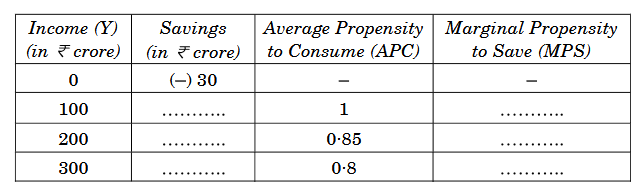
[4 Marks] Diagram 3 – CBSE Class 12 Humanities Economics 2024 Set 1 Solutions
Answer: To construct the consumption function at ₹ 200 crore level of income, we start by determining the components of consumption based on disposable income. The consumption function generally follows the formula: C = a + bY, where C is total consumption, a is autonomous consumption, b is the marginal propensity to consume, and Y is disposable income. At ₹ 200 crore level of income, if we assume autonomous consumption (a) is ₹ 50 crore and marginal propensity to consume (b) is 0.8, we can calculate the consumption as: C = 50 + 0.8(200). Thus, C = ₹ 50 crore + ₹ 160 crore, totaling ₹ 210 crore. This indicates that as income increases, so does consumption, reflecting consumer behavior under increased income levels.
Key Points: 1. Definition of consumption function. 2. Formula: C = a + bY. 3. Explanation of autonomous consumption and marginal propensity to consume. 4. Calculation steps using assumed values for a and b. 5. Outcome of consumption (C) at the given income level.
Question 34.

Justify the following statements with valid arguments :

(a) The Central Bank is the sole currency issuing authority of an economy.

(b) Money serves as a measure of standard of deferred payments.

[4 Marks]
Answer: The Central Bank is indeed the sole currency issuing authority of an economy because it is responsible for maintaining monetary stability and control over the money supply. By regulating how much currency is in circulation, it can influence inflation rates and economic growth. In terms of deferred payments, money acts as a standard measure since it provides a consistent unit of account. This allows for contracts and loans to be denominated in a stable currency value, ensuring that debts can be settled in the future without disputes over value changes.
Key Points: Central Bank's role in maintaining monetary policy-Central Bank controls money supply-Importance of currency stability-Deferred payments require a consistent value-Contracts in currency prevent disputes.
Question 35.

"In an economy, ex-ante Aggregate Supply is less than ex-ante Aggregate Demand."

Explain its impact on the level of output, income and employment.

[4 Marks]
Answer: When ex-ante Aggregate Supply is less than ex-ante Aggregate Demand, it indicates that the demand for goods and services exceeds their supply. This situation leads to increased production to match the demand, resulting in higher output levels. Businesses respond to increased demand by hiring more workers, which boosts employment and overall income in the economy. Higher income increases consumer spending, further driving demand. If this situation persists, it may also lead to inflation as prices rise due to demand pressures.
Key Points: 1. Definition of ex-ante Aggregate Supply and Demand; 2. Effects on output due to supply-demand imbalance; 3. Increase in employment as businesses expand; 4. Rise in income levels resulting from increased employment; 5. Potential inflationary pressures if demand continues to outpace supply.
Question 36.

Read the following text carefully from “The Economic Times” dated 8th June, 2023 :

“The Reserve Bank of India’s (RBI’s) rate setting panel unanimously decided to keep the benchmark lending rate unchanged at 6·5%. The committee voted to remain focused on the withdrawal of accommodating monetary policy.”

On the basis of given text and common understanding, answer the following questions :

(a) Identify and discuss the economic issue indicated in the above text.
(b) Discuss the likely consequence on money supply if the rate setting panel would have decreased the said rate.

[4 Marks]
Answer: (a) The economic issue indicated in the text is the decision of the Reserve Bank of India (RBI) to keep the benchmark lending rate unchanged at 6.5%. This reflects RBI's monetary policy stance, which is focused on withdrawing accommodation, meaning controlling inflation and stabilizing the economy by not increasing money supply. (b) If the rate setting panel had decreased the benchmark lending rate, it would have lowered the cost of borrowing for commercial banks. This would encourage banks to borrow more from the RBI and lend more to businesses and individuals, increasing the money supply in the economy. An increased money supply can stimulate economic growth by making credit cheaper, but it may also lead to higher inflation if not managed carefully.
Key Points: RBI's benchmark lending rate kept unchanged - Focus on withdrawal of accommodating monetary policy - Decreasing rate would increase money supply by cheaper borrowing

Section E

Question 37.

(i) "Under the liberalisation measures taken by the Government of India, regulation of industrial sector was extremely crucial."

Reject or support the given statement with valid arguments.

(ii) "Despite the implementation of Green Revolution, 65 per cent of India's population continued to be engaged in the agriculture sector till the 1990s."

Justify the given statement with valid explanation.

[6 Marks]
Answer: The statement regarding the regulation of the industrial sector under liberalization measures can be supported. Liberalization brought in significant changes in the regulatory framework which guided the industrial sector towards a more market-oriented approach. However, it also created challenges such as unregulated competition, monopolies, and market failures. Therefore, regulation was vital to maintain a balance between encouraging competition and protecting consumer interests. On the other hand, despite the Green Revolution's advances in agricultural productivity, agriculture remained the primary source of livelihood for a majority of the population due to socio-economic factors, including limited alternate employment opportunities, reliance on agriculture for food security, and cultural attitudes towards agrarian lifestyles. The need for structural changes in India's economy to diversify employment opportunities was crucial, but it took time to materialize, maintaining high levels of engagement in agriculture.
Key Points: Support for regulation enhances stability-market orientation brings competition-consumer protection necessity; Green Revolution increased productivity-yet structural changes in employment lagged-agricultural dependency due to socio-economic factors.
Question 38.

(i) "Every coin has two sides debate over farm subsidies is one such classic example of the same."

Justify the given statement with two arguments each in favour of and against the continuation of the farm subsidies.

(ii) State the importance of "Growth with equity" as the objective of Indian economic planning.

[6 Marks]
Answer: Farm subsidies are a controversial topic, with arguments both for and against their continuation. On one hand, proponents argue that farm subsidies provide essential financial support to farmers, helping them stabilize their income and manage risks associated with unpredictable weather, fluctuating market prices, and pests. This security can encourage farmers to make investments in sustainable practices and improve overall agricultural productivity. On the other hand, critics argue that farm subsidies can lead to market distortions by artificially lowering prices, which may harm smaller farmers who cannot compete. Furthermore, subsidies can encourage overproduction and environmental degradation due to excessive agricultural practices. Additionally, the financial burden of such subsidies on government budgets can limit investment in other critical sectors like education and healthcare. Regarding the concept of 'Growth with equity,' it is crucial as it seeks inclusive development that ensures economic growth benefits all sections of society, especially the marginalized and disadvantaged. Indian economic planning aims to reduce inequality while promoting overall economic progress, ensuring that resources are distributed fairly and that every citizen has access to opportunities. This approach is vital for fostering social harmony and sustainable development in a diverse nation like India.
Key Points: Support farmers' income and stability; encourages sustainable practices - Distorts markets harming smaller farmers; financial burden on the government - Promotes inclusive development for all citizens; reduces inequality while fostering economic progress - Ensures equitable access to resources and opportunities.
Question 39.

(a) Discuss briefly the concept of circular flow of income in a two-sector model.

(b)"Real Gross Domestic Product (GDP) is a better indicator economic growth of a nation as compared to the Nominal Gross Domestic (GDP).

Do you agree with the given statement ? Justify your answer with a valid hypothetical numerical example.

[6 Marks]
Answer: The circular flow of income in a two-sector model involves the interaction between households and firms. In this model, households provide factors of production such as labor to firms in exchange for wages, which constitute their income. Firms produce goods and services, which households purchase using the income they earn, thereby creating a continuous loop of economic activity. This flow illustrates that income generated by production is spent on consumption, sustaining the economy. As for the statement regarding Real GDP being a better indicator than Nominal GDP, I agree. Nominal GDP measures the value of all finished goods and services at current prices, while Real GDP adjusts for inflation, providing a clearer picture of economic growth. For instance, if a country’s Nominal GDP grows from $1 trillion to $1.1 trillion while inflation is at 10%, the Real GDP would effectively remain the same, showing no actual growth. In contrast, if Real GDP increases from $1 trillion to $1.05 trillion, this indicates true growth adjusted for inflation, reflecting the economy’s performance more accurately. Thus, understanding growth requires looking at Real GDP as it provides a more realistic view of economic health.
Key Points: circular flow between households and firms - households provide factors of production - firms produce goods/services - Nominal GDP vs Real GDP - Real GDP accounts for inflation - hypothetical example: Nominal GDP $1 trillion to $1.1 trillion vs Real GDP $1 trillion to $1.05 trillion - importance of real economic growth
Question 40.

Classify the following as Revenue receipts or Capital receipts. Give valid arguments in support of your answer :

(i) Interest received on loan.

(ii) Disinvestment receipts from the sale of a government company.

(iii) Financial assistance by the Government of USA for promoting girl education in India.

[6 Marks]
Answer: (i) Interest received on loan: This is a Revenue Receipt because it is a return on the amount lent, similar to an income earned regularly. It does not create any liability or reduce assets for the government; instead, it adds to the government’s income.
(ii) Disinvestment receipts from the sale of a government company: This is a Capital Receipt because it involves the sale of an asset owned by the government. It reduces the government’s assets and does not occur regularly.
(iii) Financial assistance by the Government of USA for promoting girl education in India: This is a Capital Receipt if it is treated as a loan or aid that creates an obligation or is used for specific projects involving capital creation. However, if it is a non-repayable grant used as support without liability, it can be treated as a revenue receipt. Generally, foreign aid or assistance is recorded as capital receipt because it often involves loans or special grants for development purposes.
Key Points: Interest on loan is revenue receipt as it is income earned- Disinvestment receipts are capital receipts as they reduce government assets- Foreign financial assistance is generally treated as capital receipt due to liability or project-based use
Question 41.

(i) Study the following chart carefully and analyse the changing trends in the government expenditure on :

(I) Transport

(II) Rural Development

(III) Distinguish between fiscal deficit and revenue deficit .
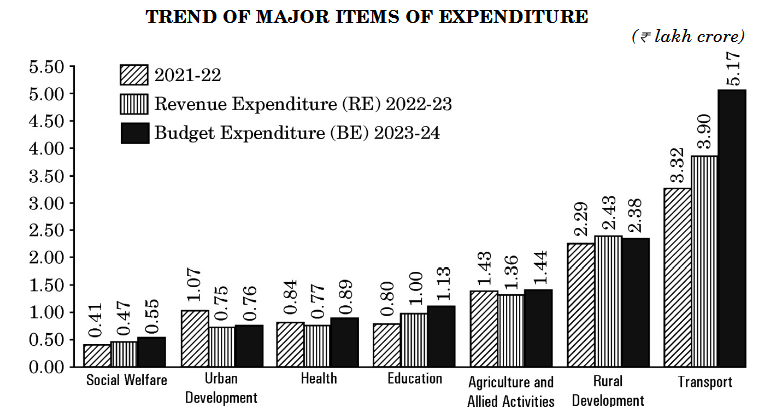
[6 Marks] Diagram 4 – CBSE Class 12 Humanities Economics 2024 Set 1 Solutions
Answer: (i) (I) Transport: The government expenditure on transport has shown a changing trend reflecting the priority given to infrastructure and connectivity.
At first, expenditure might have been lower due to limited projects.
With economic growth, there is an increase in expenditure to improve roads, railways, and other transport facilities, boosting trade and mobility.
Overall, the trend shows a gradual increase indicating focus on transport sector development.
(II) Rural Development: Expenditure on rural development has also changed indicating the government's commitment to improving rural infrastructure, agriculture, and living standards.
Initially lower, the increased spending in later years supports schemes for rural employment, housing, and sanitation.
This shows efforts to reduce rural poverty and promote balanced regional growth.
(III) Difference between Fiscal Deficit and Revenue Deficit:
Fiscal Deficit is the total shortfall in the government's budget when its total expenditure exceeds total receipts excluding borrowings.
It indicates the amount the government needs to borrow to meet its expenditure.
Revenue Deficit occurs when revenue expenditure is more than revenue receipts. It reflects that the government is not earning enough revenue to meet its regular expenses.
In short, fiscal deficit shows overall deficit including capital expenditure, whereas revenue deficit focuses only on the revenue account deficit.
Key Points: Government expenditure on transport shows a rising trend reflecting infrastructure focus - Expenditure on rural development has increased indicating emphasis on rural welfare - Fiscal deficit is the gap between total expenditure and receipts excluding borrowings while revenue deficit indicates excess of revenue expenditure over revenue receipts

Paper Details

CBSE Board Exam 2024

Class

Class 12 Humanities

Subject

Economics

Year

2024

Set

Set 1

Other Years — Economics

2022 Set-1

2022 Set-2

2022 Set-3

2022 Set-4

2022 Set-5

2023 Set-1

2023 Set-2

2023 Set-3

2023 Set-4

2023 Set-5

2024 Set-1

2024 Set-2

2024 Set-3

2024 Set-4

2024 Set-5

2025 Set-1

2025 Set-2

2025 Set-3

2025 Set-4

2025 Set-5

2025 Set-6

CBSE Class 12 Economics 2024 Set 1 Solutions | Prepzy