Class 12 Humanities . English . Kaleidoscope . Broken Images
Chapter 21: Broken Images
Ch 21
English
Class 12 Humanities
Dual Identity
Girish Karnad
- Born in 1938; he was a writer, playwright, actor and film director.
- He wrote in Kannada and English; his plays often use history and mythology to explore contemporary issues.
- He received the Padma Shri (1974), Padma Bhushan (1992) and Jnanpith Award (1998).
- The play explores personal and academic values, bilingualism and identity.
The television interview begins
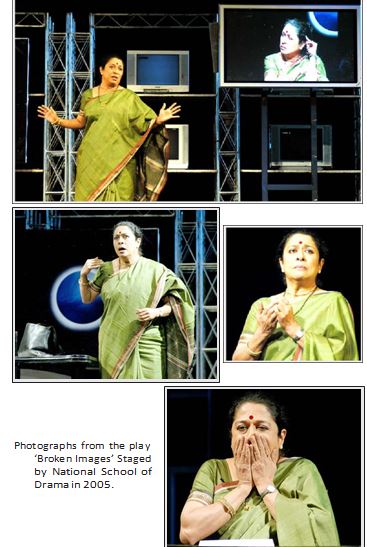
- Manjula Nayak enters a modern television studio to speak directly to an unseen audience.
- The announcer introduces her as a well-known Kannada short-story writer and former English lecturer in Bangalore.
- Her first English novel, The River Has No Memories, became a bestseller around the world; its advance helped her leave teaching and focus on writing.
- That evening’s Kannada telefilm is based on her novel.
Manjula’s personal and creative identity
- Manjula says she is officially Mrs Manjula Murty, but her creative self remains Manjula Nayak.
- She suggests that marriage should not intrude too much into a writer’s creative identity.
Manjula on writing in English
- Manjula says her novel came to her in English unexpectedly; writing in English was not a deliberate rejection of Kannada.
- Some respected intellectuals and writers accuse her of betraying Kannada and writing for foreign readers.
- Her British publishers value the novel for its genuine Indian feel, rather than a Western viewpoint.
- She challenges claims that Indian writers cannot write honestly in English and points out the hypocrisy of making such claims in English.
- She accepts that earning money is a valid reason to write in English; the novel’s advance enabled her to resign and write full-time.
- She suggests that criticism is partly driven by anxiety and jealousy about the money, fame and influence available to English-language writers.
- The Kannada word artha means both “meaning” and “money,” linking literary value with financial reward.
Manjula Nayak
- Confident and experienced: she is at ease in the television studio and addresses viewers directly.
- Witty and self-aware: she jokes about criticism and the difficulty of speaking about one’s own work.
- Independent: she defends her freedom to write in the language in which her work emerges and keeps her creative identity distinct from her married name.
- Pragmatic: she openly acknowledges that income and the chance to write full-time matter.
Language and creative identity
Manjula’s identity crosses Kannada and English, and her creative name remains separate from her married name. The play questions the idea that choosing English automatically means rejecting one’s culture or writing for a foreign audience.
Art, money and recognition
The debate over Manjula’s language choice also reflects the unequal financial rewards and recognition available to writers in different languages.
What does Manjula mean when she distinguishes Mrs Manjula Murty from Manjula Nayak?
Why did Manjula write her novel in English?
What does Manjula suggest lies behind the criticism of Indian writers who write in English?
Quick recap
- Girish Karnad’s plays use history and mythology to examine contemporary concerns.
- Manjula is a Kannada writer and former English lecturer whose first English novel became an international bestseller.
- Her official married name is Mrs Manjula Murty, while her creative self remains Manjula Nayak.
- She says the novel came to her in English without a deliberate change of allegiance.
- Manjula rejects the claim that writing in English necessarily means writing for foreigners or being dishonest.
- The language debate is tied to unequal financial rewards, fame and literary recognition; artha means both “meaning” and “money.”
Facing Reality
The Novel’s Inspiration
Malini
- Gentle and beloved: Manjula remembers her as beautiful and gentle.
- Emotionally significant: Caring for Malini helped Manjula understand the emotional life of a person confined to a wheelchair.
Manjula’s Writing and Kannada Identity
- Manjula explains that she drew on her experience nursing Malini to portray the inner world of a disabled person.
- While working full-time as a lecturer and living among memories of her sister, she struggled to write in English.
- Her husband, Pramod Murty, encouraged her through difficult moments and helped her complete the novel.
- Manjula is proud of being a Kannada writer. Though she wrote the novel in English, its Kannada adaptation was made by the director.
- She thanks the cast, crew and Shree-TV, then ends her address and prepares to leave.
Pramod Murty
- Supportive: He encouraged Manjula and kept her going when she felt unable to finish the novel.
- Important to the novel’s completion: Manjula says she would not have completed it without his support.
The Image Comes to Life
The Screen Image Challenges Manjula
- After the broadcast ends, Manjula checks whether she is still on air and assumes the telecast has stopped.
- Her image on the screen speaks to her, even though the camera is off and the image is not copying her movements.
- Manjula is startled and suspects a technical problem, but the Image insists there is no hitch.
- The scene establishes that Manjula and her screen Image now respond to each other as if they are both living characters.
Manjula
- Empathetic: Her care for Malini shaped her understanding of disability and emotional experience.
- Determined but uncertain: She completed a novel in English despite feeling inexperienced and struggling with the work.
- Proud of her roots: She values Kannada language and culture, even though she wrote the novel in English.
The Image
- Independent: It speaks and acts separately from Manjula, even when the camera is off.
- Confrontational: It stops Manjula from leaving and makes her face the unexplained situation.
Care, Empathy and Disability
Manjula’s experience caring for Malini gives her insight into the emotional life of a person with a disability and becomes the novel’s human source.
Image and Reality
The screen Image’s unexpected independence disrupts the boundary between representation and reality, beginning the play’s central confrontation.
Quick recap
- Malini’s life and Manjula’s care for her inspired the novel’s central character.
- Malini is the only character based on a real person; the plot and other characters are fictional.
- Pramod Murty’s encouragement helped Manjula finish the novel.
- Manjula is proud of her Kannada identity, and the novel was adapted into Kannada.
- After the broadcast, Manjula’s Image speaks independently and confronts her.
- The scene introduces the play’s tension between image and reality.
Love And Loyalty
After Manjula’s Speech
- Manjula’s image confronts her after a public speech in which she spoke emotionally about her sister Malini.
- Manjula insists that her grief is real and recalls her deep love for Malini, who was lively, intelligent and attractive despite being confined to a wheelchair.
Sisters, Family and Language
- Malini received much of their parents’ attention and care. Manjula lived with her grandparents in Dharwad, but later joined her parents in Bangalore and remembers that time as especially happy.
- After their parents’ deaths, Malini insisted that the Koramangala house be sold so Manjula would not have to give up her job or change her life. Manjula also admits she disliked the area and wanted to live among Kannada speakers.
- Manjula tried to claim Kannada as her own, but says she could not have written about Malini in Kannada: Malini’s inner life and friendships were in English. Living together also helped Manjula improve her English.
The Novel and Manjula’s Self-Image
- The Image challenges Manjula about the success of her novel and her plans after resigning from her job. Manjula rejects the suggestion that she used Malini for her own benefit.
- Manjula acknowledges that she appears in the novel as an unattractive first cousin, but explains that the negative character serves the story’s structure.
- Her conversation reveals both her ability to examine herself and her tendency to defend her choices.
Pramod and the Unanswered Questions
- Manjula recalls Pramod’s awkward, humorous attempt to express his love, and their eventual marriage. Pramod and Malini were close, which Manjula says made life easier for both of them.
- Pramod now lives in Los Angeles, having moved to the United States after Malini’s death. The Image presses Manjula about the timing and his absence from her novel’s launch.
- Manjula becomes angry at the questioning, demanding to know who the Image is. Her sudden anger leaves the private tensions around her life unresolved.
Manjula
- Loving and grieving: she insists that her affection for Malini remains genuine.
- Ambitious and self-aware: she recognises her own position in the novel but defends her artistic choices.
- Defensive under pressure: she reacts angrily when the Image probes her private life and Pramod’s departure.
The Image
- Acts as a probing counterpart to Manjula, questioning her motives, memories and choices.
- Uses wit and pointed questions to expose tensions that Manjula would rather avoid.
Malini
- As described by Manjula, she is intelligent, vivacious and deeply curious about life.
- Although disabled and dependent on care, she is sensitive to Manjula’s needs and refuses to make her sister sacrifice her own life.
Pramod
- Warm, fun-loving and awkward in expressing affection, as shown by his mistaken-letter courtship.
- He shares an affectionate bond with Malini and later moves to the United States after her death.
Love and Loyalty
Manjula’s devotion to Malini is sincere, but the Image’s questions complicate the picture of sisterly loyalty and invite readers to consider self-interest, guilt and truth.
Self-Examination and Truth
The Image’s questioning forces Manjula to face the gap between her public account and private feelings. Her final outburst suggests that some questions remain unresolved.
Language and Identity
Manjula’s wish to belong to Kannada culture conflicts with the fact that Malini’s life and relationships were rooted in English, shaping the language of Manjula’s writing.
“I loved her. Still. I don’t think I have ever been as close to anyone else.”
Manjula
“She wanted no sacrifices on her account, no compromises.”
Manjula
How does Malini show consideration for Manjula?
Why does Manjula say she could not have written about Malini in Kannada?
What makes Manjula angry at the end of the extract?
Quick recap
- The Image questions Manjula after her emotional speech about Malini.
- Manjula describes her strong bond with Malini and the different attention each sister received.
- Malini’s sensitivity leads her to protect Manjula from sacrifices connected with her care.
- The sisters’ languages and Manjula’s writing raise questions of identity and belonging.
- The Image challenges Manjula’s motives and her portrayal of people in her novel.
- Pramod’s move after Malini’s death prompts an angry, unresolved ending.
Exercise
How genuine is Manjula’s love for her sister? What picture of the absent sister emerges from the play? How should we understand Manjula’s reply to the image’s remark, “Her illness was unfortunate. But because of it, she got the best of everything,” and what does it foreshadow?
What language debate does the play raise, and what does it satirise through its celebrity’s TV monologue? Consider that the writer is a Kannada woman who unexpectedly produces an international bestseller in English.
Why use the image, turn a monologue dialogic, and contrast the celebrity’s posture when the camera is on and off?
Quick recap
- Assess Manjula’s love through both affection and evidence of guilt or resentment.
- The image’s remark about the sister’s illness prompts a defensive reply and signals deeper tensions.
- The play raises post-1947 debates about English, Indian languages, bilingualism and the mother tongue.
- The image, dialogic form and camera-on/off contrast expose the gap between public image and private self.
English — ALL CHAPTERS
1
The Last Lesson
2
Lost Spring (Stories of Stolen Childhood)
3
Deep Water
4
The Rattrap
5
Indigo
6
Poets and Pancakes
7
The Interview (From the Introduction to The Penguin Book of Interviews edited by Christopher Silvester).
8
Going Places
9
My Mother at Sixty-six
10
Keeping Quiet
11
A Thing of Beauty
12
A Roadside Stand
13
Aunt Jennifer’s Tigers
1
I Sell My Dreams
2
Eveline
3
A Wedding In Brownsville
4
Tomorrow
5
One Centimetre
6
A Lecture Upon The Shadow
7
Poems By Milton
8
Poems By Blake
9
Kubla Khan OR A Vision In A Dream: A Fragment
10
Trees
11
The Wild Swans At Coole
12
Time And Time Again
13
Blood
14
Freedom
15
The Mark On The Wall
16
Film-making
17
Why The Novel Matters
18
The Argumentative Indian
19
On Science Fiction
20
Chandalika
21
Broken Images
1
The Third Level
2
The Tiger King
3
Journey to the end of the Earth
4
The Enemy
5
On The Face Of It
6
Memories of Childhood