Class 12 Humanities . English . Kaleidoscope . Film Making
Chapter 16: Film-making
Ch 16
English
Class 12 Humanities
Art Of Film-making
Ingmar Bergman
- Swedish film director and writer; lived from 1918 to 2007.
- Known for stark films, subtle black-and-white imagery and shades, ambiguous content and a brooding atmosphere.
- Important films: The Seventh Seal (1957), Wild Strawberries (1958), The Virgin Spring (1960), The Silence (1963), Persona (1967), The Passion of Anna (1970) and Cries and Whispers (1973).
- Cries and Whispers is in colour and makes strong use of red and its shades; this selection is from the introduction to Four Screen-plays (1960).
Film-making in Sweden
- During the filming of The Virgin Spring in Dalarna, the crew worked by a forest lake in cold, difficult conditions with old equipment and little money.
- When cranes appeared above the forest, everyone stopped work to watch them. Bergman saw this as a moment that captured teamwork, resourcefulness and openness to wonder in Swedish film-making.
Childhood and imagination
- At his grandmother’s home in Uppsala, Bergman associated moving sunlight and cathedral bells with sound. At five, piano music and sunlight seemed to bring a picture of Venice to life with moving water, birds, people and bells.
- Growing up in a vicarage exposed him early to life, death and religious ideas through his father’s work. A magic lantern made its images vivid: he imagined the wolf in the slides as the Devil.
The filmmaker as conjurer
- At ten, Bergman received a small film projector. Its short film showed a girl waking in a meadow and moving out of view; he projected it every night until it broke.
- He calls cinema a conjuring trick because it creates the illusion of movement and can strongly affect an audience’s feelings.
- A one-hour film contains 27 minutes of darkness between frames, an example of the visual deception on which cinema depends.
- The filmmaker may seem an impostor, but a willing audience accepts the illusion and can laugh, feel fear, believe, or be moved.
Cinema as illusion and wonder
Film-making combines technical illusion with the power to stir emotion and imagination. For Bergman, it also involves shared effort and noticing unexpected beauty.
Which childhood experiences influenced Bergman’s later interest in film-making?
Why does Bergman compare film-making to conjuring?
Quick recap
- Bergman’s films are known for starkness, ambiguity and a brooding atmosphere; Cries and Whispers emphasizes red.
- The crane sighting reflects the teamwork and unexpected wonder of film-making.
- His childhood experiences showed him how light, sound and images can create imagined worlds.
- The magic lantern and projector helped shape his fascination with visual illusion.
- Cinema turns separate frames, including stretches of darkness, into apparent movement and emotion.
Split Second Impressions
The First Spark of a Film
- Starting point: A film may begin with a fleeting impression—a remark, music, light, an agreeable event, or an imagined actor.
- Nature: The impression quickly disappears but leaves a mood and a wealth of images and associations; it is not yet a complete story.
- Development: The writer compares it to a bright thread emerging from the unconscious: carefully following it can reveal the film.
From an Impression to a Screenplay
- Formation: The original idea, or “primitive nucleus,” gradually takes shape. Each film develops its own rhythms, which guide the pattern of its picture sequences.
- Screenplay challenge: The filmmaker must translate moods, rhythms, atmosphere, tensions, sequences and tones into words—a difficult and incomplete process.
- Dialogue: Dialogue is the only part of the original complex of rhythms and moods that can be satisfactorily transferred to the screenplay; even dialogue is sensitive and difficult to convey fully.
- Delivery: Dialogue depends on rhythm, tempo and what happens between lines, details a practical script cannot fully record. Screenplays can suggest location, character and atmosphere, but their success depends on the writer’s skill and the reader’s understanding.
The Rhythm of a Film
- Essentials: Montage, rhythm and the relationship between pictures give a film its vital dimension; without them, it is lifeless.
- Limits of the script: A written script cannot fully capture how a film breathes and pulsates. The filmmaker wishes for a notation that could record a film’s inner structure and preserve the relationship between each part and the whole.
- Film and literature: They work differently. Reading uses conscious thought and intellect, gradually affecting imagination and emotion; film invites the viewer into an illusion and reaches feelings through its sequence of pictures.
- Film and music: Music is closest to film because both affect emotions directly rather than mainly through the intellect. Film is also fundamentally rhythmic, like continuous inhalation and exhalation.
Creativity and Film Form
A film grows from a vague inner impression into a structured sequence of images. Its emotional rhythm is essential, but cannot be fully captured by a screenplay.
What is the nature of the first impressions that form the basis for a film?
Which art form is film-making closest to, and why?
Quick recap
- A film can begin with a fleeting impression that leaves a lasting mood.
- The original impression gradually develops into a film with its own rhythm.
- A screenplay cannot fully translate the emotional and sensory qualities of a film.
- Dialogue is the only part of the original complex that can be satisfactorily transferred, yet delivery and pauses remain hard to capture.
- Montage, rhythm and picture relationships give a film its vital structure.
- Film is closer to music than literature because both affect feelings directly.
Film And Written Literature
Adapting Literature into Film
Why Books Are Difficult to Film
- Different forms: Literature and film work in different ways; a literary work’s irrational or deeply personal core may not translate into visual images.
- Two-way loss: Translating literature into film may also damage the film’s own special, irrational dimension.
- Adaptation challenge: Turning literature into film requires many complex changes, which may demand great effort without producing a satisfying result.
The Film-maker’s Medium
Bergman’s Creative Purpose
- Chosen medium: Bergman does not aspire to write novels, stories, essays, biographies or plays; he wants to express himself through films.
- Film subjects: His films explore conditions, tensions, images, rhythms and characters that matter to him.
- Method of expression: He sees the motion picture, with its complex process of creation, as his way of communicating with other people.
Scriptwriting and the Audience
The Script and Public Response
- Purpose of the script: Writing the script is difficult but useful because it forces the film-maker to test whether his ideas are logically valid.
- Creative conflict: Bergman balances complex situations expressed through images with the desire to make the film clear.
- Audience: He makes films for the general public, so audience expectations matter; however, he may follow his own instincts.
- Unconventional work: Audiences can respond sensitively to an unusual or unexpected direction.
Directing and Film Interpretation
Collaboration on Set
- Shared purpose: During filming, the crew must feel connected and work towards the same goal.
- Disagreement: Disputes may arise, but clear directions—or “marching orders”—help everyone move towards the intended result.
- Director’s role: Bergman sees clear leadership and coordinated effort as central to directing.
Critics and Audience Reaction
- Interpretation: Bergman allows reviewers and critics to interpret his films freely and does not explain to them what to think.
- Individual response: Each viewer may be attracted to or repelled by a film; both are genuine reactions.
- Value of a film: A film should provoke a response. If it leaves the audience indifferent, Bergman considers it unsuccessful.
Originality and Artistic Influence
Borrowing and Inspiration
- Originality: Bergman rejects trying to be different at any cost; originality cannot be deliberately manufactured—an artist either is original or is not.
- Mutual influence: It is natural for artists to borrow from, learn from and contribute to one another.
- Strindberg: August Strindberg was Bergman’s greatest literary influence. *The People of Hemsö* deeply affected him, and he hoped to produce *A Dream Play*.
- Olof Molander: Molander’s 1934 production of *A Dream Play* was a formative dramatic experience for Bergman.
Film as Personal Expression and Shared Experience
Bergman treats film as his personal medium of expression, but making and experiencing it depend on collaboration and on the audience’s freedom to respond.
Why may a film based on a book be unsuccessful?
According to Bergman, what is the relationship between a film-maker and the audience?
What does Bergman say about originality and artistic influence?
Quick recap
- Literature’s inner or irrational qualities may not translate successfully into film, and adaptation may also damage film’s distinct irrational dimension.
- Bergman sees film, rather than writing, as his medium of communication.
- Scriptwriting tests ideas while balancing visual complexity and clarity.
- Film crews need clear direction and a shared purpose.
- A film should provoke a response; viewers may interpret it freely.
- Artists naturally influence and borrow from one another; Strindberg was important to Bergman.
Significant Person
Family and Professional Influences
- Parents: Their strict, wholesome middle-class home gave the writer something to rebel against, but also taught him efficiency, punctuality and financial responsibility.
- Craftsmanship: These values helped him set high standards; he describes himself as conscientious, hardworking and careful in making films.
- Torsten Hammaren: After heading the municipal theatre in Hälsingborg for two years, the writer spent four years in Gothenburg, where Hammaren taught him about theatre.
- Alf Sjöberg: The director of *Torment* taught him much during his first attempts at filmmaking.
- Lorens Marmstedt: After the writer’s first film failed, Marmstedt taught him filmmaking from the beginning. His key lesson was to judge one’s work coldly and honestly when viewing rushes.
- Herbert Grevenius: One of the few who believed in him as a writer, Grevenius encouraged him when he struggled with scripts and turned towards drama and dialogue.
- Carl Anders Dymling: His producer trusted the responsibility of a creative artist more than profit calculations, enabling the writer to work freely and with integrity.
Creative Freedom and Responsibility
The writer sees creative freedom as essential to his identity as a filmmaker. He feels unable to compromise and therefore does not wish to work outside Sweden, where he has this freedom.
The Tightrope of Film-making
- Risk: A filmmaker must balance creative work against the demands of producers, banks, theatre owners and audiences; without public attendance and income, the industry cannot sustain itself.
- Industry pressure: Its ruthless, profit-driven system can destroy talent, initiative and creativity, turning filmmaking from play into struggle.
- Personal cost: Failure, criticism and public indifference hurt the writer more than before. The industry’s brutality is clear, though it can also have an advantage.
Religion and Philosophy
- Religion: Religious questions remain constantly important to the writer, but he approaches them intellectually rather than through religious emotion or sentimentality.
- Central conflict: He explores the relationship between reason and intuition; their conflict often produces confusion, likened to a Tower of Babel.
- Eino Kaila: The writer was deeply affected by *Psychology of the Personality* and its idea that people live according to their positive and negative needs.
Cathedral-building
- Chartres story: After lightning destroyed the cathedral, people from different walks of life rebuilt it together. The builders remained anonymous.
- Art and worship: The writer believes art lost a vital creative purpose when it became separated from worship. Earlier artists served a shared purpose with humility, rather than seeking fame or immortality.
- Modern individualism: He criticises artists’ self-absorption and isolation, which can make them focus on their own anxieties and fail to listen to one another.
- His artistic aim: He wants to contribute one piece to a shared creative achievement—the cathedral—without regard to personal fame or religious belief.
Art as Collective Service
The cathedral represents art made through shared effort, humility and service to something greater than the individual. The writer wishes to take part in such collective creation.
What is the story of the Cathedral of Chartres, and how does the writer relate it to filmmaking?
What are some flaws of the film-making world described by the writer?
Quick recap
- The writer’s parents shaped both his rebelliousness and his disciplined standards of work.
- His mentors taught him theatre, filmmaking, self-criticism and scriptwriting.
- Producer Carl Anders Dymling’s trust gave him creative freedom and integrity.
- The film industry’s commercial pressures can damage creativity and make filmmaking a struggle.
- The writer’s religious concerns are intellectual, especially the tension between reason and intuition.
- The Chartres cathedral represents humble, anonymous, collective artistic creation.
Interview With Umberto Eco
Eco and The Name of the Rose
- Umberto Eco was an Italian professor at the University of Bologna, known for his work on semiotics, literary interpretation and medieval aesthetics.
- A distinguished novelist and academic, he received more than 30 honorary doctorates and numerous awards.
- The Name of the Rose, published in 1980, combines detective fiction with metaphysics, theology and medieval history; it sold over 10 million copies.
Readers and the novel’s success
- Eco rejects the assumption that readers only want easy or popular entertainment; many enjoy challenging books, even if they also choose light television at times.
- Although the novel sold about 10–15 million copies worldwide, Eco notes that this was only a small share of the world’s population.
- His American publisher expected about 3,000 sales, but the book sold two or three million copies in the United States.
- Eco considers the novel’s success impossible to predict; he believes it might not have succeeded in the same way if published ten years earlier or later.
The novel adapted into a film
- Eco compares his novel to a layered sandwich: it contains several meanings, while a film must select only some of them.
- He did not simply reject the film for differing from the book. However, the experience led him to ask his publisher not to sell the novel’s film rights.
- Eco found it painful that many readers—he estimated 80 per cent—read the book after seeing the film, because the film may shape how they imagine its characters and interpret the story.
- He acknowledges that a film can bring success and financial reward, but says these benefits do not remove his concern about the film pre-empting a reader’s imagination.
Foucault’s Pendulum and Dan Brown
- Eco’s rule against selling his novel’s film rights also prevented Stanley Kubrick from adapting Foucault’s Pendulum; Eco thought it might have made a great film.
- Discussing Dan Brown’s The Da Vinci Code, Eco says his own novel explored a similar kind of literature: a myth that takes on an appearance of reality.
- He contrasts his approach with Brown’s presentation of such material as historical truth.
Umberto Eco
- Intellectually wide-ranging: a scholar of semiotics, literature and medieval aesthetics as well as a novelist.
- Open-minded about popular culture: he enjoys light television but also values demanding reading.
- Protective of readers’ freedom to imagine and interpret a novel without a film fixing its images or meaning.
Books, films and interpretation
A film adaptation must leave out some layers of a novel and may guide the audience’s interpretation. Eco values the imaginative freedom readers have when they encounter a book directly.
The unpredictability of success
The novel’s unexpectedly large readership shows that publishers cannot reliably predict what audiences will embrace or when a book will find its readers.
- Semiotics
- The study of signs and how they create meaning.
- Metaphysics
- The branch of philosophy concerned with the nature of reality and existence.
- Medieval aesthetics
- Ideas about art and beauty in the medieval period.
- Adaptation
- A work reshaped for another medium, such as turning a novel into a film.
Why did Eco ask his publisher not to sell the film rights to his novel?
How does Eco explain the unexpected success of The Name of the Rose?
How does Eco distinguish his approach from Dan Brown’s?
Quick recap
- Eco was a scholar and novelist whose 1980 novel The Name of the Rose became an unexpected international success.
- He argues that readers can enjoy both demanding literature and easy entertainment.
- The novel’s success could not be confidently predicted, even by its publisher.
- A film cannot preserve every layer of a novel and may influence how readers imagine it.
- Eco restricted film rights after The Name of the Rose was adapted, though he recognised the film’s potential benefits.
- Eco links his work and The Da Vinci Code through myth and historical reality, while distinguishing their approaches.
Exercise
Sentence Structure
Sentence — A sentence generally consists of a subject, which names who or what the sentence is about, and a predicate, which says something about it.
Parts of a sentence
- Subject: Usually answers “who?” or “what?” before the verb.
- Predicate: Begins with the verb and tells what the subject does or is.
- Object: Often follows the verb and answers “what?” or “whom?”
- Adjunct: Adds information such as place; it may be a prepositional phrase.
- Modifiers: Articles and adjectives can describe the object; an intensifier strengthens an adjective.
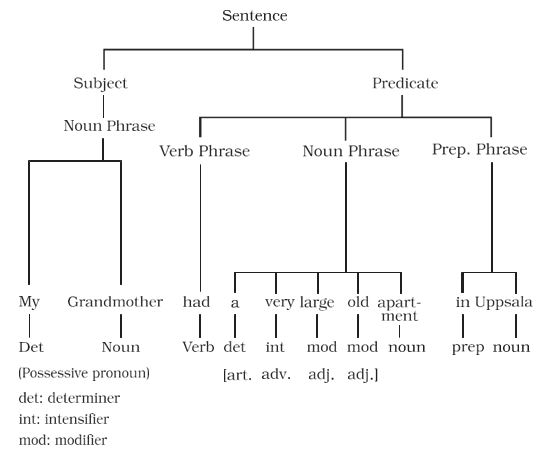
Example analysis
- Sentence: “My grandmother had a very large old apartment in Uppsala.”
- Subject: “My grandmother”; verb: “had”; object: “apartment”.
- Modifiers: “a”, “very”, “large” and “old” describe or qualify “apartment”; adjunct: “in Uppsala”.
Pronunciation: Elision
Elision — The omission of a sound in connected, rapid speech, often when consonants occur together in a cluster.
- Example: In “next day”, the /t/ may be dropped in fluent speech.
- Key point: Natural speech does not always pronounce every written or expected sound distinctly.
Screenplay Format
- Description: Gives directions for props, lighting, actors’ positions and movements.
- Dialogue: Contains the words spoken by the characters.
- Layout: A screenplay section can identify its title, actors and scene, then separate description from dialogue.
What are the main parts of a sentence?
What is elision in pronunciation?
What belongs in the description and dialogue columns of a screenplay?
Quick recap
- A sentence is built around a subject and a predicate.
- The predicate begins with a verb; an object may follow the verb.
- An adjunct adds details such as location, often through a prepositional phrase.
- Elision is the loss of a sound in connected speech.
- Screenplay descriptions give staging directions; dialogue records spoken words.
English — ALL CHAPTERS
1
The Last Lesson
2
Lost Spring (Stories of Stolen Childhood)
3
Deep Water
4
The Rattrap
5
Indigo
6
Poets and Pancakes
7
The Interview (From the Introduction to The Penguin Book of Interviews edited by Christopher Silvester).
8
Going Places
9
My Mother at Sixty-six
10
Keeping Quiet
11
A Thing of Beauty
12
A Roadside Stand
13
Aunt Jennifer’s Tigers
1
I Sell My Dreams
2
Eveline
3
A Wedding In Brownsville
4
Tomorrow
5
One Centimetre
6
A Lecture Upon The Shadow
7
Poems By Milton
8
Poems By Blake
9
Kubla Khan OR A Vision In A Dream: A Fragment
10
Trees
11
The Wild Swans At Coole
12
Time And Time Again
13
Blood
14
Freedom
15
The Mark On The Wall
16
Film-making
17
Why The Novel Matters
18
The Argumentative Indian
19
On Science Fiction
20
Chandalika
21
Broken Images
1
The Third Level
2
The Tiger King
3
Journey to the end of the Earth
4
The Enemy
5
On The Face Of It
6
Memories of Childhood