Class 12 Humanities . English . Vistas . The Enemy
Chapter 4: The Enemy
Ch 4
English
Class 12 Humanities
The Symbolism in Sadao Hoki's Life
Sadao’s Background and His Father’s Vision
Sadao’s early life and career
- Home: Sadao’s house stood on the rocky Japanese coast where he had played as a boy.
- Father’s influence: His father stressed education and saw Japan’s islands as “stepping stones to the future.”
- Training: Sadao went to America at 22 to study surgery and medicine, returning to Japan at 30.
- Position: He became a renowned surgeon and scientist, developing a way to make wounds completely clean.
- Why he remained in Japan: He was not sent abroad with the troops because he was perfecting this discovery and might be needed to operate on the old General.
Sadao and Hana
Their relationship and family
- Meeting: Sadao met Hana in America at Professor Harley’s home and felt he could love her.
- Marriage: They completed their studies and returned to Japan. Sadao’s father approved of Hana, and their marriage was arranged in the traditional way after the couple had already agreed.
- Family life: They are happy together and have two children. Sadao’s father would have accepted Hana only because she was Japanese.
The Wounded Stranger
A man washes ashore
- Discovery: Sadao and Hana see a man emerge from the mist, stagger, and collapse on the beach.
- Identity: He is a white American prisoner of war, making him an enemy during wartime.
- Injury: The unconscious man is bleeding and wears wet, ragged clothes.
- Diagnosis: Sadao finds a reopened gunshot wound on the man’s lower right back; the flesh is blackened with powder.
- Setting: The rocky, isolated shore and concealing fog leave the couple unseen as they discover him.
Symbolism and Central Tension
Key symbols and their significance
- The islands: The father’s “stepping stones” image represents his faith in Japan’s future and the possibilities Sadao is expected to help shape.
- The house and coast: Sadao’s childhood home on the Japanese shore reflects his strong roots in his homeland.
- The fog: It creates an atmosphere of uncertainty as the wounded stranger appears and the couple’s difficult choice begins.
- The wounded American: His presence sets up a conflict between Sadao’s duty as a doctor and his loyalty to Japan during wartime.
Dr Sadao Hoki
- Skilled and dedicated: He is a renowned surgeon and scientist focused on improving wound treatment.
- Respectful of his father: He takes his father’s words and expectations seriously.
- Compassionate and observant: He examines the stranger’s injury even after discovering that the man is a white foreigner.
Hana
- Affectionate: She shares a warm, close relationship with Sadao.
- Concerned: She reacts with alarm when the stranger collapses and accompanies Sadao to him.
Professional duty versus patriotism
The American prisoner’s arrival creates a moral dilemma: should Sadao save him as a doctor or hand him over to the Army as a patriot? This excerpt introduces the conflict but does not show Sadao’s decision.
Quick recap
- Sadao: A Japanese surgeon and scientist, educated in America, who returned to Japan.
- Why he stayed: He was perfecting a wound-cleaning discovery and might be needed to operate on the old General.
- Hana: Sadao’s Japanese wife; they met in America and married after returning home.
- The stranger: An unconscious American prisoner of war with a reopened gunshot wound is found on the shore.
- Conflict: The discovery raises the choice between medical responsibility and wartime patriotism.
A Soldier's Dilemma
Identifying the Soldier and Facing the Choice
- Sadao stops the bleeding of the unconscious, wounded man, then considers putting him back into the sea.
- The dilemma: If they shelter a white man, they may be arrested; if they hand him over as a prisoner, he will certainly die.
- The man's identity: His cap identifies him as a sailor from the U.S. Navy. Sadao and Hana realise he is an escaped American prisoner of war, wounded in the back.
- Their decision: Though Sadao calls the man his enemy, neither he nor Hana can bring themselves to put him back into the sea. They decide to carry him into the house.
Shelter, Treatment and Further Conflict
- A temporary plan: Sadao and Hana say they will give the man to the police, both to reassure the servants and to protect their family and Sadao's position.
- The old bedroom: They place the soldier in the unused room that had belonged to Sadao's father. Hana is troubled that the dirty stranger may soil its fine quilt.
- The urgent medical question: Sadao finds the soldier's pulse and heartbeat. He believes the man will die without an operation, but the operation itself may also kill him.
- Hana's fear: She worries that saving the enemy may bring danger. Sadao asks her to consider the possibility that the man may die if they do nothing.
- The household: Hana calls Yumi to help wash the soldier, but first attends to the children. Yumi puts the baby to bed.
Dr Sadao
- Skilled and compassionate: His medical training leads him to stop the bleeding and assess the soldier's condition.
- Conflicted: He considers the man an enemy but cannot abandon a wounded person.
- Responsible: He worries about the safety of his family and the consequences for his position.
Hana
- Compassionate but anxious: She agrees that they cannot put the soldier back into the sea, yet fears the risks of helping him.
- Practical: She suggests telling the servants that they intend to hand him over to the police.
- Caring mother: She checks on the children before continuing with the crisis.
Humanity versus National Loyalty
Sadao and Hana see the wounded sailor as an enemy, yet their compassion makes it impossible to leave him unaided. The scene contrasts wartime loyalties and fear with the responsibility to save a life.
Why do Sadao and Hana decide to take the American sailor into their house?
What makes Sadao believe the sailor needs an operation?
Does this passage establish whether Sadao will be arrested?
Quick recap
- Identity: The wounded man is an escaped American prisoner of war and a U.S. Navy sailor.
- Risk: Sadao and Hana fear arrest if they shelter him.
- Decision: They cannot bring themselves to put him back into the sea, so they carry him into the house.
- Medical dilemma: Without an operation he may die; the operation itself is risky.
- Central conflict: Their duty to a human life clashes with wartime hostility and personal danger.
A Tale of Two Hearts
The Servants’ Fear and Hana’s Decision
The servants refuse to help
- The gardener’s fear: He believes Sadao should let the wounded American die, fearing that helping an enemy will bring revenge on the household.
- Hana’s response: Though frightened and unsure whether helping an enemy is right, she asks Yumi to bring hot water.
- Yumi’s refusal: She will not wash the American because he is white, dirty and, she says, not her responsibility.
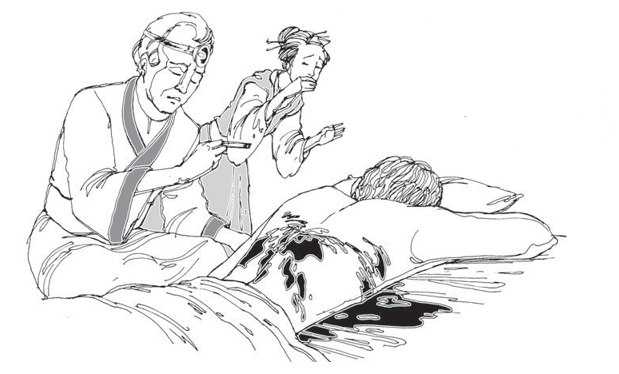
- Hana takes charge: After Yumi leaves, Hana washes the wounded man herself, insisting that he is a helpless human being.
Sadao Begins the Operation
Hana assists Sadao
- Sadao’s decision: He arrives in his surgeon’s coat with his emergency bag and prepares to operate, despite the American being an enemy.
- Hana’s support: She fetches towels and matting, then helps turn the patient so Sadao can clean his back and treat the wound.
- The wound: Sadao finds that the bullet is still inside and that the man has lost a great deal of blood.
- Hana’s distress: Seeing the operation makes her retch and leave the room, but she returns when Sadao needs her to give the anesthetic.
- The operation continues: Sadao works quickly and coolly, even while wondering why he is saving a man he considers an enemy.
Hana
- Compassionate: She sees the American as a wounded, helpless man rather than only as an enemy.
- Courageous: Though afraid and physically distressed, she washes him and returns to help during the operation.
- Responsible: She supports Sadao by fetching supplies and preparing to administer the anesthetic.
Dr. Sadao
- Skilled and composed: He examines the wound and carries out the operation with focused precision.
- Duty-bound: He continues treating the patient because stopping would mean the man would die.
- Conflicted: He questions why he is saving an enemy, yet his medical work carries on.
Yumi
- Prejudiced and fearful: She refuses to wash the American because he is white.
- Avoids involvement: She says the matter is not her responsibility and returns to her own work.
Human compassion versus hostility
The servants view the American through fear and wartime hostility, while Hana and Sadao’s actions show compassion toward a wounded human being.
Professional duty and personal conflict
Sadao’s medical duty leads him to operate even as he questions why he is saving an enemy; Hana also overcomes fear to assist him.
How does Hana respond when Yumi refuses to wash the American?
What does Hana do during Sadao’s operation?
Quick recap
- The gardener and Yumi fear or reject helping the wounded American.
- Hana overcomes her fear and washes the patient herself.
- Sadao decides to operate and discovers the bullet is still in the wound.
- Hana is sickened by the operation but returns to assist.
- The episode contrasts wartime hostility with compassion and medical duty.
The Hidden Pain of War Victims
Scars and the Human Cost of War
Hana notices the prisoner’s scars
- Hana’s concern: The American prisoner looks painfully thin, and his twisted lips suggest suffering.
- Uncertain reports: Stories of prisoners being mistreated circulate as rumours, while newspapers claim people welcome the Japanese armies.
- Fear of cruelty: Hana recalls General Takima’s violence towards his wife and wonders whether the prisoner was tortured.
- Visible evidence: She notices deep red scars beneath the young man’s ear and draws Sadao’s attention to them.
Sadao’s Duty as a Surgeon
The operation
- Surgical focus: Sadao concentrates on removing the bullet, relying on his detailed knowledge of the human body.
- Professional principle: His former anatomy professor taught that operating without complete knowledge of the body is like committing murder.
- Human connection: Sadao instinctively calls the prisoner “my friend,” temporarily forgetting that he is an enemy.
- The prisoner’s pain: After the bullet is removed, the unconscious man mutters that his “guts” have been injured.
- Choice to save him: Sadao gives an injection when the prisoner’s pulse becomes extremely weak; the pulse grows stronger, and Sadao says the man will live.
The Prisoner’s Recovery and Uncertain Future
Hana cares for the young American
- Hana’s care: The frightened, weak prisoner wakes and is fed by Hana because the servants refuse to enter his room.
- A cautious bond: Hana comforts him despite disliking him; he learns she speaks English because she lived in America.
- Tom’s fear: On the third day, Sadao orders him to rest. Tom asks whether they will hand him over.
- Sadao’s dilemma: Sadao admits he does not know what to do, though he says he ought to give the prisoner to the police as a prisoner of war.
The Servants’ Opposition
Conflict within the household
- Servants’ accusation: The servants believe Sadao and Hana have become too attached to America and are failing to put Japan first.
- Sadao’s explanation: He insists Americans are enemies, but his medical training prevents him from letting a person die when he can save him.
- Their protest: The gardener and cook argue that Sadao should have let the prisoner die; Yumi fears that the family’s children could suffer if Sadao is condemned as a traitor.
- Hana’s conflict: She understands much of the servants’ argument but feels compelled to continue caring for the prisoner. Her concern is not personal affection.
- Tom’s identity: When he tells her his name is Tom, Hana responds distantly; she still sees him as a troubling prisoner.
Sadao
- Skilled surgeon: Uses his precise knowledge to remove the bullet and revive the prisoner.
- Committed to medical duty: Treats the American as a patient despite recognising him as an enemy.
- Torn by conflict: Knows he may be expected to hand the prisoner to the police but has not decided what to do.
Hana
- Compassionate: Notices the prisoner’s suffering, feeds him and tries to calm his fear.
- Conflicted: Understands the household’s danger but continues to care for him despite her dislike.
Tom
- Vulnerable: A young, badly injured American prisoner recovering from surgery.
- Afraid and uncertain: Wakes terrified, asks whether he will be handed over and gives Hana his name.
Humanity versus wartime loyalty
Sadao’s medical duty and Hana’s compassion conflict with wartime hostility and pressure to prioritise national loyalty.
The suffering of war victims
The prisoner’s injuries, scars and fear reveal the physical and emotional pain war inflicts on individuals, even those regarded as enemies.
Quick recap
- Hana suspects the American prisoner may have been tortured after noticing scars beneath his ear.
- Sadao’s surgical skill saves the prisoner, despite his awareness that the man is an enemy.
- Hana cares for the recovering prisoner while the servants refuse to help.
- Sadao has not decided whether to hand the prisoner to the police.
- The servants fear that sheltering an American could bring disgrace or punishment upon the family.
- The episode highlights the clash between wartime loyalty and compassion for a suffering human being.
Understanding War Victims' Pain
Sadao’s Unfinished Report
- Recovery: Sadao examines the prisoner’s wound daily; after the last stitches are removed, the young man is expected to recover fully in about two weeks.
- Report: Sadao begins a report to the police, typing that an escaped prisoner washed ashore on February 21.
- Conflict: He hides the unfinished report, unable to bring himself to report the American he has treated.
The Servants Leave
- Departure: The servants leave together, unwilling to remain in a household sheltering an enemy prisoner.
- Hana: Frightened and burdened by unfamiliar work, she maintains her dignity, thanks the servants and pays them.
- Yumi: She is distressed at leaving the children and offers to return if the baby misses her; Hana decides not to call her back.
- Hana’s doubt: She asks why she and Sadao cannot see clearly what they ought to do, when the servants seem certain.
The Prisoner Recovers
- Recovery: Sadao lets the prisoner begin standing for short periods so he can regain strength.
- Gratitude: The American thanks Sadao for saving his life, but Sadao coldly warns him not to thank him too soon.
- Fear: Sadao sees terror in the young man’s eyes and notices the crimson scars on his neck, but does not ask about them.
The Messenger’s Visit
- Alarm: Hana fears the servants have reported Sadao and that the uniformed messenger has come to arrest him.
- Relief: The messenger has come to summon Sadao because the General is suffering another attack of pain.
- Concern: Hana admits she feared Sadao would be arrested. Sadao says he must find a way to get rid of the prisoner for her sake.
The General’s Plan
- Dependence: The General says Sadao cannot be arrested because he may need his surgical skill; he trusts no other surgeon as much.
- Attitude: The General jokes about combining German ruthlessness with American sentimentality, and says he would rather not be the test case.
- Proposal: He offers to send private assassins to kill the prisoner quietly and remove the body, without Sadao needing to know when they come.
- Agreement: Sadao agrees, thinking this would take the matter out of his hands and spare Hana worry; he decides not to tell her about the plan.
- Conflict: The General’s concern is chiefly self-preservation, while Sadao remains caught between professional duty, compassion and wartime loyalty.
Sadao
- Conflicted: He hides his police report and struggles to decide the prisoner’s fate.
- Skilled and valued: The General considers him indispensable because of his surgical ability.
- Compassionate but guarded: He treats the prisoner, yet responds coldly to his thanks and agrees to the General’s plan.
Hana
- Dignified: She thanks the departing servants despite feeling frightened and exhausted.
- Anxious: She fears the messenger has come to arrest Sadao.
- Reflective: She questions why she and Sadao cannot decide what they ought to do.
The General
- Self-interested: He protects Sadao because he depends on him for medical care.
- Pragmatic: He proposes a secret killing to solve the problem without involving Sadao directly.
- Powerful and humorous: He can arrange assassins through his private network and jokes about combining foreign traits.
Humanity and Wartime Loyalty
Sadao’s care for the wounded American conflicts with wartime loyalty. The servants’ departure and Hana’s doubts reveal the moral strain this conflict places on the household.
Power and Self-Preservation
The General’s decisions are shaped by his need for Sadao’s medical skill. His offer to arrange the prisoner’s death shows how wartime authority can treat human lives as problems to be managed.
Why does Sadao hide the unfinished report to the police?
Why does the General decide that Sadao cannot be arrested?
What solution does the General propose for dealing with the prisoner?
Quick recap
- Report: Sadao begins, then hides, a report about the escaped American; it records February 21 as the date he washed ashore.
- Servants: They leave the household, prompting Hana to question her and Sadao’s uncertainty.
- Recovery: The prisoner thanks Sadao, who remains guarded despite treating him.
- Messenger: Hana fears arrest, but the message concerns the General’s illness.
- General: He protects Sadao because he needs his medical skill and proposes a secret assassination.
- Conflict: The episode highlights the struggle between compassion, wartime loyalty and self-preservation.
A Patient's Perspective
Tom’s recovery and gratitude
- Recovery: Tom gets out of bed and asks whether the stiffness near his wound will remain. Sadao examines the healing scar and suggests massage or exercise.
- Gratitude: Tom recognises that Sadao has saved his life. He says that if all Japanese people were like Sadao, there might not have been a war.
- Sadao’s response: Sadao is moved but cannot speak easily; he soon directs Tom back to bed.
Sadao’s anxiety and indecision
- Fear: Sadao sleeps badly, imagining sounds in the garden and wondering whether men have come to take the American away.
- Delay: He repeatedly hopes Tom will have disappeared, but finds him safe and sleeping the next morning.
- Growing strain: Even after several nights, Tom remains in the house. A crash during a rainy night frightens Sadao and Hana, but the room is quiet.
- Tom’s progress: By morning, Tom has shaved, washed and regained colour. He says he is well.
Sadao arranges Tom’s escape
- Decision: Unable to endure another night of fear, Sadao tells Tom to escape to a nearby, unfortified island and wait for a Korean fishing boat.
- Preparation: After dark, Sadao secretly provides a boat, food, bottled water and quilts. He chooses a moonless night and works without a flashlight.
- Signal plan: He gives Tom a flashlight: two flashes at sunset mean he needs help; one means he is safe but still on the island. Tom must not signal after dark or light a fire.
- Underlying conflict: Sadao says it is inconvenient to keep Tom longer, though his actions again protect the man’s life. Hana’s former servants are expected to return once Tom is gone.
Sadao
- Compassionate: He continues caring for Tom and makes a practical plan for his escape.
- Anxious and conflicted: He fears the consequences of sheltering an enemy, and the strain disrupts his sleep.
- Self-effacing: He calls Tom’s continued presence inconvenient, avoiding an open expression of concern.
Tom
- Recovering: He regains strength, washes and shaves, and becomes cheerful.
- Grateful: He understands that Sadao has saved him and sincerely thanks him.
- Cooperative: He accepts Sadao’s plan to escape without protest.
Humanity beyond wartime divisions
Tom’s gratitude and Sadao’s continued protection show how personal compassion can cross national and wartime hostility.
Fear and moral strain
Sadao’s sleeplessness and repeated hesitation reveal the emotional cost of protecting an enemy while fearing discovery.
What does Tom say to Sadao about the war?
How does Sadao help Tom escape?
Why does Sadao say it is inconvenient to keep Tom longer?
Quick recap
- Tom recovers and openly thanks Sadao for saving him.
- Sadao remains fearful and loses sleep while Tom stays in the house.
- Hana and Sadao are startled by a night-time crash, but Tom is still safe.
- Sadao eventually arranges Tom’s escape to a nearby island.
- The signal plan allows Tom to ask for help while avoiding discovery.
- Human compassion persists despite the divisions of war.
Sadao's Moral Dilemma Explored
The American’s Departure
The American’s Departure
- Disguise: Sadao gives the American Japanese clothes and covers his blond hair with black cloth.
- Departure: The young man leaves into the darkness of the garden. Sadao waits for a final flash from the shore before closing the partition.
- Escape plan: Sadao had told him to wait for a Korean fishing boat; the passage does not confirm how or when he leaves.
The General’s Forgotten Promise
- Delay: A week after his emergency operation, the General asks whether the prisoner escaped; Sadao confirms that he did.
- Confession: The General admits he forgot his promise to have the prisoner killed because he was focused on his own illness.
- Reassurance: Worried that his lapse might be seen as disloyalty, the General receives Sadao’s assurance of his patriotism.
- Safety: Sadao understands that the General’s dependence on him makes him safe from exposure.
Sadao’s Reflection
- Relief: Sadao searches the sea at night but sees no light and no one on the island. He believes the prisoner is safe.
- Prejudice: Memories of anti-Japanese prejudice in America lead Sadao to recall his own contempt for the landlady who had cared for him.
- Recognition: Remembering the wounded American’s face, Sadao wonders why he could not kill him.
Sadao
- Compassionate: He helps the wounded American despite the danger and wartime hostility.
- Cautious: He keeps the escape secret and reassures the General to protect himself.
- Self-questioning: He recognises his own prejudice and remains puzzled by his inability to kill the prisoner.
Humanity versus Prejudice
Sadao acts compassionately toward an enemy, while his memories reveal that prejudice can affect people on both sides. His final question shows that his humane response remains difficult for him to explain.
Quick recap
- Sadao disguises the American and lets him leave; he had told him to wait for a Korean fishing boat.
- The General admits he forgot his promise to have the prisoner killed while recovering from surgery.
- Sadao reassures the General and realises that he is safe from exposure.
- Sadao’s reward is knowing the prisoner is likely safe, not any official reward.
- His memories of prejudice in America prompt him to recognise his own past prejudice.
- Sadao still wonders why he could not kill the wounded American.
Exercise
How does the story show the conflict between private duty and national loyalty?
Why does Hana support Sadao despite the domestic staff’s objections?
What does the General’s attitude suggest, and how might Sadao’s final decision be judged?
Quick recap
- Sadao’s medical duty conflicts with national loyalty during wartime.
- His compassion leads him to help the wounded enemy soldier.
- Hana supports Sadao despite pressure from the domestic staff.
- The General’s attitude may be viewed as self-absorbed and irresponsible.
- The story asks readers to consider whether humanity can overcome prejudice and national divisions.
English — ALL CHAPTERS
1
The Last Lesson
2
Lost Spring (Stories of Stolen Childhood)
3
Deep Water
4
The Rattrap
5
Indigo
6
Poets and Pancakes
7
The Interview (From the Introduction to The Penguin Book of Interviews edited by Christopher Silvester).
8
Going Places
9
My Mother at Sixty-six
10
Keeping Quiet
11
A Thing of Beauty
12
A Roadside Stand
13
Aunt Jennifer’s Tigers
1
I Sell My Dreams
2
Eveline
3
A Wedding In Brownsville
4
Tomorrow
5
One Centimetre
6
A Lecture Upon The Shadow
7
Poems By Milton
8
Poems By Blake
9
Kubla Khan OR A Vision In A Dream: A Fragment
10
Trees
11
The Wild Swans At Coole
12
Time And Time Again
13
Blood
14
Freedom
15
The Mark On The Wall
16
Film-making
17
Why The Novel Matters
18
The Argumentative Indian
19
On Science Fiction
20
Chandalika
21
Broken Images
1
The Third Level
2
The Tiger King
3
Journey to the end of the Earth
4
The Enemy
5
On The Face Of It
6
Memories of Childhood