Class 12 Humanities . English . Kaleidoscope . Poems By Blake
Chapter 8: Poems By Blake
Ch 8
English
Class 12 Humanities
‘The Divine Image’ & ‘The Human Abstract’
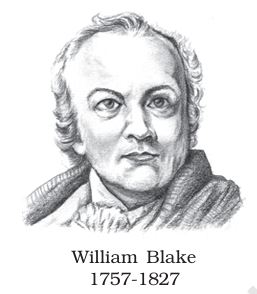
William Blake
- English poet, painter and engraver; lived from 1757 to 1827.
- He opposed the rationalism and materialism of his age.
- He saw and painted people beset by evil, yet striving for the divine within them.
- His poems appear in Songs of Innocence and Songs of Experience, representing contrary states of the human soul; most poems in the first volume have counterparts in the second.
What the poems explore
- The Divine Image presents Mercy, Pity, Peace and Love as virtues shared by God and humanity, forming a basis for universal kinship.
- The Human Abstract shows how social conditions and self-interest can make these virtues appear dependent on suffering and conceal cruelty beneath respectable appearances.
The Divine Image
The Divine Image
- People turn to Mercy, Pity, Peace and Love when they suffer.
- They are grateful to these virtues for comfort and help.
- The four virtues express the nature of God.
- They also belong to humanity, presented as God's child.
- The virtues are given human qualities and forms.
- Love makes the human form divine, while Peace is its outward covering.
- People everywhere seek these virtues in hardship.
- To pray to them is to recognise the divine in human goodness.
- Every person deserves love, whatever their religious or cultural identity.
- Where compassion and love exist, God is present.
The Divine Image: shared divinity
The poem locates the divine in human virtues. Mercy, Pity, Peace and Love connect people across places and religious identities.
The Human Abstract
The Human Abstract
- The speaker ironically suggests that Pity and Mercy depend on poverty and suffering.
- The lines criticise a society that preserves inequality instead of relieving it.
- The apparent peace rests on mutual fear, not genuine care.
- Self-interest allows Cruelty to trap people deliberately.
- Cruelty is associated with holy fears and tears, giving it a pious appearance.
- Humility grows beneath Cruelty, suggesting that it is fostered and controlled by this system.
- Mystery grows like a dark canopy over the system.
- The Caterpillar and Fly feed on this obscurity, which helps the destructive system persist.
- The system produces Deceit, made attractive by its sweet appearance.
- The Raven makes its nest in the Tree's deepest shade, extending the image of a world sheltered by deceit.
- Even gods cannot find the source of this destructive Tree in the natural world.
- Its roots lie in human thought: people create the systems of deceit and oppression.
The Human Abstract: manufactured virtue and oppression
The poem criticises a society that produces poverty and fear, then presents pity, humility and peace as virtues. The symbolic Tree reveals that deceit and oppression originate in the human mind.
| Device | Example | Effect |
|---|---|---|
| Personification | “Cruelty knits a snare” | Makes Cruelty seem like an active, calculating trapper. |
| Extended metaphor | The Tree, its shade and fruit in The Human Abstract | Shows how human-made deceit grows and shelters evil. |
| Symbolism | “the human form divine” | Connects human goodness with divine presence. |
| Irony | “Pity would be no more / If we did not make somebody Poor” | Exposes the hypocrisy of relying on suffering to display compassion. |
How do the two poems present Mercy, Pity, Peace and Love differently?
Quick recap
- Blake saw and painted people beset by evil but striving for the divine within them.
- Songs of Innocence and Songs of Experience represent contrary states of the human soul; most poems in Songs of Innocence have counterparts in Songs of Experience.
- The Divine Image links Mercy, Pity, Peace and Love with both God and humanity.
- The poem calls for love and respect across religious and cultural differences.
- The Human Abstract uses the Tree as a symbol of human-made deceit and oppression.
- Its final image locates the Tree's roots in the human brain.
Exercise
The Two Views of Human Nature
How are the two poems related, and what do they suggest about humanity?
Divine Virtues and Their Distortion
What do the lines about Mercy, Pity, Love and Peace mean, and how are these virtues distorted?
Language and Form
What pattern is used in the syllables of The Divine Image?
Related Reading: The Chimney Sweeper
- Songs of Innocence: A child chimney sweeper describes hardship, while Tom Dacre dreams of an angel freeing the sweepers and offering hope.
- Songs of Experience: A young sweeper, abandoned in the snow, blames his parents and society for exploiting him.
- Contrast: The Innocence poem presents hope amid suffering; the Experience poem exposes oppression and hypocrisy.
- Social criticism: Together, the poems condemn a society that exploits children while allowing adults to hide behind religious respectability.
Quick recap
- The Divine Image presents human virtues as reflections of the divine.
- The Human Abstract shows how social injustice and selfishness distort ideals.
- Blake portrays people as capable of both compassion and corruption.
- His poems contrast original human harmony with a fallen world of discord and tyranny.
- The Divine Image alternates eight- and six-syllable lines with an unstressed–stressed rhythm.
- The two Chimney Sweeper poems contrast imagined hope with a sharper exposure of exploitation.
English — ALL CHAPTERS
1
The Last Lesson
2
Lost Spring (Stories of Stolen Childhood)
3
Deep Water
4
The Rattrap
5
Indigo
6
Poets and Pancakes
7
The Interview (From the Introduction to The Penguin Book of Interviews edited by Christopher Silvester).
8
Going Places
9
My Mother at Sixty-six
10
Keeping Quiet
11
A Thing of Beauty
12
A Roadside Stand
13
Aunt Jennifer’s Tigers
1
I Sell My Dreams
2
Eveline
3
A Wedding In Brownsville
4
Tomorrow
5
One Centimetre
6
A Lecture Upon The Shadow
7
Poems By Milton
8
Poems By Blake
9
Kubla Khan OR A Vision In A Dream: A Fragment
10
Trees
11
The Wild Swans At Coole
12
Time And Time Again
13
Blood
14
Freedom
15
The Mark On The Wall
16
Film-making
17
Why The Novel Matters
18
The Argumentative Indian
19
On Science Fiction
20
Chandalika
21
Broken Images
1
The Third Level
2
The Tiger King
3
Journey to the end of the Earth
4
The Enemy
5
On The Face Of It
6
Memories of Childhood