Class 12 Humanities . English . Kaleidoscope . Eveline
Chapter 2: Eveline
Ch 2
English
Class 12 Humanities
"Eveline: The Paralysis Of Choice In Joyce's Dublin"
James Joyce
- Irish writer James Joyce lived from 1882 to 1941 and became a major literary figure of the early twentieth century.
- He is known for experimenting boldly with narrative techniques.
- “Eveline” is one of the fifteen stories in *Dubliners*, first published in 1914; *Ulysses* is his best-known work.
Eveline at home
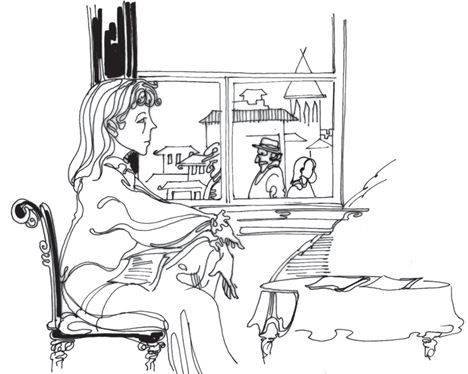
- Sitting by the window, Eveline remembers her childhood, when the children played together in a field that was later built over.
- Her mother and brother Ernest are dead; her other brother Harry is often away. The familiar home now feels at risk of being left behind.
- The room’s objects remind her of home, even though she has never felt curious enough to learn the name of the priest in the photograph.
The choice to leave
- Eveline weighs the security of home against a new life abroad. At home she has food and shelter, but also exhausting work and little freedom.
- She gives her wages to her father, who often quarrels with her over money and threatens her. She also keeps the household running and cares for the younger children.
- She imagines that marriage will bring respect and protect her from the treatment her mother endured, but she feels uncertain about abandoning her family and familiar life.
Frank and the promise to her mother
- Frank is a sailor who has travelled widely. Eveline remembers him as kind, open-hearted and fond of music; he plans to take her to Buenos Aires and marry her.
- Eveline’s father disapproves of Frank and forbids their relationship, so the couple meet secretly.
- A street organ’s music recalls the night her mother was dying and Eveline’s promise to keep the family home together. Her mother’s unhappy life deepens Eveline’s fear of repeating that fate.
At the station
- At the North Wall station, Eveline prays for guidance as the boat prepares to leave. She thinks Frank may save her, but the sea and the unknown future fill her with terror.
- When Frank urges her to come, she grips the railing and refuses to move. He goes beyond the barrier, but she remains motionless and gives him no sign of recognition or farewell.
- The story ends without explaining her choice fully: Eveline’s fear and emotional paralysis prevent her from acting on her plan to escape.
Eveline
- Dutiful and hardworking: she earns money, manages the household and cares for the younger children.
- Trapped and fearful: her father threatens her, and she worries about facing an unfamiliar country and life.
- Conflicted: she longs for freedom with Frank but feels bound by home, family duty and her promise to her mother.
- Paralysed at the crucial moment: despite planning to leave, she cannot board the boat.
Frank
- A sailor with experience of distant places, including Buenos Aires.
- Eveline remembers him as affectionate and generous; he offers her marriage and a chance to leave Dublin.
- His plans represent escape, but the story does not show whether life with him would meet Eveline’s hopes.
Eveline’s father
- He is controlling and often quarrels with Eveline over money; she fears his threats and violence.
- He can also show affection, as when he reads to her and makes toast while she is ill, adding to her conflicted feelings about leaving.
Paralysis and choice
Eveline can imagine escape but cannot take the decisive step. Fear, uncertainty and competing loyalties leave her unable to choose a new life.
Duty, family and the past
Eveline’s promise to her mother and her responsibility for the household pull her toward staying. Her mother’s life warns her of what may lie ahead, yet also binds her emotionally to home.
Limited freedom in Dublin
Eveline’s low-paid work, household burdens and fear of male authority restrict her choices. Her personal struggle reflects the pressures and stagnation of everyday life in Joyce’s Dublin.
““No! No! No!””
Eveline
“‘Derevaun Seraun!’”
Eveline, remembering her mother
- cretonne
- A heavy printed fabric used for curtains or upholstery.
- nix
- A lookout; someone who watches for danger.
- palpitations
- Unusually rapid or forceful heartbeats.
- courting
- Dating with the intention of marriage.
- avenue
- A broad street or road.
Quick recap
- Eveline is torn between an oppressive but familiar home and a possible new life with Frank.
- Her hard work, fear of her father and responsibility for the household shape her decision.
- The street organ recalls her promise to her dying mother and the sacrifices of her mother’s life.
- At the station, Eveline cannot overcome her fear or board the boat.
- The ending captures the story’s central idea: emotional paralysis can block escape and change.
Exercise
Story Discussion and Appreciation
Areas to Consider
- Story questions: Analyse Eveline’s feelings towards people in her life, her emotional conflict before leaving, why she lets the chance to escape go, and how her indecision appears as departure nears.
- Discussion: The exercises invite reflection on the difficult balance between family duty and personal happiness, including a real-life difficult choice.
- Appreciation: Consider possible meanings of the window, gathering dusk and dusty cretonne; notice that the narrative follows Eveline’s consciousness.
- Final images: Explore the emotions evoked by the bell, the seas, Eveline’s frantic grip on the iron and her passive appearance; consider whether the author passes judgement on her.
Language: Parallelism
Parallelism — The use of matching grammatical forms for coordinated ideas, creating balance and emphasising their relationship.
How It Works
- Equal form: Matching structures reinforce ideas of equal importance and make a sentence balanced.
- Effect: Successive parallel ideas emphasise their connection; parallelism can express similarity or contrast.
- Example: “to go away, to leave her home” repeats the infinitive form.
- Example: “One was to Harry; the other was to her father” uses matching sentence patterns to refer to two letters.
- Contrast: The comparison between “their little brown houses” and “bright brick houses with shining roofs” uses contrasting descriptions to emphasise the difference.
- Word choice: “Ernest had been her favourite but she liked Harry too” balances the two ideas through corresponding descriptions of her feelings.
What is parallelism, and what is its effect?
Pronunciation: Syllables and Stress
- Syllables: The lesson states that a word has as many syllables as it has vowels; “man” has one syllable and “manner” has two.
- Stress: In a word with more than one syllable, the syllable pronounced more prominently is the stressed syllable.
- Example: In “manner,” the first syllable is more prominent; dictionaries show stress in pronunciation guides.
What is a stressed syllable?
Quick recap
- The story exercises invite analysis of Eveline’s feelings, conflict, indecision and choice.
- The appreciation prompts explore symbols, the stream of Eveline’s consciousness and the emotions of the final images.
- Parallelism matches grammatical forms to create balance and emphasise relationships between ideas.
- Parallel structures can express similarity or contrast, including the descriptions of the houses.
- The lesson gives “man” as one syllable and “manner” as two.
- A stressed syllable is pronounced more prominently than the others in a multisyllabic word.
English — ALL CHAPTERS
1
The Last Lesson
2
Lost Spring (Stories of Stolen Childhood)
3
Deep Water
4
The Rattrap
5
Indigo
6
Poets and Pancakes
7
The Interview (From the Introduction to The Penguin Book of Interviews edited by Christopher Silvester).
8
Going Places
9
My Mother at Sixty-six
10
Keeping Quiet
11
A Thing of Beauty
12
A Roadside Stand
13
Aunt Jennifer’s Tigers
1
I Sell My Dreams
2
Eveline
3
A Wedding In Brownsville
4
Tomorrow
5
One Centimetre
6
A Lecture Upon The Shadow
7
Poems By Milton
8
Poems By Blake
9
Kubla Khan OR A Vision In A Dream: A Fragment
10
Trees
11
The Wild Swans At Coole
12
Time And Time Again
13
Blood
14
Freedom
15
The Mark On The Wall
16
Film-making
17
Why The Novel Matters
18
The Argumentative Indian
19
On Science Fiction
20
Chandalika
21
Broken Images
1
The Third Level
2
The Tiger King
3
Journey to the end of the Earth
4
The Enemy
5
On The Face Of It
6
Memories of Childhood