Class 12 PCB . Physics . Physics Part II . Dual Nature of Radiation and Matter
Chapter 3: Dual Nature Of Radiation And Matter
Ch 3
Physics
Class 12 PCB
Introduction
Evidence for the Electron
Light, discharge tubes and cathode rays
- Wave nature of light: Maxwell’s equations and Hertz’s experiments strongly supported light as an electromagnetic wave; Hertz demonstrated the generation and detection of electromagnetic waves in 1887.
- Discharge tube: At very low gas pressure (about mm of mercury), an applied electric field produced a discharge and a fluorescent glow on the glass opposite the cathode.
- Fluorescence: The glow was attributed to radiation from the cathode; soda glass appeared yellowish-green.
- Cathode rays: William Crookes discovered them in 1870 and suggested in 1879 that they were streams of fast-moving, negatively charged particles.
- Other milestones: Roentgen discovered X-rays in 1895; J. J. Thomson confirmed the particle nature of cathode rays and named their particles electrons in 1897.
Properties and universality of electrons
- Thomson’s measurements: Using mutually perpendicular electric and magnetic fields, Thomson measured cathode-ray particle speed and specific charge, the charge-to-mass ratio.
- Speed: Cathode-ray particles travelled at about – times the speed of light, where .
- Specific charge: The accepted magnitude of the electron’s charge-to-mass ratio is .
- Universality: The specific charge was unchanged with different cathode materials or gases. Particles emitted by ultraviolet irradiation or heating also had the same specific charge, showing they were identical electrons.
- Significance: Thomson proposed electrons as universal constituents of matter and received the 1906 Nobel Prize in Physics for this work.
Electron charge and mass
- Millikan’s oil-drop experiment: In 1913, R. A. Millikan found that the charge on an oil droplet was always an integral multiple of the elementary charge.
- Quantisation of charge: Electric charge occurs in discrete units; the magnitude of the elementary charge is .
- Electron mass: Combining the electron’s charge with its specific charge gives its mass.
Here is the magnitude of electron charge and is its mass.
Electron Emission
Work function — The work function, denoted by , is the minimum energy an electron needs to escape from a metal surface.
Why electrons need energy to escape
- Free electrons: Metals contain mobile electrons responsible for electrical conductivity, but they are normally confined within the metal.
- Attraction at the surface: An electron trying to leave makes the surface positively charged; attractive forces from the ions pull it back.
- Escape condition: An electron must receive at least the work function energy. Its value depends on the metal and the condition of its surface.
- Unit: Work function is commonly measured in electron volts (eV). One eV is the energy gained by an electron accelerated through a potential difference of one volt.
The electron volt is a unit of energy used commonly in atomic and nuclear physics.
| Type | Condition/Energy | Example | Note |
|---|---|---|---|
| Thermionic emission | Heating supplies thermal energy to electrons. | A heated metal | Electrons escape when they gain sufficient energy. |
| Field emission | A very strong electric field, about , pulls electrons out. | Spark plug | Emission is caused by the applied electric field. |
| Photoelectric emission | Light of suitable frequency supplies energy. | Light shining on a metal surface | The emitted light-generated electrons are called photoelectrons. |
What evidence showed that cathode-ray particles are universal constituents of matter?
Define the work function and state its unit.
What did Millikan’s oil-drop experiment establish?
Quick recap
- Maxwell’s equations and Hertz’s experiments established strong evidence for light’s wave nature.
- Thomson identified electrons in cathode rays and found their specific charge to be independent of the cathode and gas.
- Millikan’s oil-drop experiment established charge quantisation and measured the elementary charge.
- The work function is the minimum energy needed for an electron to escape a metal surface.
- Electrons can be emitted by heating, a strong electric field, or light of suitable frequency.
- One electron volt equals .
Photoelectric Effect
Discovery and Basic Idea
- Discovery: In 1887, Heinrich Hertz found that ultraviolet light enhanced sparks in his electromagnetic-wave experiments.
- Basic idea: Light falling on a metal can transfer energy to surface electrons, enabling some to escape.
Hallwachs’ and Lenard’s Observations
Threshold frequency — The minimum frequency of incident light required to emit electrons from a given material.
Experimental Arrangement
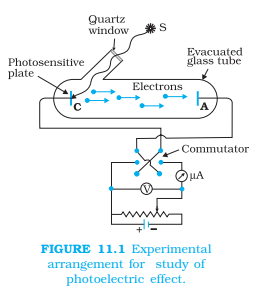
Effect of Light Intensity on Photocurrent
At fixed frequency and collector potential, photocurrent is directly proportional to incident light intensity.
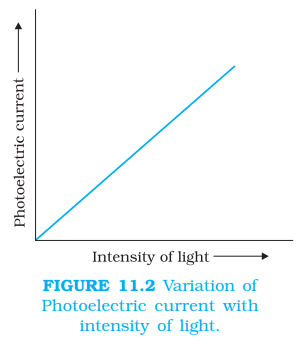
What is threshold frequency?
How does light intensity affect photocurrent?
Quick recap
- Photoelectric effect is the emission of electrons from a surface under suitable incident light.
- Hertz observed the effect in 1887; Hallwachs and Lenard investigated it in detail.
- Emitted electrons travel from the emitter to the positive collector, causing current.
- No emission occurs below a material-dependent threshold frequency.
- At fixed frequency and potential, photocurrent increases linearly with light intensity.
Effect Of Potential On Photoelectric Current
Effect of Potential on Photoelectric Current
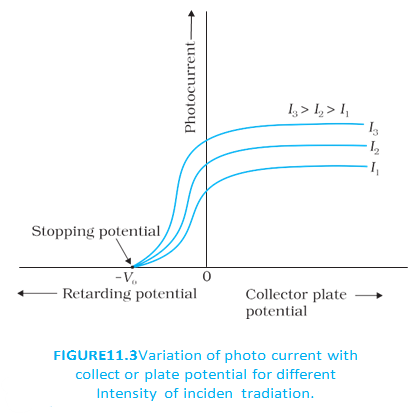
Effect of Light Intensity
- Experiment: The incident-light intensity is varied while its frequency and the collector potential are kept fixed, and the photocurrent is measured.
Effect of Frequency and Threshold Frequency
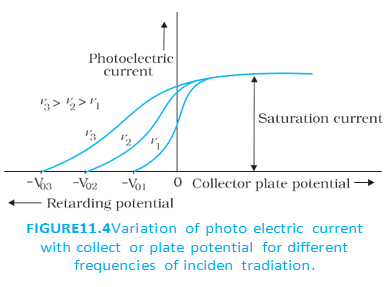
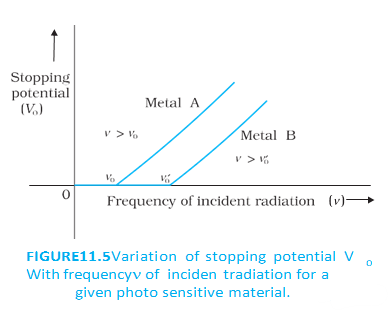
Main Experimental Features
- Threshold frequency: Below the material’s threshold frequency, photoelectric emission does not occur, regardless of light intensity.
- Emission time: Above threshold, photoelectrons are emitted essentially instantaneously, even with very dim light.
Photoelectric Effect and Wave Theory of Light
What is threshold frequency? What happens below it?
Give two observations that the classical wave theory fails to explain.
Quick recap
- Increasing positive collector potential raises photocurrent until it reaches saturation.
- Stopping potential is the retarding-potential magnitude that stops the most energetic electrons: .
- At fixed frequency, greater intensity increases photocurrent and saturation current, not stopping potential.
- Stopping potential and maximum kinetic energy increase with frequency; each metal has a threshold frequency.
- Below threshold there is no emission, while above threshold emission is nearly instantaneous.
- Classical wave theory cannot explain the threshold, frequency dependence of electron energy, or prompt emission.
Einstein’s Photoelectric Equation: Energy Quantum Of Radiation
Light Quanta and Photoelectric Emission
- Light quanta: Einstein proposed that radiation consists of discrete energy packets, each with energy .
- Emission: An electron absorbs one photon; if its energy exceeds the metal’s work function, the electron escapes.
Einstein’s Photoelectric Equation
Frequency, Intensity and Threshold
Consequences of the Threshold
- Below threshold: If , no photoelectrons are emitted, however intense the light is or however long it shines.
- At threshold: If , electrons can just escape, with .
- Above threshold: If , photoelectric emission occurs; increasing intensity increases the photoelectric current.
- Material dependence: A larger work function gives a larger threshold frequency, since .
Instantaneous Emission and Photoelectric Current
- Instantaneous process: Photoelectric emission begins as soon as an electron absorbs a photon; it does not require energy to build up over time.
- Photocurrent: Above the threshold frequency, greater light intensity means more photons arrive per second and more electrons are emitted per second.
Stopping Potential and Experimental Verification
The slope is universal; the intercept depends on the metal’s work function.
Experimental Test
- 1905Einstein proposed the light-quantum explanation of the photoelectric effect.
- 1906–1916Millikan carried out measurements to test Einstein’s photoelectric equation.
- 1916Millikan’s results confirmed the equation and gave a value of consistent with other measurements.
How does light intensity affect photoelectron kinetic energy and photoelectric current?
What is the threshold frequency, and what happens below it?
What does the slope of a versus graph represent?
Quick recap
- Radiation transfers energy in photons, each with energy .
- Einstein’s equation is .
- Emission requires , where .
- At fixed frequency, intensity changes photoelectric current, not maximum kinetic energy.
- Emission is instantaneous because one photon transfers energy to one electron.
- The slope of the stopping-potential graph is ; Millikan’s measurements verified Einstein’s equation.
Particle Nature Of Light: The Photon
Evidence for the Photon
Photon — A photon is a quantum of electromagnetic radiation that behaves like a particle when radiation interacts with matter.
Evidence and key dates
- Photoelectric effect: Light transfers energy to matter in discrete packets, each with energy .
- Compton scattering: In 1924, A. H. Compton's X-ray scattering experiment with electrons further confirmed light's particle-like behaviour.
- Nobel Prize: Einstein received the 1921 Nobel Prize in Physics for theoretical physics and the photoelectric effect; Millikan received the 1923 prize for work on elementary electric charge and the photoelectric effect.
Photon Properties
Each photon travels at speed and has energy and momentum related to its frequency or wavelength.
Important features
- Frequency and wavelength: Photons with the same frequency or wavelength have identical energy and momentum, regardless of radiation intensity.
- Intensity: At fixed wavelength, increasing intensity increases the number of photons crossing an area per second, not the energy of each photon.
- Charge: Photons are electrically neutral and are not deflected by electric or magnetic fields.
- Collisions: Total energy and momentum are conserved, but photon number need not be; photons may be absorbed or created.
Photon Rate from Light Power
Power is energy emitted per second. If each photon has energy , the photon rate is .
Example: laser photon rate
- Given: A laser emits light of frequency and power .
- Energy per photon: .
- Photon rate: photons per second.
Threshold Frequency and Stopping Potential
At threshold, photon energy equals the work function and the emitted electron has zero maximum kinetic energy; below threshold, no photoelectrons are emitted.
At stopping potential , the maximum kinetic energy of emitted photoelectrons equals .
Example: caesium
- Given: Caesium has work function .
- Threshold frequency: .
- Wavelength at zero photocurrent: For stopping potential , .
- Emission condition: Photoelectrons are emitted when photon energy is at least the work function; at equality, their maximum kinetic energy is zero.
Do not confuse intensity with photon energy: at fixed frequency, greater intensity means more photons per second, while each photon retains the same energy.
Quick recap
- Light behaves as packets called photons when interacting with matter.
- A photon has energy and momentum .
- At fixed frequency, intensity changes photon number, not energy per photon.
- Photons are neutral; energy and momentum are conserved in collisions, but photon number may change.
- At threshold, ; emission occurs at equality as well as above threshold.
- At stopping potential, .
Wave Nature Of Matter
Wave–Particle Duality
| Aspect | Evidence / example |
|---|---|
| Wave-like | Interference, diffraction and polarisation |
| Particle-like | Photoelectric and Compton effects involve energy and momentum transfer by photons |
| Both descriptions | In vision, focusing by the eye lens is described by waves, while absorption by retinal rods and cones involves photons |
Matter can also behave as a wave
- Hypothesis: In 1924, Louis Victor de Broglie proposed that moving particles of matter, such as electrons and protons, can show wave-like properties under suitable conditions.
- Reasoning: De Broglie proposed a symmetry between matter and energy: since radiation has wave and particle aspects, matter should too.
De Broglie Wavelength
De Broglie wavelength — The wavelength associated with a moving particle is called its de Broglie wavelength.
Here is momentum, is particle mass, is speed and is Planck’s constant. For a non-relativistic particle, .
What the relation tells us
- Dual character: Wavelength is a wave property, while momentum is a particle property; Planck’s constant connects them.
- Dependence: At fixed speed, greater mass means greater momentum and a smaller wavelength; at fixed mass, greater speed also means a smaller wavelength.
- Scale: Matter-wave effects are measurable for subatomic particles, but macroscopic objects have wavelengths too small to detect.
- Status: For material particles, the relation was a hypothesis whose validity could be tested experimentally.
Photons and Matter Waves
For a photon of frequency , its momentum is . Substitution into the de Broglie relation gives the electromagnetic wavelength .
| Particle and motion | Momentum | Wavelength |
|---|---|---|
| Ball: , | ||
| Electron: , | ||
| Ball: , |
Reading the examples
- Calculation: Use , then calculate ; take .
- Electron: Its wavelength is comparable to X-ray wavelengths, so electron wave behaviour can be significant.
- Ball: Its wavelength is extraordinarily small—about times the size of a proton in the cited example—so it is beyond experimental measurement.
State the de Broglie relation and explain what it implies.
Quick recap
- Light displays wave behaviour in interference, diffraction and polarisation, and particle behaviour in energy-transfer effects such as the photoelectric effect.
- De Broglie proposed in 1924 that moving matter also has wave-like properties.
- The matter-wave wavelength is for a non-relativistic particle.
- A photon’s de Broglie wavelength equals its electromagnetic wavelength.
- Subatomic particles can have measurable matter waves; everyday objects have wavelengths far too small to detect.
Summary & Points To Ponder
Work Function and Electron Emission
Work function — The work function, , is the minimum energy needed for an electron to escape from a metal surface.
Ways to Supply Emission Energy
- Heating: Thermal energy can help electrons escape.
- Strong electric field: An applied field can enable electron emission.
- Suitable light: Irradiation can release electrons when the photon energy is sufficient.
- Inside the metal: Electrons move approximately in a constant potential, but need additional energy to leave.
Photoelectric Effect
Photoelectric effect — The photoelectric effect is the emission of electrons from a metal when light of suitable frequency falls on it.
Key Features
- Suitable frequency: Some metals respond to ultraviolet light, while others respond to visible light.
- Energy conversion: Light energy is converted into electrical energy, consistently with conservation of energy.
- Instantaneous emission: Photoelectrons are emitted without an appreciable delay when suitable light is incident.
- Electron energies: Electrons in a metal have a distribution of energies, so the additional energy needed to escape varies between electrons.
- Work function: It is the least escape energy; electrons with higher initial energy need less additional energy to escape.
| Quantity | Depends on | Does not depend on |
|---|---|---|
| Photoelectric current | Incident-light intensity, applied potential difference, and emitter material | — |
| Stopping potential, | Incident-light frequency and emitter material | Light intensity for a fixed frequency |
The stopping potential is the retarding potential needed to stop the most energetic photoelectrons.
Threshold Frequency
- Threshold frequency: Each metal has a minimum frequency, , required for photoelectric emission.
- Below threshold: If , no photoelectrons are emitted, however intense the light.
- Threshold relation: The work function is related to threshold frequency by .
Photon Explanation and Einstein’s Equation
| Point | Classical wave picture | Photon picture |
|---|---|---|
| Energy transfer | Radiation transfers energy continuously | Energy is transferred in discrete amounts in light–matter interactions |
| Photoelectric observations | Cannot explain the independence of from intensity, the existence of stopping potential, threshold frequency, or instantaneous emission | Photon absorption by an electron explains these observations |
| Photon energy | Does not describe light as photons | Each photon has energy , set by frequency rather than intensity |
A photon’s energy and momentum are related to the frequency and wavelength of the radiation.
Photon energy overcomes the work function; the remainder becomes the emitted electron’s maximum kinetic energy.
Evidence and Significance
- Key discriminator: Stopping-potential independence from intensity and dependence on frequency distinguish the photon explanation from the classical wave picture.
- Discrete transfer: Observations show that energy transfer in light–matter interactions occurs in units of ; this is not, by itself, exactly the same claim as saying light consists of particles.
- Millikan’s measurements: His precise measurements confirmed Einstein’s equation and yielded an accurate value of Planck’s constant, .
- Significance: The confirmation helped establish acceptance of the particle, or photon, description of electromagnetic radiation.
Wave–Particle Duality and Matter Waves
Dual Nature
- Radiation: It has both wave and particle aspects; the experiment determines which description is most useful.
- Matter: Louis Victor de Broglie proposed that moving material particles also have a wave-like character.
- Matter waves: The waves associated with moving particles are also called de Broglie waves.
This relation links the wave quantity to the particle quantity momentum .
When Matter Waves Are Significant
- Particle properties: The de Broglie wavelength is independent of a particle’s charge and nature; it depends on its momentum.
- Subatomic particles: For electrons and protons, small mass and momentum can give a measurable wavelength, comparable to atomic-plane spacing in crystals.
- Macroscopic objects: Their wavelengths are extremely small and beyond ordinary measurement.
| Quantity | Symbol | Dimensions | Unit | Key relation |
|---|---|---|---|---|
| Planck’s constant | J s | |||
| Stopping potential | V | |||
| Work function | J or eV | |||
| Threshold frequency | Hz | |||
| de Broglie wavelength | m |
Points to Ponder
Electron Energies in Metals
- Approximation: Electrons are treated as moving freely inside a metal in a constant potential, but they are not free to escape.
- Energy distribution: Electrons do not all have the same energy. Their distribution differs from the Maxwell distribution of gas molecules because electrons obey the Pauli exclusion principle.
- Escape energy: Higher-energy electrons need less additional energy to escape; the work function is the least energy needed for an electron to leave the metal.
Matter-Wave Velocities
- Wavelength: The matter-wave wavelength given by has physical significance.
- Phase velocity: The phase velocity, , has no physical significance.
- Group velocity: The group velocity is physically meaningful and equals the particle’s velocity.
State Einstein’s photoelectric equation and explain its terms.
What happens to photoelectric emission below the threshold frequency?
Write the de Broglie relation and state when its wavelength is measurable.
Quick recap
- Work function: is the minimum energy needed for an electron to escape a metal.
- Photoelectric effect: Emission is instantaneous; current depends on intensity, while stopping potential depends on frequency and emitter material.
- Threshold: Below , no emission occurs, however intense the light.
- Einstein’s equation: ; Millikan’s confirmation supported acceptance of the photon description.
- Matter waves: Moving particles have de Broglie wavelength ; it is significant for subatomic particles.
- Wave velocities: Matter-wave group velocity equals particle velocity; phase velocity has no physical significance.
Physics — ALL CHAPTERS
1
Electric Charges And Fields
2
Electrostatic Potential And Capacitance
3
Current Electricity
4
Moving Charges And Magnetism
5
Magnetism And Matter
6
Electromagnetic Induction
7
Alternating Current
8
Electromagnetic Waves
1
Ray Optics And Optical Instruments
2
Wave Optics
3
Dual Nature Of Radiation And Matter
4
Atoms
5
Nuclei
6
Semiconductor Electronics: Materials, Devices And Simple Circuits