Class 12 PCB . Physics . Physics Part II . Nuclei
Chapter 5: Nuclei
Ch 5
Physics
Class 12 PCB
Introduction
Nucleus — The tiny central region of an atom where its positive charge and most of its mass are concentrated.
Nuclear size and atomic structure
- Relative size: The nuclear radius is about times smaller than the atomic radius.
- Relative volume: The volume of a nucleus is about times the volume of its atom; hence, an atom is almost entirely empty space.
- Mass concentration: Despite its tiny size, the nucleus contains more than of the atom’s mass.
- Scale analogy: If an atom were enlarged to classroom size, its nucleus would be roughly the size of a pinhead.
The volume ratio follows from the cube of the linear-size ratio.
What this chapter studies
- Nuclear structure: The constituents of the nucleus and how they are held together.
- Nuclear properties: The size, mass and stability of nuclei.
- Nuclear phenomena: Radioactivity, nuclear fission and nuclear fusion.
Quick recap
- The nucleus is the tiny central region containing an atom’s positive charge and most of its mass.
- Its radius is about of the atomic radius, and its volume is about of the atomic volume.
- An atom is almost entirely empty space.
- The nucleus contains more than of an atom’s mass.
- The chapter covers nuclear structure, properties, radioactivity, fission and fusion.
Atomic Masses And Composition Of Nucleus
Atomic Mass Unit
The carbon-12 reference defines the atomic mass unit in kilograms.
- Why use u? Atomic masses are extremely small in kilograms; a carbon-12 atom has mass .
- Atomic masses: Many are close to integral multiples of the hydrogen-atom mass, but exceptions occur; chlorine's atomic mass is about .
- Measurement: Atomic masses are accurately measured with a mass spectrometer.
Isotopes and Average Atomic Mass
- Same element: Isotopes have the same atomic number and electronic structure, but different neutron numbers and masses.
- Natural occurrence: Most elements are mixtures of isotopes; their relative abundances vary from element to element.
- Chlorine isotopes: Their masses are and , with abundances and , respectively.
For percentage abundances, multiply each isotope mass by its percentage abundance, add the products, then divide by .
The weighted average agrees with chlorine's reported atomic mass.
Hydrogen Isotopes and the Proton
| Isotope | Nuclear symbol | Protons | Neutrons | Atomic mass |
|---|---|---|---|---|
| Protium (lightest hydrogen) | ||||
| Deuterium | ||||
| Tritium |
- Proton: The nucleus of the lightest hydrogen isotope is a proton; this isotope has a relative abundance of .
- Proton mass: .
- Mass relation: A hydrogen atom has mass ; subtracting the electron mass, , gives approximately the proton mass.
- Tritium: Tritium nuclei are unstable and are produced artificially in laboratories.
Protons and Nuclear Charge
- Protons: Each proton is stable and carries one unit of positive fundamental charge, .
- Electrons: All atomic electrons lie outside the nucleus. An atom with atomic number has electrons, with total charge .
- Nuclear charge: Since the atom is neutral, the nucleus has charge and contains exactly protons.
- Nuclear electrons: The earlier idea that electrons are constituents of the nucleus was ruled out using quantum theory.
Discovery and Properties of the Neutron
Evidence for a neutral nuclear particle
- Deuterium and tritium each contain one proton, while hydrogen, deuterium and tritium nuclear masses are in the ratio .
- The extra mass implies neutral nuclear matter: about one proton mass in deuterium and two in tritium.
- In , James Chadwick bombarded beryllium nuclei with alpha particles and observed neutral radiation.
- The radiation could knock protons out of light nuclei; conservation of energy and momentum ruled out photons as its source.
- Chadwick concluded that it consisted of neutrons, whose mass is nearly equal to the proton mass.
A neutron is slightly heavier than a proton.
- Recognition: Chadwick received the Nobel Prize in Physics for discovering the neutron.
Nuclear Composition and Notation
- Atomic number ()
- Number of protons in the nucleus.
- Neutron number ()
- Number of neutrons in the nucleus.
- Mass number ()
- Total number of protons and neutrons: .
- Nucleon
- A proton or neutron; the number of nucleons in a nucleus is its mass number .
In , is the chemical symbol, the mass number and the atomic number; the neutron number is .
- Gold nuclide: has nucleons: protons and neutrons.
Isotopes, Isobars and Isotones
| Type | Same quantity | Different quantity | Example |
|---|---|---|---|
| Isotopes | Atomic number | Neutron number and mass number | Deuterium and tritium |
| Isobars | Mass number | Atomic number | and |
| Isotones | Neutron number | Atomic number | and |
- Isotope chemistry: Isotopes have identical electronic structures, so they have identical chemical behaviour and occupy the same position in the periodic table.
- Gold: Gold has isotopes, with mass numbers ranging from to .
Define isotopes, isobars and isotones.
How many protons and neutrons are in ?
Quick recap
- One atomic mass unit is one-twelfth of a carbon-12 atom's mass: .
- Atomic masses of isotope mixtures are abundance-weighted averages.
- Isotopes share ; they differ in neutron number and mass.
- Chadwick identified the neutron in ; its mass is .
- A neutral atom with atomic number has protons and nuclear charge .
- A nuclide is written , with .
- Isobars share ; isotones share .
Size Of The Nucleus
Estimating Nuclear Size from Scattering
Rutherford scattering
- Closest approach: An alpha particle with kinetic energy comes within about of a gold nucleus.
- Size limit: Since the gold nucleus’s positive charge repels the alpha particle, the nuclear radius must be less than this closest-approach distance.
- Higher-energy particles: They approach more closely; when short-range nuclear forces begin to affect scattering, results deviate from predictions based on Coulomb repulsion alone.
- Size estimate: The distance at which these deviations begin can be used to infer nuclear size.
Electron scattering
- Method: Fast electrons are directed at targets made of different elements.
- Use: Electron-scattering experiments have accurately measured the sizes of nuclei across the elements.
Nuclear Radius and Density
Nuclear radius — A nucleus with mass number has a radius proportional to .
Here, , with .
What the radius relation implies
- Volume: Since nuclear volume is proportional to , it is proportional to .
- Density: Nuclear mass is also proportional to ; therefore, nuclear density is approximately constant for all nuclei.
- Liquid-drop picture: Nuclei behave like drops of matter with nearly constant density.
- Nuclear matter density: Approximately , compared with water’s density of about .
- Reason for the contrast: Ordinary matter is mostly empty space because atoms are mostly empty; nuclear matter is extremely dense.
For a spherical nucleus, is its mass and its radius.
Example: Density of an Iron Nucleus
Worked calculation
- Given: Iron nucleus mass and mass number .
- Radius: .
- Density: Substituting this radius and the given mass into gives .
- Comparison: Matter in neutron stars has a density comparable to nuclear matter, indicating extreme compression.
Why is nuclear density nearly the same for all nuclei?
Quick recap
- An alpha particle of approaches a gold nucleus to about , giving an upper limit on its size.
- Deviations from pure Coulomb-scattering predictions reveal when short-range nuclear forces affect scattering.
- Fast-electron scattering provides accurate measurements of nuclear sizes.
- Nuclear radius follows , where .
- Nuclear volume and mass both scale with , so nuclear density is nearly constant.
- Nuclear matter density is about ; neutron-star matter can be comparably dense.
Mass-Energy And Nuclear Binding Energy
Mass–Energy Equivalence
Mass–energy equivalence — Mass is a form of energy and can be converted into other forms of energy, and vice versa.
The energy equivalent of mass depends on the speed of light in vacuum, .
Energy conservation
- Conservation: Initial and final total energies are equal when the energy associated with mass is included.
- Conversion: Mass and other forms of energy can transform into one another; they need not be conserved separately.
Example: energy equivalent of 1 g
- Convert mass: .
- Apply the relation: .
Nuclear Mass Defect and Binding Energy
Mass defect — The mass defect is the difference between the total mass of a nucleus’s separate nucleons and the measured mass of the nucleus.
is the proton number, is the mass number, and are proton and neutron masses, and is nuclear mass.
Example: oxygen-16
- Nucleon mass total: For , .
- Nuclear mass: The atomic mass is ; subtracting the mass of electrons, , gives .
- Mass defect: .
Nuclear binding energy — Binding energy is the energy required to separate a nucleus completely into its individual protons and neutrons.
The mass defect corresponds to the energy needed to unbind the nucleus.
Atomic mass unit and oxygen-16 binding energy
- Conversion: and ; equivalently, .
- Oxygen-16: .
- Binding energy: .
Binding energy per nucleon — Binding energy per nucleon is the average energy required per nucleon to separate a nucleus into its individual nucleons.
is the mass number of the nucleus.
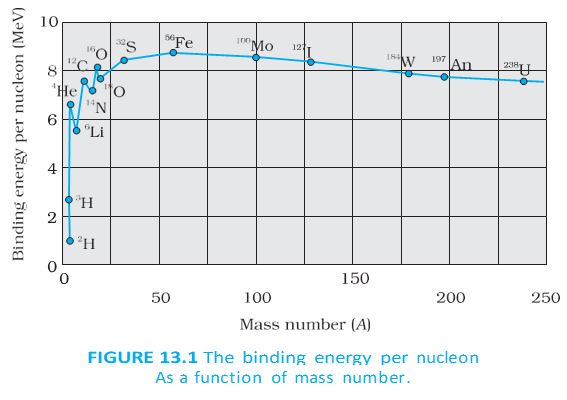
| Nuclei | Binding energy per nucleon |
|---|---|
| Light nuclei: | Lower than the middle-mass region |
| Middle-mass nuclei: | Nearly constant; maximum is about near |
| Heavy nuclei: | Lower; for , about |
What the curve tells us
- Attractive nuclear force: Nucleons are held together by an attractive force strong enough to produce several MeV of binding energy per nucleon.
- Short range and saturation: Each nucleon interacts mainly with nearby nucleons; adding nucleons to a large nucleus changes its average binding energy only slightly.
- Saturation property: A nucleon affects only other nucleons within the short range of the nuclear force, so its number of effective neighbours is limited.
Why fission releases energy
- A heavy nucleus such as one with has lower binding energy per nucleon than a middle-mass nucleus.
- It can split into two nuclei of about each.
- The products have higher binding energy per nucleon and are more tightly bound.
- The increase in total binding energy is released as energy; this is the basis of nuclear fission.
Why fusion releases energy
- Two very light nuclei, typically with , join to form a heavier nucleus.
- The heavier product has greater binding energy per nucleon than the lighter nuclei.
- The final nucleus is more tightly bound, so energy is released; fusion is the energy source of the Sun.
What is the relation between mass defect and nuclear binding energy?
Why is the binding energy per nucleon nearly constant for middle-mass nuclei?
Quick recap
- Mass and energy are equivalent: ; total energy includes mass energy.
- A nucleus has less mass than its separate nucleons; the difference is the mass defect.
- Nuclear binding energy is , and binding energy per nucleon is .
- .
- Binding energy per nucleon peaks near and is nearly constant for .
- Fission of heavy nuclei and fusion of light nuclei release energy because their products are more tightly bound.
Nuclear Force
Nuclear Force
Nuclear force — The strong, short-range force that binds protons and neutrons (nucleons) inside a nucleus.
Key properties
- Strength: It is much stronger than the Coulomb force; gravity is weaker even than the Coulomb force. It overcomes proton–proton electric repulsion and binds the nucleus.
- Range: It falls rapidly to zero beyond a few femtometres (), so a nucleon interacts mainly with nearby nucleons.
- Saturation: Its short range explains why binding energy per nucleon is nearly constant, about for average-mass nuclei.
- Charge independence: The force is approximately the same for neutron–neutron, proton–neutron and proton–proton pairs.
- Mathematical form: Unlike Coulomb’s law or Newton’s law of gravitation, nuclear force has no simple mathematical form.
| Separation | Potential energy / force |
|---|---|
| The force is repulsive. | |
| Potential energy is minimum; the force is zero at the minimum. | |
| The force is attractive, then rapidly weakens with distance. |
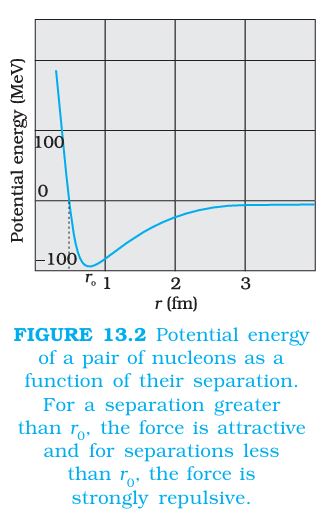
Do not assume nuclear force is always attractive: it is repulsive below about and attractive beyond that.
Radioactivity
Radioactive decay — The nuclear process in which an unstable nucleus decays and emits particles or radiation.
Discovery
- A. H. Becquerel: Discovered radioactivity in .
- Evidence: Radiation from a uranium compound blackened a photographic plate through black paper and silver; later experiments established radioactivity as a nuclear phenomenon.
| Type | Emission | Key detail |
|---|---|---|
| -decay | A helium nucleus, | The emitted nucleus contains two protons and two neutrons. |
| -decay | An electron or a positron | A positron has the same mass as an electron but an equal and opposite charge. |
| -decay | High-energy photons | Photon energies are hundreds of keV or more. |
Quick recap
- Nuclear force binds nucleons and is much stronger than the Coulomb force.
- It has a short range of a few , explaining saturation and nearly constant binding energy per nucleon.
- The force is approximately charge-independent and has no simple mathematical form.
- At , the nucleon-pair potential energy is minimum; the force is repulsive below and attractive above this distance.
- Radioactive decay is the decay of an unstable nucleus; the three types are alpha, beta and gamma decay.
Nuclear Energy
Binding Energy and Nuclear Energy
Nuclear energy — Energy released or absorbed when nuclear reactions change the total binding energy of the nuclei.
- Binding-energy curve: For nuclei with , binding energy per nucleon is nearly constant at about ; it is lower for lighter and heavier nuclei.
- Energy release: Products with greater total binding energy have less total mass, so a transformation to these products releases energy.
- Two routes: Heavy nuclei release energy by fission; light nuclei release energy by fusion.
- Energy scale: Nuclear reactions release energy of the order of MeV—about a million times more per unit mass than chemical reactions.
- Comparison: Fission of of uranium yields about ; burning of coal yields about .
Nuclear Fission
Nuclear fission — The splitting of a heavy nucleus into two or more intermediate-mass fragments, often after neutron absorption.
- Induced fission: Nuclear reactions can be initiated by bombarding nuclei with particles such as neutrons, protons or alpha particles.
- Fission products: The fragments are radioactive and emit beta particles successively as they decay towards stable products.
- Energy released: Uranium fission releases about per fissioning nucleus.
- Energy transfer: Fission energy first appears as kinetic energy of the fragments and neutrons, then becomes heat in surrounding matter.
- Uses: Nuclear reactors use fission to produce electricity; an atom bomb releases energy through uncontrolled fission.
Estimating the Energy Released in Fission
- Illustrative split: A nucleus with splits into two fragments, each with .
- Binding energy per nucleon: The original nucleus has about per nucleon; the fragments have about per nucleon.
- Gain: The increase is about per nucleon, so the total gain is .
- Estimate: This is consistent with an energy release of the order of per fission.
Nuclear Fusion and Energy in Stars
Nuclear fusion — The joining of light nuclei to form a heavier, more tightly bound nucleus, with energy released.
- Coulomb barrier: Positively charged nuclei repel each other; they must approach closely enough for the short-range attractive nuclear force to act.
- Barrier height: It depends on the charges and radii of the interacting nuclei. For two protons it is about and is higher for nuclei with greater charges.
- Fusion condition: The nuclei need sufficient kinetic energy to overcome Coulomb repulsion and get close enough to fuse.
For average protons to have enough energy to overcome the Coulomb barrier:
Thermonuclear fusion — Fusion caused by heating particles until they have sufficient kinetic energy to overcome Coulomb repulsion.
- Sun’s temperature: The Sun’s interior is about , much lower than the estimate for average protons to overcome the barrier.
- High-energy protons: Solar fusion occurs because some protons have energies well above the average.
- Solar fuel: Hydrogen in the Sun’s core is converted into helium through the multistep proton-proton cycle.
Net Effect of the Proton-Proton Cycle
- Reaction count: Reactions 1–3 occur twice for each occurrence of reaction 4.
- Net result: Four hydrogen nuclei and two electrons form one helium-4 nucleus, two neutrinos and six gamma rays, releasing .
Fusion of Heavier Elements in Stars
- After hydrogen depletion: The core cools and begins to collapse under gravity; compression raises its temperature.
- Helium fusion: At about , helium nuclei fuse to form carbon.
- Further fusion: Rising core temperatures can produce heavier elements, but fusion cannot produce elements more massive than those near the binding-energy peak.
- Sun’s lifetime: The Sun is about years old and has enough hydrogen to continue for roughly another years.
- Red giant stage: When hydrogen burning stops, the Sun’s core cools and collapses under gravity while its outer envelope expands; the Sun becomes a red giant.
Controlled Thermonuclear Fusion
- Aim: Controlled fusion reactors seek to generate steady power by heating nuclear fuel to about .
- Fuel state: At this temperature, the fuel is plasma—a mixture of positive ions and electrons.
- Main challenge: Plasma must be confined without contact with a container, since no container can withstand such a high temperature.
- Research: Several countries, including India, are developing methods to confine the plasma.
- Potential: If successful, fusion reactors could provide an almost unlimited source of power.
Conservation and Mass-Energy Conversion
- Nuclear balancing: The number of atoms of each element need not be conserved because nuclear reactions can transmute elements.
- Conserved quantities: In ordinary nuclear-reaction accounting, proton number and neutron number are separately conserved; at very high energies, total charge and baryon number are the strictly conserved quantities.
- Mass difference: Proton and neutron numbers may balance even when the total binding energy differs between reactants and products.
- Mass-energy conversion: Binding energy contributes negatively to mass; its difference between the two sides appears as energy released or absorbed.
- Chemical reactions: Chemical binding energy also contributes negatively to mass, so chemical reactions involve mass-energy conversion in principle. Their mass defects are almost a million times smaller than those in nuclear reactions.
In what sense are nuclear reactions balanced?
How does mass-energy conversion occur in a nuclear reaction?
Does mass-energy conversion occur in chemical reactions?
Quick recap
- Fission and fusion release energy when products have greater total binding energy than the starting nuclei.
- Uranium-235 fission releases about per nucleus; its energy ultimately becomes heat.
- Fusion requires nuclei to overcome Coulomb repulsion; sufficient heating can produce thermonuclear fusion.
- The Sun converts hydrogen into helium through the proton-proton cycle, releasing per net reaction.
- Stars can fuse elements up to those near the binding-energy peak, but not beyond it.
- Both nuclear and chemical reactions involve mass-energy conversion, though chemical mass defects are far smaller.
Summary & Points To Ponder
Nuclear Structure and Mass
The nucleus
- Charge and mass: The nucleus is positively charged and contains more than of an atom’s mass.
- Relative size: A nucleus has a radius about times smaller than the radius of its atom.
- Atomic mass unit: is defined as one-twelfth the mass of a atom; .
- Nucleons: Protons and neutrons make up the nucleus; a neutron is neutral and has almost the same mass as a proton.
Atomic number and mass number — Atomic number is the number of protons; mass number is the total number of protons and neutrons, so , where is the neutron number.
Nuclide — A nuclear species is written as , where is its chemical symbol.
| Type | Same quantity | Different quantity |
|---|---|---|
| Isotopes | Atomic number | Neutron number |
| Isobars | Mass number | Atomic number and neutron number |
| Isotones | Neutron number | Atomic number and mass number |
Isotopic composition
- Natural mixtures: Most elements contain two or more isotopes.
- Atomic mass: An element’s atomic mass is the weighted average of its isotope masses, based on their relative abundances.
Nuclear Size and Forces
Radius and density
- Shape and measurement: A nucleus can be treated as spherical; electron-scattering experiments determine its radius.
- Radius law: Nuclear radius grows as the cube root of mass number, with .
- Density: Since nuclear mass and volume scale with , nuclear density is nearly independent of nuclear size and is of order .
Use for the radius of a nucleus with mass number .
Strong nuclear force
- Binding force: A short-range strong nuclear force binds protons and neutrons in the nucleus.
- Charge independence: The force does not distinguish between a proton and a neutron.
Mass Defect, Binding Energy and Nuclear Energy
Mass defect — The mass defect is the difference between the total mass of separate nucleons and the smaller mass of the bound nucleus.
Here and are the proton and neutron masses, and is the nuclear mass.
Binding energy — Binding energy is the energy equivalent of the mass defect; it is the energy needed to separate a nucleus into its nucleons.
Einstein’s mass–energy relation converts the mass defect into binding energy.
Binding energy per nucleon
- Near-constant region: For mass numbers to , binding energy per nucleon is nearly constant at about .
- Energy scale: Energies in nuclear processes are about a million times greater than those in chemical processes.
Q-value — The Q-value is the change in kinetic energy in a nuclear process: final kinetic energy minus initial kinetic energy.
A positive indicates that kinetic energy is released.
By conservation of mass–energy, the Q-value can also be found from initial and final masses.
Radioactivity, Fission and Fusion
Radioactivity — Radioactivity is the transformation of unstable nuclei accompanied by emission of alpha, beta or gamma radiation.
| Radiation | Nature |
|---|---|
| Alpha () | Helium nuclei |
| Beta () | Electrons |
| Gamma () | Electromagnetic radiation with wavelengths shorter than X-rays |
Fission and fusion
- Energy release: A nuclear process releases energy when it changes less tightly bound nuclei into more tightly bound nuclei.
- Fission: A heavy nucleus splits into smaller fragments; for example, uranium-235 can split after absorbing a neutron.
- Fusion: Lighter nuclei combine to form a larger nucleus; hydrogen fusion into helium powers stars, including the Sun.
Radioactive Decay Quantities
| Quantity | Symbol | Dimension | Unit and meaning |
|---|---|---|---|
| Atomic mass unit | — | ; one-twelfth the mass of a atom | |
| Decay constant | |||
| Half-life | ; time for half the initial nuclei to decay | ||
| Mean life | ; time for the number of nuclei to fall to of its initial value | ||
| Activity | Becquerel (); measure of radioactive-source activity |
Points to Ponder
| Point | Nuclear matter | Atom |
|---|---|---|
| Density and size | Density is approximately independent of nuclear size. | Atomic mass density does not follow this rule. |
| Method | What it senses |
|---|---|
| Electron scattering | Nuclear charge distribution |
| Alpha-particle and similar scattering | Nuclear matter |
Mass–energy conservation
- Unified conservation law: Mass and energy are not separately conserved in nuclear processes; the conserved quantity is their combined mass–energy.
- Use of mass differences: The initial and final masses determine the Q-value through .
Why fission and fusion can release energy
- The binding-energy-per-nucleon curve rises toward intermediate-mass nuclei.
- Two light nuclei can fuse, or a heavy nucleus can split by fission.
- The products can be more tightly bound per nucleon than the starting nuclei.
- The increase in binding energy is released as energy.
Fusion conditions and nuclear shells
- Coulomb barrier: Positively charged light nuclei repel each other, so they need sufficient initial energy to approach closely; fusion therefore requires very high temperatures.
- Shell evidence: The binding-energy-per-nucleon curve is smooth overall but has peaks at nuclides such as and , indicating nuclear shell structure.
Electron–positron pair
- Particle and antiparticle: An electron and positron have equal masses and charges equal in magnitude but opposite in sign.
- Annihilation: When they meet, they annihilate and release energy as gamma-ray photons.
Nuclear stability
- Neutron-to-proton ratio: Stable light nuclei have approximately ; for heavy nuclei the stable ratio rises to about .
- Reason for extra neutrons: More neutrons help offset the increasing repulsion between protons in heavy nuclei.
- Unstable nuclei: Nuclei with an excess of neutrons or protons relative to the stability ratio are unstable; radioactivity signals this instability.
- Stable fraction: Only about of known isotopes are stable. Other isotopes have been produced in laboratories by particle bombardment or identified in astronomical observations.
Define mass defect and relate it to nuclear binding energy.
Why can fission of heavy nuclei and fusion of light nuclei release energy?
How does the neutron-to-proton ratio relate to nuclear stability?
Quick recap
- A nucleus contains protons and neutrons; , and nuclides are written .
- Isotopes share , isobars share , and isotones share ; elemental atomic masses are abundance-weighted averages.
- Nuclear radius follows , giving nearly size-independent nuclear density.
- Mass defect gives binding energy through ; nuclear process energies greatly exceed chemical energies.
- Radioactivity emits alpha, beta or gamma radiation; fission splits heavy nuclei and fusion combines light nuclei.
- Fission and fusion can release energy when products are more tightly bound; fusion needs high temperatures to overcome the Coulomb barrier.
- Stability requires an appropriate neutron-to-proton ratio: about for light nuclei and for heavy nuclei.
Physics — ALL CHAPTERS
1
Electric Charges And Fields
2
Electrostatic Potential And Capacitance
3
Current Electricity
4
Moving Charges And Magnetism
5
Magnetism And Matter
6
Electromagnetic Induction
7
Alternating Current
8
Electromagnetic Waves
1
Ray Optics And Optical Instruments
2
Wave Optics
3
Dual Nature Of Radiation And Matter
4
Atoms
5
Nuclei
6
Semiconductor Electronics: Materials, Devices And Simple Circuits