Class 12 PCB . Physics . Physics Part I . Electromagnetic Waves
Chapter 8: Electromagnetic Waves
Ch 8
Physics
Class 12 PCB
Introduction
How Electromagnetic Waves Were Predicted
Maxwell’s Key Insight
- Established link: Electric current produces a magnetic field; a changing magnetic field produces an electric field.
- Maxwell’s proposal: A time-varying electric field also produces a magnetic field.
- Displacement current: Maxwell introduced this term to resolve an inconsistency in Ampère’s circuital law for a charging capacitor.
- Maxwell’s equations: Together with the Lorentz force law, they express the basic laws of electromagnetism.
Electromagnetic wave — A propagating wave of coupled, time-varying electric and magnetic fields.
Importance and Evidence
- Prediction: Maxwell’s equations predict electromagnetic waves travelling at a speed close to the measured speed of light, .
- Conclusion: Light is an electromagnetic wave, unifying electricity, magnetism and light.
- Experimental evidence: Heinrich Hertz demonstrated electromagnetic waves experimentally in 1885.
- Applications: Marconi and others developed their technological use, enabling major advances in communication.
- Range: The electromagnetic spectrum extends from gamma rays, with wavelengths around , to long radio waves, around .
Displacement Current and Ampère–Maxwell Law
Conduction current — Current carried by moving charges in a conductor.
Why the Original Law Fails for a Charging Capacitor
- Original Ampère law: It relates the magnetic field around a closed loop to the conduction current passing through a surface bounded by that loop.
- Surface ambiguity: For a loop around the capacitor wire, a surface cutting the wire encloses current ; a pot-shaped surface between the plates encloses no conduction current.
- Contradiction: The two surfaces have the same boundary but would predict different magnetic fields, so the original law is incomplete for a charging capacitor.
- Resolution needed: The magnetic field must have the same value whichever surface is chosen.
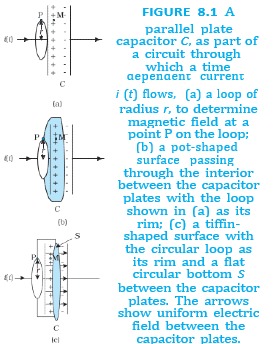
Electric Flux and Displacement Current
- Between the plates: The electric field passes through the capacitor surface even though no conduction current crosses the gap.
- Flux: For plate area , charge and a uniform field between the plates, the electric flux is .
- Changing charge: Since , the changing electric flux gives .
- Displacement current: The current-equivalent term due to changing electric flux is .
Use this for the current contribution produced by a changing electric flux.
| Region | Conduction current | Displacement current |
|---|---|---|
| Outside the plates, in the wire | ||
| Between the plates |
Physical Effects and Field Symmetry
- Same magnetic effect: Displacement current contributes to a magnetic field just as conduction current does; the field between capacitor plates matches that just outside.
- Steady fields: If the electric field does not change with time, then .
- More general media: Conduction and displacement currents can coexist in a region; in some regions, changing electric fields produce displacement current without conduction current.
- Reciprocal field changes: A changing magnetic field produces an electric field (Faraday’s law), while a changing electric field produces a magnetic field (Ampère–Maxwell law).
- Not fully symmetrical: No magnetic monopoles are known; electric charges are sources of electric fields.
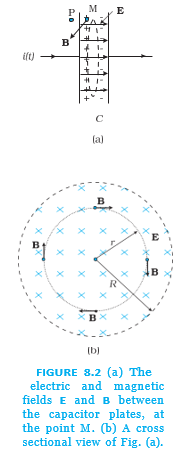
Maxwell’s Equations in Vacuum
Why did Maxwell add displacement current to Ampère’s law?
State the Ampère–Maxwell law and explain its two current terms.
Quick recap
- Maxwell proposed that a changing electric field produces a magnetic field.
- Displacement current is .
- In a charging capacitor, conduction current in the wire is replaced by displacement current between the plates.
- The Ampère–Maxwell law includes both conduction and displacement current.
- Changing electric and magnetic fields can produce one another, enabling electromagnetic waves.
- Maxwell’s equations predict light as an electromagnetic wave travelling at about .
Electromagnetic Waves
Sources of Electromagnetic Waves
Electromagnetic wave — A self-propagating disturbance of oscillating electric and magnetic fields that carries energy through space.
How electromagnetic waves are produced
- Stationary charges produce electrostatic fields, not electromagnetic waves.
- Steady currents produce magnetic fields that do not vary with time; they do not radiate electromagnetic waves.
- Accelerated charges radiate electromagnetic waves. An oscillating charge is an example of an accelerated charge.
- Regeneration: an oscillating electric field produces an oscillating magnetic field, which in turn produces an oscillating electric field as the wave travels.
- Frequency and energy: the wave frequency equals the source charge’s oscillation frequency; the radiated energy comes from the source.
Why the first demonstrations used radio waves
- Frequency limit: yellow light has a frequency of about , far above the roughly attainable with electronic circuits.
- Result: experimental demonstrations of electromagnetic waves were first made in the lower-frequency radio-wave region.
Early experimental work
- 1887Hertz experimentally confirmed Maxwell’s theory using electromagnetic waves in the low-frequency radio-wave region.
- Seven years after HertzJagadish Chandra Bose produced and observed shorter-wavelength waves, from 25 mm to 5 mm, in a laboratory.
- Around the same timeGuglielmo Marconi transmitted electromagnetic waves over many kilometres, marking the beginning of communication using them.
Nature and Properties of Electromagnetic Waves
Field directions and wave form
- Transverse nature: the electric field, magnetic field, and direction of propagation are mutually perpendicular.
- Plane-wave example: for propagation along the -axis, the electric field may oscillate along and the magnetic field along .
- Phase: the electric and magnetic fields oscillate in step, with the same phase and frequency.
- Direction: the wave propagates along .
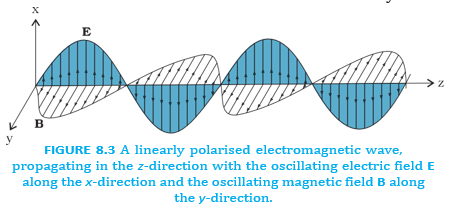
For a wave travelling along , the electric and magnetic field components have the same phase.
The wave number is related to wavelength, and angular frequency is related to frequency.
The propagation speed is and, in vacuum, equals the speed of light .
In a vacuum electromagnetic wave, the field amplitudes are related by the speed of light.
Key properties
- No material medium required: electromagnetic waves propagate through vacuum; the electric and magnetic fields sustain the travelling wave.
- Vacuum speed: electromagnetic waves travel at about in vacuum, independent of wavelength to high experimental precision.
- Energy transfer: radio and television signals carry energy; sunlight transfers energy from the Sun to Earth.
Electromagnetic Waves in a Material Medium
In a medium with permittivity and permeability , wave speed depends on the medium’s electrical and magnetic properties.
The refractive index of medium with respect to medium is the ratio of the speed of light in medium to that in medium .
Examples
- Field direction and magnitude: if a wave travels along and , then points along and has magnitude ; hence .
- Wave parameters: for , the wavelength is and frequency is .
- Electric field from magnetic field: the same wave has amplitude and field .
Do not confuse wave speed with frequency: in vacuum, while frequency is set by the source and wavelength depends on the wave speed.
What produces electromagnetic waves, and how do the fields sustain their propagation?
State the relationship between the electric and magnetic fields and the direction of propagation.
Write the wave-speed expressions for vacuum and a material medium.
Quick recap
- Accelerated charges radiate electromagnetic waves; stationary charges and steady currents do not.
- Oscillating electric and magnetic fields regenerate one another, and the wave carries energy from its source.
- Electric field, magnetic field, and propagation direction are mutually perpendicular; the propagation direction is .
- In vacuum, and .
- In a medium, ; the relative refractive index is the ratio of wave speeds in the two media.
- Hertz demonstrated radio waves in 1887; Bose produced shorter-wavelength waves and Marconi achieved long-distance transmission.
Electromagnetic Spectrum
The Electromagnetic Spectrum
Electromagnetic spectrum — The complete range of electromagnetic waves, classified roughly by frequency and wavelength.
Overview
- Types: Radio waves, microwaves, infrared, visible light, ultraviolet, X-rays and gamma rays.
- Order: From longest to shortest wavelength: radio → microwave → infrared → visible → ultraviolet → X-ray → gamma.
- Boundaries: The regions have no sharp divisions; their ranges can overlap. Classification also reflects how waves are produced or detected.
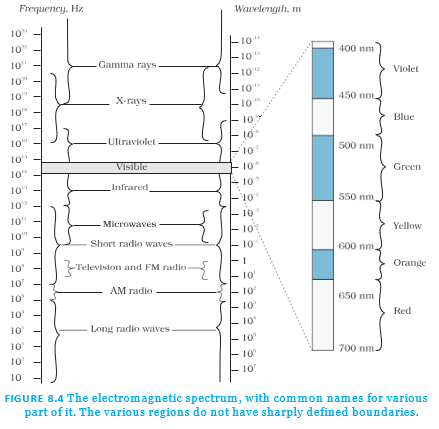
Radio Waves
Radio waves — Electromagnetic waves produced by accelerated charges in conducting wires.
Frequency bands and uses
- General range: About to ; used in radio and television communication.
- AM radio: –; AM means amplitude modulation.
- Short-wave bands: Use frequencies up to .
- Television: Uses radio waves from to .
- FM radio: –; FM means frequency modulation.
- Cellular phones: Transmit voice using radio waves in the ultrahigh-frequency (UHF) band.
Microwaves
Microwaves — Short-wavelength radio waves, typically with frequencies in the gigahertz (GHz) range.
Production and applications
- Production: Special vacuum tubes, including klystrons, magnetrons and Gunn diodes.
- Radar: Short wavelengths suit aircraft navigation systems; radar also enables speed guns to measure fast-moving objects and vehicles.
- Microwave ovens: The frequency is selected to match the resonant frequency of water molecules.
- Heating: Water molecules absorb microwave energy and gain kinetic energy, raising the temperature of water-containing food.
Infrared Waves
Infrared waves — Electromagnetic waves produced by hot bodies and molecules, lying just beyond the low-frequency end of visible light.
Properties and uses
- Heat waves: Water molecules and substances such as CO₂ and NH₃ absorb infrared radiation; increased molecular thermal motion heats the material and its surroundings.
- Applications: Infrared lamps are used in physical therapy; infrared detectors on satellites support military observation and crop monitoring.
- Remote controls: Electronic devices, including semiconductor light-emitting diodes, emit infrared used in household remote switches.
- Greenhouse effect: Earth absorbs incoming visible light and re-emits energy as longer-wavelength infrared; greenhouse gases such as CO₂ and water vapour trap some of this radiation, helping maintain Earth's average warmth.
Infrared and the greenhouse effect
- Visible sunlight passes relatively easily through the atmosphere.
- Earth's surface absorbs it and re-emits energy as infrared radiation.
- Greenhouse gases absorb and trap some infrared, helping retain Earth's warmth.
Visible Light
Visible light — The part of the electromagnetic spectrum detected by the human eye.
Range and vision
- Frequency: About to .
- Wavelength: About to .
- Importance: Light emitted or reflected by objects provides visual information about the world.
- Different sensitivities: Human eyes detect visible light; snakes can detect infrared, while the visible range of many insects extends into ultraviolet.
Ultraviolet Rays
Ultraviolet (UV) radiation — Radiation beyond the violet end of visible light, with wavelengths shorter than visible light.
Range, effects and applications
- Wavelength: Approximately () down to ().
- Sources: Special lamps, very hot bodies and the Sun.
- Atmospheric protection: Most solar UV is absorbed by the ozone layer, about – above Earth.
- Effects: Large UV exposure harms humans; it also increases melanin production, causing skin tanning.
- Glass: Ordinary glass absorbs UV, so tanning or sunburn does not occur through glass windows.
- Protection and uses: Welders use special glass goggles or face masks; focused UV beams are used in LASIK (laser-assisted in situ keratomileusis) surgery, and UV lamps kill germs in water purifiers.
- Ozone concern: CFCs, including freon, deplete the protective ozone layer; this is an international concern.
X-rays
X-rays — High-frequency electromagnetic radiation beyond the ultraviolet region.
Production, effects and uses
- Wavelength: The text gives an approximate range from () down to ().
- Production: Commonly produced by bombarding a metal target with high-energy electrons.
- Uses: Medical diagnosis and treatment of certain forms of cancer.
- Safety: X-rays can damage or destroy living tissues and organisms; avoid unnecessary or excessive exposure.
Gamma Rays
Gamma rays — The highest-frequency electromagnetic radiation, with extremely short wavelengths.
Production and use
- Wavelength: Approximately to less than .
- Production: Nuclear reactions and radioactive nuclei.
- Medical use: Used to destroy cancer cells.
Production and Detection Summary
| Type | Wavelength range | Production | Detection |
|---|---|---|---|
| Radio | > | Rapid acceleration and deceleration of electrons in aerials | Receiver aerials |
| Microwave | to | Klystron or magnetron valve | Point-contact diodes |
| Infrared | to | Vibrations of atoms and molecules | Thermopiles, bolometers and infrared photographic film |
| Visible light | to | Atomic electrons emit light when moving to a lower energy level | Eye, photocells and photographic film |
| Ultraviolet | to | Inner-shell electrons move to a lower energy level | Photocells and photographic film |
| X-rays | to | X-ray tubes or inner-shell electrons | Photographic film, Geiger tubes and ionisation chambers |
| Gamma rays | < | Radioactive decay of the nucleus | Photographic film, Geiger tubes and ionisation chambers |
Do not treat the wavelength limits as exact boundaries: electromagnetic-spectrum regions are approximate and can overlap.
How do microwave ovens heat food?
How does the ozone layer protect life, and what threatens it?
Quick recap
- The electromagnetic spectrum runs from radio waves at long wavelengths to gamma rays at the shortest wavelengths.
- Spectrum regions have approximate, overlapping boundaries.
- Radio waves serve communication; microwaves are used in radar and heating water-containing food.
- Infrared is absorbed as heat and is involved in Earth's greenhouse effect.
- Visible light is detected by the human eye; different animals detect different wavelength ranges.
- The ozone layer absorbs most solar UV; X-rays and gamma rays also have medical applications but can damage living tissue.
Summary
Displacement Current
- Displacement current: A changing electric flux produces a displacement current, given by .
- Role: It acts as a source of magnetic field like conduction current and completes the Ampere–Maxwell law.
Production and Verification
- Production: Accelerated charges radiate electromagnetic waves; an oscillating charge emits waves at its oscillation frequency.
- Verification: Hertz produced and detected electromagnetic waves in 1887, confirming a key prediction of Maxwell’s theory.
Structure of an Electromagnetic Wave
In vacuum, the electric and magnetic field amplitudes are related by:
Speed of Electromagnetic Waves
- Vacuum speed: Electromagnetic waves travel at , equal to the speed of light.
- In a medium: Their speed is , determined by the medium’s permeability and permittivity.
Electromagnetic Spectrum and Interaction with Matter
- Spectrum: Electromagnetic waves span a continuous range of wavelengths and frequencies, with no sharp boundaries between regions.
- Regions: The spectrum includes gamma rays, X-rays, ultraviolet, visible, infrared, microwaves and radio waves.
Sources and Effects of Different Wavelengths
- Sources: Different regions arise in different ways, from nuclear reactions and hot bodies to accelerated charges in circuits.
- Interaction: Their electric and magnetic fields act on charges in matter; absorption and other effects depend on wavelength and the material.
Human Vision and Sunlight
What is displacement current, and why did Maxwell introduce it?
State the orientation and amplitude relation of the fields in an electromagnetic wave.
Why are infrared waves often called heat waves?
Quick recap
- A time-varying electric field gives rise to displacement current, which produces a magnetic field.
- Accelerating charges radiate electromagnetic waves; a harmonically oscillating charge produces waves of the same frequency.
- In an electromagnetic wave, the electric field, magnetic field and propagation direction are mutually perpendicular.
- In vacuum, and .
- The spectrum runs from gamma rays to radio waves as wavelength increases; all travel at the same speed in vacuum.
- Matter’s response depends on wavelength and material; infrared waves can raise temperature.
- Hertz produced and detected metre-scale electromagnetic waves in the laboratory in 1887.
Physics — ALL CHAPTERS
1
Electric Charges And Fields
2
Electrostatic Potential And Capacitance
3
Current Electricity
4
Moving Charges And Magnetism
5
Magnetism And Matter
6
Electromagnetic Induction
7
Alternating Current
8
Electromagnetic Waves
1
Ray Optics And Optical Instruments
2
Wave Optics
3
Dual Nature Of Radiation And Matter
4
Atoms
5
Nuclei
6
Semiconductor Electronics: Materials, Devices And Simple Circuits