Class 6 . Mathematics . Ganita Prakash . Fractions
Chapter 7: Fractions
Ch 7
Mathematics
Class 6
Introduction
Fractions as Equal Shares
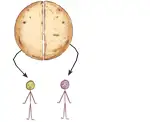
The fraction is read as one half or one upon two.
Sharing One Roti
- Two children: One roti divided equally gives each child roti.
- Four children: One roti divided equally gives each child roti.
Comparing Equal Shares
When the same whole is divided equally among more people, each person gets a smaller share. Thus, .
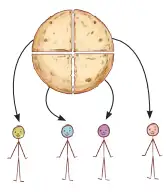
For the same roti, a half is more than a quarter.
Compare Shares of the Same Whole
- Check that both shares are parts of the same whole.
- Compare the number of equal pieces: more pieces make each piece smaller.
- Conclude that the share from two equal pieces is larger.
Compare each child’s share when one roti is shared equally between two children and between four children.
- One roti divided equally between two children gives each one half.
- The same roti divided equally between four children gives each one quarter.
- Four children receive smaller shares than two children sharing the same roti.
One sandwich is shared equally by three children. What fraction does each child receive?
Which is greater: or of the same whole?
Quick recap
- A fraction describes an equal share of a whole.
- One roti shared equally by two children gives each child .
- is read as “one half” or “one upon two.”
- One roti shared equally by four children gives each child .
- For the same whole, more equal shares mean a smaller share for each person.
- .
Fractional Units and Equal Shares
Fractional Units and Equal Shares
Use this when a quantity is divided equally.
Ordering Unit Fractions
For positive denominators, if , then , provided the fractions refer to the same whole.
Compare unit fractions
- Check that both fractions have numerator and refer to the same whole.
- Compare their denominators.
- The fraction with the larger denominator is smaller.
Which is greater, or ?
- Compare the denominators.
- The fraction with denominator is the smaller share.
Do not assume that a unit fraction is larger because its denominator is larger. More equal parts mean smaller shares, so .
A wholesale merchant divides kg of rice equally into four packets. What is the weight of each packet?
A big fish weighs kg and a small fish weighs kg. What is their combined weight?
Arrange quarter, half, three quarters, one and a quarter, one and a half, and two and a half from smallest to largest.
Quick recap
- A fractional unit is one of equal parts of a whole, written .
- Dividing a quantity equally among shares gives per share.
- A larger denominator means a smaller unit fraction when the whole is the same.
- because nine equal parts are smaller than five equal parts.
- Fractions can represent equal shares and can be added to find a combined quantity.
Fractional Units as Parts of a Whole
Understanding Fractional Units of a Whole Chikki (Snack)
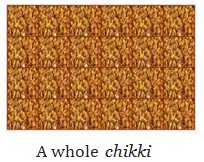
Fractional unit — A fractional unit is one of the equal parts made when a whole is divided into equal parts.
When a whole is divided into equal parts, each part is of the whole. The parts may have different shapes but have the same size if they are equal parts.
Use for one of equal parts; such parts make of the whole.
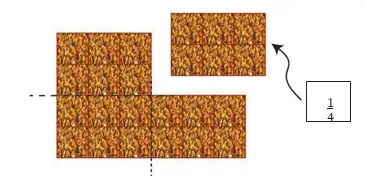
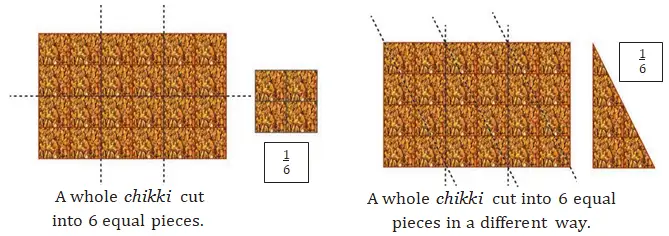
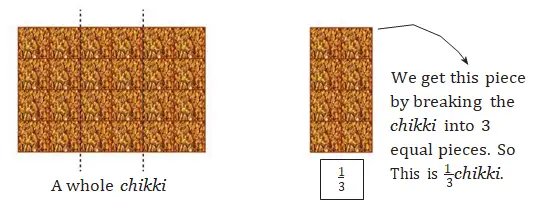
Finding the fraction represented by one or more pieces
- Count the equal parts in the whole; this is the denominator.
- Count how many of those parts are shown; this is the numerator.
- Write the fraction as shown parts over total equal parts.
What fraction of the whole is represented by the three pieces?
- A whole is divided into four equal pieces, and three pieces are taken.
- Write the number of pieces taken over the total number of equal pieces.
A whole chikki is divided into eight equal parts. What fraction is one part?
A figure shows one piece of a whole divided into equal parts. What fraction does the piece represent?
| Label | Fraction |
|---|---|
| a | |
| b | |
| c | |
| d | |
| e | |
| f | |
| g | |
| h |
Do not use the shape of a piece to decide its fraction. Count equal-sized parts of the whole; differently shaped equal parts represent the same fraction.
Quick recap
- A fractional unit is one equal part of a whole.
- If the whole is divided into equal parts, each part is .
- The denominator counts all equal parts; the numerator counts the parts shown.
- pieces of size make of the whole.
- Equal parts can have different shapes while remaining the same size.
Measuring Using Fractional Units
Building Amounts from Fractional Units
Use this to add equal fractional units or identify the fraction represented by a number of equal pieces.
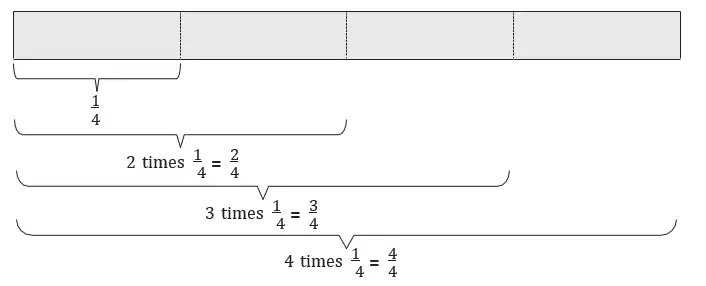
Represent an Amount with Fractional Units
- Identify how many equal parts make one whole.
- Write the size of one part as a unit fraction.
- Count the parts and use that count as the numerator.
- If the amount exceeds a whole, group complete sets of parts into wholes.
What amount is times of a roti?
- Write nine quarter-units as repeated addition.
- Group four quarters into each whole.
Reading and Naming Fractions
Read a fraction as its numerator multiplied by the unit fraction named by its denominator.
Read a Fraction
- Read the denominator to name the equal-sized parts.
- Read the numerator to count how many of those parts are present.
- Say the fraction as the count of those unit fractions.
Explain what means.
- The denominator shows that each part is one sixth.
- The numerator shows that five such parts are counted.
Write six halves as a fraction and as a number of wholes.
Write five quarter-units as a repeated addition and a fraction.
In , state the numerator and denominator and explain what the fraction counts.
Quick recap
- Divide a whole into equal parts to get unit fractions of size .
- units of size make .
- A fraction can be understood as repeated addition of its unit fraction.
- The numerator counts parts; the denominator tells how many equal parts make one whole.
- Fractions can represent amounts greater than one whole, such as .
Marking Fraction Lengths on the Number Line
Marking Fractions on a Number Line
Fraction on a number line — A fraction marks a point a certain number of equal parts away from .
Equal Parts and Fraction Marks
- Unit interval: The distance from to is one unit; divide it into equal parts to locate fractions.
- Denominator: Divide each unit into the number of equal parts shown by the denominator.
- Numerator: Count that many parts from to locate the fraction.
- Beyond : Continue the same equal spacing past to mark fractions greater than .

| Unit divided into | Example marks |
|---|---|
| 2 equal parts | |
| 3 equal parts | |
| 5 equal parts | |
| 8 equal parts |


When each unit is divided into equal parts, the th mark from is . The same spacing continues beyond .
Use this when the unit is divided into equal parts and you count marks from .
How to Mark a Fraction
- Identify the denominator and divide each unit into that many equal intervals.
- Starting at , count the number of intervals given by the numerator.
- Place the point at the end of the last interval; continue past if needed.
Mark on the number line.
- Divide the interval from to into ten equal parts.
- Count three of those parts from .
- Place the point at the third division after .

Fractions Between and Beyond Whole Numbers
- Between and : There are infinitely many fractions; the interval can be divided into more and more equal parts.
- Textbook response: The source gives “an uncountable number of fractions.” More precisely, fractions (rational numbers) are countably infinite.
- Beyond : Keep the same partition in every unit. In fifths, the marks after include .
- Halfway point: is three halves from , so it lies halfway between and .

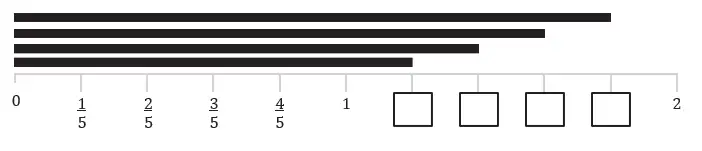
Mark , and between and .
Write the fractions for the sixth, seventh, eighth and ninth fifth-marks from .
How many fractions lie between and ?
Do not stop counting at for fractions greater than one; continue using the same equal intervals beyond .
Quick recap
- Divide each unit into equal parts according to the denominator.
- Count from according to the numerator to locate a fraction.
- Continue equal spacing beyond for fractions greater than one.
- lies halfway between and .
- There are infinitely many fractions between and ; they are countably infinite.
Mixed Fractions
Fractions Greater Than One
- Improper fractions: Fractions greater than 1 have a numerator larger than the denominator.
- Whole units: They may contain one or more whole units, sometimes with an additional fractional part.
Writing an Improper Fraction as a Mixed Number
- Conversion: Divide the numerator by the denominator; the quotient gives the whole units and the remainder gives the fractional part.
- Exact division: If the remainder is 0, the fraction is a whole number rather than a mixed number.
Writing a Mixed Number as a Fraction
Write as a mixed number.
Write as a mixed number.
Write as a fraction.
When converting an improper fraction to a mixed number, keep the original denominator; use only the division remainder as the new numerator.
Quick recap
- A fraction is greater than when its numerator is larger than its denominator.
- Divide numerator by denominator to find the whole part and remainder.
- Write the remainder over the original denominator in the mixed number.
- A fraction that divides evenly is a whole number, not a mixed number.
- Convert a mixed number using .
Equivalent Fractions Part-1
Equivalent Fractions
Equivalent fractions — Fractions that represent the same length or quantity, even when they are written using different-sized fractional units.
Recognising Equivalent Fractions
- Same length: Fractions that end at the same point on a fraction wall are equivalent.
- Different units: The same length may be divided into different numbers of equal parts.
- Examples: One half can be written as , , or .
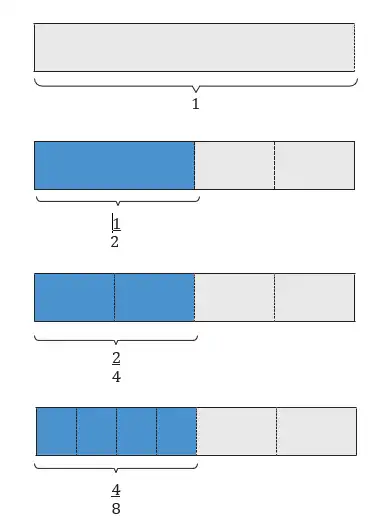
Each chain names fractions with the same length.
Fractions are equivalent if their lengths are equal; on a fraction wall, their bars end at the same point.
Reading a Fraction Wall
Counting Fractional Units
- Sixths make a half: Three pieces of length make , so .
- Sixths make a third: Two pieces of length make , so .
- Matching lengths: The wall also shows that and .
- More divisions: A fraction wall can be extended to show fractional units from halves through tenths.
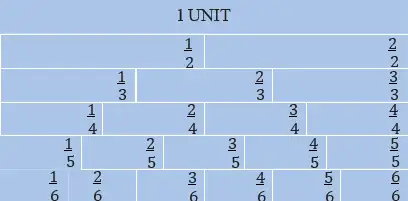
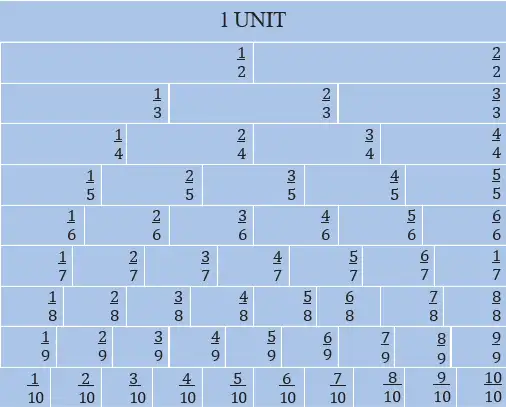
Check Fractions Using a Fraction Wall
- Locate both fractions on the fraction wall.
- Compare the points where their bars end.
- If the bars end at the same point, the fractions are equivalent.
Which fraction with denominator is equivalent to ?
- Find how many sixths have the same length as one half.
- Three pieces of length one-sixth reach the same point as one half.
- Therefore, three-sixths and one-half are equivalent.
Examples from the Fraction Wall
These fractions all have the same length as two-thirds.
Do not assume fractions in the same list are all equivalent: , but . Thus, is not equivalent to the other two.
Check Your Understanding
Are and equivalent?
Give two fractions equivalent to .
Are , , and all equivalent?
Quick recap
- Equivalent fractions represent the same length or quantity.
- Fractions ending at the same point on a fraction wall are equivalent.
- .
- Three sixths make one half; two sixths make one third.
- .
- and are equivalent, but neither equals .
Equivalent Fractions Part-2
Fractions as Equal Shares
Equal sharing — When a quantity is shared equally among people, each person’s share is the total quantity divided by the number of people.
Sharing examples
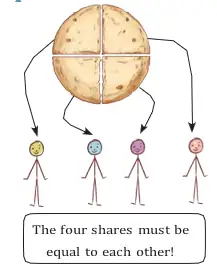
- One roti: Shared among children, each child gets roti.
- Division fact: .
- Addition fact: .
- Multiplication fact: .
- Three rotis: Each of children gets roti; .
- Three-roti facts: ; also, .
- Two rotis: Each of children gets roti; .
- Two-roti facts: ; also, .
- General rule: Sharing units equally among people gives each person units.
Equivalent Fractions
Equivalent fractions — Fractions that represent the same amount or share are called equivalent fractions.
Recognising equivalent shares
- Same share: Sharing roti among children, rotis among , or rotis among gives each child half a roti.
- Example: .
- Another example: Sharing cakes among children gives the same share as sharing cakes among children: .
- Simplest form: A fraction is in simplest form when its numerator and denominator have no common factor greater than .
- Examples: is the simplest form of both and .
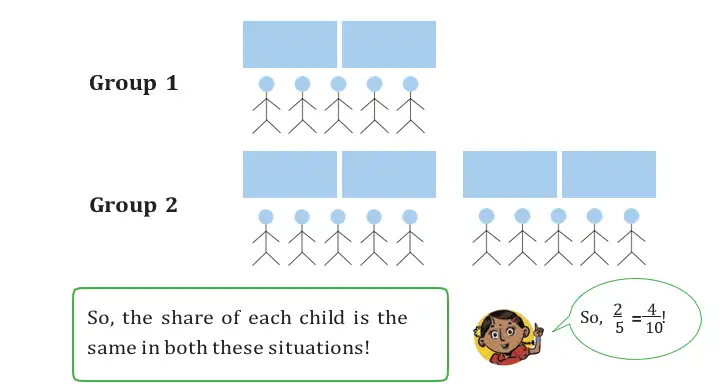
Multiplying or dividing both the numerator and denominator by the same non-zero number does not change a fraction’s value.
Use the same non-zero multiplier or divisor for the numerator and denominator.
Finding an Equivalent Fraction
- Choose the numerator or denominator that must change.
- Find the number that changes it to the required value.
- Multiply or divide the other part of the fraction by the same number.
What is Anil’s share, and what equivalent fraction has denominator ?
- Two cakes are shared equally among five children, so Anil’s share is two-fifths of a cake.
- To write an equivalent fraction with denominator , multiply the numerator and denominator by .
- Simplify the result.
Comparing Shares
Compare fractions using equal parts
- Same denominator: The fraction with the greater numerator is greater; for example, and .
- Same numerator: The fraction with the smaller denominator is greater, because the same quantity is shared among fewer people; thus, .
- Make equivalent fractions: To compare and , write ; therefore, .
- Fixed number of people: Increasing the units being shared increases each person’s share.
| Comparison | Reason |
|---|---|
| and | , and |
| and | , and |
Five glasses of juice are shared equally among four friends. How many glasses shared among eight friends gives the same share per friend?
Four kilograms of potatoes are divided equally into three bags. For the same amount per bag, into how many bags should kilograms be divided?
Which share is larger: chikki per child or chikki per child?
Do not multiply or divide only the numerator or only the denominator when making an equivalent fraction; use the same non-zero operation on both.
Quick recap
- Equal sharing of units among people gives each person units.
- Equal shares can be written as equivalent fractions, such as .
- Multiply or divide both numerator and denominator by the same non-zero number to make an equivalent fraction.
- A fraction is in simplest form when its numerator and denominator have no common factor greater than .
- With equal denominators, compare numerators; with equal numerators, the smaller denominator gives the greater fraction.
- For a fixed number of people, sharing more units gives each person a larger share.
Equivalent Fractions Part-3
Comparing Fractions
For fractions with denominators and , multiply each fraction by the other denominator to give them denominator .
Compare Fractions with Different Denominators
- Choose a common denominator, such as the product of the denominators.
- Rewrite both fractions as equivalent fractions with that denominator.
- Compare the numerators and state the comparison of the original fractions.
Compare and .
- Use the product of the denominators as a common denominator.
- Rewrite each fraction with denominator .
- Compare the numerators; therefore, the first fraction is larger.
Do not compare the numerators when the denominators differ. First make the denominators equal; for example, and are equivalent to the original fractions but are not directly comparable by numerator because their denominators differ.
Fractions in Lowest Terms
Dividing the numerator and denominator by the same non-zero common factor gives an equivalent fraction. Dividing by their highest common factor reduces the fraction directly to lowest terms.
Here, is the highest common factor of the numerator and denominator.
Reduce a Fraction
- Find a common factor of the numerator and denominator.
- Divide both by that factor and repeat if they still share a factor.
- Stop when the only common factor is .
Which is larger: or ?
Compare and using a common denominator.
Express in lowest terms.
Quick recap
- Equal denominators mean equal-sized fractional units, so compare the numerators.
- For unlike denominators, rewrite fractions with a common denominator before comparing.
- The product of two denominators is one valid common denominator.
- Equivalent fractions keep the same value when the numerator and denominator are divided by the same factor.
- A fraction is in lowest terms when its numerator and denominator have no common factor except .
- Dividing by the highest common factor gives the simplest form directly.
Comparing Fractions
Comparing Fractions with Unlike Denominators
Comparing fractions — Comparing fractions means deciding which fraction is greater, smaller, or whether the fractions are equal.
When fractions have the same positive denominator, compare their numerators: the fraction with the greater numerator is greater. To compare unlike denominators, first rewrite the fractions with a common denominator.
Multiplying the numerator and denominator by the same positive number gives an equivalent fraction.
Compare or order fractions
- Find a common denominator for all the fractions.
- Rewrite each fraction as an equivalent fraction with that denominator.
- Compare the numerators. For ascending order, list from smallest to largest; for descending order, list from largest to smallest.
Compare with , and with .
- Use the common denominator 45 for the first pair.
- Compare the numerators of the equivalent fractions.
- Use the common denominator 63 for the second pair.
- Compare the numerators of the equivalent fractions.
Do not compare numerators alone when denominators differ. First make the denominators the same.
Compare and .
Write in ascending order.
Write in descending order.
Quick recap
- Use equivalent fractions to give unlike fractions a common denominator.
- With the same denominator, the greater numerator gives the greater fraction.
- For ascending order, arrange fractions from smallest to largest.
- For descending order, arrange fractions from largest to smallest.
Addition and Subtraction of Fractions Part-1
Adding Fractions
When fractions have the same denominator, add their numerators and keep that denominator: for example, the total number of equal fractional units is added.
Use when both fractions are measured in the same-sized parts.
Add fractions
- Check whether the denominators are the same.
- If they differ, rewrite the fractions with a common denominator.
- Add the numerators and keep the common denominator.
- If the result is improper, convert it to a mixed number if appropriate.
What fraction of the chikki did they eat together, and what fraction remained?
- Meena ate one-half of the chikki and her brother ate one-quarter. Express both amounts in quarters.
- Add the equal-sized parts to find the amount eaten altogether.
- Subtract the amount eaten from the whole to find what remains.
Adding Fractions with the Same Denominator
Adding same-denominator fractions can give an improper fraction; regrouping the numerator into whole groups of the denominator gives a mixed number.
Find .
Find and write the result as a mixed number.
Do not add the denominators when the fractions already have a common denominator. For example, , not .
Quick recap
- Fractions with the same denominator have the same-sized fractional units.
- For a common denominator, add the numerators and keep the denominator.
- Use a common denominator before adding fractions whose denominators differ.
- An improper sum can be rewritten as a mixed number.
- A whole minus the part used gives the part remaining.
Addition and Subtraction of Fractions Part-2
Adding Fractions with Different Denominators
Common denominator — A common denominator lets fractions be rewritten with the same fractional unit before adding them.
Fractions with the same denominator are added by adding their numerators and keeping the denominator. For different denominators, first make equivalent fractions with a common denominator.
Brahmagupta’s Method
- Common denominator: Use a common multiple of the denominators; the least common multiple (LCM) usually gives the smallest one.
- Equivalent fractions: Multiply each numerator and denominator by the same number to reach the common denominator.
- Add: Add the numerators and keep the common denominator.
- Simplify: Reduce the result to lowest terms if possible.
- Historical note: Brahmagupta first explicitly described this general method of adding fractions in 628 CE.
Use the first form for like denominators and the second for unlike denominators.
Steps for Adding Unlike Fractions
- Find the LCM of the denominators to choose a common denominator.
- Rewrite each fraction as an equivalent fraction with that denominator.
- Add the numerators and keep the common denominator unchanged.
- Simplify the answer, or write it as a mixed number when needed.
Find .
- Find the LCM of the denominators.
- Rewrite both fractions with denominator 15.
- Add the numerators and keep the common denominator.
Do not add the denominators. First make the fractional units the same; then add only the numerators.
Add .
Add and simplify .
Geeta buys m of lace and Shamim buys m. Is their lace enough to cover a border of length 1 m?
Quick recap
- Use equivalent fractions to make denominators the same before adding unlike fractions.
- The LCM of the denominators is a convenient common denominator.
- Add the numerators and keep the common denominator.
- Simplify the sum to lowest terms or express it as a mixed number.
- For like denominators, add the numerators directly; never add the denominators.
- Brahmagupta explicitly described the general method in 628 CE.
Addition and Subtraction of Fractions Part-3
Subtracting Fractions with the Same Denominator
Like-denominator subtraction — Fractions with the same denominator have the same fractional unit, so subtract their numerators and keep the denominator.
Key points
- Same fractional unit: Each fraction part represents the same-sized piece.
- Subtraction: Remove the number of fractional units shown by the subtrahend.
- Simplify: Reduce the answer to lowest terms when possible.
Use when both fractions have the same denominator.
Find .
- The denominators are the same, so subtract the numerators and keep the denominator.
- Simplify the resulting fraction if possible.
Subtracting Fractions with Different Denominators
Unlike-denominator subtraction — To subtract fractions with different denominators, first rewrite them as equivalent fractions with a common denominator.
Multiplying the numerator and denominator of a fraction by the same non-zero number keeps its value unchanged. Choose multipliers that give the fractions a common denominator.
A common denominator, often the least common multiple of the denominators, makes the fractional units equal.
Common-Denominator Method
- Find a common denominator for the fractions.
- Rewrite each fraction as an equivalent fraction with that denominator.
- Subtract the numerators and keep the common denominator.
- Simplify the answer to lowest terms if possible.
Find .
- Use a common denominator of twelve.
- Subtract the numerators and retain the denominator.
Do not subtract the denominators. Make the denominators equal first, then subtract only the numerators.
Find .
Subtract from .
Jaya's school is km from home. She travels km by auto and walks the rest. How far does she walk?
A Fraction Subtraction Comparison
- Compare: Jeevika takes minutes and Namit takes minutes for a round of the park.
- Result: , so Namit takes minute less.
Quick recap
- With equal denominators, subtract the numerators and keep the denominator.
- With different denominators, first make equivalent fractions with a common denominator.
- Subtract only after both fractions have the same fractional unit.
- Simplify the result to lowest terms when possible.
- For “subtract from ,” calculate .
A Pinch of History
Origins and notation of fractions
Early fraction notation
- Indian names: Fractions were called *bhinna* (“broken”) or *bhaga* and *ansha* (“part” or “piece”) in Sanskrit.
- Indian notation: The fraction notation used today originated in India; the Bakshali manuscript, from around CE, shows a form similar to modern notation.
- Fraction bar: Al-Hassar, a Moroccan mathematician, introduced the line between numerator and denominator in the th century.
- Spread: The notation travelled to Europe via the Arabs, became common there around the th century, and later spread worldwide.
| Name or text | Date | Key contribution |
|---|---|---|
| Sulbasutras | Vedic times | Show knowledge of rules for operations with fractions. |
| Aryabhata | 499 CE | Used the Indian fraction system. |
| Brahmagupta | 628 CE | Formally codified procedures for computing with fractions; his methods remain in use. |
| Sridharacharya | Around 750 CE | Used the Indian fraction system. |
| Mahaviracharya | Around 850 CE | Used the Indian fraction system. |
Unit fractions and Egyptian fractions
Unit fraction — A fraction with numerator , such as .
Egyptian fraction — A fraction written as a sum of unit fractions; ancient Egyptian and Babylonian cultures mainly used unit fractions.
General fractions
- General fraction: A fraction whose numerator is not necessarily .
- Development: General fractions and rules for addition, subtraction, multiplication, and division were developed in India.
- Example: A fraction can be expressed as a sum of unit fractions: .
Adding and subtracting fractions
To add or subtract fractions, multiply each fraction’s numerator and denominator by the other denominator. Then add or subtract the resulting numerators over the common denominator.
Use a common denominator to combine fractions.
Use a common denominator
- Multiply each fraction’s numerator and denominator by the other denominator.
- Add or subtract the new numerators and keep the common denominator.
- Simplify the result if possible.
Add and .
- Rewrite both fractions with denominator .
- Add the numerators and keep the denominator.
Puzzle: different unit fractions that add to one
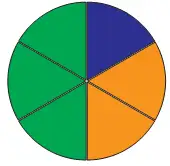
The largest unit fraction is . Two distinct unit fractions include one smaller than , so their sum is less than .
Three distinct unit fractions
- Only solution, apart from order: .
- Reasoning: Begin with . Making the fractions different requires replacing one term by the larger and balancing with smaller terms.
- Next choice: With included, the next distinct unit fraction is . The remaining amount is .
| Solution |
|---|
Write as a sum of unit fractions.
Verify that four different unit fractions can add to using , , , and .
Quick recap
- The Sanskrit words *bhinna*, *bhaga*, and *ansha* referred to fractions or parts.
- Modern fraction notation originated in India; Al-Hassar introduced the fraction bar in the th century.
- Indian texts recorded fraction operations, and Brahmagupta formally codified methods that remain in use.
- An Egyptian fraction expresses a fraction as a sum of unit fractions.
- Two distinct unit fractions cannot sum to ; the only three-distinct-term solution is .
- There are six sums of four different unit fractions equal to .
Summary
Meaning and parts of a fraction
Fraction — A fraction represents an equal share or a number of equal parts of a whole.
Fractional units and notation
- Fractional unit: When one whole is divided into equal parts, each part is a fractional unit.
- Numerator: The top number counts the fractional units being considered.
- Denominator: The bottom number tells how many equal parts make one whole; it cannot be zero.
In , is the numerator and is the denominator.
Write the fraction for 5 of 6 equal parts.
- A whole is divided into 6 equal parts, and 5 parts are taken.
- The numerator is 5 and the denominator is 6.
Mixed fractions and the number line
Mixed fraction — A mixed fraction has a whole-number part and a fractional part, such as .
Fraction on a number line — Every fraction corresponds to a point on the number line; divide each unit interval into as many equal parts as the denominator indicates.
Locate a fraction between 0 and 1
- Divide the interval from 0 to 1 into equal parts using the denominator.
- Count from 0 the number of parts given by the numerator.
- Mark the point reached.
How do you locate on a number line?
- Divide the interval from 0 to 1 into 4 equal parts.
- Count 3 parts from 0 and mark that point.
Equivalent fractions and simplest form
Equivalent fractions — Fractions that represent the same share or number are called equivalent fractions.
Multiplying or dividing both numerator and denominator by the same non-zero number gives an equivalent fraction.
Lowest terms — A fraction is in lowest terms (simplest form) when its numerator and denominator have no common factor except 1.
Simplify a fraction
- Find a common factor of the numerator and denominator greater than 1.
- Divide both by that factor; repeat until no such factor remains.
Write in lowest terms.
- Divide the numerator and denominator by their common factor, 3.
- The remaining numerator and denominator have no common factor except 1.
Adding and subtracting fractions
Fraction addition and subtraction — Add or subtract fractions by expressing them in the same fractional unit—that is, with the same denominator.
For fractions with a common denominator, add or subtract the numerators and keep the denominator unchanged.
First make the denominators equal using equivalent fractions; then combine the numerators.
Add or subtract fractions
- Find a common denominator and rewrite each fraction as an equivalent fraction.
- Add or subtract the numerators, keeping the common denominator.
- Simplify the answer if possible.
Evaluate .
- Use 12 as a common denominator for all three fractions.
- Combine the numerators and keep the denominator.
Do not add or subtract denominators. Make the denominators equal first, then combine only the numerators.
Write an equivalent fraction to with denominator 20.
Simplify .
Find .
Quick recap
- A fraction describes equal parts; the numerator counts parts and the denominator tells the total equal parts.
- A mixed fraction combines a whole number and a fraction; fractions can be marked as points on a number line.
- Equivalent fractions have the same value; multiply or divide numerator and denominator by the same non-zero number.
- A fraction is in lowest terms when the numerator and denominator have no common factor except 1.
- To add or subtract, first use a common denominator; then combine numerators and keep the denominator.