Class 6 . Mathematics . Ganita Prakash . Number Play
Chapter 3: Number Play
Ch 3
Mathematics
Class 6
Numbers can Tell us Things
Numbers Communicate Information
- Uses: Numbers help us organise daily life and communicate information.
- Applications: We use numbers to count, measure, keep track of time and money, and solve everyday problems.
Numbers from Neighbours’ Heights
Here, is the height at position , and is the number reported there. Count the taller neighbours immediately beside that position.
Find the numbers for a line of children
- Look at each child’s immediate neighbour or neighbours.
- Compare their heights with that child’s height.
- Count the neighbours who are taller; this count is the number reported.
What numbers do the five children report?
- Five children, from left to right, have height ranks . Find their reported numbers.
- The first child has one shorter neighbour, so reports ; the second has two taller neighbours, so reports .
- The third has two shorter neighbours, so reports ; the fourth has two taller neighbours, so reports .
- The last child has one shorter neighbour, so reports .
The positions and heights in a line restrict which sequences of reports are possible.
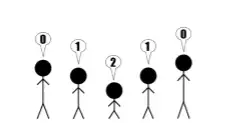
Can the child at an end report ? Explain.
Can five children of different heights report ?
Show that the sequence is possible.
Quick recap
- Numbers can represent information such as time, measurements, counts, and money.
- In the line-up puzzle, each number is the count of taller immediate neighbours.
- An end child has one neighbour; only an interior child can report .
- Equal heights are not taller than one another, so a line of equal-height children reports all zeroes.
- The tallest child always reports , so a line cannot consist entirely of s.
- Among five children, at most two can report .
Supercells
What Is a Supercell?
- Definition: A supercell contains a number greater than the numbers in all its adjacent cells.
- In a row: Adjacent cells are the cells immediately to the left and right. An end cell has only one adjacent cell.
- In a grid: Adjacent cells are immediately above, below, left, or right; diagonal cells are not neighbours.
- Example: In a row, 626 is a supercell if its neighbours are 577 and 345, since it is greater than both.
- Maximum number: To make as many supercells as possible in a row, place them in alternating cells, with smaller numbers between them.
Quick recap
- A supercell’s number must be strictly greater than all its neighbours.
- In a row, an end cell has only one neighbour; in a grid, only side-sharing cells count.
- For a row of cells with distinct numbers, the maximum number of supercells is .
- To maximise supercells in a row, place high and low numbers alternately, starting with a high number.
- With distinct numbers, the largest number is always a supercell and the smallest is never one.
Patterns of Numbers on the Number Line
Placing and Ordering Numbers
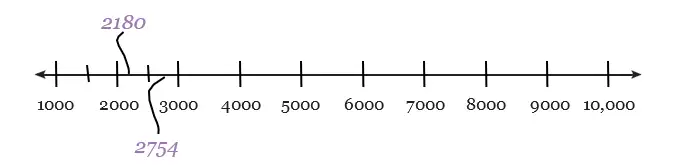
For numbers and , if , then lies to the left of .
Locate a Number
- Find the labelled values or interval that contain the number.
- Use the line's markings and spacing to judge the number's position within the interval.
- Place it in the correct order: smaller values to the left, larger values to the right.
Where should be placed on a number line marked in thousands?
- Locate between the consecutive thousands and .
- It is greater than , so it lies to the right of and closer to .
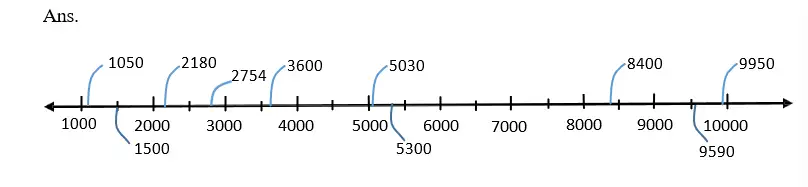
Numbers in the Lecture
- Given numbers: , , , , , , , , , , and .
- Increasing order: .
Reading Number Sequences
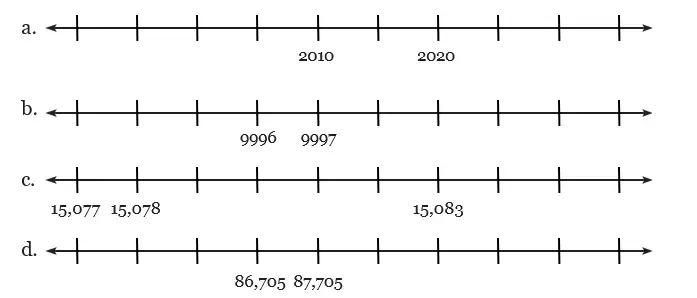
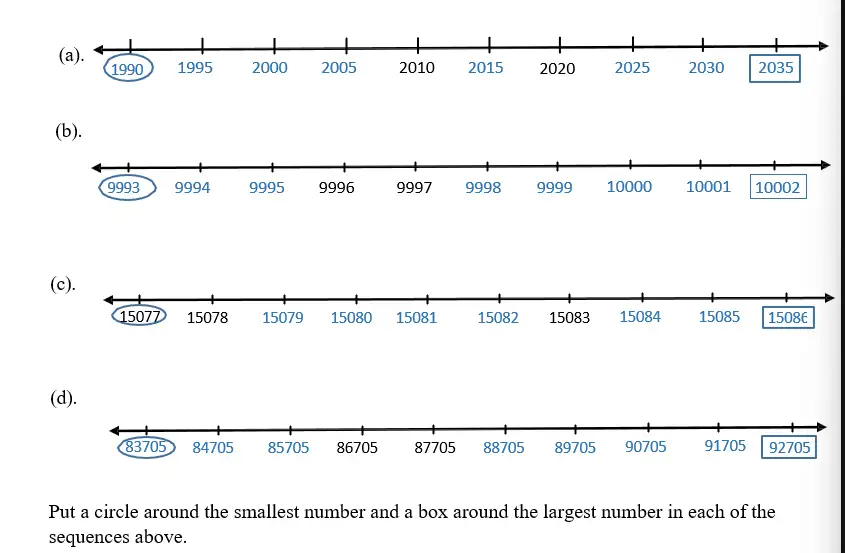
Arrange , , , and from smallest to largest.
Find the smallest and largest numbers in , , , and .
Between which consecutive thousands should be placed?
Quick recap
- Numbers increase from left to right on a number line.
- Equal spacing represents equal changes in value.
- Use labelled intervals and markings to locate a number.
- Read number sequences from their marks and spacing.
- The smallest number is leftmost; the largest is rightmost.
- The lecture's given numbers in increasing order are , , , , , , , , , , and .
Playing with Digits
Counting Numbers by Number of Digits
For , the count is followed by zeros: .
Use this to count numbers with exactly digits.
Find the count for a given digit length
- Identify the number of digits, .
- Substitute into the counting formula.
- Evaluate the expression.
How many four-digit numbers are there?
- Use the formula with .
- Evaluate.
Digit Sums
Add the digits of the number.
Find a digit sum
- Write the digits separately.
- Add their values.
- For a required sum, check that the chosen digits add to the target.
Find the smallest number with digit sum and the largest five-digit number with digit sum .
- For the smallest number, two digits are needed. Make the tens digit as small as possible while allowing the units digit to complete the sum.
- For the largest five-digit number, put the largest possible digit first, then use the remaining sum and fill the other places with zeros.
Patterns in Digit Sums
- From to : digit sums rise from to ; from to , from to ; and from to , from to .
- At a tens rollover: the digit sum drops by , such as from to .
- Consecutive-digit numbers: have sums .
- Pattern: these sums are multiples of and increase by each time. The pattern does not continue beyond as a three-digit number with consecutive increasing digits.
Making Larger Numbers with the Same Digit Sum
- Digit sum: Add the digits of a number; different numbers can have the same digit sum.
- Examples: The digit sums of 68, 176, and 545 are all 14.
- Forming numbers: Arrange digits to make numbers with a chosen digit sum; the smallest and largest possible numbers depend on the number of digits allowed.
Counting Occurrences of a Digit
From to , each fixed non-zero digit occurs times in each place, so it occurs times overall.
For the range from to .
Count digit occurrences in a full range
- Identify the number of digit places, .
- Count occurrences in one place: each digit appears times.
- Multiply by the number of places.
How many times does the digit occur from to ?
- Consider the three places in numbers from to .
- The digit appears times in each place.
- Add the occurrences across the three places; adds no .
How many five-digit numbers are there?
Find the digit sum of .
Find the digit sums of and . What pattern do they show?
Quick recap
- There are numbers with exactly digits.
- A digit sum is the total obtained by adding every digit of a number.
- The smallest number with digit sum is ; the largest five-digit one is .
- Adding zeros between and makes larger numbers while keeping digit sum .
- Digit sums of are multiples of and rise by .
- The digit occurs times from to and times from to .
Pretty Palindromic Pattern
Palindromic Numbers
- Definition: A palindrome reads the same from left to right and from right to left.
- Examples: 66, 848, 575, 797, and 1111 are palindromic numbers.
- Three-digit form: A three-digit palindrome has the same first and last digit, such as 121 or 333.
Reverse-and-Add Palindromes
Starting with , find the palindrome produced by reverse-and-add.
- Reverse to get , then add.
- is not a palindrome; reverse it to get and add.
- reads the same both ways, so stop.
A Five-Digit Palindrome Puzzle

Is a palindrome? Explain briefly.
Do not stop the reverse-and-add process just because a sum has repeated digits; check that the entire number reads the same in both directions.
Quick recap
- A palindrome reads identically from left to right and right to left.
- A three-digit palindrome has the form ; a five-digit palindrome has the form .
- For three-digit palindromes, choose matching outside digits and any allowed middle digit.
- Reverse-and-add means adding a number to its digit reversal, repeating until a palindrome appears.
- Use place-value relationships and the odd/even condition to solve digit puzzles.
The Magic Number of Kaprekar
Kaprekar Routine and Constants
- Routine: Arrange a number’s digits in descending and ascending order, then subtract the smaller number from the larger.
- Repeat: Apply the same steps to each result until the number stops changing.
- Four-digit constant: For a four-digit number with at least two different digits, the routine reaches 6174; this is the Kaprekar constant.
- Example: Starting with 6382 gives 8632 − 2368 = 6264, then 6642 − 2466 = 4176, and then 7641 − 1467 = 6174.
- Three-digit numbers: The corresponding constant is 495 for three-digit numbers with at least two different digits.
Quick recap
- Arrange a number's digits from largest to smallest and smallest to largest.
- Subtract the smaller arrangement from the larger, preserving leading zeros.
- For valid -digit starts, the routine reaches .
- For valid -digit starts, it reaches .
- Both constants repeat under the routine.
Clock and Calendar Numbers
Patterns on a 12-Hour Clock
For a four-digit display, the first digit must match the last, and the two middle digits must match.
Finding the next palindromic time
- Move forward through the clock times, keeping the usual 12-hour order.
- Check whether the four displayed digits read the same in reverse.
- Count the minutes from the starting time to the first matching display.
From , how long until the next two palindromic times?
- Starting at , the next palindromic time is .
- The palindromic time after that is ; it is minutes after .
Patterns in Dates
For a date written as a string of digits, each digit must match the digit equally far from the opposite end.
Checking a date pattern
- Write the date in day/month/year order and remove the separators when checking its digit pattern.
- Compare the digits with the stated repeating or reversing pattern.
- Confirm that the day and month are valid.
Show why has the repeating sequence .
- Write as one digit string: .
- The sequence occurs twice in the string.
- The date is valid, so it is a date with the repeating sequence .
When Does a Calendar Repeat?
The shift from one year’s starting weekday to the next is the year length modulo .
Checking a possible calendar repeat
- Count the common years and leap years between the two years.
- Add weekday shift for each common year and for each leap year.
- The starting weekday must return to the same day, and both years must be the same type.
Why can a calendar repeat after a six-year interval containing one leap year?
- Across a six-year interval with one leap year, there are five common-year shifts and one leap-year shift.
- A shift of days returns to the same weekday.
- The calendar can repeat if the year type and leap-year arrangement also match.
Smallest and Largest Numbers from Digits
Use the same digits to form the two numbers, then add or subtract them as required.
Forming the extreme numbers
- Arrange the chosen digits from smallest to largest to form the smallest number.
- Arrange the same digits from largest to smallest to form the largest number.
- Calculate the requested sum or difference and compare it with the target.
Find the smallest and largest numbers made from , then find their sum and difference.
- Arrange in ascending and descending order.
- Subtract to find the difference.
- Add to find the sum.
Palindrome Numbers
A five-digit palindrome has matching first and last digits, and matching second and fourth digits.
Find the sum and difference of the smallest and largest five-digit palindromes.
- Use the smallest and largest five-digit palindromes.
- Add them.
- Subtract the smaller from the larger.
Kaprekar Constant
Rearrange the digits of the current number in descending and ascending order, then subtract.
Repeating the Kaprekar process
- Arrange the four digits in descending order and ascending order.
- Subtract the ascending arrangement from the descending arrangement.
- Use the result for the next round, keeping four places with leading zeroes if necessary.
- Stop when the result is and count the rounds taken.
How many rounds does take to reach the Kaprekar constant?
- Round .
- Round .
- Round .
- Round .
- Round .
- Round .
- Round .
In the Kaprekar process, keep leading zeroes when arranging digits. For example, the ascending arrangement of is , not .
Starting at , how many minutes are there until ?
Using the digits , find the sum and difference of the smallest and largest four-digit numbers.
How many Kaprekar rounds does take to reach ?
Quick recap
- Patterned times repeat digits or read the same forwards and backwards.
- Patterned dates can repeat a digit sequence or form a palindrome; check that the date is valid.
- A calendar repeat requires the same year type and the same weekday for January 1.
- Arrange digits in ascending order for the smallest number and descending order for the largest.
- A palindrome reads the same forwards and backwards; the smallest and largest five-digit ones are and .
- The four-digit Kaprekar process reaches when the starting number has at least two different digits.
Mental Math
Forming target numbers by addition and repetition
Target number — A target number is made by combining available numbers using the allowed operations.
Key ideas
- Repeat numbers: In an addition-only target, an available number may be used as many times as needed.
- Build the target: For example, and .
- The thousand target: Using , , and , cannot be made; it is the only thousand that cannot be made. All other thousands can be formed.
- Other targets: ; ; .
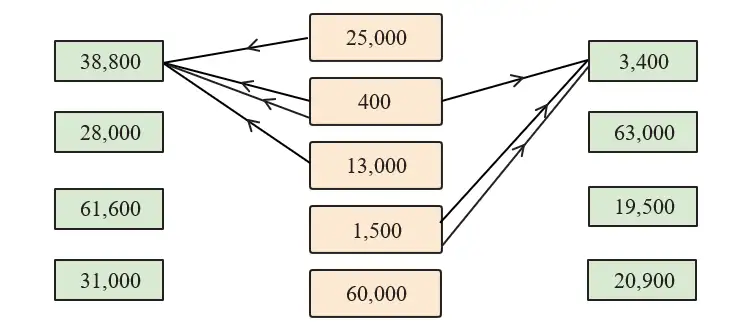
Here, are non-negative whole-number counts of the available values.
Make a target mentally
- Choose an available value that fits the target or its remainder.
- Repeat or combine values, then add them mentally.
- Check that the total equals the target exactly.
Make using , , and .
- Choose the available values to make .
- Add the values.
Adding and subtracting available numbers
Signed combination — A signed combination forms a target by adding some available numbers and subtracting others.
Key ideas
- Available numbers: , , , , and .
- Use both operations: Add or subtract available values to reach a target; a value may be reused.
- Example: .
Each is an available number; a positive or negative sign indicates whether it is added or subtracted.
Reach a target using addition and subtraction
- Select available values that are close to the target.
- Add values that move the total towards the target; subtract values that would make it too large.
- Calculate and check the final total.
Make using the available numbers.
- Start with and subtract and .
- Add , then subtract and .
| Target | One valid combination |
|---|---|
Digit lengths and whether a result is possible
Digit length — A number’s digit length is the number of digits in its numeral; for example, is the smallest five-digit number.
An -digit positive whole number is at least and at most . Check the smallest and largest possible inputs to decide whether a result is possible.
Examples with five-digit numbers
- Addition: Two five-digit numbers can give a five-digit sum: .
- Subtraction: Two five-digit numbers can give a five-digit difference: .
Test whether a requested result is possible
- Find the smallest and largest possible inputs of each stated digit length.
- Work out the smallest or largest possible result, as needed.
- Compare that range with the requested result; if it lies outside the range, it is impossible.
Can two four-digit numbers add to make a six-digit number?
- The greatest four-digit number is , so the greatest sum of two four-digit numbers is:
- A six-digit number starts at , which is greater than .
| Requested result | Example or reason |
|---|---|
| Five-digit five-digit gives a five-digit number greater than | |
| Five-digit three-digit gives a six-digit sum | |
| Four-digit four-digit gives a six-digit sum | Impossible: the maximum sum is . |
| Five-digit five-digit gives a six-digit sum | |
| Five-digit five-digit gives | Impossible: the minimum sum is . |
| Five-digit five-digit gives less than | |
| Five-digit three-digit gives a four-digit difference | |
| Five-digit four-digit gives a four-digit difference | |
| Five-digit five-digit gives a three-digit difference | |
| Five-digit five-digit gives | Impossible: the maximum difference is . |
| Statement | Classification and reason |
|---|---|
| Five-digit five-digit gives a five-digit number | Sometimes: , but . |
| Four-digit two-digit gives a four-digit number | Sometimes: ; however, . |
| Four-digit two-digit gives a six-digit number | Never: The greatest possible sum is , which is five digits. |
| Five-digit five-digit gives a five-digit number | Sometimes: is five digits, while is not. |
| Five-digit two-digit gives a three-digit number | Never: The smallest possible difference is , which is four digits. |
Can be a six-digit sum?
Make from , and , using addition or subtraction.
Is it always, sometimes or never true that a five-digit number minus a five-digit number gives a three-digit difference?
Quick recap
- Use repeated addition of available values to build a target; values may be reused.
- is the only thousand that cannot be made from , , and .
- When subtraction is allowed, combine values with plus and minus signs to reach a target.
- An -digit positive whole number lies from to .
- Use smallest and largest possible results to decide whether a digit-length condition is possible.
- A statement may be always, sometimes or never true; justify it with bounds or examples.
Playing with Number Patterns
Recognising and Summing Patterns
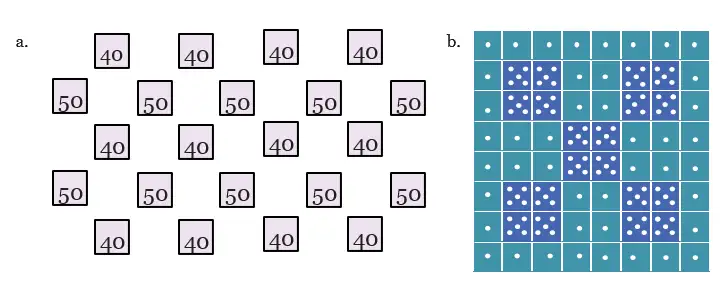
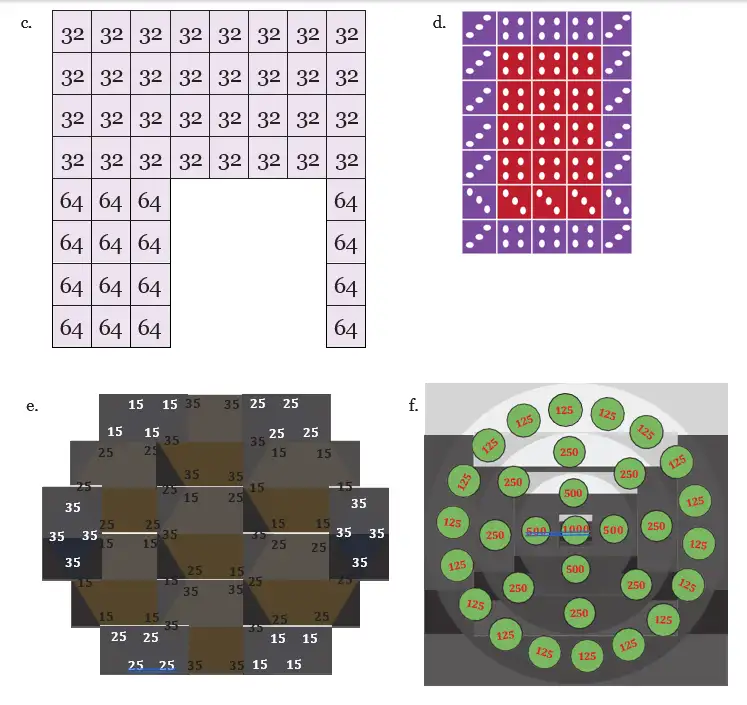
Use this when an arrangement has equal groups; count any objects outside those groups separately.
A quick way to sum a visual pattern
- Count the total number of objects or labels.
- Identify equal groups or groups with repeated values.
- Multiply the value of each equal group by the number of groups, then add the group totals.
- Check that every object or number was counted once.
How can you find the sum of a pattern with labels of and labels of ?
- Suppose a pattern contains labels of and labels of . Express their total.
- Multiply each label value by its count.
- Add the two group totals.
A grid has rows with dots in each row. Write an expression for the total number of dots.
A pattern has labels of and labels of . Write an expression for their sum.
Do not multiply by a group size unless the groups are equal; count any leftover objects separately.
Quick recap
- Look for repeated groups, rows, columns, or labels in a number pattern.
- Equal groups can be counted using multiplication.
- Add the totals of different groups to find the full sum.
- Count every object or label once, including any leftovers.
- Use the pattern's structure to choose a quicker way to add.
An Unsolved Mystery — the Collatz Conjecture!
The Collatz Rule and Sequences
Collatz sequence — A sequence made by repeatedly applying the even-or-odd rule to a positive whole number.
The rule
- Even number: Divide it by .
- Odd number: Multiply it by , then add ; this produces an even number.
- Repeat: Apply the rule to each new number. The sequences shown eventually reach .
Here, is the current positive whole number.
Write the Collatz sequence starting with .
- Start with , which is even, and halve it.
- Halve , then apply to the odd number .
- Continue applying the rule until the sequence reaches .
| Starting number | Collatz sequence |
|---|---|
The Collatz Conjecture
The conjecture says that starting with any positive whole number and repeatedly applying the rule will eventually produce .
Status and key idea
- Proposed: German mathematician Lothar Collatz conjectured this in .
- Unsolved: The conjecture remains unproved; seeing many sequences reach does not prove it is true for every positive whole number.
- Pattern: Odd numbers become even after the step, and even numbers are halved. This pattern alone does not guarantee that every sequence reaches .
Do not claim the conjecture is proved because sample sequences reach . It is an unsolved conjecture, not an established result.
Write the Collatz sequence starting with .
Write the Collatz sequence starting with .
Quick recap
- For an even term, divide by ; for an odd term, calculate .
- Repeat the rule to form a Collatz sequence.
- The conjecture says every positive whole-number start eventually reaches .
- Lothar Collatz proposed the conjecture in .
- The conjecture remains unsolved; examples do not prove it for all starting numbers.
Simple Estimation
Meaning and purpose of estimation
- Estimation: Finding an approximate value rather than an exact count or measurement.
- Purpose: An estimate is useful when an exact answer is unnecessary or difficult to obtain.
- Method: Use familiar quantities and round numbers to make a reasonable approximation.
Estimating counts and totals
Use when groups contain roughly the same amount. Let be the estimated total, the number of groups, and the estimated amount in each group.
Estimate a total from groups
- Find or estimate the amount in one group.
- Multiply by the number of similar groups.
- Round the result if a convenient approximate answer is sufficient.
Estimate the number of students in a school with five grades, each having three sections of about the same size as the example class.
- A class has sections with 32, 29, and 35 children. Add the section counts.
- Round the total to a nearby, convenient number.
- If five grades each have three similar sections, estimate the whole-school total using about 100 children per grade.
Estimating everyday quantities
- Everyday quantities: Estimation helps us make sensible guesses about amounts and totals around us.
- Useful method: Compare with a familiar quantity or estimate one group, then scale up for similar groups.
Estimating time and distance
Use when an amount is repeated over time or distance. Let be the estimated total, the amount per unit, and the number of units.
Estimate school hours using hours per day, working days per year, and years attended. Let be total hours, hours per day, working days per year, and years.
Example: checking school hours
- Assumptions: About 6 school hours each day and 200 working days each year give about school hours per year.
- Check the claim: hours would equal about years at this rate, which is much longer than about 8 years of schooling through Grade 6.
- Conclusion: The estimate of hours is too high under these assumptions; about hours is a more suitable estimate.
Checking whether an estimate is reasonable
Do not treat an estimate as an exact answer. Check whether the result fits the assumptions; changing quantities, prices, routes, or rates can change the estimate.
A school has five grades with three sections in each grade. If each section has about 33 students, estimate the total number of students.
Using 6 school hours per day and 200 working days per year, estimate the school hours in 8 years. Is 13,000 hours a reasonable estimate?
A map-based estimate for the distance from Gandhinagar to Kohima is about 2,500 km. Is this an exact distance?
Quick recap
- Estimation gives an approximate answer when an exact one is not needed.
- Estimate totals by multiplying the approximate amount in one group by the number of groups.
- For repeated amounts, multiply an estimated rate by the number of units.
- Use sensible assumptions and round to convenient numbers.
- Check whether the result is realistic; estimates change when assumptions change.
Games and Winning Strategies
Building a Winning Strategy
Winning strategy — A plan that guarantees a win when followed correctly, whatever number the opponent chooses within the rules.
If a player may add any number from to , respond so that your move and the opponent's move add to . This lets you land on the same target pattern each turn.
Work backwards from the winning number in steps of . If is a multiple of , the second player can take the pattern; otherwise, the first player can start on the remainder.
The 21 Game
Rules and strategy
- Rules: Start by saying , or ; each turn, add , or to the last number. The first to say wins.
- Key total: Make your move and the opponent's next move add to .
- Winning positions: The player using the strategy aims to say .
In the 21 game, how can the first player guarantee a win?
- Start by saying the first winning position.
- If the opponent adds , add to reach the next winning position. Here can be , or .
- Repeat this response to land on each position in the pattern and finish at .
Do not choose moves at random: aim for the winning-position pattern, and respond with the amount needed to complete .
The 99 Game
Rules and strategy
- Rules: The first player says a number from to ; each turn, add to . The first to say wins.
- Key total: Complement each opponent's addition to make the two additions total .
- Winning positions: Aim to say .
- Who can force a win: The second player; after the first player's opening number, add enough to reach .
In the 99 game, the first player says . What should the second player do, and what pattern should they follow?
Changing the Rules
Find the strategy for a new game
- Let be the greatest amount a player may add, and note the winning target .
- Find the complement total, one more than the largest allowed addition.
- Count backwards from in steps of to find the target pattern.
- If the pattern reaches , the second player can force the win; otherwise, the first player starts at the smallest positive target in the pattern.
Starting from , players add , or ; the first to reach wins. What is the winning strategy?
Quick recap
- A winning strategy aims for a pattern of numbers that guarantees reaching the target.
- When additions range from to , use the complement total .
- In the 21 game, the first player starts at and targets .
- In the 99 game, the second player can reach first, then target successive multiples of .
- For a new game, count backwards from the target in steps of to identify who can force a win.
Summary
How Numbers Are Used
Uses of numbers
- Communicate: Numbers convey information.
- Find patterns: Numbers help us notice and discover patterns.
- Estimate: Numbers help compare or estimate magnitudes.
- Solve problems: Numbers can be used to pose and solve puzzles.
- Play games: Numbers can be used to play games and develop ways to win.
Computational Thinking
Computational thinking — The skill of thinking about and forming systematic procedures for using numbers to solve problems or achieve a purpose.
Number Problems and Conjectures
Easy to ask, hard to solve
- Number problems: Some are easy to state but very difficult to solve.
- Unsolved problems: Many number problems remain unsolved.
- Example: Collatz’s Conjecture is an example of a number problem that is easy to pose but difficult to solve.
What is computational thinking in number play?
Name some purposes for which numbers are used.
Quick recap
- Numbers can communicate information and help us find patterns.
- Numbers are useful for estimating magnitudes.
- Numbers can be used to pose and solve puzzles and play games.
- Computational thinking involves forming systematic procedures for using numbers.
- Some number problems are easy to pose but difficult to solve.
- Collatz’s Conjecture is an example of a difficult number problem.