Class 6 . Mathematics . Ganita Prakash . Lines and Angles
Chapter 2: Lines and Angles
Ch 2
Mathematics
Class 6
Point
Point
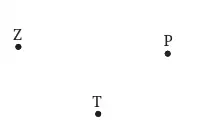
How can three marked locations be named clearly?
- Three separate locations are marked as dots.
- Give each dot a different capital-letter label: A, B, and C.
- Read them as Point A, Point B, and Point C.
What does a geometric point represent, and what dimensions does it have?
How should points labelled M, R, and S be read aloud?
Quick recap
- A point marks a precise location.
- A point has no length, breadth, or height.
- A tiny dot represents a point but is imagined to be invisibly thin.
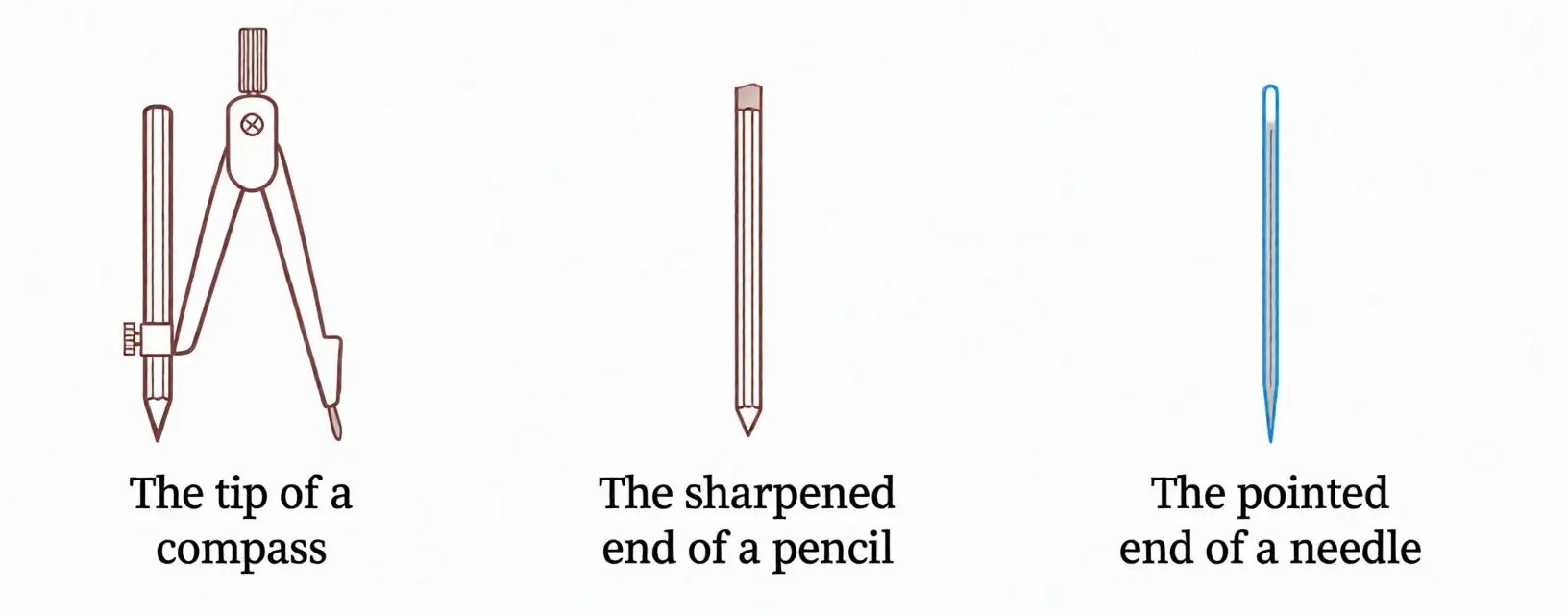
- Pointed tips can serve as models of points.
- Name points with capital letters, such as Point Z.
Line Segment
Line segment — A line segment is the straight path between two points, including both points; its endpoints are the two points at its ends.
Quick recap
- A line segment is a straight path joining two endpoints.
- It is the shortest route between its endpoints.
- The endpoints are included in the segment.
- The segment from to is written as or .
Line
What Is a Line?
Line — A line is a straight path that extends endlessly in both directions.
Exactly one line passes through any two distinct points. A line cannot be drawn completely because it has no endpoints and continues forever in both directions.
Naming a Line
- By two points: A line through points and is denoted by .
- By a lowercase letter: A line may also be named using a letter such as or .
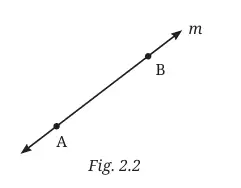
The double-headed arrow indicates that the line continues in both directions.
Naming a Line Through Two Points
- Identify the two distinct points on the line.
- Write their names with a double-headed arrow above them, or use the line's lowercase letter name.
How can the line through and be named?
- A line passes through points and . Name the line using its points.
- Place a double-headed arrow over the two point names.
A line through and is named using its points. Write its notation.
How many distinct lines pass through two distinct points?
Quick recap
- A line is straight and extends endlessly in both directions.
- A line has no endpoints, so it cannot be drawn completely.
- Exactly one line passes through any two distinct points.
- A line through and is written as .
- A line may also be named with a lowercase letter, such as or .
Ray
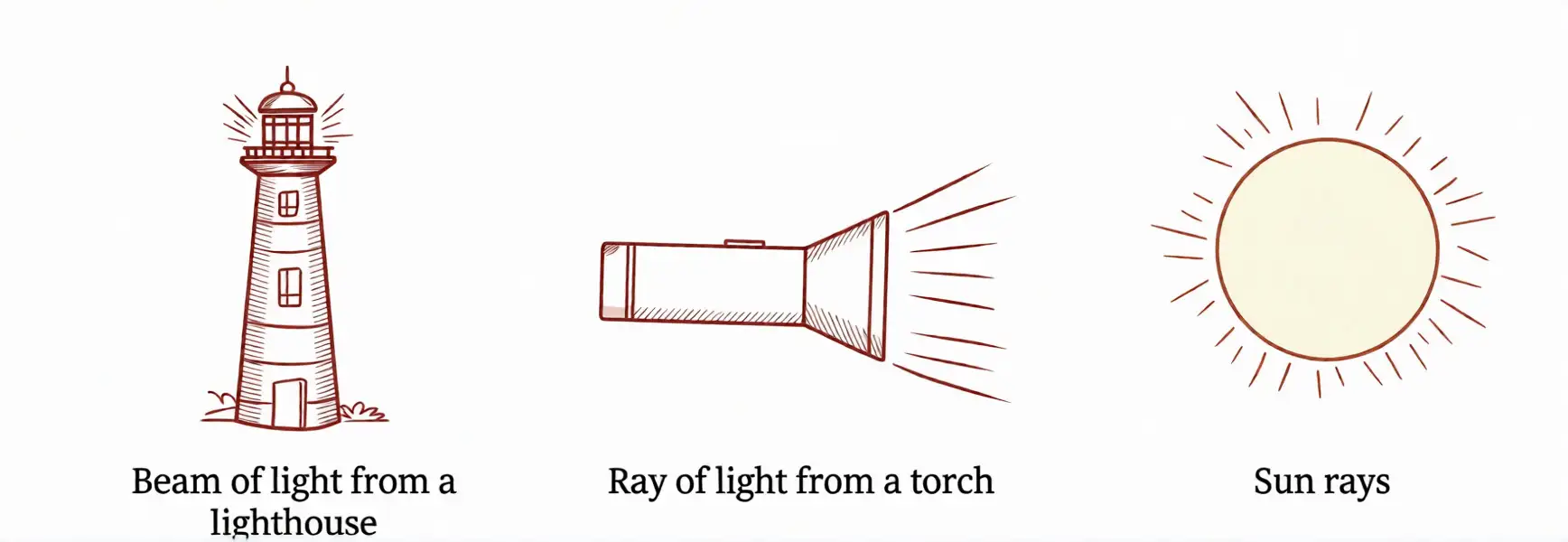
Ray — A ray is part of a line that begins at one point and continues endlessly in one direction.
Key features
- Starting point: The point where a ray begins is its endpoint or initial point.
- Direction: The arrow shows the direction in which the ray continues without end.
- Naming: Name a ray using its starting point first, followed by another point on it.
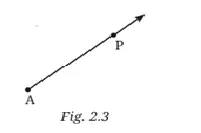
The first letter names the starting point; the second is another point along the ray.
A ray can be named using any point on it after its starting point. If and lie on the same ray starting at , then . Reversing the letters changes the starting point, so is not the same ray.
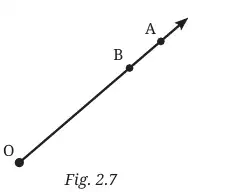
How to name a ray
- Identify the point where the ray begins.
- Choose another marked point on the ray.
- Write the starting point first, with an arrow over both letters.
A ray starts at and passes through and . Name the ray in two ways.
- A ray starts at and passes through and . Name the ray in two ways.
- Use the starting point first, then either point on the ray.
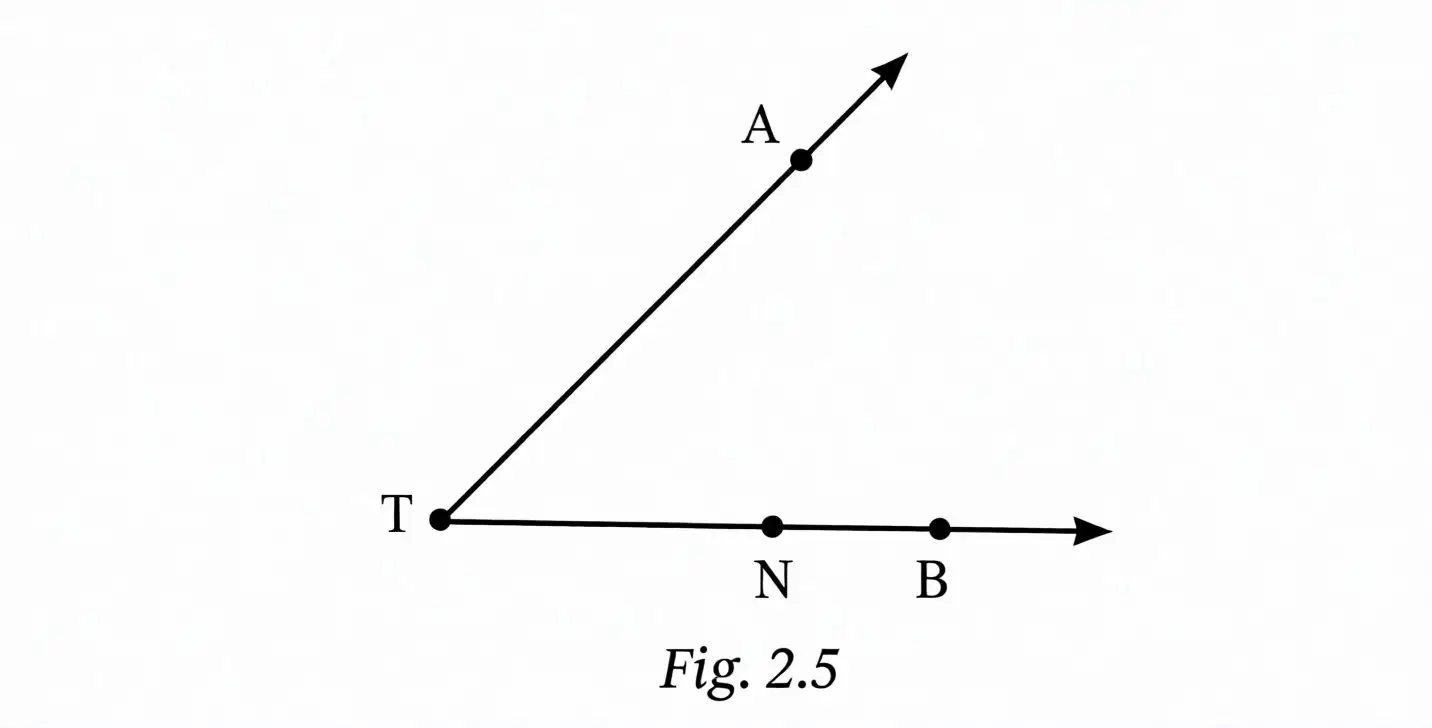
Reading rays in a diagram
- From the diagram: The rays shown can be named , , , and .
- Check the start: starts the first three rays; starts .
Many lines can pass through one point, but exactly one line passes through two distinct points.
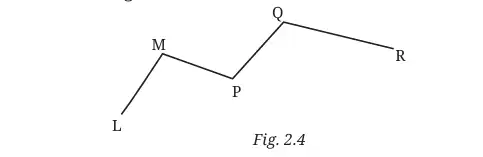
Line segments in a broken path
- Segments: The path contains , , , and .
- Segment membership: and lie on one segment each; , , and lie on two each.
A ray begins at and passes through . Write its name.
A ray starts at and passes through and . Is the same ray as ?
How many lines can pass through one given point? How many lines can pass through two distinct given points?
Quick recap
- A ray starts at one point and continues endlessly in one direction.
- Name a ray with its starting point first, then another point on it.
- Changing the first letter changes the ray's starting point.
- Many lines pass through one point; exactly one passes through two distinct points.
- In the broken path ––––, the segments are , , , and .
Angle Part-1
An Angle and Its Parts
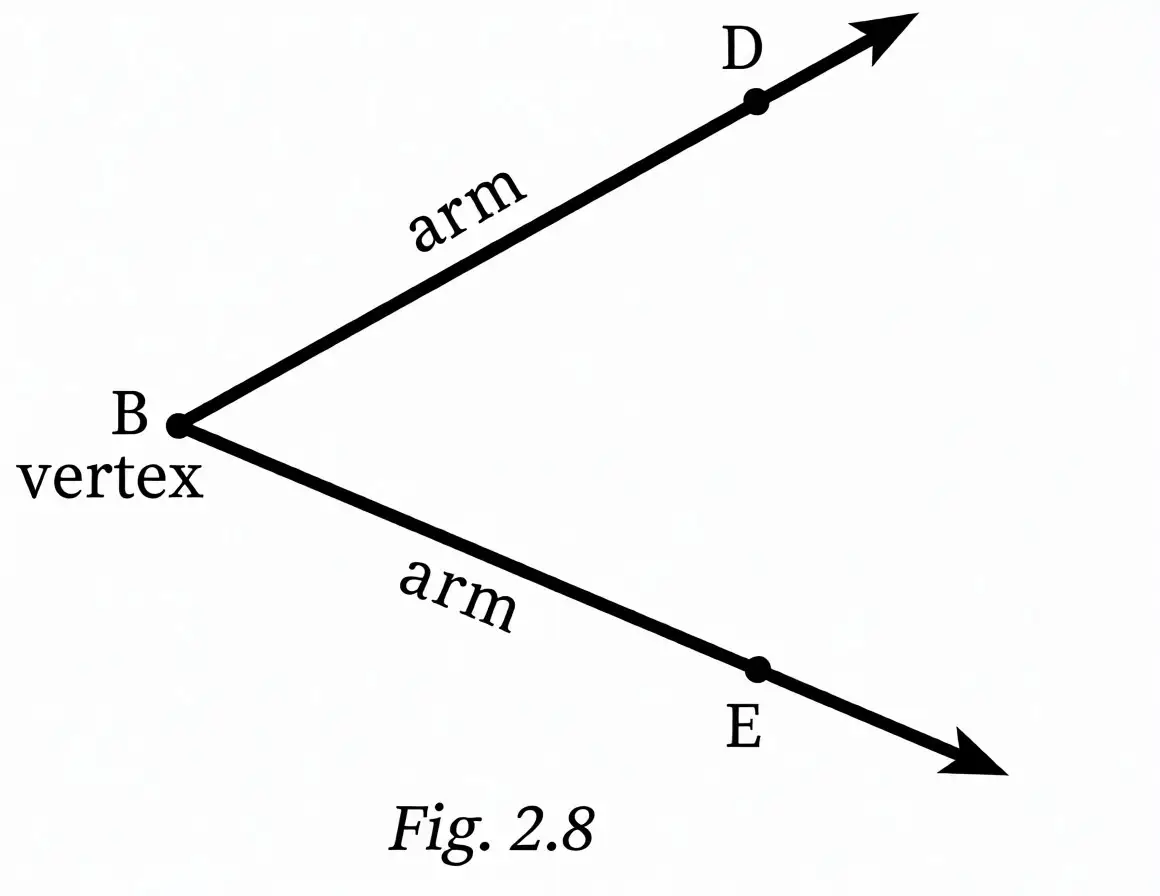
The vertex is the middle letter in a three-letter angle name.
Name an angle
- Find the common endpoint; this is the vertex.
- Choose one point on each arm.
- Write the vertex letter in the middle.
Two rays and meet at Q. Name the angle in both orders.
- The rays and meet at Q, so Q is the vertex.
- Place Q in the middle and use one point from each arm.
- Reversing the arm points gives another name for the same angle.
Rays and meet at L. Name the angle in both orders.
In , which letter names the vertex?
Angle Size as Rotation
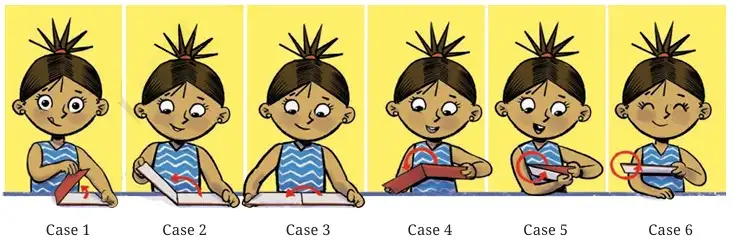
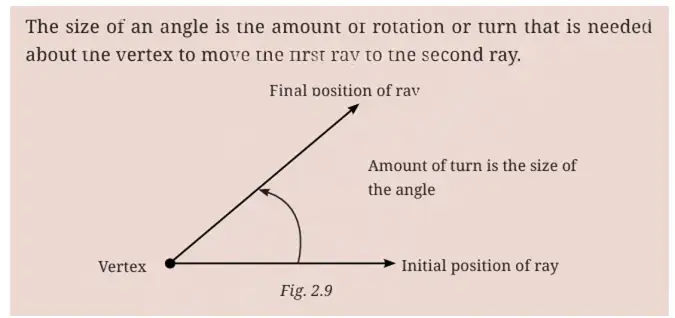
The angle with the greater amount of rotation is larger.
Compare two angles
- Identify the starting arm and final arm for each angle.
- Compare how far each arm turns around its vertex.
- The angle with the greater turn is larger.
A book cover turns farther in Case 2 than in Case 1. Which case shows the larger angle?
- Case 2 requires a greater turn of the book cover than Case 1.
- A greater turn forms a larger angle.
The cover turns more in Case 4 than in Case 3. Which case has the larger angle?
Do not judge an angle by the length of its arms; its size depends on the amount of rotation.
Quick recap
- An angle is formed by two rays sharing a common starting point.
- The common endpoint is the vertex, and the rays are the arms.
- An angle can be named by its vertex alone when clear, or by three letters with the vertex in the middle.
- Reversing the two arm letters gives another name for the same angle.
- Angle size depends on the amount of rotation, not arm length.
- A greater turn forms a larger angle.
Angle Part-2
Angles as Turns and How to Name Them
The middle letter of a three-letter angle name is its vertex. A single-letter name is clear only when there is just one angle at that vertex.
The vertex is the middle letter; the first and last letters lie on the arms.
Identify and name an angle
- Find the common endpoint of the two arms; this is the vertex.
- Write one point on the first arm, then the vertex, then one point on the second arm.
- If several angles share the vertex, use three letters so the intended angle is clear.
Why should the angle between and be named rather than just ?
- Three rays , and meet at . Identify the angle between and .
- The common endpoint of the arms is the vertex.
- Place the vertex letter in the middle of the angle name.
- A single-letter name is unclear because several angles are formed at .
Do not put the vertex at either end of a three-letter angle name: it must be the middle letter.
Lines and Angles from Sets of Points
When no three of the points lie on one line, each pair determines one line.
If every point is joined to all the others and no three points are collinear, each vertex has one angle for every pair of rays.
| At / through | Names |
|---|---|
| Lines | |
| Vertex | |
| Vertex | |
| Vertex | |
| Vertex |
List lines and angles from points
- For lines, list each pair of points once.
- For angles, take each vertex in turn and pair its rays.
- Write each angle with its vertex letter in the middle, then check that none are missed or repeated.
How many lines and angles can be named from four points when no three are collinear?
- For four points , with no three on one line, find the number of lines and angles.
- Count the lines by choosing pairs from the four points.
- At each point, three rays are formed; choose pairs of rays to count its angles.
Draw and name an angle whose arms are and . State its vertex.
Three non-collinear points are joined in pairs. Name the lines and all the angles.
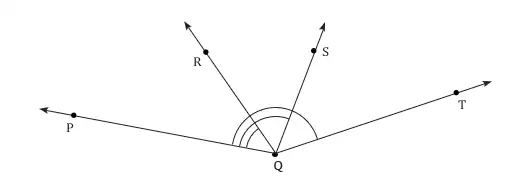
At , rays , and form marked angles. Name and by their arms and vertex.
Quick recap
- An angle is formed by two rays with a common endpoint, called the vertex.
- In a three-letter angle name, the vertex is the middle letter.
- Use three letters when more than one angle is formed at the same vertex.
- Each pair of points determines one line when no three points are collinear.
- For points, the number of lines is .
- For points joined in pairs with no three collinear, the total number of angles is .
Comparing Angles Part-1
Comparing Angles
- Angle size: An angle is larger when it involves a greater amount of rotation.
- Comparison: Comparing angles helps determine which opening or turn is smaller, larger, or equal in size.
Comparing by Superimposition
If the vertices and both arms of two angles lie exactly on top of one another, the angles are equal in size. For example, when overlaps and overlaps , .
Compare two angles by superimposition
- Place the two vertices together.
- Align one arm of the first angle with one arm of the second.
- Compare the positions of the remaining arms to decide which angle is greater or whether they are equal.
Angle Addition and Comparing Parts
Use this when rays divide an angle into adjacent parts.
Which is greater: or ?
- Compare the whole angle with its middle part when rays and lie inside .
- Write the whole angle as the sum of its adjacent parts.
- The two additional parts have positive size, so the whole angle is greater.
Applying Angle Comparison
Do not judge angle size by the lengths of its arms or by appearance alone. Compare the opening by aligning the vertices and one arm, or measure the angles.
In the ray arrangement shown, compare and .
In the shown arrangement, compare and .
Can you decide by sight alone whether or is greater?
Quick recap
- An angle's size depends on the amount of turn between its arms.
- Visual comparison may be unreliable, especially for angles close in size.
- Superimposition requires matching the vertices and aligning one pair of arms.
- If both pairs of arms overlap, the angles are equal.
- An angle divided into adjacent parts equals the sum of those parts.
- The whole angle is greater than any one of its smaller parts.
Comparing Angles Part-2
Comparing Angles Without Superimposition
Angle comparison using a circle — A transparent circle helps compare angles by aligning their vertices and one arm, then checking the position of the other arm.
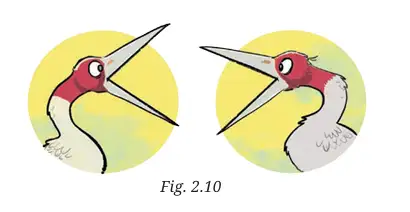
Circle comparison method
- Place the centre: Put the circle’s centre at the angle’s vertex.
- Mark the arms: Note where each arm meets the circle’s edge.
- Align: At the second angle, match the centre to its vertex and align one arm with the corresponding arm.
- Compare: Check whether the other arm lies inside, on, or outside the other angle’s arm.
After aligning the vertices and one pair of arms, the angle whose other arm lies farther from the aligned arm is greater. Coincident other arms indicate equal angles; the arm closer to the aligned arm gives the smaller angle.
Use these relations to record whether one angle is greater than, equal to, or less than another.
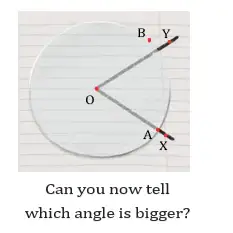
Compare two angles with a transparent circle
- Place the circle’s centre at the first angle’s vertex and mark where its arms meet the edge.
- Move the circle to the second angle and place its centre at the second vertex.
- Align one arm of the second angle with the corresponding marked arm.
- Compare the positions of the other arms to decide which angle is greater, smaller, or equal.
Which angle is greater if, after alignment, the other arm of the second angle lies outside the other arm of the first angle?
- Compare the two angles by aligning their vertices and one arm.
- After alignment, the other arm of the second angle lies outside the other arm of the first angle.
- The second angle’s arm is farther from the aligned arm, so it forms the greater angle.
Do not judge an angle by the length of its arms. Angle size depends on the opening between the arms, not how long the arms are.
After aligning the vertices and one arm, the other arms of two angles coincide. What can you conclude?
After alignment, one angle’s other arm lies between the aligned arm and the other angle’s remaining arm. Which angle is smaller?
Quick recap
- A transparent circle can compare angles without superimposing the angles themselves.
- Match the circle’s centre to each vertex and align one pair of arms.
- The farther other arm makes the greater angle.
- Coincident other arms mean the angles are equal.
- The other arm closer to the aligned arm gives the smaller angle.
- Arm length does not determine angle size.
Making Rotating Arms
Forming and Comparing Angles
Angle — An angle is the opening formed when two arms meet at a common endpoint.
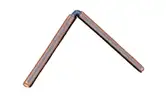
Key points
- Rotating arms can be arranged to make angles with different openings.
- Compare angles by placing one over the other (superimposing them).
- Order several angles from smallest to largest by comparing their openings.
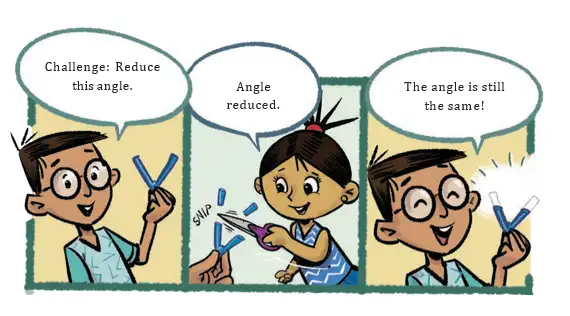
An angle's size depends on the opening between its arms, not on the lengths of the arms. For the slit test, arms pass through only when their angle matches the slit and the arms are shorter than the slit.
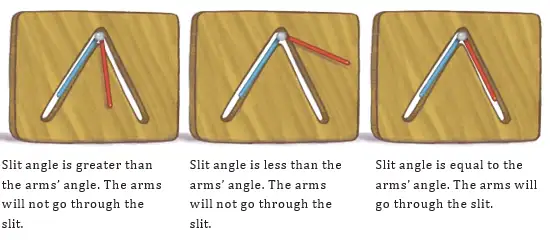
Compare angles by superimposition
- Place the common endpoints of the two angles together.
- Line up one arm of each angle in the same direction.
- Compare the other arms: the wider opening is the larger angle.
- Repeat the comparison to arrange several angles from smallest to largest.
Will rotating arms of different lengths pass through the same angle-shaped slit?
- Two rotating arms have different lengths, but their openings match when superimposed.
- Their angles are equal because the openings match.
- They pass through the same angle-shaped slit if both arms are shorter than the slit.
When two angles are superimposed with one arm lined up, one of the other arms lies farther from the lined-up arm. Which angle is larger?
A pair of rotating arms has the same angle as a slit, but the arms are longer than the slit. Will they pass through?
Do not judge an angle by arm length. Longer arms do not make a larger angle; compare the openings.
Quick recap
- An angle is the opening formed when two arms meet at a common endpoint.
- The size of an angle depends on its opening, not on the lengths of its arms.
- Superimposition helps compare angles and arrange them from smallest to largest.
- Rotating arms pass through an angle-shaped slit only when their angle matches the slit.
- For the slit test, the arms must also be shorter than the slit.
Special Types of Angles Part-1
Straight Angle
Straight angle — An angle whose arms lie in a straight line is called a straight angle.
Key properties
- Turn: A straight angle is half of a full turn.
- Division: A ray from its vertex divides it into two adjacent angles whose measures add to .
- Equal parts: Dividing a straight angle equally gives two right angles.
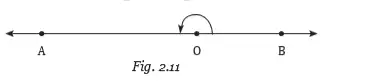
A straight angle is half of a full turn.
Divide a straight angle equally by folding
- Mark a straight angle with vertex and arms and .
- Fold the paper so arm overlaps arm ; the crease passes through .
- The crease divides the straight angle into two equal angles.
What angle is formed by half of a full turn?
- A half turn forms a straight angle.
- Evaluate the measure.
Right Angle
Right angle — A right angle is exactly half of a straight angle.
Key properties
- Measure: A right angle measures .
- Turn: It is one-quarter of a full turn.
- Recognition: It may look like an L, but it is a right angle only when its measure is exactly .
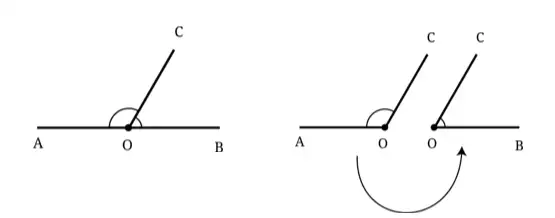
A right angle is half a straight angle and one-quarter of a full turn.
Identify a right angle
- Check whether the angle is half of a straight angle.
- Or check whether it is one-quarter of a full turn.
What angle is formed by one-quarter of a full turn?
- A quarter turn is one-fourth of a full turn.
- Evaluate the angle measure.
Perpendicular Lines
Perpendicular lines — Two lines that meet at right angles are called perpendicular lines.
Key properties
- Intersection: Two perpendicular lines form four right angles at their intersection.
- Creases: A crease perpendicular to another crease divides the full angle around their intersection into four equal angles.
Each of the four angles formed is a right angle.
Make perpendicular creases
- Make a crease to represent the first line.
- Fold the paper so the two arms of the first crease overlap; make a new crease through the fold.
- The new crease is perpendicular to the first and forms four right angles.
How many right angles do two perpendicular lines form?
- At an intersection of perpendicular lines, each angle is a right angle.
- Count the four angles around the intersection.
A straight angle is divided into two equal angles. What is the measure of each?
What fraction of a full turn is a right angle, and what is its measure?
How many right angles are formed when two perpendicular lines intersect?
Quick recap
- A straight angle measures and is half of a full turn.
- A ray divides a straight angle into two adjacent angles whose measures total .
- A right angle is half a straight angle and measures .
- A right angle is one-quarter of a full turn.
- Two lines meeting at right angles are perpendicular and form four right angles.
Special Types of Angles Part-2
Classifying Angles by Their Size
Angle classification — Angles can be grouped by comparing their opening with a quarter-turn and a half-turn.
| Type | Turn size |
|---|---|
| Acute | Less than a quarter-turn |
| Right | Exactly a quarter-turn |
| Obtuse | More than a quarter-turn but less than a half-turn |
| Straight | Exactly a half-turn |
Key Features
- Acute: Its opening is smaller than a right angle.
- Obtuse: Its opening is larger than a right angle but smaller than a straight angle.
- Orientation: Turning an angle in a different direction does not change its type.
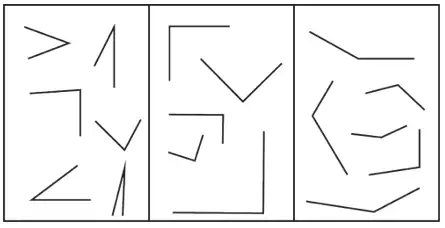
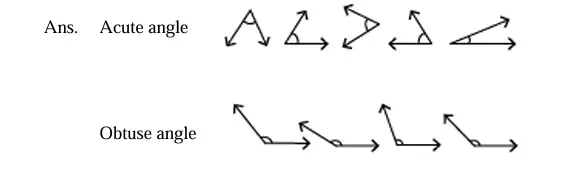
Sharp and Blunt
Acute means sharp; obtuse means blunt—these words hint at their smaller and larger openings.
Classifying an Angle
- Compare the angle's opening with a quarter-turn and a half-turn.
- Name it acute, right, obtuse, or straight using the turn-size table.
Classify an angle that is larger than a quarter-turn but smaller than a half-turn.
- The angle is larger than a quarter-turn but smaller than a half-turn.
- This matches the definition of an obtuse angle.
What type of angle has an opening smaller than a quarter-turn?
Counting Acute Angles in a Triangle Pattern
Triangle pattern — The pattern counts the acute angles formed as inner triangles are added to a larger triangle.
Pattern Facts
- Counts: With , , , and inner triangles, the counts are , , , and acute angles.
- Change: Each additional inner triangle adds acute angles.
- Rule: If is the number of inner triangles, the count is .
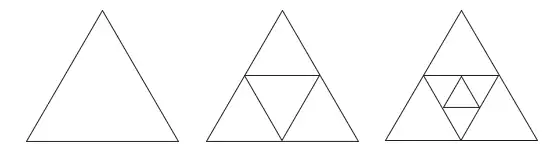
Use for the number of inner triangles and for the number of acute angles.
Finding the Count at a Later Stage
- Identify the number of inner triangles, .
- Substitute into the count rule.
- Calculate to find the number of acute angles.
How many acute angles are there when the pattern has inner triangles?
- For inner triangles, substitute into the rule.
- Evaluate the expression.
How many acute angles are there with inner triangles?
The stated counts increase by and fit . The printed expression does not fit those counts, so use the rule matching the listed pattern.
Quick recap
- An acute angle is smaller than a quarter-turn; a right angle is exactly a quarter-turn.
- An obtuse angle is larger than a quarter-turn but smaller than a half-turn.
- A straight angle is exactly a half-turn.
- The triangle pattern gives acute-angle counts .
- For inner triangles, the count matching the listed pattern is .
Measuring Angles Part-1
Measuring an Angle in Degrees
Degree — A degree is one of equal parts of a full turn; it is written as .
Angle measure
- Measure: An angle’s measure is the number of units it contains.
- Notation: If an angle contains unit angles, its measure is .
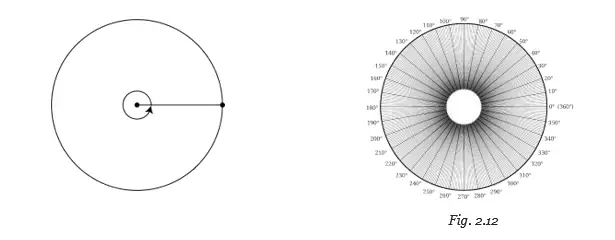
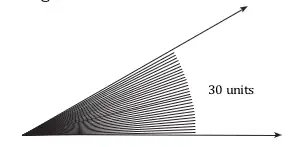
Measures of Common Turns
A full turn measures ; a straight angle is half a turn, and a right angle is half a straight angle. Their measures are , , and , respectively.
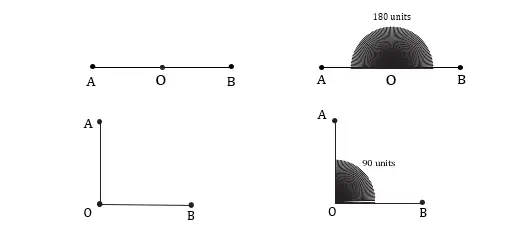
Finding the Measure of Equal Sectors
Divide the full turn by the number of equal sectors.
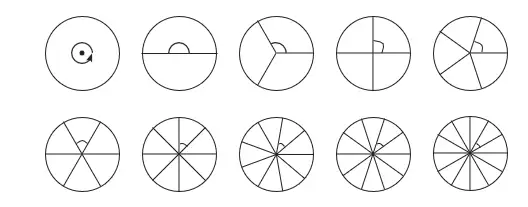
Measure an equal sector
- Use the full-turn measure.
- Divide it by the number of equal sectors, .
What is the angle measure of each of equal sectors?
- Find the angle in each of equal sectors of a circle.
- Divide the full-turn measure by the number of sectors.
Do not divide by the number of sectors incorrectly: each sector’s measure is divided by the number of equal sectors.
Find the angle measure in each sector when a circle is divided into and equal parts.
What is the measure of a half turn and a quarter turn?
Quick recap
- A degree is one of equal parts in a full turn.
- An angle’s measure counts how many one-degree units it contains.
- A full turn is , a straight angle is , and a right angle is .
- For equal sectors in a circle, each sector measures .
Measuring Angles Part-2
Degree Measures and Unlabelled Protractors
Degree measure of an angle — An angle’s measure is the number of units between its two arms.
Protractor divisions
- Protractor A protractor may be a full circle divided into equal parts or a semicircle divided into equal parts.
- Each division On a semicircular protractor, each of the divisions measures .
- Unlabelled marks Long marks indicate every ; a medium mark halfway between them indicates .
- Reading Place the centre at the angle’s vertex and count the degree divisions between its arms.
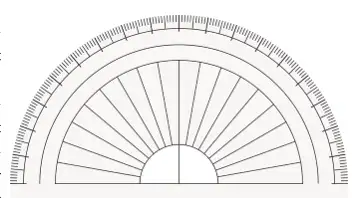
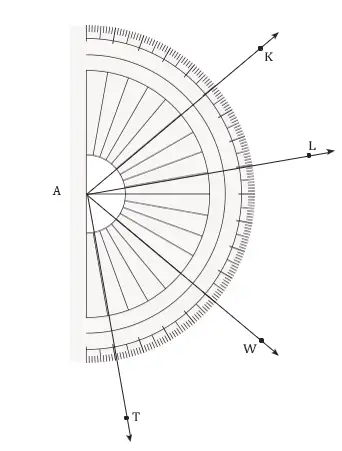
Reading an unlabelled protractor
- Place the protractor’s centre at the angle’s vertex.
- Locate the marks where the two arms meet the scale.
- Count the intervening divisions, using the and marks to count efficiently.
Find on the unlabelled protractor.
- Count the degree divisions between arms and .
Other angles on the unlabelled protractor
- Measures and .
- Efficient counting Use the longer and medium marks to count by and .
Reading a Labelled Protractor
Two scales
- Opposite directions A labelled protractor has two scales: one increases from right to left and the other from left to right.
- Choose the scale Align one arm with the baseline and use the scale whose is at that arm.
- Find the angle Read both arms on the same scale and subtract the smaller reading from the larger.
Use when both arms’ readings are taken from the same scale.
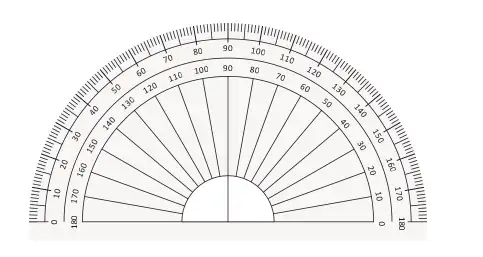
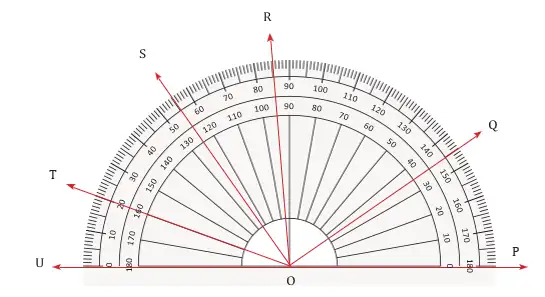
| Angle | Measure |
|---|---|
Naming the angles
- Order of arms Reversing the arm names does not change the angle: .
Find from the outer-scale readings.
- The outer-scale readings for arms and are and .
- Subtract the smaller reading from the larger.
Do not choose a scale just because it is easier to see. Use the scale whose is on the arm aligned with the baseline; subtract readings taken from that same scale.
On the unlabelled protractor, find and .
Two arms meet the same protractor scale at and . Find the angle between them.
Quick recap
- A full-circle protractor has equal divisions; a semicircular one has .
- Each division on the semicircular protractor represents .
- On an unlabelled protractor, long marks show every and medium marks every .
- A labelled protractor has two scales that increase in opposite directions; choose the scale starting at on the aligned arm.
- For readings on the same scale, subtract the smaller from the larger to find the angle.
Measuring Angles Part-3
Measuring an Angle Directly
Protractor measurement — Measure an angle by aligning a protractor with its vertex and one arm, then reading where the other arm meets the scale.
Place the protractor centre on the vertex. Align one arm with the baseline and its mark; read from the scale that starts at that zero.
The angle measure is the degree reading where the second arm crosses the correct scale.
Use a Protractor
- Place the protractor's centre on the angle's vertex.
- Align one arm with the baseline so that it passes through .
- Read the degree mark where the other arm crosses the scale starting at that zero.
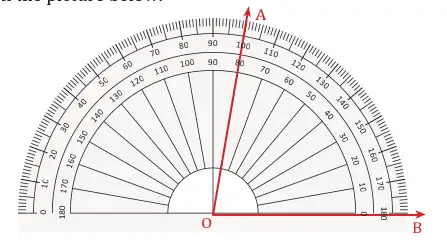
What is the approximate measure of the angle shown?
- The centre is at the vertex, and one arm is aligned with .
- The other arm crosses near the mark.
Do not automatically read the scale that increases left to right. Start at the mark aligned with the first arm.
Making a Paper Protractor
Paper protractor — A paper protractor is a semicircle with angle divisions marked using equal folds.
A full turn measures , a half-turn measures , and a quarter-turn measures . Equal folds divide an angle into equal parts.
Divide the total angle, , by the number of equal parts, .
Fold and Mark the Semicircle
- Draw and cut out a circle; one full turn measures .
- Fold it in half and cut along the crease to make a semicircle of ; mark the baseline as .
- Fold the semicircle in half to mark a quarter-turn crease at .
- Fold again to form marks at and .
- Fold once more to divide each part in half, forming divisions.
- Unfold and label the creases along the semicircle's edge.
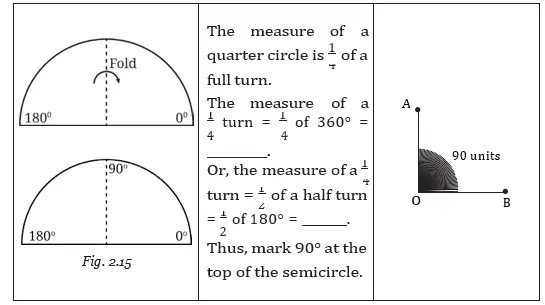
Dividing a straight angle of into eight equal parts gives an angle of in each part.
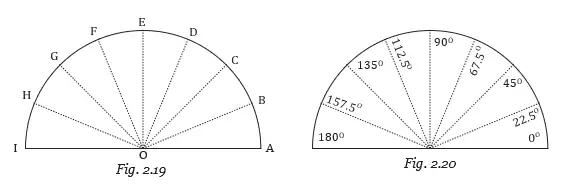
What is the measure of each of the eight equal angles in a semicircle?
- The semicircle measures and is divided into eight equal angles.
- Each adjacent pair of crease marks forms one such angle.
- Useful folded marks: A semicircle can be marked at , , , and intervals.
- Limitation: These folds create selected degree marks, not every possible angle measure.
Angle Readings from the Diagrams
- Three protractor readings: The diagrams give , , and .
- Other readings: The two angles shown are and ; a folded paper protractor cannot measure these exactly.
Angle Bisector
Angle bisector — An angle bisector is a ray from the vertex that divides an angle into two equal angles.
An angle bisector divides the original angle into two equal parts; each part measures half the original angle.
Each of the two equal parts is half the original angle.
Bisect an Angle by Folding
- Fold the paper so that the two arms of the angle overlap.
- The crease from the vertex divides the angle into two equal parts.
- Find the measure of each part by halving the original angle.
A ray bisects a right angle. What is the measure of each resulting angle?
- A right angle measures ; divide it equally into two parts.
- Both resulting angles have the same measure.
The centre of a protractor is on the vertex, and one arm is aligned with . The other arm crosses . What is the angle measure?
A semicircle is divided into eight equal angles. Find the measure of each angle.
Can a folded paper protractor marked at intervals measure angles of and exactly?
Quick recap
- Place the protractor's centre on the vertex and align one arm with the correct mark.
- A full turn is , a half-turn is , and a quarter-turn is .
- Folding a semicircle creates useful marks at , , , and .
- Eight equal parts of a straight angle measure each.
- An angle bisector divides an angle into two equal parts.
Measuring Angles Part-4
Measuring a Reflex Angle
Use this when the marked angle is the larger angle around the vertex.
A reflex angle is shown with an unmarked angle of . Find the marked reflex angle.
- The unmarked angle measures .
- Subtract it from one complete turn.
Reading Angles with a Protractor
Correct protractor setup
- Place the protractor’s centre exactly on the angle’s vertex.
- Align the protractor’s baseline with one arm of the angle.
- Read the scale that starts at on the aligned arm.
- Read the number where the other arm crosses the scale.
Do not place the centre away from the vertex, tilt the baseline, or read the scale starting from the wrong . Reposition the protractor and use the scale whose zero lies on the aligned arm.
Angle measurements
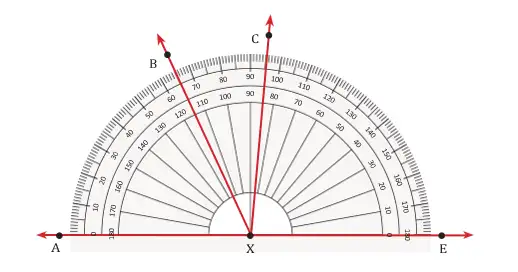
- Diagrams a–f: , , , , , and , respectively.
- Rays from : , , , and .
- Rays from : , , and .
Angles of a Triangle
Measuring the three interior angles of different triangles suggests that their measures add up to . This is a conjecture to explore here; its explanation is studied later.
Angles in Everyday Situations
Angle as a measure of position or rotation — An angle describes the difference in direction between two arms that meet at a vertex.
Real-life examples
- Clock: The clock face is divided into equal intervals, so each interval between successive numbers is .
- At whole hours: The clockwise turn from to the hour hand is multiplied by the hour number: o’clock is , o’clock is , and o’clock is .
- Other clock turns: From clockwise, o’clock is and o’clock is . The smaller angle at o’clock is .
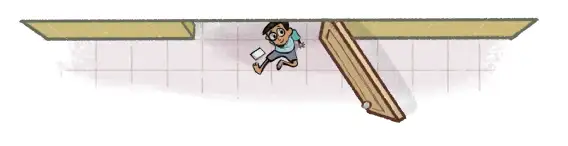
- Door: The vertex is where the door meets the wall; the arms follow the door edge and the wall.
- Swing: Compare the fixed starting position with the swing’s position at its greatest reach on either side.
- Sloping slab: Compare the slab’s slanted edge with a horizontal reference direction. The reference may be imagined if it is not drawn.
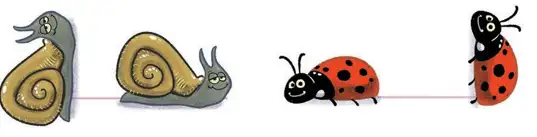
- Rotation: Compare an object’s direction before and after turning; the vertex is the point of rotation, and the arms show the initial and final directions.
At o’clock, what is the clockwise turn from to the hour hand?
A triangle has angles and . What does the angle-sum conjecture suggest for its third angle?
A reflex angle surrounds an unmarked angle of . Find the reflex angle.
Quick recap
- A reflex angle equals minus the smaller angle between the same arms.
- For a correct protractor reading, align its centre with the vertex and its baseline with one arm.
- The diagrams in this lecture give angle readings from to .
- Measurements of triangle angles suggest a total of .
- Each interval between adjacent clock numbers represents .
- Angles can describe openings, slopes, swing positions, and rotations.
Drawing Angles Part-1
Parts of an Angle
The angle name and measure for the example are:
Drawing an Angle with a Protractor
Steps to draw an angle
- Draw the base ray from the vertex in the chosen direction.
- Place the protractor’s centre at the vertex and align its zero line with the base ray.
- Starting from zero on the correct scale, locate the mark for the required angle and mark a point.
- Use a ruler to draw a ray from the vertex through the marked point.
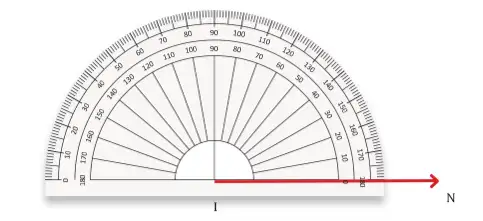
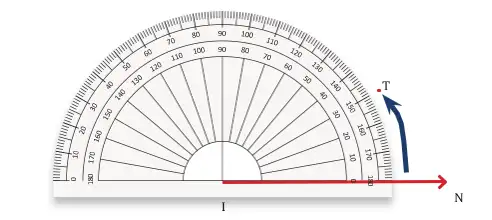
Draw measuring , using as the base arm.
- Draw the base ray from vertex through .
- Place the protractor centre at and align its zero line with .
- From zero, mark the point and label it .
- Join to with a ruler; the two rays form the required angle.
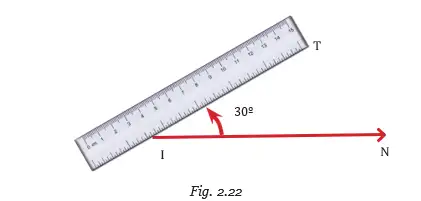
Do not start reading from the wrong zero mark. Use the scale whose zero aligns with the base ray.
Draw using as the base arm.
Draw using as the base arm.
Quick recap
- An angle’s middle naming letter indicates its vertex.
- The arms of an angle are rays with a common endpoint.
- Draw one ray first and use it as the base arm.
- Align the protractor centre with the vertex and its zero line with the base ray.
- Mark the required degree from the correct zero, then draw the second ray through that mark.
Drawing Angles Part-2
Recognising and Estimating Angles
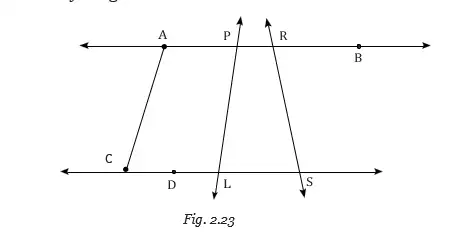
Angles Named in the Diagram
- Examples: , , , , and .
- More examples: , , , , and .
- Check: Look for additional pairs of rays meeting at the same vertex.
Use this to compare an estimated or drawn angle with its target measure.
Symbols in the Formula
- : Difference in degrees; is the guess or drawn measure and is the actual or target measure.
- Absolute value: The difference is non-negative, regardless of which measure is larger.
Measure an Angle with a Protractor
- Place the protractor’s centre exactly at the angle’s vertex.
- Align the protractor’s baseline with one arm of the angle.
- Read the scale that starts at zero on the aligned arm, where the other arm crosses it.
Drawing an Angle with a Protractor
To draw an angle of a given measure, use the protractor to mark that measure from one arm, then draw the second arm through the mark.
Draw an Angle of a Given Measure
- Draw a ray and mark its endpoint as the vertex.
- Place the protractor centre at the vertex and align its baseline with the ray.
- Find the required measure on the correct scale and mark it.
- Draw a second ray from the vertex through the mark.
Draw an angle measuring .
- Draw a ray and choose its endpoint as the vertex.
- Set the protractor centre at the endpoint and align the baseline with the ray.
- Mark the point at the required measure on the scale beginning at zero.
- Draw a ray from the vertex through the mark; the angle has the required measure.
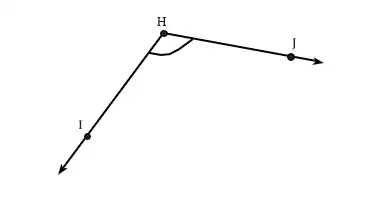
Use a protractor to draw angles measuring , , , , and .
How can you draw an angle equal in measure to the angle shown at ?
Do not read from whichever protractor scale is easiest to see; use the scale whose zero aligns with the starting arm.
Quick recap
- An angle has two rays meeting at a vertex; the vertex letter is written in the middle when naming it.
- Estimate an angle by comparing it with familiar angles, then check with a protractor.
- To measure an angle, centre the protractor at the vertex and align its baseline with one arm.
- Read the scale that begins at zero on the aligned arm.
- To draw an angle, mark the required measure and draw the second ray through the mark.
- To copy an angle, measure it first and construct a new angle with the same measure.
Types of Angles and their Measures Part-1
Classifying Angles by Measure
- Acute angle: Greater than 0° and less than 90°.
- Right angle: Exactly 90°; it is half of a straight angle.
- Obtuse angle: Greater than 90° and less than 180°.
- Straight angle: Exactly 180°, or half a full turn.
- Reflex angle: Greater than 180° and less than 360°.
Quick recap
- An acute angle satisfies .
- A right angle measures exactly ; an obtuse angle is between and .
- A straight angle measures exactly .
- A reflex angle is greater than but less than .
- A whole angle measures exactly .
- Use the boundary values carefully: and are not acute or obtuse.
Types of Angles and their Measures Part-2
Angles on a Straight Line
Use when adjacent angles lie on a straight line.
Find a missing angle on a straight line
- Identify the two adjacent angles that make the straight angle.
- Subtract the known angle from .
In the diagram, and . Find and .
- Given and , find and .
- Since is a straight angle, subtract .
- Subtract from .
Classifying and Drawing Angles
| Type | Measure |
|---|---|
| Acute | |
| Right | |
| Obtuse | |
| Straight | |
| Reflex |
Draw an angle with a protractor
- Draw one ray and place the protractor's centre at its endpoint.
- Mark the required measure on the correct scale, then draw a second ray through the mark.
- For a reflex angle, first draw the smaller angle and use minus that measure.
Classify angles measuring , , , and .
- Classify angles measuring , , , and .
- is between and .
- is a right angle, while lies between and .
- lies between and .
Do not call an obtuse angle: obtuse angles are strictly less than .
Angles Around a Point
Use when a full turn is divided into equal angles.
The Ashoka Chakra has equally spaced spokes. Find the angle between adjacent spokes and the largest acute angle between two spokes.
- The Ashoka Chakra has equally spaced spokes. Find the angle between adjacent spokes.
- Divide one full turn by .
- Acute angles between spokes are multiples of below ; the largest is .
- Angles around a point add to ; this also explains why three angles of , , and fit around a point.
- For a full turn divided into equal parts, each part measures .
Two adjacent angles on a straight line are and . Find .
A full turn is divided into equal angles. Find each angle and classify it.
An acute angle remains acute when doubled, tripled, and quadrupled, but becomes obtuse when multiplied by . Find its possible whole-number measures.
Quick recap
- Adjacent angles on a straight line add to .
- Acute angles are below ; right angles are ; obtuse angles lie between and .
- A straight angle is and a reflex angle lies between and .
- A full turn around a point measures .
- For equal angles around a point, each angle is .
- When checking angle puzzles, translate each condition into an inequality and combine them.
Summary
Points, Line Segments, Lines and Rays
Point — A point marks a location and is named using a capital letter.
Line segment — A line segment is the part of a line between two endpoints; it represents the shortest distance between them.
Line — A line is a straight path that extends indefinitely in both directions.
Ray — A ray starts at one endpoint and extends indefinitely in one direction.
| Object | Example notation | Key feature |
|---|---|---|
| Line segment | Two endpoints | |
| Line | or | Extends both ways |
| Ray | Starts at and extends through |
Angles and Their Measurement
Angle — An angle is formed by two rays that share a common endpoint.
Parts and Notation
- Vertex: The common endpoint of the rays is the vertex.
- Arms: The two rays forming the angle are its arms.
- Naming: If rays and form an angle, it can be named or ; is the vertex.
Angle size — The size of an angle measures the turn needed to rotate one arm onto the other about the vertex.
Angles are measured in degrees; a protractor is used to measure their degree size.
| Type | Measure |
|---|---|
| Acute | |
| Right | |
| Obtuse | |
| Straight | |
| Reflex |
Classify an Angle
- Read the angle's measure in degrees.
- Compare it with the boundaries in the angle-types table.
- Name the angle using the matching interval or exact value.
What type of angle measures ?
- Classify an angle measuring .
- Its measure is greater than and less than .
Classify an angle measuring .
Name the angle formed by rays and , and identify its vertex.
Quick recap
- A point marks a location and is named with a capital letter.
- A line segment has two endpoints; a line extends in both directions, while a ray extends from one endpoint in one direction.
- An angle consists of two rays with a common endpoint, called its vertex.
- An angle's size measures the turn from one arm to the other; angles are measured in degrees using a protractor.
- One full turn is .
- Acute, right, obtuse, straight and reflex angles fall into ranges based on , and .