Class 6 . Mathematics . Ganita Prakash . Prime Time
Chapter 5: Prime Time
Ch 5
Mathematics
Class 6
Common Multiples and Common Factors Part-1
Common Multiples
If the least common multiple of two numbers is , then their common multiples are .
Use the least common multiple to list common multiples. To count multiples up to , divide by the number and take the whole-number part.
Find common multiples
- List the multiples of each number, or find their least common multiple.
- Identify numbers appearing in both lists.
- For a counting question, divide the upper limit by the relevant number and take the whole-number part.
What are the common multiples of and up to ?
- Find the common multiples of and up to .
- List the multiples of that do not exceed .
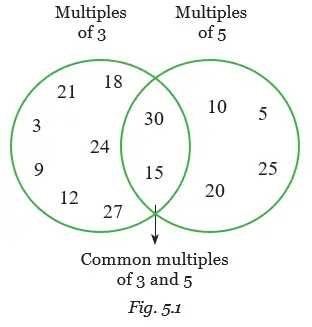
The Idli-Vada Game
| Call | Count up to |
|---|---|
| Idli, including idli-vada | |
| Vada, including idli-vada | |
| Idli-vada |
Game examples
- Up to : idli is said times, vada times, and idli-vada times.
- Up to : idli is said times, vada times, and idli-vada times.
- Tenth idli-vada call for and is at , since .
Do not count idli-vada as an extra call when finding the total number of idli or vada calls; those totals already include common multiples.
Using Common Multiples to Compare Numbers
The clue does not uniquely determine : the other number also works with , since every multiple of is a multiple of . Under the stated rule, both and fit.
In a game played from to with and , how many times is idli-vada said?
List the common multiples of and up to .
For the pair and another number, nobody says only vada. Which of could the other number be?
Quick recap
- A common multiple is a multiple shared by two or more numbers.
- Common multiples of and are multiples of .
- In the game, common multiples trigger idli-vada.
- For and , the common multiples are .
- Up to , the number of multiples of is .
- Idli and vada totals in the game include the idli-vada calls.
Common Multiples and Common Factors Part-2
Factors and Jump Sizes
Factor (divisor) — A factor of a number divides it exactly, with no remainder.
The jump rule
- Jump size: Starting from , repeated jumps of size land on multiples of .
- Exact landing: A jump size lands on a target number exactly when it is a factor of that number.
- Example: The factors of are .
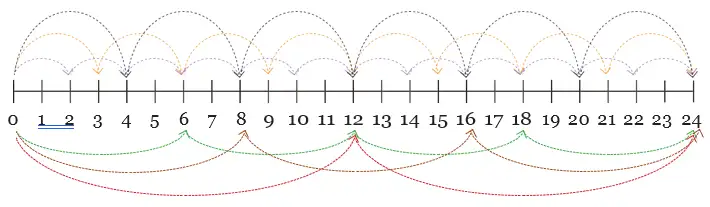
Common Factors
Common factor — A common factor of two or more numbers is a factor of every one of them.
Finding and using common factors
- How to find them: List the factors of each number, then choose those appearing in every list.
- Jump game: A jump size reaches every treasure exactly when it is a common factor of all the treasure numbers.
- Example: The common factors of and are and .
- More examples: Common factors of and are ; of and are .
- Three numbers: The common factors of are ; of are .
The common factors are the factors shared by all the given numbers.
Finding common factors
- List all factors of each given number.
- Select only the factors found in every list.
Find all common factors of and .
- List the factors of both numbers.
- Select the factors appearing in both lists.
Common Multiples
Common multiple — A common multiple of two or more numbers is a number that is a multiple of every one of them.
Multiples of a number are formed by multiplying it by positive whole numbers.
Identifying common multiples
- Grid clue: Numbers marked as multiples of both given numbers are their common multiples.
- Example: Common multiples of and include .
- Between and : The common multiples of and are .
- Jump game: Common factors are suitable jump sizes for reaching two treasures; common multiples are numbers reached by multiples of both numbers.
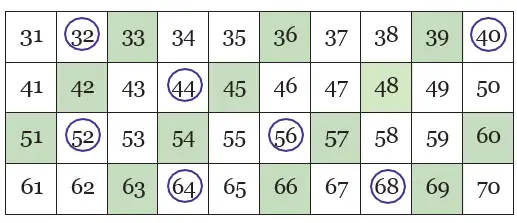
Finding common multiples in a range
- List the multiples of one number that lie in the range.
- Keep only those divisible by every other given number.
Find the common multiples of and between and .
- List the multiples of in the required range.
- Choose those that are also multiples of .
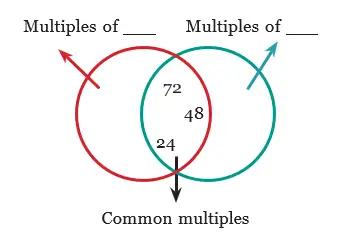
Least Common Multiple
Least common multiple — The least common multiple (LCM) is the smallest positive number that is a multiple of all the given numbers.
Prime-factor rule
- Rule: Use the greatest power of each prime required by any of the given numbers, then multiply those prime powers.
- Examples: The smallest multiple of every number from to , except , is ; including , it is .
For each prime, take the greatest exponent appearing in any given number.
Finding the smallest common multiple
- Write each given number as a product of prime factors.
- Choose the greatest power of each prime that appears.
- Multiply the chosen prime powers.
Find the smallest number that is a multiple of every number from to .
- Use the largest required powers of the primes for the numbers from to .
- Multiply these prime powers.
Perfect Numbers and Number Clues
Perfect number — A perfect number is a number for which the sum of all its factors is twice the number.
Number clues
- Example: The factors of are ; their sum is , so is perfect.
- Factor and digit sum: Below , a number with factor and digit sum is .
- Two factors and digit clue: Below , a number with factors and whose digits differ by is .
- Idli-vada game: The possible pairs of numbers below whose first common multiple is after include , , and ; the first common multiples are .
- Multiples of : Those that are not multiples of include .
Find a perfect number between and .
- List the factors of and add them.
- Check whether the sum equals twice the number.
Find the common factors of and .
Find all multiples of strictly between and .
Find the smallest number that is a multiple of every number from to , except .
- Factors divide a number exactly; multiples are formed by multiplying it by whole numbers.
- Common factors divide every given number; common multiples are multiples of every given number.
- Perfect number: The sum of all its factors equals twice the number.
Quick recap
- A jump size reaches a number exactly when it is one of that number's factors.
- Common factors are shared divisors; common multiples are numbers divisible by every given number.
- Common multiples of and include .
- To find an LCM using prime factors, use the greatest required power of each prime.
- and are perfect numbers because each has factor sum twice its value.
Prime Numbers
Prime, Composite and Neither
- Prime numbers: Numbers with exactly two factors: 1 and the number itself. Examples include 2, 3, 5 and 7.
- Composite numbers: Numbers with more than two factors. Examples include 4, 6, 8 and 9.
- Neither: The number 1 has only one factor, so it is neither prime nor composite.
Co-prime Numbers for Safekeeping Treasures
Safe Pairs and Co-prime Numbers
Co-prime numbers — Two numbers are co-prime if their only common factor is .
Key Points
- Safe pair: Jumpy cannot reach both numbers using the same jump size greater than ; such a pair has no common factor greater than .
- Test: A common factor greater than means the numbers are not co-prime.
- Examples: and are co-prime; and are not, since both are divisible by .
| Pair | Co-prime? | Reason |
|---|---|---|
| and | No | Common factor: |
| and | Yes | No common factor greater than |
| and | Yes | No common factor greater than |
| and | No | Common factor: |
| Pair | Co-prime? | Reason |
|---|---|---|
| and | Yes | No common factor greater than |
| and | Yes | No common factor greater than |
| and | No | Common factor: |
| and | Yes | No common factor greater than |
| and | No | Common factor: |
How to Check Whether Two Numbers Are Co-prime
- List the factors of both numbers.
- Identify their common factors.
- If their only common factor is , they are co-prime.
Are and co-prime?
- List the factors of and .
- Compare the lists to find their common factors.
Co-prime Numbers and the First Common Multiple
First common multiple — The first common multiple of two numbers is their least positive common multiple.
For a co-prime pair, the first common multiple is the product of the two numbers.
| Number pair | Co-prime? | First common multiple | Product |
|---|---|---|---|
| and | Yes | ||
| and | Yes | ||
| and | Yes | ||
| and | No | ||
| and | No | ||
| and | No |
Comparing a First Common Multiple with the Product
- Find the first common multiple of the two numbers.
- Calculate their product.
- For a co-prime pair, these two values are equal.
What is the first common multiple of and ?
- and are co-prime, so their first common multiple is their product.
- Calculate the product.
- The first common multiple equals the product.
Co-prime Art
Thread Patterns
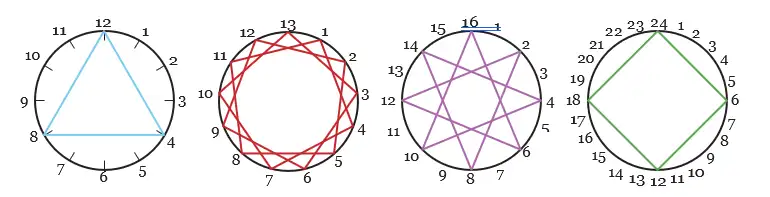
- Setup: Pegs are arranged around a circle; the thread connects pegs by repeatedly moving a fixed number of positions.
- Thread-gap: A gap of means the next peg is positions away.
- Key relationship: The thread reaches every peg exactly when the number of pegs and the thread-gap are co-prime.
- Otherwise: If the number of pegs and the gap share a factor greater than , the thread visits only some pegs before returning to its start.
With pegs and thread-gap , the thread visits all pegs if and only if and are co-prime. The number of distinct pegs visited before returning to the start is divided by their greatest common factor.
Are and co-prime?
For and , compare the first common multiple with their product.
With pegs and a thread-gap of , does the thread reach every peg?
Quick recap
- Co-prime numbers have no common factor other than .
- A shared factor greater than means a pair is not co-prime.
- For a co-prime pair, the first common multiple equals the product.
- Examples of co-prime pairs include and , and and .
- For and , and , and and , the first common multiple is less than the product.
- In thread art, the thread reaches every peg exactly when the peg count and thread-gap are co-prime.
Prime Factorisation Part-1
Checking Whether Two Numbers Are Co-prime
Two numbers are co-prime exactly when their prime factorisations have no prime factor in common.
Test whether two numbers are co-prime
- Find the prime factorisation of each number.
- Compare the prime factors in the two products.
- A shared prime factor means the numbers are not co-prime; no shared prime factor means they are co-prime.
Are and co-prime?
- Write each number as a product of primes.
- The prime factor occurs in both numbers, so they have a common factor greater than .
Seeing no common factor in just one chosen factorisation does not prove that two numbers are co-prime; use their complete prime factorisations.
Prime Factorisation
Prime factorisation — Writing a number as a product of prime numbers is called its prime factorisation; each prime in the product is a prime factor.
Key points
- Breaking down: Keep splitting composite factors until every factor is prime.
- Numbers greater than : Every such number has a prime factorisation.
- The number : It has no prime factorisation because it is not divisible by any prime.
- A prime number: Its prime factorisation is the number itself.
- Repeated factors: Record every occurrence of a prime; for example, may appear more than once.
A number is written as a product of prime factors; repeated primes are included as often as they occur.
Find a prime factorisation
- Split the number into two factors.
- If a factor is composite, split it again.
- Continue until all factors are prime, then multiply them to check the original number.
Find the prime factorisation of .
- Split into two factors.
- Break each composite factor into primes.
- Combine the prime factors and check their product.
Uniqueness and Order of Prime Factors
Every number greater than has only one prime factorisation, apart from the order in which its prime factors are written.
Why order does not matter
- Commutativity of multiplication: Changing the order of factors does not change their product.
- Associativity of multiplication: Changing how factors are grouped does not change their product.
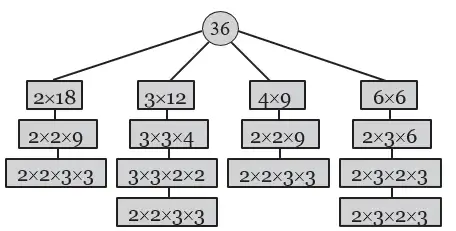
- Same prime factors: Factor trees may split a number differently, but they give the same primes with the same number of occurrences.
- Standard form: Prime factors are usually written in increasing order.
Show that the two prime-factor products for are equivalent.
- The prime factors of can be written in either order.
- Both products contain two s and one , so they are the same prime factorisation.
Find the prime factorisation of .
Are and co-prime?
Write the prime factorisation of in increasing order.
Quick recap
- Co-prime numbers have no common factor except .
- Use complete prime factorisations to check whether two numbers are co-prime.
- A prime factorisation expresses a number as a product of primes.
- Every number greater than has a prime factorisation; does not.
- Prime factorisation is unique apart from the order of the factors.
- Commutativity changes factor order; associativity changes grouping without changing the product.
- Write prime factors in increasing order as a standard form.
Prime Factorisation Part-2
Prime Factorisation of a Product
- Combine factors: To find the prime factorisation of a product, find the prime factorisation of each factor and multiply them together.
- Example: Since and , .
- Repeated primes: Include each prime factor as many times as it occurs in the factorisations of the factors.
Quick recap
- Factor each part of a product into primes, then combine all prime factors, including repeats.
- Two numbers are co-prime exactly when their prime factorisations share no prime factor.
- Distinct prime numbers are co-prime; a prime number is not co-prime with itself.
- For divisibility, every prime factor of the divisor must occur in the dividend.
- The number of occurrences of each prime matters when checking divisibility.
Divisibility Tests Part-1
Why use divisibility tests?
- Divisibility test: A quick way to check whether one number is a factor of another without doing long division.
- Example: Testing a large number such as is easier with divisibility rules than checking by division.
Divisibility by 10
Divisibility by 10 — A number is divisible by if its last digit is .
Every multiple of ends in ; a number ending in is a multiple of .
Here, is the last digit.
Check divisibility by 10
- Look at the number's last digit.
- If it is , the number is divisible by ; otherwise, it is not.
Is divisible by ?
- Check whether is divisible by .
- Its last digit is .
- Therefore, it is divisible by .
Divisibility by 5
Divisibility by 5 — A number is divisible by if its last digit is or .
The last digit alone decides divisibility by : multiples of end in or .
Here, is the last digit.
Check divisibility by 5
- Look at the number's last digit.
- If it is or , the number is divisible by .
Is divisible by ?
- Check whether is divisible by .
- Its last digit is , which is one of the allowed digits.
- Therefore, it is divisible by .
Useful fact
- Largest multiple below a limit: The largest number less than that is divisible by is .
Divisibility by 2
Divisibility by 2 — A number is divisible by if its last digit is even.
A number is divisible by exactly when its last digit is , , , , or .
Here, is the last digit.
Check divisibility by 2
- Look at the number's last digit.
- If it is even, the number is divisible by ; if it is odd, it is not.
Is divisible by ?
- Check whether is divisible by .
- Its last digit, , is even.
- Therefore, it is divisible by .
Multiples in a range
- Between and : The multiples of are , , , , , and .
Divisibility by 4
Divisibility by 4 — A number is divisible by if the number formed by its last two digits is divisible by .
The last two digits determine divisibility by in both directions: if they form a multiple of , the whole number is divisible by , and vice versa.
Here, is the number formed by the last two digits and is a whole number.
Check divisibility by 4
- Read the last two digits as a number.
- Check whether that number is divisible by .
- If it is, the original number is divisible by ; otherwise, it is not.
Is divisible by ?
- Check whether is divisible by .
- The number formed by its last two digits is .
- is divisible by , so is divisible by .
Do not use only the last digit to test divisibility by . For instance, is divisible by but is not, even though both end in .
Which of , , and are divisible by ? Which are divisible by ?
List the multiples of strictly between and .
Which of , , and are divisible by ?
Quick recap
- A number is divisible by if its last digit is .
- A number is divisible by if its last digit is or .
- A number is divisible by if its last digit is even: , , , , or .
- For divisibility by , check the number formed by the last two digits.
- The divisibility test for depends on the last two digits, not just the last digit.
Divisibility Tests Part-2
Divisibility by 8
Use this equivalence to test divisibility by .
Test a number for divisibility by 8
- Take the number formed by the last three digits.
- Check whether that number is divisible by .
- If it is divisible by , the original number is divisible by too.
Is divisible by ?
- Test whether is divisible by .
- Use its last three digits.
- Since is divisible by , so is the original number.
Do not test only the last two digits for divisibility by . Check the last three digits; for example, is divisible by even though its last two digits, , are not.
Quick Divisibility Checks
- Divisibility tests: These quick rules use digit patterns to check whether one number divides another, often without long division.
- Useful patterns: The tests in this section apply to divisibility by 2, 4, 5, 8 and 10.
Leap Years
Apply the century-year exception as well as the divisibility-by- rule.
How many leap years are there from through ?
- Count leap years from through .
- The first and last multiples of in this range are and .
- Count the terms in this arithmetic sequence.
Four-Digit Palindromes Divisible by 4
Find the smallest and largest four-digit palindromes divisible by .
- For the smallest four-digit palindrome, the first digit cannot be : its last digit would be odd, so the last two digits could not be divisible by .
- Try the next possible first digit and check the last two digits.
- For the largest, the first digit cannot be because the last two digits would end in ; with first digit , the largest valid palindrome is .
Sums of Even and Odd Numbers
Is the sum of two odd numbers always a multiple of ?
- Check whether the sum of two odd numbers is always divisible by .
- One pair gives a multiple of .
- Another pair does not.
Remainders for Division by 10, 5 and 2
Find the remainders when is divided by , and .
- Find the remainders when is divided by , and .
- For division by , the remainder is the units digit.
- For division by , subtract the largest multiple of below .
- Since is even, division by leaves no remainder.
Combining Divisibility Tests
Which two tests are sufficient to show that is divisible by , , , and ?
- Check whether passes the two sufficient tests.
- Its units digit is , so it is divisible by .
- Its last three digits are divisible by .
- Therefore it is divisible by , , , and .
Is divisible by ?
Which of , , , and are divisible by all of , , , and ?
Give two numbers whose product is , with neither number having units digit .
Quick recap
- A number is divisible by if its last three digits are divisible by .
- For leap years, use the multiple-of- rule with the century exception for and .
- A four-digit palindrome divisible by must have its last two digits divisible by ; the extremes are and .
- Sums of two even numbers or two odd numbers are sometimes—but not always—multiples of .
- Remainders on division by , and can be found using the units digit and parity.
- To test divisibility by all of , checking divisibility by both and is sufficient.
Fun with Numbers
Special Numbers
Special number — A number is special when it has a property that distinguishes it from the other numbers in the set being compared.
Comparing
- : The only single-digit number and the only multiple of ; it is also a perfect square.
- : The only even number and the only multiple of ; it is also a perfect square.
- : The only multiple of ; it is also a perfect square.
- : The only prime number and the only number that is not a perfect square.
| Set | Examples of distinguishing properties |
|---|---|
| is the only even number; is the only odd composite number. | |
| is the only single-digit number; is a power of ; has repeated digits; is the only two-digit even number. | |
| is a perfect cube; is single-digit; is three-digit; is a two-digit prime. | |
| is prime; is a perfect cube; is divisible by ; is a multiple of . |
How to Find a Special Number
- Choose a property to test, such as parity, primality, square numbers, or divisibility.
- Check each number in the set against that property.
- Identify the number that alone has the property; more than one valid reason may be possible.
Prime-Number Product Puzzles
Prime number — A prime number is a whole number greater than that has exactly two factors: and itself.
Grid Rules and Strategy
- Entries: Every cell must contain a prime number; primes may repeat.
- Rows: The product of the three entries in a row equals its total on the right.
- Columns: The product of the three entries in a column equals its total below.
- Strategy: Factor row and column totals into primes, place compatible factors, then verify every product.
| Total | Prime factorisation |
|---|---|
| ; ; |
For a grid with entries , is row 's total and is column 's total.
Solving a Prime-Product Grid
- Prime-factor the row and column totals.
- Use totals with forced factor combinations to fill cells or rows.
- Check that every row and column product matches its stated total.
Fill the grid using primes, with row totals and column totals .
- The column total forces all three entries in that column to be .
- Divide each row total by its middle entry to find the product of the other two cells.
- Choose prime factors for the remaining cells so their column products also match.
- Verify the products across rows and down columns.
Fill the grid using primes. Row totals are ; column totals are .
Fill the grid using primes. Row totals are ; column totals are .
Fill the grid using primes. Row totals are ; column totals are .
Do not use as the middle column total in the grid with row totals : it would make the totals inconsistent. The correct column total is , since .
Quick recap
- A number is special because of a property that distinguishes it within its set; different properties may give valid answers.
- is the only multiple of among , and is the only multiple of .
- A prime number is greater than and has exactly two factors: and itself.
- Prime-product grids require each row and column product to equal its stated total.
- Use prime factorisation to place grid entries, then verify every row and column.
Summary
Factors, Prime Numbers and Composite Numbers
Count the positive factors of .
Is prime or composite?
- List the positive factors of .
- There are more than two factors, so is composite.
Prime Factorisation
Each factor in the product must be prime.
Find a prime factorisation
- Divide the number by a prime factor.
- Continue factoring the quotient until every factor is prime.
- Write all prime factors as a product and check their product equals the original number.
Find the prime factorisation of .
- Break into factors until only primes remain.
- Factor the remaining composite number.
- Check the product.
Co-prime Numbers
The greatest common factor of co-prime numbers is .
Are and co-prime?
- Write the prime factorisations.
- There is no common prime factor.
Testing Whether One Number Is a Factor of Another
For the same primes, compare the exponents in the two factorizations.
Is a factor of ?
- Write both numbers as products of primes.
- All prime factors of occur in with enough copies.
Is prime or composite?
Are and co-prime?
Do not call prime: a prime number must have exactly two distinct factors, and itself.
Quick recap
- A factor divides a number exactly.
- A prime has exactly two factors; a composite has more than two.
- Every number greater than has a prime factorisation, unique apart from order.
- Co-prime numbers have no common factor other than .
- A factor's prime factors must all be included, with enough copies, in the number's prime factorisation.