Class 6 . Mathematics . Ganita Prakash . Patterns in Mathematics
Chapter 1: Patterns in Mathematics
Ch 1
Mathematics
Class 6
Introduction - What is Mathematics?
Mathematics as the Study of Patterns
Mathematics — Mathematics is the search for patterns and explanations of why those patterns exist.
Where Patterns Occur
- Everywhere: Patterns occur in nature, homes, schools, and the motion of the Sun, Moon, and stars.
- Daily life: Mathematics helps with shopping, cooking, measuring areas, estimating speed, and playing games.
- Creativity and reasoning: Mathematics is both an art and a science: it involves creatively noticing patterns and systematically explaining them.
From Patterns to Applications
- Notice a pattern in the world.
- Find an explanation for why it occurs.
- Apply that explanation in new situations and develop useful technologies or solutions.
How Mathematics Helps Humanity
- Space science: Understanding patterns in the motion of stars, planets, and satellites contributed to the theory of gravitation and made satellite launches and space travel possible.
- Medicine: Understanding patterns in genomes has helped with diagnosing and treating diseases.
- Engineering and technology: Mathematical ideas help design buildings, bridges, vehicles, computers, and communication devices.
- Everyday systems: Mathematics supports business, economies, calendars, clocks, and scientific experiments.
Give examples of how mathematics is used in everyday life.
How can mathematics help propel humanity forward?
Quick recap
- Mathematics searches for patterns and explains why they occur.
- Patterns appear in nature, everyday tasks, science, and technology.
- Mathematics combines creativity and systematic explanation; it is both an art and a science.
- Explanations of patterns can be used beyond the context in which they were found.
- Studying celestial motion helped develop gravitation and space travel.
- Understanding genome patterns has supported disease diagnosis and treatment.
Patterns in Numbers
Whole Numbers and Number Sequences
Whole numbers — Whole numbers begin with and continue as .
Number sequence — An ordered list of numbers formed according to a rule is called a number sequence.
Number theory — The branch of mathematics that studies patterns in whole numbers is called number theory.
How to read a sequence
- Whole numbers vs counting numbers: Whole numbers include ; counting numbers start at .
- Order matters: Each number has a position in the sequence.
- Rule: Look for what changes from one term to the next, or how each term is formed.
- Extension: Apply the same rule to find later terms.
Common Whole-Number Sequences
| Sequence name | Example and rule | Next three terms |
|---|---|---|
| Whole numbers | ; add | |
| All 1s | ; repeat | |
| Counting numbers | ; add | |
| Odd numbers | ; add | |
| Even numbers | ; add | |
| Triangular numbers | ; add consecutive counting numbers | |
| Squares | ; terms are squares of counting numbers | |
| Cubes | ; terms are cubes of counting numbers | |
| Virahanka numbers | ; add the previous two terms | |
| Powers of 2 | ; multiply by | |
| Powers of 3 | ; multiply by |
For term position , counting numbers are ; odd numbers have the form , and even numbers have the form . Triangular numbers are formed by adding consecutive counting numbers. Squares and cubes are repeated products of the same number.
Use these rules when the term position is known. For counting, odd, even, triangular, square and cube sequences, ; for powers, .
Each term after the first two is the sum of the two terms before it.
Recognising and Extending a Sequence
Find the rule and continue
- Compare consecutive terms to find a repeated change or operation.
- If the changes do not give a simple rule, check whether terms use earlier terms or a known number pattern.
- Apply the identified rule to generate the next terms.
Continue by three terms.
- Find the rule in the Virahanka sequence and write its next three terms.
- Add the last two terms to find the next term.
- Repeat the same addition for the following terms.
Do not assume every sequence grows by adding the same number: powers of and powers of grow by multiplication, while Virahanka numbers use the sum of the previous two terms.
Write the next three terms: .
Write the next three triangular numbers after .
Write the next three powers of after .
Quick recap
- Whole numbers begin at ; counting numbers begin at .
- A number sequence is an ordered list whose terms follow a rule.
- Number theory studies patterns in whole numbers.
- Odd and even numbers increase by ; powers follow repeated multiplication.
- Triangular numbers add consecutive counting numbers; square and cube terms are and .
- Each Virahanka term after the first two is the sum of the previous two.
- Identify the rule before extending a sequence.
Visualising Number Sequences
Seeing Number Sequences as Dot Patterns
Visual representation — A visual representation uses dots or objects arranged in a pattern to show how the terms of a number sequence are formed.
| Sequence | Example terms | Visual idea |
|---|---|---|
| Ones | One dot in each representation | |
| Counting numbers | Add one dot at a time | |
| Odd numbers | Arrange dots to show successive odd totals | |
| Even numbers | Dots can be paired | |
| Triangular numbers | Dots form triangles | |
| Square numbers | Dots form square arrays | |
| Cube numbers | Objects form cubes |
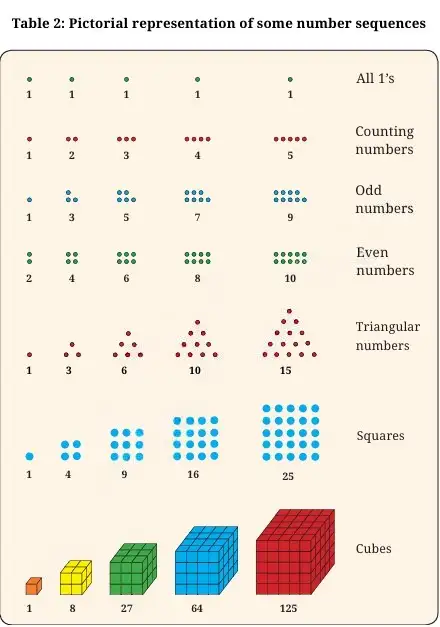
Recognising the Shapes
- Triangular numbers can be arranged in rows that make a triangle: .
- Square numbers make square arrays, such as , , and .
- Cube numbers count objects arranged in cubic layers, such as .
- Different arrangements can represent the same number in different ways.
The total number of dots in a triangle with rows is:
An -by- square has dots; a cube with side length has objects.
One Number, Different Shapes
- Example: is both a triangular number and a square number.
- Triangle: dots can be arranged in rows, since .
- Square: The same dots form a square array.
Hexagonal Numbers
Hexagonal numbers — Hexagonal numbers are totals of dots arranged in the hexagonal patterns shown in this sequence.
Pattern in the Given Sequence
- Terms: The pattern begins .
- Increases: Add , then , then ; the increase grows by each time.
- Next term: Add to to get .
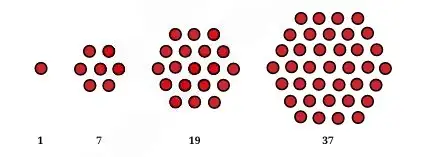
For the displayed pattern, the th term is:
What is the next term in ?
- Find the next term in the hexagonal pattern by comparing consecutive terms.
- Find the increases between consecutive terms.
- The increases rise by , so the next increase is .
- Add the next increase to the last term.
Picturing Powers
Powers of 2 and Powers of 3
- Powers of : The sequence starts ; each term is double the previous term.
- Powers of : The sequence starts ; each term is triple the previous term.
- Visual growth: A picture can show each new arrangement with twice as many or three times as many objects as before.
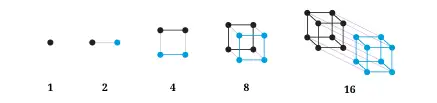
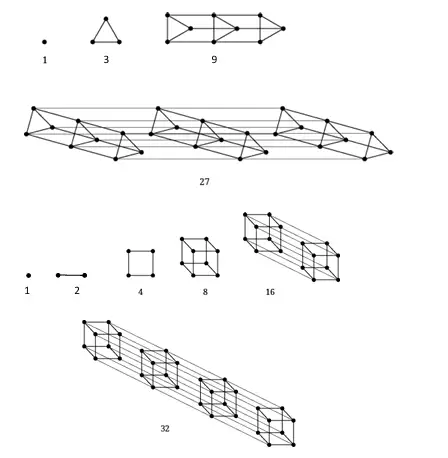
How to Read a Visual Sequence
- Count the objects in each picture to identify the number sequence.
- Compare consecutive terms or arrangements to find how the pattern grows.
- Use the growth rule to draw or determine the next arrangement.
Write the first five powers of and state the growth rule.
Show that is a triangular number. How many rows are needed?
Quick recap
- Dot arrangements reveal how number sequences are built and grow.
- Triangular numbers include ; square numbers include .
- Cube numbers include .
- can be arranged as both a triangle and a square.
- The displayed hexagonal sequence begins and continues with .
- Powers of double and powers of triple at each step.
Relations among Number Sequences
Odd-Number Sums Form Square Numbers
Use this rule when adding the first positive odd numbers.
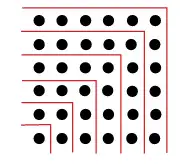
Find an Odd-Number Sum
- Count the odd numbers being added.
- Square the number of terms.
Find the sum of the first six positive odd numbers.
- There are six odd numbers in the sum.
- Apply the square-sum rule.
Counting Numbers and All-Ones Patterns
The largest counting number in the pattern determines the square.

Evaluate an Up-and-Down Sum
- Find the largest counting number in the pattern.
- Square the peak number to find the sum.
Evaluate the up-and-down sum with peak six.
- The largest counting number is six.
- Square the peak to find the total.
Triangular Numbers and Square Numbers
Here denotes the th triangular number.
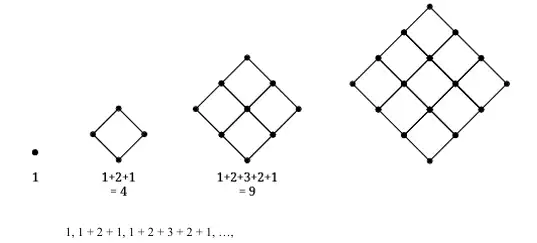
Add Consecutive Triangular Numbers
- Identify the two consecutive triangular numbers.
- Use the pair rule to find their square total.
Find the sum of the fifth and sixth triangular numbers.
- The fifth and sixth triangular numbers are fifteen and twenty-one.
- Add the consecutive triangular numbers.
Powers of Two
Use this for the first powers beginning with .
Find a Power-of-Two Partial Sum
- Count the powers being added.
- Find the next power of two and subtract one.
Find the sum of the first four powers of two, then add one.
- There are four powers in the sum.
- The sum is one less than the next power of two.
- Adding one gives the next power of two.
Hexagonal Numbers and Cube Numbers
Triangular number at zero — Define so the hexagonal-number pattern has a consistent starting term.
Here is the th term, beginning with ; .
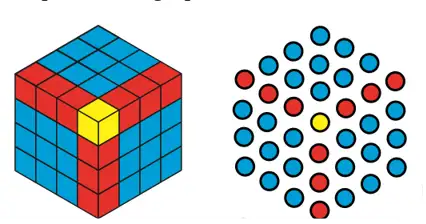
Add the First Hexagonal-Pattern Terms
- Count the terms being added.
- Cube that count to find the sum.
Add the first four terms of the hexagonal-number pattern.
- The first four terms are one, seven, nineteen, and thirty-seven.
- Their sum is the cube of the number of terms.
What is the sum of the first ten positive odd numbers?
Find .
Find the sum of the first five powers of two, starting from one.
Quick recap
- The sum of the first odd numbers is .
- Counting up to and back down to also gives .
- Accumulating the all-ones sequence gives triangular numbers: .
- The th triangular number is ; consecutive triangular numbers add to a square.
- The first powers of two sum to ; adding one gives .
- The first terms of the hexagonal-number pattern sum to the cube number .
Patterns in Shapes
Geometry — Geometry is the branch of mathematics that studies shapes and patterns in them.
Shapes and dimensions
- Dimensions: Shapes may be one-dimensional, two-dimensional, three-dimensional, or higher-dimensional.
- Examples: A line is one-dimensional; a flat polygon is two-dimensional; a solid is three-dimensional.
Shape Sequences
Shape sequence — A shape sequence is an ordered set of shapes formed by following a consistent rule.
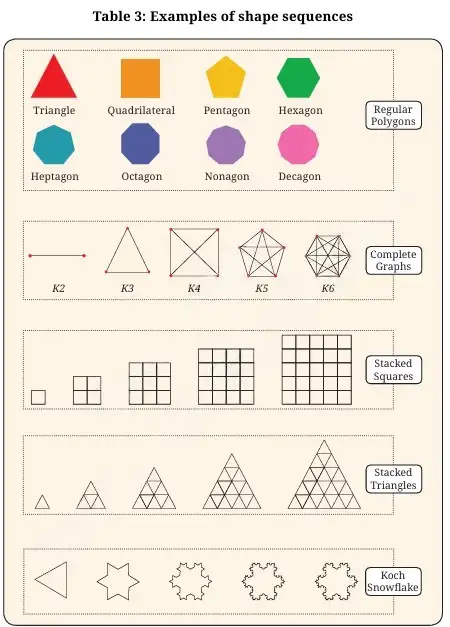
Numerical patterns in shape sequences
- Polygon sides: The number of sides can increase as .
- Triangular arrangements: Counts can follow .
- Square arrangements: Counts can follow ; different shape constructions may produce the same counts.
- Repeated scaling: A pattern may multiply by each step: .
Rules for recognising a shape pattern
- Inspect: Compare consecutive shapes and note what is added, removed, or changed.
- Count: Track a feature such as sides, small shapes, dots, or line segments.
- State the rule: Describe how each shape is formed from the previous one.
- Next shape: A next shape can be drawn when the intended rule is clear; without a stated rule, more than one continuation may be possible.
Use these formulas for the first triangular or square counts.
For a sequence starting at and multiplying by at every step, the th term is:
A triangular arrangement has counts . What is the next count?
- Write the counts and compare consecutive terms.
- Find how many units are added each time.
- The next shape adds units, so its count is .
Do not assume a pattern has only one possible continuation. State the rule you are using before deciding what the next shape is.
A sequence of regular polygons has sides. How many sides should the next polygon have?
A square arrangement sequence has counts . What is the next count?
A shape pattern has segment counts . What is the next count?
Quick recap
- Geometry studies shapes and patterns in one, two, three, or higher dimensions.
- A shape sequence follows a rule that connects each shape to the next.
- Shape patterns can be tracked by counting sides, units, or line segments.
- Triangular counts follow ; square counts follow .
- A clear rule is needed to justify a proposed next shape.
Relation to Number Sequences
Regular Polygons
Use this when the first term is a triangle.
Find the Polygon at a Given Position
- Let the position in the sequence be .
- Find the number of sides using the position rule.
- The number of corners is equal to the number of sides.
How many sides and corners does the eighth regular polygon in the sequence have?
- Find the number of sides and corners in the eighth polygon.
- Apply the position rule.
- A polygon has as many corners as sides.
Complete Graphs
For a complete graph with points, count each pair of points once.
Count Lines in a Complete Graph
- Count the points.
- Use the complete-graph line-count rule.
- Simplify to get the number of lines.
How many lines are in a complete graph with six points?
- Find the number of lines joining six points in a complete graph.
- Substitute into the line-count rule.
- Calculate the result.
Stacked Squares
Use this to find the number of small squares in the th arrangement.
Count Squares in an Arrangement
- Find the arrangement number.
- Multiply the number of rows by the number of columns.
- Write the result as a square number.
How many small squares are in the fifth stacked-square arrangement?
- Find the number of small squares in the fifth arrangement.
- Use the square-number rule.
- Evaluate.
Stacked Triangles
For an arrangement with maximum row size , add the rising and falling row counts.
Count Triangles in a Stacked Arrangement
- Identify the largest row count.
- List the row counts as they rise and fall.
- Add the rows, or use the square-number rule.
How many small triangles are in the stacked arrangement with largest row size three?
- For maximum row size three, list the rows.
- Add the row counts.
- Confirm using the square-number rule.
Koch Snowflake Line Segments
Here, the first shape is step .
Find a Koch Snowflake Segment Count
- Identify the shape's step number.
- Multiply the starting count by four for each replacement.
- Evaluate the expression.
How many line segments are in the fourth Koch snowflake shape?
- Find the line segments in the fourth shape.
- Use the segment-count rule.
- Calculate.
How many lines are in a complete graph with five points?
How many small triangles are in the stacked arrangement with largest row size four?
How many line segments are in the fifth Koch snowflake shape?
Quick recap
- A polygon has the same number of sides and corners; regular polygons begin with counts .
- Complete-graph line counts form the triangular sequence .
- Stacked squares form the square-number sequence .
- Stacked-triangle row counts rise and fall, and their totals are square numbers.
- Each Koch snowflake step multiplies the segment count by , starting from .
Summary
Mathematics as the Study of Patterns
- Mathematics: The search for patterns and explanations of why they exist.
- Applications: Understanding patterns helps solve problems and advance science and technology.
Number Sequences
Adding the first odd numbers gives the square number .
What is the sum of the first four odd numbers?
- Add the first four odd numbers.
- Use the sum pattern for the first odd numbers with .
Shape Sequences
Find the sum of the first six odd numbers.
Which type of sequence is ?
Quick recap
- Mathematics searches for patterns and explains why they occur.
- Number sequences include counting, odd, even, square, triangular, cube, Virahānka, and powers-of-two sequences.
- The sum of the first odd numbers is .
- Pictures can help reveal number-sequence patterns and relationships.
- Shape sequences include regular polygons, complete graphs, stacked shapes, and Koch snowflake iterations.
- Shape sequences can be related to number sequences.