Class 6 . Mathematics . Ganita Prakash . Playing with Constructions
Chapter 8: Playing with Constructions
Ch 8
Mathematics
Class 6
Artwork Part-1
Drawing with Ruler and Compass
Why use construction tools?
- Ruler and compass help make straight lines and circles accurately.
- Constructions can make combined shapes more precise than freehand drawing.
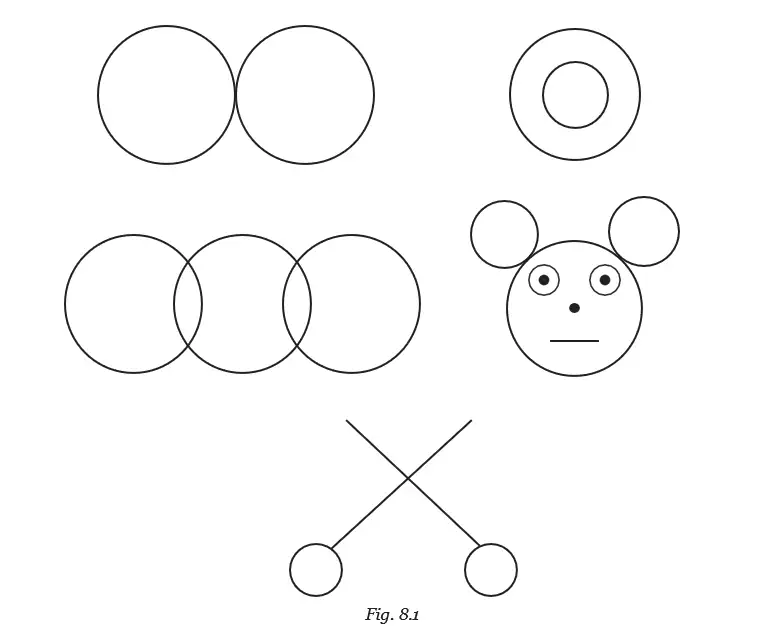
Curves
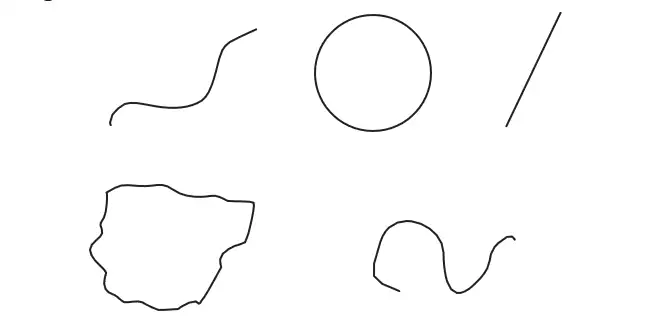
Curve — A curve is a shape that can be drawn on paper with a pencil; it may be straight, circular, or irregular.
Types and examples
- Open curve: Its ends do not meet.
- Closed curve: Its ends meet and enclose a region.
- Examples: A straight line, a circle, and an irregular outline are all curves.
Circle, Centre, and Radius
Circle — A circle is the curve made up of all points at the same distance from one fixed point.
The fixed point is the centre. The distance from the centre to any point on the circle is the radius, and is the same for every point on the circle.
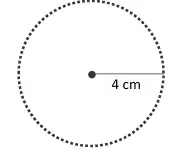
For any point X on a circle with centre P, PX is the radius.
Drawing a Circle with a Compass
Construct a circle
- Mark the centre point and set the compass width to the required radius using a ruler.
- Place the compass point on the centre and keep it fixed.
- Rotate the compass so the pencil traces a complete curve.
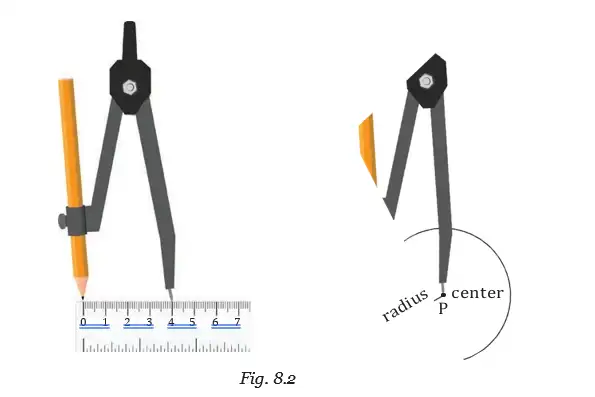
How do you draw a circle with centre P and radius 4 cm?
- Set the compass opening to the required radius.
- Place the compass point at P and keep it steady.
- Turn the compass once to draw the circle; each point X on it is 4 cm from P.
Do not move the compass point while drawing; keep it fixed at the centre and move the pencil around it.
A circle has centre O and radius 3 cm. What is the distance from O to any point A on the circle?
A point B is 5 cm from centre O. If B lies on the circle, what is the circle's radius?
To draw a circle of radius 2 cm, what compass width should you set?
Quick recap
- A curve can be straight, circular, open, or closed.
- A circle consists of points all at the same distance from a fixed centre.
- The distance from the centre to any point on a circle is its radius.
- Set the compass opening equal to the required radius.
- Keep the compass point fixed at the centre while drawing.
Artwork Part-2
Constructing a Person
Building the design
- Components: The person design combines a circular part with a second shape that has straight sides and a curved edge.
- Curved edge: Choose a suitable compass radius and estimate where to place the compass point to make the curve fit.
- Unspecified measurements: Use the reference design to estimate the radius and compass-point position.
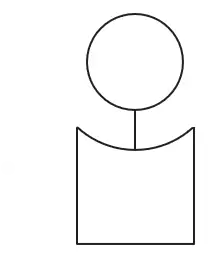
The compass setting gives the radius of the arc drawn.
Construct the curved component
- Draw the circular part and the straight-sided outline.
- Choose a compass radius that appears suitable for the curved edge.
- Estimate the compass-point position and draw the arc; adjust if it does not fit.
How can the person design be drawn when no measurements are given?
- Draw the two components of the design.
- Set the compass to an estimated radius for the curved edge.
- Try a suitable compass-point position and draw the curve to fit the outline.
Constructing a Wavy Wave
Semicircle — A semicircle is half of a circle, with its diameter along the central line.
Wave dimensions
- Choose a length: If none is specified, choose any convenient central-line length; here, .
- Divide equally: Two semicircular waves use two equal diameters, so .
- Compass setting: A semicircle with diameter has radius .
- Smaller-than-semicircle waves: Use the same construction for both waves so that they are identical.
Use these relationships to find the diameter and radius of each semicircle.
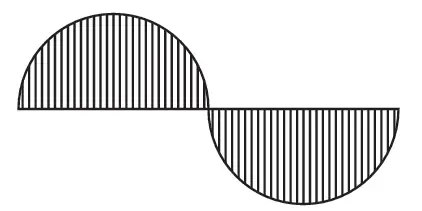
Construct two semicircular waves
- Choose and draw the central line.
- Divide it into two equal parts; each part is a semicircle's diameter.
- Set the compass to half of each diameter and draw the semicircles on opposite sides.
For two equal semicircular waves on a central line of length , what are and the compass radius?
- Take the central line to be eight centimetres long and divide it equally.
- Use each half as the diameter of one semicircle.
- Set the compass to half the diameter.
Do not use the whole central-line length as the diameter of each wave; divide the line into two equal diameters.
Drawing Eyes with a Compass
Construction challenge
- Task: The prompt asks you to reproduce the eyes using a compass.
- Eye construction: Draw the upper and lower curves as matching arcs, placing the compass centres symmetrically above and below the eye’s horizontal midpoint.
What can be determined from the eye-construction prompt alone?
- Represent the radius needed for a curved part by an unknown value.
- Use the compass and choose its setting and point position to match the given eye outline.
- Without measurements or the full construction hint, an exact compass setting cannot be stated.
A central line of length is divided equally to make two semicircular waves. Find each diameter and radius.
How can you make two identical waves that are smaller than semicircles on equal chords?
Quick recap
- The person design combines circular, straight, and curved parts.
- Estimate a compass radius and point position when the design gives no measurements.
- For a semicircle, the diameter is twice the radius.
- For , each of two equal diameters is and each radius is .
- Use matching construction choices to make the two smaller waves identical.
- Eye curves: Place the compass centres symmetrically so the upper and lower arcs form a balanced eye.
Squares and Rectangles
Rectangle: sides and angles
Opposite sides of a rectangle are equal in length, and all four angles are .
Use these equalities to check whether a figure is a rectangle.
Square: sides and angles
All four sides of a square are equal, and all four angles are .
Check both the side lengths and the angles to identify a square.
Naming a quadrilateral
Check a quadrilateral's name
- Start at the first listed corner.
- Check that each next corner is the next one along a side.
- Confirm that the last corner joins back to the first.
Which option is not a name for the square: , , or ?
- The square's corners go around its boundary in the order shown.
- The names , and follow the boundary order.
- changes the order of the last two corners, so it does not follow the boundary.
Rotated squares and rectangles
Rotation preserves lengths and angles, so a rotated square remains a square and a rotated rectangle remains a rectangle.
Recognising shapes on a dot grid
Check a shape on a dot grid
- Trace the four sides by following the grid points.
- Compare the grid-step pattern of the sides to check the required side equalities.
- Check the corner directions for right angles.
- Use the properties together: equal sides and four right angles identify a square.
A four-sided figure has four angles. Its opposite sides are equal, but its four sides are not all equal. What is it?
In the dot-grid collection in Figure , which labelled figure is a square?
Do not decide that a tilted figure is not a square or rectangle. Check its side lengths and angles; rotation does not change them.
Quick recap
- A rectangle has equal opposite sides and four angles.
- A square has four equal sides and four angles.
- A square satisfies the rectangle properties; a rectangle need not have all sides equal.
- Name corners in order around the boundary, starting at any corner and going either way.
- Rotation changes orientation but preserves side lengths and angles.
- Dot-grid positions can help compare sides and identify right angles.
Constructing Squares and Rectangles
Constructing a Square
- Base: Draw a line segment of the required side length, for example, 6 cm.
- Perpendiculars: Construct perpendicular lines at both endpoints on the same side of the base.
- Equal sides: Mark the given side length on each perpendicular using a ruler or compass.
- Complete: Join the two marked points to form the square, then check that all sides are equal and all angles are 90°.
Quick recap
- A square has four equal sides and four right angles.
- A square can be constructed by drawing perpendicular sides of the required length.
- A rectangle has four right angles and equal opposite sides.
- For a rectangle with side lengths and , each pair of opposite sides is equal.
- Four right angles force opposite sides to be equal, so such a quadrilateral cannot have unequal opposite sides.
An Exploration in Rectangles Part-1
Distances Between Points on Opposite Sides
In a rectangle with , what condition on and gives the minimum separation?
Rectangles Made from Identical Squares
A rectangle has breadth and is divided into three identical squares. Find its length.
Two identical squares form a rectangle of length . Find its breadth.
Quick recap
- In the by rectangle, the minimum separation is .
- Equal offsets, , make a rectangle and give .
- The farthest separation is a diagonal: or .
- Three identical squares in a row make a rectangle with length three times its breadth.
- Two identical squares in a row make a rectangle with length twice its breadth.
- Matching side marks indicate equal lengths.
An Exploration in Rectangles Part-2
Completing a Rectangle with a Compass
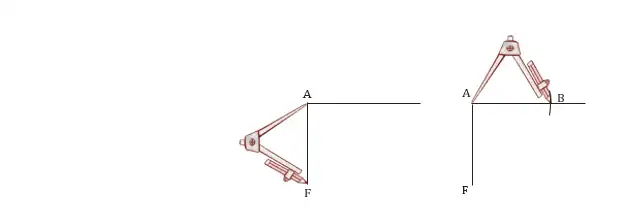
Rectangles Divided into Identical Squares
- Identical squares: A rectangle can be partitioned into identical squares when its dimensions fit equal square side lengths.
- Planning: A rough diagram and marks for equal sides help organise the construction before drawing.
- Applications: The same idea can be used to plan rectangles divided into two or three identical squares.
A Square Inside a Rectangle
Use when the square is centred and aligned with the rectangle’s sides.
How can a square be centred inside an rectangle?
- For a rectangle measuring , take the shorter side as the square’s side.
- Find the equal gap on each end of the longer sides.
- Draw the square with a margin at each end; its centre matches the rectangle’s centre.
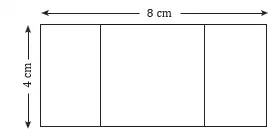
Further Square Constructions
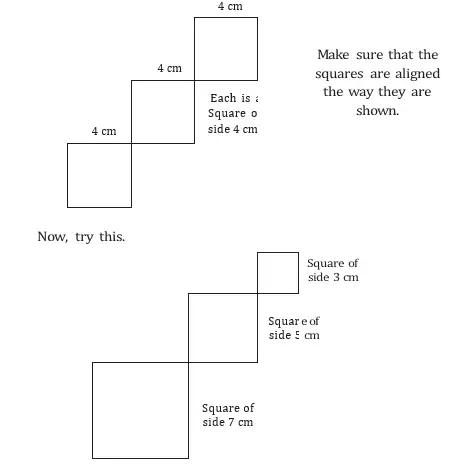
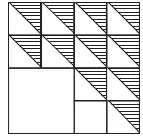
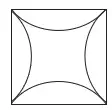
Construct a rectangle and divide it into three identical squares.
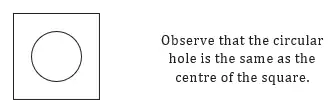
Where should the centre of a circular hole be placed inside a square?
Quick recap
- Compass transfer: Copy onto the perpendicular at because .
- Impossible divisions: is an example that cannot be split into two identical squares; cannot be split into three.
- Centred square: In an rectangle, use a square and equal end gaps.
- Square centre: The diagonals intersect at the centre; use this point to centre a circular hole.
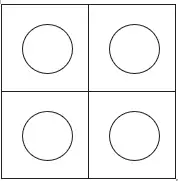
- Patterns: Construct square designs with smaller squares, diagonals, shading, circles, and compass arcs.
Exploring Diagonals of Rectangles and Squares Part-1
Diagonals in Rectangles and Squares
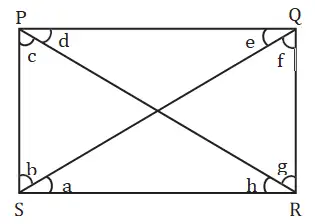
A diagonal crossing parallel opposite sides forms equal corresponding angles. At either endpoint, the two parts of the corner angle add to .
A diagonal of a square bisects the two right angles at its endpoints, forming two angles at each endpoint.
The two parts of a rectangle’s right angle total ; in a square, they are equal.
Identify equal angle pairs
- Mark the opposite sides of rectangle as parallel.
- For diagonal , match the angles formed with each pair of parallel sides.
- For a square, divide each right angle equally.
Do not assume that a diagonal bisects every rectangle’s corner angle. This happens in a square, not in a general rectangle.
Constructing a Rectangle with a Diagonal at 30° and 60°
Rectangle construction — To construct a rectangle with a specified diagonal angle, construct that angle and use perpendicular sides to complete the right angles.
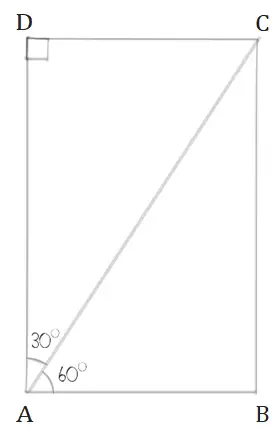
A rectangle has four right angles and equal opposite sides. Either fact can help locate its fourth vertex.
For rectangle , diagonal makes the specified angle at ; the adjacent sides are perpendicular and the opposite sides are equal.
Construct the rectangle
- Draw an arbitrary base segment and construct a perpendicular ray at .
- At , draw a ray making with ; let it meet the perpendicular ray at .
- Through , draw a line perpendicular to . The angle between this line and is the remaining part of the right angle.
- Locate either by drawing through a line perpendicular to , or by marking on the perpendicular through . Join to .
Construct rectangle so diagonal divides angle into and . Find the corresponding angles at .
- Draw and construct a perpendicular ray at .
- From , draw the diagonal ray at to ; it meets the perpendicular ray at .
- Draw through perpendicular to ; the angle from to is the remaining part of the right angle.
- Through , draw a line perpendicular to to meet at , completing the rectangle.
- The diagonal makes the matching corresponding angles at .
In rectangle , diagonal splits angle into beside and beside . Find the two parts of angle .
A rectangle’s diagonal divides a corner angle into two equal parts. What is the special shape, and how large is each part?
Quick recap
- A diagonal joins two opposite vertices.
- In a rectangle, diagonal angles formed with opposite parallel sides are equal; the two parts of a corner total .
- A square’s diagonal bisects the right angles at its endpoints into angles.
- To construct the rectangle, draw a base, a perpendicular ray, and the diagonal at the required angle.
- Complete the rectangle using perpendicular lines or equal opposite sides.
Exploring Diagonals of Rectangles and Squares Part-2
Constructing a Rectangle from One Side and a Diagonal
Side-and-diagonal construction
- Draw the given side.
- Construct a perpendicular ray at one endpoint.
- With the other endpoint as centre and the diagonal as radius, draw a circle or the required arc. Mark its intersection with the ray.
- Draw perpendiculars through the two known vertices; their intersection is the fourth vertex.
- Verify the rectangle by checking its right angles and opposite sides.
Construct a rectangle with one side and diagonal .
- Draw the known side.
- At , construct a perpendicular ray to .
- With centre and radius , draw a circle or arc. Its intersection with the ray is .
- Through , draw a perpendicular to . Through , draw a perpendicular to ; their intersection is .
- The completed quadrilateral is the required rectangle.
Constructing Rectangles from Diagonal Angles
If a rectangle’s diagonal divides each opposite right angle into and , the two sides of each right triangle formed by the diagonal are equal. Hence adjacent sides of the rectangle are equal, so it is a square.
What do you observe when a rectangle’s diagonal divides the opposite angles into and ?
- Draw a diagonal of a convenient length.
- At its endpoints, construct rays on the same side of the diagonal so each right angle is split into two angles.
- Complete the rectangle using perpendiculars or parallels.
- The right triangles formed by the diagonal have equal legs; therefore adjacent sides of the rectangle are equal.
Construct a rectangle in which a diagonal divides the opposite angles into and .
Construct a rectangle with side and diagonal .
Construct a rectangle with one side and diagonal .
Do not estimate the unknown vertex or use the side endpoint as the circle’s centre by default. The circle’s centre is the vertex opposite the unknown point across the given diagonal.
Quick recap
- Use a perpendicular and a circle intersection to locate a rectangle vertex from one side and a diagonal.
- The circle is centred at the known vertex opposite the unknown point across the diagonal; its radius is the diagonal length.
- Complete the rectangle with perpendiculars or parallels, then check its right angles.
- , so these angle parts make a rectangle corner.
- If a diagonal splits opposite right angles into two angles, the rectangle is a square.
Points Equidistant from Two Given Points Part-1
Locating a Point at Equal Distance
If lies on circles centred at and , both with radius , then .
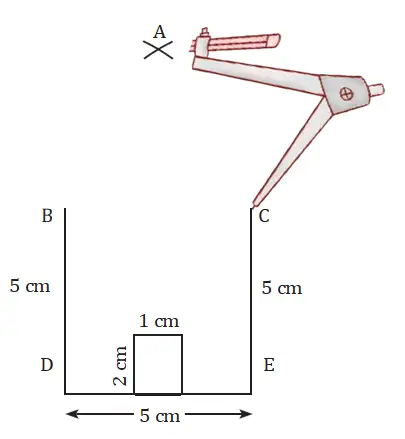
Complete the house outline
- Draw the house body and its central rectangle, following the given measurements.
- Set the compass to the required boundary length and draw an arc centred at .
- Without changing the compass opening, draw an arc centred at ; mark their intersection as .
- Join to and to with straight lines.
- With centre and radius , draw the remaining arc from to .
How can the top of the house be constructed so that the two straight sides and the curved edge have length/radius ?
- Construct the top point so it is from both and .
- Open the compass to and draw an arc centred at .
- Keeping the same opening, draw an arc centred at ; label an intersection .
- Join to and to to form the two straight sides.
- Draw the curved boundary from to with centre and radius .
Do not change the compass opening between the two arcs. If the radii differ, their intersection does not guarantee equal distances from and .
Construct a point that is from each of two points and .
Two points and are apart. Construct a point that is from each.
Quick recap
- A circle represents all points at a fixed distance from its centre.
- Draw equal-radius arcs from both given points to locate a point equally distant from them.
- An intersection of arcs of radius gives .
- Compass arcs can replace full circles when only their intersection is needed.
- For the house, join the top point to and , then draw the remaining arc centred at the top point.
Points Equidistant from Two Given Points Part-2
Using Equal Distances to Build Shapes
- Equal distances: Arcs or circles from two points can locate a point that is the same distance from both.
- Intersections: Their intersection gives a precise point, avoiding trial and error with a ruler.
- Applications: Compass constructions using equal distances can help recreate figures such as a larger house and artwork.
Constructing a Four-Sided Figure with Equal Sides
Construct a non-square quadrilateral with all sides .
- Draw two segments of length meeting at ; choose an angle that is not a right angle.
- With centre and radius , draw an arc; repeat with centre and the same radius.
- Name the arc intersection other than as , then join to and to .
- The four sides are equal, and the chosen angle ensures the figure is not a square.
Using the Same Ideas in Artwork
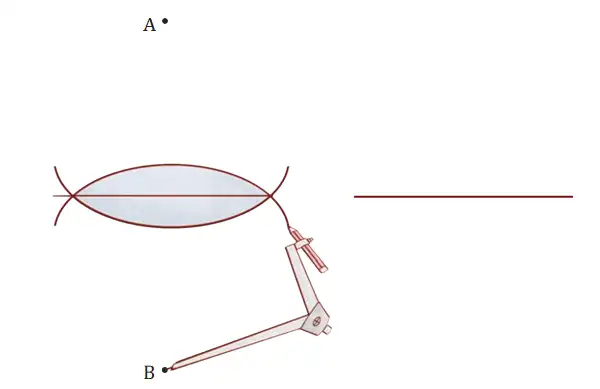
If , how can you locate a point so that ?
How can you construct points equidistant from two points and ?
Do not change the compass opening while copying equal sides. Also, the four-sided figure with equal sides is not automatically a square; its angles must also be right angles.
Quick recap
- Equal-radius arcs locate points equally distant from two centres.
- A point on the perpendicular bisector of a segment is equidistant from its endpoints.
- Keep the compass opening fixed to copy equal side lengths.
- The other intersection of equal-radius arcs can complete a four-sided figure with equal sides.
- A rhombus has four equal sides, but it is a square only when its angles are right angles.
- Symmetric placement of compass centres helps create balanced artwork.
Summary
Circles and the Radius
If is the centre and is any point on the circle, the radius is the distance .
Constructing a Circle
- Mark the required centre and set the compass opening to the given radius.
- Keep the compass point fixed at the centre and rotate the pencil arm to draw the circle.
Planning and Constructing Rectangles
Rectangle from the Lengths of Two Sides
- Draw one side to its given length.
- Construct perpendicular lines at both ends and mark the other side length on them.
- Join the two marked points to complete the rectangle.
Rectangle from One Side and a Diagonal
- Draw the given side and construct a perpendicular at one endpoint.
- With the other endpoint as centre and the given diagonal as radius, mark where the arc meets the perpendicular.
- Complete the rectangle using lines parallel to the given side and the perpendicular side.
Construct a rectangle with adjacent sides of lengths and .
- Construct a rectangle with adjacent sides of lengths and .
- Draw a segment of length .
- Construct perpendiculars to at and , and mark and on the same side of .
- Join to to complete the rectangle .
Construct a circle with centre and radius .
Construct a rectangle with one side and diagonal .
Quick recap
- Every point on a circle is at the same distance from its centre; that distance is the radius.
- A compass draws a circle when its opening is set to the radius.
- A rough diagram helps plan a geometric construction.
- A rectangle can be constructed from the lengths of two adjacent sides.
- A rectangle can also be constructed from one side and a diagonal.